Get 20% OFF All Premium 3D & STL Models!

The allure of classic automobiles transcends generations, captivating enthusiasts with their timeless design, engineering marvels, and rich history. For 3D artists, game developers, architects, and visualization specialists, recreating these iconic vehicles presents a unique blend of challenge and opportunity. It demands not just technical skill, but a deep appreciation for automotive heritage to translate every curve, every chrome glint, and every historical detail into a faithful digital representation. At 88cars3d.com, we understand this passion, offering a curated selection of high-quality 3D car models designed to meet the most stringent professional demands. One such masterpiece, a true digital homage to an automotive legend, is the 1933 Cadillac V16 (452-C) Town Car 3D model. This isn’t just a collection of polygons; it’s a meticulously crafted digital artifact, ready to elevate your projects, whether you’re animating a cinematic period piece, building a historically accurate virtual environment, or creating a stunning photorealistic render.
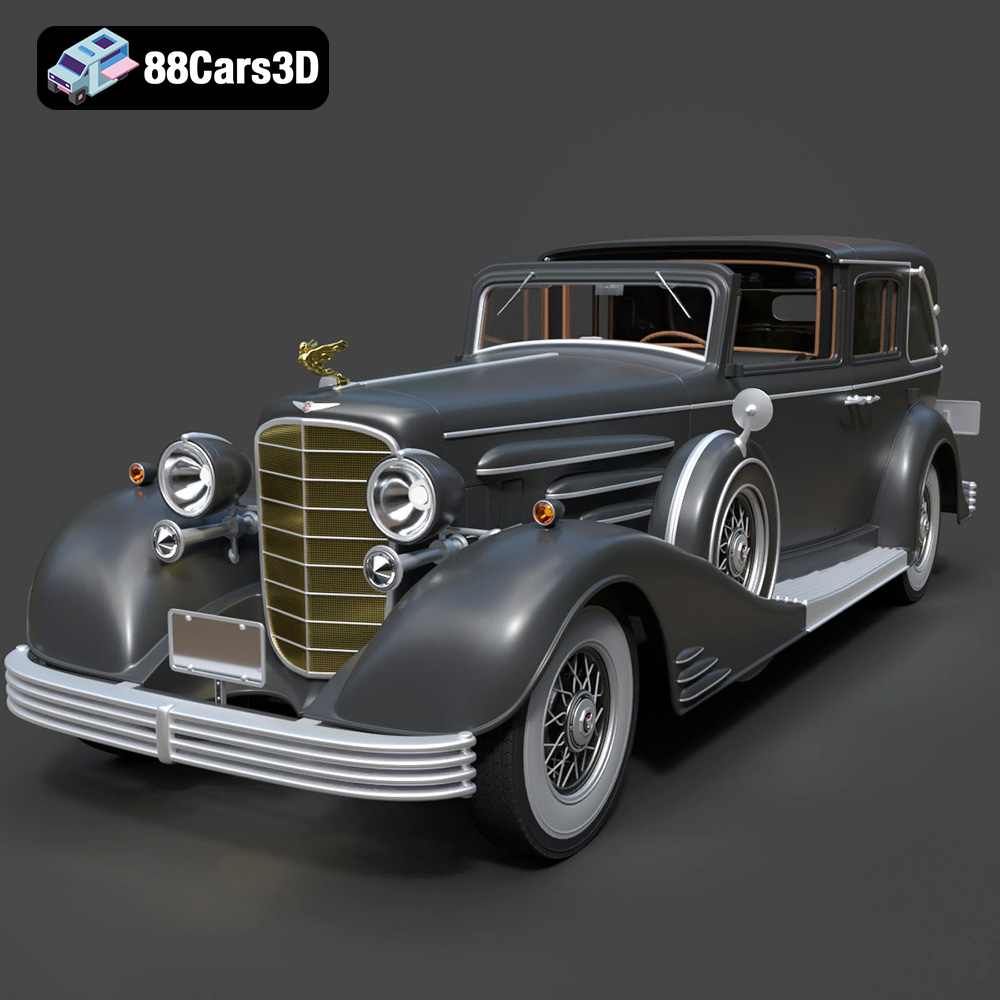
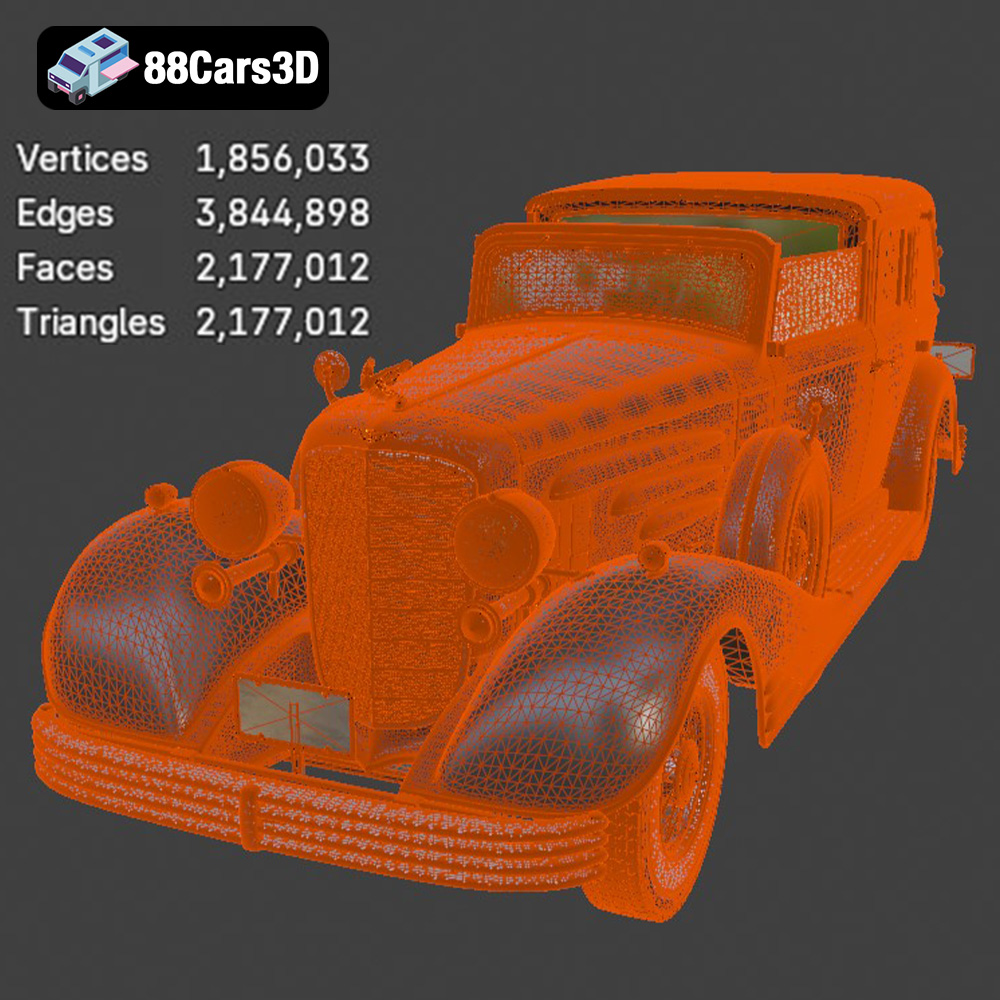
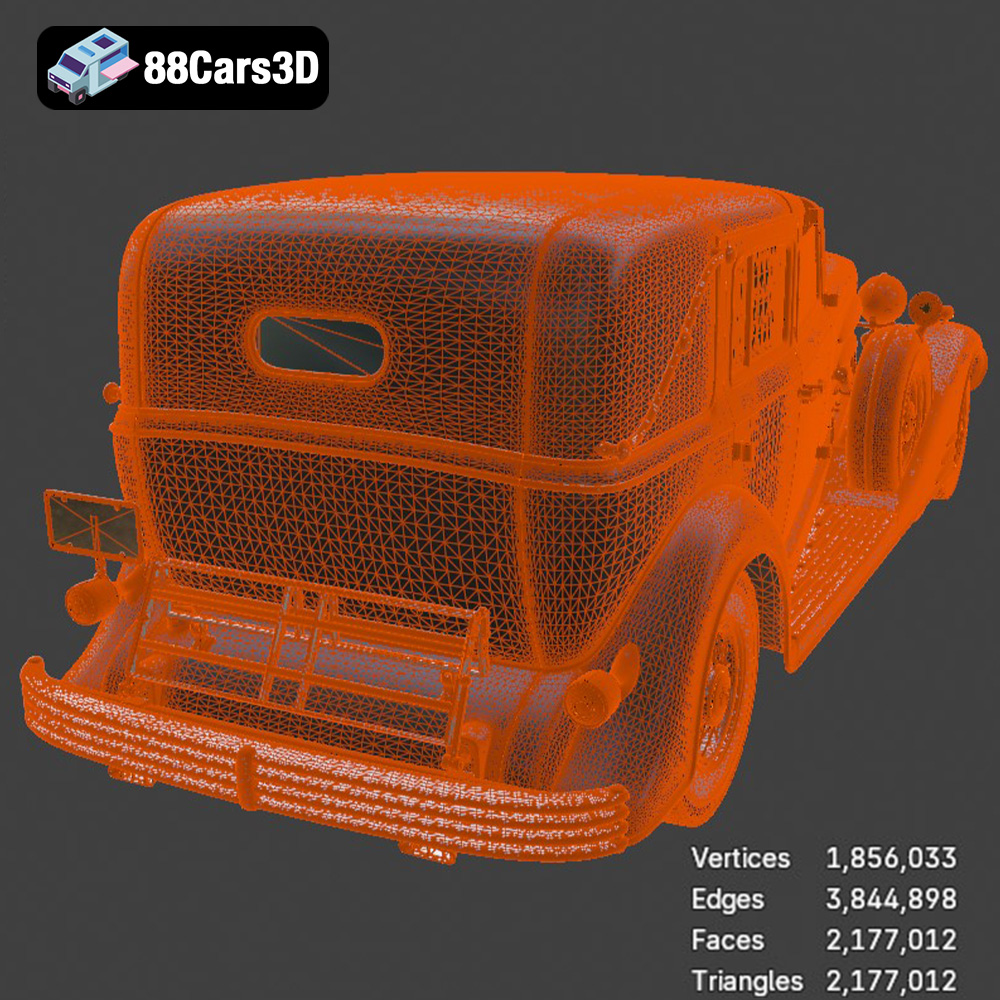
This exquisite model embodies the pinnacle of pre-war American luxury. The original 1933 Cadillac V16 (452-C) Town Car, with its colossal 16-cylinder engine, sweeping pontoon fenders, and iconic Goddess hood ornament, defined an era of unparalleled prestige and bespoke coachbuilding. Our featured 3D model captures this essence with extraordinary visual fidelity, boasting a detailed topology of over two million triangles. This intricate level of detail ensures breathtaking realism, making it an invaluable asset for historical recreations, architectural visualizations, and cinematic productions where accuracy and aesthetic brilliance are paramount.
Navigating the diverse world of 3D modeling often begins with understanding file formats. Each format serves specific purposes, offering unique advantages for different stages of a project or different software ecosystems. Selecting the correct format is crucial for maintaining data integrity, optimizing performance, and ensuring compatibility. The 1933 Cadillac V16 452-C Town Car 3D model comes equipped with a comprehensive suite of file formats, offering maximum flexibility for any professional workflow.
The `.blend` file is Blender’s native format, preserving an entire scene with all its data, including meshes, materials, textures, lighting, cameras, animation data, and even custom scripts. For artists working primarily in Blender, this format provides a fully editable and organized project file. It’s ideal for deep customization, adjusting materials, modifying geometry, or extending animations. Its self-contained nature ensures that all scene components are correctly linked and ready for immediate use within Blender.
FBX (Filmbox) is one of the most widely adopted proprietary file formats for 3D content exchange, developed by Autodesk. It’s particularly strong in transferring entire scene graphs, including models, animations, cameras, and lights, between different software applications like 3ds Max, Maya, Blender, Unity, and Unreal Engine. For real-time pipelines in game development, `.fbx` is often the go-to choice due to its robust support for skeletal animations, blend shapes, and PBR (Physically Based Rendering) material data. Its widespread compatibility makes it ideal for collaborative projects and asset sharing.
OBJ (Object) is a simple, universal 3D geometry definition file format that is highly compatible across almost all 3D software. It primarily stores geometric data like vertices, normals, UV coordinates, and faces. While it doesn’t store animation or scene data, it’s excellent for transferring static mesh information cleanly. Accompanying `.obj` files are typically `.mtl` (material library) files, which define basic material properties like color and texture maps. For simple model exchange or when you need raw mesh data, `.obj` remains a reliable choice.
GLB (GL Transmission Format Binary) is a binary version of the glTF format, specifically designed for efficient transmission and loading of 3D scenes and models in web-based, Augmented Reality (AR), and Virtual Reality (VR) applications. It packs all necessary data – geometry, materials, textures, animations – into a single file, making it incredibly fast to load and display. The `.glb` format is a game-changer for interactive 3D experiences on the web, virtual showrooms, or mobile AR, where performance and file size are critical.
STL (Stereolithography) is almost universally used for 3D printing. It represents a 3D model as a series of connected triangles (a tessellation of the surface). While it does not contain color or texture information, its simplicity and ubiquity make it the standard for sending models to 3D printers. For hobbyists looking to print a physical replica of the 1933 Cadillac, the `.stl` format from 88cars3d.com is essential, ready for slicing software.
PLY (Polygon File Format or Stanford Triangle Format) is a file format for storing 3D data from 3D scanners. It can store a variety of properties, including color, transparency, normals, texture coordinates, and scalar values for each vertex or face. While less common for general 3D model exchange, it’s valued in scientific and engineering applications, as well as for precise mesh analysis and CAD workflows due to its ability to store detailed information beyond just geometry.
The `.unreal` format denotes an asset specifically prepared and optimized for direct import into the Unreal Engine. This often implies proper scaling, collision setups, level of detail (LOD) generation, and PBR material configurations that align seamlessly with Unreal’s rendering pipeline. This format drastically reduces setup time for game developers and real-time visualization artists, allowing them to integrate the Cadillac V16 directly into their interactive scenes with minimal fuss.
Similar to `.blend` for Blender, the `.max` file is the native project format for Autodesk 3ds Max. It contains all scene data, including models, materials, textures, lighting, cameras, animation, and plug-in data. For artists working within the 3ds Max ecosystem, this file offers full editability, allowing for comprehensive customization, rigging, and rendering within a familiar environment. It’s crucial for studios whose pipelines are built around 3ds Max for architectural visualization, animation, or high-end rendering.
Recreating a vehicle like the 1933 Cadillac V16 (452-C) Town Car in 3D is a meticulous endeavor that goes beyond simply replicating shape. It involves deep research, precision modeling, and an artistic touch to convey the spirit of the original. The model available at 88cars3d.com exemplifies this dedication, offering a level of detail that satisfies both historical accuracy and visual appeal.
The journey begins with extensive historical research. For the Cadillac V16, this would involve studying blueprints, period photographs, archival footage, and even physical inspections of surviving examples. This research informs every modeling decision, ensuring that the sweeping pontoon fenders, the iconic Goddess hood ornament, the majestic chrome V-shaped grille, and the dual side-mount spare tires are all proportioned and shaped with absolute fidelity. The resulting 3D model is a testament to this process, boasting real-world scale accuracy based on the actual 1933 vehicle chassis and wheelbase.
The exterior of the Cadillac model showcases accurate frame geometry and classic 1930s proportions. Detailed engine block enclosures give a glimpse of the legendary 452 cubic-inch V16 layout, complemented by an authentic dual exhaust system and undercarriage details. Period-correct lighting, from elegant carriage lights to massive bullet-style headlights, is faithfully recreated. The multi-spoke wire wheels fitted with classic wide whitewall tires are a focal point, along with historically accurate leaf spring suspension detailing. Crucially, separate components for wheels, suspension, and steering ensure the model is ready for complex animation.
The interior is equally impressive. The opulent rear passenger compartment, with its tufted seating and rich woodwork, reflects the era’s luxury. The exposed driver’s open-air cockpit, authentic to the Town Car coachwork, features a classic Art Deco instrument cluster with detailed gauges and accurate control details, including pedals and a large-diameter steering wheel. This optimized geometry even makes it suitable for first-person POV in gaming and VR experiences, providing an immersive glimpse into the past.
The versatility of a well-crafted 3D car model is defined by its ability to seamlessly integrate into various professional pipelines. Whether you’re a seasoned artist using 3ds Max, a game developer working in Unreal Engine, or an indie creator favoring Blender, the 1933 Cadillac V16 452-C Town Car model from 88cars3d.com provides robust compatibility and optimized assets.
For architectural visualization (arch-viz) and high-end rendering, 3ds Max combined with renderers like V-Ray or Corona is a powerhouse. The `.max` file provided with the Cadillac model offers full editability within this environment. Artists can easily import the model, adjust materials for specific lighting conditions – perhaps a dramatic studio setup or a sun-drenched outdoor scene – and set up complex camera animations. The model’s high polygon count (2,177,012 triangles) is perfectly suited for these scenarios, ensuring every reflection on the chrome, every nuanced curve of the bodywork, and the rich textures of the interior upholstery are rendered with photorealistic precision. Customization options, such as changing body/coachwork colors to classic two-tone finishes or adjusting material finishes from matte leather to highly polished chrome, are straightforward.
Game developers demand both visual fidelity and performance optimization. The `.unreal` and `.fbx` formats of the Cadillac V16 are game-ready. Importing the asset into Unreal Engine allows developers to take advantage of its physically based rendering (PBR) pipeline. The model’s optimized geometry strikes a perfect balance, maintaining breathtaking visual realism while being suitable for high-end real-time engines. Proper pivot setups for steering, wheel rotation, and suspension travel are pre-configured, drastically reducing the setup time required for vehicle physics and animation. Imagine this classic car cruising through a historically accurate open-world game or serving as a prized vehicle in a high-fidelity racing simulator. The attention to detail, from the multi-spoke wire wheels to the intricate engine enclosures, ensures an immersive player experience.
Blender, a powerful open-source 3D suite, offers incredible flexibility for artists. The `.blend` file included with the Cadillac model means Blender users get a fully prepared scene, complete with materials and textures. This allows for immediate rendering with Cycles or Eevee, or further customization. Artists can explore different lighting setups, create detailed animations of the car driving or its components moving, or integrate it into larger scenes. The clean topology of the model facilitates subdivision surfacing if even higher detail is desired for extreme close-ups, while the provided high poly count ensures quality out-of-the-box. The ability to modify tire textures for weathered appearances or adapt lighting for different environments gives artists complete creative control.
The utility of a premium 3D model extends far beyond static renders. The 1933 Cadillac V16 452-C Town Car model is designed with versatility at its core, enabling its use across a spectrum of cutting-edge digital and physical applications.
Augmented Reality (AR) and Virtual Reality (VR) environments demand highly optimized assets that can be rendered in real-time without compromising visual quality. The `.glb` format, specifically designed for web, AR, and VR, makes this model an excellent candidate for immersive virtual showrooms, interactive configurators, and mobile AR experiences. Imagine a user exploring the Cadillac V16 in a virtual space, examining every detail of its opulent interior or witnessing its majestic exterior scale in their own living room via AR. The optimized geometry ensures smooth performance even on less powerful devices, while the visual fidelity creates a truly engaging experience.
As mentioned, the model is “game-ready.” With 2,177,012 triangles, it’s suitable for the most demanding current-generation games that prioritize visual realism. Whether it’s an open-world title requiring a diverse vehicle fleet, a dedicated racing game focusing on classic cars, or an interactive simulator, this Cadillac model integrates seamlessly. Its proper pivot setup for steering, wheel rotation, and suspension travel is critical for implementing realistic vehicle physics, offering a compelling blend of historical accuracy and interactive gameplay.
For enthusiasts and collectors, the ability to bring a digital model into the physical world through 3D printing is a compelling feature. The `.stl` format included with the Cadillac V16 is perfectly suited for this. Whether you’re aiming for a display-scale hobbyist model at 1:12, 1:18, or 1:24, the provided technical specifications guide users through recommended print settings. This includes layer height (0.04–0.12 mm, with resin printing recommended for fine details), wall thickness, infill percentages, and crucial support requirements for intricate parts like the exhaust system, wire spokes, and steering wheel. The detailed instructions on print orientation and post-processing (sanding, primer, authentic factory colors) ensure that the physical replica is as close to the digital ideal as possible.
The true value of a professional 3D asset lies not just in its visual appeal, but in its underlying technical structure. The 1933 Cadillac V16 452-C Town Car model is engineered for peak performance and realism across various applications, demonstrating a profound understanding of optimization without sacrificing detail.
With a robust 2,177,012 triangle count, the model strikes an ideal balance. For high-end cinematic rendering and architectural visualizations, this polycount provides ample detail to capture every nuance and reflection, making it suitable for breathtaking photorealism. For real-time applications like game development or AR/VR, this level of detail is impressive yet intelligently structured. Modern game engines are increasingly capable of handling higher polycounts, especially for hero assets. Furthermore, for situations where performance is paramount, a well-structured high-poly model serves as an excellent base for generating lower Level of Detail (LOD) versions. These LODs progressively simplify the geometry as the object moves further from the camera, ensuring consistent performance without a noticeable drop in visual quality to the end-user. The clean topology of the Cadillac model facilitates this process, making it a truly versatile asset.
Accuracy in 3D modeling goes beyond visual fidelity; it extends to real-world scale and mechanical articulation. The Cadillac model is meticulously built to real-world scale based on the actual 1933 vehicle chassis and wheelbase. This is crucial for applications where the model must interact realistically with environments, such as in architectural scenes, driving simulators, or virtual tours. Furthermore, the model includes proper pivot setups for essential animations: steering, individual wheel rotation, and suspension travel. This pre-configured articulation significantly streamlines the rigging and animation process, allowing artists to immediately begin creating dynamic scenes without the tedious task of setting up hierarchical relationships and pivot points from scratch. This attention to mechanical accuracy makes it ideal for dynamic simulations and interactive experiences.
The availability of a meticulously crafted 3D model like the 1933 Cadillac V16 (452-C) Town Car opens up a world of creative possibilities for professionals across various industries. Its historical accuracy and technical robustness make it an indispensable tool for a range of projects.
Imagine a period drama set in the glamorous 1930s. Rather than relying on costly physical props or complex green-screen techniques for every shot, filmmakers can utilize this 3D Cadillac model to populate street scenes, create dynamic chase sequences, or even generate entire establishing shots of the vehicle arriving at a grand mansion. Its cinematic-quality detail ensures it holds up under close-ups and dramatic lighting, seamlessly blending with live-action footage or serving as the star of fully animated sequences. The separate, animatable components for wheels, suspension, and steering allow for highly realistic vehicle animation, crucial for believable motion picture content.
For luxury automotive brands or classic car dealerships, this model offers unprecedented potential for marketing. Instead of expensive photoshohoots with physical vehicles, virtual showrooms can be created, allowing potential buyers to explore the Cadillac V16 from every angle, customize its paint scheme, and even “sit inside” the meticulously detailed interior via VR. Architectural visualization studios can integrate this classic car into their renders of historical buildings or luxurious estates, instantly adding a touch of period authenticity and lifestyle appeal. The ability to quickly iterate on different color schemes, material finishes, and environmental lighting drastically speeds up the visualization process, delivering stunning results efficiently.
Beyond commercial applications, the 1933 Cadillac V16 452-C Town Car 3D model holds significant educational and archival value. Museums and historical societies can use it to create interactive exhibits, allowing visitors to virtually dissect the V16 engine, explore the interior details, or even “drive” the car through historical streetscapes. Researchers can use the accurately scaled model for studies in automotive design and engineering history. The digital preservation of such an iconic vehicle ensures that its legacy can be explored and appreciated by future generations, offering insights into the pinnacle of pre-war American craftsmanship.
The demands of modern 3D production require assets that are not only visually stunning but also technically robust, versatile, and optimized for diverse workflows. The 1933 Cadillac V16 (452-C) Town Car 3D model stands as a prime example of such an asset, meticulously crafted to represent an undisputed masterpiece of American automotive history with extraordinary fidelity. From its detailed exterior and opulent interior to its intelligently structured geometry and comprehensive file format support, every aspect has been considered for professional application.
Whether your project involves crafting photorealistic renders in 3ds Max, developing immersive real-time experiences in Unreal Engine, or bringing historical accuracy to cinematic productions, this model provides the foundation for excellence. Its adaptability for AR/VR applications and even 3D printing further underscores its value as a truly multi-purpose digital asset. For professionals seeking to infuse their projects with a touch of timeless elegance and unparalleled detail, the 1933 Cadillac V16 452-C Town Car 3D model, available at 88cars3d.com, is an investment in quality and creative potential. Explore this magnificent piece of digital artistry and elevate your next project to a new echelon of realism and historical accuracy.
The 1933 Cadillac V16 (452-C) Town Car is an undisputed masterpiece of American automotive history, representing the absolute pinnacle of pre-war luxury and bespoke coachbuilding. Renowned for its whisper-quiet, colossal 16-cylinder engine and the distinctive open-chauffeur “Town Car” body style, this magnificent vehicle defined 1930s elegance and prestige. Key visual elements include its sweeping pontoon fenders, the iconic Goddess hood ornament, majestic chrome V-shaped grille, and dual side-mount spare tires, all culminating in a breathtakingly regal silhouette. This premium 3D model boasts an extraordinary level of visual fidelity with a detailed topology of 2,177,012 triangles, capturing every nuanced curve and chrome accent of the classic original. Despite its high detail, the geometry is intelligently structured to ensure stunning photorealism while remaining versatile for high-end digital applications. It stands as an exceptional asset for developers and artists demanding true-to-life representation in historical recreations, architectural visualizations, and cinematic productions.
$37.50
.blend
.cadillac
.fbx
.glb
.max
.obj
.ply
.rendering
.stl
.unreal
.v16
1933
452-c
car-3d-model
classic-car
game asset
game-ready
luxury car
optimized
pre-war
town-car
VR/AR