Get 20% OFF All Premium 3D & STL Models!

In the fast-evolving world of digital visualization, the demand for high-quality 3D assets is paramount. From immersive video games and cutting-edge virtual reality experiences to photorealistic architectural renderings and industrial design, detailed 3D models form the backbone of countless projects. Among these, automotive 3D models hold a special place, captivating enthusiasts and professionals alike with their intricate designs and dynamic potential. Few vehicles embody this blend of classic appeal and raw performance quite like the Ford Cobra.
The Ford Cobra is more than just a car; it’s a legend, an icon of American muscle and racing heritage. Its unmistakable silhouette, aggressive stance, and roaring V8 engine have cemented its place in automotive history. For 3D artists, game developers, and visualization specialists, recreating such a storied vehicle presents both a challenge and an opportunity. A meticulously crafted digital representation of the Cobra allows creators to harness its legacy in new, innovative ways, bringing its powerful presence to virtual worlds and cinematic scenes.
This comprehensive guide delves into the technical intricacies and creative possibilities offered by professional-grade 3D car models, exemplified by the exceptional Ford Cobra 3D model available on 88cars3d.com. We’ll explore the critical role of various file formats, the technical specifications that define a truly “game-ready” asset, and how such models are integrated into diverse professional workflows, from high-fidelity automotive rendering to dynamic game assets for next-generation titles. Whether you’re a seasoned professional or an aspiring artist, understanding these elements is key to unlocking the full potential of digital automotive design.
Choosing the correct 3D model file format is a critical decision that impacts workflow, compatibility, and the ultimate utility of your digital asset. Different formats are optimized for distinct purposes, from real-time engine integration to universal compatibility and 3D printing. The Ford Cobra 3D model thoughtfully includes a wide array of formats, ensuring maximum flexibility for any project. Let’s explore these essential formats in detail:
The .blend format is native to Blender, the popular open-source 3D creation suite. When you download a .blend file, you’re getting a complete Blender project, often with all materials, textures, lighting, and even animation data packaged within. This format is ideal for artists who primarily use Blender, offering full editability of the mesh, rigging, UV maps, and shader networks. It provides the most flexibility for making custom modifications, such as changing geometry, adding new parts, or tweaking material properties directly within Blender’s powerful environment. For the Ford Cobra model, this means access to the original scene, allowing for deep customization and understanding of its construction.
.fbx (Filmbox) is an industry-standard proprietary file format owned by Autodesk, widely adopted for its excellent interoperability across various 3D applications and game engines. It’s particularly favored in game development for engines like Unreal Engine and Unity due to its robust support for mesh data, animation, skeletons, blend shapes, and materials. An .fbx file efficiently transfers complex scenes while maintaining hierarchy and transformations, making it the go-to choice for exporting game-ready assets. The Ford Cobra .fbx is meticulously prepared to ensure seamless import into real-time environments, maintaining correct scale, pivots, and material assignments.
The .obj (Wavefront OBJ) format is one of the most widely supported and universal 3D file formats. It’s a simple, text-based format that stores geometric data—vertices, normals, texture coordinates, and faces—and can reference external material (.mtl) files. Its simplicity ensures excellent cross-software compatibility, making it a reliable choice for transferring models between different 3D applications when other formats might cause issues. While it doesn’t support animation or advanced material definitions, its universality makes the Ford Cobra .obj an excellent fallback for integration into virtually any 3D workflow.
.glb (GL Transmission Format Binary) is the binary version of glTF, a royalty-free specification for the efficient transmission and loading of 3D scenes and models by applications. It’s quickly becoming the “JPEG of 3D” due to its optimization for web-based, AR, and VR applications. A .glb file packages 3D model data (geometry, textures, animations) into a single file, making it incredibly easy to share and integrate into web browsers, mobile AR apps, and lightweight VR experiences without complex setups. The Ford Cobra .glb is perfect for virtual showrooms, interactive product displays, or embedding into online portfolios.
.stl (Stereolithography) is the de facto standard file format for 3D printing. It represents a 3D model as a series of connected triangles, describing only the surface geometry without color, texture, or other attributes. For anyone looking to bring the digital Ford Cobra into the physical realm, the .stl file is essential. It’s specifically prepared for additive manufacturing, ensuring a manifold (watertight) mesh that 3D printers can interpret correctly. The Cobra model’s inclusion of an .stl format opens up possibilities for creating physical replicas, scale models, or custom parts.
The .ply (Polygon File Format or Stanford Triangle Format) is a versatile format for storing 3D data, particularly useful for scanned data, CAD, and scientific applications where precision and additional per-vertex or per-face data are important. It can store not only geometry but also properties like color, transparency, normals, texture coordinates, and even reliability information for each vertex or face. While less common for general game assets, the Ford Cobra .ply provides a highly precise representation of the model’s geometry, valuable for engineering analysis, reverse engineering, or specialized rendering pipelines.
While not a standalone file format in the traditional sense, the inclusion of “unreal” typically signifies that the asset has been specifically prepared and optimized for direct import into Unreal Engine. This often implies a tailored .fbx or asset package that follows Unreal Engine’s conventions for naming, scaling, material setup, and collision. For the Ford Cobra, this means it’s ready to drop into an Unreal project with minimal setup, leveraging the engine’s powerful rendering capabilities for stunning real-time visuals without extensive manual adjustments.
The .max format is the native file format for Autodesk 3ds Max, a leading software for 3D modeling, animation, and rendering. Like .blend for Blender, a .max file contains the complete scene data, including geometry, modifiers, materials, textures, lighting, cameras, and animation keyframes. It offers the highest level of editability for users working within 3ds Max, allowing full control over every aspect of the model. For professional rendering studios using V-Ray, Corona, or other advanced renderers within 3ds Max, the Ford Cobra .max file provides an ideal starting point for high-end visualizations and cinematic sequences.
Achieving photorealistic quality and optimal performance in 3D projects hinges on the underlying technical specifications of the models used. The Ford Cobra 3D model from 88cars3d.com exemplifies this balance, meticulously engineered to deliver both stunning visual fidelity and game-ready optimization. Understanding these specifications is crucial for any professional working with digital automotive assets.
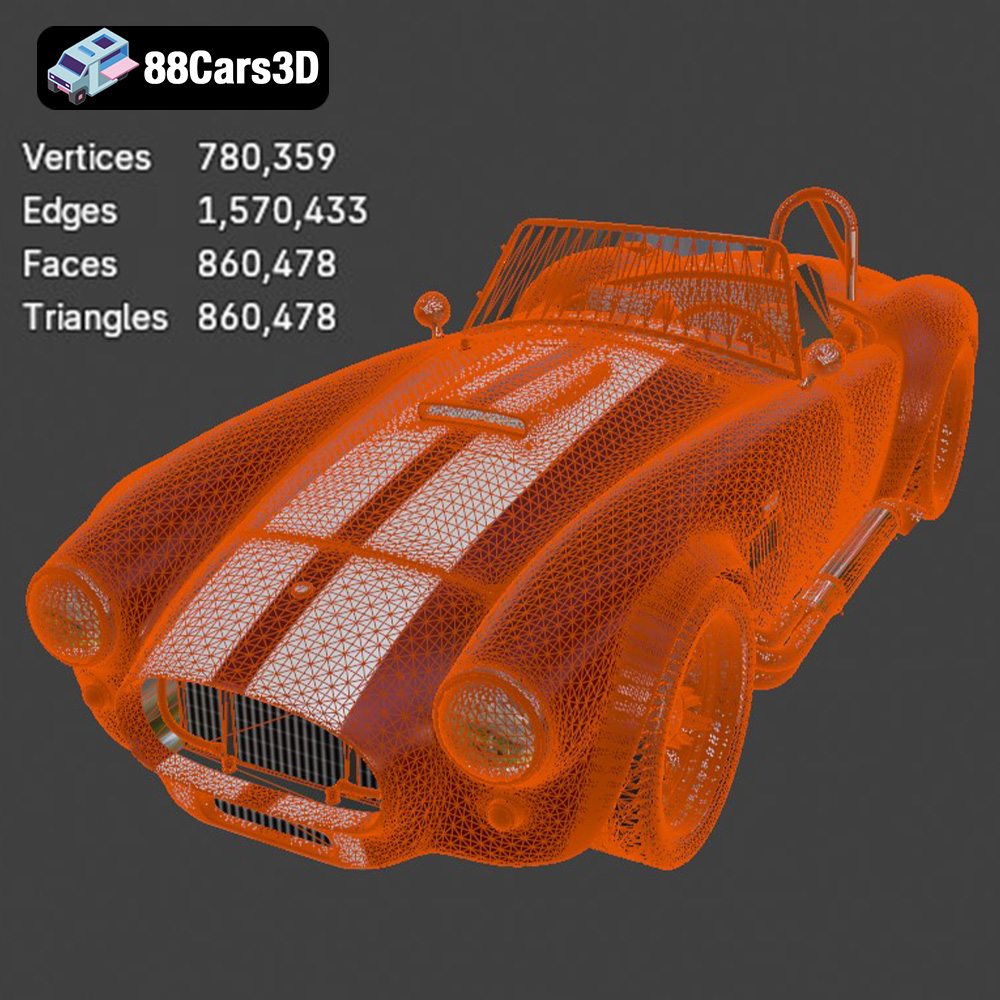
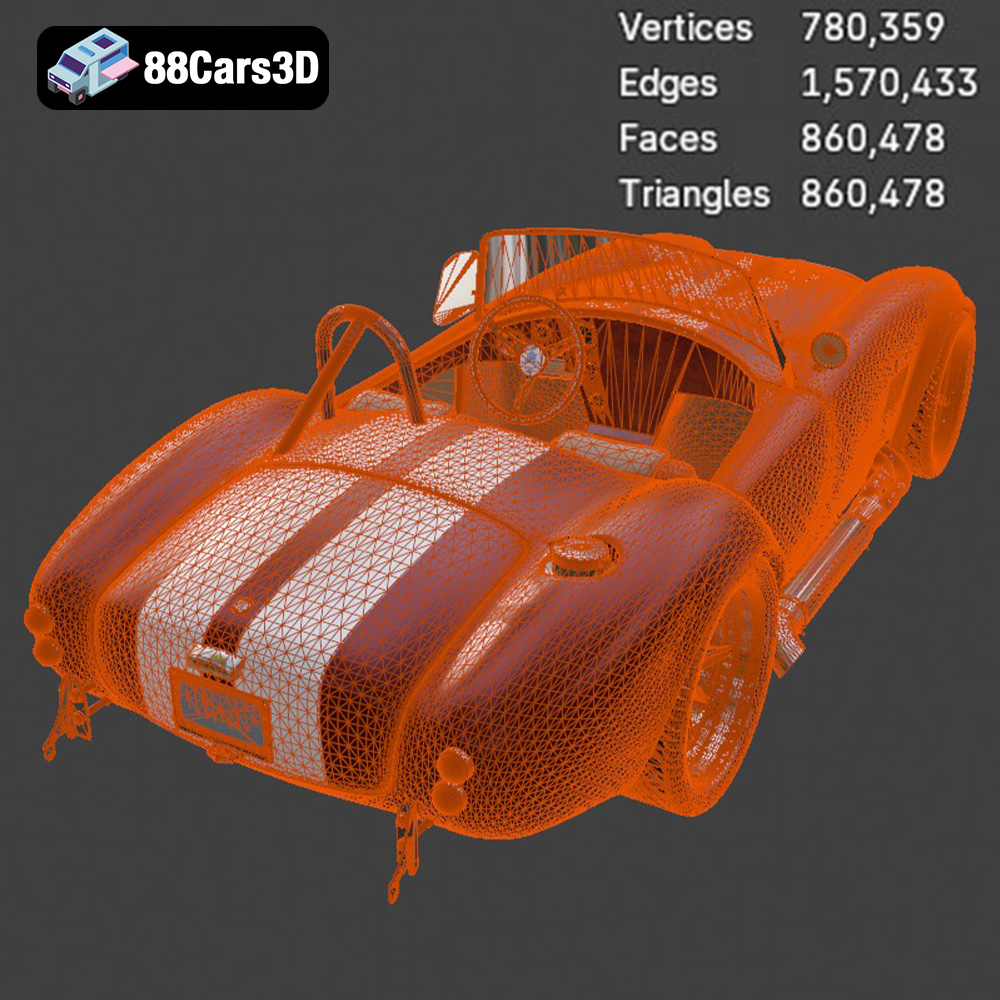
The core of any 3D model’s visual quality lies in its topology – how the polygons are arranged. The Ford Cobra boasts a highly detailed topology with 860,478 triangles. This figure represents a sweet spot, providing enough geometric detail to capture the Cobra’s iconic flared fenders, aggressive wide stance, and intricate mechanical elements without overburdening real-time engines. For game development, where performance is paramount, this poly count ensures the model can be rendered smoothly even in complex scenes, earning its “game-ready” designation. For high-end rendering and visualization, this level of detail supports close-up shots and high-resolution outputs without sacrificing authenticity.
Beyond raw poly count, the model’s optimization extends to proper UV mapping for textures, clean mesh for deformation, and efficient material assignments. These factors collectively contribute to a model that not only looks great but also performs exceptionally across various applications, from racing simulators to virtual showrooms.
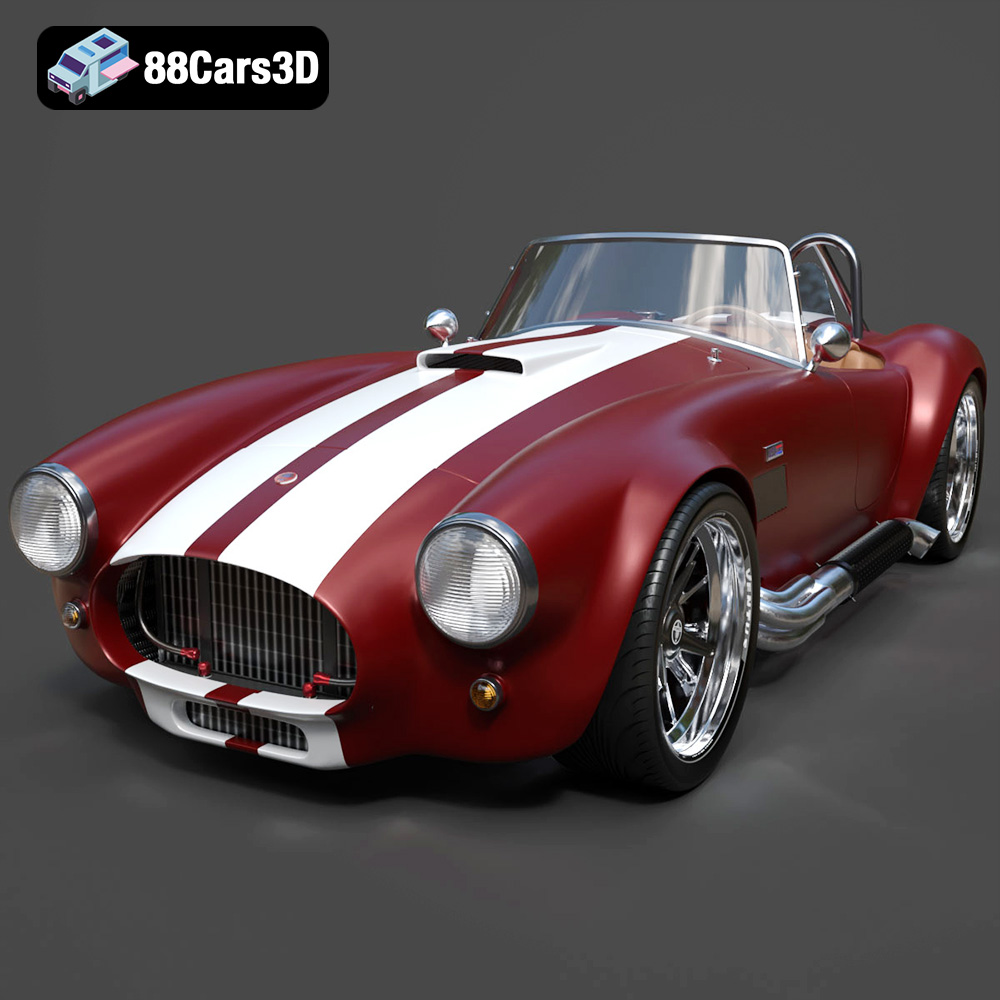
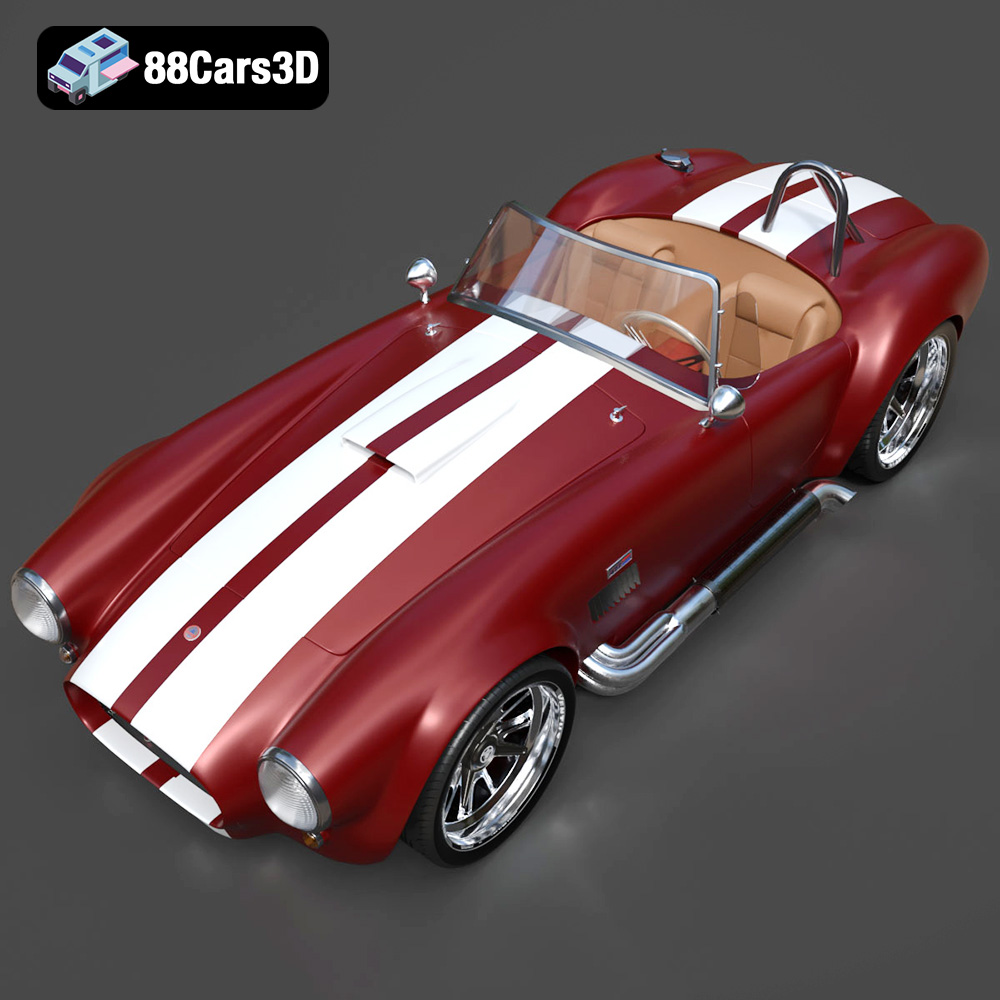
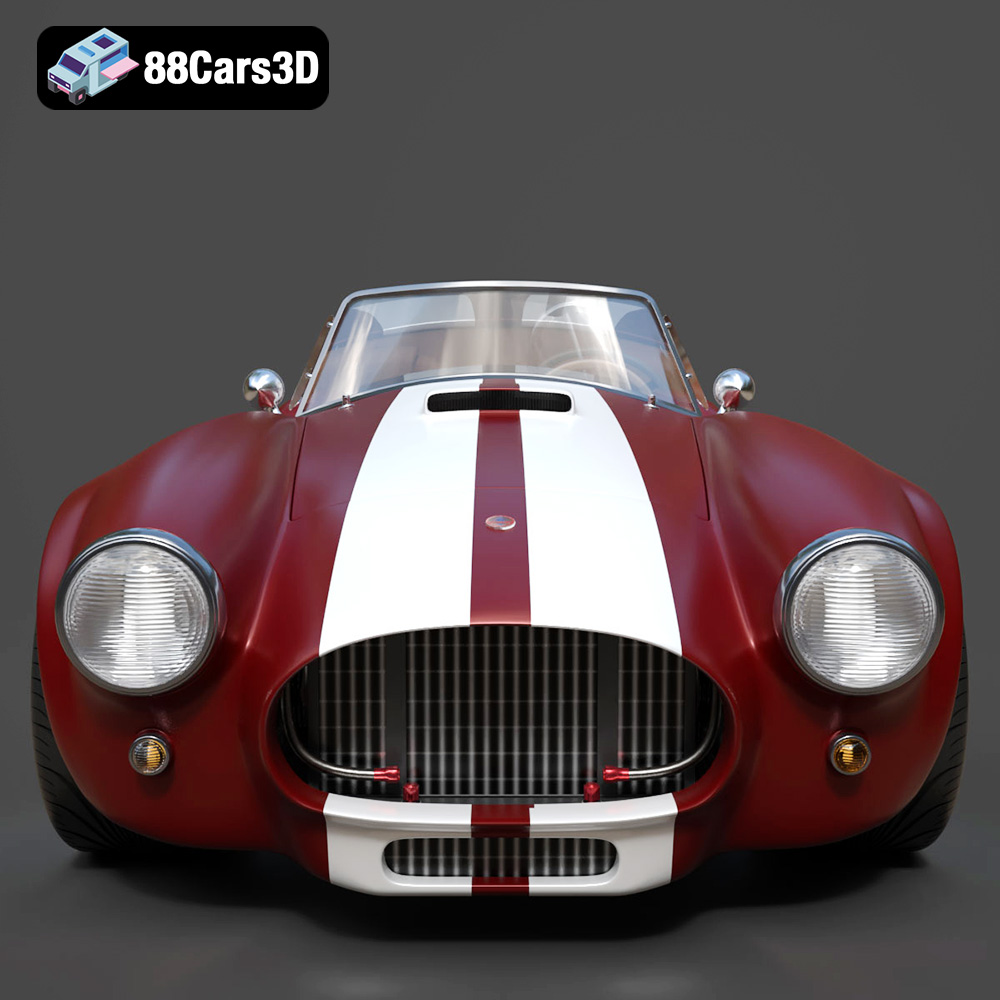
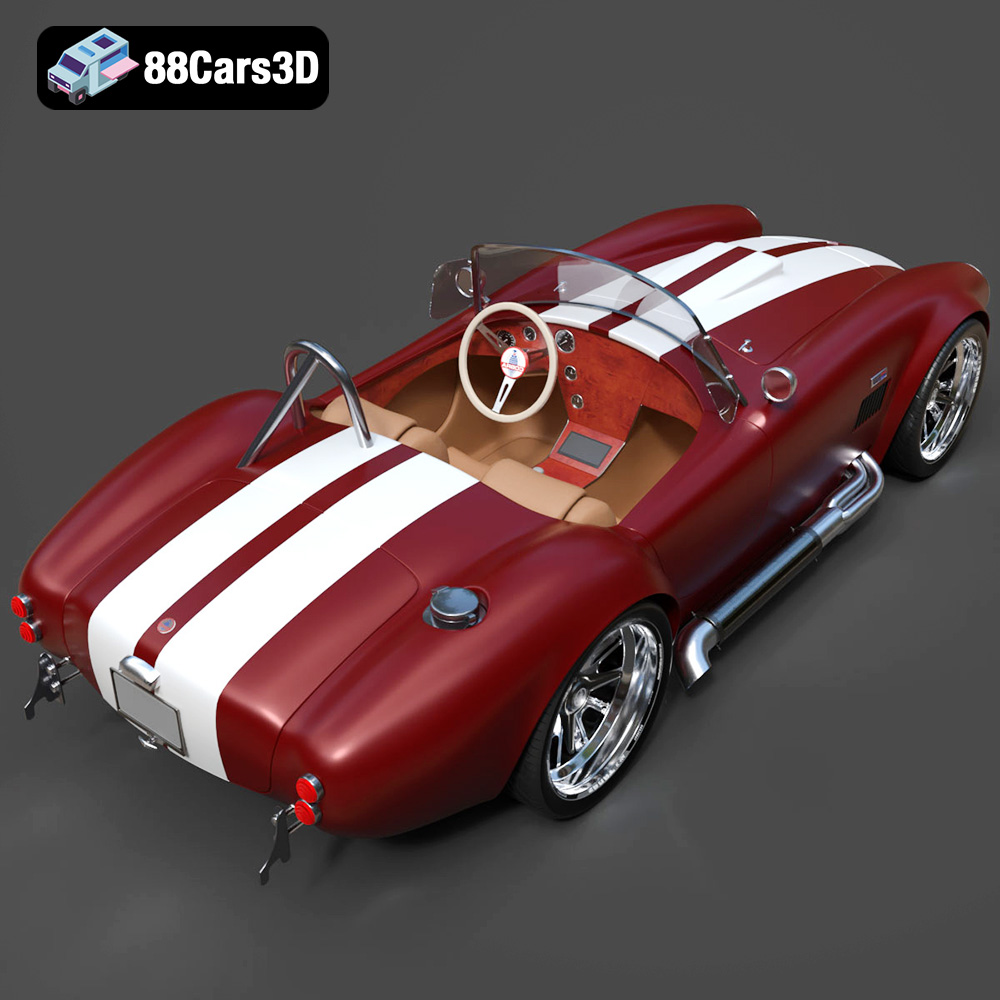
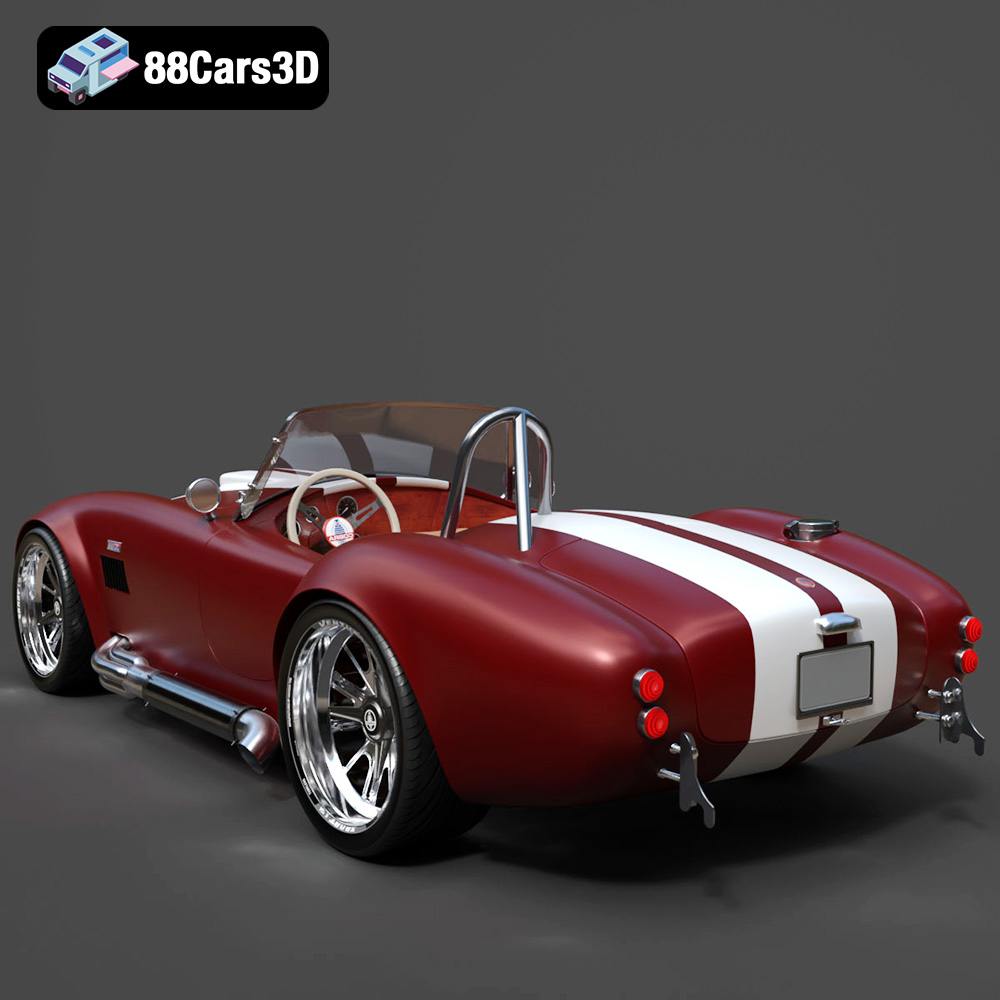
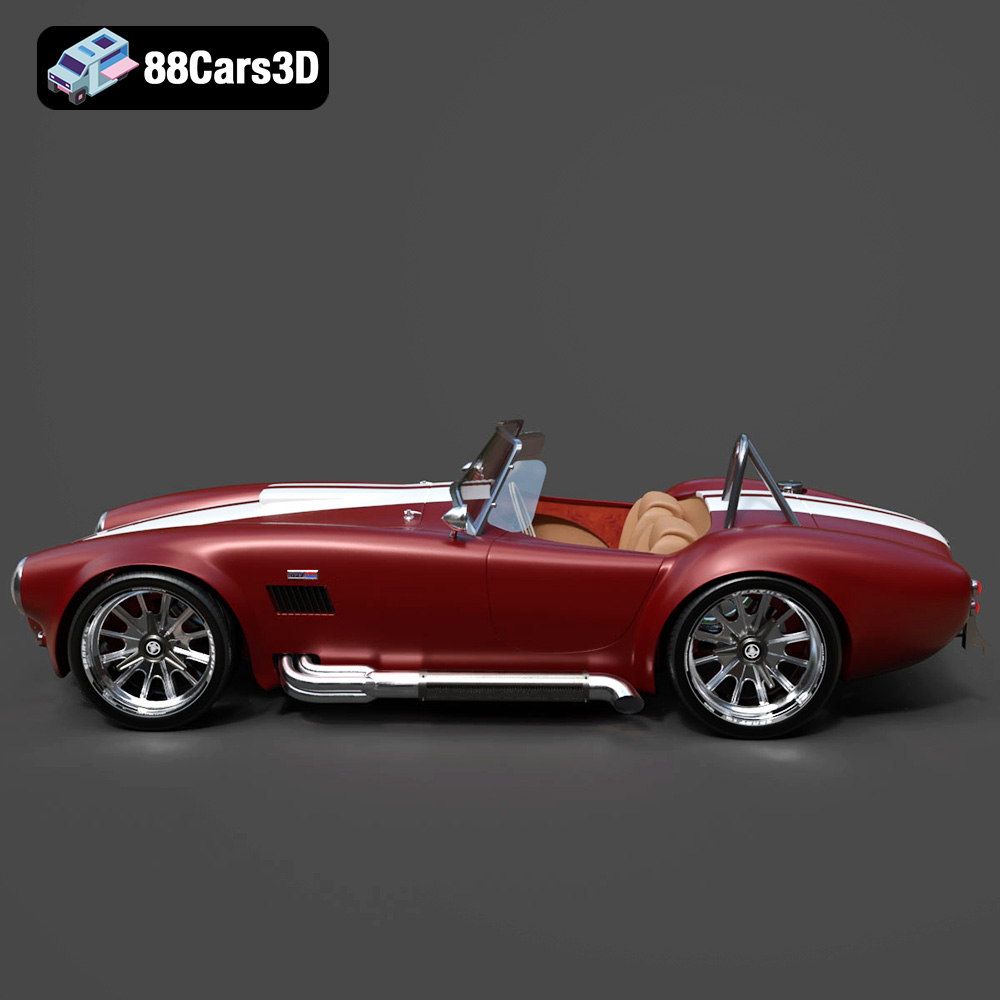
The commitment to realism is evident in every aspect of the Ford Cobra model’s design. The exterior features include accurate frame geometry, signature chrome side-exit exhausts, classic round headlights, and authentic knock-off style wheels with wide performance tires. These elements are not merely present; they are meticulously modeled to reflect their real-world counterparts, down to the subtle curves and material reflections.
The attention to detail extends beneath the surface with a detailed V8 engine block, complete with prominent air cleaners, and fully modeled suspension and undercarriage components. For animators, the separation of wheels, suspension, and steering components is invaluable, allowing for realistic movement and interaction. Inside the cockpit, vintage leather-textured bucket seats, a classic wood-rimmed steering wheel, and a period-correct analog instrument cluster create an immersive experience, even optimized for first-person viewpoints in gaming environments.
Accuracy in 3D modeling goes beyond visual appeal; it’s about adhering to real-world specifications. The Ford Cobra 3D model is built to real-world scale, based on actual vehicle chassis dimensions. This precision is vital for integration into existing environments, ensuring the car fits naturally alongside other assets and adheres to physical constraints in simulations. Coupled with proper pivot setups for steering, wheel rotation, and suspension travel, this model is not just a static display piece but a dynamic asset ready for complex animations, vehicle physics, and interactive experiences.
High-quality 3D car models like the Ford Cobra are versatile assets, serving as foundational elements in a multitude of professional pipelines. Their integration into different software and engines requires specific approaches to leverage their full potential. From initial import to final render or game implementation, understanding these workflows is key to successful project execution.
For users of industry-standard DCC (Digital Content Creation) tools like 3ds Max and Blender, the provided native file formats (.max and .blend respectively) offer the most comprehensive starting point. Importing the Ford Cobra model into these environments typically involves:
Game developers and AR/VR creators rely heavily on real-time engines like Unreal Engine and Unity. The Ford Cobra’s game-ready optimization and .fbx/.unreal formats streamline its integration:
The inclusion of an .stl format for the Ford Cobra opens a unique workflow: bringing the digital model into the physical world through 3D printing. This process involves specific considerations:
The Ford Cobra 3D model, with its blend of high detail and optimization, is an indispensable asset across a spectrum of professional applications. Its versatility makes it a valuable investment for studios and individual artists aiming for excellence in their respective fields.
For game developers, the Ford Cobra model is a perfect example of a high-value game asset. Its optimized polycount (860,478 triangles) strikes an excellent balance, providing stunning visual realism without bogging down game engines. This makes it ideal for:
Augmented and Virtual Reality technologies thrive on detailed, performant 3D models to create convincing digital overlays and fully immersive environments. The Ford Cobra model is exceptionally suited for these applications:
For high-end visualization and cinematic projects, where every detail matters, the Ford Cobra model excels. Its fidelity supports:
The journey of a 3D model doesn’t always end on a screen. For many enthusiasts and professionals, the ultimate goal is to hold a physical representation of their digital creation. The Ford Cobra 3D model, with its included .stl format, is perfectly poised for the exciting world of 3D printing, allowing hobbyists and collectors to manifest this automotive legend in tangible form.
While the .stl format is provided, successful 3D printing requires careful preparation and an understanding of the specific settings:
One of the most critical aspects of 3D printing complex models is managing supports and print orientation. Overhangs and intricate parts will require support structures to prevent warping or failure during printing:
A raw 3D print is just the beginning. The real magic often happens in post-processing, transforming a plastic model into a showroom-worthy replica:
In the dynamic realm of 3D content creation, a versatile and customizable asset is an invaluable investment. The Ford Cobra 3D model from 88cars3d.com isn’t just a static representation; it’s a flexible foundation designed to adapt to a myriad of creative visions and evolving project requirements. Its inherent customization options and robust technical specifications ensure its utility long into the future.
One of the significant advantages of professional-grade 3D car models is the degree to which they can be personalized. The Ford Cobra model offers extensive customization possibilities, allowing artists to tailor it precisely to their needs:
These customization options save countless hours of modeling from scratch, allowing creators to focus on artistic direction and iteration, ultimately accelerating project timelines and enhancing creative output.
Investing in high-quality game assets or rendering models also means considering their longevity. The Ford Cobra model is designed with future compatibility in mind:
This forward-thinking approach means that purchasing the Ford Cobra 3D model from 88cars3d.com is not just a transaction for a single project, but an investment in a versatile asset that will continue to provide value across many future endeavors.
The digital landscape demands assets that are both visually stunning and technically robust. As we’ve explored, a high-quality 3D car model like the Ford Cobra exemplifies the perfect fusion of artistic fidelity and functional optimization. From its meticulously detailed exterior and interior to its game-ready topology and broad format compatibility, this model stands out as a premier asset for a multitude of applications.
We delved into the critical importance of various file formats, understanding how each serves specific purposes, whether it’s the full editability of .blend and .max, the universal compatibility of .fbx and .obj, the web-optimization of .glb, or the print-readiness of .stl. This comprehensive approach ensures that the Ford Cobra is not just a model, but a complete solution for diverse workflows.
The detailed technical specifications, including its balanced 860,478 triangle count and real-world scale, underpin its effectiveness in demanding environments such as cinematic automotive rendering, immersive AR/VR experiences, and high-performance game development. Its animatable components further enhance its utility, allowing for dynamic interactions and realistic simulations. Moreover, the ability to seamlessly transition from digital art to a physical 3D print adds another layer of versatility and creative fulfillment.
Ultimately, investing in a meticulously crafted asset like the Ford Cobra 3D model from 88cars3d.com empowers creators to achieve unparalleled realism and efficiency in their projects. It’s more than just a model; it’s a gateway to bringing legendary automotive heritage into the digital age, ready to accelerate your creative vision.
The Ford Cobra represents the pinnacle of classic American muscle, combining lightweight roadster design with immense V8 performance. Known for its iconic flared fenders, aggressive wide stance, signature side-exit exhausts, and legendary racing heritage, this vehicle is a true automotive masterpiece that captures the essence of 1960s sports cars. This meticulously crafted 3D model features a highly detailed topology with 860,478 triangles. It ensures stunning visual fidelity and game-ready optimization, making it an exceptional asset for high-end rendering, game development, AR/VR environments, and detailed animation work. Perfect for classic car racing simulators, vintage automotive showcases, cinematic animations, and virtual reality garage experiences.
$57.99
.blend
.cobra
.fbx
.ford
.glb
.max
.obj
.ply
.rendering
.roadster
.sports car
.stl
.unreal
car-3d-model
classic-car
game asset
game-ready
low-poly
muscle-car
optimized
VR/AR