Get 20% OFF All Premium 3D & STL Models!

In the vast and ever-evolving landscape of digital content creation, the foundation of any immersive experience, stunning visualization, or interactive application lies in the quality of its 3D assets. From the intricate detailing of an architectural rendering to the dynamic environments of a AAA game, the demand for models that are both visually impressive and technically optimized has never been higher. Professionals across various industries—game development, architectural visualization, film production, and even product design—rely on precision-engineered 3D models to bring their creative visions to life.
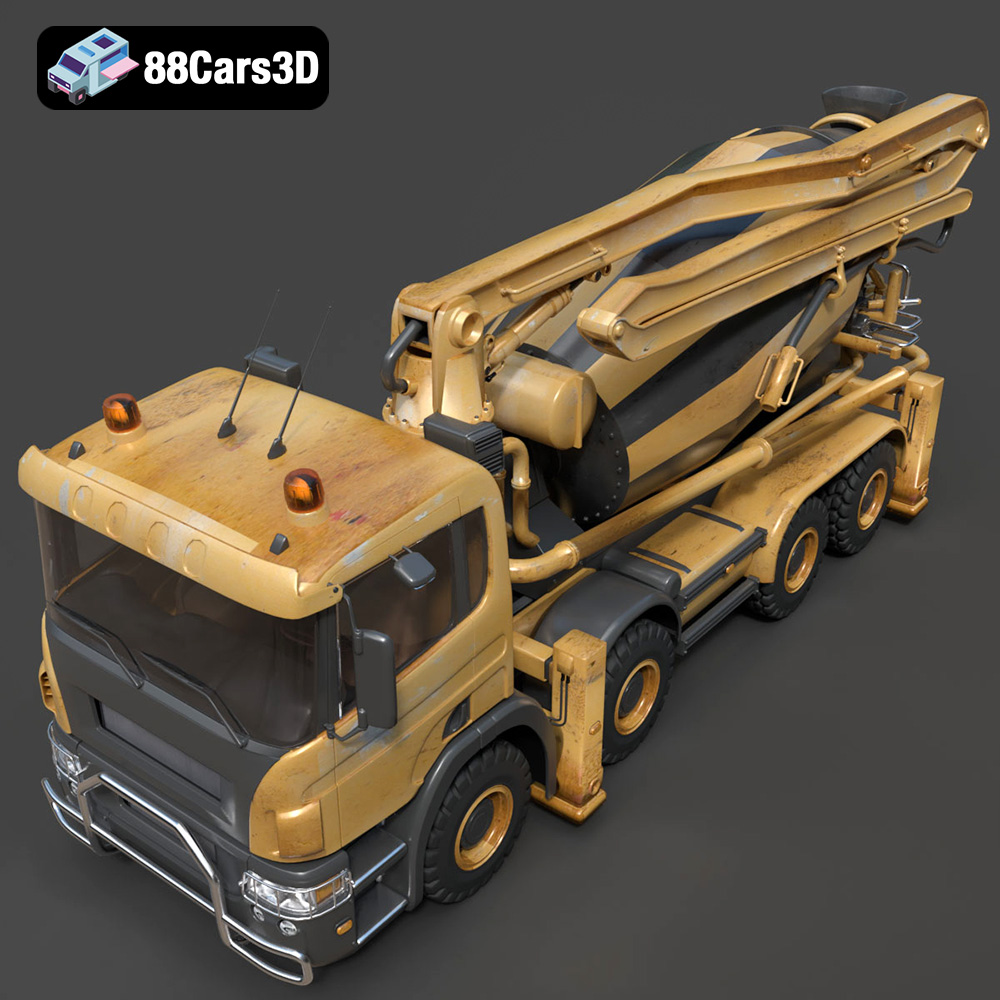
Today, we’ll delve into the essential elements that define a superior 3D model, exploring the technical nuances, workflow considerations, and diverse applications that underscore their value. We’ll specifically highlight how a meticulously crafted asset, such as the Concrete Mixer 3D Model available on 88cars3d.com, serves as a prime example of what modern digital production demands. This industrial powerhouse, with its robust design and intricate mechanics, embodies the blend of realism and optimization crucial for any project needing a heavy-duty construction presence.
Choosing the right file format is not just a technicality; it’s a strategic decision that impacts compatibility, performance, and workflow efficiency across your entire project. Different formats are optimized for distinct purposes, from real-time engine integration to high-resolution rendering and even physical 3D printing. Understanding these distinctions is paramount for any professional dealing with 3D car models, industrial equipment, or game assets.
The .blend file format is the native format for Blender, the popular open-source 3D creation suite. When you download a .blend file, you’re not just getting a mesh; you’re often receiving a complete Blender scene. This includes the model’s geometry, materials, textures, rigging, animations, lights, cameras, and even scene settings. It’s fully editable within Blender, making it ideal for artists who use Blender as their primary DCC (Digital Content Creation) tool. For a model like the Concrete Mixer, having the .blend file means direct access to its construction, allowing for easy material adjustments, re-rigging, or integrating it into an existing Blender project with all its original scene data intact.
Autodesk’s .fbx (Filmbox) format is arguably the most widely adopted interchange format in the 3D industry. Its strength lies in its ability to store not just geometry, but also complex data like animation, rigging, skinning, lights, and cameras in a single file. This makes it ideal for transferring assets between different 3D applications such as 3ds Max, Maya, Blender, and directly into real-time engines like Unreal Engine and Unity. For game developers and animators, .fbx is the go-to for ensuring that animated 3D car models or industrial equipment like the Concrete Mixer retain their pivot setups and animation data when moved between stages of the pipeline. Its versatility ensures broad compatibility for complex assets.
The .obj (Wavefront OBJ) format is one of the oldest and most universally supported 3D formats. It’s a simple, text-based format primarily used for exchanging pure geometric data (vertices, normals, texture coordinates, and faces). While it lacks support for advanced features like animation or rigging, its simplicity ensures almost universal compatibility across virtually all 3D software. This makes .obj an excellent choice when you need to share a model’s basic form, like the chassis of a truck or the drum of a concrete mixer, with maximum compatibility. Material definitions are typically handled via an accompanying .mtl file.
.glb (GL Transmission Format Binary) is the binary version of .gltf, an open-standard, royalty-free format for 3D scenes and models developed by the Khronos Group. Optimized for web and real-time applications, .glb packages all necessary data—geometry, materials, textures, and animations—into a single file, making it incredibly efficient for streaming and display in AR/VR and browser-based environments. For applications where a 3D car model or heavy machinery needs to be viewed quickly and efficiently on a website or in a mobile AR app, .glb is the definitive format, offering a compact and performant solution. This makes it perfect for showcasing products like the Concrete Mixer in an interactive online viewer or AR experience.
The .stl (Stereolithography) format is the standard file type for 3D printing. It represents a 3D model as a series of connected triangles, defining only the surface geometry without any color, texture, or material information. While simple, this format is universally accepted by 3D printers and slicing software. When designing models for physical output, such as a display-scale Concrete Mixer model for hobbyists or engineers, converting to .stl is the crucial final step. The Concrete Mixer 3D Model, being convertible to .stl, allows enthusiasts to bring this digital asset into the physical realm.
.ply (Polygon File Format or Stanford Triangle Format) is another format for storing 3D data, often used in scientific and academic fields. It can store a wider range of properties, including color, transparency, surface normals, and range data, on the front and back of polygons. While not as universally adopted as .obj or .fbx for general 3D art, .ply is valued for its extensibility and precision, particularly in applications like 3D scanning, CAD, and computational analysis where accurate geometric data with additional vertex or face properties is critical.
The .unreal format, or more accurately, assets packaged and optimized specifically for Unreal Engine, represent models ready for direct import and use within the engine ecosystem. This often means the .fbx has been meticulously prepared, collision meshes have been created, materials are configured using Unreal’s physically-based rendering (PBR) system, and LODs (Levels of Detail) are set up. An “Unreal-ready” asset like the Concrete Mixer ensures maximum performance and visual fidelity straight out of the box, saving developers significant time on asset preparation and integration.
The .max file format is the native scene file for Autodesk 3ds Max, a powerful 3D modeling, animation, rendering, and visualization software. Like .blend, a .max file contains all scene information, including geometry, modifiers, materials, textures, lighting, cameras, and animations specific to 3ds Max. For users whose primary workflow revolves around 3ds Max, having the original .max file offers the most flexibility for customization, advanced rendering setups, and integrating the Concrete Mixer into complex architectural or cinematic scenes with full access to its construction history and specific 3ds Max features.
The Concrete Mixer 3D Model from 88cars3d.com is a testament to the meticulous attention to detail and technical prowess required for modern digital asset creation. It’s more than just a visual representation; it’s an engineered solution designed to meet diverse professional demands, from immersive game environments to high-end visualization.
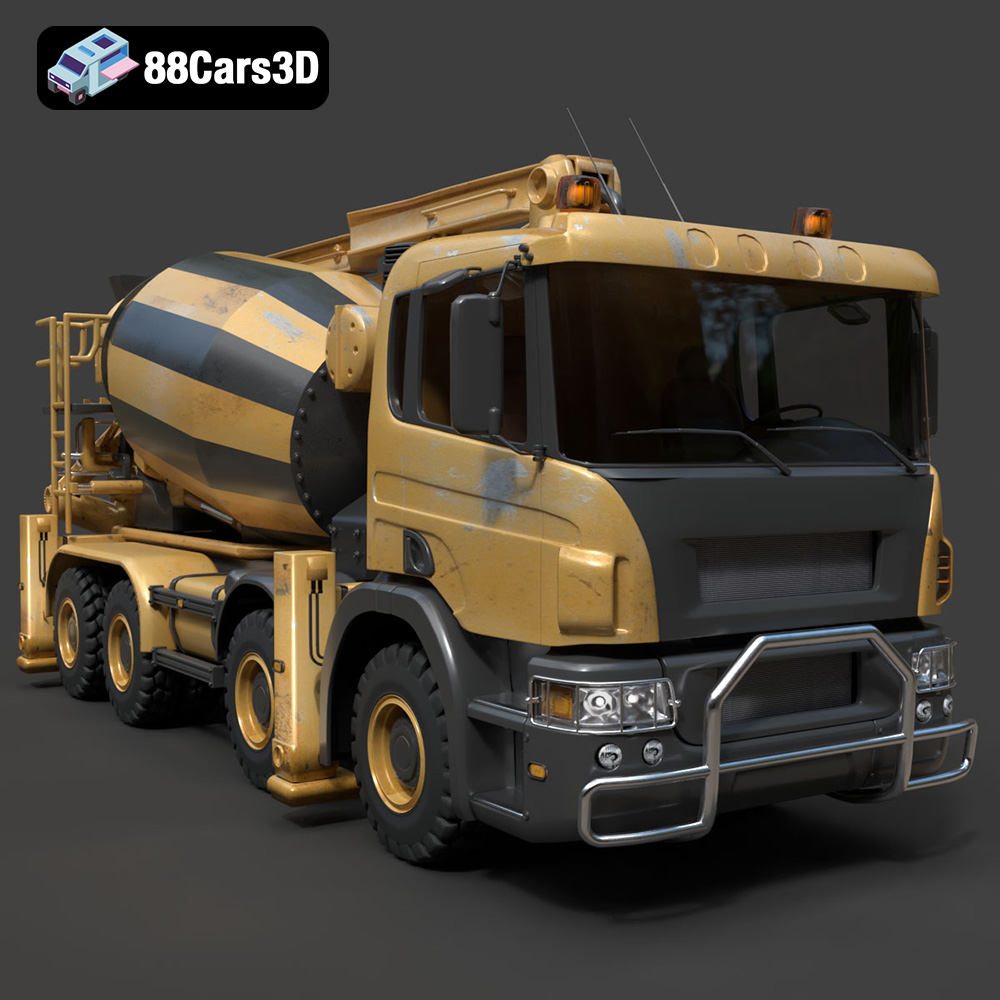
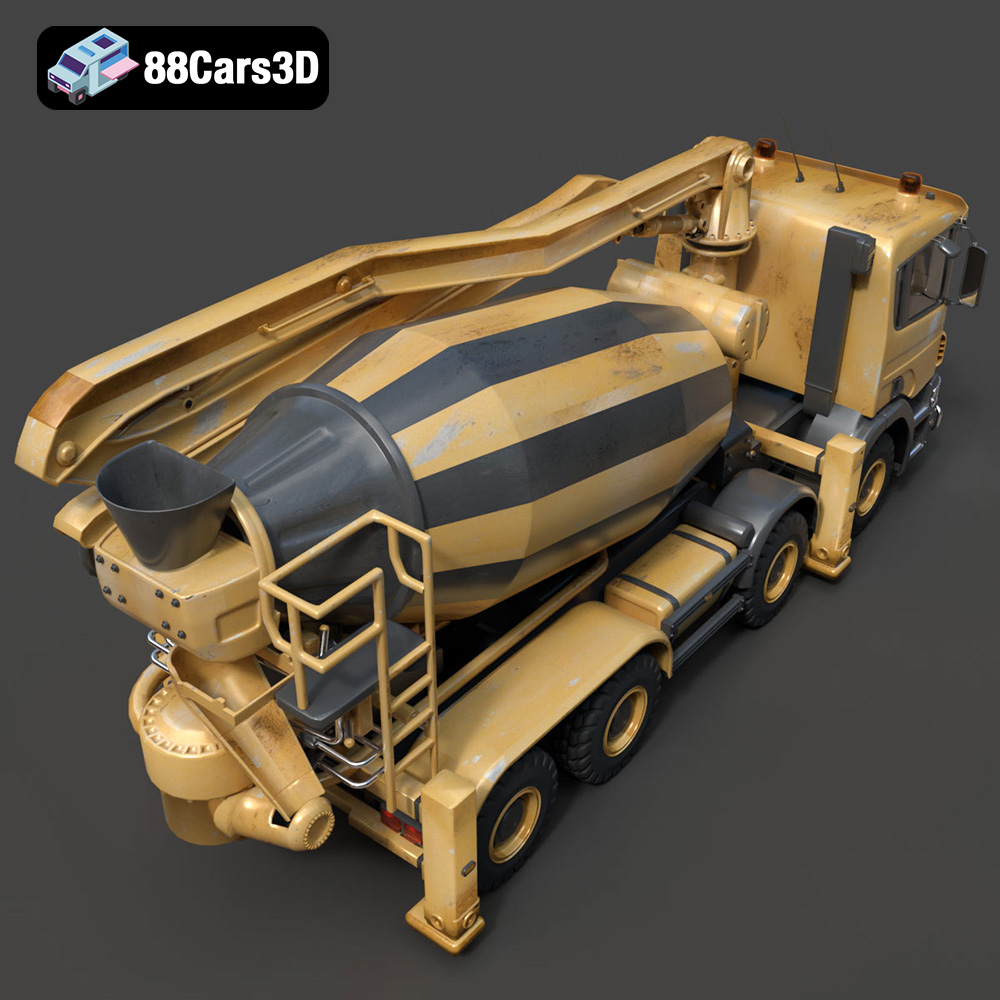
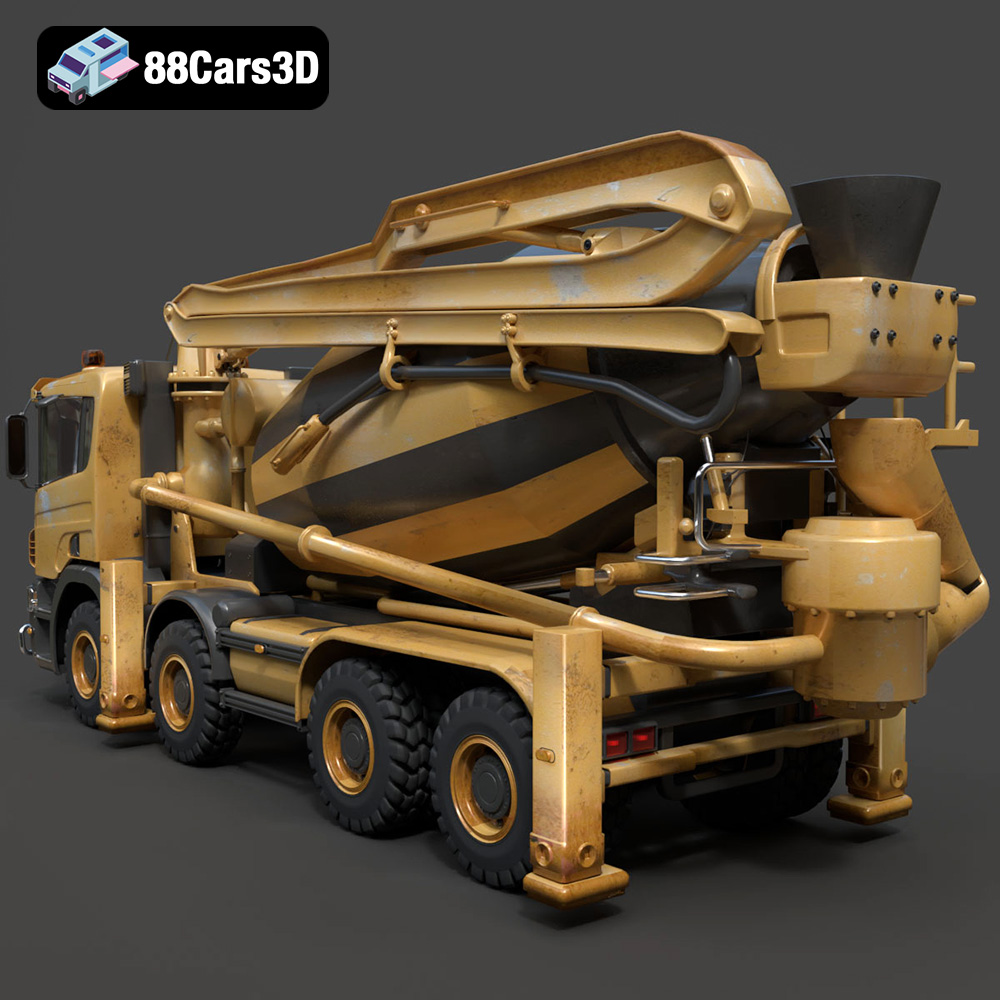
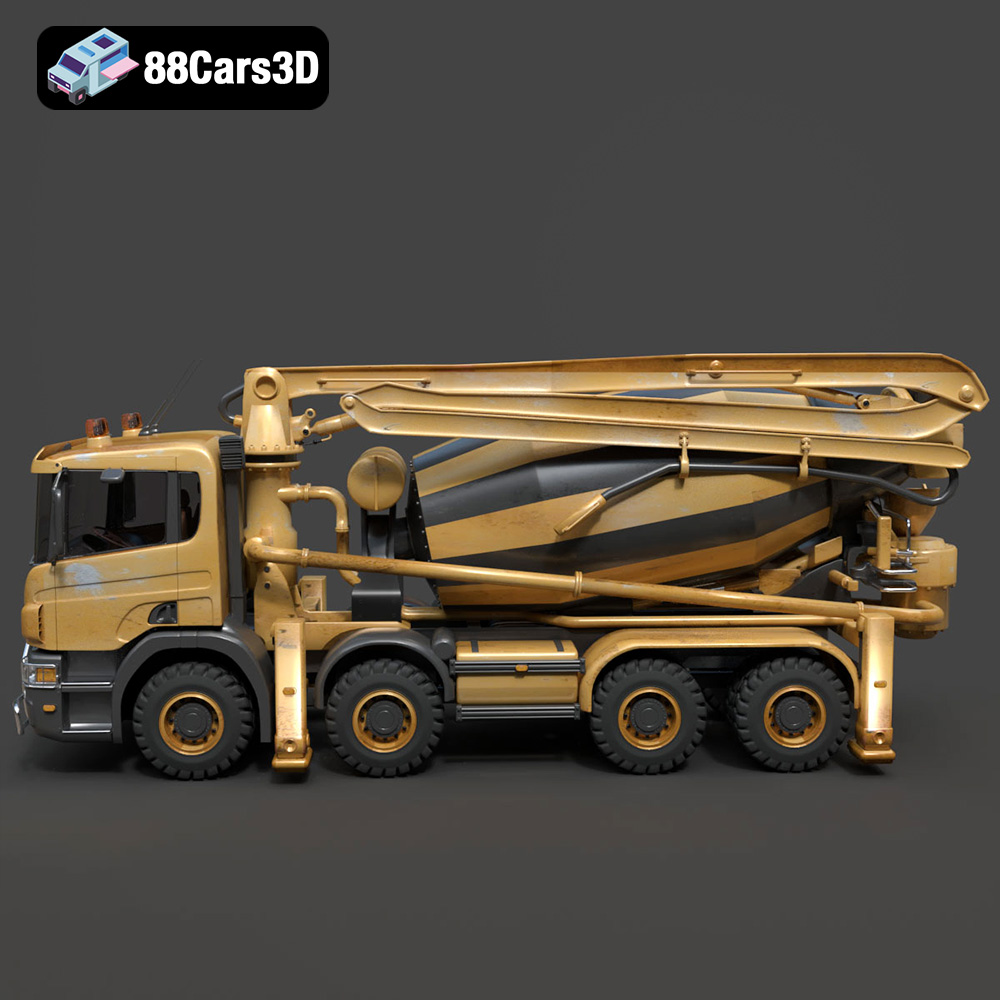
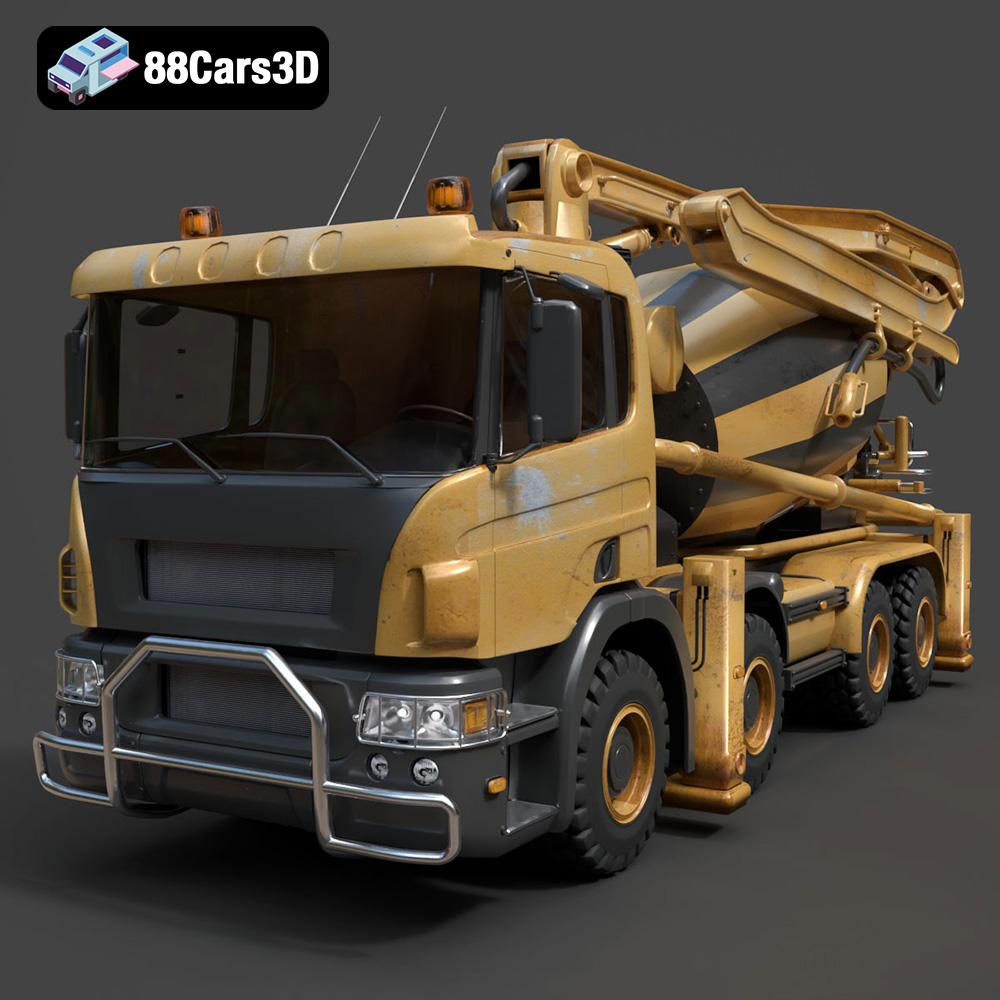
The model captures the essence of a construction site workhorse with remarkable fidelity. Externally, it boasts an accurate heavy-duty frame geometry and realistic proportions, reflecting a real-world vehicle chassis. Key features like the detailed large-displacement diesel engine block and exhaust stacks are meticulously modeled, providing a layer of authenticity often overlooked in less detailed assets. The iconic rotating mixing drum, complete with structural mounting rings, is fully realized, ready for animation. Industrial lighting details, including beacon lights, headlights, and rear work lights, contribute to its realistic appearance and functionality in varied lighting conditions. Heavy-duty commercial wheels and multi-axle tire configurations, along with reinforced leaf-spring suspension details, underscore its rugged utility and ability to handle heavy payloads. Critically, separate components for wheels, suspension, the mixing drum, and steering are included, making it animation-ready for dynamic simulations.
The attention to detail extends to the cockpit and interior. While utilitarian, the heavy-duty driver seat and cabin layout are accurately modeled, including an industrial-grade steering wheel, column details, instrument cluster, and fleet communication radios. Operational control levers and hydraulic interfaces are present, enhancing the realism for first-person POV in gaming and simulation scenarios. This interior optimization ensures that whether the asset is viewed from afar or interacted with up close, it maintains a consistent level of quality.
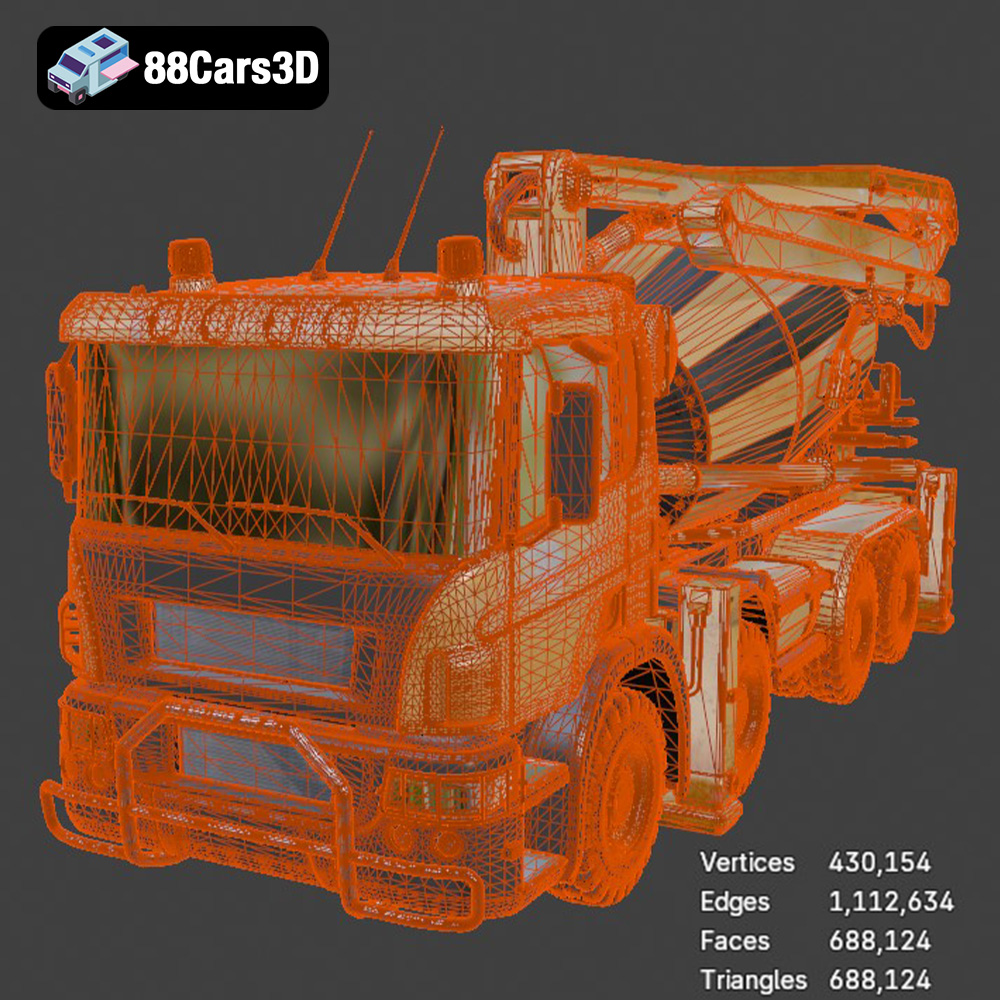
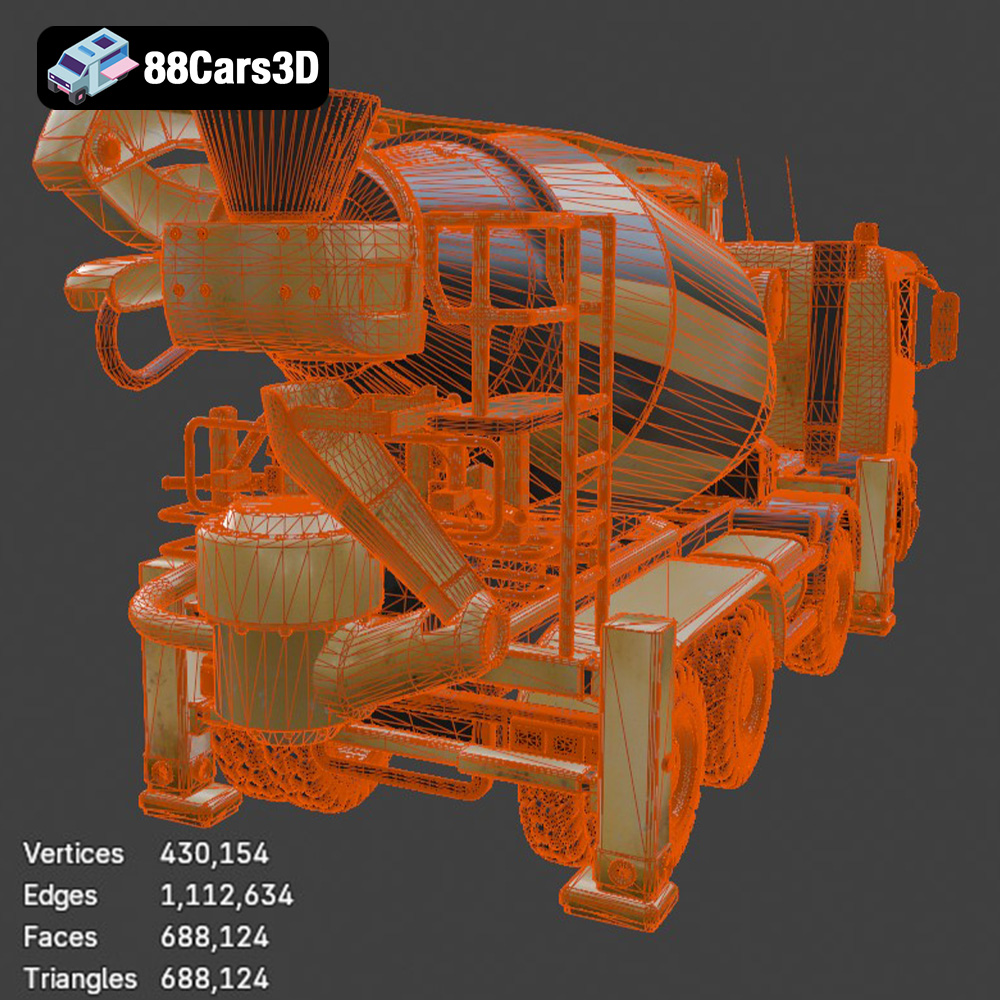
A significant advantage of this Concrete Mixer model lies in its optimized topology. With 688,124 triangles, it strikes a perfect balance between exceptional visual realism and efficient performance. This polycount is “game-ready,” meaning it can be seamlessly integrated into real-time engines like Unreal Engine and Unity without causing significant performance bottlenecks, a crucial factor for open-world games and large-scale simulations. Its real-world scale accuracy ensures correct integration into scenes and environments, eliminating the need for tedious scaling adjustments. Furthermore, the model comes with a proper pivot setup for all animated parts – steering, wheel rotation, drum rotation, and suspension travel. This pre-configured rigging dramatically accelerates animation workflows, making it an invaluable asset for animators and game developers.
The Concrete Mixer’s design and technical specifications make it exceptionally versatile. For game development, its optimized polycount and game-ready status are ideal for open-world games, simulation titles, and city builders, providing a robust and detailed vehicle asset without compromising frame rates. In the realm of AR/VR, its fidelity and optimization are perfect for immersive virtual training scenarios, interactive configurators, and mobile AR experiences, allowing users to interact with heavy machinery in a realistic digital space. For traditional rendering and visualization, it excels in industrial campaigns, construction scene depictions, and studio lighting setups, where photorealism is paramount. Even for hobbyists, the model’s convertibility to .stl format opens doors to 3D printing, enabling the creation of display-scale models with fine details, provided appropriate print settings are applied.
Integrating a complex 3D asset like the Concrete Mixer into a professional workflow requires understanding how its various file formats and technical features can be best utilized within specific software environments. From game engines to rendering suites, efficiency is key.
For game developers and real-time visualization artists, the included .unreal format (or rather, the pre-optimized asset intended for Unreal Engine) is a significant advantage. This means the Concrete Mixer 3D Model is likely prepared with appropriate PBR materials, collision meshes, and potentially even LODs (Levels of Detail) configured for optimal performance within Unreal Engine. Developers can simply import the asset, and it should immediately function within the engine’s rendering pipeline. The proper pivot setups for the wheels, steering, and mixing drum translate directly into the engine, allowing for straightforward Blueprint scripting for vehicle physics and animations. This significantly reduces the time typically spent on asset preparation, letting developers focus on gameplay mechanics or scene construction.
For example, integrating the mixer into a construction simulation would involve importing the asset, applying a physics asset, and then setting up a vehicle Blueprint to control its movement and the rotation of the drum. The pre-set pivots make it easy to link rotational inputs to the drum’s mesh, creating a realistic, functional vehicle within minutes.
Artists working in 3ds Max or Blender will find the native .max and .blend files invaluable. These formats provide full access to the model’s original scene structure, allowing for deep customization and advanced rendering setups. In 3ds Max, animators can directly manipulate the individual components—wheels, suspension, steering, and the mixing drum—using the pre-defined pivots. This facilitates the creation of complex animations, such as a concrete mixer driving through a construction site, maneuvering, and operating its mixing drum. For rendering, 3ds Max users can easily apply V-Ray or Corona Renderer materials, adjust lighting, and create photorealistic still images or animated sequences for marketing or architectural visualization projects.
Similarly, Blender users can leverage the .blend file for seamless integration into their projects. The procedural nature of Blender’s node-based material system allows for extensive customization of the truck’s appearance, from adding mud and dust to the tires to altering the paint finish of the cabin and drum. The comprehensive rigging (pivot points) means that a Blender artist can quickly set up drivers or constraints for realistic suspension compression, wheel rotation, and drum spin, making the Concrete Mixer a dynamic element in any animation.
The inclusion of the .stl file format allows for a unique bridge between the digital and physical realms. While 3D car models are often digital-only, the Concrete Mixer offers the possibility of becoming a tangible display piece. For hobbyists, engineers, or product designers, the .stl file can be imported into slicing software (like Cura, PrusaSlicer, or Chitubox for resin printers). Here, users can define print settings such as recommended scale (1:35 / 1:48 / 1:50), layer height, infill, and crucially, support structures. For a complex model like the Concrete Mixer with its intricate exhaust, mirrors, chutes, and axles, supports are essential to ensure a successful print. Resin printing is often recommended for models with fine details due to its ability to achieve thinner layers and higher resolution. Post-processing steps, including sanding, priming, and painting with authentic fleet colors and weathering, can then transform the printed model into a realistic miniature.
A high-quality 3D model provides an excellent starting point, but its true power is unlocked through customization and smart optimization. The Concrete Mixer 3D Model offers ample opportunity for artists and developers to tailor it to specific project needs.
The ability to customize the model’s appearance is crucial for various applications. For game development, changing cabin and drum colors allows developers to create different fleet variations or to integrate custom branding for in-game companies. Modifying tire textures from clean street variants to heavy mud variants can dramatically alter the vehicle’s context, making it suitable for pristine cityscapes or rugged construction sites. Adjusting material finishes—from a clean, glossy showroom look to a heavily weathered, rusted aesthetic—can tell a story about the vehicle’s operational history. These modifications are typically done within the 3D software (Blender, 3ds Max) or directly within the game engine (Unreal, Unity) by swapping out texture maps or adjusting material parameters. For industrial visualization, matching specific company colors or adding logos directly to the model can create powerful, personalized marketing assets.
Integrating the Concrete Mixer into a larger scene often involves more than just dropping it in. Proper lighting is paramount for photorealistic rendering. Utilizing HDRI (High Dynamic Range Image) environments can provide realistic sky and ambient lighting, making the vehicle appear naturally lit within a specific real-world location. Adding targeted artificial lights—like spot lights to highlight specific features or area lights to simulate studio setups—can further enhance its visual impact. For animation, simulating dust particles around the wheels or subtle vibrations through a noise modifier can add significant realism. In game engines, dynamic lighting and shadow casting are essential for making the mixer feel like part of the environment, especially with its industrial lighting details that can illuminate night scenes.
Even with an optimized model like the Concrete Mixer, large-scale projects, especially in game development or AR/VR, may require further optimization. This can involve creating additional Levels of Detail (LODs), where simpler versions of the model are rendered when viewed from a distance, saving GPU resources. Baking high-resolution details into normal maps can reduce polycount while retaining visual fidelity. For truly massive scenes with many instances of the model, instancing techniques can be employed to render multiple copies efficiently. These advanced techniques ensure that the Concrete Mixer, even in its highly detailed form, can be scaled to meet the performance demands of virtually any project, affirming its value as a truly game-ready asset.
The demand for high-quality 3D models like the Concrete Mixer extends across numerous industries, demonstrating their critical role in visualization, simulation, and interactive experiences.
In architectural visualization (arch-viz), conveying the scale and activity of a future construction site is crucial. Integrating realistic 3D car models and heavy machinery like the Concrete Mixer into architectural renderings can transform static building designs into vibrant, dynamic scenes. Imagine a rendering of a new skyscraper, with the Concrete Mixer actively pouring foundations, excavators moving earth, and trucks transporting materials. Such scenes not only add realism but also help clients visualize the project’s timeline and operational flow. For firms presenting proposals, these detailed assets enhance storytelling, making abstract blueprints feel tangible and exciting. The Concrete Mixer’s accuracy and detail make it perfect for close-up shots within these visualizations, providing an unmatched sense of authenticity.
Virtual Reality (VR) and Augmented Reality (AR) are revolutionizing training across hazardous industries. For heavy machinery operators, traditional training can be costly and dangerous. Immersive VR simulations, powered by high-fidelity 3D models, offer a safe and effective alternative. A virtual Concrete Mixer, complete with a detailed cockpit and accurate operational controls, can be used to train new operators on driving, maneuvering, and operating the mixing drum and chute assembly. The ability to simulate various scenarios, from navigating challenging terrain to performing precise pours, allows trainees to gain critical experience without risking real-world accidents. The game-ready optimization of the Concrete Mixer 3D Model is ideal for these demanding, performance-critical VR environments.
For game developers, realism and immersion are paramount. Whether it’s an open-world sandbox game, a detailed city builder, or a vehicle simulation, authentic game assets elevate the player experience. The Concrete Mixer 3D Model, as a highly optimized and detailed heavy-duty vehicle, is an ideal component for populating these digital worlds. Developers can use it to create bustling construction zones, realistic industrial parks, or dynamic cityscapes. Its animation-ready components allow for interactive gameplay, where players might operate the mixer, drive it across maps, or simply witness it as part of a living, breathing game environment. The availability of multiple file formats, including .fbx and Unreal-ready options, ensures seamless integration into major game engines, facilitating rapid development and deployment of compelling interactive experiences.
The journey through the intricacies of 3D modeling reveals that truly exceptional assets are a synergy of artistic fidelity and technical precision. The Concrete Mixer 3D Model stands as a prime example, embodying the qualities professionals seek: high-fidelity detailing, game-ready optimization, and versatile compatibility across a spectrum of applications and file formats.
From architectural visualization to immersive AR/VR experiences, and from intricate game development to physical 3D prints, the value of a well-crafted 3D model cannot be overstated. It saves invaluable time, enhances visual appeal, and provides the flexibility necessary for diverse creative pipelines. When searching for such meticulously designed assets, remember that platforms like 88cars3d.com specialize in providing the high-quality 3D car models and heavy machinery necessary to elevate your projects.
Whether you’re a seasoned game developer, an arch-viz artist, or an aspiring 3D printing enthusiast, investing in optimized and versatile game assets like this Concrete Mixer ensures a robust foundation for your digital endeavors. Explore the possibilities and empower your creative vision with assets that truly deliver on both realism and performance.
The Concrete Mixer is a powerhouse of the construction site, renowned for its heavy-duty utility and iconic rotating mixing drum. This industrial marvel is characterized by its robust chassis, immense diesel engine, and the intricate rear chute assembly designed for precise concrete pouring. Its utilitarian styling and rugged aesthetic make it an essential element for any modern construction or city environment. Boasting a high-fidelity topology with 688,124 triangles, this 3D model delivers exceptional visual realism while maintaining efficient optimization. Designed for seamless integration into real-time engines, it provides the perfect asset for demanding game development, immersive AR/VR applications, high-end animation, and architectural visualization.
$47.50
.blend
.fbx
.glb
.max
.obj
.ply
.rendering
.stl
.truck
.unreal
concrete-mixer
construction-vehicle
game asset
game-ready
heavy-machinery
industrial-equipment
low-poly
optimized
truck-3d-model
VR/AR