Get 20% OFF All Premium 3D & STL Models!

In the dynamic worlds of game development, architectural visualization, AR/VR experiences, and high-fidelity rendering, the quality of 3D assets is paramount. From the sleek curves of sports cars to the rugged utility of heavy machinery, meticulously crafted models can transform a project from good to exceptional. The demand for accurate, optimized, and versatile 3D models of specialized vehicles, particularly construction equipment, continues to grow. These assets serve as the foundational elements for creating immersive environments, realistic simulations, and compelling visual narratives.
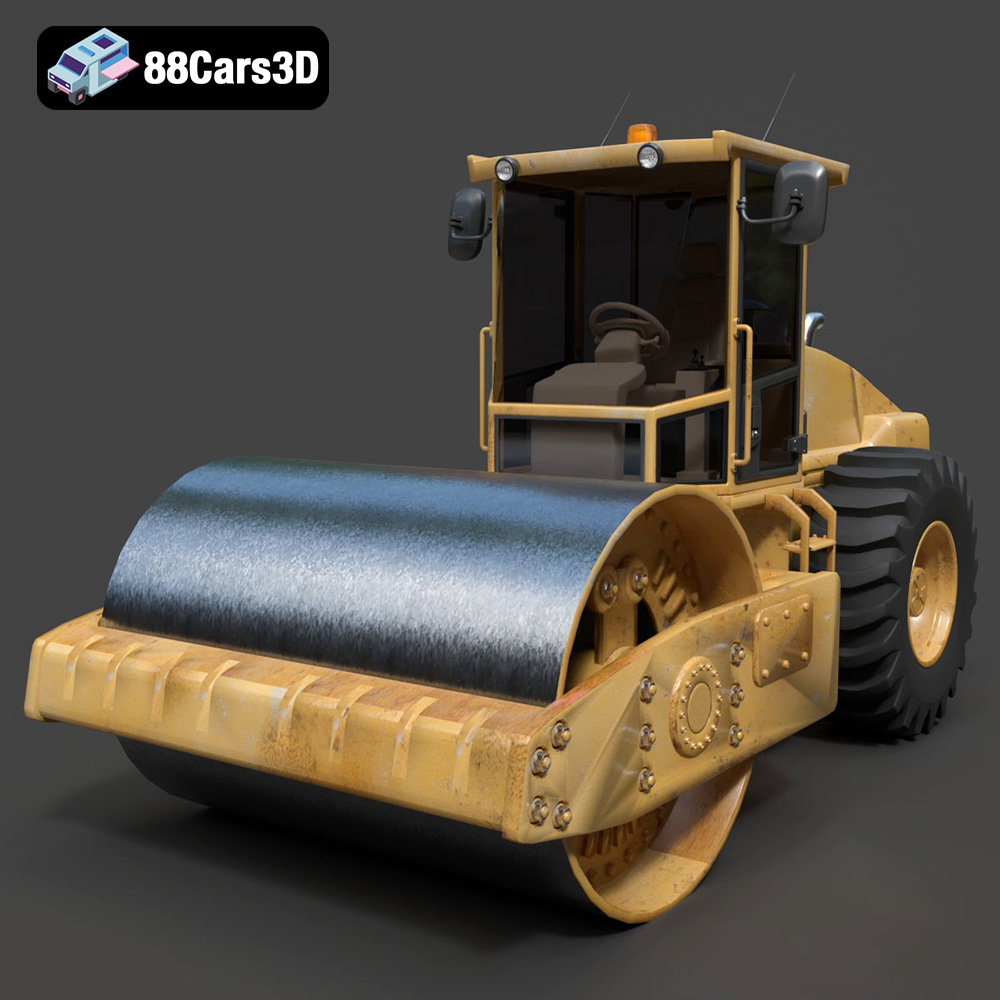
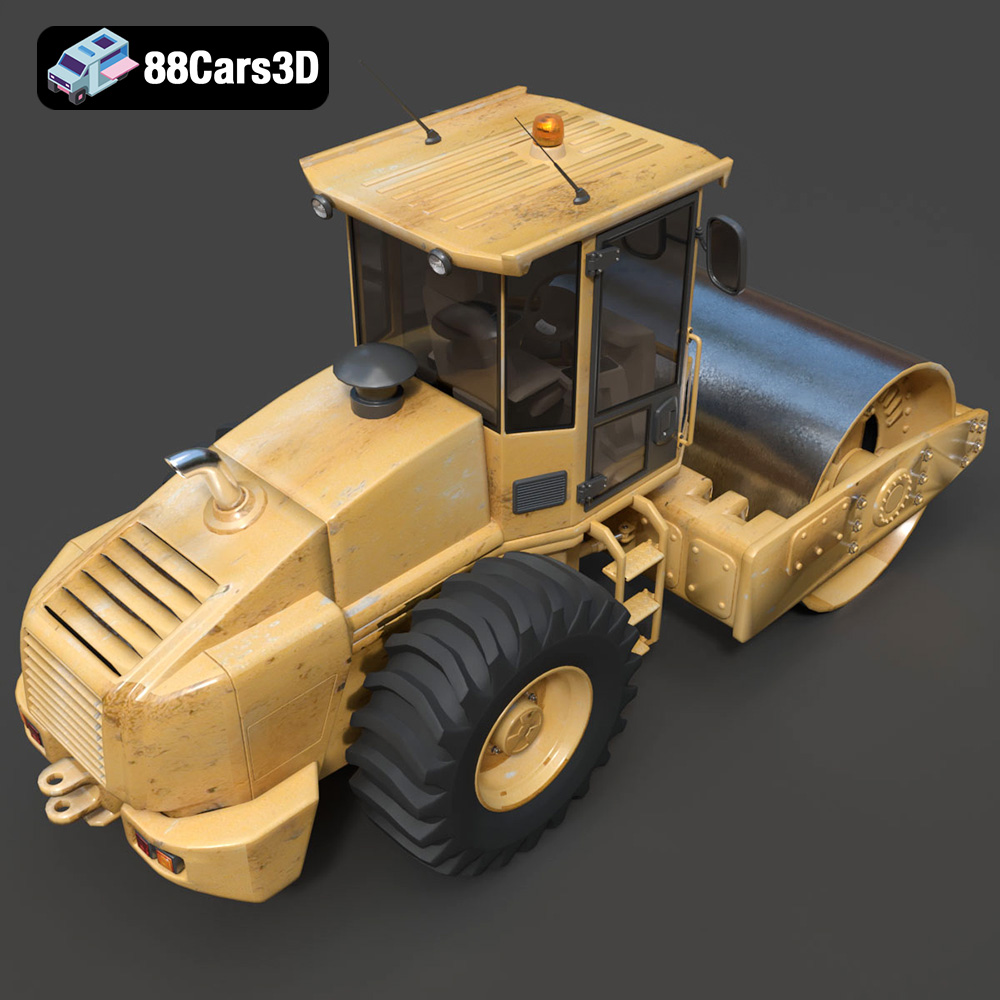
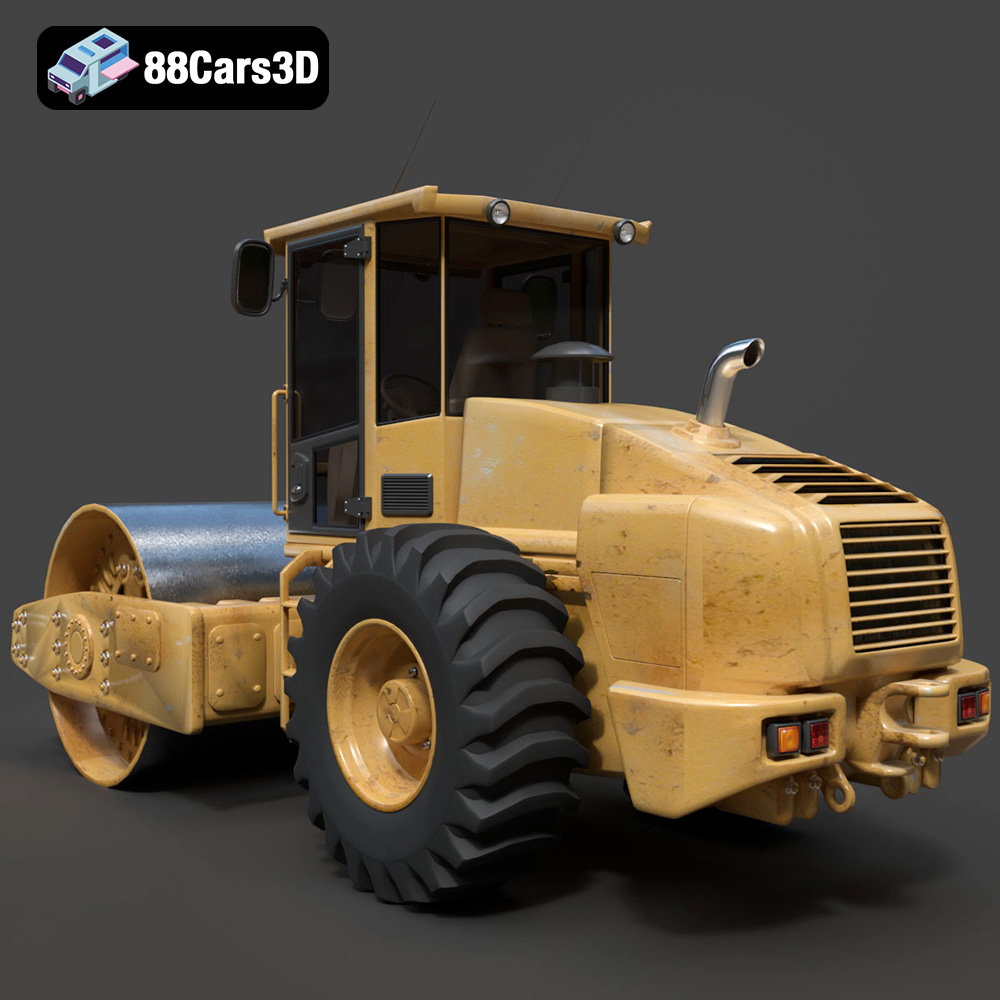
Today, we’re putting a spotlight on a particular workhorse of the digital construction yard: the Soil Road Roller 3D Model. This highly detailed asset, available for download at 88cars3d.com, is an exemplary demonstration of how advanced 3D modeling can bridge the gap between industrial utility and digital realism. Capturing the massive presence and mechanical intricacies of its real-world counterpart, this model offers a powerful tool for professionals seeking unparalleled detail and optimization in their projects.
The Soil Road Roller is more than just a model; it’s a testament to precision engineering, featuring a large steel compaction drum, an articulated heavy-duty frame, a robust diesel engine block, and authentic functional styling cues such as rugged hydraulic lines and industrial-grade exhausts. Whether you’re building a construction site simulator, populating an open-world industrial game, or creating an infrastructure visualization, this model provides the visual fidelity and technical flexibility needed to bring your digital scenes to life.
The versatility of any 3D model is often defined by the array of file formats it supports. Each format is designed with specific use cases and software ecosystems in mind, offering unique advantages in terms of compatibility, data preservation, and optimization. When acquiring a high-quality asset like the Soil Road Roller 3D Model, understanding these formats is crucial for seamless integration into your preferred workflow. Let’s explore the common file types provided with professional 3D models.
The `.blend` format is the native file type for Blender, the popular open-source 3D creation suite. When you download a `.blend` file, you’re not just getting the mesh; you’re receiving a complete, fully editable Blender scene. This includes all materials, textures, lighting setups, cameras, animation data, and even modifiers applied to the mesh. For artists whose primary workflow revolves around Blender, this is the most convenient and powerful format, allowing for direct manipulation, re-texturing, and animation within their familiar environment without any data loss during import/export. It preserves the entire creative context of the model.
The `.fbx` (Filmbox) format, developed by Autodesk, has become a de facto standard for exchanging 3D data between various software applications, especially in game development and animation pipelines. It excels at storing not only geometry but also materials (though often simplified), textures, animations, rigging, and even scene hierarchy. For projects destined for real-time engines like Unreal Engine and Unity, `.fbx` is the go-to format due to its robust support for animation and skeletal data. It ensures that your animated heavy equipment, like the Soil Road Roller, moves as intended when imported into an engine.
The `.obj` (Wavefront OBJ) format is one of the oldest and most universally supported 3D formats. It’s a simple, text-based format primarily used for transferring geometric data (vertices, normals, texture coordinates, and faces). While it doesn’t typically store advanced material properties, rigging, or animation directly, it’s incredibly reliable for cross-software compatibility. If you need a clean mesh to start a new texturing or rigging process in a different application, `.obj` is often the safest bet, ensuring the core shape of your Soil Road Roller remains intact. Material definitions are usually stored in a companion `.mtl` file.
`.glb` (GL Transmission Format Binary) is the binary version of `.gltf`, an open standard for 3D scenes and models. Its key advantage lies in its optimization for web-based applications, augmented reality (AR), and virtual reality (VR) environments. A `.glb` file typically bundles all necessary data—geometry, materials, textures, and even animations—into a single, compact file. This makes it ideal for fast loading and efficient rendering in browsers, mobile AR apps, and immersive VR experiences, perfect for showcasing the Soil Road Roller in an interactive, real-time online configurator or a mobile AR app.
The `.stl` (Stereolithography) format is the standard for 3D printing. It represents 3D models as a series of connected triangles, describing only the surface geometry of an object without color, texture, or other CAD attributes. When preparing a model like the Soil Road Roller for physical fabrication, converting it to `.stl` is the essential step. It’s universally read by slicing software, which then translates the mesh into instructions for a 3D printer. While it’s a “dumb” format in terms of preserving design intent, its simplicity is precisely what makes it effective for manufacturing.
The `.ply` (Polygon File Format or Stanford Triangle Format) is another format for storing 3D data, particularly useful for high-resolution scanned data and scientific applications. It can store a wider range of properties than `.obj`, including color per vertex, transparency, and even confidence values. While less common for general content creation, it’s a robust format for transferring precise mesh data, often used in CAD, reverse engineering, and scientific visualization where the integrity of raw scanned data or dense meshes for analysis is critical.
The `.unreal` format isn’t a standalone 3D model file type in the traditional sense, but rather a representation of a fully prepared asset *within* the Unreal Engine ecosystem. When a vendor provides an `.unreal` file, it usually implies a pre-packaged asset or project file that can be directly imported or migrated into an Unreal Engine project. This often means materials are set up, textures linked, pivot points are correct, and collisions might already be defined. It signifies a highly optimized, engine-ready asset specifically tailored for Unreal’s real-time rendering capabilities, saving developers significant setup time.
Similar to `.blend` for Blender, `.max` is the native project file format for Autodesk 3ds Max. This format captures the entire scene data within 3ds Max, including geometry, modifiers, materials, textures, lighting, cameras, animation curves, and scene hierarchy. For professionals working within the Autodesk ecosystem, a `.max` file offers the highest level of editability and fidelity, allowing direct access to all creation steps and parameters applied to the Soil Road Roller model for further animation, rendering, or scene composition.
The inclusion of these diverse formats with the Soil Road Roller 3D Model highlights its adaptability, ensuring that regardless of your software preference or project requirements, you have the right data for the job. Such comprehensive file support is a hallmark of professional-grade 3D assets found on platforms like 88cars3d.com.
Building digital environments, especially those featuring heavy machinery, demands a balance between visual fidelity and performance optimization. The Soil Road Roller 3D Model exemplifies this delicate equilibrium, presenting a robust asset that is both incredibly detailed and suitable for real-time applications. Let’s dissect the key features that make this model a standout.
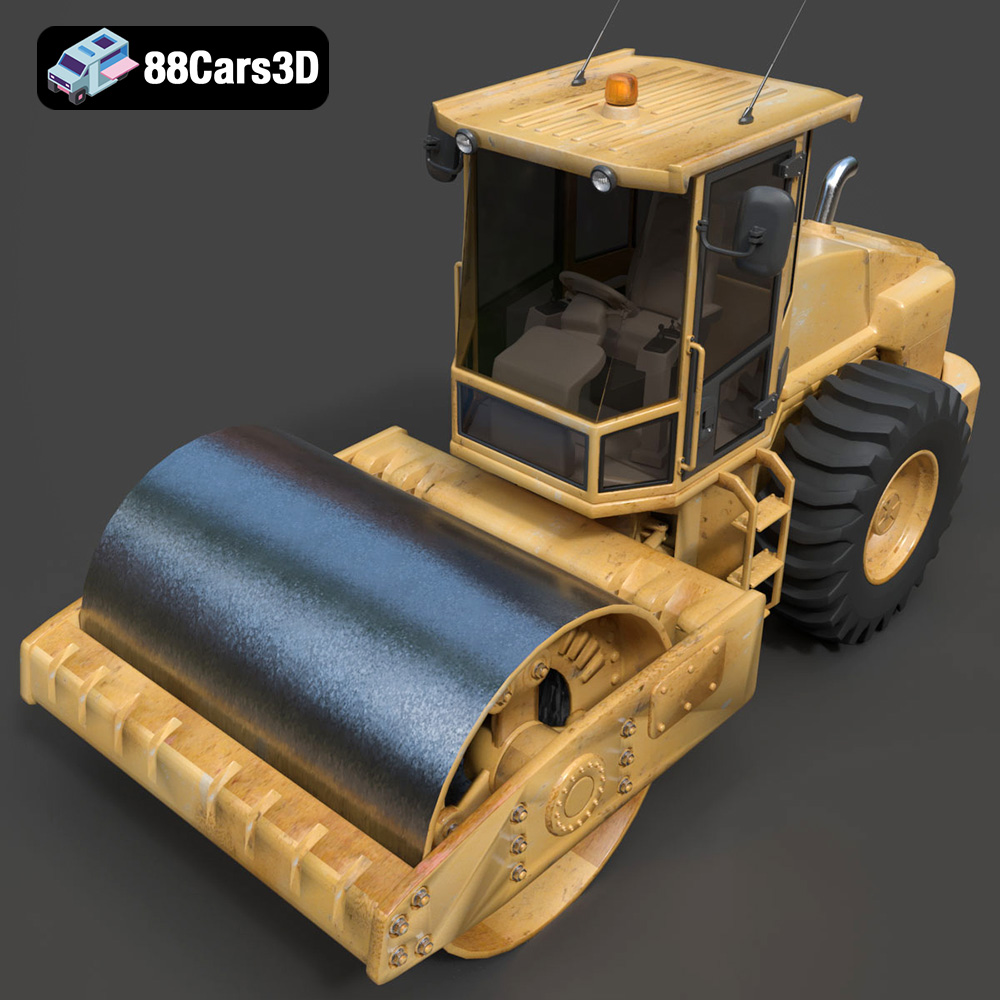
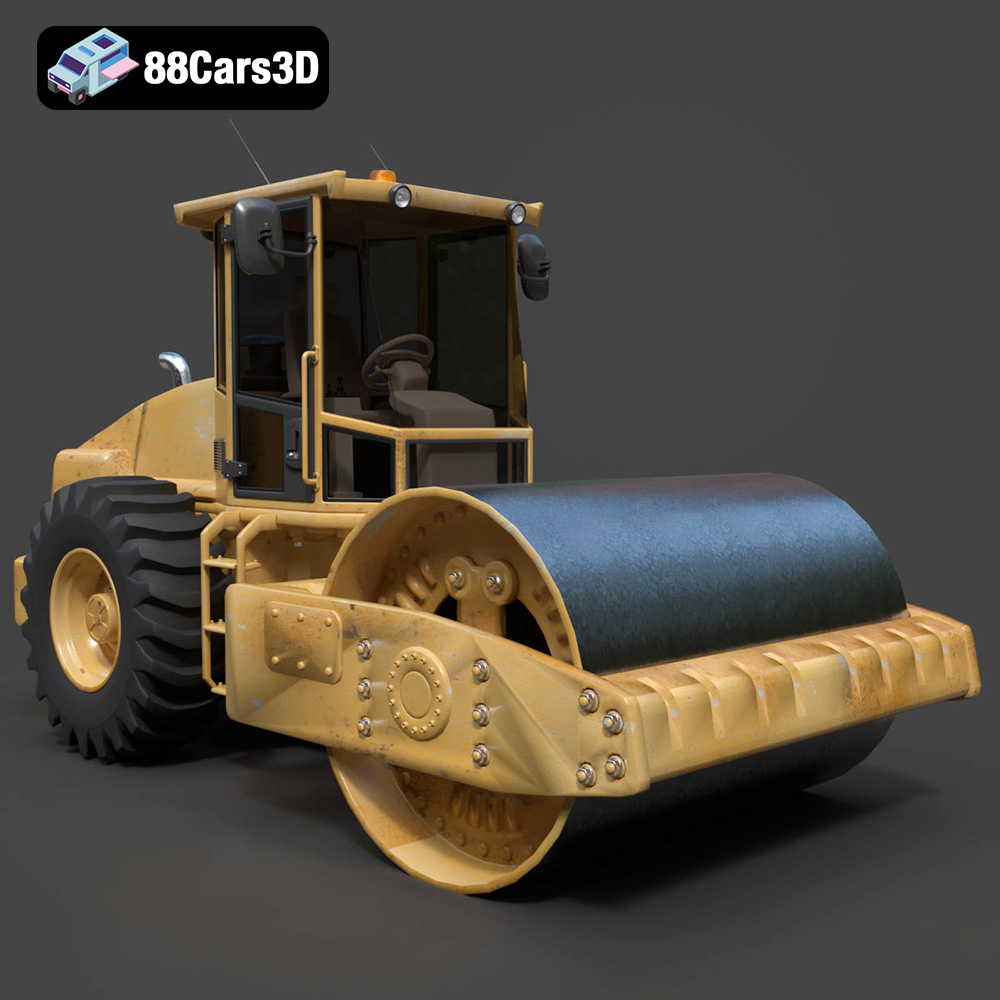
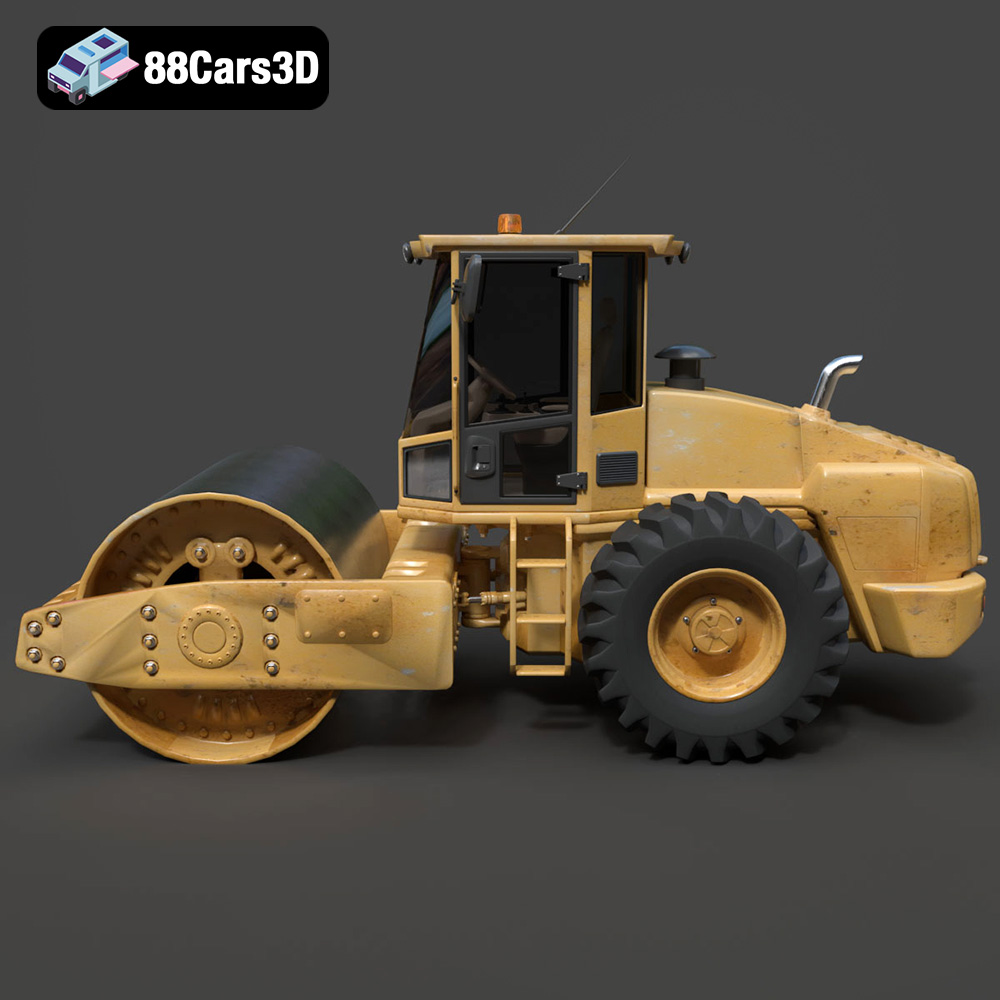
The first impression of any 3D model comes from its exterior, and the Soil Road Roller doesn’t disappoint. Its accurate articulated frame geometry and proportions immediately convey the sense of a massive industrial machine. Every component, from the detailed heavy-duty diesel engine block to the vertical heavy machinery exhaust system with its rain cap, is meticulously modeled. These details are not merely aesthetic; they provide the visual cues necessary for a believable and immersive experience, whether in a high-resolution render or an interactive game world. The presence of high-intensity LED work lights, headlights, and warning beacons further enhances realism, suggesting operational readiness and potential for dynamic lighting scenarios.
Crucially, the massive steel front compaction drum and deep-tread rear pneumatic tires are accurately represented. These aren’t just simple shapes; their forms reflect the real-world functionality and wear associated with a road roller. Exposed hydraulic cylinders, hoses, and articulation joints add another layer of mechanical authenticity, crucial for close-up shots or interactive simulations where the machine’s movements are closely observed. The separate drum, wheels, articulation joints, and steering components are designed with animation in mind, providing animators with the flexibility to create realistic movements and interactions.
While often overlooked in exterior shots, the cockpit and interior details are vital for first-person perspectives in games and VR simulations. The Soil Road Roller 3D Model includes an industrial operator seat with a detailed suspension base, implying comfort and functionality. The heavy-duty steering column and directional control joysticks are not just props but suggest interactive elements for a player or user. A comprehensive instrument cluster and monitoring displays, along with control details such as pedals, hydraulic levers, and safety switches, complete the interior. This attention to inner workings ensures that the model can be used effectively for detailed walkthroughs, immersive simulations, and even virtual training modules, where the user might spend significant time inside the vehicle.
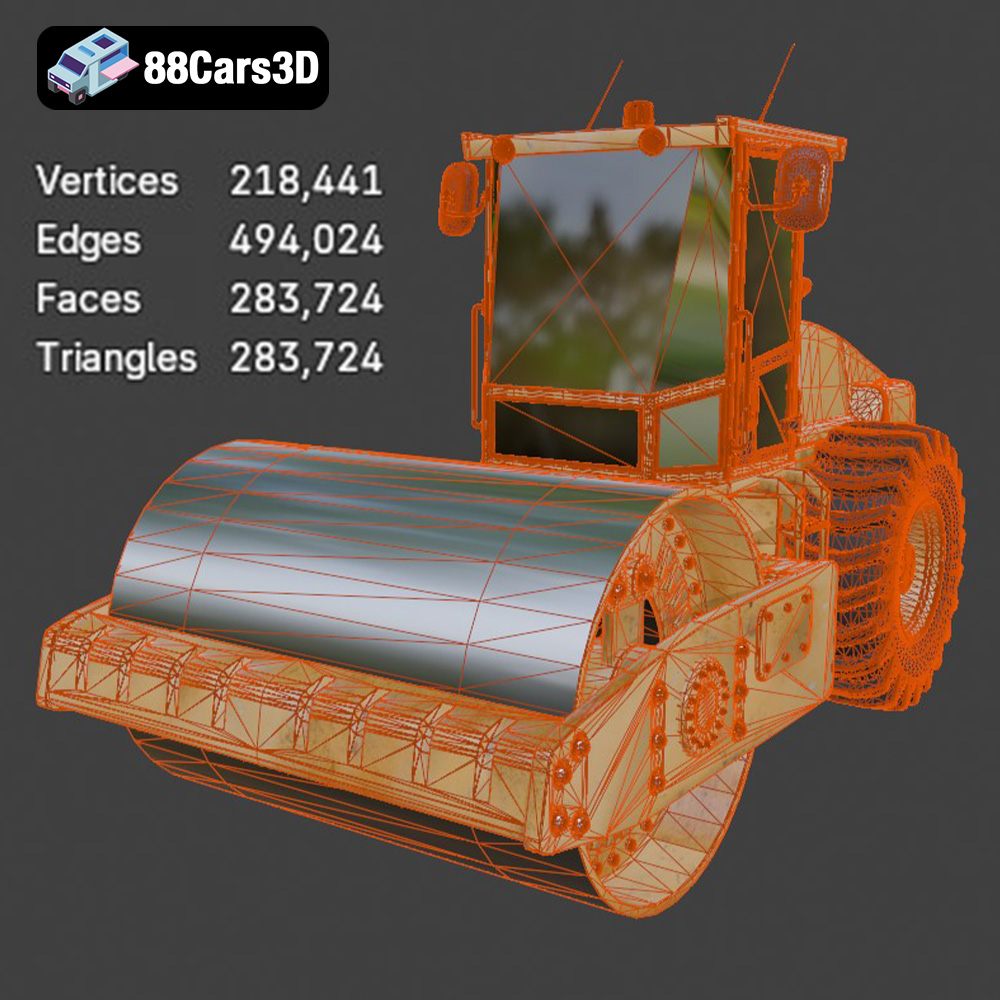
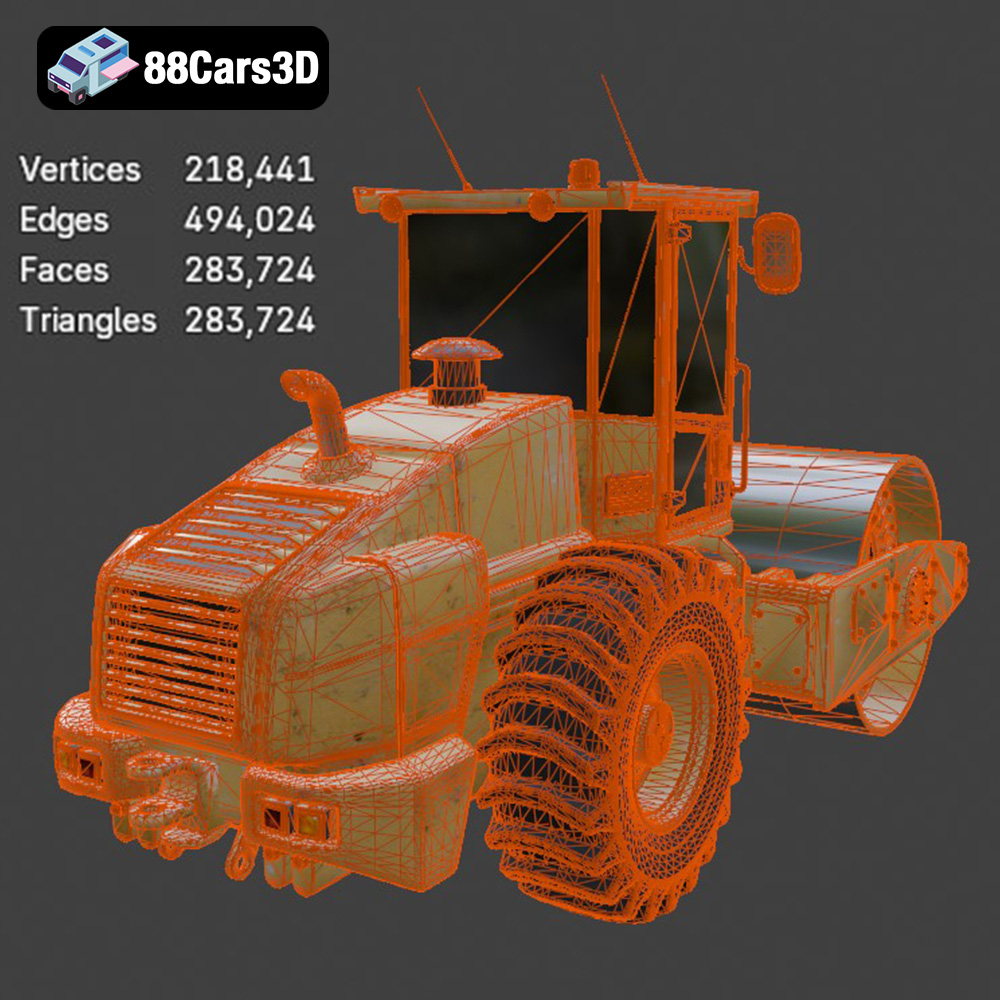
One of the most critical aspects of a professional 3D asset, especially for real-time applications, is its technical specification, particularly its polycount. With a precise topology of 283,724 triangles, the Soil Road Roller 3D Model strikes a perfect balance. This polycount is high enough to deliver exceptional realism through carefully modeled surfaces and mechanical components, making it ideal for close-up renders and cinematic sequences. Simultaneously, it’s optimized for real-time engines like Unreal and Unity, ensuring smooth performance without excessive strain on system resources.
Beyond polycount, the model boasts real-world scale accuracy, based on actual vehicle chassis dimensions. This is vital for maintaining proportionality in large-scale environments and for precise interactions with other assets. Furthermore, proper pivot setups for steering, wheel rotation, and suspension travel are pre-configured. This thoughtful preparation drastically reduces development time for animators and riggers, allowing them to quickly implement realistic movement without having to re-engineer the model’s core kinematics. This optimization is a key advantage for game developers and simulation engineers, ensuring the model is truly game-ready and easy to integrate.
The true value of a versatile 3D asset lies in its seamless integration into diverse professional workflows. The Soil Road Roller 3D Model, with its optimized geometry and extensive file format support, is engineered to fit effortlessly into various pipelines, from cinematic rendering to interactive real-time experiences.
For visual artists and animators focusing on photorealistic rendering, the Soil Road Roller 3D Model provides an excellent foundation. In software like Autodesk 3ds Max (using the provided .max file) or Blender (with the .blend file), artists can leverage advanced rendering engines such as V-Ray, Corona Renderer, Cycles, or Eevee to achieve stunning results.
* **Workflow Example (3ds Max/V-Ray):** Import the .max file. The model comes with a clean mesh and often basic material assignments. Artists can then swap out placeholder materials for physically based rendering (PBR) textures, fine-tuning roughness, metallic, and normal maps to simulate realistic wear, paint sheen, or metallic glints. Leveraging V-Ray’s powerful lighting systems – HDRI environment maps, dome lights, and targeted area lights – can create dramatic studio shots or replicate natural outdoor lighting. The model’s separate animated parts (drum, wheels, steering) allow for dynamic poses or even short animation loops, demonstrating its articulation in marketing materials or product showcases.
* **Workflow Example (Blender/Cycles):** The .blend file offers the most direct route. Artists can dive straight into Blender’s Cycles renderer, known for its unbiased, photorealistic output. Using Blender’s node-based material system, complex material shaders can be built, incorporating dirt, grime, or specific branding. With its real-world scale, the road roller can be placed into existing architectural visualizations or engineering renders, adding industrial context and a sense of dynamic activity to static scenes.
The “game-ready & optimized” nature of the Soil Road Roller 3D Model shines brightest when integrated into real-time engines like Unreal Engine and Unity. The provided .fbx and .unreal formats are specifically tailored for these environments.
* **Workflow Example (Unreal Engine):** Utilizing the .unreal asset, developers can simply migrate the model directly into their Unreal project. This typically means the model comes with pre-configured materials, textures, and proper pivot points. Developers would then verify material instances, adjust them to fit the project’s visual style, and implement physics assets for collision detection. The model’s separated components are crucial here, allowing for easy implementation of vehicle physics and animation blueprints. For example, a basic vehicle blueprint can be rapidly set up, connecting the steering input to the model’s steering component and wheel rotation to simulate realistic movement on a construction site.
* **Workflow Example (Unity):** The .fbx file is ideal for Unity. Upon import, Unity’s FBX importer handles the mesh, materials (often needing re-assignment of textures), and potentially any basic animation data. Developers would create new PBR materials in Unity, assigning the provided texture maps (albedo, normal, roughness, metallic). The pre-set pivot points on the drum, wheels, and articulation joints simplify the process of attaching colliders, setting up wheel colliders for realistic suspension, and integrating the model into Unity’s vehicle physics systems for driving mechanics in a construction simulator.
Beyond traditional rendering and game development, the Soil Road Roller 3D Model is highly valuable for cutting-edge applications in AR/VR and professional simulation.
* **AR/VR Experiences:** The .glb format is perfect for immediate deployment in web-based AR/VR viewers or mobile applications. Imagine an AR app where a user can project the road roller onto a real-world surface, inspecting its details in 1:1 scale, or a VR training simulation where an operator learns the controls and functions of the heavy machinery in an immersive virtual environment. The model’s optimized geometry ensures smooth frame rates, a critical factor for comfortable AR/VR experiences.
* **Industrial Simulation:** For engineering firms or training facilities, this model can be a core component in developing complex industrial simulations. It could be integrated into a larger virtual construction site, simulating soil compaction processes, visualizing logistics, or even testing different site layouts before physical implementation. The model’s realistic mechanical components (hydraulics, engine block) allow for visual feedback in these simulations, demonstrating functional aspects without the need for physical prototypes.
The comprehensive technical specifications and multi-format support make this Soil Road Roller 3D Model an incredibly adaptable and efficient asset, saving valuable time and resources across a spectrum of professional applications.
The utility of a high-quality 3D model extends far beyond digital rendering and interactive applications. For hobbyists, engineers, and product designers, the ability to transform a digital asset into a physical object through 3D printing offers unique opportunities for display, prototyping, and even educational tools. The Soil Road Roller 3D Model, with its inclusion of the .stl format, is perfectly poised for this transition.
When preparing any complex 3D model for 3D printing, careful consideration must be given to scale and the intended printing material. The Soil Road Roller 3D Model is recommended for scales like 1:12, 1:18, or 1:24. These scales offer a good balance between retaining fine details and managing print size and material cost. A 1:12 scale model will be significantly larger and more detailed than a 1:24 model, suitable for a prominent display piece.
* **Material Choice:** For models with intricate features and tight tolerances, resin printing (SLA/DLP) is highly recommended. Resin printers can achieve layer heights as fine as 0.04–0.12 mm, capturing the hydraulic lines, exhaust components, and cockpit details with exceptional clarity. FDM (Fused Deposition Modeling) printers, while more common, might struggle with the smallest details and require more post-processing.
* **Structural Integrity:** The model’s design for 3D printing thoughtfully addresses structural integrity. Recommending the frame to be printed angled helps prevent warping and ensures a stronger base. Printing wheels separately allows for cleaner results and easier post-processing or painting of individual components. Wall thickness recommendations (1.2–2.0 mm) are crucial for ensuring the printed parts are robust enough to withstand handling and assembly without being excessively bulky. Infill (20–30%) is a standard balance for strength without wasting material.
Successful 3D printing is often only half the battle; the real magic happens in post-processing. For a detailed model like the Soil Road Roller, this stage is where the physical replica truly comes to life, mirroring the authenticity of its digital counterpart.
* **Support Removal:** The recommendation for supports on detailed parts like the exhaust, mirrors, and handlebars is essential. Carefully removing these supports, especially on resin prints, is a delicate process to avoid damaging the fine features.
* **Sanding and Priming:** Resin prints often require cleaning with isopropyl alcohol and UV curing, followed by light sanding to remove any layer lines or imperfections. FDM prints will require more extensive sanding. Applying a good quality primer creates a uniform surface for painting, revealing any remaining flaws and ensuring better paint adhesion.
* **Painting and Finishing:** This is where the model transitions from a raw print to a finished product. Applying authentic factory colors, such as standard industrial yellow or orange, using airbrushing or fine brushes, brings significant realism. Metallic finishes for engine components, wear and tear effects, and subtle dirt overlays can further enhance the model’s appearance, simulating a road-worn piece of heavy machinery. The ability to print and finish these models offers a tangible connection to the digital asset, making them invaluable for display, educational purposes, or even as high-quality prototypes.
A truly professional 3D model isn’t just about static accuracy; it’s about adaptability. The Soil Road Roller 3D Model provides a robust foundation, but its design inherently supports extensive customization, allowing artists and developers to tailor it precisely to their project’s unique requirements. This flexibility enhances its value significantly across various applications.
The appearance of heavy equipment is heavily influenced by its environment and operational history. The Soil Road Roller 3D Model allows for easy modification of its material finishes to reflect a wide range of scenarios:
* **Color Schemes:** While construction equipment is typically yellow or orange, the model facilitates changing body and tank colors to standard fleet colors or even custom corporate branding. This is crucial for corporate visualization projects or games that feature specific company assets.
* **Wear and Tear:** Artists can adjust material finishes from pristine matte or gloss to weathered metallic, incorporating rust, dirt, and mud overlays. Imagine the model used in a pristine showroom rendering versus a mud-caked, heavily used version in a post-apocalyptic game. This range of texture options allows for immediate narrative context and visual realism.
* **Lighting Adaptation:** The inclusion of high-intensity LED work lights and warning beacons allows for dynamic lighting setups. These can be adjusted for different environments—a brightly lit construction site during the day, a foggy evening scene, or a night operation under powerful spotlights. This flexibility ensures the model integrates seamlessly into any lighting condition.
Beyond static renders, the Soil Road Roller 3D Model is structured for dynamic animation, making it ideal for interactive simulations, cinematic sequences, and game mechanics.
* **Articulated Movement:** With separate drum, wheels, articulation joints, and steering components, the model is prepped for full kinematic animation. This means the steering can be animated realistically, the compaction drum can rotate, and the articulated frame can pivot, accurately mimicking the complex movements of a real road roller. This is paramount for realistic vehicle physics in games or for showcasing operational procedures in simulations.
* **Mechanical Interaction:** The exposed hydraulic cylinders and hoses are not just visual details; they can be animated to contract and extend, reflecting the actual operation of the machine’s steering or frame articulation. Even the engine block, with its robust detail, could be used for subtle vibrations or dynamic effects to convey power.
* **Interactive Controls:** The detailed cockpit, including the steering column, joysticks, pedals, and levers, offers hooks for interactive animation. In a VR training simulation, a user could manipulate these digital controls, and the corresponding external parts of the road roller would react, providing realistic feedback and a deeper sense of immersion.
This capacity for deep customization and animation ensures that the Soil Road Roller 3D Model isn’t just a static prop but a dynamic, adaptable asset capable of meeting the evolving demands of modern digital content creation. Such versatility is a hallmark of the high-quality 3D car models and heavy equipment found at 88cars3d.com.
In the realm of digital content creation, the difference between good and great often lies in the quality and versatility of the assets employed. The Soil Road Roller 3D Model stands as a prime example of a meticulously crafted asset that meets the rigorous demands of various professional applications. From its precise topology, balancing high visual fidelity with game-ready optimization, to its comprehensive file format support, this model empowers artists, developers, and engineers to achieve unparalleled realism and efficiency.
Whether you are designing an immersive open-world game, developing an intricate AR/VR experience, producing stunning architectural visualizations, or even bringing a physical replica to life through 3D printing, the Soil Road Roller offers a robust and adaptable solution. Its detailed exterior, functional interior, and thoughtful technical specifications—including accurate real-world scale and pre-set pivot points for animation—ensure that it integrates seamlessly into workflows spanning 3ds Max, Blender, Unreal Engine, Unity, and beyond.
The emphasis on providing multiple file formats, from native .blend and .max files to universal .fbx and .obj, and specialized .glb, .stl, and .unreal formats, underscores its utility and ease of integration. This kind of comprehensive support is a hallmark of the premium 3D vehicle models available on platforms like 88cars3d.com, where quality and user-friendliness are paramount. By leveraging assets like this Soil Road Roller, creators can streamline their development process, elevate their visual storytelling, and deliver truly impactful digital experiences. Explore this model and many other high-quality 3D car models and game assets to elevate your next project.
The Soil Road Roller is an essential piece of heavy construction equipment, meticulously designed for earthwork, soil compaction, and road paving projects. This highly detailed 3D model captures its massive industrial presence, featuring a large steel compaction drum, an articulated heavy-duty frame, a robust diesel engine block, and authentic functional styling cues such as rugged hydraulic lines and industrial-grade exhausts.
With a precise topology of 283,724 triangles, this model balances high visual fidelity with game-ready optimization. It delivers exceptional realism through carefully modeled surfaces and mechanical components, making it ideal for close-up renders, cinematic sequences, and real-time environments across game development, AR/VR applications, and professional visualization software.
Perfect for construction site simulators, open-world industrial environments, infrastructure visualization, and heavy machinery games.
.blend, .fbx, .obj, .glb, .stl, .ply, .unreal, .max
Tags:
soil-road-roller, road-roller, compactor, heavy-equipment, construction-vehicle, game-ready, low-poly, optimized, vehicle-3d-model, game-asset, rendering, vr-ar, blend, fbx, obj, glb, stl, ply, unreal, max
$24.99
.blend
.fbx
.glb
.heavy-equipment
.max
.obj
.ply
.rendering
.stl
.unreal
compactor
construction-vehicle
game asset
game-ready
low-poly
optimized
road-roller
soil-road-roller
vehicle-3d-model
VR/AR