Get 40% OFF All Premium 3D & STL Models!

In the vast landscape of automotive history, few vehicles command the same reverence and passion as the Ford Mustang. A true icon of American muscle, the Mustang has evolved through generations, each leaving its indelible mark. Among these, the S197 generation, particularly the 2008 Ford Mustang GT, stands out for its masterful blend of retro aesthetics and modern performance. It’s a car that evokes nostalgia while simultaneously projecting an aggressive, timeless appeal.
For 3D artists, game developers, architectural visualizers, and VR/AR pioneers, bringing such an iconic machine into the digital realm requires more than just a passing resemblance. It demands meticulous attention to detail, technical precision, and a deep understanding of how these assets will perform across diverse platforms. This is where a truly high-quality 3D model, like the Ford Mustang GT 2008 3D Model available on 88cars3d.com, becomes an indispensable tool. It’s not just a mesh of polygons; it’s a meticulously crafted digital replica ready to drive your projects forward, whether it’s a photorealistic rendering, an immersive gaming experience, or even a tangible 3D print.
The 2008 Ford Mustang GT, a pivotal model within the S197 generation, masterfully combined heritage styling cues with contemporary engineering. Its design harked back to the original fastback Mustangs of the 1960s, while its powerful 4.6L V8 engine and refined chassis offered a modern driving experience. This particular era of Mustang holds a special place in the hearts of enthusiasts, making it a highly sought-after subject for digital recreation.
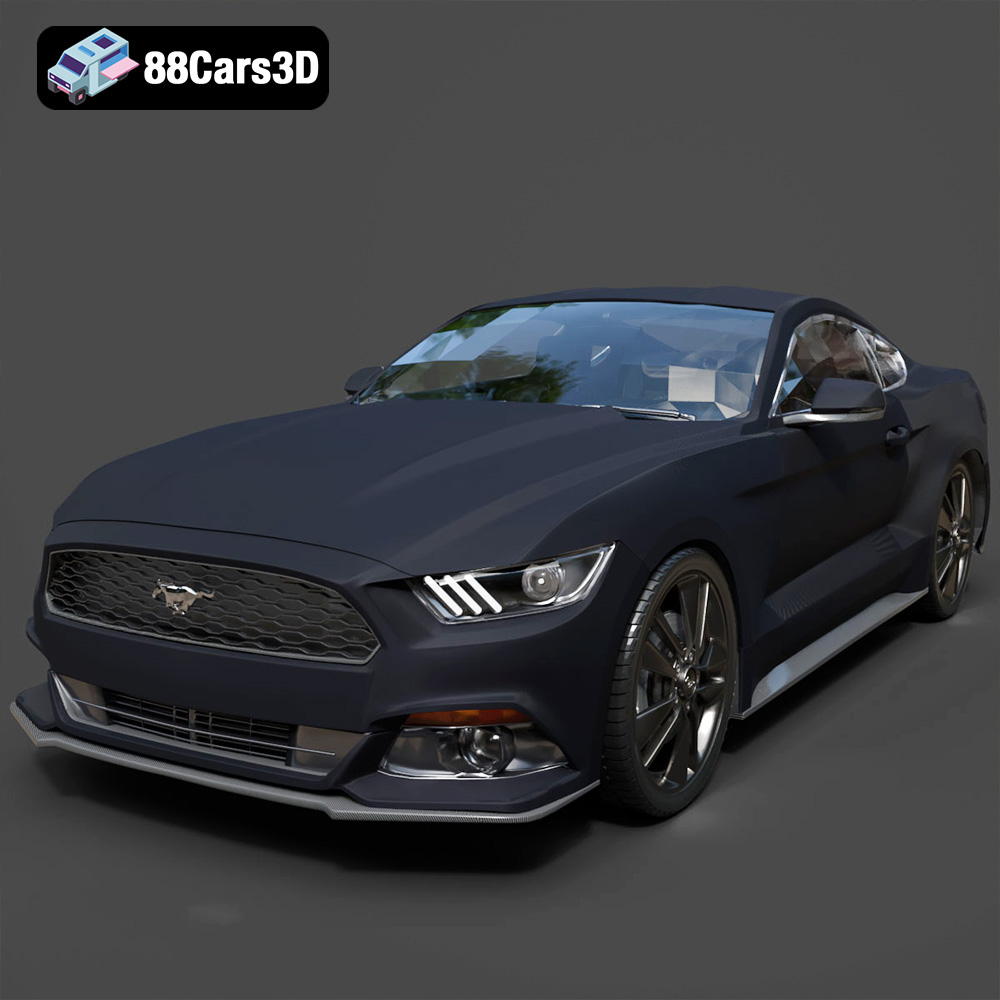
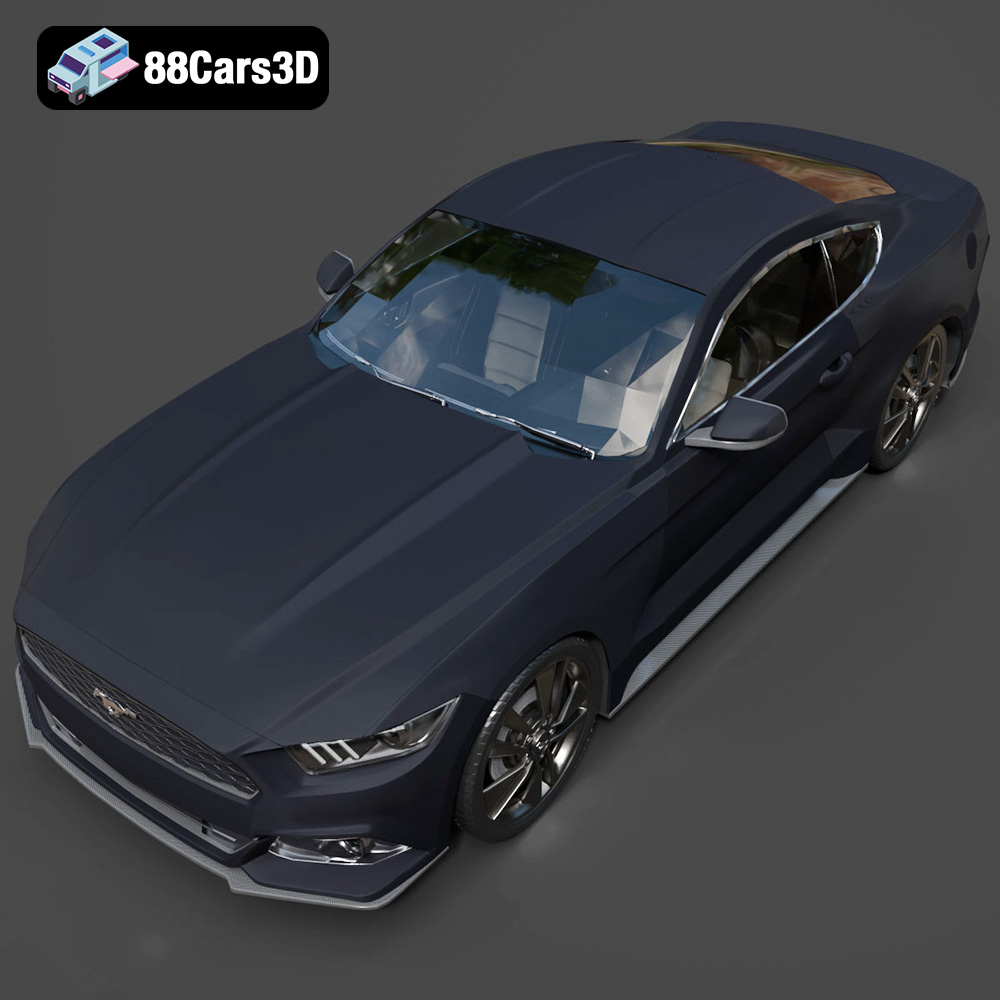
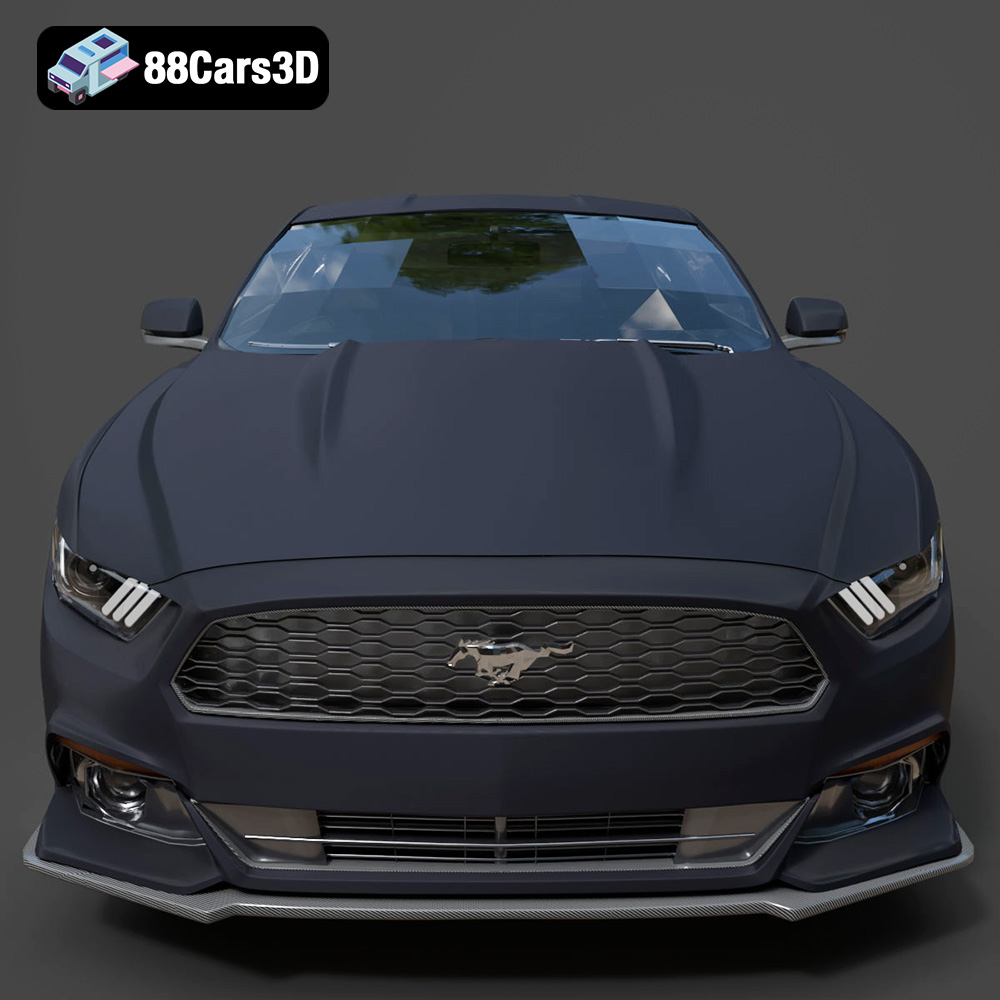
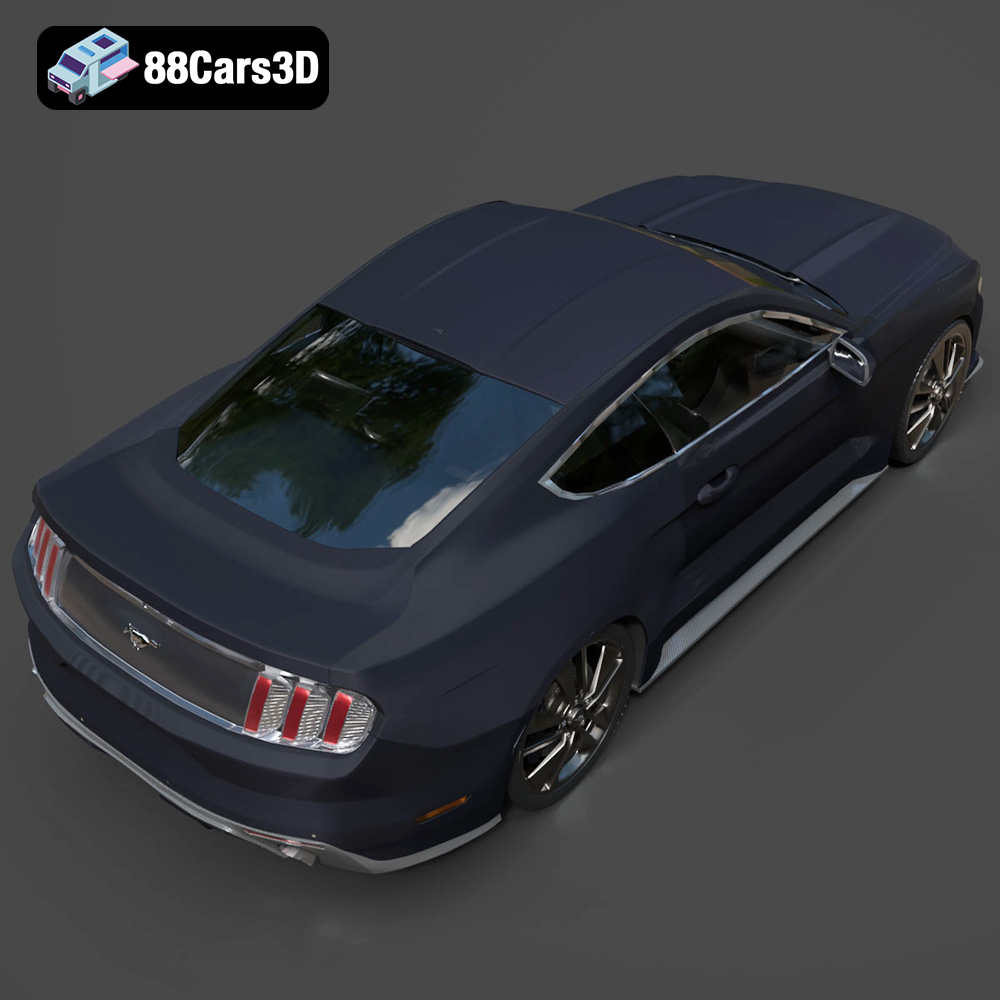
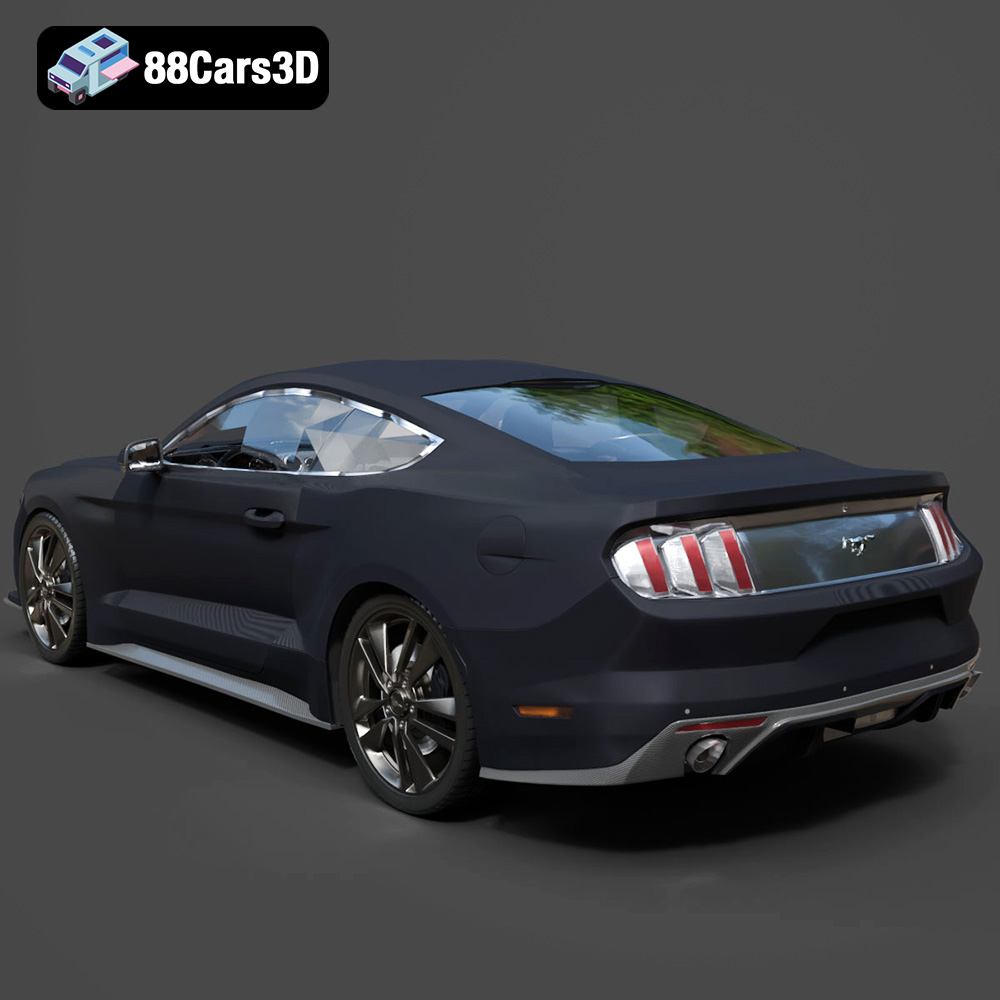
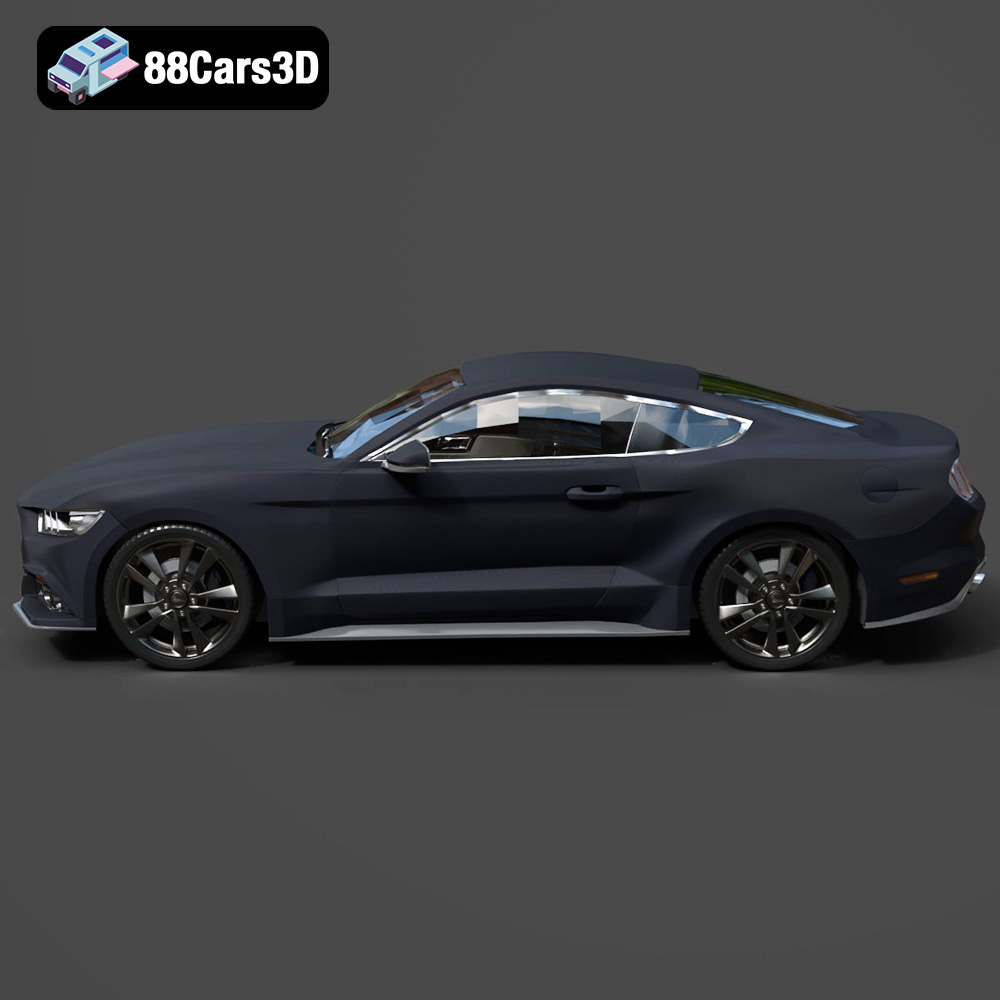
A truly authentic 3D model must do more than simply approximate the car’s shape; it needs to capture its essence. The Ford Mustang GT 2008 3D model meticulously recreates the aggressive front grille, proudly displaying the signature galloping pony emblem. The muscular hood, hinting at the potent V8 beneath, is accurately modeled, as is the unmistakable sweeping roofline of the fastback design. Every curve and edge, from the distinctive side scoops to the flared wheel arches, reflects the bold, aggressive stance that cemented this vehicle’s place in automotive culture. The iconic tri-bar taillights and aggressive halogen headlight assemblies are rendered with precision, ensuring that the car looks correct from every angle, under any lighting condition.
Furthermore, the model includes classic 5-spoke alloy wheels wrapped in high-performance street tires, detailed strut, and solid rear axle suspension setup. These are not merely static elements; the wheels, suspension, and steering components are separate, allowing for complex animations and realistic physics simulations—a critical advantage for game developers and animators.
The interior of a vehicle model is just as crucial as its exterior, especially for applications requiring first-person views or interactive experiences. The Ford Mustang GT 2008 3D model doesn’t disappoint, offering a detailed and accurate cockpit. Sport bucket seats with intricate leather stitching patterns provide a tactile feel even in a digital space. The three-spoke retro-inspired steering wheel, complete with the pony emblem, and the twin-pod instrument cluster with accurate gauge detailing, transport the user directly into the driver’s seat. A complete center console with a manual shifter, pedals, and climate controls rounds out the immersive interior. This level of detail is paramount for open-world driving games, VR experiences, and automotive configurators where users expect a high degree of fidelity in both exterior and interior elements.
The versatility of a 3D model is often defined by the file formats it supports. Different formats are optimized for various workflows, software environments, and end-use applications. Understanding these distinctions is crucial for selecting the right model and integrating it seamlessly into your project pipeline. The Ford Mustang GT 2008 3D model comes with a comprehensive suite of formats, ensuring broad compatibility and flexibility.
The .blend format is native to Blender, a powerful and increasingly popular open-source 3D creation suite. When you receive a model in .blend format, you’re getting a complete Blender scene, often including PBR (Physically Based Rendering) materials, lighting setups, and even animation rigs. This format is ideal for artists who primarily work in Blender, offering the highest level of editability. You can easily modify geometry, adjust materials, re-texture, or integrate the model into a larger Blender project without any data loss or conversion artifacts. It’s perfect for detailed customization and iterative design processes, providing a strong foundation for any creative endeavor within Blender.
FBX (Filmbox) is a proprietary file format owned by Autodesk, widely regarded as the industry standard for interoperability between 3D software and game engines. It supports not only geometry but also materials, textures, animations, bones, and light information. The .fbx format is particularly favored in game development for engines like Unreal Engine and Unity due to its robust support for animations and hierarchical structures. It’s an excellent choice for exporting animated characters or complex models like vehicles into a real-time environment, ensuring that all components, pivots, and animation data transfer correctly and efficiently. For the Mustang model, the .fbx ensures that the separate wheels, suspension, and steering components retain their animation-ready setup.
OBJ (or .obj) is one of the most widely supported and simplest 3D file formats, making it a universal choice for cross-software compatibility. It stores geometry (vertices, normals, texture coordinates, and faces) and can reference external material files (.mtl). While it doesn’t support animation or rigging, its simplicity ensures that almost any 3D software can import an .obj file reliably. It’s often used for static mesh exchange and is excellent for situations where you primarily need the geometry without complex animation data, or as a fallback for maximum compatibility. It’s a clean, dependable format for bringing the Mustang’s detailed body into virtually any 3D application for rendering or further modification.
GLB (GL Transmission Format Binary) is the binary version of glTF, an open-standard, royalty-free specification for the efficient transmission and loading of 3D scenes and models by applications. GLB embeds textures and other assets directly into a single file, making it incredibly easy to share and integrate. It’s specifically optimized for web-based 3D applications, augmented reality (AR), and virtual reality (VR) experiences, offering a compact file size and fast loading times. For showcasing the Mustang in a web viewer, a mobile AR app, or an interactive VR showroom, .glb is the format of choice due to its efficiency and PBR material support.
STL (Stereolithography) is the de facto standard file format for 3D printing. It represents a 3D model as a series of connected triangles, describing only the surface geometry of an object without any color, texture, or material information. While less useful for rendering or animation, it is indispensable for additive manufacturing. The .stl format generated from the Mustang 3D model allows hobbyists and professionals to physically manifest the digital asset, creating tangible scale models. When preparing for 3D printing, it’s critical to consider aspects like mesh integrity, manifold geometry, and scale, which the source model supports.
PLY (Polygon File Format) is another common format for storing 3D data, particularly useful for scanned data or precise mesh information. It can store a variety of properties beyond simple geometry, such as color, transparency, normals, and even confidence values. While less common for general artistic asset exchange compared to FBX or OBJ, PLY is highly valued in scientific, engineering, and CAD applications where precision and additional data attributes are important for analysis or manufacturing. For the Ford Mustang GT 2008, the .ply format provides a robust option for users who might need to integrate the model into CAD pipelines or perform mesh analysis.
While not a universal file extension in the same way .fbx or .obj are, an “.unreal” asset often implies a pre-configured asset package specifically optimized for Unreal Engine. This typically means the model has already been imported into Unreal, has its materials set up (often using Unreal’s robust material editor), has proper collision meshes, LODs (Levels of Detail), and potentially even basic blueprints for interaction. This format saves significant time for developers, as the heavy lifting of engine integration is already complete. The Mustang model provided in an “.unreal” package would be ready to drop into an Unreal project, immediately functional for game development or high-fidelity cinematic sequences.
The .max format is native to Autodesk 3ds Max, one of the most powerful and widely used 3D modeling, animation, and rendering software packages in the industry. Similar to a .blend file for Blender, a .max file contains the complete 3ds Max scene, including all geometry, materials, textures, lighting setups, cameras, and animation data. This format provides the highest level of editability for users working in 3ds Max, allowing for detailed modifications, complex rigging, advanced rendering setups (using V-Ray, Corona, etc.), and professional animation workflows. For the Ford Mustang GT 2008, the .max file enables seamless integration into high-end architectural visualization, automotive advertising, and film production pipelines.
In the world of 3D, especially for high-performance applications like real-time gaming or immersive VR, raw visual appeal is only one part of the equation. Technical precision and optimization are paramount. The Ford Mustang GT 2008 3D model from 88cars3d.com exemplifies this balance, offering both stunning visual fidelity and robust technical underpinnings.
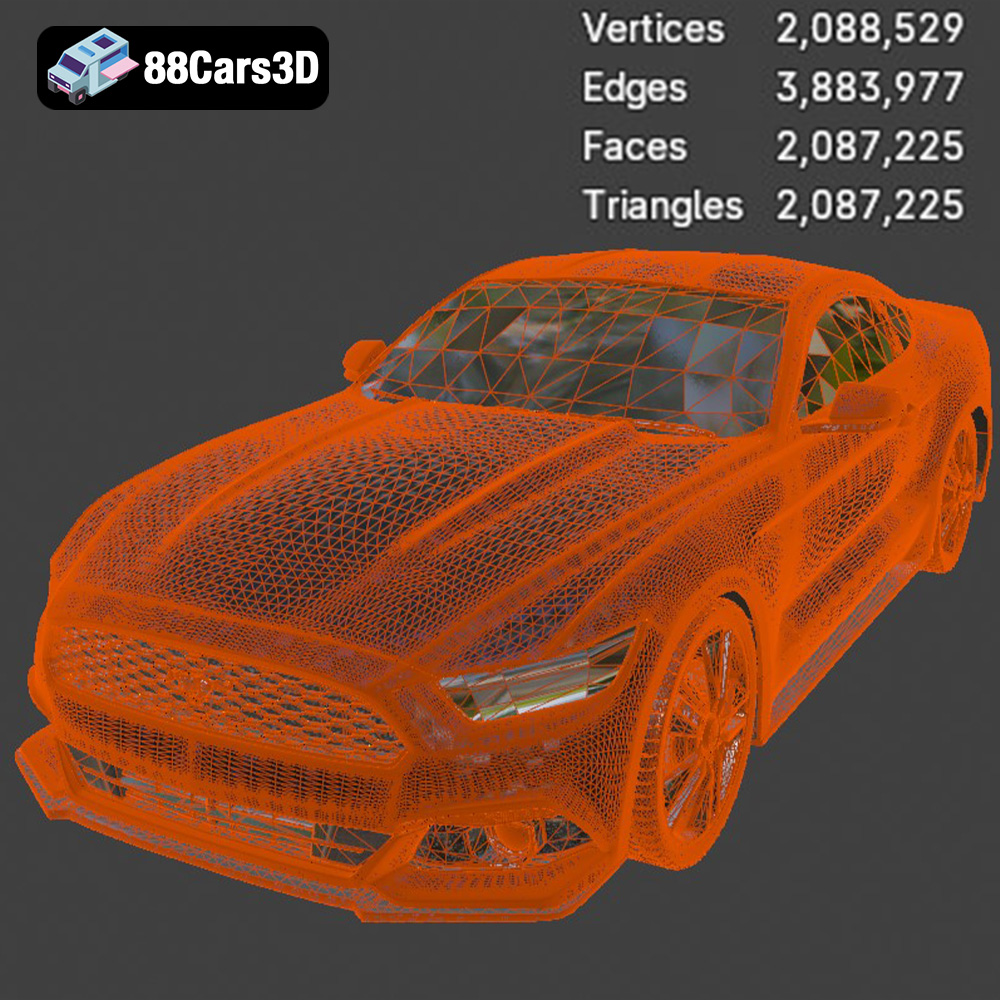
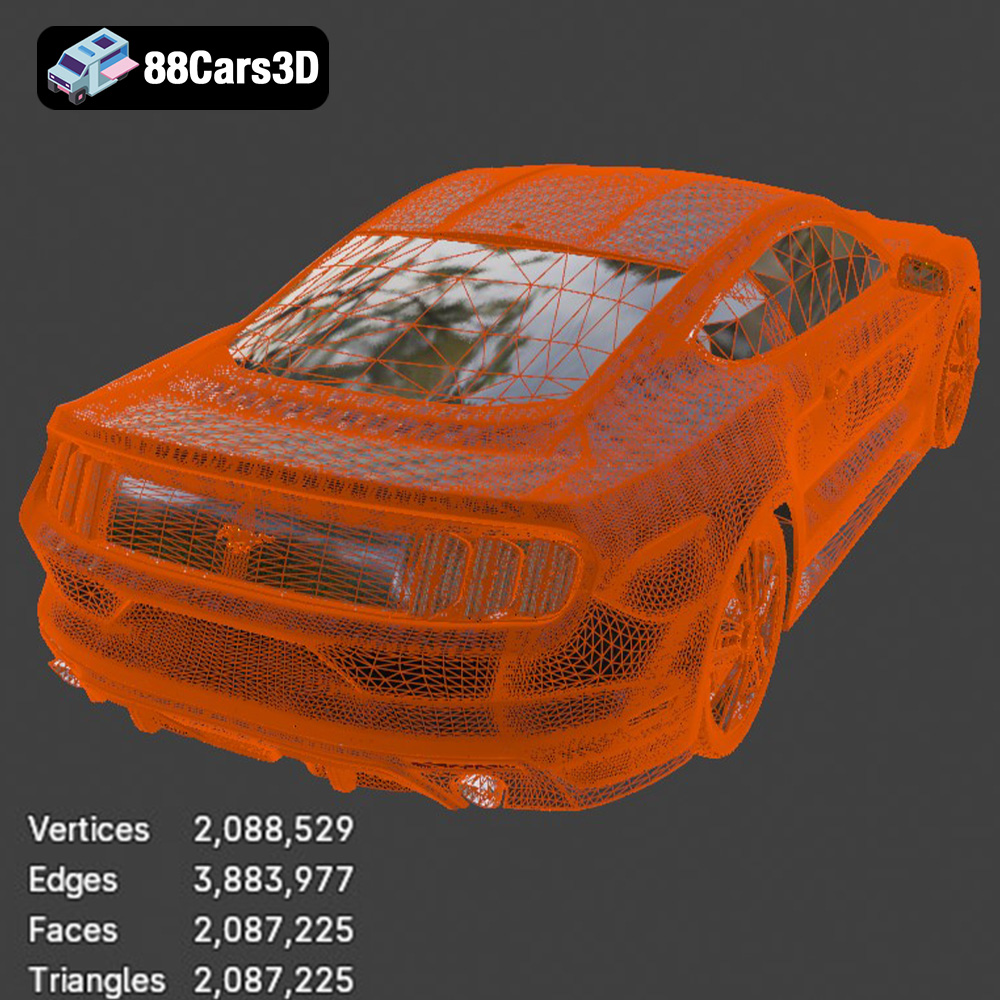
The model boasts a comprehensive geometry with a triangle count of 2,087,225. This figure is a critical indicator of detail and performance. For high-end visualization, close-up renders, and cinematic sequences, this polycount ensures exceptional visual fidelity, allowing for smooth curves and intricate details without visible faceting. Crucially, for game development and AR/VR, this polycount strikes a perfect balance. While not “low-poly” in the traditional sense, it’s optimized to maintain high-end visual realism in real-time engines like Unreal and Unity without excessively taxing system resources. Meticulous topology ensures clean deformations and efficient rendering, while high-resolution material setups enhance the realism, from metallic paint finishes to intricate dashboard textures.
Accuracy extends beyond static aesthetics. The model features real-world scale accuracy, based on actual vehicle chassis dimensions, ensuring it fits seamlessly into environments and interacts correctly with other assets. Furthermore, for dynamic applications, proper pivot setups are essential. The separate wheels, suspension, and steering components are designed with correct pivot points, enabling realistic wheel rotation, independent suspension travel, and accurate steering kinematics. This level of articulation is critical for creating convincing driving simulations, intricate animations, or dynamic scenes where the car needs to respond realistically to its environment.
The provision of multiple file formats is a testament to the model’s broad compatibility. Whether you’re working in Autodesk 3ds Max for architectural visualizations, Blender for an indie game project, or directly within Unreal Engine for a cinematic, the Ford Mustang GT 2008 3D model is designed for seamless integration. This compatibility reduces friction in development pipelines, allowing artists and developers to focus on creativity rather than complex format conversions or asset cleanup.
The versatility of a high-quality 3D automotive model means it can be deployed across a multitude of industries, each benefiting from its precision and detail. The Ford Mustang GT 2008 3D model is not just a digital sculpture; it’s a powerful asset ready to elevate diverse projects.
For game developers, this model is an outstanding resource. Its optimized polycount and meticulous topology make it ideal for open-world games where realism and performance must coexist. Imagine cruising through a virtual city or racing down a track in a highly detailed Mustang GT. The separate, animatable components for wheels, suspension, and steering enable accurate physics simulations, crucial for realistic driving mechanics in racing titles and simulators. Whether it’s a core playable vehicle, an AI-driven opponent, or a background prop populating a virtual street, this 3D car model provides the fidelity and technical readiness demanded by modern game engines.
The burgeoning fields of Augmented Reality (AR) and Virtual Reality (VR) thrive on high-fidelity assets that can create truly immersive experiences. This Mustang model is perfect for virtual showrooms, allowing potential buyers to explore every angle and detail of the car in a digital space. Its optimized geometry is suitable for AR applications on mobile devices, enabling users to place the Mustang in their real-world environment. For interactive configurators, the detailed interior and exterior, coupled with customization options, provide a rich, engaging user experience where colors, materials, and even tire textures can be dynamically altered, offering a glimpse into future automotive retail.
Beyond interactive applications, the model excels in traditional rendering and visualization. Marketing agencies, automotive designers, and CGI studios can leverage its detail for stunning brand campaigns, lifestyle scenes, and studio lighting setups. The high-resolution material setups, from the metallic flakes in the paint to the intricate stitching on the seats, ensure photorealistic output. Imagine a dramatic advertisement featuring the Mustang under dynamic lighting, or a sleek studio render showcasing its aggressive lines. This 3D car model provides the visual punch needed to captivate audiences and convey a premium aesthetic, making it an invaluable asset for professional visualization projects.
The digital world often crosses over into the physical, and for 3D enthusiasts, bringing a virtual model to life through 3D printing is an incredibly rewarding experience. The Ford Mustang GT 2008 3D model, with its .stl format included, opens up this exciting avenue, allowing hobbyists and model makers to craft their own scale replicas.
Successful 3D printing begins with careful preparation. The model is recommended for scales such as 1:12, 1:18, or 1:24, offering a good balance between manageable size and retaining fine details. For optimal print quality, especially for intricate parts, a layer height of 0.04–0.12 mm is suggested. Resin printing is highly recommended for achieving the sharpest details and smoothest surfaces, particularly for features like the grilles, emblems, and interior components. Wall thickness should be between 1.2–2.0 mm to ensure structural integrity without unnecessary material usage. Crucially, supports will be required for detailed parts like the exhaust system, side mirrors, and complex interior elements to prevent warping and ensure overhangs print correctly. The model is also designed for print orientation, with the main frame printed at an angle for structural integrity, and wheels printed separately to maximize detail and reduce support material.
Once printed, the journey doesn’t end. Post-processing is key to transforming a raw print into a show-stopping model. This typically involves careful removal of supports, sanding to smooth out layer lines, and applying a primer coat to prepare the surface for painting. For an authentic finish, hobbyists can then apply factory colors like Grabber Orange or Vista Blue, or experiment with custom finishes and metallic paints. The ability to print individual components allows for easier painting and assembly, mirroring traditional model kit building. This fusion of digital design and physical craftsmanship offers a unique opportunity to interact with the Ford Mustang GT 2008 in an entirely new dimension.
Beyond its inherent detail and multi-format compatibility, the true power of a professional 3D car model lies in its adaptability. Artists and developers rarely use an asset “as is”; they tailor it to fit their specific creative vision and project requirements. The Ford Mustang GT 2008 3D model from 88cars3d.com provides robust options for customization and seamless integration into various professional workflows, from high-end rendering in 3ds Max to real-time interactive experiences in Unreal Engine.
The included high-resolution materials are designed to be easily adjustable. This means you can effortlessly change body colors, experimenting with classic factory colors like Grabber Orange or Vista Blue, or creating unique custom finishes. Modify tire textures to simulate different performance characteristics, switching between track-ready slicks and everyday street variants. Adjust material finishes from a showroom-glossy metallic to a stealthy matte, or even an aged, weathered look. Furthermore, adapting the lighting for different environments is fundamental to any 3D scene. The model’s clean topology and PBR material setup ensure that it responds realistically to various lighting conditions, allowing artists to achieve moods ranging from a sun-drenched street scene to a dramatic night render.
The breadth of included file formats directly supports diverse professional pipelines:
The Ford Mustang GT 2008 3D model’s comprehensive technical specifications and broad file format support ensure that it’s not just a beautiful asset but a highly functional and adaptable tool, ready to be a cornerstone of any professional 3D project.
The 2008 Ford Mustang GT stands as a testament to American automotive design, a car that blends raw power with an unmistakable retro aesthetic. Translating such an icon into a high-fidelity 3D model requires immense skill and attention to detail. The Ford Mustang GT 2008 3D Model from 88cars3d.com delivers precisely that, offering a digital asset that is both visually stunning and technically robust.
From its meticulously crafted exterior and detailed interior to its optimized geometry and extensive file format support, this 3D car model is a versatile powerhouse. Whether you’re building the next open-world racing game, creating an immersive AR/VR experience, producing high-end automotive visualizations, or even bringing the model to life through 3D printing, it provides the foundation for exceptional results. Its compatibility with industry-standard software like 3ds Max, Blender, Unreal Engine, and Unity ensures a smooth workflow, empowering artists and developers to focus on creativity without technical roadblocks.
For professionals seeking top-tier 3D car models that combine historical accuracy with modern technical demands, this Ford Mustang GT 2008 model is an invaluable addition to any asset library. Dive into your next project with confidence, knowing you have a premium digital asset from 88cars3d.com ready to accelerate your vision.
The 2008 Ford Mustang GT is an iconic American muscle car that perfectly captures the retro-futuristic styling of the legendary S197 generation. This highly detailed 3D model brings the classic pony car aesthetic to life, featuring the aggressive front grille with the signature galloping pony emblem, a muscular hood hinting at the powerful 4.6L V8 engine underneath, and the unmistakable sweeping roofline of the fastback design. Every curve and edge has been modeled to reflect the bold, aggressive stance that made this vehicle a staple of automotive culture.
$85.50
.2008
.blend
.fbx
.ford
.glb
.max
.mustang
.obj
.ply
.rendering
.stl
.unreal
car-3d-model
game asset
game-ready
low-poly
muscle-car
mustang-gt
optimized
pony-car
VR/AR