Get 20% OFF All Premium 3D & STL Models!

In the dynamic worlds of automotive design, game development, cinematic rendering, and immersive AR/VR experiences, the quality of your 3D assets can make or break a project. The pursuit of photorealism and functional accuracy in digital environments demands meticulously crafted models that not only look authentic but are also technically robust for various professional workflows. Whether you’re a seasoned game developer needing optimized assets, an automotive designer visualizing a new concept, or an architect integrating vehicles into a scene, the foundation of your success lies in the fidelity and flexibility of your 3D car models.
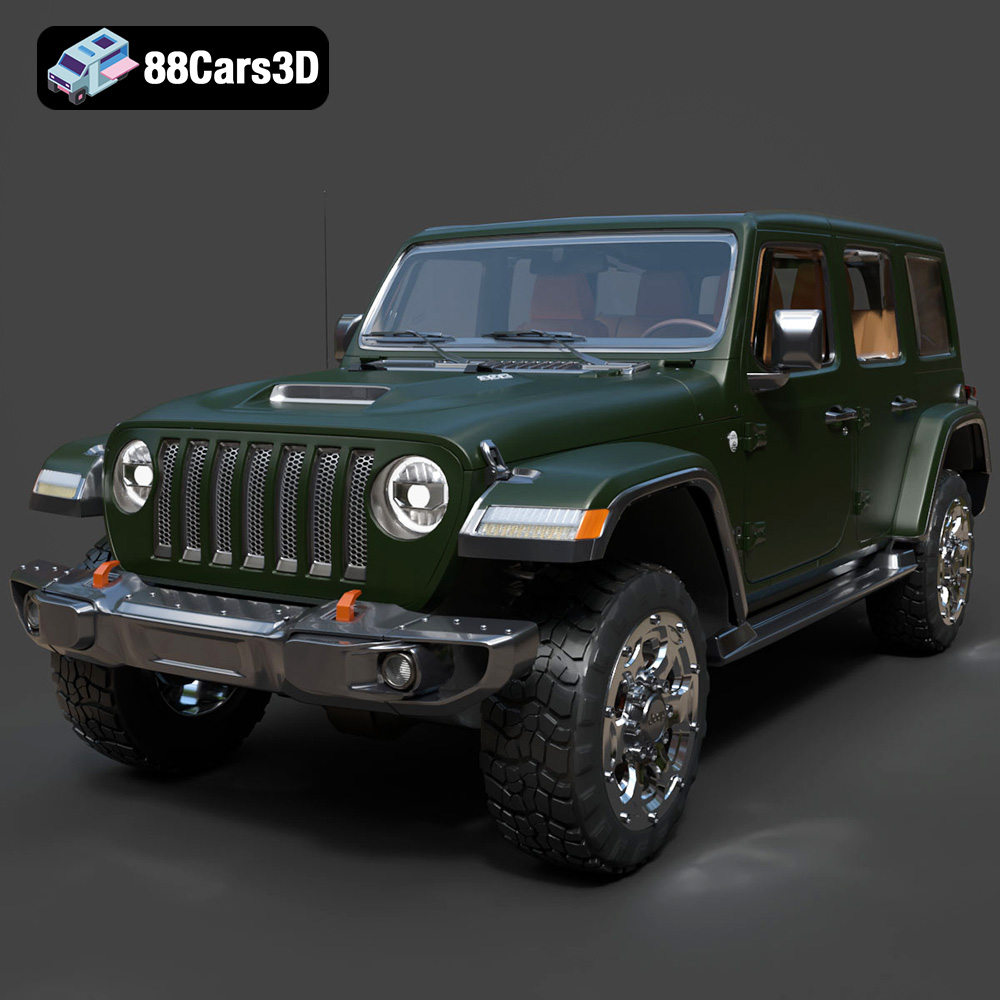
Few vehicles embody ruggedness, freedom, and iconic design quite like the Jeep Wrangler. Its distinctive silhouette, formidable off-road capabilities, and rich heritage make it a perfect subject for high-fidelity 3D replication. Imagine having access to a digital twin of this legendary 4×4, ready to be dropped into your project, pre-optimized for performance, and brimming with intricate detail. This is precisely what professional 3D assets offer, and the Jeep Wrangler 3D Model Download available on 88cars3d.com exemplifies this standard, providing a versatile foundation for a myriad of creative and technical applications. This comprehensive guide will explore the intricacies of leveraging such premium 3D assets, from understanding essential file formats to integrating them into complex production pipelines, ensuring your projects stand out with unparalleled realism.
The vast ecosystem of 3D design software and engines relies on a variety of file formats, each with its strengths, weaknesses, and specific use cases. Choosing the right format is paramount for smooth workflows, data integrity, and optimal performance. The Jeep Wrangler 3D Model, for instance, comes equipped with a comprehensive suite of formats, ensuring maximum compatibility across diverse platforms.
The .blend format is the native file type for Blender, the powerful open-source 3D creation suite. When you download a .blend file, you’re not just getting the mesh; you’re often getting a fully editable scene, complete with materials, textures, lighting setups, camera positions, and even animation data. This format is ideal for users who primarily work within Blender, offering the most comprehensive access to the original artist’s scene organization and parameters. For the Jeep Wrangler 3D model, the .blend file allows for deep customization, material tweaking using Blender’s node-based shader editor, and intricate scene manipulation for rendering or further asset development.
.fbx (Filmbox) is arguably the most widely adopted proprietary 3D file format for data exchange between various 3D applications, CAD software, and game engines like Unreal Engine and Unity. Developed by Autodesk, FBX files can store not only geometric data (vertices, faces, UVs) but also materials, textures, animation, skeletal data, and even camera and lighting information. Its robust nature makes it an excellent choice for transferring complex animated models. For game development with the Jeep Wrangler 3D model, .fbx is often the go-to for importing the vehicle with all its skeletal rigging (for suspension, steering, wheel rotation) and material assignments intact, ready for real-time environments.
The .obj (Wavefront OBJ) format is a simple, universal 3D data format that represents geometry alone (vertices, UVs, normals, and faces). While it doesn’t support animation or scene data, its widespread compatibility makes it a safe bet for transferring basic mesh information between almost any 3D software. Materials are typically defined in a companion .mtl file. The .obj format for the Jeep Wrangler 3D model is excellent when you need a clean mesh for sculpting, retopology, or when importing into software that might not fully support more complex formats, ensuring a consistent geometric base.
.glb (GLB, the binary version of glTF) is an efficient, compact format optimized for the web, AR (Augmented Reality), and VR (Virtual Reality). It bundles 3D models, textures, animations, and PBR (Physically Based Rendering) materials into a single file, making it incredibly easy to load and display in browsers and mobile applications. Its “transmission format” design ensures fast loading times and minimal parsing overhead. The .glb version of the Jeep Wrangler 3D model is perfect for virtual showrooms, interactive product configurators on websites, or mobile AR apps where users can view the vehicle in their real-world environment.
.stl (Stereolithography) is the standard file format for 3D printing. It represents a 3D model as a collection of unconnected triangular facets, defining only the surface geometry of the object. It does not carry color, texture, or material information, making it purely a geometric definition for physical manufacturing. For hobbyists or professionals looking to 3D print the Jeep Wrangler model, the .stl file is indispensable, providing a clean, manifold mesh ready for slicing software and subsequent fabrication.
The .ply (Polygon File Format, or Stanford Triangle Format) is often used to store 3D data from 3D scanners, CAD software, or scientific applications. It can store a variety of properties including color, transparency, normals, texture coordinates, and data confidence values, making it highly versatile for representing complex data. While less common for general animation, it’s valuable for precise data exchange or for integrating the Jeep Wrangler into workflows that involve mesh analysis or reverse engineering.
While not a direct file extension in the traditional sense like .fbx or .obj, “.unreal” refers to assets packaged and optimized specifically for Unreal Engine. This often implies an .fbx import that has been carefully processed, textured with Unreal’s material system, and set up with appropriate LODs (Levels of Detail), collision meshes, and blueprints for immediate use within the engine. When a model is provided in an “unreal” format, it typically means it’s ready-to-go, saving significant setup time for game developers. The Jeep Wrangler 3D model is noted to be “engine-ready” for real-time environments, implying this level of optimization.
The .max format is the native file format for Autodesk 3ds Max, a leading software for 3D modeling, animation, rendering, and visualization. Like .blend, a .max file contains the complete scene data, including geometry, materials, textures, lighting, cameras, animation, and scene organization. It offers maximum flexibility for users working within 3ds Max, allowing for full modification, complex rigging, and high-end rendering setups using renderers like V-Ray or Corona. The .max version of the Jeep Wrangler 3D model enables artists to dissect and repurpose every element of the model within a professional production pipeline.
Creating a truly high-fidelity 3D car model like the Jeep Wrangler is a labor-intensive process that goes far beyond basic modeling. It requires an artist’s eye for detail, a deep understanding of automotive design, and technical prowess in 3D software. The goal is to capture not just the shape, but the essence and functional mechanics of the real-world vehicle.
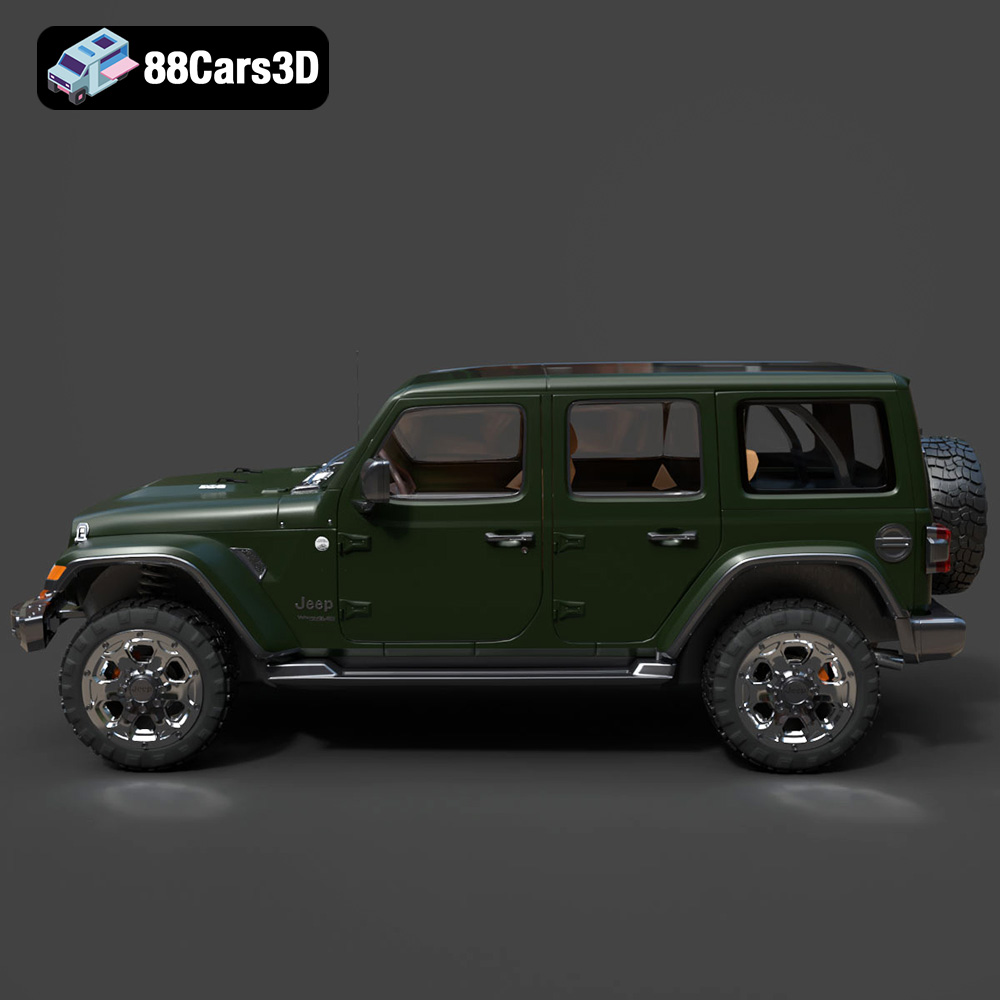
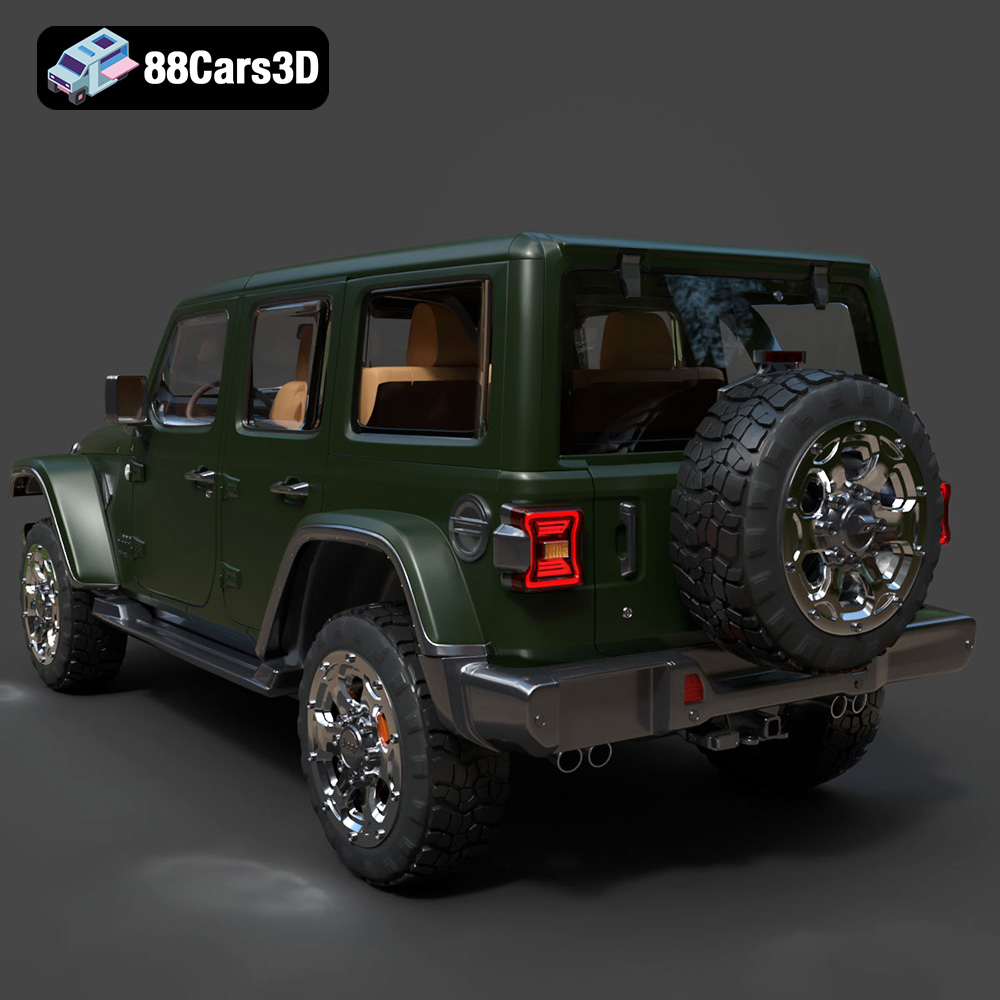
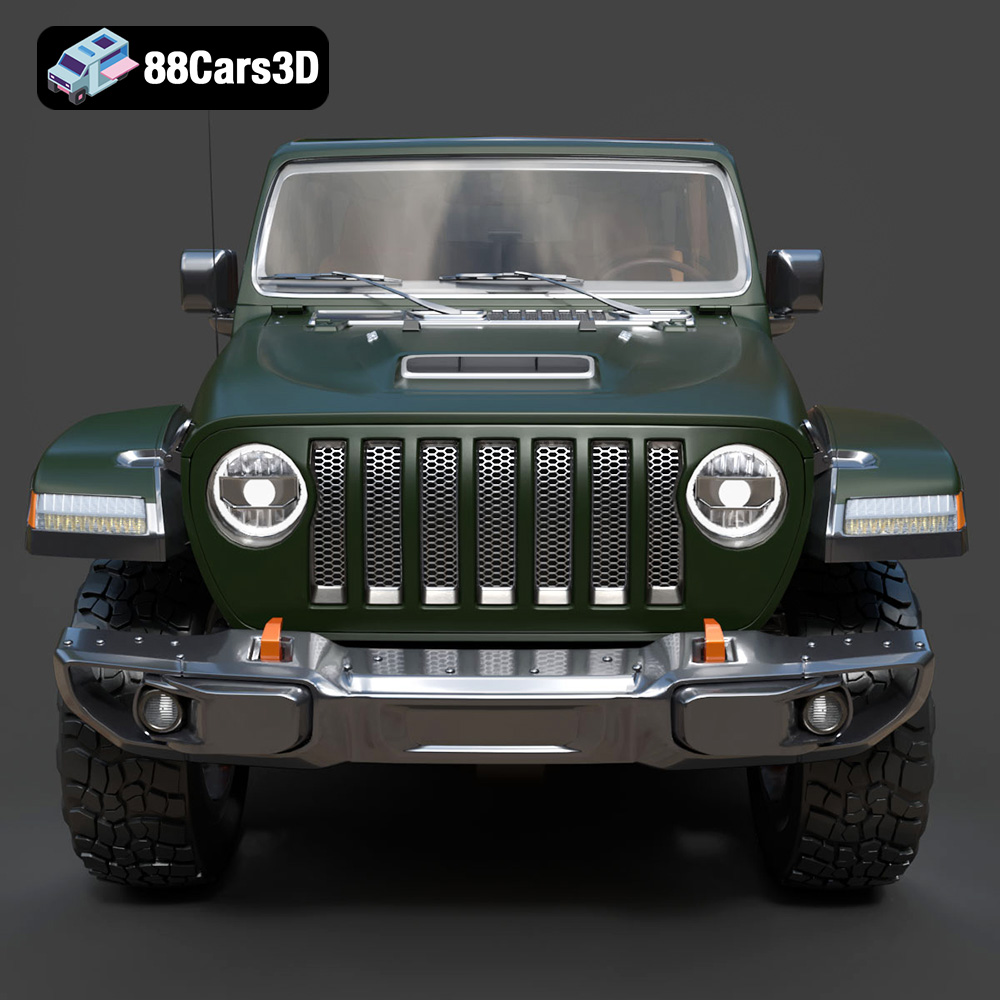
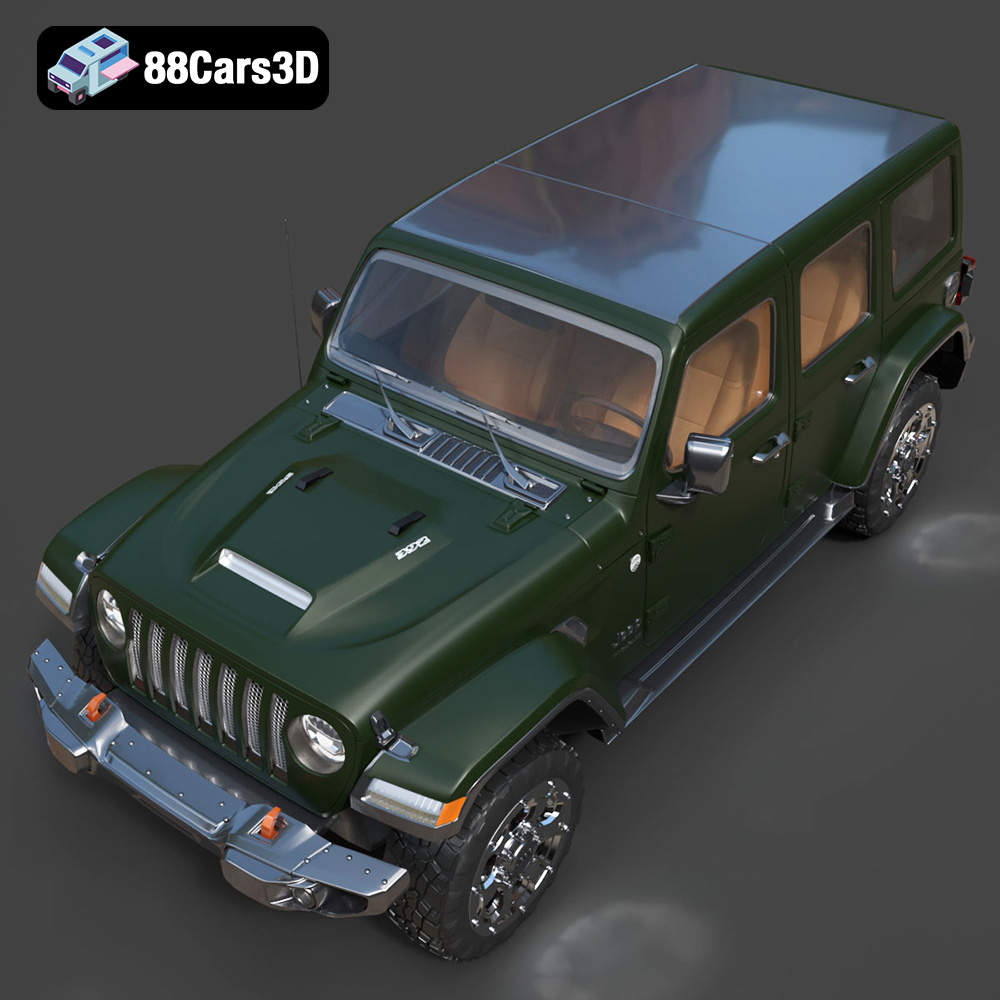
The iconic boxy silhouette, the signature seven-slot grille, and the round headlights are what make the Jeep Wrangler instantly recognizable. A premium 3D model meticulously recreates these elements with precise measurements and proportions, based on actual vehicle chassis data. This includes accurate frame geometry, robust front and rear bumpers, exposed hinges, and even subtle panel gaps. Details extend to the heavy-duty off-road alloy wheels, aggressive all-terrain tires, and the intricate solid axle suspension, complete with shocks, springs, and track bars. These aren’t just visual embellishments; for rendering and animation, they are crucial components that convey realism and allow for authentic motion.
While often seen less in external renders, a detailed interior is vital for first-person perspectives in games, virtual tours, and cinematic close-ups. The Jeep Wrangler 3D model boasts a fully realized cockpit, featuring rugged seats with accurate stitching, a multifunctional steering wheel, a heavy-duty dashboard layout, and a high-resolution instrument cluster. Even subtle controls like pedals, the gear selector, and the 4WD transfer case lever are precisely modeled. This level of interior detail ensures that the model is versatile enough for a wide range of applications, providing an immersive experience whether the viewer is inside or outside the vehicle.
Beyond visual accuracy, a professional 3D car model is engineered for functionality. The Jeep Wrangler model’s technical specifications highlight optimized geometry and proper pivot setups. This means that components like wheels, suspension, and steering are separate entities with correctly placed pivot points, making them “animation-ready.” A robust exhaust system and undercarriage armor are also modeled, providing structural integrity for realistic crash simulations, detailed undercarriage renders, or simply adding to the overall believability. Such attention to mechanical detail transforms a static model into a dynamic asset, capable of performing convincingly in real-time simulations and animated sequences.
The demands of real-time environments, such as game engines and AR/VR platforms, are unique. They require a delicate balance between visual fidelity and computational efficiency. High-quality 3D car models, like the Jeep Wrangler 3D Model, are engineered with these constraints in mind.
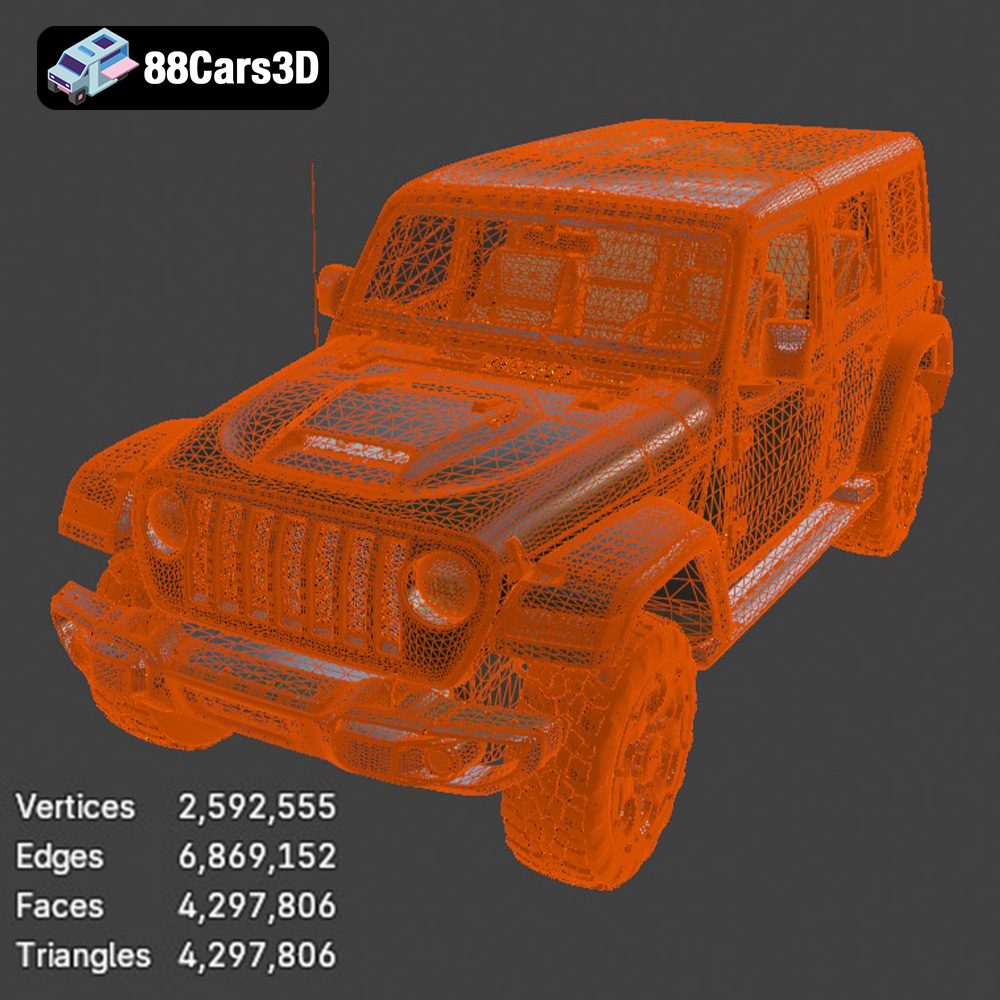
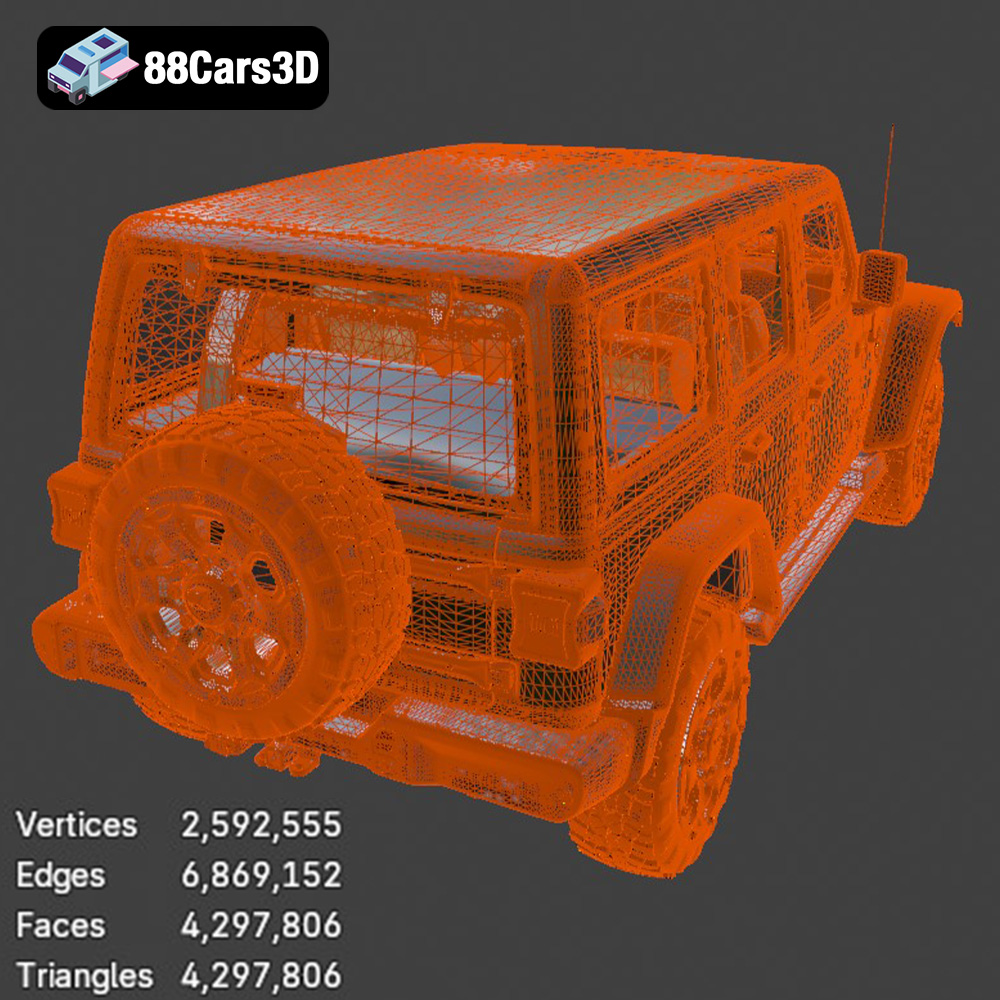
The Jeep Wrangler 3D model features a topology of 4,297,806 triangles. This figure represents a crucial balance. It’s high enough to deliver uncompromising visual fidelity and intricate detail – far beyond what simple game assets might offer – yet it remains structured and optimized for advanced applications. For modern game engines like Unreal Engine and Unity, this polycount allows for impressive visual realism without crippling frame rates, especially when combined with features like Levels of Detail (LODs) and efficient PBR material setups. Developers can use this model as a hero asset, knowing it will hold up under close inspection while still performing well in a dynamic game world.
Integrating a complex 3D car model into a game engine is a multi-step process. Using the .fbx or the specific “.unreal” optimized version of the Jeep Wrangler model simplifies this significantly. Developers would typically import the .fbx, ensure material slots are correctly assigned, then apply PBR textures (Albedo/Base Color, Metallic, Roughness, Normal, Ambient Occlusion). The pre-set pivot points for steering, wheel rotation, and suspension travel are invaluable here, allowing for quick and accurate setup of vehicle physics and animation blueprints. Collision meshes would be generated or imported to ensure realistic interactions within the game environment. This streamlined process allows teams to focus on gameplay mechanics and environmental design rather than laborious asset preparation.
Augmented Reality (AR) and Virtual Reality (VR) present unique challenges, particularly regarding performance on mobile devices. The .glb format of the Jeep Wrangler 3D model is specifically designed for these platforms. Its optimized structure and bundled textures ensure fast loading times and smooth rendering in AR/VR applications. Imagine a virtual showroom where potential buyers can explore the Jeep Wrangler in full 3D, customize colors and features, or even place it in their driveway using AR on their smartphone. High-quality 3D car models are the backbone of such immersive experiences, providing the visual richness that makes these applications compelling and engaging.
For advertising, product visualization, and architectural integration, photorealistic rendering of 3D car models is paramount. Artists and studios rely on high-fidelity assets to produce stunning visuals that can be indistinguishable from real-world photography.
The .max format of the Jeep Wrangler 3D model, combined with industry-leading renderers like V-Ray or Corona Render in 3ds Max, unlocks its full potential for cinematic-quality visuals. Artists can leverage advanced lighting techniques, global illumination, and sophisticated material shaders to create breathtaking scenes. The detailed topology, accurate UV mapping (implied for a model of this quality), and PBR-ready materials allow for the recreation of realistic paint finishes, tire rubber, glass reflections, and intricate metallic components. This precision is crucial for automotive brand campaigns, virtual studio photography, or integrating the vehicle seamlessly into architectural visualizations.
Beyond technical rendering, professional 3D car models facilitate creative storytelling. A studio lighting setup can highlight the Jeep Wrangler’s rugged lines and strong presence, perfect for product showcases. Conversely, placing the model within a lifestyle scene – perhaps tackling a digital mountain trail or parked by a serene lakeside – requires the model to hold up under diverse environmental lighting and interact realistically with its surroundings. The model’s detailed engine bay, undercarriage, and interior components allow for dynamic camera angles and close-ups, enriching the narrative and visual appeal of any render. 88cars3d.com offers assets that make these complex visual narratives achievable.
One of the significant advantages of working with a detailed 3D model is the endless customization potential. For the Jeep Wrangler, this means easily changing body and tank colors to match specific brand palettes or custom finishes. Tire textures can be swapped between aggressive off-road variants and smoother street versions. Material finishes, such as matte, gloss, or metallic, can be adjusted to convey different product aesthetics. This flexibility is invaluable for marketing agencies and automotive companies who need to showcase various configurations or adapt the vehicle to different advertising campaigns without the cost and time of physical photography shoots.
The digital realm often inspires physical creation, and 3D printing offers a tangible way to bring virtual models into the real world. The Jeep Wrangler 3D model is designed with 3D printing in mind, opening up possibilities for collectors, designers, and hobbyists.
The .stl file format is specifically provided for 3D printing. While the original model has a high triangle count, the .stl version will be optimized for solid manifold geometry, essential for successful printing. Before printing, the model will be loaded into a slicer software (like Cura, PrusaSlicer, or Chitubox), which converts the 3D model into a series of thin layers for the printer. Key considerations include checking for errors, ensuring all parts are watertight, and preparing the model for optimal print orientation.
The product description provides excellent guidelines for 3D printing the Jeep Wrangler: recommended scales (1:12, 1:18, 1:24), layer heights (0.04–0.12 mm, with resin printing suggested for fine details), and wall thickness (1.2–2.0 mm). Supports will be required for intricate parts like the exhaust, mirrors, and handlebars to prevent warping or collapse during printing. Post-processing is where the model truly comes to life: sanding for smoothness, priming for an even surface, and then painting with authentic factory colors and metallic finishes to replicate the real vehicle’s appearance. This attention to detail in the digital model translates directly into a higher quality physical output.
Beyond static display, 3D printed models can serve various purposes. They can be used as maquettes for larger physical builds, as prototypes for custom accessories, or simply as highly detailed collectibles. For designers, a physical model offers a tangible reference point for proportions and aesthetics, complementing the digital workflow. The ability to produce a detailed physical representation of the Jeep Wrangler from its digital counterpart highlights the comprehensive utility of such a high-quality 3D asset from 88cars3d.com.
In today’s fast-paced production environments, time is a precious commodity. Relying on pre-built, professional-grade 3D assets offers a significant strategic advantage for individuals and studios alike.
Developing a high-fidelity 3D car model like the Jeep Wrangler from scratch requires hundreds, if not thousands, of hours of skilled labor, from concept modeling and sculpting to retopology, UV mapping, texturing, and rigging. By acquiring a ready-made asset, projects can bypass this time-consuming and expensive initial phase. This drastically accelerates project timelines, allowing teams to allocate resources to other critical areas such as level design, animation, or marketing. The cost-effectiveness of purchasing a pre-made asset compared to in-house development is often substantial, making it a smart investment for any production.
Professional 3D marketplaces like 88cars3d.com curate models that meet rigorous quality standards. These models are typically created by experienced artists, ensuring clean topology, accurate scale, consistent material definitions, and comprehensive file format support. This consistency is vital for maintaining visual integrity across a project, especially in large-scale productions where multiple artists might be working on different aspects. The Jeep Wrangler 3D model’s detailed technical specifications and wide array of included formats are a testament to this commitment to quality, guaranteeing a reliable asset right out of the box.
The versatility of a well-crafted 3D car model means it can be deployed across an incredibly diverse range of industries. From interactive game environments where the Jeep Wrangler becomes an drivable vehicle, to high-definition brand visualizations showcasing its rugged appeal, to educational simulators demonstrating its off-road capabilities, or even to AR/VR experiences for virtual exploration. The ability of one asset to serve so many purposes underscores the value of investing in a robust, multi-format 3D model. It’s not just a model; it’s a foundation for countless creative and technical endeavors.
The world of 3D modeling is an intricate blend of artistic vision and technical precision. High-fidelity 3D car models are more than just digital representations; they are powerful tools that drive innovation across various industries, from immersive game development and captivating automotive rendering to interactive AR/VR experiences and tangible 3D prints. The Jeep Wrangler 3D Model Download serves as an excellent example of a professional-grade asset, offering unparalleled detail, robust technical specifications, and broad compatibility through its diverse file formats.
By understanding the nuances of formats like .blend, .fbx, .obj, .glb, .stl, .ply, .unreal, and .max, creators can strategically integrate these assets into their pipelines, maximizing efficiency and achieving stunning results. Whether you’re aiming for photorealistic renders in 3ds Max, dynamic gameplay in Unreal Engine, or a physical replica via 3D printing, a well-crafted 3D car model provides the essential foundation. Exploring the comprehensive selection of high-quality 3D car models at 88cars3d.com can unlock new possibilities and elevate your projects to the next level of digital automotive excellence.
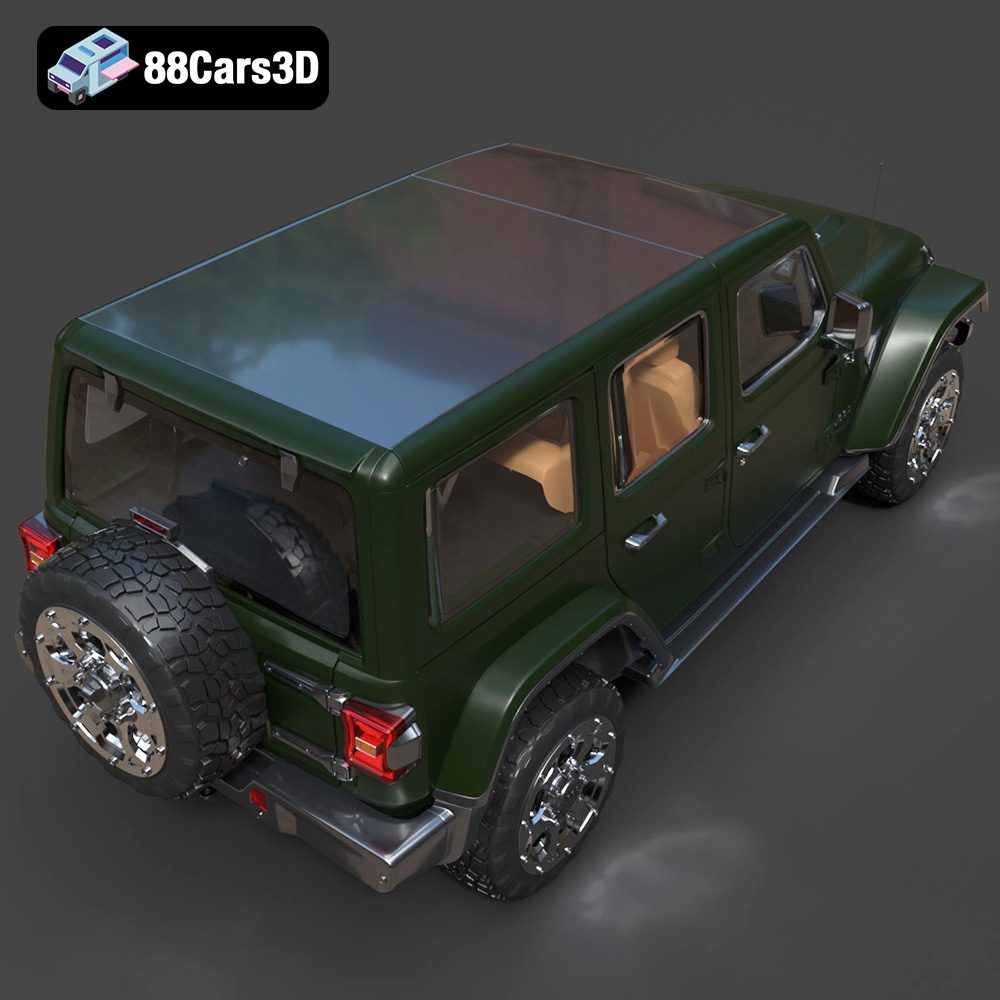
Capture the spirit of adventure with this high-fidelity Jeep Wrangler 3D model. Boasting 4,297,806 triangles, it offers exceptional detail from its iconic grille to its rugged suspension, making it perfect for game development, cinematic rendering, AR/VR, and even 3D printing. Optimized for real-time engines and fully customizable, this model delivers uncompromising visual fidelity and versatility across all major 3D software platforms. Includes .blend, .fbx, .obj, .glb, .stl, .ply, .unreal, and .max formats.
$90.00
.4×4
.blend
.fbx
.glb
.jeep
.max
.obj
.ply
.rendering
.stl
.unreal
.wrangler
car-3d-model
game asset
game-ready
high poly
off-road
optimized
SUV
VR/AR