Get 20% OFF All Premium 3D & STL Models!

In the dynamic worlds of game development, architectural visualization, industrial training, and immersive AR/VR experiences, the demand for highly detailed, authentic 3D assets is paramount. Generic placeholders simply won’t cut it when the goal is to convey realism, functionality, and a sense of tangible presence. This is particularly true for heavy machinery and construction vehicles, where every rivet, hydraulic line, and weathered surface contributes to the overall credibility of a scene. The focus isn’t just on visual appeal, but also on technical integrity – ensuring that models are optimized for performance across diverse platforms while retaining intricate detail.
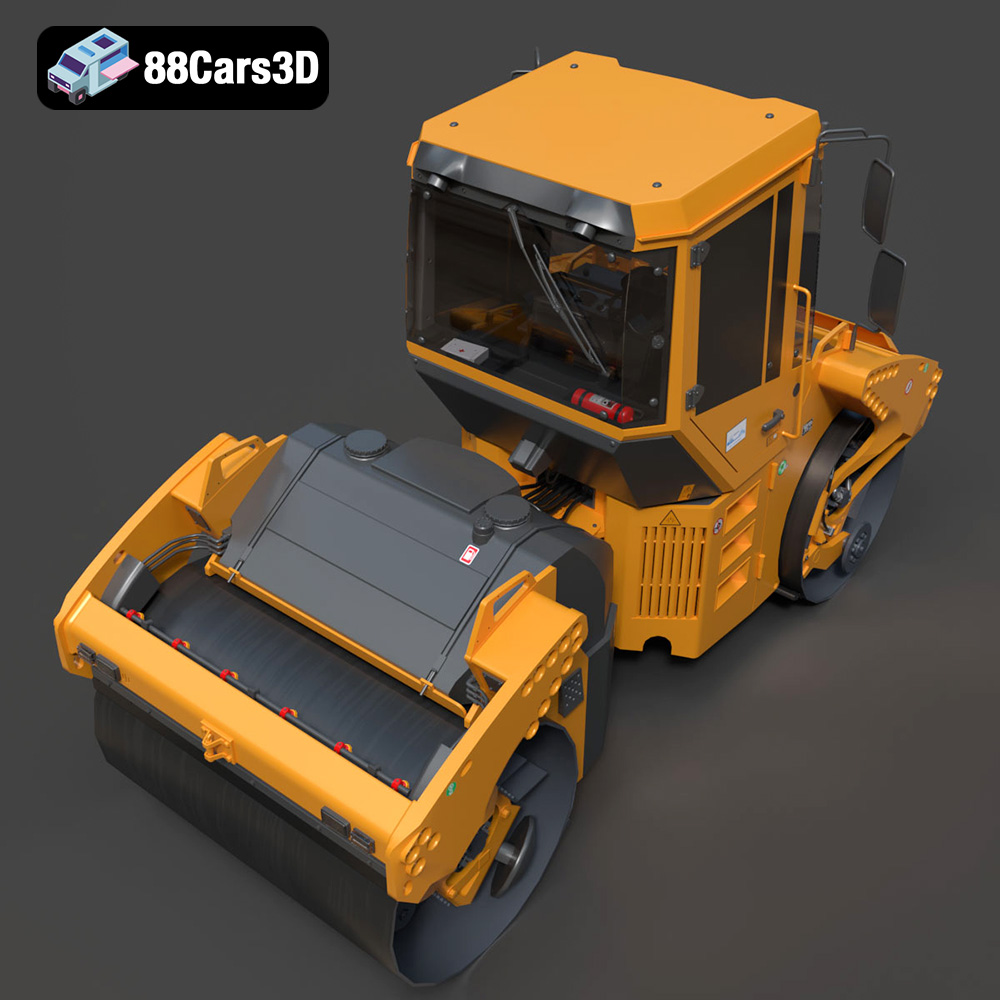
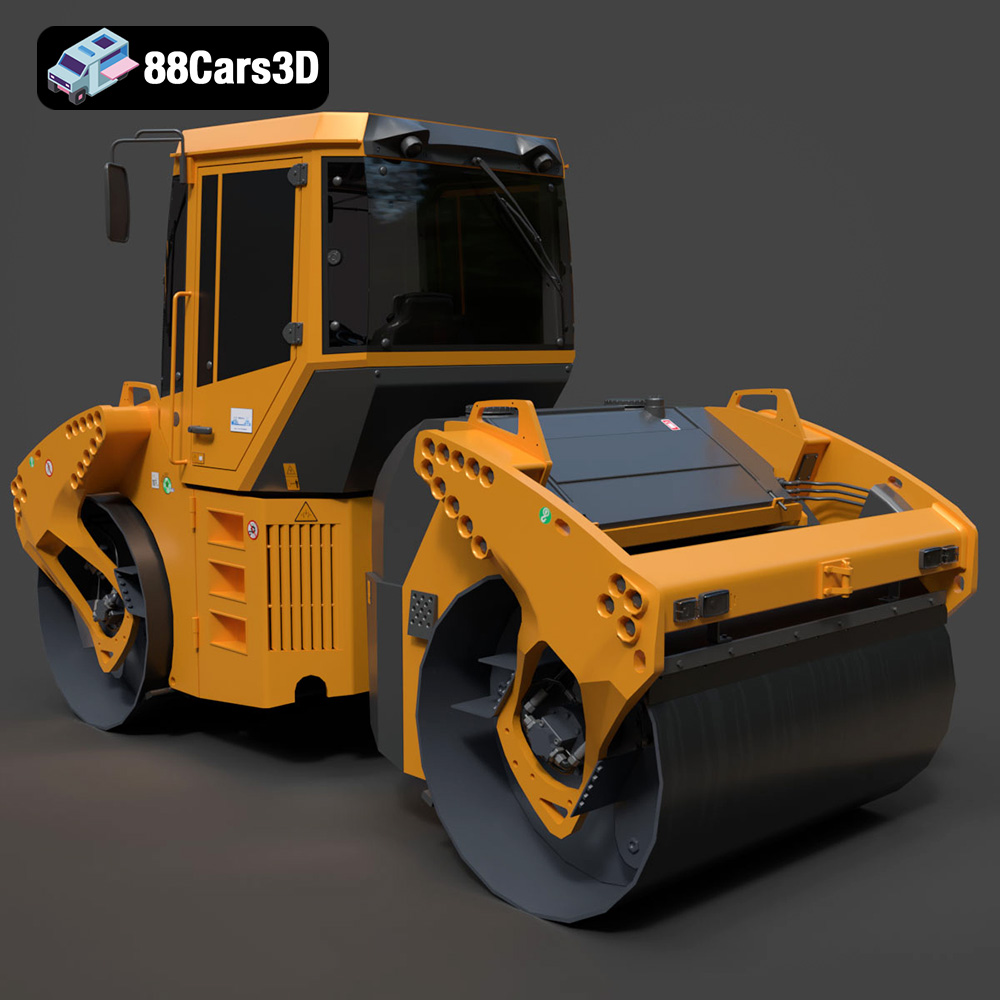
Today, we delve into the meticulous craftsmanship behind industrial 3D models, using a prime example that showcases the fusion of visual fidelity and technical optimization: the Articulated Tandem Road Roller Dusty 3D Model. This particular model, available on platforms like 88cars3d.com, encapsulates the rugged essence and heavy-duty presence of essential construction equipment, making it an invaluable asset for professionals seeking to elevate their digital projects.
Choosing the correct 3D model file format is a critical decision that impacts workflow, compatibility, and ultimately, the success of a project. Each format serves a specific purpose, offering unique advantages depending on the application – be it real-time rendering, animation, 3D printing, or web-based display. Understanding these distinctions is fundamental for any professional working with 3D car models or any complex game assets.
The .blend format is native to Blender, a powerful open-source 3D creation suite. A .blend file typically encapsulates an entire Blender scene, including all geometry, materials, textures, lighting, cameras, animations, rigging, and even custom scripts. This makes it an ideal choice when you plan to continue working within Blender, allowing for full editability and access to all the original scene data. For artists who want to dissect, modify, or re-render the Articulated Tandem Road Roller with Blender’s Cycles or Eevee, the .blend file provides the most comprehensive starting point.
The .fbx (Filmbox) format, developed by Autodesk, is arguably the most widely adopted interchange format in the 3D industry. It’s renowned for its ability to store a broad range of 3D data, including geometry, materials, textures, skeletal animation, and camera information, all within a single file. This makes it ideal for transferring assets between different 3D software applications and, crucially, for integration into game engines like Unreal Engine and Unity. For the road roller model, an .fbx file ensures that pivots for articulation and drum rotation are preserved, ready for real-time pipelines and animations.
The .obj (Wavefront OBJ) format is a universal, open-standard format primarily used for representing 3D geometry. It stores vertex positions, UV coordinates, normals, and face information, often accompanied by a separate .mtl (material) file for basic material properties. While it’s excellent for static mesh data and offers broad compatibility across almost all 3D software, .obj files typically do not support animation, rigging, or advanced material setups. It’s a reliable fallback for cross-software compatibility, especially when the goal is to integrate the road roller as a static, high-fidelity prop.
The .glb (GL Transmission Format Binary) is a relatively newer format that has rapidly gained traction, particularly for web-based 3D, augmented reality (AR), and virtual reality (VR) applications. It’s a binary version of the glTF format, packing all model data – geometry, textures, materials, and animations – into a single, compact file. This optimization makes it incredibly efficient for streaming and displaying 3D models directly in browsers or mobile AR/VR experiences without extensive processing. The .glb version of the Articulated Tandem Road Roller would be perfect for virtual showrooms or interactive web configurators.
The .stl (Stereolithography) format is the de facto standard for 3D printing. It represents a 3D model as a series of connected triangles, describing only the surface geometry without color, texture, or material information. While excellent for outputting a physical model, its lack of advanced data means it’s not suitable for rendering or animation workflows. For hobbyists or professionals looking to create a physical scale model of the road roller for dioramas or display, the .stl file is indispensable.
The .ply (Polygon File Format) is another format for storing 3D data, often used for 3D scanned data or models requiring precise vertex and polygon information. It can store a variety of properties beyond just geometry, such as color, transparency, and normals per vertex or face, making it valuable for scientific visualizations, CAD applications, or advanced mesh analysis. While less common for general-purpose rendering than .fbx or .obj, it offers a robust solution for specific engineering or research-focused tasks involving the road roller model.
The “.unreal” format isn’t a standalone file extension in the same way .fbx or .obj are. Instead, it signifies that the asset is provided as an Unreal Engine project package or a fully configured asset ready for direct import and use within Unreal Engine. This often means the original .fbx or other source files have been imported, materials set up with PBR shaders, textures linked, collision meshes generated, and possibly even LODs (Levels of Detail) configured. This provides an immediate, ready-to-use asset, optimized for Unreal’s real-time rendering pipeline, streamlining the integration of the Articulated Tandem Road Roller into complex game worlds or interactive simulations.
Finally, the .max format is the native file type for Autodesk 3ds Max. Similar to .blend for Blender, a .max file contains a complete 3ds Max scene, including geometry, materials, textures, lighting, animation, modifiers, and plugins. It’s the preferred format for anyone working within 3ds Max, offering full editability and access to all the sophisticated rendering and animation tools available in the software. For those integrating the road roller into high-fidelity automotive rendering projects or complex industrial animations using 3ds Max, the .max file provides native control and maximum flexibility.
The availability of the Articulated Tandem Road Roller Dusty 3D Model in all these diverse formats ensures maximum compatibility and utility, catering to a wide spectrum of professional needs and project requirements.
The true value of a premium 3D model lies in its ability to convincingly replicate real-world objects, especially those with complex mechanical functions and a history of hard work. The Articulated Tandem Road Roller Dusty 3D Model excels in this regard, offering an unparalleled level of detail that brings authentic industrial character to any digital scene. This isn’t just about throwing textures onto a basic shape; it’s about understanding the intricacies of the machine and translating them into a digital form.
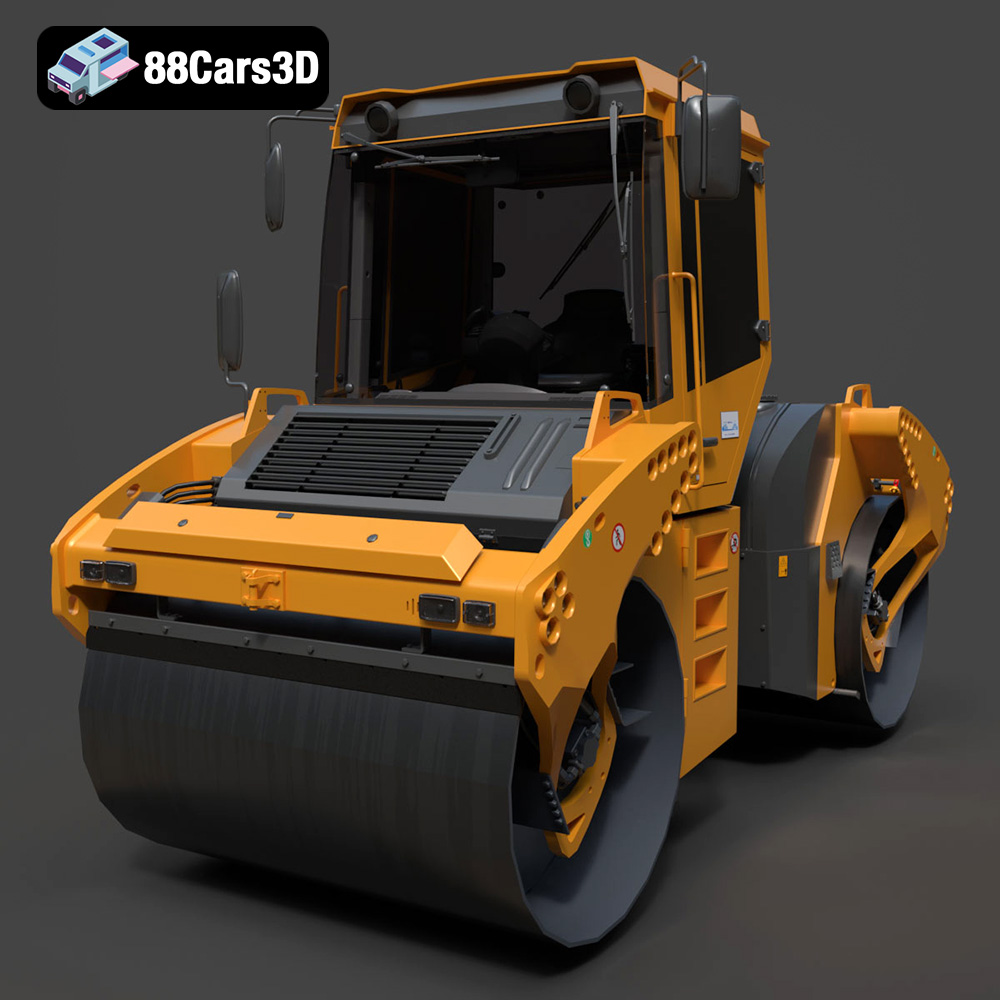
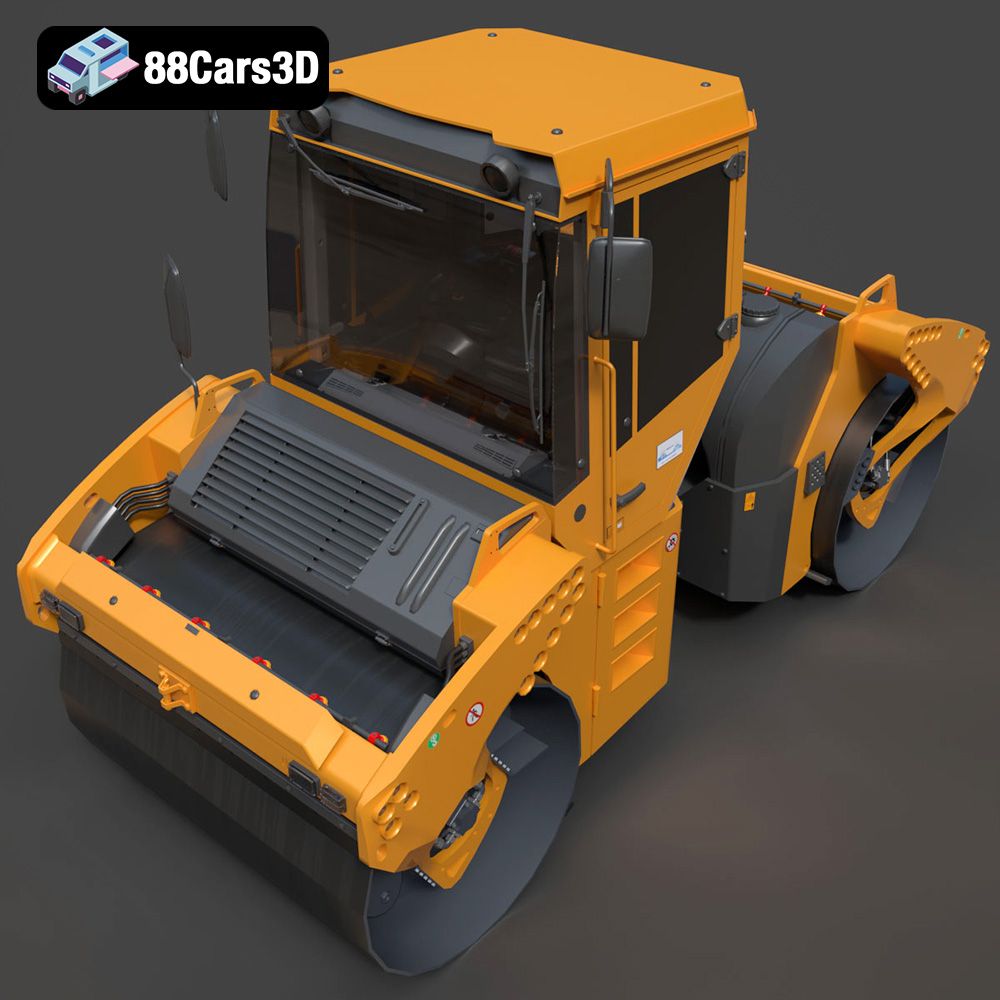
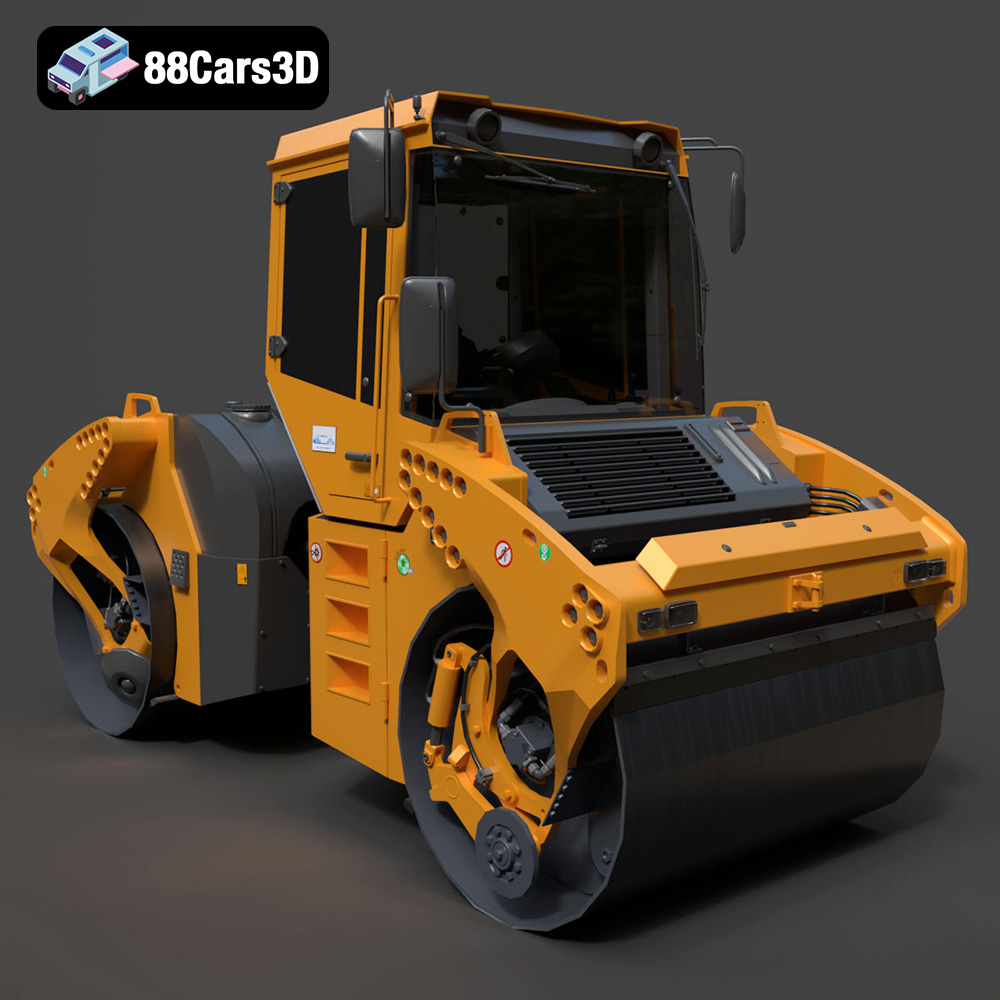
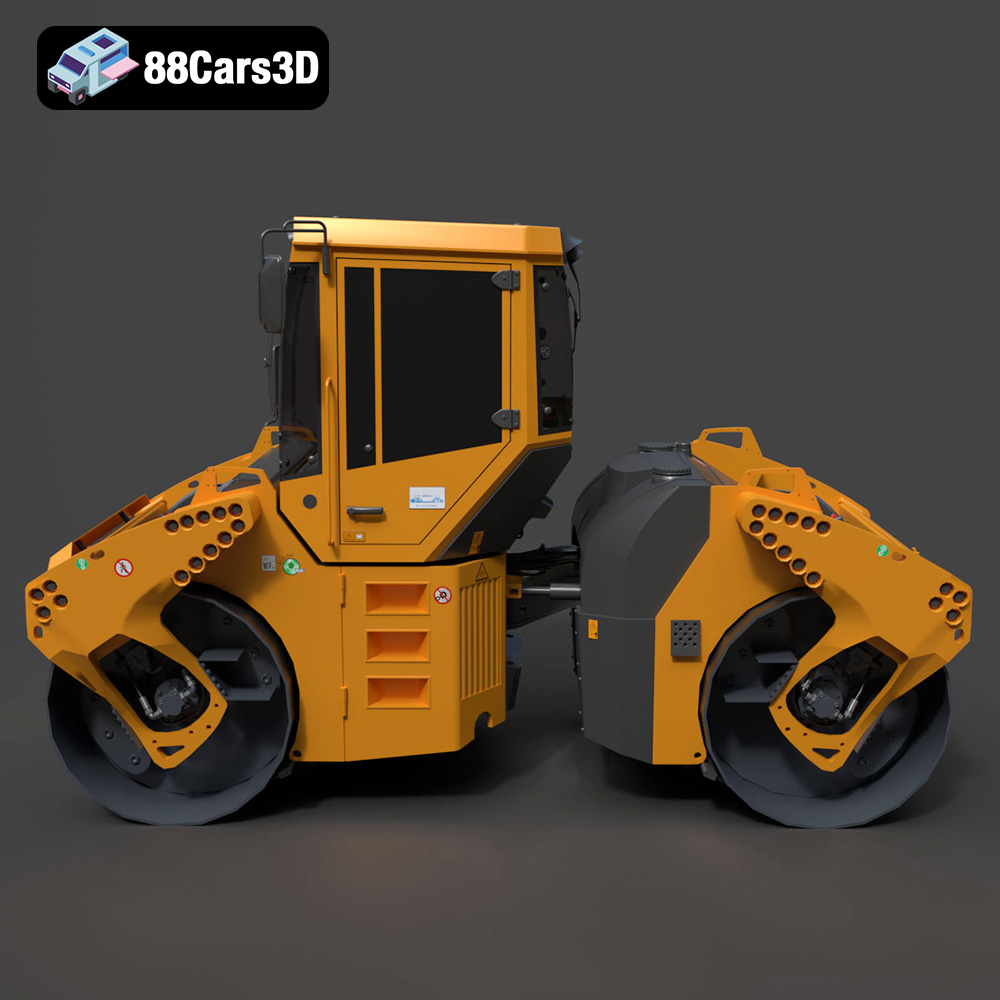
Every visual element of this road roller model is meticulously crafted. The exterior features showcase accurate frame geometry, capturing the robust proportions of a real-world tandem road roller. Beyond the primary shapes, the model includes finely detailed hydraulic rams, hoses, and the critical mechanical articulation joint that allows the machine to steer. The dual steel compaction drums are rendered with realistic weathered and dusty texturing, immediately conveying a sense of practical use on a construction site. Authentic lighting details, including work lights, beacons, and safety indicators, are present, ready to be illuminated for night scenes or emergency situations. The robust roll-over protection structure (ROPS) and safety railings are precisely modeled, reflecting industry safety standards, while detailed chassis components and side-mounted engine access panels complete the heavy-duty aesthetic.
The level of detail extends beyond the exterior to the operator’s cockpit. This is crucial for applications demanding first-person perspectives, such as heavy machinery simulators or interactive training modules. The model features an ergonomic operator suspension seat, textured floor mats, a detailed steering wheel, and precise directional joysticks. An accurate instrument cluster and industrial control panel are included, complete with safety switches, levers, and pedals. This attention to interior detail ensures that the model provides an immersive and credible experience, making it a perfect game asset for those seeking realism from every angle.
Beyond visual fidelity, technical accuracy is paramount. The Articulated Tandem Road Roller model adheres to real-world scale, based on actual paving vehicle dimensions. This ensures that when integrated into an architectural visualization or a game environment, it fits seamlessly alongside other real-world scaled assets. Furthermore, the model boasts proper pivot setups for accurate articulated steering, drum rotation, and chassis flex. This engineering consideration is vital for animators and game developers who need the vehicle to behave realistically, allowing for dynamic and believable movement without extensive re-rigging.
In the realm of modern 3D applications, high visual quality must often be balanced with optimized performance. A stunning model that brings a system to its knees is of little practical use in real-time environments. The Articulated Tandem Road Roller Dusty 3D Model demonstrates a masterful approach to this challenge, making it an ideal choice for game development, AR/VR, and other interactive experiences.
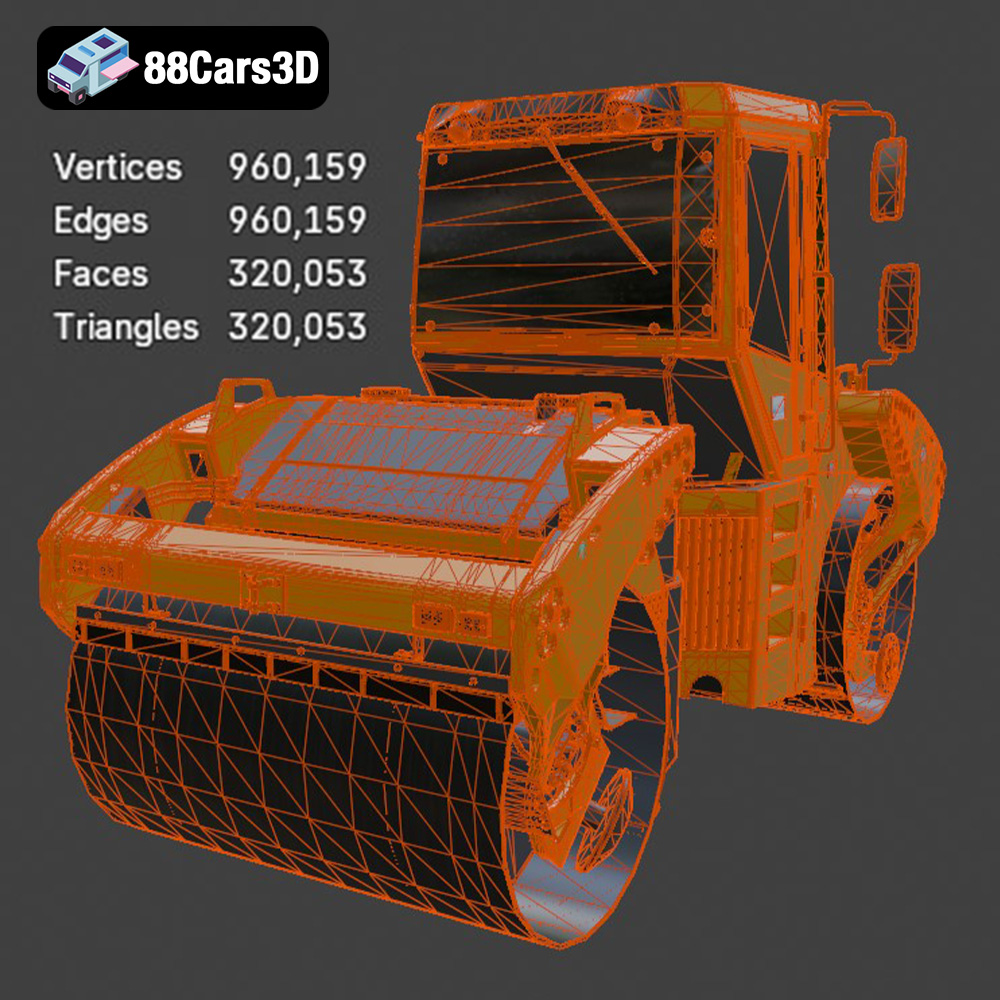
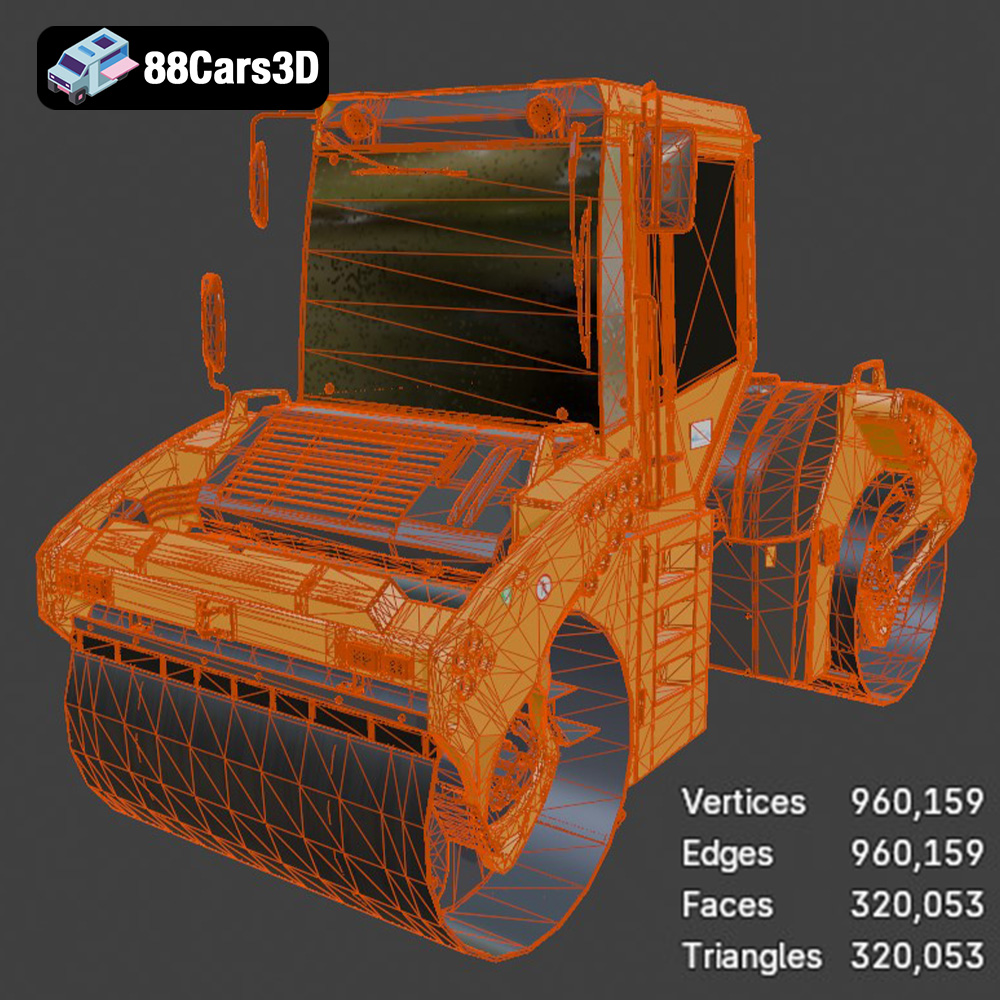
The model strikes a perfect balance with a highly detailed yet efficient topology of 320,053 triangles. This specific poly count is a deliberate choice, designed to provide high-end visual realism without overburdening game engines like Unreal or Unity. For context, many game-ready vehicles can range from 100,000 to over a million triangles, depending on the game’s fidelity targets and platform. At 320,053 triangles, this road roller delivers significant detail – capturing complex curves, mechanical components, and a robust profile – while remaining optimized for smooth frame rates in demanding real-time environments. This makes it an exceptional game asset, ready for integration into complex scenes alongside other detailed 3D car models or environmental elements.
The geometry is structured to support seamless integration into real-time engines. This typically involves clean UV unwrapping for efficient texture application and proper material zones for Physical Based Rendering (PBR) workflows. When imported into Unreal Engine or Unity via its .fbx or .unreal formats, the model’s textures (albedo, normal, roughness, metallic, AO maps) can be quickly linked to create realistic PBR materials that respond accurately to light. This ease of integration saves developers significant time and resources, allowing them to focus on game logic and environment design rather than asset optimization.
Beyond its static mesh, the model’s design includes crucial animation-ready features. Separate drums and steering articulation components are properly pivoted, enabling smooth and accurate articulated steering, drum rotation, and even subtle chassis flex. This pre-configured setup is a huge advantage for animators and game designers, as it eliminates the laborious task of setting up pivots and hierarchies from scratch. Developers can immediately begin animating the road roller’s movement, whether it’s navigating a virtual construction site, performing compaction tasks in a simulator, or participating in an in-game cinematic.
The versatility of a well-crafted 3D model like the Articulated Tandem Road Roller Dusty extends across a multitude of industries and applications. Its balanced optimization and detail make it adaptable to scenarios ranging from interactive digital experiences to tangible physical replicas.
The immersive capabilities of Augmented Reality (AR) and Virtual Reality (VR) are transforming how we interact with digital content. For the construction and industrial sectors, this model is perfect for developing immersive safety training modules. Imagine a trainee virtually operating the road roller, learning safety protocols and operational procedures in a realistic, risk-free environment. It’s also ideal for virtual showrooms, allowing potential buyers to inspect the machinery from every angle, or for mobile AR experiences where a digital road roller can be superimposed onto a real-world construction site, providing context and visualization. The .glb format, in particular, is optimized for these browser and mobile-based AR/VR displays, facilitating smooth, interactive experiences.
In architectural visualization, context is everything. Placing a detailed Articulated Tandem Road Roller on a virtual construction site adds realism and scale to proposed developments. For industrial marketing campaigns, the model can be used in high-resolution renders and animations to showcase new equipment, demonstrate capabilities, or simply add a robust, authentic element to promotional materials. Its weathered, dusty finish immediately tells a story, making it excellent for studio lighting setups and cinematic sequences that require a grounded, hard-working aesthetic. For automotive rendering projects that involve heavy machinery, this model adds a layer of professionalism.
The digital realm can seamlessly transition into the physical thanks to 3D printing. The Articulated Tandem Road Roller Dusty 3D Model is convertible to .stl format, making it suitable for display-scale hobbyists and dioramas. The product description even provides specific 3D print settings, recommending scales like 1:35, 1:50, or 1:87, and suggesting resin printing for fine details like hydraulic lines. This opens up avenues for creating tangible prototypes, educational models, or highly detailed elements for miniature construction scenes. The advice on post-processing – including sanding, priming, and applying authentic industrial colors with weathering – guides users toward achieving a truly authentic physical replica.
Acquiring a high-quality 3D model is just the first step. The true power lies in how seamlessly it integrates into existing professional workflows. The Articulated Tandem Road Roller Dusty 3D Model, with its diverse file formats and optimized structure, is designed for smooth integration across various industry-standard software.
For users of 3ds Max, the native .max file provides the most comprehensive access. It allows direct manipulation of all scene elements, including materials, textures, and geometry, enabling artists to easily adjust the model to specific project requirements. Animators can leverage 3ds Max’s powerful rigging and animation tools, building upon the model’s pre-defined pivots for steering and drum rotation. Similarly, Blender users benefit from the native .blend file, offering full editability. This is crucial for artists who might want to re-texture the road roller with custom materials, add unique wear-and-tear using Blender’s procedural tools, or integrate it into complex scene compositions for high-fidelity rendering with Cycles or Eevee. Both software environments allow for precise control over the model’s appearance and behavior, making it versatile for any automotive rendering or industrial visualization project.
Unreal Engine, a leading real-time platform for games and simulations, is a prime destination for this model. Importing the .fbx file is a straightforward process. Once in Unreal, developers can set up PBR materials, ensuring that the dusty, weathered textures accurately reflect light. Critical steps involve generating collision meshes (either simple box collisions for basic movement or more complex per-poly collisions for detailed interaction), and configuring LODs (Levels of Detail). LODs are essential for performance optimization in large environments; they automatically swap to lower-poly versions of the model when it’s further from the camera, reducing rendering overhead without noticeable visual degradation. The model’s optimized polycount and clear geometry facilitate these processes, making it a truly game-ready asset.
Beyond static placement, the Articulated Tandem Road Roller can become a dynamic, interactive element. In game development, it can be scripted to be a drivable vehicle, complete with realistic physics and controls, contributing to a rich open-world or simulator experience. For industrial simulations, it can be integrated into a larger virtual construction site, interacting with other machinery, terrain, and simulated environmental factors. The model’s proper pivot setup is invaluable here, allowing developers to focus on the behavioral logic rather than foundational rigging. This level of readiness significantly accelerates production timelines, making it a cost-effective solution for creating compelling 3D car models and industrial assets.
While the Articulated Tandem Road Roller Dusty 3D Model is already a high-quality, game-ready asset, its true long-term value lies in its inherent customizability and potential for adaptation across various projects. Savvy professionals understand that digital assets are investments, and their longevity depends on their flexibility.
The included customization options provide extensive creative control. Users can easily change equipment colors, for instance, from the standard industrial yellow or orange to custom fleet colors specific to a company or game faction. The ability to modify dirt and weathering textures allows for seamless integration into diverse environments – from a pristine factory-fresh look to heavy mud and dust variants that tell a story of hard work on challenging terrains. Adjusting material finishes, such as switching between matte metal, rusted steel, or gloss paint, provides further avenues for aesthetic modification. Even lighting setups can be adapted for specific conditions, like realistic night-time construction environments, enhancing the atmospheric impact of a scene. This flexibility ensures the model can be tailored to fit almost any visual brief, providing immense value to any project utilizing 3D car models or industrial equipment.
A well-structured 3D model like this road roller is not a one-off purchase but a foundational asset that can be reused and adapted across multiple projects. Its modular design (separate drums, articulation joint, cockpit components) means elements can potentially be isolated and repurposed for other construction vehicles or machinery. The high-quality base mesh and textures serve as an excellent starting point for future variations, updates, or even next-generation game titles. By investing in such a versatile and technically sound model from 88cars3d.com, studios and individual artists future-proof their asset libraries, ensuring they have high-quality, adaptable resources at their fingertips for years to come. This approach not only saves time and money but also fosters consistency and quality across a portfolio of work.
The journey through the intricacies of the Articulated Tandem Road Roller Dusty 3D Model underscores a fundamental truth in the digital content creation industry: high-quality, technically optimized assets are indispensable. From the meticulous detail of its exterior and interior to its game-ready poly count and diverse file format compatibility, this model represents the pinnacle of industrial 3D modeling.
Whether you’re developing a cutting-edge construction simulator, crafting immersive AR/VR training experiences, producing photorealistic architectural visualizations, or even bringing a digital concept to life through 3D printing, the demands for realism and performance are constant. This road roller model, with its authentic weathered finish and carefully engineered structure, provides a robust solution, streamlining workflows and elevating the visual fidelity of your projects. It’s an investment in efficiency, quality, and the power to create truly captivating digital worlds.
For professionals seeking top-tier 3D car models, industrial vehicles, and game assets that offer both aesthetic excellence and technical prowess, platforms like 88cars3d.com continue to be a vital resource. The Articulated Tandem Road Roller Dusty 3D Model is a testament to the fact that with the right assets, the possibilities for digital creation are truly limitless.
The Articulated Tandem Road Roller Dusty edition captures the rugged essence and heavy-duty presence of essential construction machinery. Featuring its iconic dual steel compaction drums and a highly detailed articulated center pivot, this model showcases a realistic weathered, dusty finish that brings authentic industrial character to any scene. From the intricate hydraulic routing to the robust operator platform, every visual element is meticulously crafted to reflect the true nature of earthmoving and paving equipment. Boasting a highly detailed yet efficient topology of 320,053 triangles, this 3D model offers the perfect balance between high-end visual fidelity and game-ready optimization. The geometry is structured to support seamless integration into real-time engines and complex renders, making it an exceptional asset for game development, AR/VR experiences, industrial animation, and professional visualization. Perfect for construction site simulations, heavy machinery games, industrial visualizations, and detailed diorama renders.
$34.50
.blend
.fbx
.glb
.max
.obj
.ply
.rendering
.stl
.unreal
articulated-tandem-road-roller
car-3d-model
construction-vehicle
dusty
game asset
game-ready
heavy-machinery
low-poly
optimized
road-roller
VR/AR