

In the dynamic world of 3D visualization, the quality of your assets dictates the impact and realism of your final output. Whether you’re crafting a cinematic masterpiece, developing an immersive game environment, or showcasing architectural designs, the vehicles that populate your scenes play a crucial role. This is especially true for luxury automobiles, where every curve, reflection, and interior stitch speaks volumes about sophistication and precision. It’s here that a meticulously crafted 3D model, such as the Bentley Continental Flying Spur 3D Model, becomes an indispensable tool for professionals seeking unparalleled fidelity.
The Bentley Continental Flying Spur, an icon of executive luxury, demands nothing less than absolute accuracy when translated into a digital medium. This particular 3D model goes beyond mere aesthetics, offering a robust foundation for a multitude of professional applications. From photorealistic rendering and automotive visualization to demanding real-time simulations and virtual production, a high-quality asset provides the technical integrity required to deliver outstanding results. It’s an investment in efficiency and visual excellence, streamlining workflows and empowering creators to focus on their artistic vision rather than wrestling with subpar geometry or inconsistent materials.
Understanding 3D Model File Formats
Navigating the diverse landscape of 3D software and engines requires a fundamental understanding of various file formats. Each format is engineered with specific strengths, making it ideal for particular stages of a project or different end-use applications. The Bentley Continental Flying Spur 3D Model from 88cars3d.com comes equipped with a comprehensive suite of formats, ensuring maximum compatibility and flexibility for any professional workflow.
.blend – The Blender Powerhouse
The .blend format is the native file type for Blender, an incredibly powerful open-source 3D creation suite. When you receive a .blend file, you’re getting a complete Blender scene, often including the model with its materials, textures, lighting setup, and even animation rigs. This format is ideal for users who primarily work in Blender and require full editability. Artists can delve into the original mesh, modify UVs, adjust shaders, re-rig for custom animations, or completely repurpose parts of the model. Its strength lies in its comprehensive nature, encapsulating everything needed to continue development within the Blender ecosystem, making it perfect for custom modifications and advanced artistic control.
.fbx – The Industry Workhorse for Real-Time
.fbx (Filmbox) is arguably one of the most widely supported proprietary 3D file formats, developed by Autodesk. It’s an excellent choice for transferring 3D data between different software applications and is especially prevalent in game development pipelines like Unreal Engine and Unity. FBX can store not just geometry, but also materials, textures, animations, skinning, and camera data, making it incredibly versatile. Its binary nature typically results in smaller file sizes and faster loading times compared to text-based formats. When working with the Bentley Continental Flying Spur for game development, .fbx is your go-to for ensuring all animated components, like wheels or doors, transfer correctly and efficiently into the game engine.
.obj – The Universal Standard
The .obj (Wavefront Object) format is a venerable, universally recognized format for 3D geometry. It’s a simple, text-based file that primarily describes the geometry of a 3D object – its vertices, faces, and UV coordinates. While it doesn’t natively store animation or advanced material properties (these are typically handled by an accompanying .mtl file), its simplicity ensures broad compatibility across virtually all 3D software packages. For cross-software transfers where pure mesh data is paramount, or as a reliable fallback, .obj remains an indispensable format. It’s perfect for ensuring the core geometry of the Bentley model can be imported and worked on in almost any 3D application.
.glb – Optimized for AR, VR, and Web
.glb (GLB Transmission Format) is the binary version of glTF (GL Transmission Format), a relatively newer format rapidly gaining traction for web-based 3D, augmented reality (AR), and virtual reality (VR) applications. GLB packages all necessary assets – geometry, materials, textures, animations – into a single, self-contained binary file. This optimization significantly reduces load times and simplifies deployment, making it ideal for interactive 3D viewers on websites, AR filters, or VR experiences where performance and single-file distribution are critical. If you’re planning to showcase the Bentley Continental Flying Spur in an interactive web configurator or an AR app, the .glb format offers unparalleled convenience and efficiency.
.stl – The 3D Printing Foundation
The .stl (Stereolithography) format is the de facto standard for 3D printing. It represents a 3D model as a series of connected triangles, essentially describing the surface geometry without color or texture information. While simple, its widespread adoption by 3D printers and slicing software makes it essential for physical prototyping. When converting a complex model like the Bentley Continental Flying Spur for 3D printing, careful consideration of scale, wall thickness, and manifold geometry is necessary, but the .stl format provides the universal language for getting your digital model into the physical world. For creating a miniature Bentley for display, .stl is the format you’ll use.
.ply – Precision Mesh for CAD and Analysis
.ply (Polygon File Format) is another format for storing 3D data, particularly useful for scanned data, CAD applications, and scientific visualization. It can store a wider range of properties than .obj, including color, transparency, and normal information per vertex or face. This makes it suitable for precise mesh analysis or when working with highly detailed point cloud or scanned data. While less common for general animation, .ply offers a robust solution for specific visualization or engineering-focused applications where fine-grained mesh data is critical.
.unreal – Engine-Ready Asset for Real-Time Environments
The .unreal format signifies an asset specifically configured and optimized for Unreal Engine. This often implies that the model has been imported, had its materials set up using Unreal’s physically-based rendering (PBR) system, collision meshes generated, and potentially Level of Detail (LOD) assets created. Having an asset in .unreal format means it’s practically plug-and-play for Unreal Engine projects, saving significant time on asset preparation and integration. For game developers or virtual production studios utilizing the Bentley Continental Flying Spur, this pre-configured asset dramatically speeds up the workflow, ensuring optimal performance and visual quality within the engine.
.max – The 3ds Max Professional’s Choice
The .max format is the native file type for Autodesk 3ds Max, a leading software in architectural visualization, cinematic rendering, and animation. Similar to .blend, a .max file contains the complete scene, including geometry, materials, lighting, cameras, and animation data. It offers full editability within 3ds Max, allowing professionals to leverage its powerful modifiers, robust rendering engines (like V-Ray or Corona Renderer), and comprehensive animation toolsets. For studios deeply integrated into the 3ds Max ecosystem, having the Bentley model in .max format provides immediate access to high-fidelity rendering and sophisticated scene construction.
The Essence of High-Quality Automotive 3D Models
Creating a truly exceptional 3D car model is an art form backed by rigorous technical discipline. It’s not just about replicating a vehicle’s appearance, but ensuring its digital integrity holds up under the most demanding scrutiny. The Bentley Continental Flying Spur 3D Model exemplifies these principles, offering a benchmark for what professionals should expect from premium automotive assets.
Topology and Mesh Integrity
At the heart of any good 3D model is its topology – the arrangement of its vertices, edges, and faces. For an automotive asset like the Bentley, clean, quad-based topology is paramount. This ensures smooth subdivision, artifact-free deformation (should the model be animated), and efficient unwrapping for UVs. Poor topology can lead to pinching, shading errors, and difficulties in modification. The Bentley Continental Flying Spur model, with its “exceptionally clean topology,” guarantees that it will render flawlessly, handle subdivision surfaces gracefully, and be easily manipulated or optimized without introducing visual glitches. This level of precision is critical for cinematic shots where the vehicle is viewed from all angles, or for close-up renders that highlight its luxurious surfaces.
Realistic Materials and Textures (PBR Workflow)
Photorealistic rendering hinges on believable materials. Modern workflows predominantly rely on Physically Based Rendering (PBR), which simulates how light interacts with surfaces in the real world. This involves maps for albedo (base color), roughness, metallic, normal, and sometimes ambient occlusion. The Bentley model’s “realistic materials and textures applied across the body, glass, chrome, and leather surfaces” signify a PBR-compliant setup. This ensures that whether you’re rendering in Blender’s Cycles, 3ds Max with V-Ray, or Unreal Engine, the car will react to lighting accurately, exhibiting the subtle sheen of polished paint, the intricate reflections of chrome, and the rich texture of leather upholstery. The quality of these textures, including their resolution and seamlessness, directly impacts the visual fidelity and ability to hold up under close-up inspection.
Interior and Exterior Fidelity
A luxury car like the Bentley Continental Flying Spur is as much about its opulent interior as its elegant exterior. A high-quality 3D model must capture both with equal diligence. “Meticulously modeled, including complex interior details, chassis elements, and authentic exterior badging” means that from the intricate stitching on the leather seats to the detailed dashboard, and from the brake calipers to the iconic Bentley emblem, every element is faithfully recreated. This level of detail is indispensable for projects requiring full visibility of the car, whether it’s a virtual showroom experience, an immersive VR environment, or a cinematic scene where a character interacts with the vehicle’s interior. Without this comprehensive detail, the illusion of realism quickly breaks down.
Professional Workflows: Integrating 3D Cars into Your Projects
The versatility of a well-made 3D car model extends across numerous professional applications. From marketing campaigns to engineering simulations, the Bentley Continental Flying Spur 3D Model provides a robust foundation, adaptable to diverse industry demands.
Architectural Visualization (ArchViz) & Cinematic Rendering
In ArchViz, vehicles are often used to add scale, context, and life to static architectural renders. A luxury car like the Bentley can instantly elevate the perceived value and sophistication of a property. Using software like 3ds Max with V-Ray or Corona Renderer, the Bentley Continental Flying Spur can be dropped into a scene, lights can be adjusted, and photorealistic images or animations can be generated. For cinematic rendering, the model’s detailed interior and exterior allow for dynamic camera movements, from wide establishing shots to intimate close-ups of the dashboard, creating compelling visual narratives. The “editable 3ds Max file for rendering and animation” (.max) specifically caters to these high-fidelity production pipelines, allowing for advanced lighting setups, material tweaks, and complex animation sequences.
Game Development & Real-Time Engines (Unreal Engine, Unity)
Modern game development demands assets that are not only visually stunning but also highly optimized for real-time performance. The Bentley Continental Flying Spur 3D Model, with its “game-engine ready format for Unreal Engine and Unity” (.fbx and .unreal), is specifically designed to meet these requirements. Developers can integrate it into racing simulators, open-world environments, or interactive experiences. The asset’s clean topology and PBR materials ensure it renders efficiently and consistently across different lighting conditions within the engine. For a high-fidelity game or simulation, having a pre-configured .unreal file dramatically cuts down on integration time, allowing teams to quickly populate their virtual worlds with a premium vehicle that looks great and performs smoothly.
AR/VR and Web-Based Experiences
As augmented reality, virtual reality, and web-based 3D applications become more prevalent, the need for optimized 3D assets grows. The Bentley Continental Flying Spur 3D Model’s inclusion of the “optimized for AR/VR and web-based visualization” (.glb) format is a testament to its forward-thinking design. This format allows for efficient streaming and rendering of 3D content directly in browsers or mobile AR/VR apps, enabling interactive showrooms, virtual test drives, or immersive product presentations. The single-file nature of .glb simplifies distribution, making it easier for brands to offer engaging 3D experiences of their products without extensive technical overhead.
Mastering Real-Time Performance with Game-Ready Assets
While photorealistic renders are impressive, the true test of a 3D asset’s engineering often comes in a real-time environment. Game engines like Unreal and Unity demand not just visual fidelity but also strict performance optimization. The Bentley Continental Flying Spur 3D Model is built with these challenges in mind, making it an excellent candidate for demanding real-time applications.
Optimization Techniques for Game Engines
Achieving smooth frame rates with detailed assets requires thoughtful optimization. High-quality 3D car models typically come with a balanced polygon count – detailed enough for close-ups but optimized to prevent excessive performance drain. Techniques like Level of Detail (LODs), where simpler versions of the model are automatically swapped in at greater distances, are crucial. Additionally, instancing (reusing the same mesh data for multiple instances of the car with different material variations) and efficient material setups (using material instances) are vital for managing draw calls. The “exceptionally clean topology optimized for performance” of the Bentley Continental Flying Spur model implies that it’s constructed with these considerations, allowing developers to integrate it without extensive re-optimization.
Collision Meshes and Physics Integration
For any interactive vehicle in a game or simulation, accurate physics and collision detection are indispensable. This involves creating simplified collision meshes (sometimes referred to as ‘proxy’ meshes) that roughly approximate the car’s shape but are far less complex than the render mesh. These invisible meshes handle all interactions with the environment – driving over terrain, colliding with obstacles, or triggering events. Integrating the Bentley Continental Flying Spur into a driving simulator would involve setting up its physics constraints, suspension, and wheel rotation, all of which rely on robust underlying collision geometry. A well-designed game asset will make this integration process much smoother, often including pre-built collision primitives or easily adaptable geometry.
Animating the Bentley: Doors, Wheels, Suspensions
Beyond static representation, many projects require the vehicle to be animated. This could involve opening doors, rotating wheels, articulating suspension systems, or even simulating damage. A high-quality model like the Bentley Continental Flying Spur should be structured in a way that facilitates these animations. This often means separate, pivot-point-aligned meshes for components like doors, wheels, and steering mechanisms. The “.fbx – Game-engine ready format” is particularly adept at carrying this animation data, ensuring that if the model comes with pre-rigged parts or is intended for animation, all necessary hierarchies and pivot points are correctly established, allowing for realistic dynamic behavior within the engine.
Beyond Rendering: 3D Printing and Prototyping
The utility of a comprehensive 3D model extends beyond the digital realm, bridging the gap into physical production and analysis. The Bentley Continental Flying Spur 3D Model offers formats specifically tailored for these tangible applications, opening up possibilities for prototyping, display, and even engineering-level scrutiny.
Utilizing .stl and .ply for Physical Models
For designers, engineers, and enthusiasts who wish to bring their digital creations into the physical world, 3D printing is an invaluable tool. The “.stl – Suitable for 3D printing and prototyping” format provided with the Bentley model is the industry standard for this. It allows the creation of physical scale models, custom parts, or even detailed prototypes of the car. While the level of detail achievable in a 3D print depends on the printer’s capabilities and the model’s preparation, having a clean .stl output from the start simplifies the process significantly. Furthermore, the “.ply – Detailed polygon mesh for analysis and visualization” can be used for more intricate industrial analysis or for specialized printing techniques where per-vertex data like color might be relevant.
Preparing Models for Manufacturing and Analysis
In a more industrial context, precise 3D models can serve as a basis for manufacturing processes or detailed engineering analysis. While not directly CAD-native, a high-quality polygon mesh like that of the Bentley Continental Flying Spur can be invaluable. It can be used for reverse engineering, generating molds (with proper design for manufacturing considerations), or for simulating aerodynamic flows in computational fluid dynamics (CFD) software (after conversion to NURBS or specific analytical formats). The clean geometry and meticulous detailing mean that engineers or product designers have a solid foundation to work from, reducing the effort needed to adapt the model for specific analytical or manufacturing tasks.
Conclusion
In the ever-evolving landscape of 3D production, the demand for high-quality, versatile assets is constant. The Bentley Continental Flying Spur 3D Model stands as a prime example of what an exceptional 3D automotive asset should be: meticulously detailed, technically robust, and adaptable to a multitude of professional workflows. From captivating photorealistic renders and cinematic sequences to optimized game assets for real-time engines, and even physical 3D prints, its comprehensive array of included file formats – .blend, .fbx, .obj, .glb, .stl, .ply, .unreal, and .max – ensures unparalleled flexibility.
Investing in a model of this caliber from 88cars3d.com means acquiring not just a digital representation of a luxury vehicle, but a powerful tool that streamlines your production pipeline, enhances visual fidelity, and empowers you to deliver stunning results across various industries. Whether your project demands the ultimate in automotive rendering, seamless game integration, or innovative AR/VR experiences, the Bentley Continental Flying Spur 3D Model is engineered to exceed expectations, allowing you to focus on creativity while resting assured of technical excellence.
Featured 3D Model
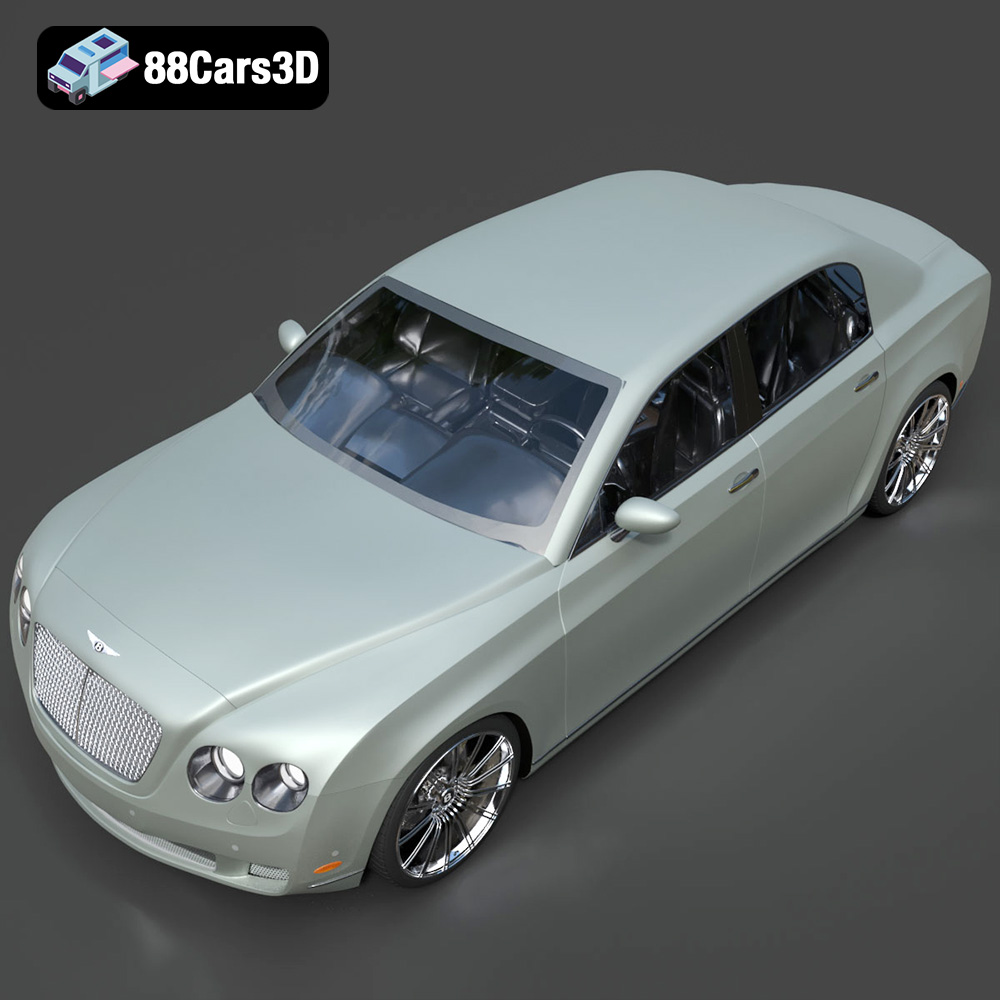
Bentley Continental Flying Spur 3D Model
Experience the sophistication of luxury motoring with this precise 3D model of the Bentley Continental Flying Spur. This model captures the iconic silhouette and detailed engineering of the executive sedan, making it perfect for photorealistic rendering projects, automotive visualization, and virtual production environments.
The asset features exceptionally clean topology optimized for performance without sacrificing visual fidelity. All components are meticulously modeled, including complex interior details, chassis elements, and authentic exterior badging. Realistic materials and textures are applied across the body, glass, chrome, and leather surfaces, ensuring professional results in any rendering engine.
Designed for maximum versatility, the Bentley Continental Flying Spur 3D Model is suitable for professional applications including architectural visualization (ArchViz), cinematic sequences, detailed vehicle simulations, and integration into modern game engines like Unity and Unreal Engine. Whether you require a static render or a dynamic asset for a driving simulator, this model is built for reliable performance.
$14.99
Product Image Gallery




Related Tags
.arvr
.bentley
.blend
.car3dmodel
.continental
.continentalflyingspur
.executivecar
.fbx
.flyingspur
.gameasset
.glb
.luxurycar
.max
.obj
.ply
.rendering
.sedan
.simulation
.stl
.unreal
