

Driving Digital Excellence: The Iconic BMW 3 Series E21 in 3D
Few vehicles evoke the same blend of nostalgia, performance heritage, and timeless design as the BMW 3 Series E21. As the inaugural generation of BMW’s legendary compact executive range, the E21 captured the hearts of drivers with its “shark nose” aesthetic, driver-centric cockpit, and engaging handling. Fast forward to today, and the allure of this classic machine is not limited to physical roads. In the world of 3D modeling, the E21 continues to inspire, serving as a powerful asset for digital artists, game developers, architects, and simulation engineers.
Crafting a faithful and technically robust 3D model of such an icon is an art form in itself. It requires not just an eye for detail, but also a deep understanding of geometry, topology, material science, and various software ecosystems. This is where premium 3D car models truly shine, transforming complex automotive engineering into versatile digital assets. Whether you’re aiming for photorealistic renders, immersive game environments, or precise engineering simulations, a high-quality model like the BMW 3 Series E21 3D Model available on 88cars3d.com becomes an indispensable tool. It provides the foundation for bringing the elegance and mechanics of this classic car to life in countless digital applications.
Understanding 3D Model File Formats
The versatility and broad application of a 3D model often hinge on the file formats it supports. Different formats are optimized for distinct purposes, software environments, and performance requirements. Understanding these distinctions is crucial for anyone working with 3D assets, especially when integrating a complex model like the BMW 3 Series E21 into a professional pipeline. At 88cars3d.com, a comprehensive range of formats is provided to ensure maximum compatibility and utility for diverse projects.
.blend – The Native Blender Scene
The .blend format represents a fully editable Blender project file. This is ideal for artists and studios that utilize Blender as their primary 3D creation suite. A .blend file typically includes not just the mesh data, but also all materials, textures, lighting setups, cameras, animations, and even modifiers or constraints applied to the model. For the BMW 3 Series E21 3D Model, having a .blend file means users can directly open the model in Blender with all its meticulously configured materials and scene elements intact, ready for immediate rendering, animation, or further customization within the Blender ecosystem.
.fbx – The Industry Workhorse for Real-Time
.fbx (Filmbox) is one of the most widely adopted proprietary file formats for 3D content exchange, particularly favored in the game development and real-time visualization industries. Developed by Autodesk, FBX supports geometry, materials, textures, animations, skinning, and camera data. Its strength lies in its ability to efficiently transfer complex scenes between different 3D software (like 3ds Max, Maya, Blender) and game engines such as Unreal Engine and Unity. When you acquire the E21 model in .fbx, you’re getting an asset optimized for seamless integration into interactive environments, preserving crucial animation data for elements like opening doors or rotating wheels.
.obj – Universal Compatibility for Cross-Software Workflows
The .obj (Wavefront OBJ) format is a universal, text-based standard for exchanging 3D geometry data. While it might not carry advanced features like rigging or animation, it excels at representing mesh data (vertices, normals, texture coordinates, and faces) and can link to external material (.mtl) files for basic shading. Its simplicity and widespread support make it an excellent choice for cross-software compatibility. Virtually every 3D application can import and export .obj, making the BMW 3 Series E21 3D Model accessible regardless of your preferred modeling or rendering software.
.glb – Optimized for AR, VR, and Browser-Based Display
.glb (GLB format, often referred to as glTF Embedded Binary) is a modern, efficient, and versatile 3D file format that has gained significant traction for web-based 3D, Augmented Reality (AR), and Virtual Reality (VR) applications. It is the binary version of glTF (Graphics Language Transmission Format), designed to be a “JPEG for 3D.” A .glb file packages all necessary data (geometry, materials, textures, animations) into a single, self-contained file, making it incredibly easy to load and display in browsers and real-time engines. For interactive product configurators, AR experiences of the E21, or web-based showrooms, .glb is the format of choice due to its optimization for fast loading and rendering.
.stl – The Standard for 3D Printing Output
The .stl (STereoLithography) format is the de facto standard for 3D printing. It represents a 3D model as a collection of unconnected triangular facets, defining only the surface geometry of an object without color, texture, or other CAD attributes. While simple, its ubiquity in manufacturing means that if you want to bring the BMW 3 Series E21 3D Model into the physical world through 3D printing, the .stl file is essential. The model’s “watertight” geometry ensures a successful conversion and print, making it suitable for creating physical scale models or prototypes.
.ply – Precision Mesh Format for CAD or Analysis
.ply (Polygon File Format or Stanford Triangle Format) is another format for storing 3D data, particularly popular for scanned 3D data and in scientific or engineering applications. It can store various properties beyond just geometry, such as color per vertex, normal vectors, and even transparency. While less common for general 3D model exchange compared to .fbx or .obj, its ability to store detailed mesh attributes makes it valuable for specific CAD workflows, precise geometric analysis, or when working with point clouds generated from laser scanners. It offers a robust option for the E21 model when precision data is paramount.
.unreal – Engine-Ready Asset for Real-Time Environments
The inclusion of an .unreal file (often referring to a specific project setup or asset package for Unreal Engine) signifies an asset that has been specifically prepared and configured for optimal use within the Unreal Engine ecosystem. This means materials are typically set up with PBR (Physically Based Rendering) principles, textures are correctly applied, and collision meshes or LODs (Level of Detail) might be pre-configured. This format greatly streamlines the integration process for game developers and real-time visualization specialists using Unreal Engine, allowing them to drop the BMW 3 Series E21 3D Model directly into their projects with minimal setup.
.max – The Definitive 3ds Max Project File
Similar to .blend for Blender, the .max format is the native file type for Autodesk 3ds Max, a powerful 3D modeling, animation, and rendering software widely used in architectural visualization, product design, and cinematic production. A .max file contains the complete scene, including the model’s geometry, materials, textures, lighting, cameras, animation data, and any modifiers or procedural elements. For users of 3ds Max, this format provides full editability and direct access to the model’s original construction, making it perfect for high-end rendering projects, detailed animations, or further scene development involving the E21.
The Art of Crafting High-Fidelity Automotive 3D Models
Creating a truly exceptional 3D car model, such as the BMW 3 Series E21 available at 88cars3d.com, goes far beyond simply tracing blueprints. It’s a meticulous process that combines artistic skill with technical precision, ensuring the digital representation is not only visually stunning but also functionally robust for a myriad of applications. This attention to detail is what separates a generic asset from a professional-grade product.
Topology and Mesh Quality: The Foundation of Realism
At the heart of any high-quality 3D model is its topology – the arrangement of vertices, edges, and faces that form the mesh. The BMW 3 Series E21 3D Model boasts clean, quad-dominant topology. This is paramount for several reasons:
- Smooth Subdivision: Quad-based meshes deform gracefully when subdivided, allowing for increased detail and smooth curves without artifacts, crucial for a car’s flowing body panels.
- Efficient Deformation: For animation, particularly dynamic elements like suspension movement or minor body flex, clean quads ensure predictable and natural deformation.
- Ease of Editing: A logical edge flow makes the model easier to modify, repair, or optimize for specific project needs.
- Rendering Performance: While not always directly tied to quads vs. triangles, optimized topology can contribute to more efficient rendering by reducing unnecessary complexity.
Furthermore, the product description highlights a “balanced level of detail.” This implies careful optimization of poly counts – ensuring sufficient detail where it matters (e.g., body lines, grilles, interior elements) without overburdening the mesh with excessive polygons in less critical areas. This balance is key for performance in real-time applications without sacrificing visual fidelity in high-resolution renders.
Real-World Accuracy and Scale
A critical technical advantage of professional 3D car models is their adherence to real-world scale. The BMW 3 Series E21 model is built to accurate dimensions, ensuring it integrates seamlessly into diverse scenes and environments without requiring scale adjustments. This is vital for:
- Architectural Visualization: Placing the car realistically within a virtual street or garage scene.
- Simulations: Accurate scale directly impacts physics and collision detection in vehicle dynamics simulations.
- AR/VR Applications: Maintaining correct proportions for a believable immersive experience.
- Composition and Lighting: Proper scale is fundamental for realistic lighting interaction and depth of field in renders.
Faithful reproduction of elements like the signature kidney grille, dual headlights, and accurate panel gaps underscores this commitment to real-world authenticity, reflecting the vehicle’s original design with precision.
Texturing, Materials, and UV Mapping
Beyond the mesh, materials and textures breathe life into a 3D model. While the description mentions “transparent materials applied to windows, headlights, and taillights,” a professional automotive model typically utilizes a Physically Based Rendering (PBR) workflow for all its surfaces. This involves:
- UV Mapping: Clean, non-overlapping UVs (coordinates that tell a 3D program how to apply a 2D texture to a 3D surface) are essential for high-resolution textures and custom liveries.
- PBR Textures: Maps like Albedo (color), Normal (fine surface detail), Roughness (specular scattering), Metallic (reflectivity), and Ambient Occlusion contribute to hyper-realistic material properties for paint, chrome, rubber, and glass.
- Material Organization: Materials are logically named and grouped, allowing artists to easily customize paint finishes, livery designs, and adjust properties for various components like metals, plastics, and fabrics within the interior.
The ability to customize paint finishes and decal placements, as highlighted in the E21’s description, relies heavily on well-prepared UVs and an organized material structure.
Integrating Automotive 3D Models into Professional Workflows
The utility of a high-quality 3D car model, such as the BMW 3 Series E21 from 88cars3d.com, is realized when it seamlessly integrates into various professional pipelines. Thanks to its clean geometry, organized hierarchy, and diverse file format support, this model is designed to be a versatile asset across different industries.
3ds Max and Blender for High-End Production
For many studios, 3ds Max and Blender remain the powerhouses for detailed modeling, animation, and high-quality rendering. The inclusion of native .max and .blend files with the BMW 3 Series E21 3D Model offers significant advantages:
- Direct Scene Access: Users can open the complete scene with all materials, textures, and object hierarchies pre-configured, minimizing setup time.
- Animation Potential: With separated components for doors, hood, trunk, and wheels, and proper pivot points, animators can easily create realistic opening/closing actions or vehicle dynamics. This is crucial for cinematic sequences, product showcases, or interactive configurators.
- Customization: The editable nature of these native files allows for deep customization, from altering material shaders to adding new details or modifying existing geometry to meet specific project demands. For example, an artist can easily change the vehicle’s color, add custom racing stripes, or even simulate damage effects using 3ds Max or Blender’s robust toolsets.
These environments are ideal for producing stunning studio renders or complex automotive animations where every detail counts.
Unreal Engine for Real-Time Immersion and Game Development
The landscape of real-time 3D has been revolutionized by engines like Unreal Engine. The BMW 3 Series E21 3D Model is specifically geared towards these applications, offering both .fbx and dedicated .unreal formats:
- Game Development: As a “production-ready asset,” the E21 model is suitable for racing games, open-world environments, or interactive car showrooms. Its optimized mesh quality ensures good performance without sacrificing visual fidelity.
- AR/VR Experiences: For immersive augmented and virtual reality, the model’s clean topology and real-world scale facilitate believable interactions. The .glb format further streamlines integration into web-based AR/VR platforms.
- Cinematic Real-Time Rendering: Unreal Engine’s powerful rendering capabilities allow for creating cinematic sequences with dynamic lighting, advanced post-processing, and real-time ray tracing, making the E21 model perfect for virtual production or high-end visualizations that demand speed and flexibility.
- Physics and Interaction: The organized hierarchy and separated components make it straightforward to set up physics simulations for wheels, doors, and suspension within Unreal Engine, enhancing realism for driving simulators or interactive vehicle demos.
Data Preparation for Specialized Applications
Beyond visual applications, the BMW 3 Series E21 model also supports specialized technical workflows:
- Simulation & Training: The model’s real-world scale and detailed, yet efficient, geometry make it ideal for vehicle dynamics simulations, driver training modules, and educational content. Engineers can integrate it into simulation software to test parameters or visualize performance.
- 3D Printing: The mention of “watertight geometry” and the inclusion of an .stl file format mean that the model is perfectly suited for physical replication. Artists and designers can easily convert the digital asset into a tangible collectible or prototype, bringing the E21 from screen to desk.
- CAD and Analysis: The .ply format, designed for precise mesh data, provides an avenue for engineers to import the model into CAD software for further analysis, reverse engineering studies, or integration into larger industrial design projects where accurate geometry is paramount.
Real-World Applications and Case Studies
The versatility of a meticulously crafted 3D car model like the BMW 3 Series E21 transcends theoretical discussions, manifesting in tangible, impactful real-world applications across various industries. From dazzling advertisements to immersive training modules, its capabilities are vast.
Cinematic Automotive Rendering and Visualization
One of the most immediate applications for high-quality 3D car models is in creating stunning visual content. Advertising agencies, film studios, and architectural visualization firms frequently leverage these assets:
- Automotive Commercials: Imagine a modern commercial for a classic car event, featuring the E21 gliding through a virtual landscape, perfectly lit and rendered. Instead of expensive physical shoots and logistics, studios can create cinematic sequences entirely in 3D, controlling every aspect from camera angles to environmental conditions. The clean geometry and customizability of the E21 model allow for photorealistic materials and reflections that rival real-world footage.
- Product Showcases: Car manufacturers or aftermarket parts suppliers can use the model to showcase new components or customization options on a classic E21, even before physical prototypes exist. This facilitates rapid iteration and marketing.
- Architectural Integration: Architects and urban planners often use 3D cars to populate their virtual scenes, adding scale and realism to proposed buildings or urban designs. The accurately scaled E21 can lend a touch of vintage elegance to a modern architectural visualization.
Game Development and Interactive Experiences
The gaming industry thrives on detailed and performance-optimized assets. The BMW 3 Series E21 3D Model is a production-ready asset, perfectly suited for interactive entertainment:
- Racing Games: From retro-inspired racing titles to highly realistic simulators, the E21 could be a prized unlockable or a core vehicle. Its separated components (doors, wheels) allow for accurate physics-based deformation, damage modeling, and dynamic animations during gameplay.
- Open-World Environments: Populating a virtual city or rural landscape with authentic-looking vehicles adds depth and immersion. The E21 could serve as a unique ambient vehicle or a drivable asset for players exploring a historical setting.
- Interactive Car Configurators: Dealerships or classic car restoration companies could develop interactive web or app-based configurators where users can customize the E21’s paint, wheels, interior colors, and even engine options in real-time. The .glb format is particularly beneficial for this, ensuring smooth web integration.
AR/VR and Immersive Visualization
As Augmented Reality and Virtual Reality technologies mature, the demand for optimized 3D assets grows exponentially. The E21 model is designed for these immersive applications:
- Virtual Showrooms: Imagine donning a VR headset and walking around a virtual garage, examining the BMW E21 from every angle, opening its doors, and even sitting inside. This provides an unparalleled level of engagement for potential buyers or enthusiasts.
- AR Car Placement: Using a smartphone or tablet, users could project a life-sized BMW E21 into their driveway or living room via AR, allowing them to visualize its presence and scale in a real-world environment. This is a powerful tool for marketing and pre-visualization.
- Museum and Heritage Experiences: Virtual museums could feature interactive 3D models of classic cars like the E21, allowing visitors to explore its history, design features, and engineering innovations in a highly engaging digital format.
Engineering, Simulation, and 3D Printing
Beyond visuals, the model’s technical precision lends itself to more analytical and tactile applications:
- Vehicle Dynamics Simulation: Engineering firms or research institutions can integrate the accurately scaled E21 model into advanced simulation software to study aerodynamic properties, crashworthiness (though typically a simpler mesh is used for hardcore physics), or vehicle handling characteristics. This supports R&D without requiring physical prototypes.
- Driver Training Modules: For professional driver training or educational purposes, the E21 can be part of a virtual driving simulator, helping trainees understand classic car dynamics or specific historical driving challenges in a safe, controlled environment.
- Prototyping and Scale Models: With its watertight geometry and .stl export capability, the model can be sent to a 3D printer to create physical scale models. This is invaluable for designers wanting to hold a physical representation, or for hobbyists and collectors wanting a custom display piece of their favorite classic.
The BMW 3 Series E21 3D Model truly represents a multifaceted tool, ready to elevate projects across an impressive spectrum of industries. Its availability on 88cars3d.com makes such professional assets accessible for a wide range of creators.
Optimizing for Performance and Visuals
Achieving both stunning visual fidelity and optimal performance in 3D applications is a delicate balance, especially with complex automotive models. Professional assets like the BMW 3 Series E21 3D Model are engineered with this challenge in mind, incorporating various optimization techniques to ensure they shine in any environment, from cinematic renders to real-time interactive experiences.
Level of Detail (LODs) and Instancing
For real-time applications such as games or AR/VR, managing polygon count is crucial. While the E21 model provides a “balanced level of detail” for close-up views, advanced workflows often involve implementing Level of Detail (LODs). This means creating multiple versions of the model, each with progressively fewer polygons. When the car is far from the camera, a low-polygon LOD is displayed, saving computational resources. As it gets closer, higher-detail LODs are swapped in seamlessly. While not explicitly stated as included, the clean topology of the BMW E21 3D Model makes it an excellent candidate for generating efficient LODs manually or through automated tools within game engines. Additionally, instancing (reusing the same mesh data for multiple identical objects) can further reduce memory footprint when populating a scene with several E21s.
Physically Based Rendering (PBR) Workflows
To achieve realistic material responses under various lighting conditions, modern 3D projects universally adopt Physically Based Rendering (PBR) workflows. While the product description mentions “transparent materials,” a comprehensive approach for the entire E21 model would involve a PBR material setup. This means using a set of textures (like Albedo/Base Color, Metallic, Roughness, Normal, Ambient Occlusion) that accurately describe how light interacts with the surface of the car’s paint, chrome, glass, rubber, and interior fabrics. The advantages of PBR are significant:
- Consistent Realism: Materials look correct regardless of the lighting environment.
- Easier Material Creation: Artists can rely on real-world material properties to guide texture creation.
- Cross-Engine Compatibility: PBR materials translate well between different rendering engines and software, ensuring the E21 model maintains its visual integrity.
The E21 model’s material properties can be easily adjusted to achieve desired visual effects, indicating a well-structured material system that supports PBR principles.
Customization and Project Versatility
One of the most powerful aspects of acquiring a professional 3D car model is the extensive customization potential it unlocks. The BMW 3 Series E21 3D Model is designed not just to be beautiful out-of-the-box, but also to be a flexible foundation for diverse creative visions. This versatility allows artists and developers to adapt the model to perfectly fit their unique project requirements.
Tailoring Visuals: Paint, Livery, and Decals
The aesthetic appeal of a car often lies in its finish. The BMW E21 model provides robust options for visual personalization:
- Paint Finishes: Easily customize the car’s paint color, reflectivity, and clear coat properties. Whether you need a glossy, deep metallic blue, a classic non-metallic white, or a matte finish for a futuristic concept, the underlying PBR material setup allows for precise control. Artists can quickly experiment with different automotive paint shaders to match specific branding or moods.
- Livery Designs and Decals: The clean UV mapping and organized material structure make it straightforward to apply custom liveries, racing stripes, sponsorship decals, or warning labels. This is invaluable for game development where multiple versions of a vehicle are often required, or for advertising where specific branding needs to be displayed prominently.
- Material Adjustments: Beyond paint, users can fine-tune material properties for all components – the subtle sheen of chrome, the texture of interior plastics, the worn look of leather seats, or the realistic rubber of the tires. This level of control ensures visual authenticity across the entire model.
Dynamic Elements and Animation
A static model can be beautiful, but an animated one truly comes to life. The BMW 3 Series E21 3D Model is built with animation in mind:
- Separated Components: The doors, hood, trunk, and wheels are modeled as individual, separated components. This is critical for animation, allowing each part to move independently without affecting the main body mesh.
- Proper Pivot Points: The model includes an “organized hierarchy with proper pivot points.” This technical detail is immensely important. Pivot points are the central axes around which objects rotate. Correctly placed pivots for doors, hinges, and wheels ensure that animations look realistic and require minimal setup. For example, a car door will swing open naturally along its hinge axis, and wheels will rotate smoothly around their central hub.
- Workflow Efficiency: This structure significantly speeds up animation workflows in software like 3ds Max, Blender, or game engines. Animators can quickly rig the car for driving sequences, open-door showcases, or even simulate basic suspension movements, making the E21 a dynamic asset for cinematics, interactive experiences, and simulations.
This deep level of customizability and animation readiness ensures that the BMW 3 Series E21 3D Model from 88cars3d.com isn’t just a static render, but a living, adaptable asset that can meet the evolving demands of any creative project.
Conclusion
In the dynamic world of 3D content creation, the difference between a good project and a truly exceptional one often hinges on the quality of its foundational assets. The BMW 3 Series E21 3D Model stands as a testament to this principle, offering a meticulously crafted digital representation of an automotive icon. From its clean, quad-dominant topology and real-world scale to its comprehensive suite of supported file formats and animation-ready structure, this model is engineered for peak performance and visual fidelity across a wide spectrum of applications.
Whether you are a seasoned automotive renderer aiming for breathtaking cinematics, a game developer building an immersive world, an AR/VR enthusiast creating interactive experiences, or an engineer conducting precise simulations, the E21 model provides the technical precision and artistic quality needed to elevate your work. Its robust design ensures seamless integration into major software like 3ds Max, Blender, and Unreal Engine, while its adaptability for customization allows for endless creative iterations.
For any professional seeking to integrate the classic allure and detailed engineering of the BMW 3 Series E21 into their digital projects, this model from 88cars3d.com represents an invaluable investment. It’s more than just a 3D car model; it’s a versatile tool designed to drive digital excellence, offering unparalleled detail, flexibility, and compatibility to power your next big idea.
Featured 3D Model
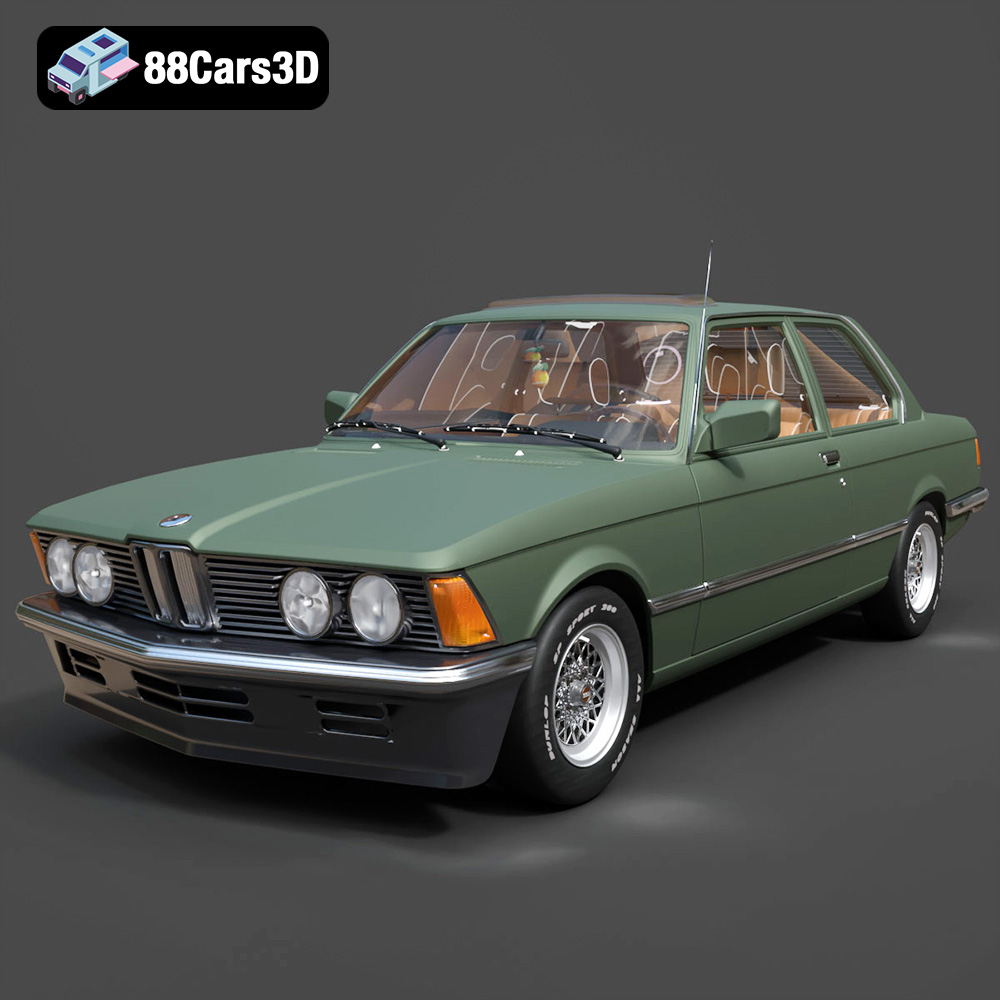
BMW 3 Series E21 3D Model
Presenting a meticulously crafted 3D model of the iconic BMW 3 Series E21, representing the first generation of BMW’s compact executive car. This model captures the distinctive styling and classic allure of the E21 era, known for its elegant lines and driver-focused design. Built with clean geometry and a balanced level of detail, it is optimized for high-quality rendering, realistic animations, precise simulations, and robust integration into game development projects.
Exterior Features:
- Faithful reproduction of the BMW 3 Series E21’s timeless bodywork, including its signature kidney grille and dual headlights.
- Accurate panel gaps and surface curvatures, reflecting the vehicle’s original design.
- Detailed wheel rims and tires with realistic tread patterns.
- Separated components for doors, hood, trunk, and wheels, allowing for dynamic animation workflows.
- Transparent materials applied to windows, headlights, and taillights for realistic light interaction.
Interior / Mechanical Features:
- Detailed interior elements, including dashboard, steering wheel, seats, and door panels, crafted for visual authenticity.
- Replicated controls and gauges within the cockpit for an immersive experience.
- Underlying mechanical components such as basic suspension and brake caliper forms, optimized for efficient mesh quality.
Technical Advantages:
- Clean, quad-dominant topology ensures smooth subdivision and deformation.
- Modeled to real-world scale for accurate integration into diverse scenes and environments.
- Organized hierarchy with proper pivot points for easy manipulation and animation of doors, wheels, and other moving parts.
Applications:
- Rendering & Visualization: Perfect for creating stunning studio renders, cinematic sequences, and architectural visualizations.
- Game Development: A production-ready asset suitable for racing games, open-world environments, and interactive experiences.
- AR/VR: Optimized for real-time applications, enabling immersive augmented and virtual reality experiences.
- Simulation & Training: Ideal for vehicle dynamics simulations, driver training modules, and educational content.
- 3D Printing: Geometry is watertight and can be easily converted to .stl for physical model creation.
Customization Options:
- Easily customize paint finishes, livery designs, and decal placements to match specific project requirements.
- Adjust material properties for metals, plastics, chrome, and rubber to achieve desired visual effects.
- Modify lighting setups to create various atmospheric conditions and scene moods.
Elevate your projects with this professionally crafted BMW 3 Series E21 3D model. Its exceptional detail, technical precision, and broad compatibility make it an invaluable asset for any serious 3D artist, developer, or simulator.
Included File Formats:
- .blend – Blender project with materials
- .fbx – Compatible with Unreal, Unity, and major 3D engines
- .obj – Universal format for nearly all 3D software
- .glb – Optimized for AR, VR, and web-based visualization
- .stl – Ready for 3D printing
- .ply – Mesh format for analysis and CAD workflows
- .unreal – Unreal Engine project setup
- .max – Editable 3ds Max scene for rendering and animation
Tags:
.bmw,.3seriese21,.coupe,.classiccar,.vintagecar,.rendering,.simulation,.gameasset,.arvr,.blend,.fbx,.obj,.glb,.stl,.ply,.unreal,.maxLamborghini Diablo SV 1995 3D Model
$20.79
Product Image Gallery


Related Tags
.3seriese21
.arvr
.blend
.bmw
.classiccar
.coupe
.fbx
.gameasset
.glb
.max
.obj
.ply
.rendering
.simulation
.stl
.unreal
.vintagecar
