

Reviving a Legend: How High-Quality 3D Car Models Drive Modern Digital Projects
In the fast-paced world of digital creation, the demand for realistic and technically precise 3D assets is ever-growing. From cinematic automotive rendering to immersive game development and sophisticated simulations, the foundation of any compelling project often lies in the quality of its core models. Classic cars, with their unique character and timeless design, hold a special place in this digital landscape, offering creators a rich palette of nostalgia and elegance.
One such icon is the BMW 3 Series E21, the trailblazing first generation of BMW’s legendary compact executive line. Its distinctive styling and driver-focused ethos have cemented its place in automotive history. For 3D artists and developers looking to integrate this classic allure into their modern projects, a meticulously crafted digital twin is indispensable. This article delves into the technical intricacies and creative possibilities offered by a premium 3D model like the BMW 3 Series E21, demonstrating its immense value across various professional workflows and highlighting why such high-quality 3D car models are a cornerstone of digital innovation.
The Foundation of Digital Excellence: Understanding 3D Model File Formats
The versatility of a 3D model is often defined by the range and quality of its included file formats. Each format serves a specific purpose, catering to different software environments, use cases, and pipeline requirements. A professional-grade asset, such as the BMW 3 Series E21 3D Model available at 88cars3d.com, ensures compatibility across the board, providing creators with the flexibility needed for complex projects. Understanding these formats is crucial for optimizing workflows and achieving desired outcomes.
.blend: Blender’s Native Powerhouse
The .blend file format is Blender’s native project format, encapsulating an entire scene with all its elements: models, materials, textures, lighting, cameras, animations, and even physics simulations. For artists primarily working within Blender, this format offers the most comprehensive and editable starting point. The BMW 3 Series E21 provided as a .blend file means users can immediately dive into customizing materials with Blender’s Cycles or Eevee render engines, adjust the existing scene setup, or even dissect the model’s clean topology for learning purposes. It ensures that all scene relationships and modifiers are preserved, offering maximum flexibility for artists invested in the Blender ecosystem.
.fbx: The Industry Standard for Interchange
Autodesk’s .fbx (Filmbox) format has become an unofficial industry standard for 3D data exchange between various software applications. It’s renowned for its ability to transfer not just geometry, but also materials, textures, animations, skinning, and camera data reliably. When integrating the BMW 3 Series E21 into game engines like Unreal Engine or Unity, or moving it between 3ds Max, Maya, and Cinema 4D, the .fbx format is often the preferred choice. Its robust structure ensures that complex hierarchies, such as separated doors, hood, and wheels with proper pivot points, are maintained, streamlining animation and rigging workflows.
.obj: Universal Compatibility
The .obj (Wavefront OBJ) format is one of the oldest and most widely supported 3D formats, making it a truly universal solution for transferring mesh data. While it handles geometry and UV coordinates exceptionally well, it typically stores material and texture references in a separate .mtl file. It’s an excellent fallback option when other formats encounter compatibility issues, ensuring that the core mesh of the BMW 3 Series E21 can be opened and worked with in virtually any 3D software. Its simplicity makes it highly stable, though it’s less ideal for complex scene data like animation or rigging information.
.glb: Streamlined for Web and AR/VR
The .glb (GLB Transmission Format) is a binary version of glTF (GL Transmission Format), specifically optimized for efficient transmission and loading of 3D scenes and models in web and real-time applications. It packages geometry, materials, textures, and animation into a single compact file, making it perfect for augmented reality (AR), virtual reality (VR), and browser-based 3D viewers. The inclusion of a .glb file for the BMW 3 Series E21 highlights its readiness for modern, interactive experiences, allowing for rapid deployment in WebGL projects or AR apps without extensive optimization.
.stl: Precision for 3D Printing
The .stl (Stereolithography) format represents a 3D model as a collection of unconnected triangular facets. It is the de facto standard for 3D printing, rapid prototyping, and CAD software. For the BMW 3 Series E21, a watertight .stl export means the model is prepared for physical manifestation, allowing designers to create scale models or prototypes with accuracy. While it doesn’t carry color or material information, its precise representation of surface geometry is crucial for successful additive manufacturing.
.ply: Data-Rich Meshes for Specific Needs
The .ply (Polygon File Format) is another widely used format, particularly in scientific, engineering, and CAD applications. It can store a wider range of properties than .obj or .stl, including color, transparency, surface normals, texture coordinates, and even reliability information. While less common for general rendering, the .ply format for the E21 model provides a robust solution for specific analyses, high-precision scanning data integration, or workflows that require detailed mesh properties beyond basic geometry.
.unreal: Native Integration for Real-Time Environments
The inclusion of a dedicated .unreal asset or project setup signifies that the BMW 3 Series E21 has been specifically pre-optimized and configured for Unreal Engine. This could mean pre-setup materials, LODs (Levels of Detail), collision meshes, and proper scaling, dramatically reducing the setup time for game developers and real-time visualization artists. This engine-ready asset allows for immediate integration into interactive experiences, cinematic sequences, or virtual production environments within Unreal Engine, leveraging its advanced rendering capabilities without the need for extensive manual adjustments.
.max: 3ds Max for Architectural and Animation Prowess
As Autodesk 3ds Max remains a dominant force in architectural visualization, product design, and animation, a native .max file for the BMW 3 Series E21 is invaluable. This format preserves all scene data specific to 3ds Max, including modifiers, complex material setups (V-Ray, Corona, etc.), lighting rigs, and animation keyframes. Artists working within 3ds Max can immediately access and manipulate the model with all its intended properties, making it an ideal choice for high-end rendering projects and complex animation sequences.
Crafting Realism: The BMW 3 Series E21 3D Model in Detail
A truly professional 3D car model distinguishes itself through its meticulous attention to detail and underlying technical integrity. The BMW 3 Series E21 3D Model exemplifies this standard, offering a blend of visual authenticity and robust technical advantages that cater to the most demanding production pipelines.
Exterior Fidelity: From Kidney Grille to Tread Patterns
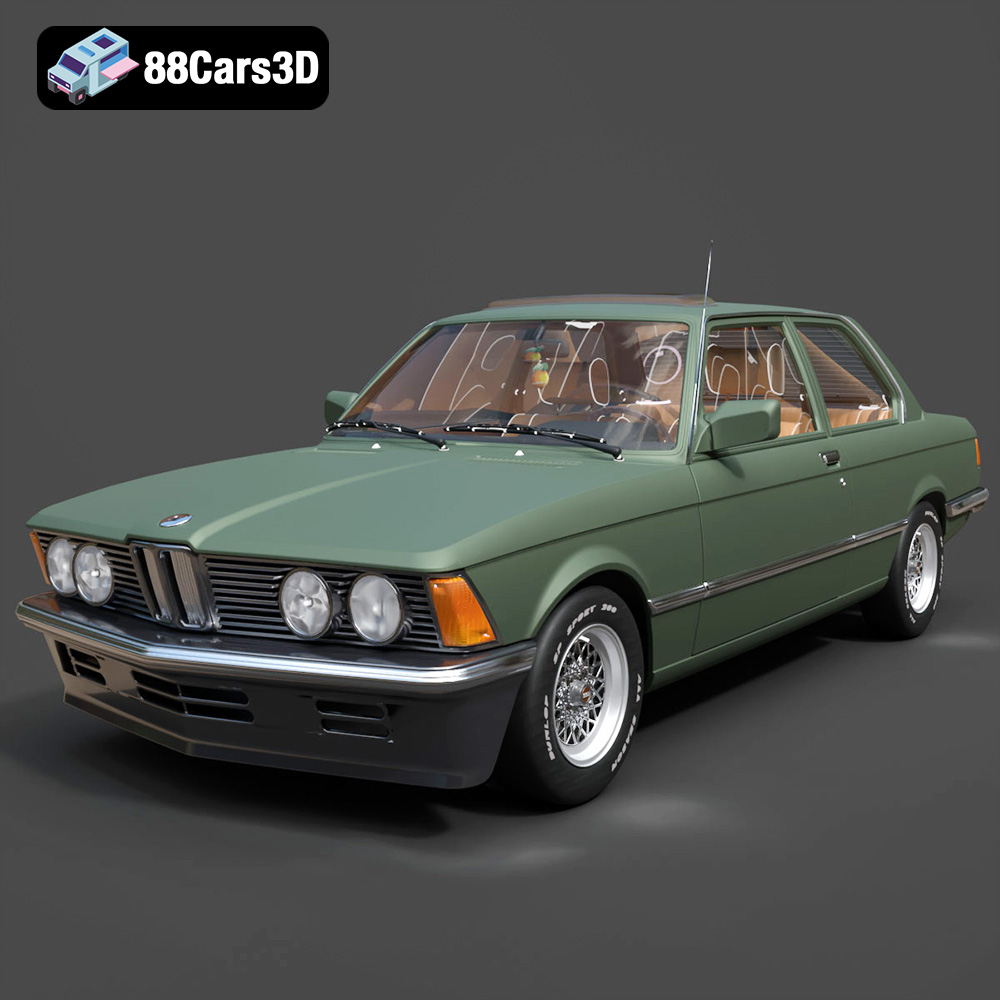
The external appearance of any automotive model is its immediate defining feature. For the BMW 3 Series E21, this means a faithful reproduction of its iconic bodywork. The signature kidney grille and dual headlights are not merely approximations but carefully modeled components, capturing their unique contours and proportions. Accurate panel gaps are crucial for realism, reflecting the vehicle’s original engineering and ensuring surfaces meet precisely. Furthermore, the detailed wheel rims and tires, complete with realistic tread patterns, significantly enhance the overall visual quality, particularly in close-up renders or dynamic animations where tire deformation and grip are critical. Separated components for doors, hood, trunk, and wheels are paramount for dynamic animation, allowing for realistic vehicle entry/exit scenarios or maintenance sequences. Transparent materials applied to windows, headlights, and taillights are fundamental for realistic light interaction, crucial for achieving photorealistic rendering results in any environment.
Interior Immersion and Mechanical Precision
Beyond the gleaming exterior, a high-quality 3D car model delves into the interior to provide a truly immersive experience. The BMW 3 Series E21 model features detailed interior elements including the dashboard, steering wheel, seats, and door panels, all crafted for visual authenticity. Replicated controls and gauges within the cockpit contribute to an interactive and believable environment, whether for driving simulations or virtual showrooms. While not always fully exposed, underlying mechanical components like basic suspension and brake caliper forms are included, optimized for efficient mesh quality. This level of detail, even when subtle, reinforces the model’s overall credibility and adds depth to any interaction or visualization.
Technical Foundations: Topology, Scale, and Rigging Readiness
The “under-the-hood” technical advantages are what make a 3D model truly usable in professional environments. The BMW 3 Series E21 model boasts clean, quad-dominant topology, which is a gold standard in 3D modeling. Quads (four-sided polygons) ensure smooth subdivision, critical for close-up renders, and predictable deformation during animation. This topology also aids in UV mapping and texturing, preventing artifacts. Modeled to real-world scale, the asset seamlessly integrates into diverse scenes and environments, eliminating the need for tedious manual scaling and ensuring accurate physics in simulations. A well-organized hierarchy with proper pivot points for moving parts (doors, wheels, etc.) is another technical boon, simplifying the animation process and enhancing workflow efficiency for artists. These technical considerations are what elevate a simple mesh into a production-ready asset, saving countless hours in complex projects.
Mastering Automotive Rendering with the E21 Model
The true beauty of a high-fidelity 3D car model, such as the BMW 3 Series E21 from 88cars3d.com, is often unleashed through expert rendering. Whether for captivating advertising campaigns, cinematic sequences, or detailed product showcases, achieving photorealism requires a combination of a superb asset and a powerful rendering workflow.
Workflow in 3ds Max and V-Ray/Corona
For many professionals, 3ds Max paired with industry-leading renderers like V-Ray or Corona is the go-to setup for automotive rendering. The included .max file of the BMW 3 Series E21 provides a head start. Users can import the model directly, benefiting from pre-assigned materials and a well-structured scene. The workflow typically involves:
- Scene Setup: Placing the E21 model within a studio environment, an HDRI background, or a custom 3D scene.
- Lighting: Crafting dynamic lighting using studio lights (e.g., area lights, photometric lights) and HDRI maps to simulate real-world conditions, emphasizing the E21’s sleek lines and reflections.
- Material Refinement: Adjusting metallic flake in the paint, fine-tuning tire rubber roughness, perfecting glass transparency and reflections, and adding subtle imperfections to surfaces to break up perfect digital uniformity. V-Ray and Corona’s physically based rendering engines excel at these nuances.
- Camera and Composition: Setting up cinematic camera angles, depth of field, and motion blur to convey speed or a sense of presence.
- Render Settings and Post-Production: Optimizing render settings for quality and speed, followed by post-processing in tools like Photoshop or Nuke to enhance color grading, add lens flares, and composite elements.
This comprehensive approach ensures that every render of the classic BMW E21 is a work of art, suitable for high-end marketing and visualization.
Achieving Photorealism in Blender Cycles/Eevee
Blender has emerged as a powerhouse in 3D, and the .blend file for the BMW 3 Series E21 allows artists to leverage its advanced rendering capabilities immediately. Cycles, Blender’s physically based path tracer, is perfect for photorealistic renders:
- Material Conversion/Adjustment: While materials are typically included, artists might wish to optimize them further for Cycles, using Principled BSDF shaders for accurate PBR representation.
- HDRI and Environment Lighting: Employing high-dynamic-range images for realistic global illumination and reflections is a common practice, providing soft, natural light.
- Camera Setup: Utilizing Blender’s camera settings for focal length, aperture, and depth of field to mimic real-world photography.
- Render Layers and Compositing: Rendering different passes (diffuse, glossy, ambient occlusion) allows for greater control in Blender’s built-in compositor, enabling precise adjustments and effects without re-rendering.
For real-time previews or stylized renders, Eevee, Blender’s real-time render engine, can be utilized. The clean topology and optimized materials of the E21 model translate well to Eevee, providing impressive results quickly.
Customization for Unique Visual Narratives
A key advantage of a high-quality 3D model is its flexibility for customization. The BMW 3 Series E21 model provides ample opportunity to craft unique visual narratives:
- Paint Finishes: Easily switch between classic BMW colors, apply custom metallic flakes, or experiment with matte and glossy finishes.
- Livery Designs & Decals: The clean UVs (assumed for such a model) enable straightforward application of custom liveries, racing stripes, or sponsorship decals, perfect for historical racing scenarios or bespoke marketing.
- Material Properties: Adjusting the reflectivity of chrome trim, the roughness of plastic components, or the subtlety of rubber textures allows for fine-tuning the model’s overall look to match specific artistic visions or historical periods.
- Lighting and Atmosphere: Beyond standard studio setups, the model can be placed in various environments – from a rainy city street to a sun-drenched coastal road – with lighting adjusted to create mood and atmosphere, making the E21 a versatile storytelling tool.
This level of customization empowers artists to transform the base model into a distinct asset that perfectly fits their project’s aesthetic.
Driving Innovation: The E21 as a Game Asset and for Real-Time Experiences
The interactive nature of game development and real-time visualization places unique demands on 3D assets. Performance, optimization, and seamless integration are paramount. The BMW 3 Series E21 3D Model, with its game-ready specifications, is ideally suited for these demanding applications.
Optimizing for Unreal Engine and Unity
Game engines like Unreal Engine and Unity are at the forefront of real-time rendering. The inclusion of .fbx and .unreal formats for the BMW 3 Series E21 significantly streamlines its integration:
- Import and Setup: Importing the .fbx or pre-configured .unreal asset into the engine typically means materials, textures, and pivot points are largely intact. Artists may need to convert materials to the engine’s native PBR (Physically Based Rendering) shader system (e.g., Unreal’s Material Editor, Unity’s Shader Graph).
- Collision Meshes: For interactive driving, custom collision meshes are often required. A well-modeled asset provides a clean base for generating these, ensuring realistic interactions with the environment.
- LODs (Levels of Detail): To maintain performance, especially in open-world games, LODs are essential. A clean, quad-dominant base mesh simplifies the creation of lower-polygon versions of the E21 that swap in as the car moves further from the camera, optimizing draw calls and rendering overhead.
- Rigging for Physics: The separated components (wheels, doors) and logical hierarchy are crucial for setting up vehicle physics and animation blueprints within the game engine, allowing for realistic suspension, steering, and damage systems.
The E21’s balanced detail ensures it looks fantastic up close while remaining efficient for real-time applications.
Unleashing Potential in AR/VR and Simulations
Augmented Reality (AR) and Virtual Reality (VR) applications demand highly optimized assets for smooth, immersive experiences. The .glb format, specifically designed for web and AR/VR, makes the BMW 3 Series E21 an excellent candidate:
- AR Visualization: Imagine placing a virtual E21 in your driveway via an AR app, exploring its classic design in a real-world context. The optimized poly count and single-file nature of .glb assets are perfect for this.
- VR Showrooms: For automotive enthusiasts, a VR showroom featuring the E21 allows for interactive exploration of its interior and exterior, providing an unparalleled sense of presence.
- Driving Simulations: Beyond games, professional driving simulators require highly accurate vehicle models for realistic physics and visual feedback. The E21’s real-world scale and detailed geometry make it suitable for training modules or historical racing simulations, where precision is paramount. The clean hierarchy facilitates robust rigging for complex physics engines.
These applications leverage the model’s technical precision to create truly engaging and functional interactive experiences.
Performance Considerations and LODs
For any real-time application, managing performance is key. While the BMW 3 Series E21 model is described as having “balanced level of detail,” understanding its polygon budget and texture resolution is important. Professional models typically include:
- Optimized Mesh Density: Avoiding excessive polygon counts where not necessary, focusing detail on visible areas, and using normal maps to simulate high-detail geometry.
- Efficient UV Layouts: Clean, non-overlapping UV maps are crucial for texture efficiency and preventing visual artifacts, especially with mip-mapping in real-time engines.
- Texture Atlases: Consolidating multiple textures into a single atlas can reduce draw calls, further boosting performance in engines.
- Multiple LODs (if applicable): While not explicitly stated, a game-ready asset often comes with several LODs, which are invaluable for maintaining frame rates across various distances and hardware configurations.
The E21’s design with clean geometry ensures that it provides a solid foundation for these optimizations, allowing developers to scale its fidelity as needed for their specific real-time target platform.
Beyond Visualization: 3D Printing and Advanced Applications
The utility of a robust 3D model extends far beyond rendering and real-time graphics. For specialized fields, the technical precision and structural integrity of the BMW 3 Series E21 3D Model open doors to entirely new applications, from tangible creations to complex analyses.
Transforming Digital to Physical: The .stl Advantage
One of the most exciting advancements in recent years is the widespread accessibility of 3D printing. The ability to transform a digital model into a physical object offers immense possibilities for designers, collectors, and engineers. The BMW 3 Series E21 3D Model, with its geometry noted as “watertight” and easily convertible to .stl, is perfectly primed for this transformation.
- Prototyping & Scale Models: Architects can include physical models of the E21 within their building scale models for an extra layer of realism. Automotive enthusiasts can print highly detailed scale replicas for display.
- Educational Tools: Educators can use 3D printed E21 models to teach design principles, automotive history, or even engineering concepts related to vehicle structure.
- Customization and Collectibles: Artists can print customized versions of the E21 with unique liveries or modifications, creating bespoke physical collectibles. The clean mesh ensures that intricate details like the kidney grille or wheel spoke patterns translate accurately to the printed object.
The transition from a virtual asset to a tangible product is a testament to the model’s fundamental structural quality.
Precision for Engineering and Analysis with .ply
While often overlooked in purely visual contexts, formats like .ply play a crucial role in technical and scientific applications. The .ply file format, known for its ability to store rich mesh data beyond simple geometry, makes the E21 model valuable for more analytical tasks.
- Reverse Engineering & Inspection: If the model were derived from a scan, the .ply could retain surface normal information, useful for comparing against physical parts or performing quality control. Even as a purely digital creation, its geometric precision can serve as a reference.
- CAD Integration: For engineers working with CAD software, the .ply format offers a bridge for integrating complex organic shapes into more structured design environments, potentially for fitment analysis or ergonomic studies related to components surrounding the car.
- Simulation Data: In advanced engineering simulations that require detailed mesh properties (e.g., fluid dynamics around the car, or stress analysis on specific components), the ability of .ply to carry additional per-vertex or per-face data can be advantageous, though often requiring further conversion to analysis-specific mesh types.
This underlines the E21 model’s suitability not just for aesthetics, but also for precision-driven workflows.
Educational and Training Modules
Beyond entertainment, high-quality 3D car models are invaluable resources for education and training. The BMW 3 Series E21 3D Model offers a fantastic platform for:
- Automotive Design Education: Students can dissect the model in their 3D software to study classic automotive design principles, understanding how curves, surfaces, and proportions contribute to the E21’s iconic look.
- Vehicle Maintenance Training: For aspiring mechanics or automotive technicians, an interactive 3D model allows for virtual exploration of components. With its separated parts (doors, hood), the E21 could be integrated into interactive training modules demonstrating assembly, disassembly, or repair procedures.
- Historical Context: Virtual museums or interactive documentaries can utilize the model to showcase the E21’s historical significance, allowing users to explore its evolution and impact without physical limitations.
The model’s blend of visual fidelity and technical organization makes it an exceptional tool for learning and development.
Conclusion
The journey from a legendary classic car to a versatile digital asset is paved with meticulous craftsmanship and technical precision. The BMW 3 Series E21 3D Model stands as a prime example of a high-quality asset that transcends mere visual representation, serving as a powerful tool for professionals across rendering, game development, AR/VR, simulation, and even 3D printing. Its comprehensive range of file formats—from native .blend and .max to universal .fbx and .obj, and specialized .glb, .stl, .ply, and .unreal—ensures unparalleled compatibility and flexibility in any professional workflow.
Whether you’re an automotive artist striving for photorealistic renders in 3ds Max, a game developer building an immersive world in Unreal Engine, or an engineer requiring precise geometry for analysis, this meticulously crafted model provides the foundation for success. The attention to detail in its exterior, interior, and underlying topology not only guarantees visual fidelity but also streamlines complex technical processes like animation, texturing, and optimization. By investing in such a robust and versatile 3D car model, creators can elevate their projects, achieve stunning results, and innovate across diverse digital landscapes.
Explore this iconic BMW 3 Series E21 3D Model and many other exceptional 3D car models at 88cars3d.com, and unlock the full potential of your next digital venture.
Featured 3D Model
BMW 3 Series E21 3D Model
Presenting a meticulously crafted 3D model of the iconic BMW 3 Series E21, representing the first generation of BMW’s compact executive car. This model captures the distinctive styling and classic allure of the E21 era, known for its elegant lines and driver-focused design. Built with clean geometry and a balanced level of detail, it is optimized for high-quality rendering, realistic animations, precise simulations, and robust integration into game development projects.
$20.79
Product Image Gallery


Related Tags
.3seriese21
.arvr
.blend
.bmw
.classiccar
.coupe
.fbx
.gameasset
.glb
.max
.obj
.ply
.rendering
.simulation
.stl
.unreal
.vintagecar
