

The Enduring Legacy of the BMW E21: From Road to Digital Canvas
There are cars, and then there are legends. The BMW 3 Series E21, the trailblazing first generation of BMW’s iconic compact executive series, undeniably falls into the latter category. Introduced in the mid-1970s, it set a new benchmark for driver engagement, elegant design, and accessible German engineering. Its distinctive lines, focused cockpit, and responsive handling captivated a generation, cementing BMW’s reputation for performance and luxury in a more compact package. Decades later, the E21 continues to command respect and admiration, making it a coveted subject for enthusiasts and digital artists alike.
In the rapidly evolving world of 3D visualization, game development, and interactive experiences, bringing such a revered classic to life requires more than just a passing resemblance. It demands meticulous detail, technical precision, and a deep understanding of what makes the E21 special. Whether for photorealistic automotive rendering, integration into a high-fidelity racing simulator, or a compelling virtual reality experience, the underlying 3D asset must be robust and versatile. This is where professional-grade 3D car models shine, offering artists and developers a powerful foundation to build upon. Today, we’ll delve into the technical intricacies and creative potential offered by a meticulously crafted digital representation of this classic – specifically, the BMW 3 Series E21 3D Model available at 88cars3d.com, exploring how it elevates modern digital projects.
Understanding 3D Model File Formats
The journey of a 3D model, from its creation to its final application, often involves a multitude of software platforms and specific pipelines. Understanding the various file formats and their unique characteristics is paramount for any professional working with 3D assets, especially detailed 3D car models like the BMW 3 Series E21. Each format serves a particular purpose, optimized for different stages of the production pipeline or specific use cases.
.blend – The Native Blender Ecosystem
The .blend file format is native to Blender, the powerful open-source 3D creation suite. When you acquire the BMW 3 Series E21 3D Model in .blend format, you’re getting a fully editable Blender scene. This means not just the mesh, but also the scene’s materials, lighting setups, cameras, animation data, and even modifiers or rigging information are preserved. For artists primarily working in Blender, this offers unparalleled flexibility for customization, material tweaks, animation rigging, or integrating the model into existing Blender projects without any loss of data fidelity. It’s the ideal starting point for intricate rendering projects using Cycles or Eevee, or for preparing the model for further export with Blender’s extensive export capabilities.
.fbx – The Industry Standard for Interoperability
.fbx (Filmbox) is a proprietary file format owned by Autodesk and has become an indispensable industry standard for 3D data exchange. Its strength lies in its ability to store not only geometric data (vertices, faces, UVs) but also animation, cameras, lights, and even some material information. For game developers, particularly those working with Unreal Engine or Unity, the .fbx format is the go-to choice for importing complex assets. The BMW 3 Series E21 3D Model in .fbx ensures seamless transfer into these real-time engines, preserving hierarchies, pivot points, and UV mapping crucial for game asset development. Its robust nature makes it ideal for complex animation pipelines and ensures compatibility across a wide range of professional 3D applications.
.obj – The Universal Exchange Format
The .obj (Wavefront OBJ) format is one of the oldest and most widely supported 3D file formats. It’s a universal standard, meaning almost every 3D software application can import and export .obj files. While it primarily stores geometric data (vertices, normals, texture coordinates), it can also reference external material libraries (.mtl files) for basic material properties. The .obj version of the BMW 3 Series E21 3D Model provides maximum compatibility, making it an excellent choice for cross-software workflows or when you need a clean mesh for sculpting, retopology, or converting to other formats. Its simplicity ensures a high degree of reliability when transferring models between different platforms and rendering engines.
.glb – Optimized for AR, VR, and Web
.glb (GL Transmission Format Binary) is the binary version of glTF, a royalty-free specification for the efficient transmission and loading of 3D scenes and models by applications. It packages all model data – geometry, materials, textures, animations – into a single file. This optimization makes .glb incredibly efficient for web-based 3D viewers, augmented reality (AR), and virtual reality (VR) applications. When working on AR/VR experiences featuring the classic BMW E21, the .glb format is ideal for its quick loading times and broad support across modern browsers and mobile platforms, enabling immersive, interactive visualizations of the vehicle.
.stl – The Backbone of 3D Printing
.stl (STereoLithography) is the standard file format for 3D printing. It represents a 3D model as a series of connected triangles, describing only the surface geometry of an object without color, texture, or other attributes. For anyone looking to bring the BMW 3 Series E21 3D Model into the physical world, the .stl format is essential. The model’s “watertight” geometry, as described by 88cars3d.com, ensures a successful conversion and print, producing a physically accurate miniature or prototype of the iconic car.
.ply – Precision for CAD and Analysis
.ply (Polygon File Format) is another format for storing 3D data, often used in scientific and engineering applications, as well as CAD and reverse engineering. It supports more complex data types than .stl, including color, transparency, and data from 3D scanners. For precise mesh analysis, simulations, or specific CAD integration where detailed surface information and potential attribute data are critical, the .ply format for the BMW 3 Series E21 offers a high level of precision and data integrity.
.unreal – Engine-Ready for Real-Time Environments
The .unreal file designation often refers to an Unreal Engine project file or a collection of assets specifically prepped for the engine. For the BMW 3 Series E21 3D Model, this signifies an asset that has been optimized and packaged directly for Unreal Engine. This typically means materials are set up, textures are linked, and potentially even LODs (Levels of Detail) or basic collision meshes are configured, saving significant integration time for game developers and real-time visualization artists. It offers an accelerated workflow, allowing artists to drop the E21 directly into their Unreal scenes with minimal setup.
.max – The 3ds Max Masterpiece
Finally, the .max format is the native file type for Autodesk 3ds Max, a cornerstone of professional 3D modeling, animation, and rendering in architectural visualization, film, and game development. A .max file contains the complete 3ds Max scene, including geometry, materials (like V-Ray or Corona), lighting, cameras, animation data, and modifiers. For artists who rely on 3ds Max for high-end automotive rendering or detailed animation sequences, the .max version of the BMW 3 Series E21 3D Model provides full creative control within their preferred environment, allowing for complex scene setups and the highest quality output.
The availability of the BMW 3 Series E21 3D Model in such a comprehensive array of formats from 88cars3d.com underscores its versatility and suitability for virtually any professional 3D pipeline. This thoughtful selection ensures that whether you’re a game developer, an architectural visualizer, a product designer, or a film artist, you have the right tools at your disposal to integrate this classic car seamlessly into your projects.
Crafting Excellence: Technical Specifications of the BMW 3 Series E21 3D Model
In the realm of professional 3D content creation, the technical underpinning of a model is as crucial as its visual appeal. The BMW 3 Series E21 3D Model from 88cars3d.com stands out not just for its accurate visual representation but also for its robust technical advantages, designed to meet the rigorous demands of various industries.
Geometry and Topology for Professional Workflows
The foundation of any high-quality 3D model lies in its geometry and topology. This E21 model boasts clean, quad-dominant topology, which is the gold standard for professional assets. Why is this important? Quads (four-sided polygons) are ideal for smooth subdivision and deformation. When you apply a subdivision surface modifier (like Turbosmooth in 3ds Max or Subdivision Surface in Blender), quad-based meshes produce cleaner, more predictable results without pinching or undesirable artifacts. This ensures that the elegant curves of the BMW E21’s bodywork remain fluid and accurate, even in high-resolution renders or close-up shots. Furthermore, clean topology simplifies UV mapping, texturing, and rigging, making the model easier to work with across different stages of production. Its balanced level of detail means the mesh is optimized to be efficient without sacrificing visual fidelity, making it suitable for both demanding cinematic renders and performance-critical real-time applications. The model is also built to real-world scale, which is vital for accurate integration into diverse scenes, architectural visualizations, or precise simulations, ensuring correct proportions and interactions with other scene elements.
Materiality and Texturing: Bringing Realism to the Forefront
Beyond the mesh itself, the materials and texturing are what truly breathe life into a 3D model. The BMW E21 model features transparent materials applied to windows, headlights, and taillights, crucial for realistic light interaction and reflective properties. While specific PBR textures are not explicitly detailed, the mention of “customizable paint finishes, livery designs, and decal placements” implies a material setup conducive to modern Physically Based Rendering (PBR) workflows. This allows artists to easily adjust metallic sheen, roughness, and color values for various components like the body paint, chrome trim, rubber tires, and interior plastics. The ability to modify material properties is paramount for achieving diverse atmospheric conditions and moods, from a showroom-pristine finish to a weathered classic look, ensuring the model can adapt to any artistic vision.
Animation Readiness and Scene Integration
A static model, no matter how beautiful, often falls short in dynamic projects. The BMW 3 Series E21 3D Model is designed with animation and interaction in mind. It features separated components for doors, hood, trunk, and wheels. This modularity is critical for creating realistic animations, whether it’s opening a door, lifting the hood to reveal an engine (even if basic forms), or simulating wheel rotation for driving sequences. Crucially, the model has an organized hierarchy with proper pivot points. Correct pivot points mean that when you rotate a wheel, it rotates around its true axle center, and a door swings open from its hinge, just like in reality. This thoughtful organization significantly streamlines the animation process, saving countless hours for animators and technical artists, and ensuring seamless integration into interactive environments or complex cinematic sequences.
Unleashing Creativity: Professional Workflows with the E21 Model
The true value of a premium 3D asset like the BMW 3 Series E21 3D Model lies in its seamless integration into diverse professional pipelines. Its versatility and technical precision make it an invaluable tool for artists and developers across various industries.
Automotive Rendering and Visualization with 3ds Max and Blender
For high-end automotive rendering and visualization, the BMW E21 model is an exceptional asset. Imagine a scenario where an advertising agency needs a photorealistic render of a classic car for a new luxury product campaign. Using the .max file in 3ds Max or the .blend file in Blender, an artist can import the E21 model and immediately begin building their scene. They can set up studio lighting, experiment with various camera angles to highlight the car’s distinctive features, and fine-tune materials using advanced renderers like V-Ray, Corona Renderer (for 3ds Max), or Cycles (for Blender). The model’s clean geometry ensures smooth surfaces, reflecting light accurately and allowing for breathtaking close-ups. With separated components, cinematic animations like doors slowly opening or wheels gracefully turning can be easily orchestrated, adding dynamic storytelling elements to the visualization.
Game Development and Real-Time Applications in Unreal Engine
In the fast-paced world of game development and real-time applications, efficiency and optimization are paramount. The BMW E21 3D Model, with its “production-ready asset” status and availability in .fbx and .unreal formats, is perfectly suited for game engines like Unreal Engine. A game studio developing a vintage racing title or an open-world game set in the 70s could integrate this model with minimal effort. Artists can import the .fbx or leverage the pre-packaged .unreal project file directly into the engine. From there, they would configure collision meshes, set up Level of Detail (LOD) variations for performance optimization, and apply game-ready PBR materials. The organized hierarchy and correct pivot points are crucial for setting up vehicle physics, rigging it to a skeletal mesh, and implementing interactive elements like opening doors or realistic driving dynamics. This model acts as a robust foundation, significantly reducing development time for a fully functional in-game vehicle.
Expanding Horizons: AR/VR, Simulation, and 3D Printing
The applications extend far beyond traditional rendering and gaming. For Augmented Reality (AR) and Virtual Reality (VR) experiences, the .glb format is ideal. An automotive museum could create an interactive AR app, allowing visitors to view a virtual BMW E21 in their space, exploring its exterior and interior details with unparalleled realism. The model’s optimization for real-time ensures smooth performance in these immersive environments. In the realm of simulation and training, the E21 model, provided as .fbx or .ply, can be integrated into vehicle dynamics simulators for driver training or engineering analysis. The precise geometry allows for accurate physical calculations, providing a realistic simulation experience. Finally, for tangible creations, the model’s watertight geometry in .stl format makes it ready for 3D printing. Enthusiasts or model makers can print highly detailed replicas of the E21, bringing a piece of automotive history to their desktops or collections.
Case Studies and Practical Applications
To truly appreciate the versatility and impact of a high-quality 3D car model, it’s helpful to consider its practical applications in real-world professional contexts. The BMW 3 Series E21 3D Model offers a wealth of opportunities across various industries.
Recreating Automotive History for Film and Media
Imagine a film production company working on a period drama set in the late 1970s. They need an authentic BMW E21 for various scenes, but sourcing, maintaining, and transporting a physical classic car can be prohibitively expensive and logistically challenging. This is where a meticulously crafted 3D model becomes invaluable. The team could license the BMW 3 Series E21 3D Model from 88cars3d.com. Using the .max or .blend file, VFX artists can seamlessly integrate the digital E21 into live-action footage. They can animate it driving through virtual cityscapes, place it as a background prop in a digital matte painting, or even use it for explosive crash sequences that would be impossible or too dangerous with a real vehicle. The model’s accurate panel gaps, surface curvatures, and detailed interior ensure that it holds up to close-ups, maintaining the illusion of a real car on screen, and drastically cutting down on production costs and time compared to traditional methods.
Enhancing Interactive Experiences: From Games to Virtual Showrooms
Consider a modern interactive experience developer tasked with creating a “classic car showcase” for an online platform or a virtual event. Instead of simply displaying images, they aim for a fully interactive 3D environment. They could utilize the BMW E21 3D Model, importing it via .fbx or .glb into a web-based 3D viewer or a dedicated VR application. Users could then freely rotate the car, zoom in on specific details like the kidney grille or the interior dashboard, and even “open” the doors and hood virtually thanks to the model’s separated components and accurate pivot points. For a game development studio, this model could be the centerpiece of a new downloadable content (DLC) pack for a popular racing game. Players could choose to drive the iconic E21, customizing its paint, rims, and even adding unique liveries. The model’s clean topology and real-world scale ensure that it performs optimally within the game engine, contributing to a fluid and immersive gameplay experience.
Why Choose a Premium 3D Car Model from 88cars3d.com?
In a marketplace flooded with digital assets, discerning professionals understand the critical difference that quality makes. Investing in a premium 3D car model like the BMW 3 Series E21 from 88cars3d.com is a strategic decision that pays dividends in terms of quality, efficiency, and project success.
The Value of Precision and Professional Craftsmanship
The creation of a truly accurate and production-ready 3D car model is a complex endeavor, requiring hundreds of hours of expert modeling, texturing, and optimization. Attempting to model a classic car like the BMW E21 from scratch can be an enormous time sink for any studio or individual artist. By choosing a professionally crafted model, you bypass this arduous initial phase. The “meticulously crafted” description isn’t merely marketing speak; it signifies attention to detail in areas like “faithful reproduction of the BMW 3 Series E21’s timeless bodywork,” “accurate panel gaps,” and “detailed wheel rims and tires with realistic tread patterns.” This level of precision ensures that your final output, whether a render or an interactive experience, carries an undeniable authenticity that cheaper, less accurate models simply cannot provide. It’s an investment in quality that reflects directly on the professionalism of your own projects.
Seamless Integration and Broad Compatibility
One of the most compelling reasons to choose a model from 88cars3d.com is the commitment to seamless integration into diverse workflows. The comprehensive list of included file formats – .blend, .fbx, .obj, .glb, .stl, .ply, .unreal, and .max – highlights this dedication. This broad compatibility means that whether your team primarily uses Blender for artistic projects, 3ds Max for architectural visualization, or Unreal Engine for game development, you have an optimized version of the BMW E21 3D Model ready to go. This eliminates the headaches of format conversion, potential data loss, or extensive re-setup often associated with less versatile assets. The organized hierarchy, proper pivot points, and clean topology further contribute to a frictionless integration experience, allowing artists and developers to focus on creative execution rather than technical troubleshooting.
Conclusion
The BMW 3 Series E21 represents a pivotal moment in automotive history, and its digital counterpart, the BMW 3 Series E21 3D Model, offers a pivotal asset for modern digital creation. We’ve explored its technical depth, from its clean, quad-dominant topology and real-world scale to its animation-ready components and versatile material setup. We’ve also delved into its broad utility across various professional workflows, demonstrating how it elevates automotive rendering, game development, AR/VR experiences, simulations, and even 3D printing.
For any serious 3D artist, developer, or simulator seeking to inject authenticity, performance, and visual fidelity into their projects, this model from 88cars3d.com is an invaluable resource. It’s more than just a 3D car model; it’s a meticulously engineered digital representation that respects the legacy of the original while providing the technical flexibility required for contemporary creative demands. By choosing such a high-caliber asset, you not only save precious development time but also ensure that your projects achieve a level of professionalism and realism that truly stands out.
Featured 3D Model
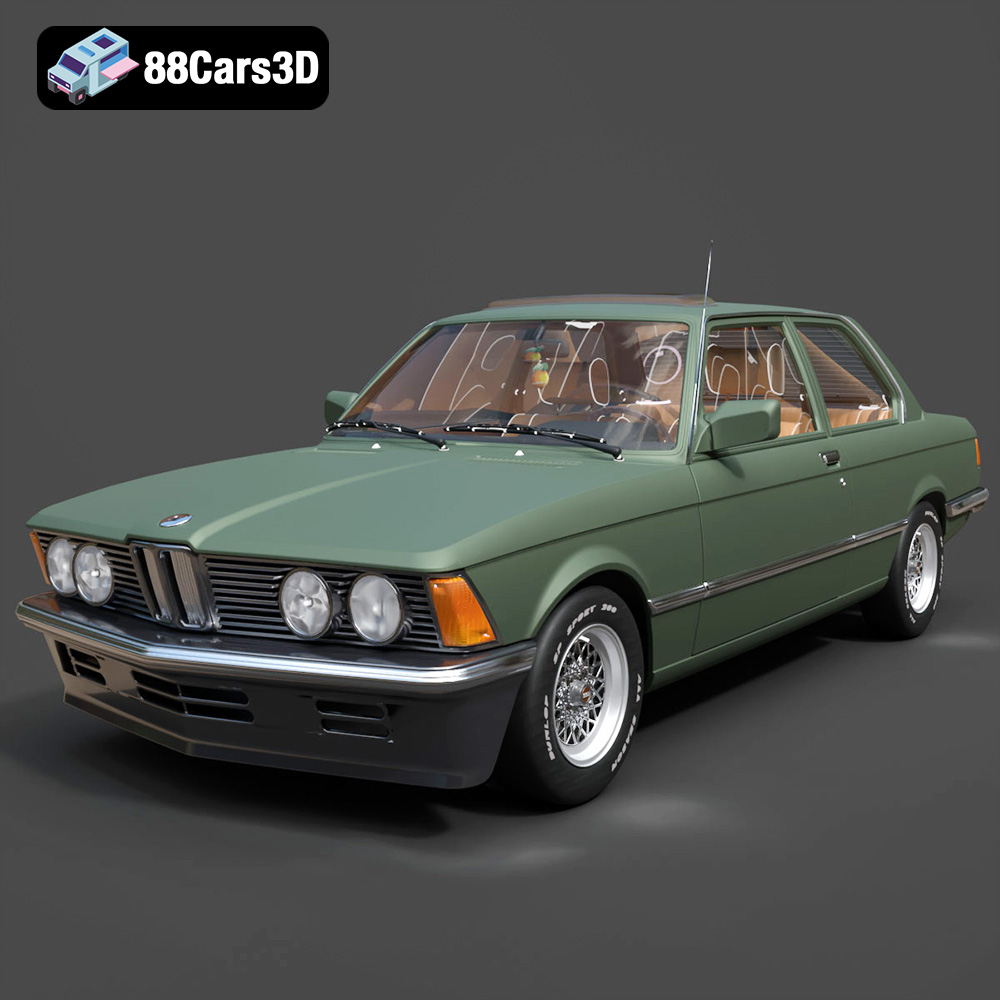
BMW 3 Series E21 3D Model
Presenting a meticulously crafted 3D model of the iconic BMW 3 Series E21, representing the first generation of BMW’s compact executive car. This model captures the distinctive styling and classic allure of the E21 era, known for its elegant lines and driver-focused design. Built with clean geometry and a balanced level of detail, it is optimized for high-quality rendering, realistic animations, precise simulations, and robust integration into game development projects. Its exceptional detail, technical precision, and broad compatibility make it an invaluable asset for any serious 3D artist, developer, or simulator.
$20.79
Product Image Gallery


Related Tags
.3seriese21
.arvr
.blend
.bmw
.classiccar
.coupe
.fbx
.gameasset
.glb
.max
.obj
.ply
.rendering
.simulation
.stl
.unreal
.vintagecar
