

The digital age has revolutionized how we design, visualize, and interact with automobiles. From breathtaking cinematic commercials to immersive virtual experiences and cutting-edge game environments, high-quality 3D car models are the fundamental building blocks of modern automotive visualization. These assets are more than just pretty pictures; they are complex technical constructions, meticulously engineered to perform across a spectrum of demanding applications.
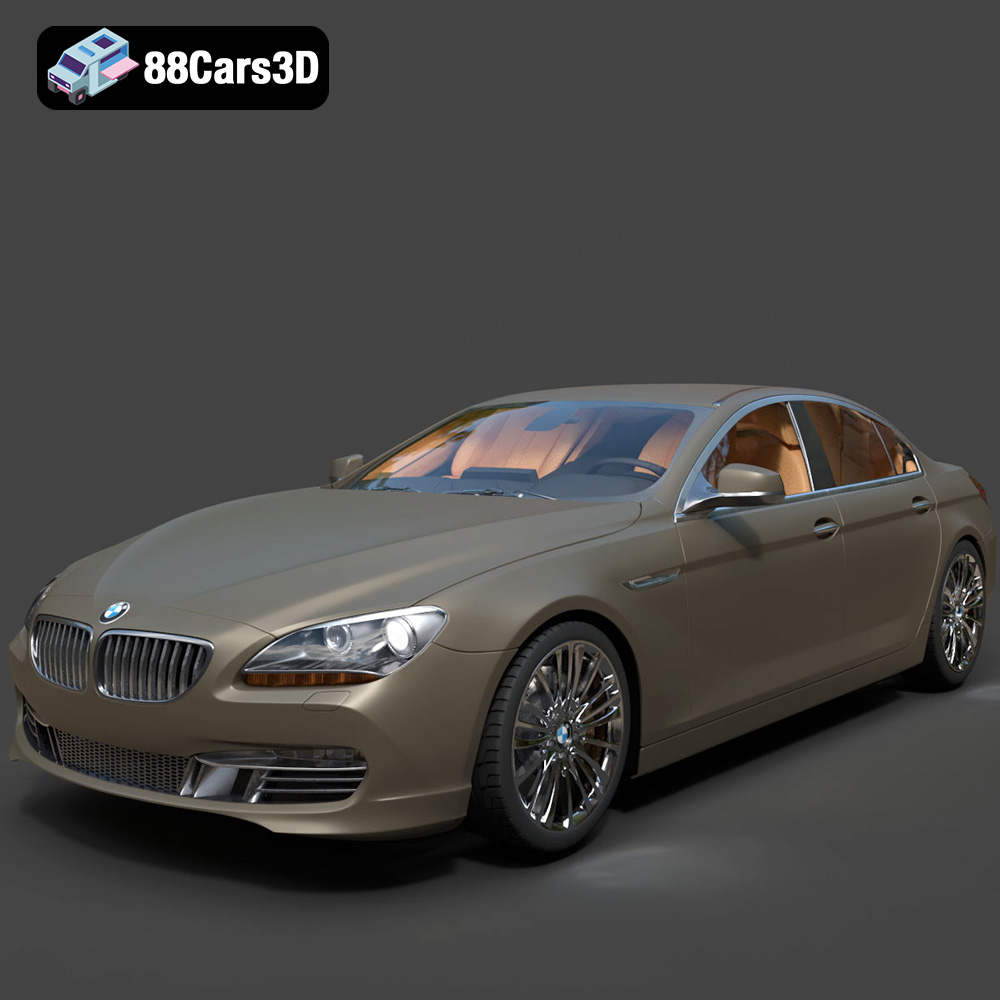
At the heart of any successful digital project lies the quality of its assets. A premium 3D car model, such as the BMW 6 Series Gran Coupe 2013 3D Model available on 88cars3d.com, is a testament to the blend of artistic skill and technical precision required in this field. It represents the sophistication and dynamic design of the actual vehicle, meticulously crafted to capture its elegant lines, powerful stance, and distinctive character. Such a model is not merely a static representation but a versatile tool, optimized for a wide range of uses, from high-fidelity rendering and cinematic animations to real-time simulations and robust game development environments.
Understanding 3D Model File Formats
One of the most crucial aspects of working with 3D models, especially complex assets like a detailed automotive model, is understanding the various file formats available. Each format serves a specific purpose, offering different advantages in terms of compatibility, data preservation, and optimization for particular workflows. The BMW 6 Series Gran Coupe 2013 3D Model comes equipped with an extensive suite of formats, ensuring maximum flexibility for professionals.
.blend – Fully Editable Blender Scene with Materials
The .blend format is Blender’s native file type. It encapsulates an entire Blender project, including all mesh data, materials, textures, cameras, lights, animation, and even modifiers and rig data. This makes it ideal for users who primarily work within Blender, offering full editability and the ability to leverage Blender’s powerful rendering engines, Cycles and Eevee. For the BMW 6 Series Gran Coupe 2013 model, the .blend file provides a complete, ready-to-render scene, allowing artists to dive straight into customization or animation without extensive setup.
.fbx – Ideal for Unreal, Unity, and Real-Time Pipelines
FBX (Filmbox) is an industry-standard format for 3D data exchange, owned by Autodesk. It’s highly versatile and widely supported across various 3D applications, game engines (like Unreal Engine and Unity), and animation software. FBX excels at preserving crucial data like geometry, materials (with PBR texture links), animations, skeletal rigs, and scene hierarchy. Its robust nature makes it the go-to choice for transferring animated characters and complex models into real-time environments, ensuring that the BMW 6 Series Gran Coupe 2013 model retains its detailed structure and material definitions when imported into a game or simulation project.
.obj – Universal Format for Cross-Software Compatibility
The OBJ (Wavefront Object) format is one of the oldest and most universally supported 3D file formats. It primarily stores geometry data (vertices, faces, UVs) and can link to external .mtl (material) files for basic material properties. While it doesn’t support animation or rigging, its widespread compatibility makes it an excellent choice for basic mesh exchange between virtually any 3D software. When you need to bring the BMW 6 Series Gran Coupe 2013 model into a less common program or simply require the raw mesh data, .obj is a reliable fallback.
.glb – Optimized for AR, VR, and Browser-Based Display
GLB (GL Transmission Format Binary) is a relatively new format gaining significant traction, especially for web-based 3D, augmented reality (AR), and virtual reality (VR) applications. It’s a binary version of glTF, designed to be a “transmission format” for 3D scenes and models. GLB files package all necessary assets (geometry, materials, textures, animations) into a single, efficient file, making them incredibly easy to load and render in browsers, mobile apps, and AR/VR platforms. The inclusion of a .glb file for the BMW 6 Series Gran Coupe 2013 model signifies its readiness for immersive, interactive digital experiences.
.stl – Suitable for 3D Printing Output
STL (STereoLithography) is the standard file format for 3D printing. It represents a 3D model as a collection of unconnected triangles, describing only the surface geometry of an object without color, texture, or other CAD attributes. While simple, it’s universally accepted by 3D printers and slicing software. If your project involves creating a physical prototype or a scale model of the BMW 6 Series Gran Coupe 2013, the .stl file is what you’ll need to bridge the gap between digital and physical.
.ply – Precision Mesh Format for CAD or Analysis
PLY (Polygon File Format) is another common format for storing 3D data, particularly popular in academic and research communities for representing 3D scanned data. It can store a wider range of properties than .stl, including color, transparency, surface normals, and texture coordinates per vertex or face. While not as universally used as FBX or OBJ for general 3D work, PLY can be valuable for specific CAD integrations, scientific visualization, or detailed mesh analysis of the BMW 6 Series Gran Coupe 2013 model.
.unreal – Engine-Ready Asset for Real-Time Environments
The .unreal format, or more accurately, assets pre-packaged or structured for Unreal Engine, provides an unparalleled level of convenience for game developers and real-time visualization specialists. This typically means an Unreal Engine project file or a dedicated content pack where the BMW 6 Series Gran Coupe 2013 model is already imported, scaled, has its materials correctly set up with PBR textures, and potentially includes LODs (Levels of Detail) and collision meshes. This ‘engine-ready’ state drastically cuts down on import and setup time, allowing users to drop the asset directly into their Unreal scenes and begin working immediately.
.max – Editable 3ds Max Project for Animation and Rendering
The .max format is the native file type for Autodesk 3ds Max, a powerhouse in the world of 3D modeling, animation, and rendering. Similar to .blend, a .max file contains all scene information, including geometry, materials, lighting, cameras, and animation data. Professionals relying on 3ds Max for high-end automotive rendering, architectural visualization, or complex rigging will find the .max file of the BMW 6 Series Gran Coupe 2013 model invaluable. It offers full native editing capabilities, enabling deep customization, advanced V-Ray or Corona Renderer setups, and intricate animation sequences.
The provision of these diverse formats with the BMW 6 Series Gran Coupe 2013 3D model underscores its versatility and the commitment of 88cars3d.com to professional users, ensuring that no matter the software or pipeline, the asset is ready for integration.
The Anatomy of a Premium 3D Car Model: Detailing the BMW 6 Series Gran Coupe 2013
A truly exceptional 3D car model goes far beyond basic shape and texture. It is a carefully engineered digital replica, where every polygon, every material node, and every texture map contributes to its overall fidelity and usability. The BMW 6 Series Gran Coupe 2013 3D Model exemplifies this dedication to detail, making it a professional-grade asset.
Exterior Features: Precision and Authenticity
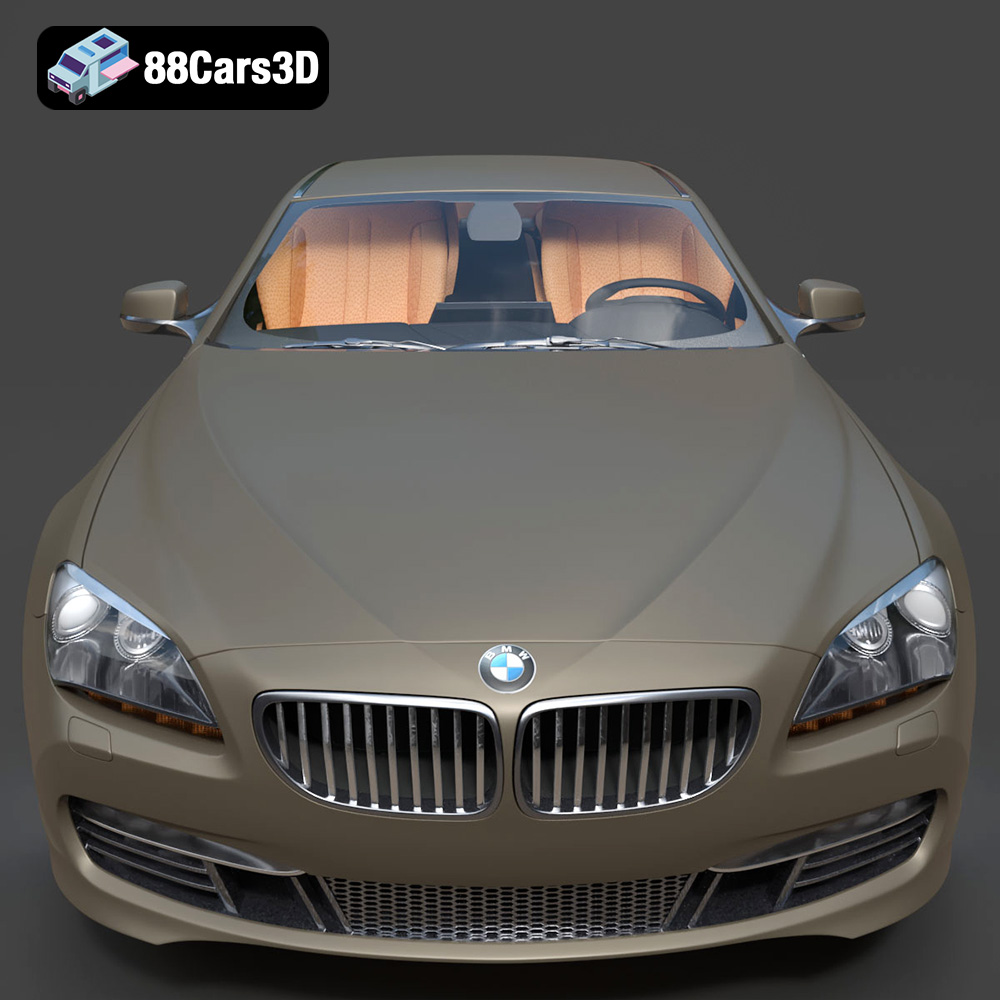
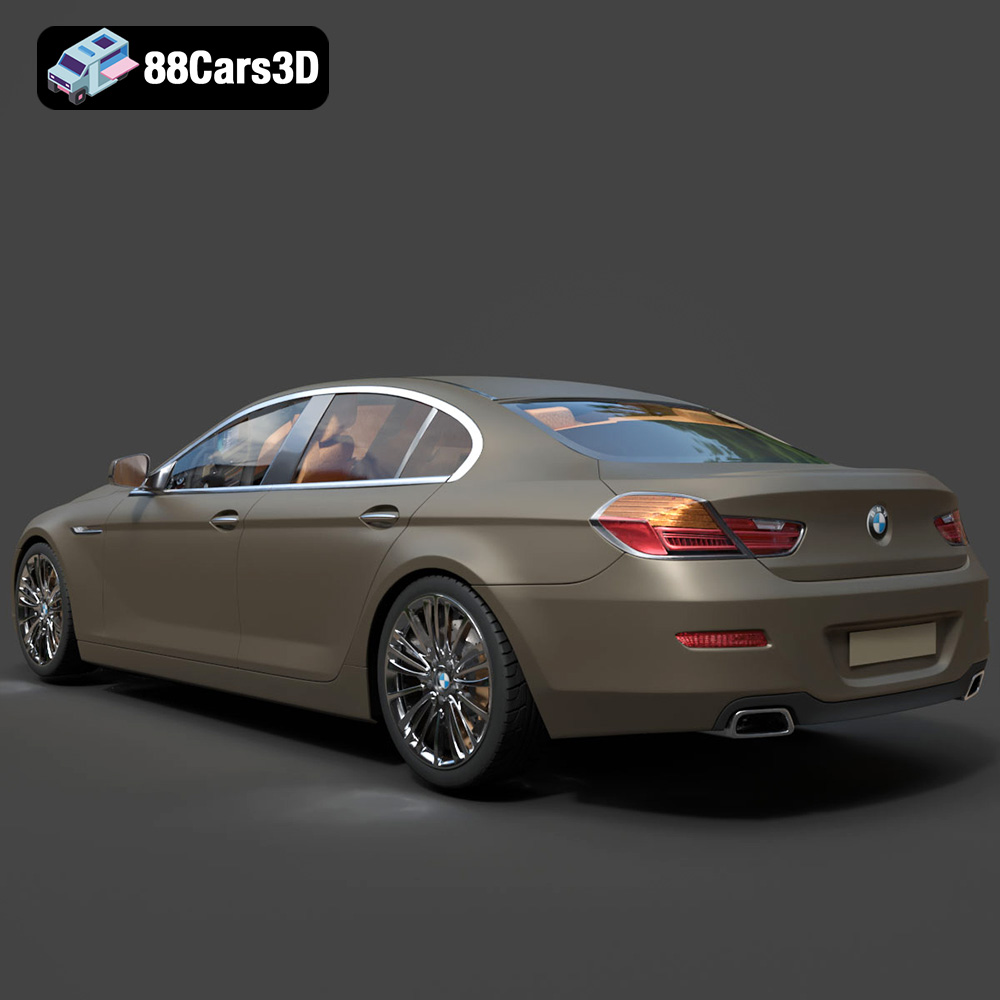
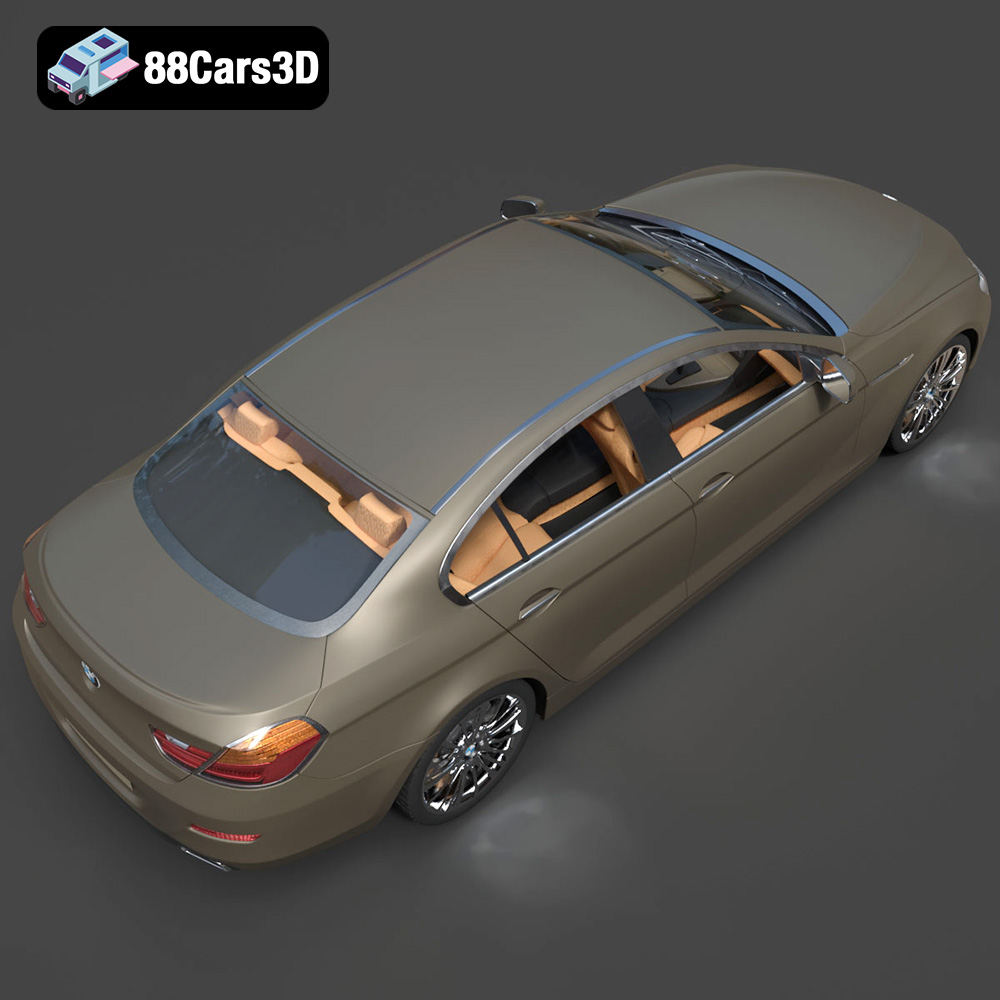
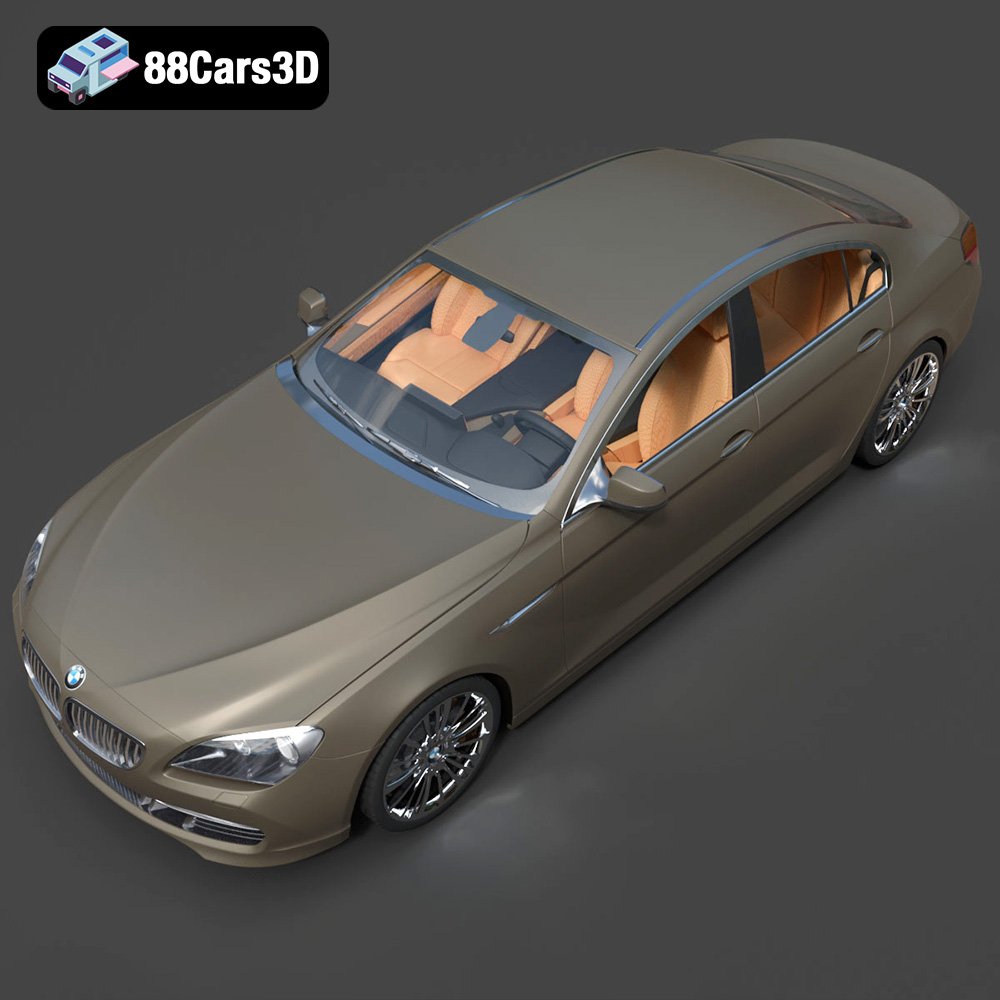
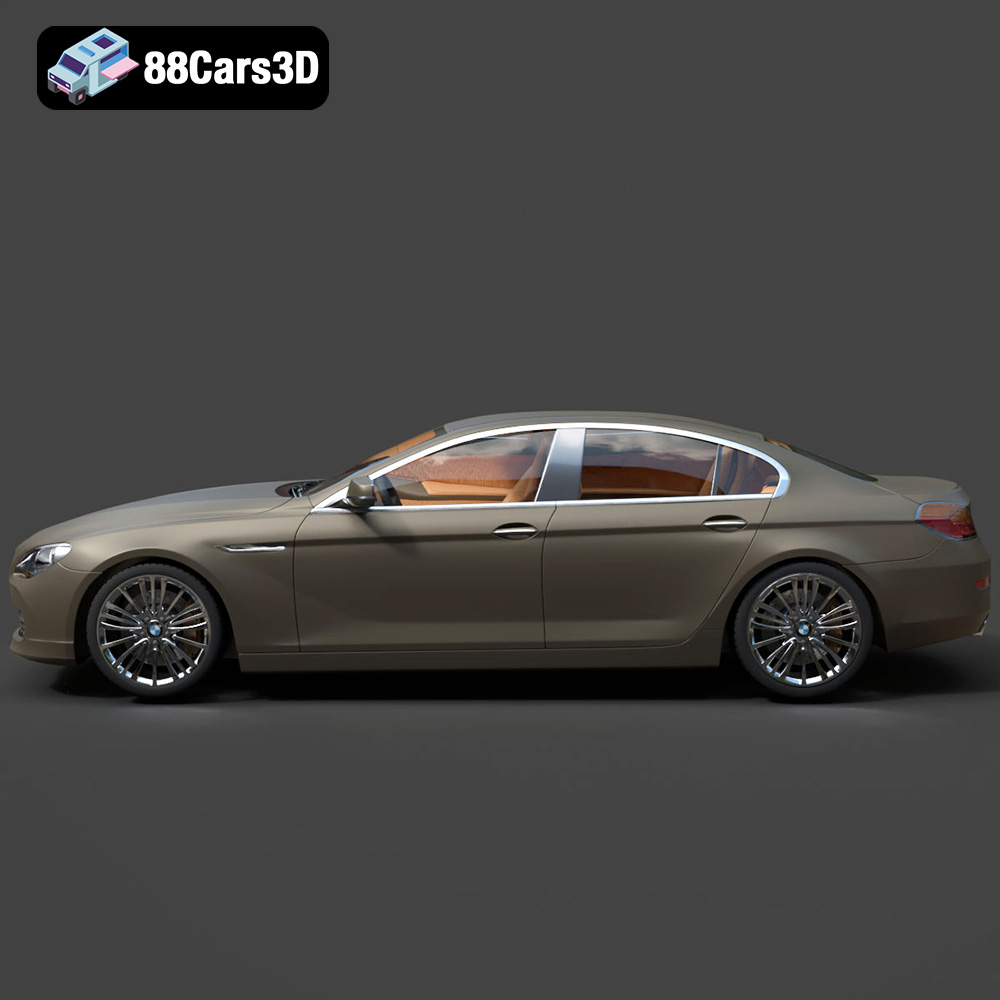
- Accurately modeled body panels: The hallmark of a high-quality automotive model is its adherence to the real-world vehicle’s design. This model meticulously reflects the 6 Series Gran Coupe’s sleek aesthetics, ensuring that the subtle curves, sharp creases, and distinct proportions are all faithfully reproduced. This level of accuracy is critical for renders that need to be indistinguishable from photographs.
- Detailed headlights and taillights: These elements are often complex and challenging to model. The BMW model features realistic lens textures and light emitters, which are essential for accurate reflections, refractions, and the overall impression of a functional vehicle in both static renders and animated sequences.
- Authentic BMW kidney grille and intricate lower air intake designs: Brand-specific details like the iconic BMW kidney grille are crucial for authenticity. This model captures these intricate designs, contributing significantly to the immediate recognition and perceived quality of the vehicle.
- High-resolution wheels and tires: Wheels and tires are often overlooked but are vital for visual realism. High-resolution models with precise tread patterns and accurate rim designs, as found on this BMW model, dramatically enhance the overall fidelity.
- Separated components for animation: Doors, hood, and trunk are separated, not merely as an aesthetic choice, but for advanced animation workflows. This allows for opening and closing animations, crucial for car configurators, cinematic sequences, or interactive showcases.
- Transparent materials for windows and light covers: Proper material setup for glass and plastic ensures realistic light refraction and reflections, adding depth and believability to the model.
- Detailed badging and emblems: Small details like logos and badges complete the illusion, providing brand authenticity and a polished finish.
Interior and Mechanical Features: Balanced Detailing for Performance
While often not visible in every shot, a well-detailed interior significantly enhances a model’s versatility for close-up renders, AR/VR experiences, or driving simulations. The BMW 6 Series Gran Coupe 2013 model boasts:
- Detailed dashboard, instrument cluster, and center console: These elements are crucial for creating an immersive cabin experience. Functional-looking controls, accurately represented gauges, and display screens add realism and depth.
- Comfortable seating, steering wheel, and door panels: The textures and material definitions for these components are optimized to convey luxury and comfort, essential for a premium vehicle.
- Optimized mesh quality: The key here is balance. The interior is detailed enough for realism but optimized to maintain performance, especially in real-time applications.
Technical Advantages: Foundation for Professional Use
Beyond aesthetics, the underlying technical construction dictates a model’s usability and flexibility:
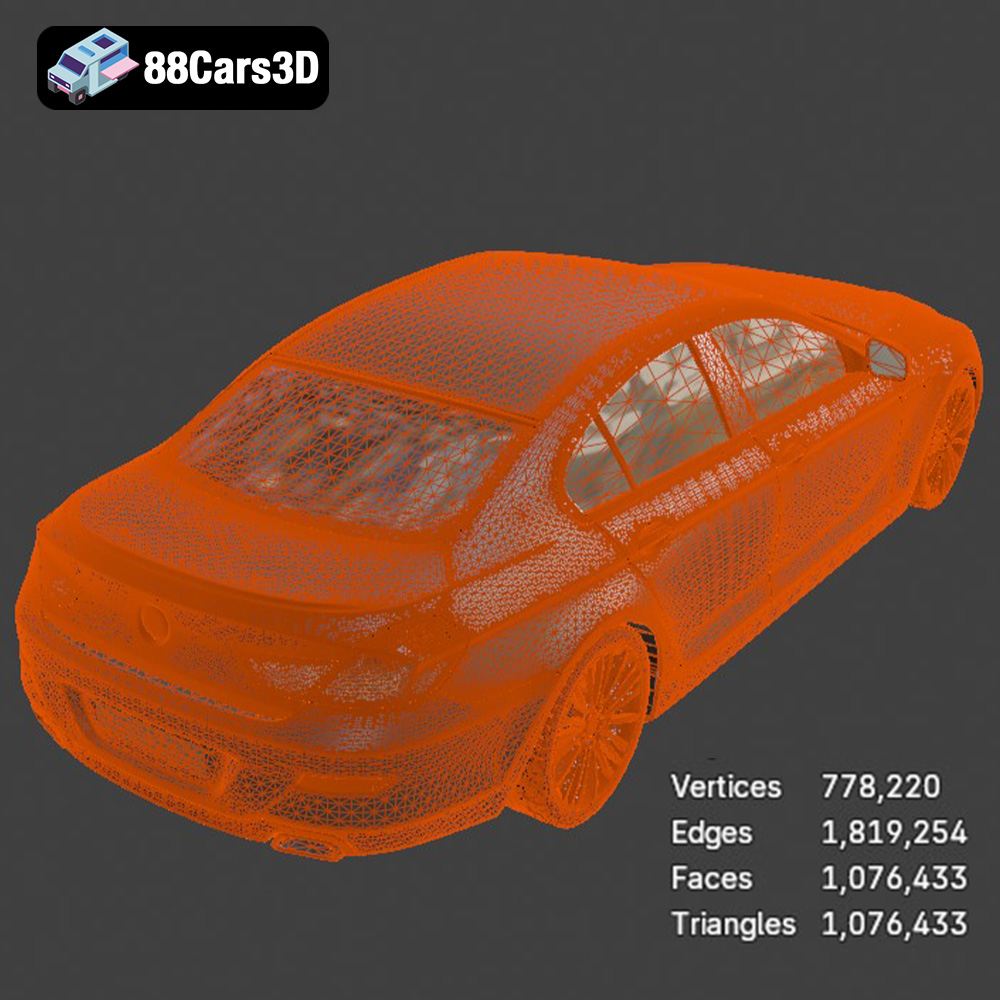
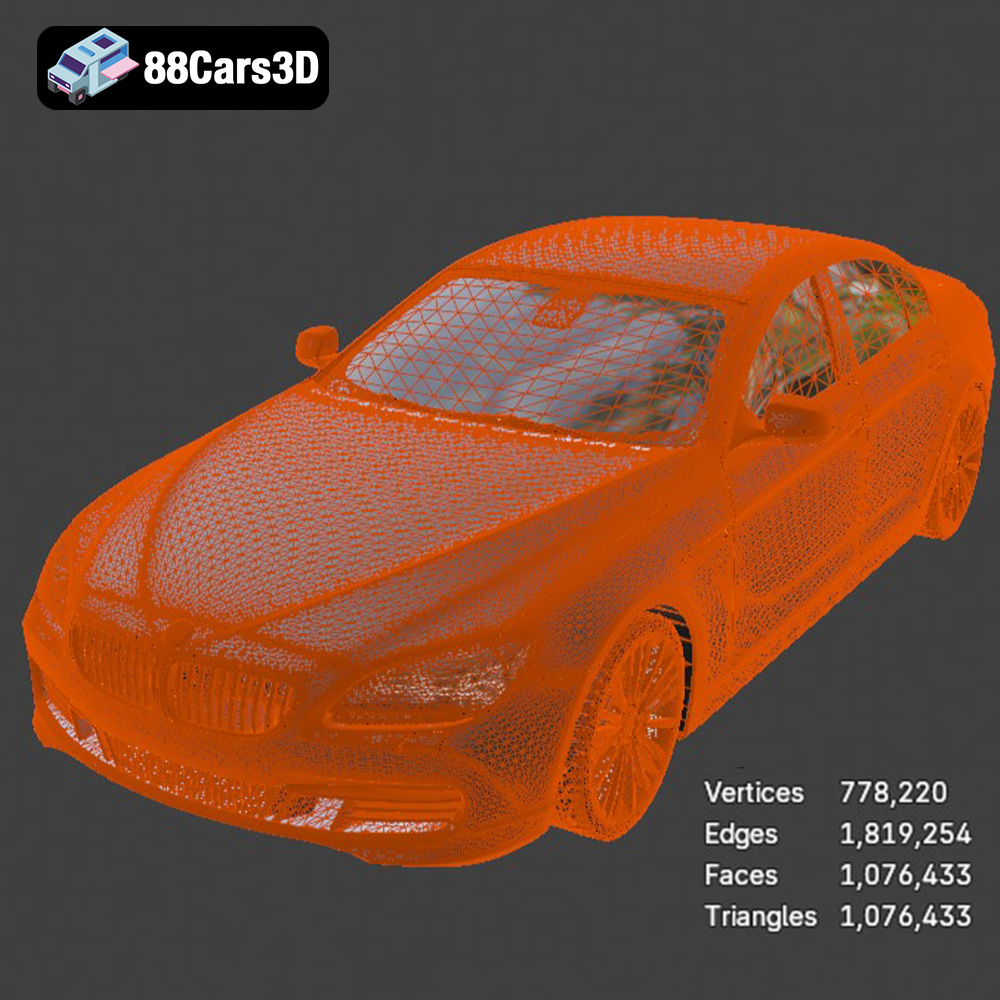
- Clean, quad-dominant topology: This is fundamental for predictable deformation, easy subdivision for higher detail levels (e.g., Catmull-Clark), and clean UV mapping. It ensures the model can be easily modified or integrated without messy geometry issues.
- Real-world scale accuracy: Essential for seamless integration into existing scenes, architectural visualizations, or simulation environments where correct proportions are vital.
- Logically organized hierarchy with proper pivot points: A well-structured scene with correctly placed pivot points simplifies animation, rigging, and component manipulation, saving significant time in production.
- Optimized material and texture setup: Efficient PBR (Physically Based Rendering) materials with correctly packed texture maps (albedo, normal, roughness, metallic, ambient occlusion) ensure consistent and accurate rendering across various engines and lighting conditions.
Professional Workflows: Integrating 3D Car Models into Production Pipelines
The true value of a high-quality 3D car model like the BMW 6 Series Gran Coupe 2013 lies in its seamless integration into various professional 3D pipelines. Whether you are a visualization artist, a game developer, or an AR/VR content creator, the robustness of the asset determines the efficiency and quality of your final output. Let’s explore some key workflows.
High-End Rendering with 3ds Max and V-Ray/Corona
For cinematic quality renders and automotive marketing visuals, 3ds Max remains a dominant force, often paired with industry-leading renderers like V-Ray or Corona. The .max file provided with the BMW 6 Series Gran Coupe 2013 model is perfectly suited for this environment. Artists can:
- Import and Scene Setup: With the native .max file, the model loads with its hierarchy, materials, and potentially basic lighting intact, saving critical setup time. Its real-world scale ensures immediate compatibility with existing scene assets.
- Advanced Material Shading: Leverage the powerful node-based material editors of V-Ray or Corona to refine car paint shaders, create complex glass refractions, and add subtle imperfections like dust or fingerprints. The optimized material setup of the BMW model provides an excellent starting point.
- Lighting and Environment: Integrate the model into studio lighting setups, HDRI environments, or custom outdoor scenes. The clean topology allows for smooth reflections and accurate light bounces, critical for photorealistic results.
- Animation: Utilize the separated parts (doors, hood, trunk, wheels) and logical hierarchy to animate compelling sequences – from opening doors to a full driving animation for a commercial spot.
Creative Development with Blender
Blender’s rise as a comprehensive 3D creation suite makes the .blend file of the BMW 6 Series Gran Coupe 2013 particularly valuable. Its open-source nature, coupled with powerful features, enables diverse workflows:
- Direct Editing and Customization: Artists can directly modify the model’s geometry, add custom body kits, or integrate it into complex scene layouts using Blender’s intuitive modeling tools.
- Cycles and Eevee Rendering: Render stunning visuals with Cycles for photorealism or Eevee for real-time feedback. The model’s PBR materials translate efficiently, requiring minimal adjustment to look great in either engine.
- Animation and Simulation: Utilize Blender’s animation tools for intricate sequences or integrate the car into physics simulations for realistic crashes or dynamic driving scenes. The clean topology ensures stable simulation results.
- Asset Management: The .blend file integrates seamlessly into Blender’s asset browser, allowing for easy reuse and sharing within a team.
Real-Time Excellence with Unreal Engine
For game development, architectural visualization walkthroughs, and virtual production, Unreal Engine stands supreme. The inclusion of an .unreal project setup (or a compatible .fbx) for the BMW 6 Series Gran Coupe 2013 model is a significant advantage:
- Engine-Ready Import: The pre-configured .unreal asset drastically reduces the time and effort typically spent on importing, scaling, and material setup. Textures are linked, and materials are often PBR-compliant, ready for Unreal’s sophisticated lighting system.
- Level of Detail (LODs): For optimal performance in real-time, models need multiple levels of detail. While not explicitly mentioned, premium models often include or are easy to generate LODs, ensuring the BMW appears highly detailed up close and efficient at a distance.
- Interactive Blueprints: Developers can create blueprints to add interactive functionality, such as opening doors, turning on lights, or even full driving mechanics, making the car a dynamic element in a game or simulation.
- Virtual Production: In cinematic real-time rendering, the model can be placed in virtual environments, lit, and animated with speed and flexibility previously unimaginable, allowing for rapid iteration and creative exploration.
Beyond Rendering: Diverse Applications for High-Fidelity Automotive Assets
The utility of a meticulously crafted 3D car model extends far beyond traditional static renders. Assets like the BMW 6 Series Gran Coupe 2013 are versatile tools that power a wide array of innovative applications across various industries.
Game Development: Fueling Virtual Worlds
In the realm of video games, especially racing simulators and open-world titles, the demand for realistic and performant vehicle assets is immense. The BMW 6 Series Gran Coupe 2013 3D model is an ideal candidate for:
- Racing Games: Its detailed exterior and interior, combined with optimized mesh quality, make it perfect for visually stunning racing experiences where players demand authenticity. Clean topology ensures the model deforms predictably with physics engines.
- Open-World Environments: As a prop or drivable vehicle in expansive virtual worlds, its real-world scale and authentic design enhance immersion. The provided file formats, especially .fbx and .unreal, facilitate seamless integration into game engines like Unity and Unreal.
- Asset Pipelines: Developers can integrate the model into their existing pipelines, applying custom damage systems, liveries, or performance upgrades, leveraging the customization options mentioned in the product description.
AR/VR: Immersive Automotive Experiences
Augmented Reality (AR) and Virtual Reality (VR) are transforming how we interact with products. High-quality 3D car models are central to these immersive experiences:
- Virtual Showrooms: Imagine prospective buyers exploring the BMW 6 Series Gran Coupe 2013 in a VR showroom, changing colors, opening doors, and examining the interior in a fully interactive 3D space. The .glb format is particularly optimized for these web and mobile-based AR/VR applications.
- Automotive Configurators: AR allows users to “place” the car in their driveway or office, viewing it in real time with their smartphone. VR offers even deeper immersion for design reviews or sales presentations.
- Training and Education: Mechanics can use AR/VR to learn about the car’s components, or drivers can experience simulations in a highly realistic environment.
Simulation & Training: Engineering and Driver Dynamics
Beyond entertainment, 3D car models play a crucial role in serious applications:
- Automotive Design Reviews: Engineers and designers use 3D models to evaluate aesthetics, ergonomics, and even preliminary aerodynamic properties in a virtual environment before physical prototypes are built.
- Driver Training Scenarios: High-fidelity models in advanced driving simulators allow for realistic training scenarios for professional drivers, emergency services, or even autonomous vehicle development.
- Technical Training Modules: For educational purposes, detailed models can be disassembled virtually to teach about engine components, chassis design, or repair procedures.
3D Printing: Bridging the Digital and Physical Divide
While a digital asset, the BMW 6 Series Gran Coupe 2013 3D model can easily transition into the physical world. With the included .stl format:
- Physical Model Creation: Create a scale model for display, prototyping, or even as a unique gift.
- Prototyping: For designers, 3D printing allows for rapid iteration of certain parts or overall form factors, providing tangible feedback early in the design process.
Optimizing for Performance and Visual Fidelity
Achieving a balance between stunning visual fidelity and efficient performance is paramount for any professional 3D asset. This is particularly true for complex subjects like 3D car models, which demand high detail while needing to function across various platforms, from high-end rendering farms to real-time game engines. The BMW 6 Series Gran Coupe 2013 3D Model is built with this crucial balance in mind.
Strategic Polygon Management and Topology
The “clean, quad-dominant topology” of the BMW model is a cornerstone of its optimization. This means:
- Efficient Detail Distribution: Polygons are concentrated where detail is most needed (e.g., around headlights, grille, wheel wells) and kept sparser on flatter surfaces, reducing overall poly count without sacrificing visual quality.
- Subdivision Readiness: Quad-based meshes are ideal for subdivision surface modifiers (like TurboSmooth in 3ds Max or Subdivision Surface in Blender), allowing artists to easily switch between low-poly and high-poly versions for different levels of detail or rendering needs.
- Predictable Deformation: Clean topology ensures that if the model were to be animated or subjected to physics simulations (like soft-body deformation), it would bend and flex naturally without undesirable pinching or tearing.
PBR Material and Texture Workflows
Physically Based Rendering (PBR) has become the standard for achieving photorealistic results across all major renderers and game engines. The BMW 6 Series Gran Coupe 2013 3D Model features an “optimized material and texture setup,” which typically implies:
- Consistent Appearance: PBR materials define how light interacts with a surface based on real-world physics, ensuring the car paint, metal, glass, and rubber components look accurate regardless of the lighting conditions or rendering engine.
- Texture Efficiency: High-resolution textures for Albedo (color), Normal (surface detail), Roughness (specularity), Metallic (metalness), and Ambient Occlusion (contact shadows) are likely packed efficiently. This might involve combining maps into fewer texture files to reduce memory footprint, especially crucial for game assets.
- Material Instances: In engines like Unreal, material instances allow artists to quickly create variations (e.g., different car paint colors, interior trim options) from a single master material, significantly reducing overhead and improving workflow speed.
Scalability through LODs (Levels of Detail)
While the BMW 6 Series Gran Coupe 2013 model is detailed, a single, high-resolution mesh is rarely suitable for all use cases, especially in real-time. Professional workflows often involve:
- Automated LOD Generation: Using tools within 3ds Max, Blender, or game engines, lower-polygon versions of the model can be automatically generated for distances where less detail is perceptible.
- Manual LOD Creation: For critical assets, manual creation of LODs ensures optimal visual quality and performance balance. This involves reducing polygon count, simplifying geometry, and even optimizing texture maps for each LOD level.
- Optimized for Performance: When integrated into game engines like Unreal, the system dynamically switches between these LODs based on the camera’s distance, ensuring the scene maintains a high frame rate while still looking detailed up close.
These optimization strategies ensure that the BMW 6 Series Gran Coupe 2013 3D model is not just a static beauty but a versatile and performant asset capable of meeting the rigorous demands of professional production pipelines.
Choosing the Right Asset for Your Project
In the vast landscape of 3D content, selecting the right assets can be the difference between a project’s success and costly delays. For anyone requiring high-quality 3D car models, especially for discerning clients or demanding applications, the criteria extend beyond just aesthetics. It delves into the technical integrity and versatility of the model itself.
Prioritizing Quality and Technical Integrity
When searching for a 3D car model, prioritize those that offer:
- Clean Geometry: As discussed with the BMW 6 Series Gran Coupe 2013 model, clean, quad-dominant topology is non-negotiable for professional use. It ensures the model is easy to work with, modify, and render without artifacts. Avoid models with excessive triangulation, N-gons, or overlapping geometry, which can lead to rendering issues and difficult UV unwrapping.
- Accurate Scale and Proportions: Real-world accuracy prevents headaches when integrating the model into existing scenes or alongside other assets.
- Optimized Materials and Textures: PBR-ready materials and well-organized, high-resolution textures are crucial for consistent and photorealistic results across various rendering environments.
- Logical Hierarchy: A well-organized scene hierarchy with correctly pivoted objects saves countless hours in animation, rigging, or simply selecting components.
Versatility through Multiple File Formats
The ability to use an asset across different software and platforms significantly increases its value. A model that offers a comprehensive suite of file formats, as seen with the BMW 6 Series Gran Coupe 2013, provides unparalleled flexibility:
- Native Formats (.blend, .max): These are ideal for deep customization and working within a specific software ecosystem, preserving all proprietary data.
- Exchange Formats (.fbx, .obj): Essential for interoperability between different 3D packages and game engines, ensuring broad compatibility.
- Specialized Formats (.glb, .stl, .ply, .unreal): These cater to niche applications like AR/VR, 3D printing, or direct integration into specific game engines, streamlining specialized workflows.
Platforms like 88cars3d.com specialize in curating such high-quality 3D car models, ensuring that professionals have access to assets that meet these rigorous standards. By investing in a meticulously crafted asset like the BMW 6 Series Gran Coupe 2013, you’re not just buying a model; you’re acquiring a robust, production-ready tool that enhances efficiency and elevates the quality of your final output across diverse creative and technical endeavors.
Conclusion
The world of 3D automotive modeling is a sophisticated blend of artistry and technical mastery. From the intricate curves of a luxury sedan to the underlying mesh topology and the optimized material setups, every detail contributes to a model’s versatility and professional utility. We’ve explored how a premium 3D car model, exemplified by the BMW 6 Series Gran Coupe 2013, serves as a cornerstone for a multitude of applications, spanning high-fidelity rendering, immersive game development, cutting-edge AR/VR experiences, and critical simulation scenarios.
Understanding the nuances of various file formats—from the native editability of .blend and .max to the universal compatibility of .fbx and .obj, and the specialized applications of .glb, .stl, .ply, and .unreal—is crucial for maximizing an asset’s potential. These formats are not merely interchangeable options but carefully chosen pathways designed to streamline specific professional workflows, ensuring that the BMW 6 Series Gran Coupe 2013 3D model can seamlessly integrate into any project pipeline.
The technical advantages of models like the BMW 6 Series Gran Coupe 2013—clean, quad-dominant topology, real-world scale, logical hierarchies, and optimized PBR materials—are what empower artists and developers to achieve breathtaking realism and efficient performance. These elements are the invisible foundations that support stunning visuals and fluid interactivity, making an asset truly production-ready.
Ultimately, selecting the right 3D car model is an investment in quality, efficiency, and the success of your digital endeavors. Platforms like 88cars3d.com are dedicated to providing such meticulously crafted assets, ensuring that professionals have access to the tools needed to bring their automotive visions to life. The BMW 6 Series Gran Coupe 2013 3D model stands as a prime example of what a high-quality asset can offer, providing unparalleled flexibility and outstanding results for any creative or technical challenge.
Featured 3D Model
BMW 6 Series Gran Coupe 2013 3D Model
Experience the sophistication and dynamic design of the BMW 6 Series Gran Coupe 2013 with this meticulously crafted 3D model. Representing the pinnacle of luxury sports sedans, this model captures the elegant lines, powerful stance, and distinctive character of the renowned vehicle. Built with clean geometry and balanced detailing, it is optimized for a wide range of applications, from high-fidelity rendering and cinematic animations to real-time simulations and robust game development environments.
$20.79
Product Image Gallery
Related Tags
.6seriesgrancoupe
.arvr
.blend
.bmw
.fbx
.gameasset
.glb
.grancoupe
.luxurycar
.max
.obj
.ply
.rendering
.sedan
.simulation
.stl
.unreal
