Get 20% OFF All Premium 3D & STL Models!

In the dynamic worlds of automotive design, cinematic rendering, game development, and interactive visualization, the quality of your 3D assets can make or break a project. From breathtaking photorealistic advertisements to immersive virtual reality experiences, a highly detailed and technically sound 3D car model is more than just an object; it’s a critical component that breathes life into digital environments. Professionals demand precision, adaptability, and an unparalleled level of detail to accurately represent the complex engineering and aesthetic appeal of modern vehicles.
Imagine showcasing a luxury sedan with every curve, every reflection, and every interior stitch rendered with stunning accuracy. This level of fidelity is precisely what professional artists and developers seek, and it’s epitomized by exceptional assets like the BMW 7 Series 2016 3D model. This model isn’t just a digital replica; it’s a meticulously crafted digital twin designed to integrate seamlessly into the most demanding workflows, offering a robust foundation for any project requiring automotive excellence. Whether your goal is a compelling automotive rendering, a realistic game asset, or an interactive AR/VR experience, the underlying quality of your 3D car models is paramount.
The versatility of a professional 3D car model is significantly enhanced by the range of file formats it supports. Each format serves a specific purpose, catering to different software ecosystems, project requirements, and delivery platforms. Understanding these formats is crucial for seamless integration and optimal performance in your chosen workflow. The BMW 7 Series 2016 3D model, for instance, comes equipped with a comprehensive suite of formats, ensuring broad compatibility.
The .blend format is native to Blender, a powerful open-source 3D creation suite. When you receive a .blend file, you’re not just getting the model; you’re getting the entire Blender scene, complete with materials, textures, lighting setups, and sometimes even animation rigs. This offers unparalleled flexibility for artists who use Blender, allowing for full editability of the mesh, modification of materials, and easy integration into existing Blender projects. It’s ideal for those who wish to delve deep into the model’s structure or customize it extensively within the Blender environment.
FBX (Filmbox) is a proprietary file format owned by Autodesk, widely regarded as the industry standard for interoperability between 3D software applications, especially within game development. An .fbx file can store a vast array of 3D data, including geometry, materials, textures, animations, and camera information. Its robust support for skeletal animations and complex scenes makes it the go-to format for exporting models into game engines like Unreal Engine and Unity. For real-time applications, .fbx ensures that assets like our BMW 7 Series 2016 3D model are efficiently transferred with all their critical data intact, ready for optimization and gameplay integration.
OBJ (Object) is one of the oldest and most universally supported 3D file formats. It’s a simple, text-based format that primarily stores geometric data (vertices, normals, texture coordinates, and faces). While it doesn’t typically store advanced features like animation or complex material definitions (it usually links to an accompanying .mtl file for basic material properties), its widespread compatibility makes it an excellent choice for transferring models between different 3D software packages where direct integration might be challenging. It’s a reliable fallback for artists working across various platforms.
GLB (GL Transmission Format Binary) is the binary version of glTF, an open-standard, royalty-free specification for the efficient transmission and loading of 3D scenes and models by applications. GLB files package all assets (geometry, textures, animations) into a single binary file, making them incredibly efficient for web-based 3D, augmented reality (AR), and virtual reality (VR) applications. Its compact size and optimized structure ensure faster loading times and smoother performance in interactive experiences, perfect for showcasing 3D car models in virtual showrooms or web configurators.
STL (STereoLithography) is the de facto standard file format for 3D printing. It represents a 3D model as a series of connected triangles, describing only the surface geometry of a 3D object without any color, texture, or other CAD attributes. While simple, this format is universally recognized by 3D printers and slicing software. When preparing a 3D car model for physical prototyping or display, converting it to .stl is the standard procedure, ensuring the model’s precise geometry is accurately translated for additive manufacturing.
PLY (Polygon File Format or Stanford Triangle Format) is another format used for storing 3D data, particularly from 3D scanners. It can store a wider range of properties than .obj, including color, transparency, and often normal vectors, making it suitable for scientific data, CAD applications, or advanced mesh analysis. While less common for general-purpose 3D asset exchange than .fbx or .obj, it’s valuable in specific engineering or analysis workflows where precise mesh information is critical.
The .unreal format implies an asset or project setup specifically tailored for Unreal Engine. This could range from an .fbx import with pre-configured materials and collision meshes within an Unreal project structure, to a complete Unreal Engine project scene that has the model already integrated with sophisticated shaders, lighting, and possibly even Blueprints for interactive elements. This format is a massive time-saver for Unreal developers, providing an asset that is truly “engine-ready” with minimal setup required.
The .max format is native to Autodesk 3ds Max, one of the most widely used 3D modeling, animation, and rendering software packages in the industry. A .max file provides a complete 3ds Max scene, including geometry, materials (with all their complex parameters), lights, cameras, and animation keyframes. For professionals working in architectural visualization, product design, or cinematic rendering with 3ds Max, this format offers the highest level of editability and allows full access to all design elements and render settings, making it perfect for complex automotive rendering projects.
Creating a truly professional 3D car model goes far beyond merely replicating its shape. It involves a meticulous blend of artistic skill and technical precision to ensure accuracy, performance, and versatility. The BMW 7 Series 2016 3D model available on 88cars3d.com stands as a prime example of this commitment to quality, demonstrating how intricate details combine with optimized structure to form an indispensable asset.
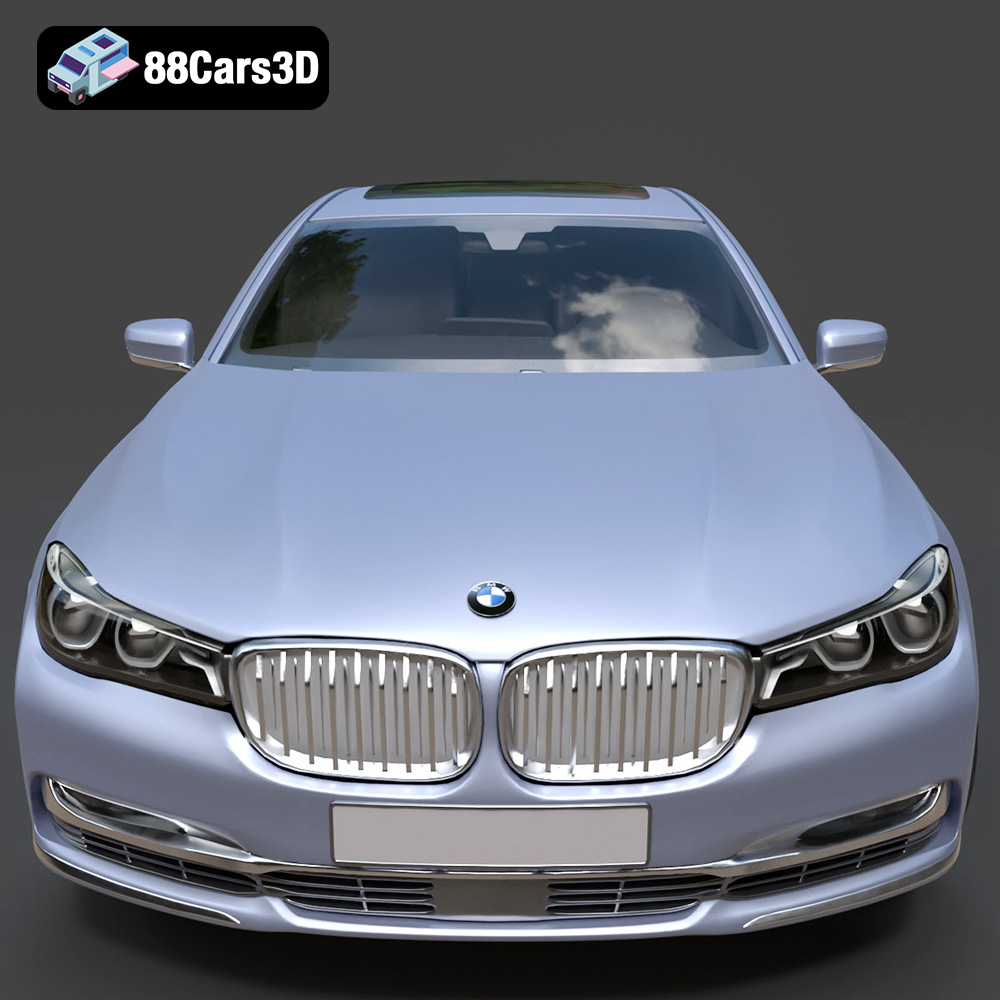
The first impression of any 3D car model comes from its exterior, and here, the BMW 7 Series 2016 excels. The accurately modeled body panels reflect the sophisticated design language of BMW, capturing the subtle curves and sharp lines that define the luxury sedan. But it’s the smaller, often overlooked, details that elevate it: the iconic ‘kidney’ grille and authentic badging are not just texture maps but carefully modeled elements. Precision-engineered headlights and taillights feature realistic transparent materials, allowing for dynamic lighting effects that mimic their real-world counterparts. High-resolution wheels and tires faithfully replicate the specific design for the 2016 model year, complete with accurate tread patterns and material properties for rubber and alloy. Crucially, components like doors, hood, and trunk are separated, not just for visual accuracy but for ease of animation, a critical feature for configurators or cinematic sequences. Reflective chrome accents and realistic window glass further enhance visual fidelity, ensuring stunning results in any automotive rendering scenario.
While the exterior catches the eye, a truly comprehensive 3D car model doesn’t neglect the interior. The BMW 7 Series 2016 model features comprehensive interior detailing, including the dashboard, steering wheel, seats, door panels, and center console. This level of detail extends to visible gauges and controls, enhancing realism for close-up shots, virtual tours, or even interactive experiences where users might ‘sit’ inside the vehicle. The mesh quality for these interior elements is optimized to ensure efficient performance, even with intricate details within the cabin. Furthermore, basic undercarriage and visible mechanical components are included where appropriate, providing a complete representation that stands up to scrutiny from various angles, making it a robust game asset or simulation component.
Underpinning all this visual fidelity are crucial technical advantages. The model boasts clean, quad-dominant topology, which is essential for smooth subdivisions and deformation. This means that if you need to increase the model’s detail level for extreme close-ups, it will subdivide gracefully without pinching or artifacts. Modeled to real-world scale, the asset seamlessly integrates into existing scenes, whether they are architectural visualizations, urban environments, or other vehicle lineups. This adherence to real-world dimensions is critical for accurate physical simulations and consistent scaling across different projects. An organized hierarchy with properly named components and pivot points further streamlines manipulation and animation workflows, saving countless hours for 3D artists and developers.
The true value of a high-quality 3D car model like the BMW 7 Series 2016 lies in its adaptability across a spectrum of professional applications. Its optimized structure and meticulous detail make it a versatile tool for various industries.
For architectural visualization studios, advertising agencies, and product design firms, creating stunning visual content is paramount. The BMW 7 Series 2016 3D model is perfect for generating photorealistic renders for brochures, billboards, or online campaigns. Its accurate materials and detailed geometry allow for cinematic sequences, showcasing the vehicle in various environments, from a sleek studio backdrop to a bustling city street. Artists can easily adjust paint finishes, material properties (like the sheen of leather or the reflectivity of chrome), and configure dynamic lighting setups to achieve specific moods and visual effects, producing truly exceptional automotive rendering.
In the demanding world of game development, performance and visual quality must strike a delicate balance. This 3D model is crafted as a game-ready asset, suitable for a range of interactive experiences. Whether it’s integrated into a racing game, populating an open-world environment, or serving as a detailed vehicle in a simulation, its optimized mesh quality ensures efficient performance without sacrificing visual impact. The inclusion of formats like .fbx and .unreal means it’s ready for immediate deployment into leading game engines, streamlining the asset pipeline for developers seeking high-quality 3D car models.
The burgeoning fields of augmented reality (AR) and virtual reality (VR) offer new frontiers for showcasing automotive designs. High-quality 3D models are the backbone of these immersive applications. The BMW 7 Series 2016 model can be utilized in AR/VR experiences for interactive car configurators, allowing potential buyers to explore color options and features in a virtual showroom, or for virtual driving simulations. Its .glb format is specifically optimized for web and immersive platforms, ensuring smooth, high-fidelity experiences across various devices and browsers, offering a powerful tool for modern visualization.
The foundation of any superior 3D asset lies in its technical integrity. Without a robust and well-structured mesh, even the most visually appealing model can become a bottleneck in production. The BMW 7 Series 2016 3D model exemplifies the critical balance between aesthetic detail and technical efficiency, a hallmark of truly professional 3D car models.
One of the standout technical advantages of this model is its clean, quad-dominant topology. For those new to 3D, ‘topology’ refers to the arrangement of vertices, edges, and faces that form the surface of a model. ‘Quad-dominant’ means the mesh is primarily composed of four-sided polygons (quads). This is crucial because quads allow for predictable and smooth subdivision, making it easy to increase the model’s resolution for close-up renders without introducing unsightly artifacts or pinching. It also facilitates easier UV mapping and texture application, as well as more reliable deformation during animation. This meticulous approach to geometry ensures that the model is not only visually appealing but also technically sound and artist-friendly.
While detail is important, it must be balanced with performance, especially for real-time applications like games or interactive AR/VR experiences. The BMW 7 Series 2016 3D model is optimized for performance without compromising its high visual fidelity. This involves careful poly-count management, ensuring that details are represented efficiently where they matter most. An optimized mesh means faster loading times, smoother frame rates in engines, and overall a more pleasant user experience. Furthermore, the model is built to real-world scale, which is essential for accurate integration into scenes that rely on physical dimensions for lighting, physics simulations, or consistency with other real-world assets. An organized hierarchy with properly named components and pivot points for individual parts (like doors, wheels, or the steering wheel) significantly enhances its usability, allowing artists to quickly select, manipulate, and animate elements without confusion.
Beyond its inherent quality, a truly professional 3D car model offers ample room for creative interpretation and customization. The BMW 7 Series 2016 3D model is engineered not just for static representation but for dynamic adaptation, empowering artists and developers to truly make it their own.
One of the most powerful aspects of working with high-quality 3D assets is the ability to customize materials. With the BMW 7 Series 2016 model, you can easily modify paint finishes to match branding colors, experiment with different metallic flakes, or apply custom graphics and liveries for unique designs. The detailed material properties for various surfaces—metal, plastic, leather, glass, chrome—can be adjusted to suit different lighting environments and artistic visions. This flexibility allows for a vast array of visual styles, from a showroom-perfect sheen to a gritty, battle-worn look for a game. Coupling this with the ability to configure dynamic lighting setups opens up possibilities for achieving dramatic visual effects and moods, making it indispensable for advanced automotive rendering.
The thoughtful construction of this 3D model extends to its animation capabilities. With separated components such as doors, hood, and trunk, along with properly set pivot points, animating actions like opening doors, raising the hood, or even subtle suspension movements becomes a straightforward process. This ‘animation readiness’ is crucial for cinematic sequences, interactive configurators, or even simply posing the car for a still render. The clean topology further supports deformation, ensuring that any animated part moves smoothly and realistically without mesh distortions, reinforcing its status as a versatile game asset or visualization tool.
In a saturated market of digital assets, discerning professionals understand that not all 3D car models are created equal. Investing in a high-quality model, like the BMW 7 Series 2016 from 88cars3d.com, is an investment in the efficiency, quality, and longevity of your projects.
A truly valuable asset provides more than just geometry. The comprehensive inclusion of various file formats (.blend, .fbx, .obj, .glb, .stl, .ply, .unreal, .max) means that this BMW 7 Series 2016 3D model is immediately usable across virtually any industry-standard software or engine. This eliminates the headache of format conversions, potential data loss, or incompatible material setups. It streamlines workflows, reduces production time, and ensures that you have the right tool for every task, whether it’s a high-poly render in 3ds Max, a game-ready asset in Unreal, or an AR experience on the web.
The technical advantages—clean topology, real-world scale, optimized mesh, and organized hierarchy—are not just buzzwords; they are guarantees of future compatibility and ease of modification. This means that as your project evolves, or as new software versions emerge, this 3D model will continue to perform reliably. It’s built with best practices in mind, making it a future-proof asset that can be easily updated, re-textured, or integrated into new pipelines without requiring a complete overhaul. For any professional serious about their 3D production, acquiring such a robust and versatile asset is a strategic decision that pays dividends in both time saved and quality delivered.
The demand for high-quality 3D automotive models continues to grow across industries, driving the need for assets that combine aesthetic brilliance with technical robustness. The BMW 7 Series 2016 3D model represents the pinnacle of this demand, offering an unparalleled blend of meticulous detail, optimized performance, and broad compatibility. From its faithfully recreated exterior and comprehensive interior to its clean topology and diverse file format support, it is engineered to meet the stringent requirements of professional workflows in automotive rendering, game development, AR/VR, and simulation.
Choosing an asset of this caliber ensures that your projects benefit from a solid foundation, allowing artists and developers to focus on creative execution rather than troubleshooting. Whether you’re crafting stunning visuals, building immersive interactive experiences, or prototyping designs, this model provides the quality and versatility necessary for exceptional results. Explore the extensive range of professional 3D car models available on 88cars3d.com and elevate your digital creations today.
Experience the epitome of automotive luxury with this professional 3D model of the BMW 7 Series 2016. Meticulously crafted to capture the essence of this executive sedan, the model boasts clean geometry and balanced detailing, making it ideal for a wide range of applications. Whether you’re working on high-fidelity renders, intricate animations, realistic simulations, or immersive game development, this 3D model provides a robust and accurate foundation for your projects.
Exterior Features:
Interior / Mechanical Features:
Technical Advantages:
Applications:
Customization Options:
This BMW 7 Series 2016 3D model offers unparalleled quality and versatility, making it an indispensable asset for any professional 3D project. Its detailed design, optimized structure, and broad compatibility ensure a smooth workflow and exceptional results.
Included File Formats:
$10.79
.7series
.arvr
.blend
.bmw
.car
.fbx
.gameasset
.glb
.luxurycar
.max
.obj
.ply
.rendering
.sedan
.simulation
.stl
.unreal