

Driving Digital Dreams: The Enduring Appeal of Classic Automotive 3D Models
In the vast landscape of 3D visualization, few subjects capture the imagination quite like meticulously crafted automotive models. From high-octane racing simulations to breathtaking architectural visualizations and cinematic renders, the demand for realistic and technically sound 3D car models is ever-growing. For designers, game developers, architects, and VR/AR creators, the difference between a good project and an exceptional one often lies in the quality of its core assets.
Classic cars, in particular, hold a special place. They are not just vehicles; they are pieces of history, design icons that evoke nostalgia and admiration. Recreating these machines in a digital environment requires not only artistic skill but also a deep understanding of technical precision. This is where assets like the BMW 7 Series E38 3D Model shine. This particular model, representing the iconic luxury full-size sedan produced from 1994 to 2001, is a prime example of how high-quality 3D assets can elevate any project. It encapsulates the distinctive lines, refined presence, and sophisticated engineering of a true automotive classic, making it an indispensable resource for anyone seeking to infuse their digital worlds with authentic automotive luxury. At 88cars3d.com, you’ll find a curated selection of such professional-grade models, designed to meet the rigorous demands of various industries.
Understanding 3D Model File Formats: The Backbone of Digital Automotive Creation
The versatility of a 3D model often hinges on its supported file formats. Each format offers unique advantages, catering to specific software, engines, or applications. Understanding these differences is crucial for any professional working with 3D car models, ensuring seamless integration and optimal performance across diverse workflows. The BMW 7 Series E38 3D Model from 88cars3d.com is provided in a comprehensive suite of formats, empowering artists and developers with maximum flexibility.
.blend – The Blender Powerhouse
The .blend format is native to Blender, a leading open-source 3D creation suite. When a model is provided in .blend, it means you’re getting a fully editable Blender scene, complete with materials, lighting, and any modifiers or rigging applied during its creation. This offers unparalleled flexibility for Blender users, allowing for deep customization, animation, and rendering directly within their preferred environment without any loss of data or conversion artifacts. It’s ideal for those who want to dive into the model’s construction, adapt its shaders, or integrate it into complex Blender-specific scenes.
.fbx – The Industry Standard for Interoperability
.fbx (Filmbox) is arguably the most widely used proprietary 3D file format for exchanging 3D data between different software applications and game engines. Developed by Autodesk, it’s known for its robust support for mesh data, materials, textures, animations, and even skeletal rigs. For game development, especially with Unreal Engine and Unity, .fbx is the go-to format due to its efficiency and ability to accurately transfer complex scene information. It’s highly optimized for real-time pipelines, making it indispensable for game assets and interactive applications.
.obj – The Universal Workhorse
The .obj (Object) format is a universal, open-standard format that has been around for decades. It’s renowned for its simplicity and wide compatibility, supported by virtually every 3D software package. While it primarily stores geometric data (vertices, normals, texture coordinates), it can reference external .mtl (material) files for basic material properties and texture maps. Its strength lies in its pure mesh representation, making it a reliable choice for cross-software compatibility when complex animations or rigging aren’t the primary concern. It’s an excellent fallback format for ensuring your model can be opened anywhere.
.glb – Optimized for AR, VR, and Web
.glb (GL Transmission Format Binary) is the binary version of glTF, a royalty-free specification for the efficient transmission and loading of 3D scenes and models by applications. It’s gaining significant traction for its optimization for AR (Augmented Reality), VR (Virtual Reality), and browser-based display. A .glb file packages all necessary data (geometry, materials, textures, animations) into a single, compact file, enabling fast loading and rendering in real-time web applications and immersive experiences. If you’re targeting web viewers or mobile AR/VR, .glb is your format of choice.
.stl – The 3D Printing Standard
.stl (Stereolithography) is the most common file format for 3D printing. It represents a 3D model as a series of connected triangles, describing only the surface geometry of an object without any color, texture, or material information. While not suitable for rendering or animation directly, its ubiquitous support in 3D printing software makes it essential for physical model production. The BMW 7 Series E38 3D Model can be easily converted to .stl, opening up avenues for creating physical prototypes or collectible models.
.ply – Precision Mesh for CAD and Analysis
.ply (Polygon File Format or Stanford Triangle Format) is a file format for storing three-dimensional data from 3D scanners. It can store a variety of properties, including color, transparency, surface normals, and texture coordinates, in addition to the standard polygonal mesh data. It’s often used in scientific applications, CAD (Computer-Aided Design), and when precision mesh data is critical for analysis or reconstruction, offering a more robust data set than .obj for certain applications.
.unreal – Engine-Ready for Real-time Environments
The inclusion of an .unreal file (or specific Unreal Engine project setup) signifies a model that has been specifically prepared for Epic Games’ powerful Unreal Engine. This often means the asset is pre-configured with materials, textures, collision meshes, and potentially LODs (Levels of Detail) to ensure optimal performance and visual fidelity within the engine. For game developers leveraging Unreal, this format dramatically streamlines the import and integration process, saving countless hours of setup time and ensuring consistency.
.max – The 3ds Max Professional Gateway
Finally, the .max format is the native file type for Autodesk 3ds Max, a long-standing industry leader for 3D modeling, animation, and rendering. An editable .max project allows users of 3ds Max to access the model’s full construction, including scene setup, modifiers, materials, and complex animations. It provides the highest level of control and fidelity for professionals working within the 3ds Max ecosystem, making it excellent for high-end rendering, complex simulations, and detailed animation sequences.
Together, these formats ensure that the BMW 7 Series E38 3D Model is not just a visual representation, but a truly versatile asset ready for any professional pipeline.
Crafting Automotive Realism: The BMW E38 in Detail
Creating a truly convincing 3D automotive model goes far beyond basic shape. It demands an obsessive attention to detail, accurately replicating every curve, panel gap, and material nuance of the real-world counterpart. The BMW 7 Series E38 3D Model exemplifies this commitment to realism, bringing a piece of automotive history to life in the digital realm.
Exterior Fidelity and Design Legacy
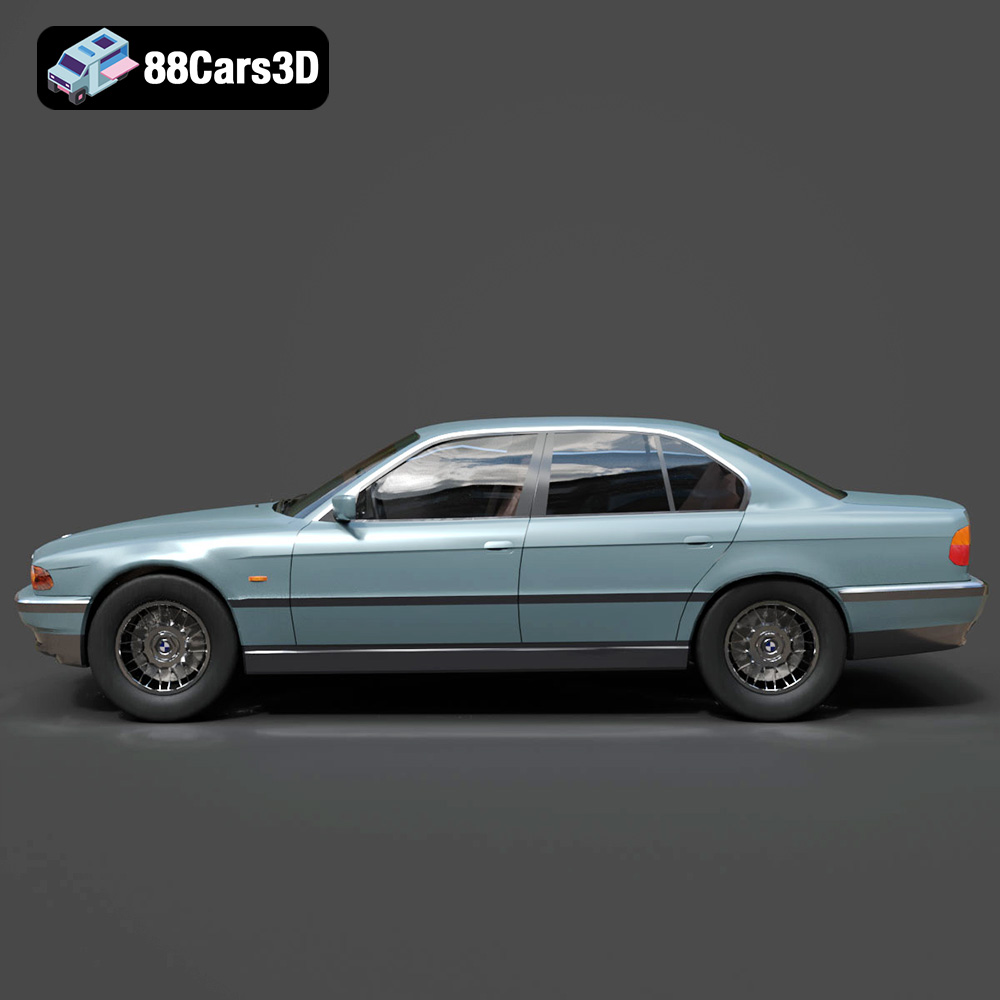
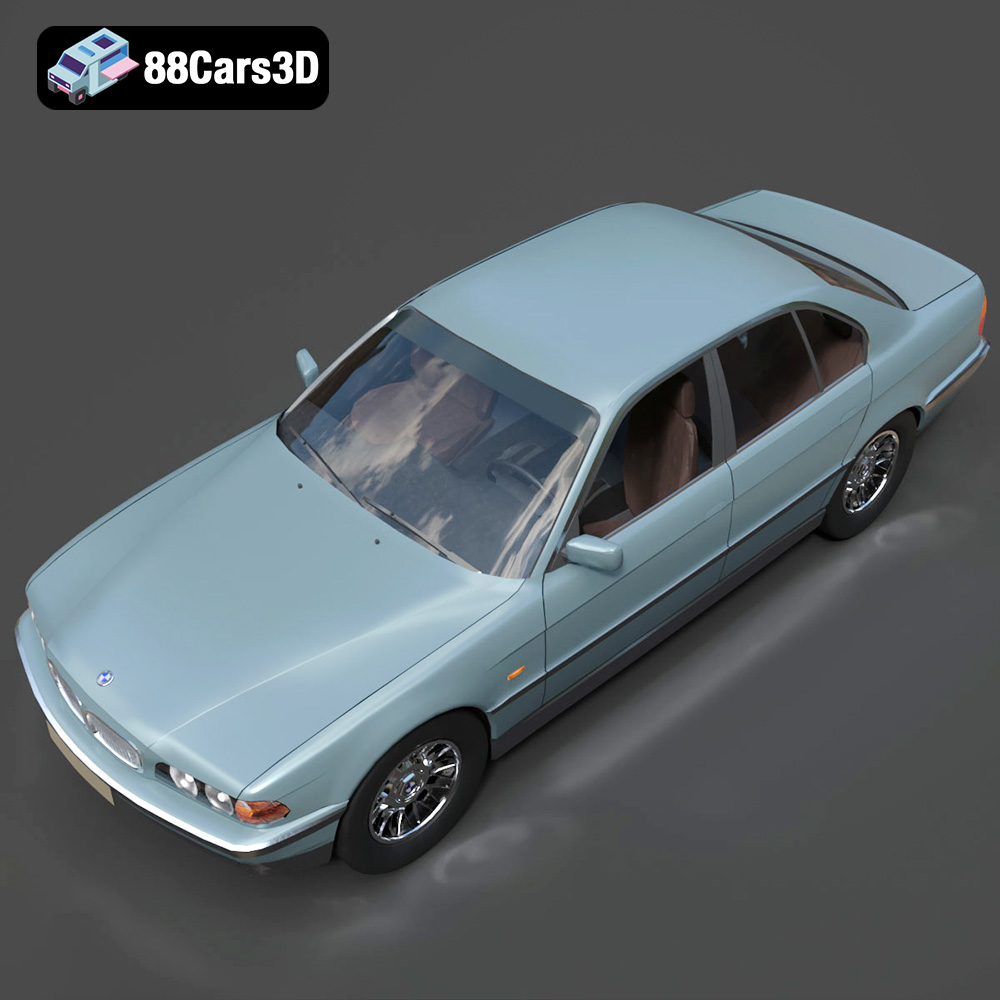
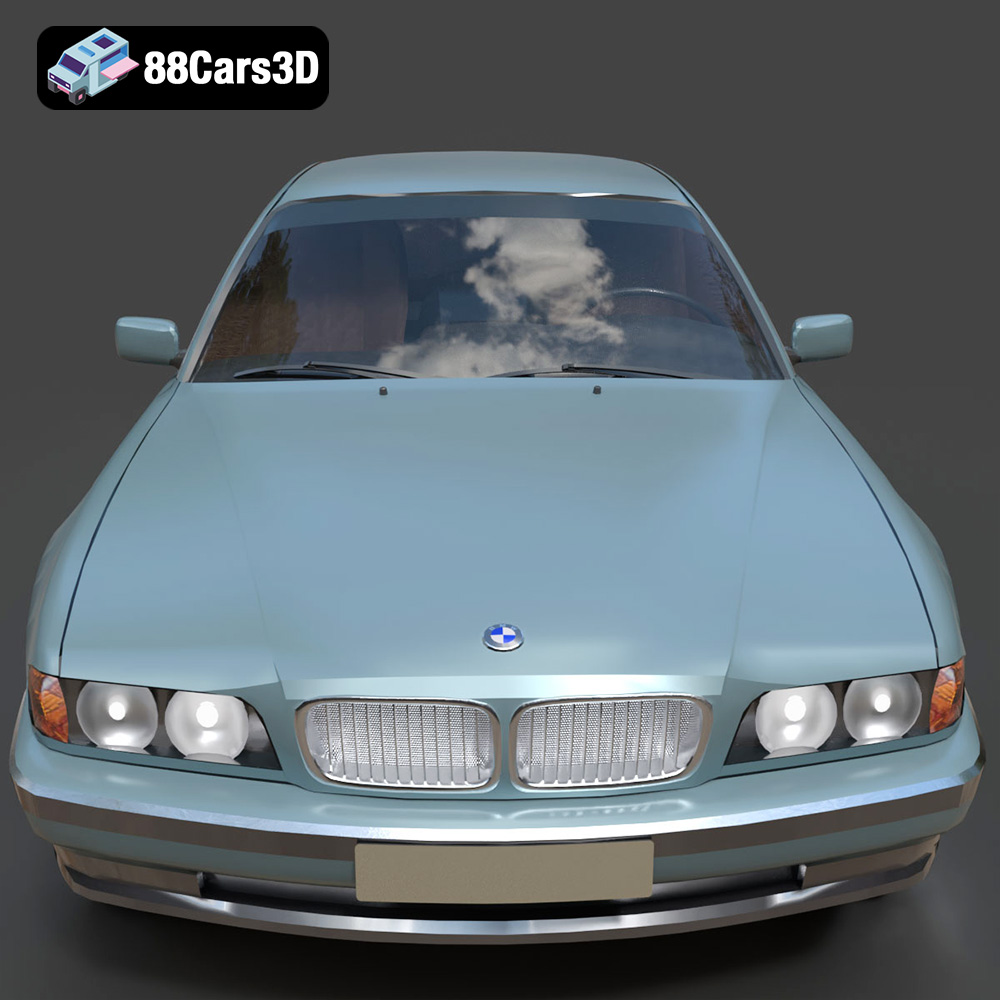
The E38 generation of the BMW 7 Series is celebrated for its elegant, understated design – a departure from some of its more flamboyant successors. This 3D model meticulously captures that iconic aesthetic. Every body panel, from the distinctive kidney grille to the sweeping lines along the side, is accurately modeled, reflecting the E38’s signature design language. Headlights and taillights are rendered with transparent materials, allowing for realistic lighting effects that truly make the car pop in any scene. The authentic wheel designs and realistic tire profiles further ground the model in reality, ensuring that even close-up renders convey a sense of genuine automotive engineering. This level of exterior detail makes the model perfect for high-quality automotive rendering and visualization projects, allowing artists to recreate the classic car’s presence with unparalleled accuracy.
Interior Immersion and Functional Elements
A car model is incomplete without a faithful representation of its interior, especially for a luxury sedan like the 7 Series. This asset features a detailed dashboard with instrumentation, a steering wheel, and accurate center console controls, providing a believable cockpit environment. The seating and door panel textures reflect the luxurious materials found in the real vehicle, enhancing the sense of immersion for anyone interacting with the model in VR or an in-game environment. Furthermore, key components like doors, the hood, and the trunk are separated, not merely for visual accuracy, but for practical application. This allows for ease of animation, enabling dynamic scenes where doors open, trunks lift, or hoods reveal engine details – a critical feature for cinematic sequences or interactive simulations.
Under the Hood and Chassis Details
While often hidden, the subtle inclusion of undercarriage and engine bay details contributes significantly to the overall realism, particularly for exterior renders with open elements or dynamic camera angles. Even if not fully modeled for engine simulations, providing basic shapes and components beneath the chassis ensures that light interacts realistically and that glimpses of mechanical parts enhance the illusion of a complete, functional vehicle. This thoughtfulness in design reinforces the model’s professional-grade quality, making it suitable for a broad spectrum of visualization needs where authenticity is paramount.
Technical Foundations for Professional Workflows
Beyond visual accuracy, the true strength of a professional 3D car model lies in its underlying technical structure. A well-constructed model ensures optimal performance, ease of manipulation, and compatibility across various platforms. The BMW 7 Series E38 3D Model is built with these principles at its core, designed for peak efficiency and adaptability in demanding creative pipelines.
Topology and Mesh Optimization
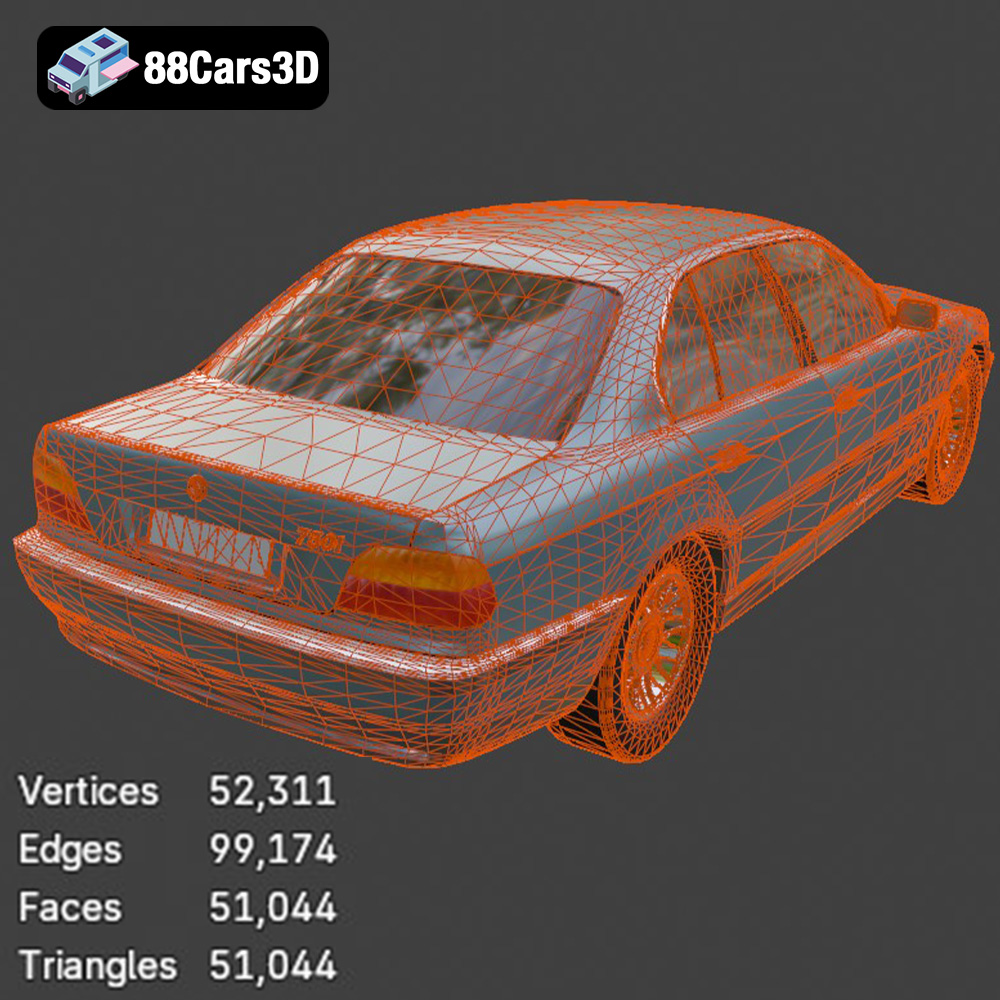
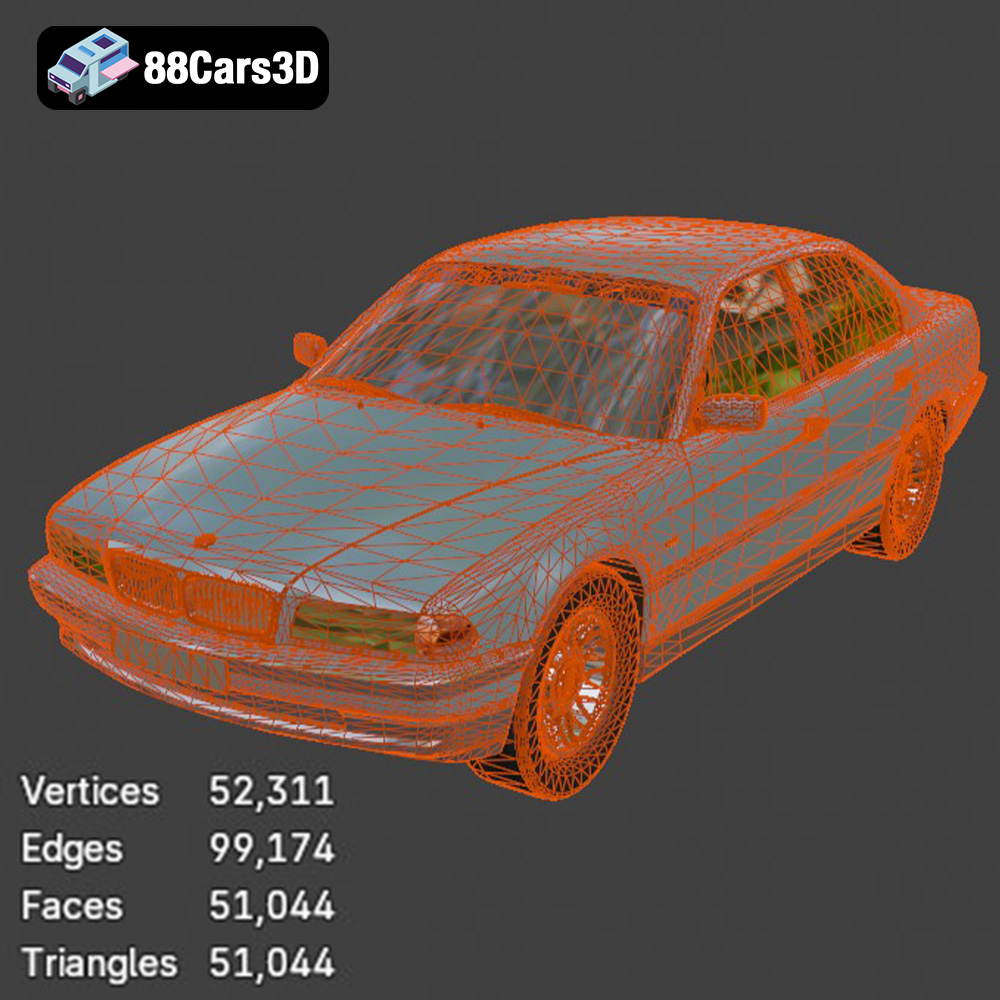
One of the most critical aspects of any 3D model is its topology – the arrangement of its polygons. This BMW E38 model boasts clean quad-dominant topology. Quads (four-sided polygons) are the preferred choice in professional modeling because they allow for predictable subdivision, leading to smooth, artifact-free surfaces when a mesh is refined using techniques like subdivision surfaces. This ensures that the model can be used for both high-resolution renders requiring extreme smoothness and lower-poly applications where efficiency is key. Furthermore, clean topology makes the mesh easier to deform for animation purposes, preventing unwanted pinching or stretching artifacts.
Real-World Scale and Asset Organization
Adhering to real-world scale is fundamental for accurate integration into any 3D scene, especially in architectural visualization or simulation projects. The E38 model is built to its actual dimensions, eliminating the need for scaling adjustments and ensuring proportional accuracy when placed alongside other assets or environments. Equally important is the model’s organized hierarchy with proper pivot points. This means that individual components like wheels, doors, hood, and trunk are logically grouped and have their rotation centers correctly positioned. This setup simplifies animation, manipulation, and customization, allowing artists to effortlessly pose the vehicle or animate its moving parts without complex restructuring.
UV Unwrapping and Material PBR Workflow
For high-fidelity renders, proper UV unwrapping and texture mapping are indispensable. The BMW 7 Series E38 3D Model is UV unwrapped, ensuring that textures can be applied accurately and without distortion. This is crucial for realistic paint finishes, chrome reflections, intricate tire treads, and detailed interior surfaces. The design principles inherent in the model support a Physically Based Rendering (PBR) workflow, meaning its materials are set up to interact with light in a physically accurate manner. This allows for consistent and believable rendering across different lighting conditions and rendering engines, ensuring that whether you’re using V-Ray, Corona, Cycles, or Unreal Engine, the car’s surfaces will respond authentically to light, creating stunningly realistic visuals.
Applications Across Industries: From Rendering to AR/VR
The true value of a versatile 3D asset lies in its broad applicability across diverse industries and platforms. The BMW 7 Series E38 3D Model is engineered to serve a wide range of professional needs, from static visualizations to interactive real-time experiences.
High-Resolution Rendering and Visualization
For artists and studios focused on producing stunning visuals, this model is a dream come true. Its clean geometry, detailed features, and PBR-ready materials make it perfect for high-resolution studio renders. Imagine the E38 showcased in a luxurious showroom, gleaming under studio lights, or serving as a focal point in a cinematic sequence. Architectural visualization projects can integrate the car seamlessly into street scenes or driveways, adding a touch of realism and aspiration. Its fidelity ensures that even extreme close-ups maintain their visual integrity, making it ideal for marketing materials, product showcases, and high-end advertising.
Game Development and Real-time Engines
The demands of game development are unique, requiring a delicate balance between visual quality and performance optimization. The E38 model is designed as an excellent game asset, optimized for efficient integration into engines like Unreal and Unity. Its balanced detail means it can represent the car accurately without excessively high polygon counts that would burden game performance. For racing simulations, open-world environments, or interactive experiences, the model’s organized hierarchy and clean topology facilitate easy implementation of physics, collisions, and character interaction. Developers can focus on gameplay, knowing the core vehicle asset is robust and engine-ready.
Immersive Experiences: AR/VR and Simulation
As augmented reality (AR) and virtual reality (VR) continue to mature, the need for high-quality, optimized 3D content becomes paramount. This BMW E38 model is ideal for creating immersive AR/VR automotive showcases. Users can explore the classic sedan from every angle, stepping inside the virtual cockpit, or even placing it within their real-world environment via AR. Beyond entertainment, the model is also highly suitable for driving simulators, automotive training modules, and engineering visualizations. Its realistic proportions and detailed interior provide a convincing platform for training scenarios or for engineers to visualize vehicle dynamics in a virtual setting.
3D Printing and Physical Prototyping
The digital world can seamlessly transition to the physical. With the ability to be easily converted to the .stl format, this model opens up avenues for 3D printing and physical model production. Hobbyists can create highly detailed scale models, while professionals might use it for rapid prototyping or creating physical representations for design reviews. The clean geometry ensures a successful conversion and print, resulting in a tangible representation of this iconic luxury car.
Customization and Integration in Your Pipeline
A truly valuable 3D asset doesn’t just look good; it empowers creators with the flexibility to adapt it to their unique vision and integrate it seamlessly into existing workflows. The BMW 7 Series E38 3D Model provides extensive customization options, ensuring it becomes a truly personal and project-specific asset.
Tailoring Visuals: Paint, Materials, and Lighting
One of the most immediate ways to customize a vehicle is through its appearance. This model allows users to easily modify paint finishes, colors, and add custom graphics or liveries. Whether you envision a classic metallic blue, a sleek black, or a unique racing livery, the underlying material setup makes these changes straightforward. Furthermore, you can adjust material properties for metals, chrome, rubber, glass, and plastics to match specific rendering styles, from photorealistic to stylized. Experiment with different reflectivity, roughness, or transparency settings to achieve the exact aesthetic your project demands. The model’s inherent quality also makes it highly responsive to adapting lighting setups, allowing you to achieve diverse scene moods and visual effects, from dramatic cinematic lighting to bright, sunny outdoor scenes.
Seamless Workflow Integration with Major Software
Thanks to the comprehensive suite of included file formats (.blend, .fbx, .obj, .glb, .stl, .ply, .unreal, .max), integrating the BMW E38 into your preferred 3D software is exceptionally smooth. For Blender users, the native .blend file offers a ready-to-render scene. 3ds Max professionals can leverage the .max file for full control over every aspect. Game developers can drop the .fbx directly into Unity or utilize the .unreal project for immediate integration into Unreal Engine. This multi-format approach minimizes setup time, reduces conversion errors, and allows creative professionals to focus on their artistic goals rather than wrestling with compatibility issues. This commitment to wide compatibility underscores the professional nature of the models found at 88cars3d.com.
Leveraging 88cars3d.com Assets for Efficiency
In a fast-paced creative industry, time is a precious commodity. Utilizing high-quality, pre-made 3D car models like the BMW 7 Series E38 from 88cars3d.com offers a significant advantage. Instead of spending countless hours on modeling from scratch, artists and developers can instantly access a production-ready asset. This dramatically accelerates project timelines, allowing teams to allocate resources to other critical areas such as scene composition, animation, lighting, or interactivity. The investment in a premium asset like this translates directly into enhanced productivity and superior final results, empowering creators to deliver stunning projects more efficiently.
Conclusion: Powering Your Projects with Automotive Excellence
The digital realm offers boundless opportunities for creative expression, and at its heart lies the quality of the assets we use. The BMW 7 Series E38 3D Model stands as a testament to the blend of artistic craftsmanship and technical excellence required to bring automotive icons to life in 3D. Its meticulous detailing, robust technical foundation, and broad application across rendering, game development, AR/VR, simulation, and even 3D printing make it an exceptionally versatile and indispensable asset.
Whether you’re a seasoned professional seeking to enhance your next big project or an aspiring artist looking for a high-quality foundation, this model offers the precision, flexibility, and historical significance to elevate your work. By providing such a comprehensive and professionally prepared asset, 88cars3d.com empowers creators to achieve unparalleled realism and efficiency in their digital automotive endeavors. Embrace the elegance of the E38 and unlock new creative possibilities for your projects today.
Featured 3D Model
BMW 7 Series E38 3D Model
Experience the timeless elegance and sophisticated engineering of the BMW 7 Series E38 with this meticulously crafted 3D model. Representing the iconic luxury full-size sedan produced from 1994 to 2001, this model captures the distinctive lines and refined presence of a true automotive classic. Built with clean geometry and balanced detailing, it is optimized for high-quality rendering, realistic animation, immersive simulation, and efficient integration into game development projects.
Exterior Features:
- Accurately modeled body panels reflecting the E38’s signature design
- Detailed front grille, headlights, and taillights with transparent materials for realistic lighting
- Authentic wheel designs and realistic tire profiles
- Separated components like doors, hood, and trunk for ease of animation and customization
- Clear window glass and functional mirrors
Interior / Mechanical Features:
- Detailed dashboard with instrumentation, steering wheel, and center console controls
- Comfortable seating and door panel textures reflecting the luxury interior
- Optimized mesh quality to balance detail with performance, suitable for various applications
- Basic undercarriage and engine bay details for exterior renders
Technical Advantages:
- Clean quad-dominant topology ensures smooth subdivision and deformation
- Modeled to real-world scale for accurate integration into scenes
- Organized hierarchy with proper pivot points for easy manipulation and animation of parts
- UV unwrapped with appropriate texture mapping for high-fidelity renders
Applications:
- Rendering & Visualization: Perfect for high-resolution studio renders, cinematic scenes, and architectural visualizations
- Game Development: Optimized as a game asset for racing simulations, open-world environments, and interactive experiences
- AR/VR: Ideal for creating immersive augmented and virtual reality automotive showcases
- Simulation & Training: Suitable for driving simulators, automotive training modules, and engineering visualizations
- 3D Printing: Can be easily converted to .stl format for physical model production
Customization Options:
- Easily modify paint finishes, colors, and add custom graphics or liveries
- Adjust material properties for metals, chrome, rubber, glass, and plastics to match specific rendering styles
- Adapt lighting setups to achieve diverse scene moods and visual effects
This BMW 7 Series E38 3D model offers a professional-grade asset for any project requiring a blend of luxury, detail, and historical automotive significance. Its versatility across multiple platforms and applications makes it an indispensable addition to your 3D asset library.
Included File Formats:
- .blend – Blender project with materials
- .fbx – Compatible with Unreal, Unity, and major 3D engines
- .obj – Universal format for nearly all 3D software
- .glb – Optimized for AR, VR, and web-based visualization
- .stl – Ready for 3D printing
- .ply – Mesh format for analysis and CAD workflows
- .unreal – Unreal Engine project setup
- .max – Editable 3ds Max scene for rendering and animation
Tags:
.bmw,.7seriese38,.luxurycar,.sedan,.classiccar,.rendering,.simulation,.gameasset,.arvr,.blend,.fbx,.obj,.glb,.stl,.ply,.unreal,.maxLamborghini Diablo SV 1995 3D Model
$10.79
Product Image Gallery



Related Tags
.7seriese38
.arvr
.blend
.bmw
.classiccar
.fbx
.gameasset
.glb
.luxurycar
.max
.obj
.ply
.rendering
.sedan
.simulation
.stl
.unreal
