

Driving Innovation: The Crucial Role of High-Quality 3D Car Models in Modern Visualization
In the dynamic worlds of automotive design, game development, cinematic production, and advanced visualization, the demand for hyper-realistic and functionally robust 3D assets has never been higher. A meticulously crafted 3D car model is more than just a digital representation; it’s a versatile tool that bridges conceptual designs with tangible experiences, enabling designers, artists, and developers to bring their visions to life with unparalleled fidelity.
From showcasing next-generation vehicle concepts in a virtual showroom to populating expansive open-world games or even creating detailed simulations for autonomous driving, the quality of a 3D car model directly impacts the success and authenticity of any project. It requires a deep understanding of vehicle aesthetics, technical precision, and optimization for diverse platforms.
This pursuit of excellence is precisely what defines professional-grade assets, such as the BMW 7-Series F02 3D Model. This exquisite digital replica exemplifies how a well-engineered 3D vehicle can serve as the cornerstone for a multitude of applications, ensuring visual appeal and technical efficiency across the board.
The Foundation of Digital Automotive Excellence: Understanding 3D Model File Formats
One of the most critical aspects of working with 3D car models, especially complex and detailed assets like the BMW 7-Series F02, is understanding the various file formats available. Each format serves a specific purpose, offering unique advantages for different stages of the production pipeline, from initial modeling and texturing to final rendering, real-time integration, and even physical output. A truly professional asset, like those found on 88cars3d.com, provides a comprehensive suite of formats to ensure maximum compatibility and workflow flexibility.
.blend – The Native Blender Ecosystem
The .blend format is Blender’s native file type, encompassing an entire scene, including mesh data, materials, textures, lighting, cameras, animation, and physics simulations. For artists and studios heavily invested in the Blender ecosystem, this format is invaluable. It allows for full editability, giving users complete control over every aspect of the BMW 7-Series F02 3D model, from adjusting shaders with Cycles or Eevee, tweaking mesh details with modifiers, or integrating it into complex animations. Its open-source nature and robust feature set make .blend a powerhouse for comprehensive 3D creation.
.fbx – The Industry Standard for Interchange
.fbx (Filmbox) is a proprietary file format owned by Autodesk, but it has become the de facto industry standard for 3D data interchange. Its strength lies in its ability to store not just mesh geometry and UVs, but also hierarchical structures, animation data, skinning, blend shapes, and PBR (Physically Based Rendering) material definitions. This makes the .fbx version of the BMW 7-Series F02 ideal for seamlessly transferring assets between different 3D software packages (like 3ds Max, Maya, Blender, Cinema 4D) and, critically, into game engines such as Unreal Engine and Unity. Its widespread adoption ensures a reliable and robust pipeline for professional game assets and cinematic animation.
.obj – The Universal Geometry Carrier
The .obj (Wavefront OBJ) format is one of the oldest and most universally supported 3D file formats. It primarily stores geometric data – vertices, normals, UV coordinates, and faces – along with references to external material files (.mtl). While it doesn’t typically store animation or rigging data, its simplicity and broad compatibility make it an excellent choice for static meshes or as a fallback option when other formats encounter issues. For the BMW 7-Series F02, the .obj version ensures that the core mesh data is accessible in virtually any 3D software, providing a solid foundation for further detailing or conversion.
.glb – Optimized for the Web, AR, and VR
.glb is the binary version of glTF (GL Transmission Format), an API-neutral runtime asset delivery format for 3D scenes and models. Designed to be compact and efficient for quick loading and rendering, .glb is optimized for web-based 3D applications, augmented reality (AR), and virtual reality (VR) experiences. It embeds textures and other resources directly into a single file, making the BMW 7-Series F02 immediately ready for interactive web viewers, mobile AR apps, or immersive VR environments, where performance and quick load times are paramount.
.stl – Precision for Physical Manufacturing
The .stl (Stereolithography) format is the standard for 3D printing. It represents the surface geometry of a 3D object using a collection of interconnected triangles, known as a triangulated mesh. The .stl version of the BMW 7-Series F02 is critical for anyone looking to produce a physical prototype, a scale model, or a collectible. For successful 3D printing, the mesh needs to be “manifold” (watertight), and designers often need to consider scale and wall thickness. This format transforms the digital car into a blueprint for physical creation.
.ply – The Versatile Polygon Mesh Format
.ply (Polygon File Format) is another format that describes 3D objects as a collection of polygons. It’s often used in applications that deal with scanned data, CAD models, and scientific visualization due to its ability to store various properties beyond just geometry, such as color, transparency, and even normal vectors per vertex or face. For precise mesh analysis or integration into specific engineering or CAD workflows, the .ply version of the BMW 7-Series F02 can be particularly useful.
.unreal – Engine-Ready for Real-Time Immersion
The .unreal format, or more accurately, an Unreal Engine project/asset ready for the engine, signifies that the BMW 7-Series F02 model has been specifically prepared and optimized for Unreal Engine. This typically means that the asset is provided with proper material setups (using Unreal’s PBR shader system), potentially with collision meshes, Level of Detail (LOD) variations for performance, and sometimes even basic blueprints for interactivity. It dramatically accelerates the workflow for game developers and real-time visualization artists, allowing them to drop the asset directly into their projects with minimal setup.
.max – The Definitive 3ds Max Scene
Finally, the .max format is the native file type for Autodesk 3ds Max, one of the leading software packages for 3D modeling, animation, and rendering. The .max file for the BMW 7-Series F02 will contain the entire 3ds Max scene, including all modifiers, material settings (e.g., V-Ray, Corona Renderer), lighting setups, and animation curves. This provides 3ds Max users with the highest level of flexibility and control for advanced rendering, complex animations, and integrating the model into elaborate architectural visualization or product configurator scenes.
By offering the BMW 7-Series F02 in this comprehensive array of formats, 88cars3d.com empowers professionals to select the precise tool they need for their specific projects, ensuring seamless integration and optimal performance regardless of their chosen software or end-use application.
Anatomy of a Premium 3D Car Model: The BMW 7-Series F02 Deep Dive
What truly sets a high-quality 3D car model apart from a generic asset is the meticulous attention to detail, both visually and technically. The BMW 7-Series F02 3D Model is a prime example of this commitment to excellence, crafted to meet the rigorous demands of professional production pipelines.
Exterior Precision and Realism
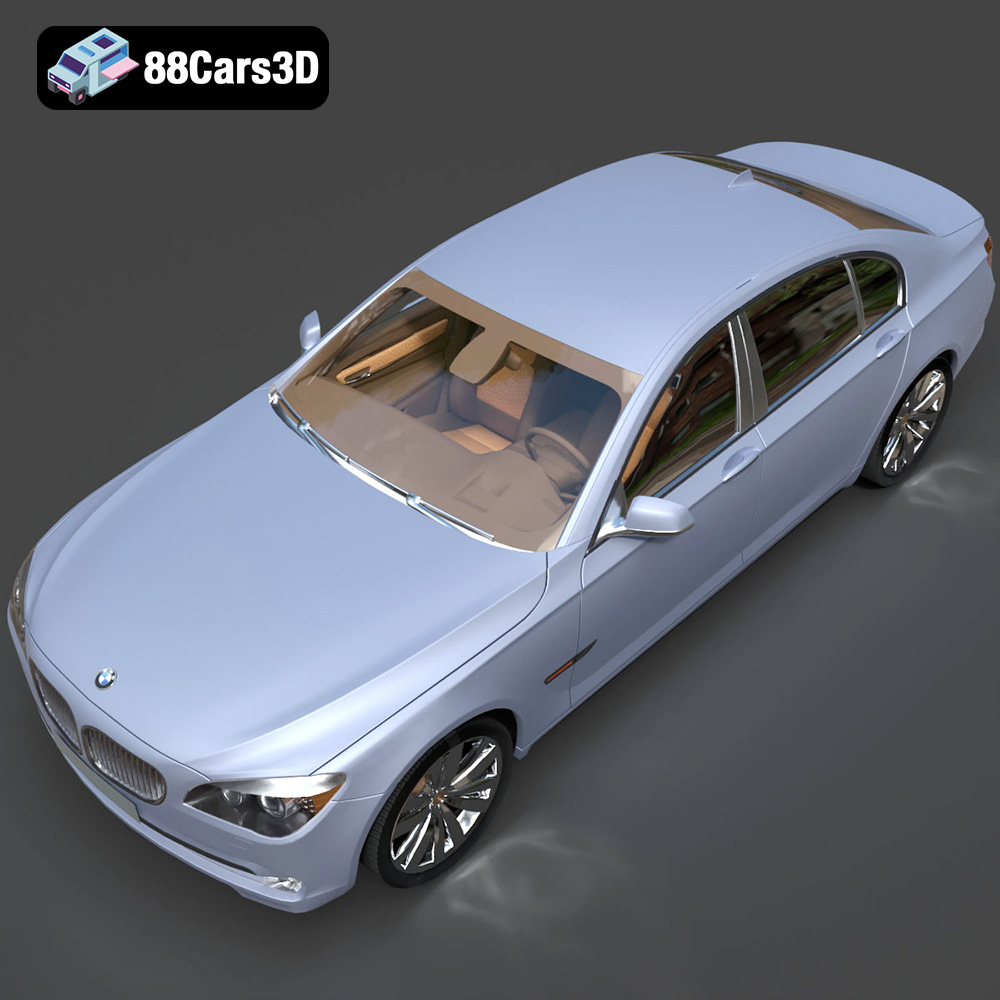
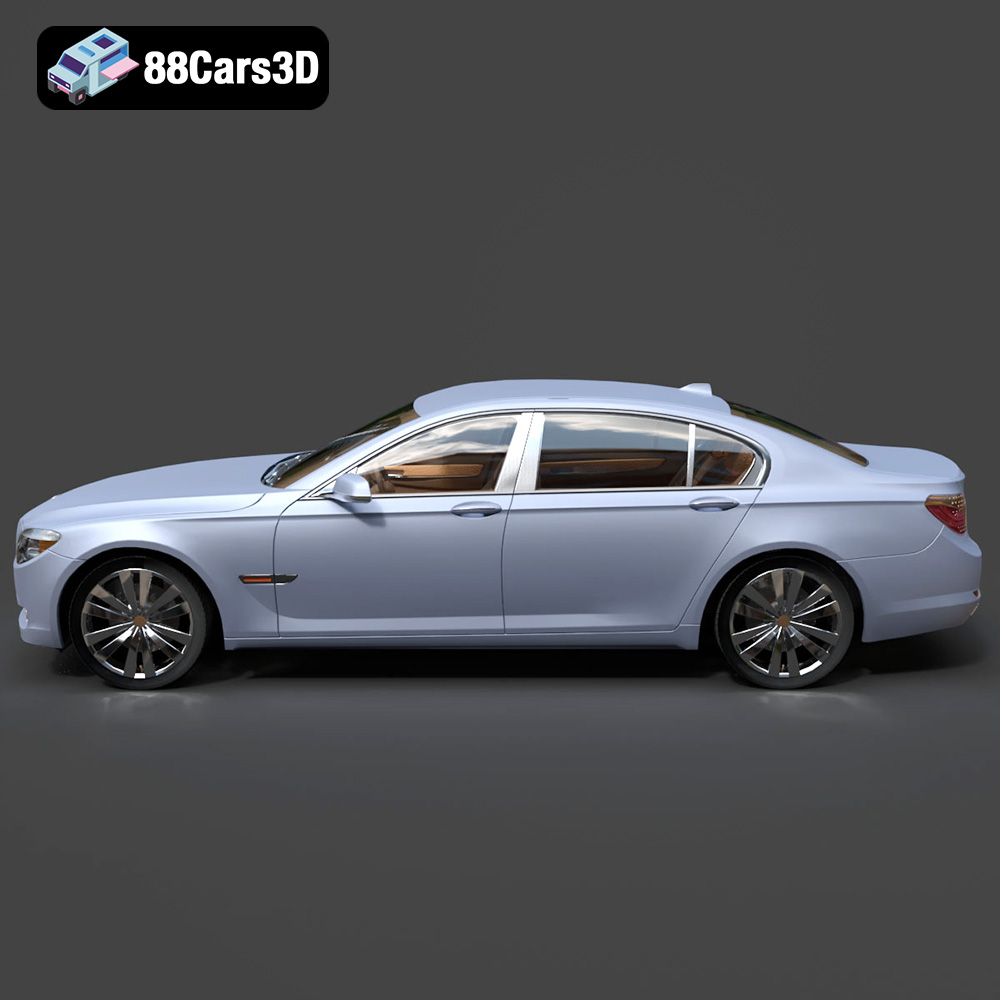
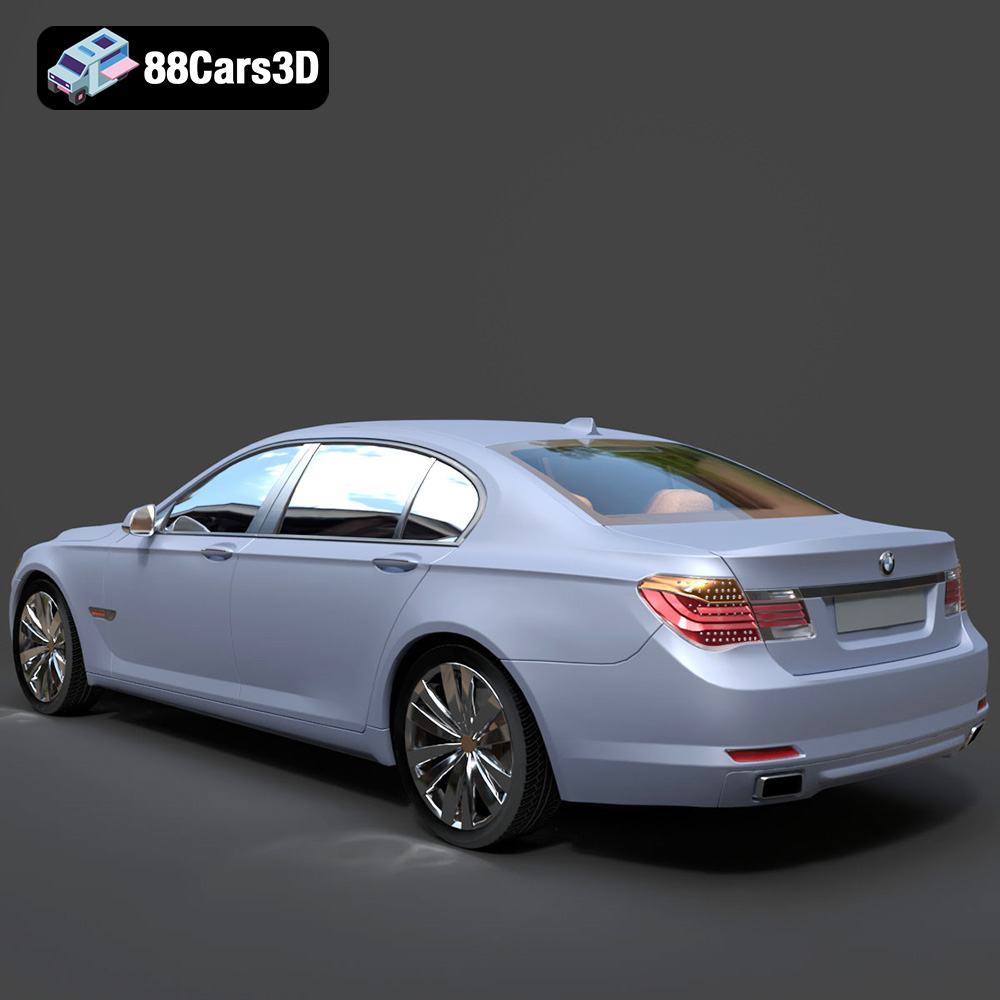
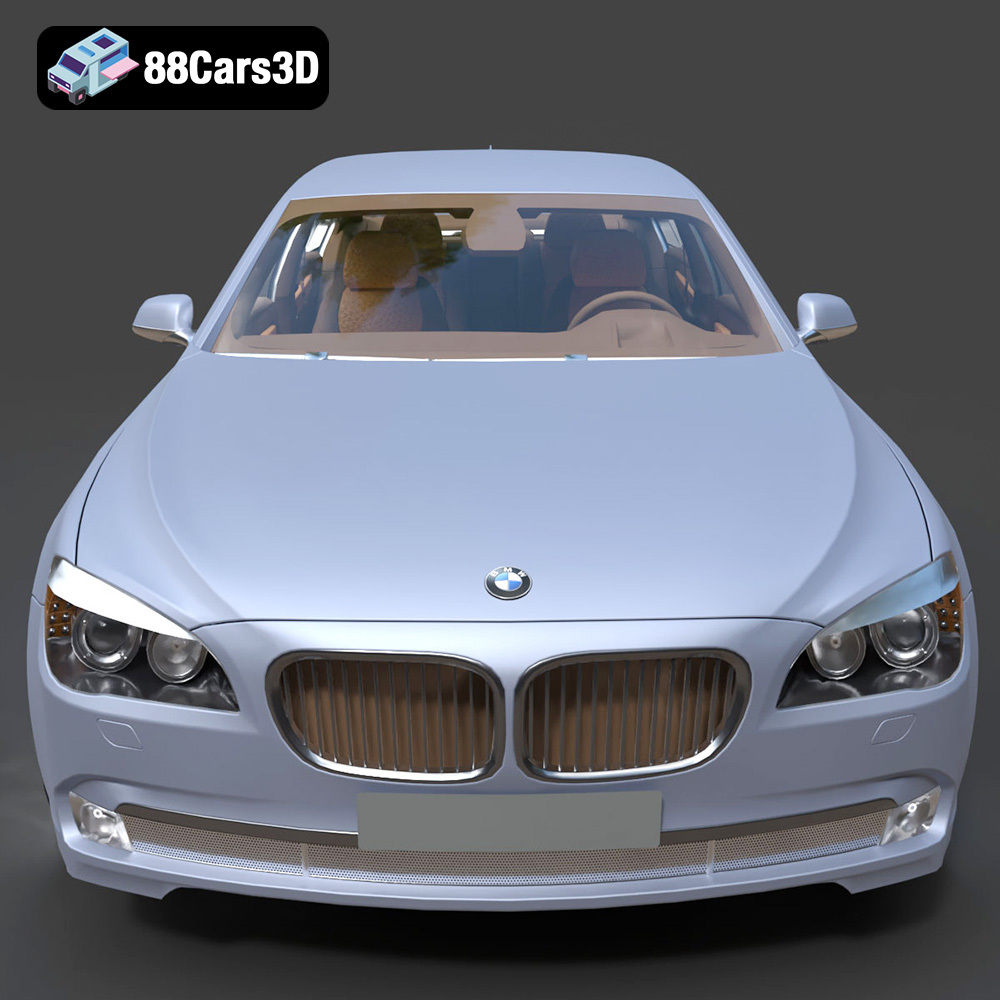
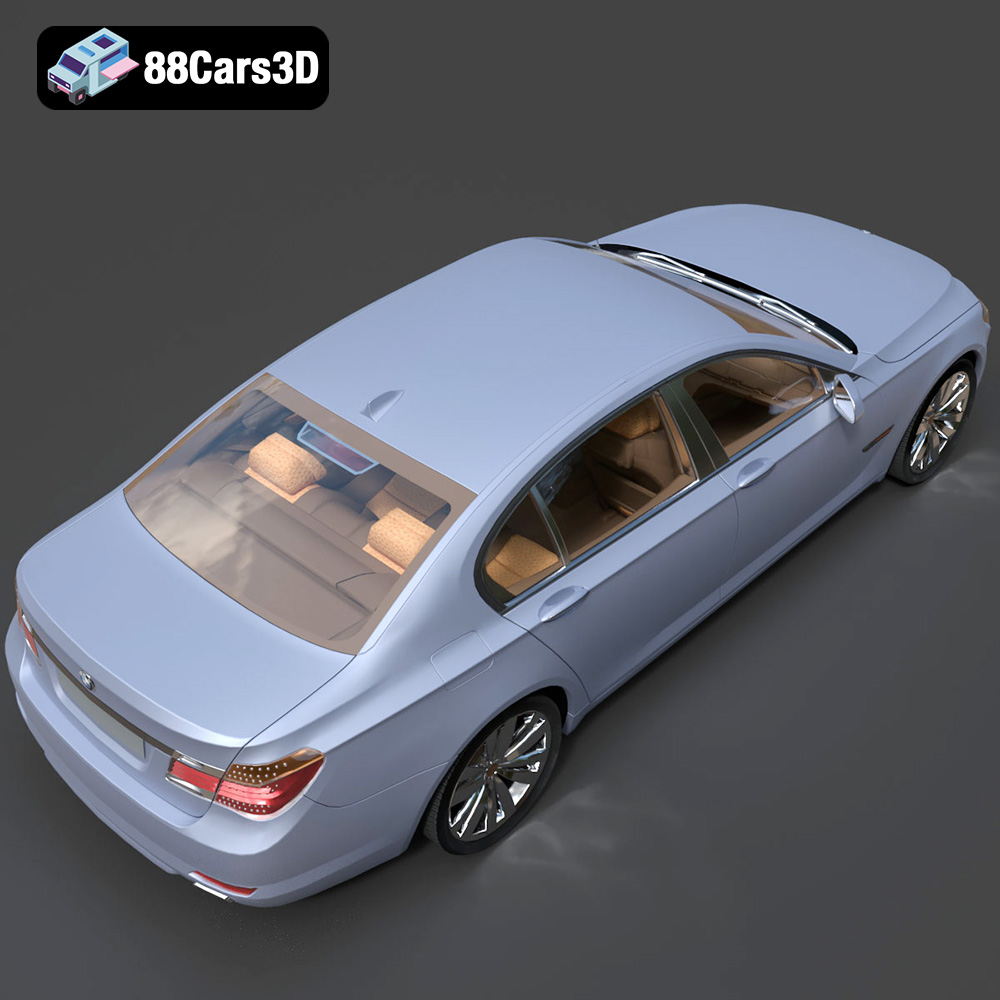
The exterior of any automotive model is its first impression, and for the BMW 7-Series F02, this impression is one of sophisticated luxury. The model features authentic body panels that faithfully replicate the elegant curves and sharp lines of the actual vehicle, embodying the signature BMW design language. Critical elements like the iconic kidney grille, intricately designed headlights, and precise rear taillights are not just placeholders but are rendered with realistic material shaders, ensuring transparent and emissive parts react accurately to light. This level of detail is crucial for captivating automotive rendering and for creating convincing visuals in games. Furthermore, the inclusion of high-resolution wheels and tires, accurately modeled to scale, along with meticulously replicated chrome accents and trim elements, adds significant depth and believability. For advanced animation workflows, the model’s design includes separated doors, hood, trunk, and wheels, allowing for dynamic opening sequences, suspension articulation, and tire rotation. Realistic glass materials for windows and windshields complete the exterior, ensuring reflections and refractions behave as expected in any lighting scenario.
Interior Fidelity and Optimization
While often seen less frequently in wide shots, a detailed interior is paramount for close-up renders, virtual tours, and first-person game experiences. The BMW 7-Series F02 3D Model doesn’t compromise here. It boasts a faithfully recreated dashboard, complete with an instrument cluster and infotainment screen details, which are critical for immersive user experiences. Comfortable seating, the steering wheel, and various center console elements are all carefully modeled to enhance realism. This interior is not just detailed but also optimized for mesh quality, ensuring that it looks excellent in both distant and intimate camera angles without unduly burdening system resources. Even basic representation of undercarriage elements is included, adding another layer of realism for those moments when the vehicle is viewed from unconventional angles, such as during a lift inspection in a virtual garage.
Technical Foundations for Flawless Performance
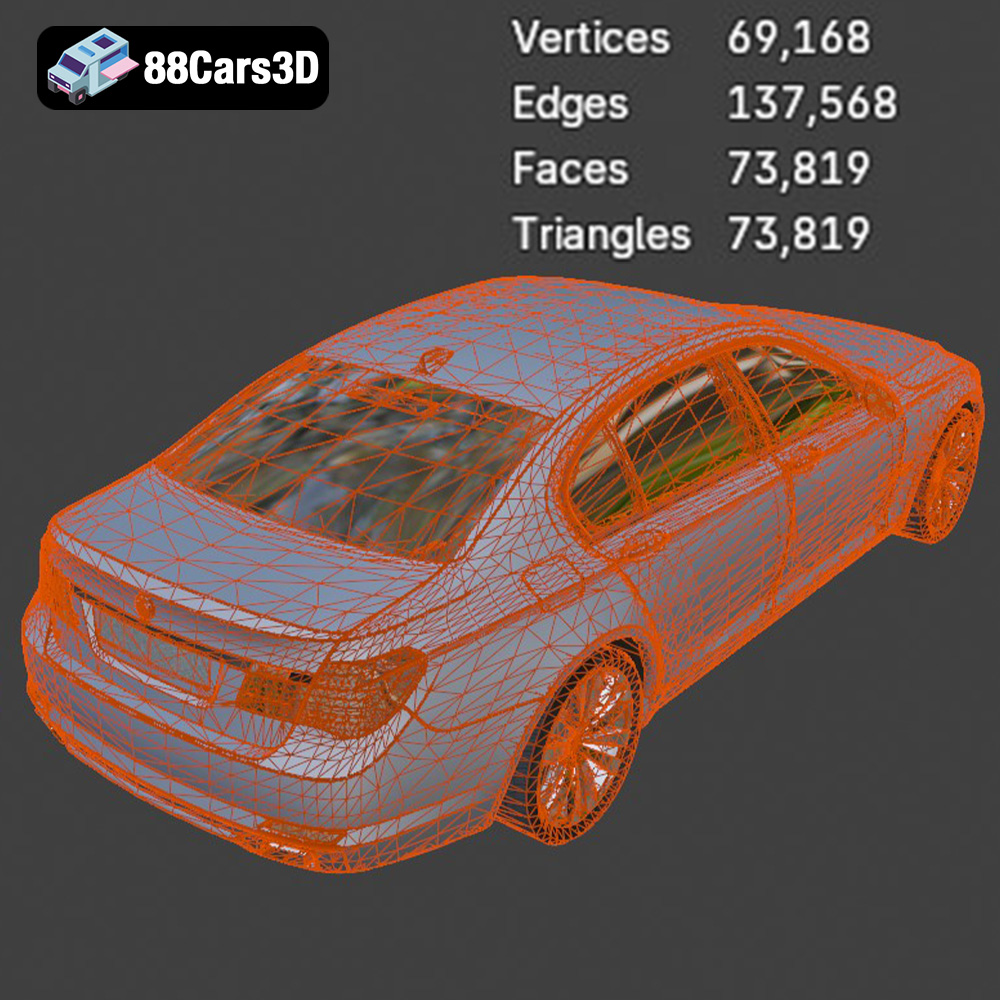
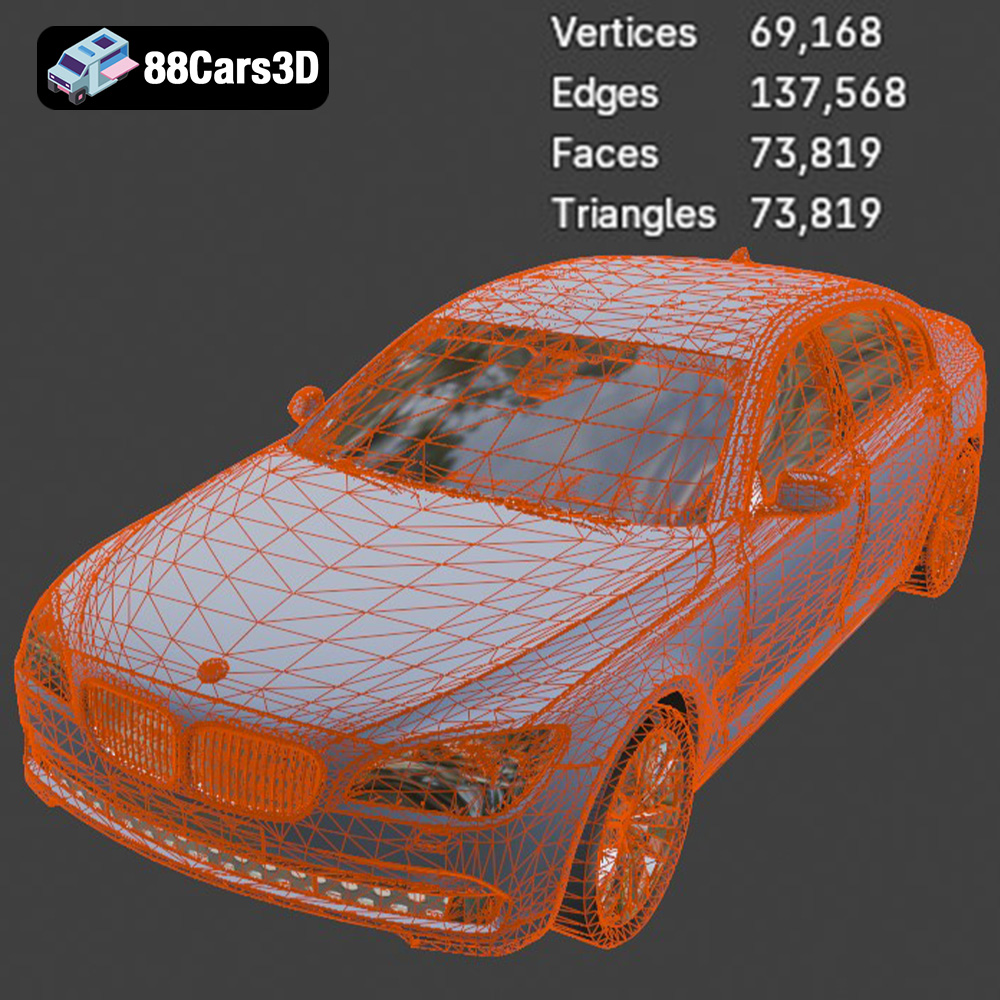
Beyond visual fidelity, the true strength of a professional 3D car model lies in its underlying technical structure. The BMW 7-Series F02 features clean, quad-dominant topology, which is the gold standard for 3D modeling. This ensures smooth subdivision, artifact-free deformation, and makes the model easy to modify or enhance further. Its accurate real-world scale dimensions guarantee seamless integration into existing scenes, whether architectural visualizations or game environments, without requiring manual resizing or scaling adjustments. A logically organized hierarchy with proper pivot points for all movable parts simplifies animation and manipulation within any 3D software. Crucially, the model is optimized for various rendering engines and real-time applications, meaning it’s built to perform efficiently, providing stunning visuals without sacrificing frame rates or increasing render times unnecessarily. This balance of detail and optimization is what makes it a premium game asset and an invaluable tool for any professional.
Professional Workflows: Integrating the BMW 7-Series F02 into Your Pipeline
The true measure of a high-quality 3D asset, like the BMW 7-Series F02 3D Model, is its ability to seamlessly integrate into diverse professional workflows. Its multi-format availability ensures that artists and developers can leverage its detail across various industry-standard software and platforms.
High-Fidelity Rendering with 3ds Max and Blender
For studios focused on breathtaking static renders and intricate animations, the native .max and .blend files are indispensable. In 3ds Max, artists can load the BMW 7-Series F02 and immediately tap into powerful rendering engines like V-Ray or Corona. The model’s clean geometry and structured hierarchy make it easy to set up sophisticated studio lighting, apply advanced material shaders (for metallic paints, realistic glass, and interior fabrics), and craft cinematic camera paths. Its separated components facilitate realistic animation of doors, wheels, and suspension. Similarly, Blender users can open the .blend file directly, leveraging Cycles for physically accurate renders or Eevee for stunning real-time visualizations. Material nodes can be fine-tuned, and Blender’s robust animation tools can bring the vehicle to life, whether for a product showcase or an architectural fly-through.
Real-Time Applications: Unreal Engine and Game Asset Development
The world of interactive media thrives on optimized, high-fidelity game assets. With the BMW 7-Series F02 3D Model’s dedicated .unreal file and robust .fbx export, integration into game engines like Unreal Engine is streamlined. Developers can import the model, and often, PBR materials are already configured, saving significant setup time. Crucially, the model’s optimized mesh quality allows for the creation of multiple Levels of Detail (LODs), ensuring excellent performance across different hardware specifications. Collision meshes can be easily generated, and physics assets applied, making the car ready for racing games, open-world simulations, or interactive virtual garages. This optimization is key to delivering visually rich experiences without compromising frame rates, a constant challenge in real-time development.
Beyond Visualization: AR/VR and 3D Printing
The versatility of this 3D model extends beyond traditional screen-based applications. The .glb format positions the BMW 7-Series F02 perfectly for augmented reality (AR) and virtual reality (VR) experiences. Its efficiency and compact nature make it ideal for quick loading in mobile AR apps or for populating immersive VR environments. Imagine visualizing the car in your driveway via AR, or exploring its interior in a full VR showroom experience. For physical prototypes or custom collectibles, the .stl format is essential. Artists can convert the digital model into a format ready for 3D printers, allowing them to bring the virtual luxury sedan into the physical world. This requires careful consideration of mesh integrity and scale, but the clean topology of the original model makes this conversion process much smoother.
Case Studies and Creative Applications of 3D Car Models
The application of high-quality 3D car models like the BMW 7-Series F02 spans a remarkable range of industries, each leveraging its precision and detail in unique ways. These models are not just digital sculptures; they are catalysts for innovation and immersive experiences.
Architectural Visualization and Product Placement
In the realm of architectural visualization (ArchViz), realism is paramount. Architects and real estate developers often use 3D car models to breathe life into their digital environments. Placing the sophisticated BMW 7-Series F02 in the driveway of a luxury home render instantly elevates the perceived value and aesthetic appeal of the property. For automotive advertising, these models are indispensable. Imagine creating a stunning digital showroom or an interactive car configurator where potential buyers can customize every detail, from paint color to interior trim, all rendered in photorealistic quality. The BMW 7-Series F02 3D Model, with its accurate scale and detailed features, provides the perfect focal point for such high-end presentations, delivering impactful automotive rendering.
Cinematic Storytelling and Virtual Production
The film and animation industries heavily rely on detailed 3D assets to create believable worlds and thrilling sequences. The BMW 7-Series F02 3D Model can be integrated into virtual production pipelines, allowing filmmakers to pre-visualize scenes with precise vehicle dynamics or even create entire car chase sequences using virtual cameras. The model’s separated components – doors, hood, trunk, and wheels – are critical here, enabling complex animations such as opening car doors, rotating wheels, or even simulating damage. This level of control provides animators with the flexibility needed to tell compelling stories, whether for a commercial, a music video, or a feature film.
Driving Simulations and Training Tools
Beyond entertainment, accurate 3D car models play a vital role in practical applications like driving simulators and professional training. Automotive engineers and researchers use these models in advanced simulations to test vehicle dynamics, aerodynamic performance, and safety systems. For driver training programs, integrating a realistic BMW 7-Series F02 into a simulator offers an immersive and safe environment for practicing various driving scenarios. The model’s adherence to real-world scale and detailed mechanics allows for accurate representation of vehicle behavior, making it an invaluable tool for both engineering validation and educational purposes. This showcases the power of a detailed 3D car model to impact critical development and training.
Customization and Future-Proofing Your Digital Garage
A truly professional 3D car model offers not just visual fidelity but also the flexibility to adapt to evolving project requirements and creative visions. The BMW 7-Series F02 3D Model excels in this regard, providing extensive customization options that empower artists and designers.
Unlocking Creative Potential Through Material Customization
The ability to easily modify the aesthetic properties of a 3D model is crucial for creative freedom. With the BMW 7-Series F02, artists can effortlessly adjust paint finishes to any desired color, experimenting with classic metallic sheens, trendy matte options, or even bespoke pearlescent effects. Material properties for chrome accents, rubber tires, glass surfaces, and interior fabrics can be independently modified to suit specific aesthetic requirements or match brand guidelines. This level of control is facilitated by well-organized material IDs and clear UV mapping, which ensure that textures and shaders are applied precisely where intended. Changing material properties can drastically alter the mood and perceived value of the vehicle, making it versatile for various presentations, from gritty game environments to pristine showroom renders.
Adapting to Evolving Project Needs
The inherent quality of the BMW 7-Series F02 3D Model, characterized by its clean, quad-dominant topology, makes it a future-proof asset. This robust mesh structure means that the model can be easily subdivided for even finer detailing if a project demands extreme close-ups or higher polygon counts for next-generation rendering. Conversely, it can be efficiently optimized further for more constrained real-time environments, demonstrating its scalability. Artists can also use this clean base to create stylistic modifications, damage models, or integrate custom accessories without introducing messy geometry. This adaptability ensures that the investment in a premium 3D car model from 88cars3d.com continues to yield value across multiple projects and evolving technological landscapes, making it a cornerstone for any digital garage.
Conclusion
The journey through the intricate world of 3D car models reveals a landscape where precision, versatility, and technical excellence are paramount. High-quality assets are not merely representations; they are fundamental tools that drive innovation and elevate visual experiences across diverse industries. From hyper-realistic automotive rendering to immersive game worlds and critical simulation environments, the demand for meticulously crafted digital vehicles continues to grow.
The BMW 7-Series F02 3D Model stands as a testament to this philosophy, offering an unparalleled blend of aesthetic fidelity and technical robustness. Its detailed exterior and interior, combined with optimized geometry and a comprehensive suite of file formats, make it an invaluable asset for professionals. Whether you are developing the next blockbuster game, producing a cinematic masterpiece, visualizing architectural marvels, or crafting intricate AR/VR experiences, this model provides the quality and flexibility needed to succeed.
By investing in professional-grade 3D car models like the BMW 7-Series F02, artists and developers gain access to assets that streamline workflows, enhance realism, and ultimately allow them to push the boundaries of their creative endeavors. Explore the possibilities and elevate your projects with exceptional 3D models available at 88cars3d.com.
Featured 3D Model
BMW 7-Series F02 3D Model
Experience automotive luxury and precision with this professional 3D model of the BMW 7-Series F02. Representing a pinnacle of executive sedan design, this model captures the sophisticated styling and elegant proportions of the renowned vehicle. Built with clean geometry and balanced detailing, it ensures visual fidelity and efficient performance across various platforms. Ideal for high-end rendering, cinematic animation, detailed simulations, and as a premium asset for game development.
Exterior Features:
- Authentic body panels reflecting the signature BMW design language
- Detailed front grille, headlights, and rear taillights with realistic material shaders for transparent and emissive parts
- High-resolution wheels and tires, accurately modeled to scale
- Chrome accents and trim elements meticulously replicated
- Separated doors, hood, trunk, and wheels for advanced animation workflows
- Realistic glass materials for windows and windshields
Interior / Mechanical Features:
- Faithfully recreated dashboard with instrument cluster and infotainment screen details
- Comfortable seating, steering wheel, and center console elements
- Optimized mesh quality for both distant shots and close-up views of interior components
- Basic representation of undercarriage elements for added realism
Technical Advantages:
- Clean, quad-dominant topology for easy subdivision and deformation
- Accurate real-world scale dimensions for seamless integration into existing scenes
- Logically organized hierarchy with proper pivot points for easy manipulation and animation
- Optimized for various rendering engines and real-time applications
Applications:
- Rendering & Visualization: Create stunning studio renders, architectural visualizations, and cinematic scenes
- Game Development: Utilize as a high-fidelity asset for racing games, open-world simulations, or virtual garages
- AR/VR: Develop immersive augmented and virtual reality experiences with a realistic vehicle model
- Simulation & Training: Integrate into driving simulators or automotive design validation tools
- 3D Printing: Convert to .stl format for physical prototyping and collectible models
Customization Options:
- Easily adjust paint finishes to any color, including metallic and matte options
- Modify material properties for chrome, rubber, glass, and interior fabrics to suit specific aesthetic requirements
- Adapt lighting setups to achieve diverse moods and environmental conditions
Elevate your projects with this meticulously crafted BMW 7-Series F02 3D model, offering unparalleled quality, versatility, and ease of use for professionals across multiple industries.
Included File Formats:
- .blend – Blender project with materials
- .fbx – Compatible with Unreal, Unity, and major 3D engines
- .obj – Universal format for nearly all 3D software
- .glb – Optimized for AR, VR, and web-based visualization
- .stl – Ready for 3D printing
- .ply – Mesh format for analysis and CAD workflows
- .unreal – Unreal Engine project setup
- .max – Editable 3ds Max scene for rendering and animation
$10.79
Product Image Gallery

Related Tags
.7seriesf02
.arvr
.blend
.bmw
.executivecar
.f02
.fbx
.gameasset
.glb
.luxurycar
.max
.obj
.ply
.rendering
.sedan
.simulation
.stl
.unreal
