

Driving Innovation: The Power of High-Fidelity 3D Car Models in Modern Design and Development
In the rapidly evolving landscape of digital content creation, the demand for hyper-realistic and versatile 3D assets has never been higher. From blockbuster cinematic sequences to immersive virtual reality experiences and next-generation game environments, high-quality 3D car models stand as crucial components, embodying both technical precision and artistic excellence. These digital counterparts of real-world vehicles are more than just visual props; they are complex data structures that power everything from design visualization and engineering simulations to interactive marketing tools.
The journey from a designer’s sketch to a fully rendered, driveable virtual vehicle is a testament to the advancements in 3D modeling and rendering technologies. It requires meticulous attention to detail, a deep understanding of surface topology, and a mastery of material science within the digital realm. Today, professionals across automotive design, game development, architectural visualization, and advertising rely on assets that not only look stunning but are also technically robust and optimized for diverse platforms.
Consider a vehicle like the BMW M3 2024 – an icon of performance luxury. To translate such a machine into a digital asset demands unparalleled realism, meticulously reproducing its aggressive styling, iconic grille design, and dynamic silhouette. This is where specialized marketplaces like 88cars3d.com become invaluable resources, offering precision-engineered assets ready for immediate deployment. A premium model like the BMW M3 2024 3D Model provides a foundation for projects ranging from close-up renders that rival photography to demanding simulation environments, ensuring visual fidelity across all professional applications.
The Evolution of Automotive 3D Modeling: Beyond Static Renders
The role of 3D car models has expanded dramatically over the past decade. What once began as a tool for static, high-resolution imagery has matured into an indispensable asset for dynamic, interactive, and real-time experiences. This evolution reflects not only the capabilities of 3D software but also the growing expectations of audiences and industries for more engaging and true-to-life digital content.
Precision in Design and Engineering Visualization
For automotive manufacturers, 3D models are fundamental to the design and engineering process long before any physical prototype is built. They allow designers to iterate rapidly, visualize changes in real-time, and present concepts with breathtaking realism. Engineers utilize these models for aerodynamic simulations, crash testing analysis, and ergonomic studies in a virtual environment, significantly reducing development costs and timelines. A highly detailed 3D car model, such as the BMW M3 2024, becomes a digital twin, capable of representing every nuance of its physical counterpart. This extends beyond external aesthetics to internal components, ensuring that every curve, panel gap, and material finish is accurately represented, offering an unparalleled level of scrutiny and refinement.
Driving Immersive Experiences: AR/VR and Real-time
Beyond traditional rendering, 3D car models are at the forefront of immersive technologies. In Augmented Reality (AR), users can place a virtual car in their driveway via a smartphone, exploring its features as if it were truly there. Virtual Reality (VR) takes this a step further, allowing full immersion inside a car’s interior, enabling virtual test drives, or facilitating collaborative design reviews in a shared virtual space. Game developers leverage these models to populate vast open worlds and create thrilling racing simulations, where performance and visual fidelity go hand-in-hand. The seamless integration of assets like the BMW M3 2024 3D Model into real-time engines like Unreal Engine and Unity is critical for these applications, demanding optimized meshes, efficient materials, and clean UV layouts to maintain high frame rates and a smooth user experience.
Understanding 3D Model File Formats
The versatility of a high-quality 3D car model like the BMW M3 2024 is largely defined by the range of file formats it supports. Each format serves specific purposes, offering unique advantages for different stages of the production pipeline, from initial modeling and animation to real-time deployment and even physical manufacturing. Understanding these formats is crucial for any professional working with 3D assets, ensuring smooth workflow transitions and optimal performance. The BMW M3 2024 3D Model, available on 88cars3d.com, is delivered with a comprehensive suite of formats, maximizing its utility.
.blend – Blender’s Native Powerhouse
The .blend format is the native file type for Blender, the powerful open-source 3D creation suite. When a model is provided in .blend format, it means you typically get a fully editable Blender scene, complete with materials, textures, lighting setups, and sometimes even animation rigs. This format is ideal for users deeply integrated into the Blender ecosystem, allowing for direct modification, rendering with Cycles or Eevee, and leveraging Blender’s extensive toolset for sculpting, texturing, and animation. For the BMW M3 2024 3D Model, the .blend file includes an editable scene with materials and lighting, offering a ready-to-render environment straight out of the box.
.fbx – The Industry Workhorse for Interoperability
.fbx (Filmbox) is arguably one of the most widely used and robust 3D file formats for data exchange between various 3D applications. Developed by Autodesk, it excels at storing not just geometry, but also materials, textures, animations, camera information, and even inverse kinematics data. This makes it an ideal choice for complex scenes and animated models. For game development, .fbx is the go-to format for importing assets into engines like Unreal Engine and Unity due to its excellent support for skeletal animations and efficient mesh handling. When you need to move a detailed asset like the BMW M3 2024 between 3ds Max, Maya, Blender, or directly into a game engine, .fbx offers reliable, comprehensive data transfer.
.obj – Universal Simplicity
The .obj (Wavefront Object) format is a universal standard known for its simplicity and wide compatibility. It primarily stores geometric data (vertices, normals, texture coordinates, and faces) and can reference external material files (.mtl) for surface properties. While it doesn’t support animation or scene data, its widespread adoption ensures that virtually all 3D software can import and export .obj files. It’s a solid choice for transferring static meshes when animation or complex scene information isn’t required, offering a highly stable and cross-software compatible base for the BMW M3 2024 3D Model.
.glb – Web and XR Ready
.glb (GL Transmission Format Binary) is an increasingly popular format, particularly optimized for AR, VR, and web-based display. It’s a self-contained binary file that embeds geometry, materials, textures, and animations into a single, compact package. This efficiency makes it perfect for fast loading and rendering in real-time environments, especially for applications deployed via web browsers or mobile AR/VR platforms. For interactive product configurators or virtual showrooms of the BMW M3 2024 on a website, .glb offers an optimized, high-performance solution.
.stl – The Path to Physicality
.stl (Stereolithography) is the de facto standard file format for 3D printing and CAD/CAM software. It represents a 3D model as a collection of triangles, defining its surface geometry without color, texture, or other attributes. While not suitable for rendering or animation, it’s essential for rapid prototyping and manufacturing. If you plan to 3D print a scaled model of the BMW M3 2024 for a physical display or concept verification, the .stl format is your primary choice.
.ply – For Precision and Analysis
The .ply (Polygon File Format) is another format for storing 3D data, particularly useful for scanned data and scientific applications where precision and a wide range of properties per vertex or face are important. It can store not only geometry but also color, transparency, normals, texture coordinates, and other data for each vertex or face. While less common for general animation or game development compared to .fbx or .obj, it’s a detailed polygon mesh format that can be valuable for analysis or visualization in specific CAD or research workflows.
.unreal – Deep Integration for Game Development
The inclusion of a .unreal file (or an asset specifically configured for Unreal Engine, often delivered as part of an Unreal project package) signifies a model optimized and ready for deep integration into Epic Games’ powerful real-time engine. This typically means the asset has been properly scaled, has collision meshes set up, materials configured using Unreal’s node-based system, and potentially even LODs (Levels of Detail) generated for performance. For game developers and simulation engineers utilizing the BMW M3 2024, this pre-configured asset dramatically streamlines the import and setup process, allowing for immediate deployment within a real-time environment.
.max – 3ds Max’s Professional Suite
Similar to .blend for Blender, .max is the native file format for Autodesk 3ds Max, a leading software for 3D modeling, animation, rendering, and visualization. A .max file contains the complete 3ds Max scene, including geometry, materials, textures, lighting, cameras, animation data, and any modifiers or plug-in specific information. This format is essential for professionals working in 3ds Max, providing full editability and access to the software’s comprehensive toolset for high-end rendering and complex animation tasks. The BMW M3 2024 3D Model’s .max file offers an editable project for detailed rendering and animation projects.
Crafting Realism: A Deep Dive into the BMW M3 2024 3D Model’s Anatomy
The hallmark of a truly professional 3D car model, such as the BMW M3 2024 3D Model found on 88cars3d.com, lies in its meticulous construction. It’s not just about looking good in a single render; it’s about being robust enough to perform flawlessly across diverse applications, from extreme close-ups to dynamic real-time simulations. This requires a profound understanding of 3D asset creation principles.
Topology and Mesh Integrity for Flawless Renders
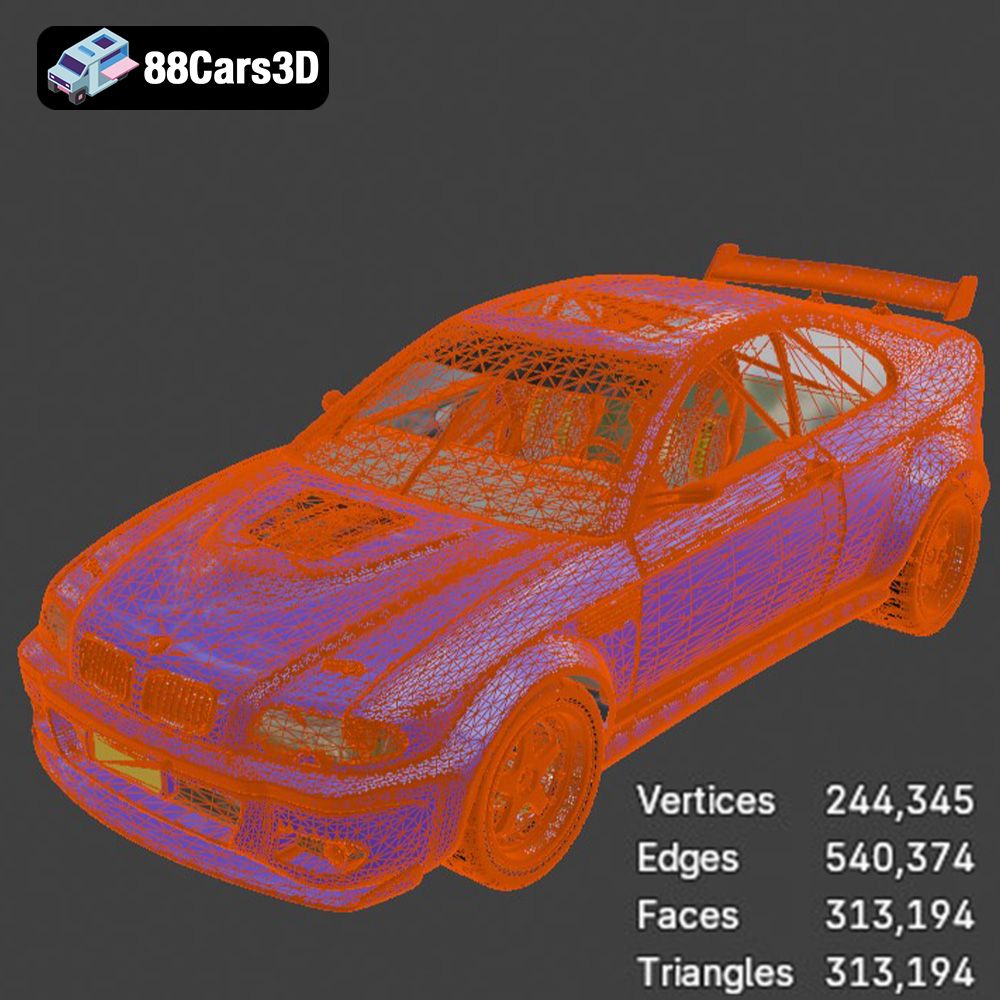
At the core of any high-quality 3D model is its topology – the arrangement of its polygons (faces, edges, and vertices). The BMW M3 2024 3D Model boasts structurally clean topology, meaning its mesh is composed predominantly of quads (four-sided polygons) with efficient edge flow. This is crucial for several reasons: it ensures smooth subdivision without unsightly pinches or artifacts, facilitates easier UV unwrapping, and behaves predictably under deformation or animation. Clean topology also means the model is optimized for demanding simulation environments, where mesh integrity directly impacts calculation accuracy. This attention to detail prevents common issues like shading errors, especially on the complex curved surfaces of a modern performance vehicle.
Material Prowess and UV Unwrapping Excellence
Realistic materials are what breathe life into a 3D model. The BMW M3 2024 3D Model comes with professionally configured materials designed to react realistically to virtual lighting. This means physically based rendering (PBR) workflows are typically employed, where material properties like albedo (base color), roughness, metallicness, and normal maps accurately simulate how light interacts with different surfaces – paint, glass, chrome, rubber, and leather. Crucially, these materials rely on excellent UV unwrapping. UVs are 2D coordinates that map textures onto the 3D model’s surface. Flawless UVs ensure that textures appear crisp, without stretching or distortion, and allow for easy texture modification or customization, making the asset highly versatile for various visual styles and branding requirements.
The Art of Detail: Exterior and Interior Fidelity
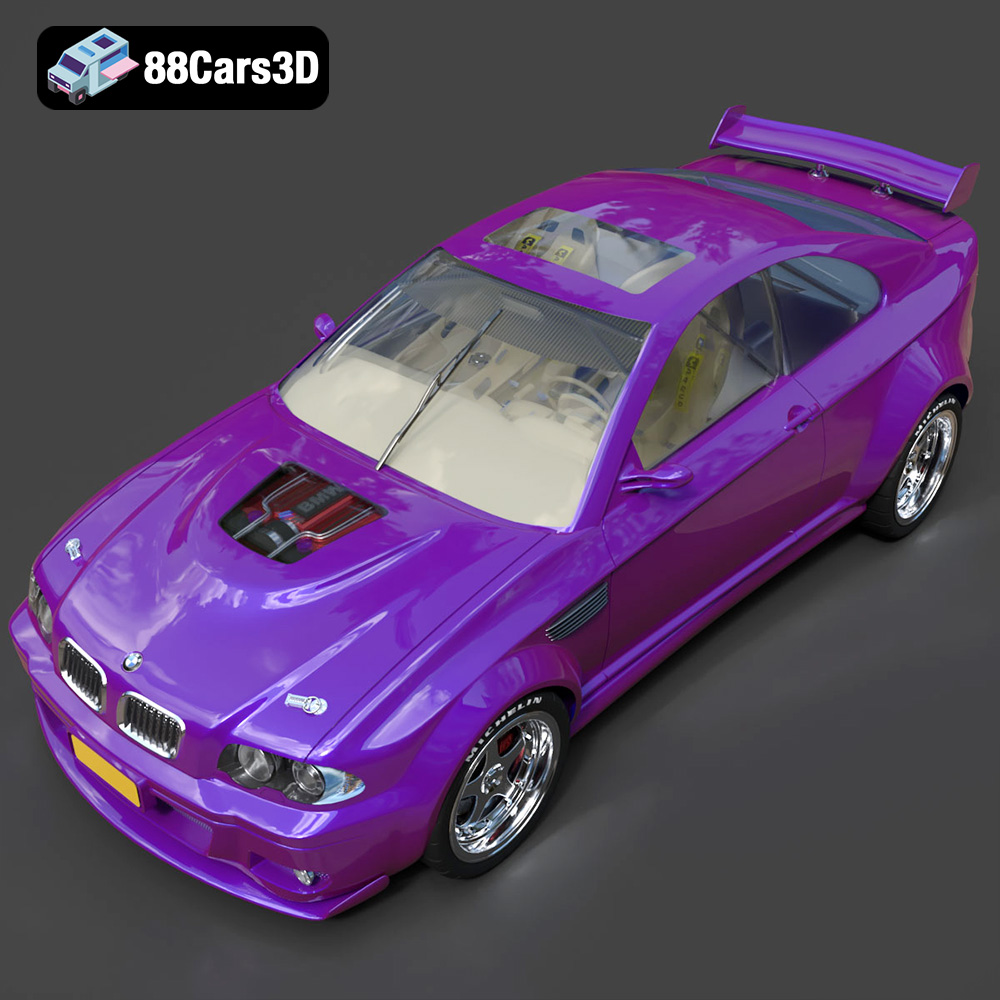
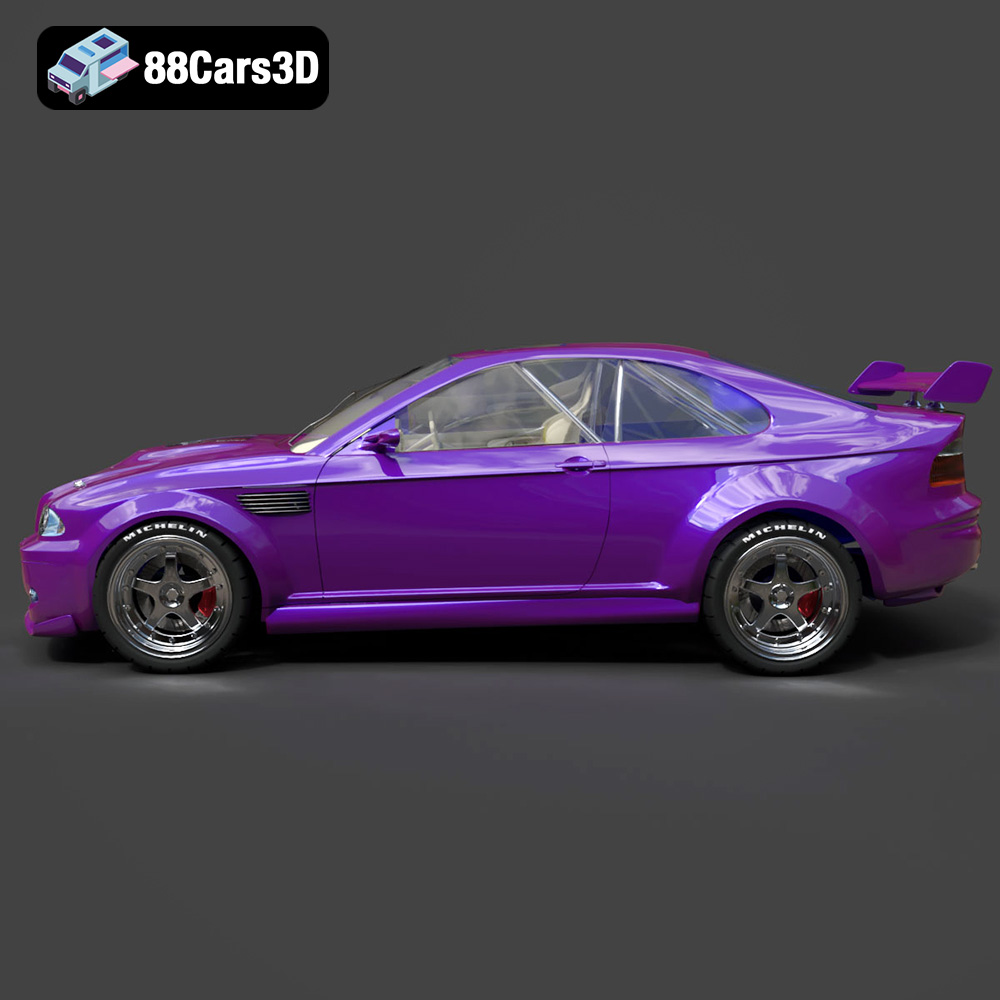
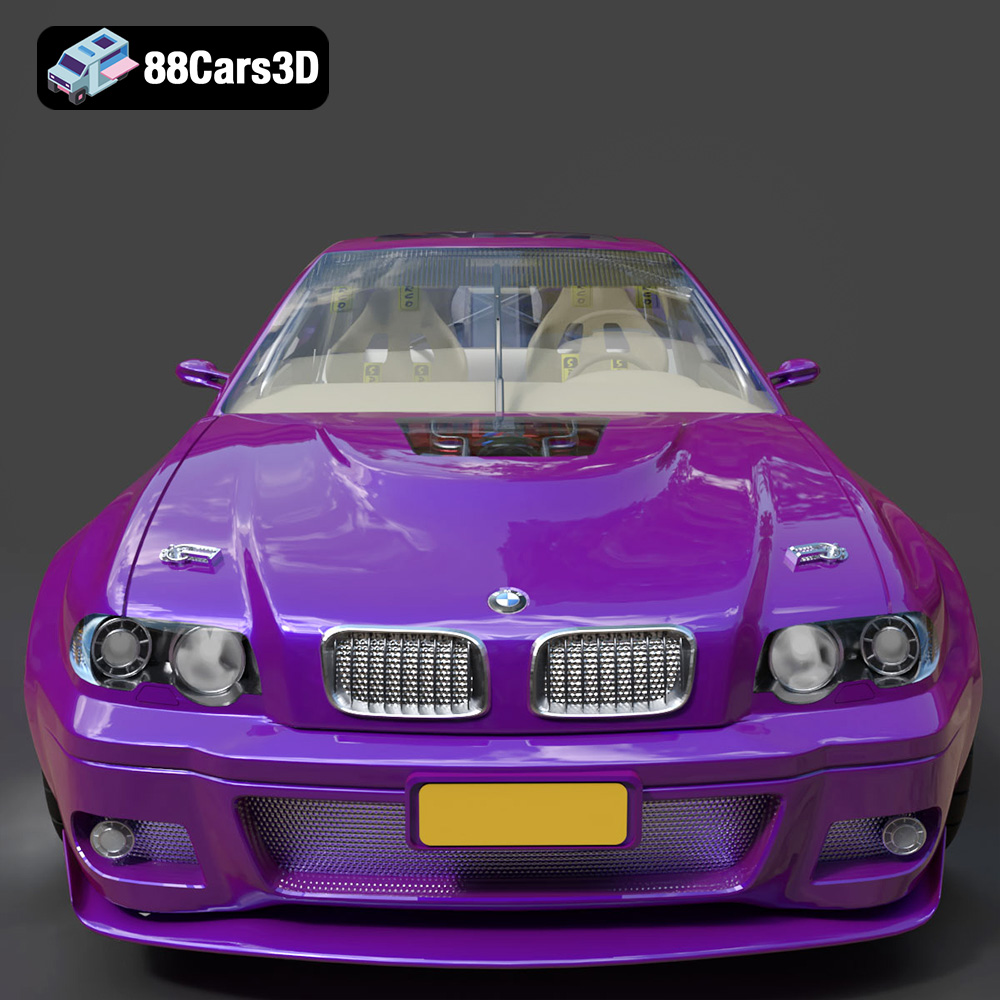
The true measure of a premium 3D car model is its fidelity to the original design, both inside and out. For the BMW M3 2024 3D Model, this means every external detail, from the intricate spoke design of the wheels and the precision of the brake calipers to the subtle curves of the body paneling and the iconic grille, has been accurately modeled. Panel gaps are tight and consistent, headlights and taillights are accurately recreated with appropriate material definitions, and badges are crisp. Furthermore, the inclusion of a fully realized interior is a game-changer. This isn’t just a basic cockpit; it encompasses detailed seats, dashboard, steering wheel, infotainment screen, door panels, and even stitching. This level of internal detail makes the asset ideal for first-person views, virtual tours, and immersive virtual experiences, where the user can truly “sit” inside the vehicle.
Professional Workflows: Integrating the BMW M3 2024 into Your Pipeline
The ultimate value of a high-quality 3D car model lies in its seamless integration into various professional workflows. The BMW M3 2024 3D Model, with its diverse file formats and inherent quality, is engineered to be a drop-in solution for a multitude of creative and technical applications.
Cinematic Rendering in 3ds Max and Blender
For artists focused on producing stunning visuals for advertising, film, or architectural visualization, the BMW M3 2024 3D Model offers an exceptional starting point. In 3ds Max, the included .max file provides a fully editable scene, allowing artists to leverage V-Ray, Corona Renderer, or Arnold to achieve photorealistic results. Users can easily adjust lighting, camera angles, and environmental settings to compose breathtaking scenes. Similarly, Blender users can utilize the .blend file, tapping into Cycles or Eevee for powerful rendering. The clean topology and PBR-ready materials ensure that the car reacts authentically to studio lighting setups, environmental HDRI maps, and advanced volumetric effects, making it perfect for generating high-resolution hero shots or dynamic animations that highlight the car’s aesthetic and performance.
Game Development with Unreal Engine and Unity
Game developers demand efficiency and performance without sacrificing visual quality. The BMW M3 2024 3D Model’s .fbx and pre-configured .unreal assets are tailored for this. For Unreal Engine, the .unreal file streamlines the import process, often arriving with optimized materials, collision meshes, and potentially even LODs (Levels of Detail) pre-configured. This allows developers to integrate the car quickly into their virtual worlds, whether for open-world exploration, racing simulations, or cinematic cutscenes. In Unity, the .fbx format provides similar ease of integration. Developers can apply Unity’s Standard Shader or custom PBR materials, set up physics components, and integrate it into driving systems, making it a robust game asset that performs well at runtime while maintaining high visual fidelity.
VR/AR Experiences and Interactive Configurators
The immersive nature of VR and AR demands models that are both highly detailed and performant. The BMW M3 2024 3D Model is ideally suited for creating interactive experiences. For VR, the fully realized interior allows users to sit inside the virtual car, exploring its dashboard, infotainment, and luxurious details. This is invaluable for virtual showrooms or driving simulations. In AR, the .glb format facilitates web-based and mobile deployment, enabling users to place the virtual M3 in their physical environment. Imagine a potential buyer using their phone to “park” the 2024 M3 in their driveway, change its paint color, or open the doors and look inside. Such interactive configurators are powerful marketing tools, offering a compelling preview of ownership.
Beyond Visualization: Practical Applications and Case Studies
The utility of a premium 3D car model like the BMW M3 2024 extends far beyond simple imagery. It serves as a foundational element for complex systems and innovative marketing strategies, proving its worth in diverse real-world scenarios.
Automotive Configurators and Virtual Showrooms
Leading automotive brands increasingly rely on interactive configurators to enhance the customer experience. A customer can select different paint colors, wheel options, interior trims, and accessories, seeing the changes in real-time. The BMW M3 2024 3D Model is perfect for this application. Its clean topology and modular design (allowing for easy swapping of parts like wheels or body kits) make it an ideal base. In virtual showrooms, customers can “walk around” and “enter” the car, exploring it from every angle without ever setting foot in a physical dealership. This technology dramatically improves engagement and facilitates informed purchasing decisions, all driven by high-quality 3D car models.
High-Fidelity Simulations and Training
Beyond entertainment, 3D car models are critical for professional simulations and training. Driving simulators used by professional race car drivers, engineers for vehicle dynamics testing, or even emergency services for training scenarios demand exceptionally accurate vehicle models. The precision-engineered nature of the BMW M3 2024 3D Model, with its accurate scale and detailed components, provides the necessary foundation for these high-fidelity simulations. Such models can be integrated into physics engines to mimic real-world vehicle behavior, allowing for realistic driving dynamics, damage models, and environmental interactions. This leads to safer, more efficient training and advanced engineering analysis.
Architectural Visualization and Environmental Integration
While often overlooked, 3D car models play a significant role in architectural visualization. Placing a realistic car, such as the BMW M3 2024, into an architectural render can instantly elevate the scene, adding scale, context, and a sense of life. Whether it’s showcasing a luxury apartment complex with a sleek car parked outside, or illustrating a new urban development with traffic flow, the presence of a high-quality vehicle makes the visualization far more convincing and appealing. The ability to easily integrate the BMW M3 2024 3D Model into environments rendered in 3ds Max, Blender, or Unreal Engine, complete with realistic shadows and reflections, adds an unparalleled layer of realism to architectural projects.
Conclusion
The digital world thrives on precision and detail, and nowhere is this more evident than in the realm of 3D car models. From the subtle curve of a body panel to the intricate stitching on an interior seat, every element contributes to the overall realism and utility of the asset. The BMW M3 2024 3D Model exemplifies this commitment to quality, offering a meticulously crafted asset suitable for the most demanding professional applications.
Whether your workflow involves cinematic rendering in 3ds Max, developing immersive game environments in Unreal Engine, or creating cutting-edge AR/VR experiences, this model provides the robust foundation you need. Its structurally clean topology, accurate scale, professionally configured materials, and comprehensive file format support ensure seamless integration and exceptional visual fidelity across various platforms. Investing in high-quality 3D car models from reputable sources like 88cars3d.com significantly accelerates production pipelines, enhances visual appeal, and empowers creators to push the boundaries of digital realism. The BMW M3 2024 3D Model isn’t just a digital car; it’s a gateway to new possibilities in design, entertainment, and interactive experiences.
Featured 3D Model
BMW M3 2024 3D Model
Capture the essence of performance luxury with the highly detailed BMW M3 2024 3D Model. This precision-engineered asset offers unparalleled realism, meticulously reproducing the aggressive styling, iconic grille design, and dynamic silhouette of the modern M3 generation. Optimized for close-up renders and demanding simulation environments, the model ensures visual fidelity across all professional applications.Key features include structurally clean topology, accurate scale, and professionally configured materials designed to react realistically to virtual lighting. Every external detail, from the wheels and brake calipers to the subtle curves of the body paneling, has been accurately modeled. A fully realized interior is included, making this asset ideal for first-person views and immersive virtual experiences.This versatile 3D asset is ready for immediate deployment in various projects, including cinematic rendering, architectural visualization, virtual reality (VR) and augmented reality (AR) experiences, high-fidelity simulations, and integration into major game development pipelines such as Unreal Engine and Unity.Included File Formats.blend – Editable Blender file with materials and lighting setup.fbx – Game-engine ready format for Unreal Engine and Unity.obj – Standard 3D model format compatible with all major software.glb – Optimized for AR/VR and web-based visualization.stl – Suitable for 3D printing and prototyping.ply – Detailed polygon mesh for analysis and visualization.unreal – Pre-configured for Unreal Engine use.max – Editable 3ds Max file for rendering and animation.Tags:.bmw, .m3, .sportssedan, .sedan, .performancecar, .car3dmodel, .rendering, .simulation, .gameasset, .arvr, .blend, .fbx, .obj, .glb, .stl, .ply, .unreal, .maxTags:.bmw, .m3, .sportssedan, .sedan, .performancecar, .car3dmodel, .rendering, .simulation, .gameasset, .arvr, .blend, .fbx, .obj, .glb, .stl, .ply, .unreal, .maxLamborghini Diablo SV 1995 3D Model
$13.99
Product Image Gallery



Related Tags
.arvr
.blend
.bmw
.car3dmodel
.fbx
.gameasset
.glb
.m3
.max
.obj
.performancecar
.ply
.rendering
.sedan
.simulation
.sportssedan
.stl
.unreal
