

Driving Realism: The Indispensable Role of High-Quality 3D Emergency Vehicles in Modern Visualization and Simulation
In the dynamic world of 3D content creation, the demand for hyper-realistic and functionally accurate assets continues to grow exponentially. From blockbuster game titles and cinematic sequences to cutting-edge AR/VR training simulations and detailed architectural visualizations, the authenticity of every element plays a pivotal role in achieving immersion and conveying narrative. Among the most critical and challenging assets to create are vehicles, particularly specialized ones like emergency vehicles, which require intricate detail, precise functionality, and robust optimization.
Today, we delve into the specialized niche of emergency vehicle modeling, exploring what sets a professional-grade asset apart and how it can elevate diverse projects. We’ll examine the technical intricacies, workflow considerations, and wide-ranging applications, with a spotlight on an exemplary model: the Ford Ambulance AmServ LTD Dusan-002 3D Model. This meticulously crafted asset is designed not just for visual appeal but for seamless integration into the most demanding professional pipelines, offering unparalleled realism and versatility for any project requiring an authentic emergency vehicle.
Understanding 3D Model File Formats: The Backbone of Digital Asset Management
The choice of file format for a 3D model is far more than a technicality; it dictates compatibility, functionality, and the efficiency of your workflow. Each format is engineered with specific strengths and limitations, making it crucial for artists, developers, and designers to understand which to deploy for their particular needs. The Ford Ambulance AmServ LTD Dusan-002 3D Model is offered in a comprehensive suite of formats, ensuring maximum flexibility and integration into virtually any professional pipeline.
.blend – The Native Blender Powerhouse
The .blend format is the native file type for Blender, the popular open-source 3D creation suite. It encapsulates an entire Blender scene, including mesh data, materials, textures, animations, rigging, cameras, lights, and even UI layouts. For users working within Blender, this format provides full editability and preserves all proprietary Blender features. This means if you purchase the Ford Ambulance AmServ LTD Dusan-002 3D Model in .blend, you receive a fully organized and editable scene, allowing you to tweak geometry, modify materials, adjust lighting, and build upon the existing setup with ease. It’s ideal for those who plan extensive modifications or want to leverage Blender’s powerful procedural tools.
.fbx – The Industry Standard for Interoperability
.fbx (Filmbox) is a proprietary file format owned by Autodesk, widely regarded as the most robust and versatile format for transferring 3D data between different software applications. It supports not just geometry and materials, but also animations, skeletons, skinning, lights, and cameras. This makes it an ideal choice for complex assets like the Ford Ambulance, especially when moving between DCC (Digital Content Creation) tools like 3ds Max or Maya and game engines such as Unreal Engine or Unity. Its robust animation support is particularly beneficial for exporting vehicle animations, such as opening doors or rotating wheels, making it an essential component for game assets and cinematic productions.
.obj – The Universal Geometry Carrier
The .obj (Wavefront OBJ) format is one of the oldest and most widely supported 3D file formats. Primarily, it excels at storing geometry data (vertices, normals, texture coordinates, and faces) and can reference external material (.mtl) files for basic material properties. While it doesn’t support animation or rigging, its universality makes it an excellent choice for static mesh transfer across virtually any 3D software. When you need to import the Ford Ambulance into a program that might not support .fbx or .max, .obj serves as a reliable fallback, providing clean, pure mesh data that can then be re-textured and integrated.
.glb – Optimized for AR, VR, and Web
.glb (GL Transmission Format Binary) is a relatively newer format designed specifically for the efficient transmission and loading of 3D scenes and models into AR, VR, and web applications. It’s a binary version of glTF, embedding all necessary data (geometry, materials, textures, animations) into a single file, which streamlines deployment and reduces load times. For developers looking to showcase the Ford Ambulance AmServ LTD Dusan-002 in an interactive web viewer, an augmented reality experience, or a lightweight VR environment, .glb offers optimal performance and simplified asset management.
.stl – The Gateway to 3D Printing
The .stl (STereoLithography) format is the de facto standard for 3D printing. It represents 3D models as a collection of unconnected triangular facets, defining only the surface geometry without color, texture, or other properties. While not suitable for rendering or animation, its simplicity makes it perfect for additive manufacturing. If your project involves prototyping, creating scale models, or even producing collector’s items of the Ford Ambulance, the .stl file provided ensures the model is watertight and ready for slicing software and subsequent physical production.
.ply – Precision Mesh for CAD and Analysis
.ply (Polygon File Format, also known as Stanford Triangle Format) is another format for storing 3D data, particularly useful for scanned data, point clouds, and precision meshes. It can store various properties beyond geometry, such as color, transparency, and even specific data for each vertex and face. For workflows involving CAD (Computer-Aided Design) integration, reverse engineering, or detailed structural analysis of the Ford Ambulance model, .ply can be a valuable format due to its precision and extensibility.
.unreal – Engine-Ready for Real-Time Environments
The inclusion of an .unreal file signifies an asset specifically prepared for Unreal Engine. This often means the model has been imported, materials set up with Unreal’s Physically Based Rendering (PBR) pipeline, textures correctly assigned, and potentially even LODs (Levels of Detail), collision meshes, and basic physics assets configured. For game developers and real-time visualization artists, this “engine-ready” format significantly accelerates the integration process, saving countless hours of setup and optimization time. The Ford Ambulance AmServ LTD Dusan-002 3D Model’s dedicated Unreal Engine setup ensures it’s ready to drop into your virtual world with minimal fuss.
.max – The 3ds Max Project for Comprehensive Control
Similar to .blend for Blender, the .max format is the native file type for Autodesk 3ds Max. It stores the complete 3ds Max scene, including all modeling, texturing, rigging, animation, lighting, and rendering settings. For professionals deeply embedded in the 3ds Max ecosystem, this file provides the ultimate level of control and editability. The .max file for the Ford Ambulance AmServ LTD Dusan-002 allows artists to fully leverage 3ds Max’s extensive toolset for high-end rendering, complex animation sequences, and integration with other Autodesk products, ensuring maximum fidelity and artistic freedom.
The Anatomy of a Professional-Grade 3D Vehicle Model
Creating a high-quality 3D vehicle model like the Ford Ambulance AmServ LTD Dusan-002 involves more than just replicating its visual form. It demands a deep understanding of real-world mechanics, functional design, and optimized 3D geometry. A truly professional asset is built from the ground up to be versatile, performant, and easily integrated into complex production pipelines.
Exterior Detailing: Beyond Surface Aesthetics
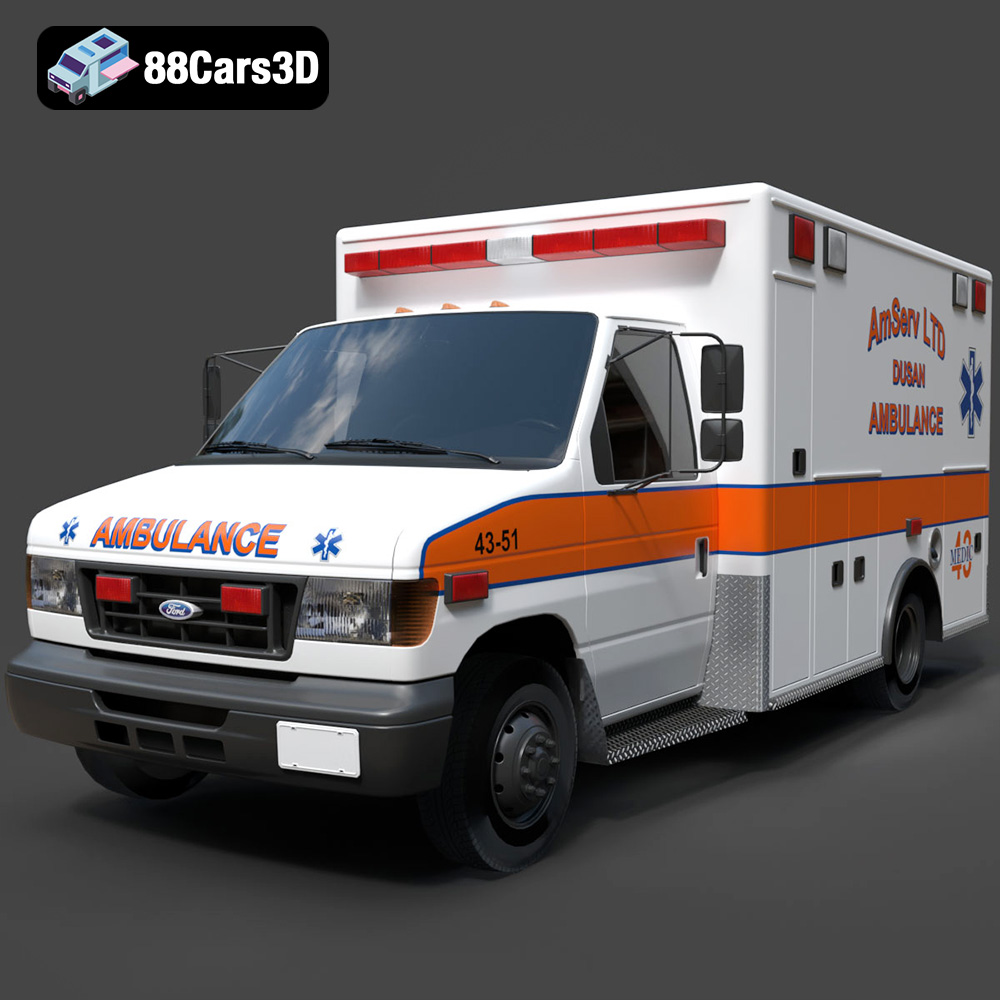
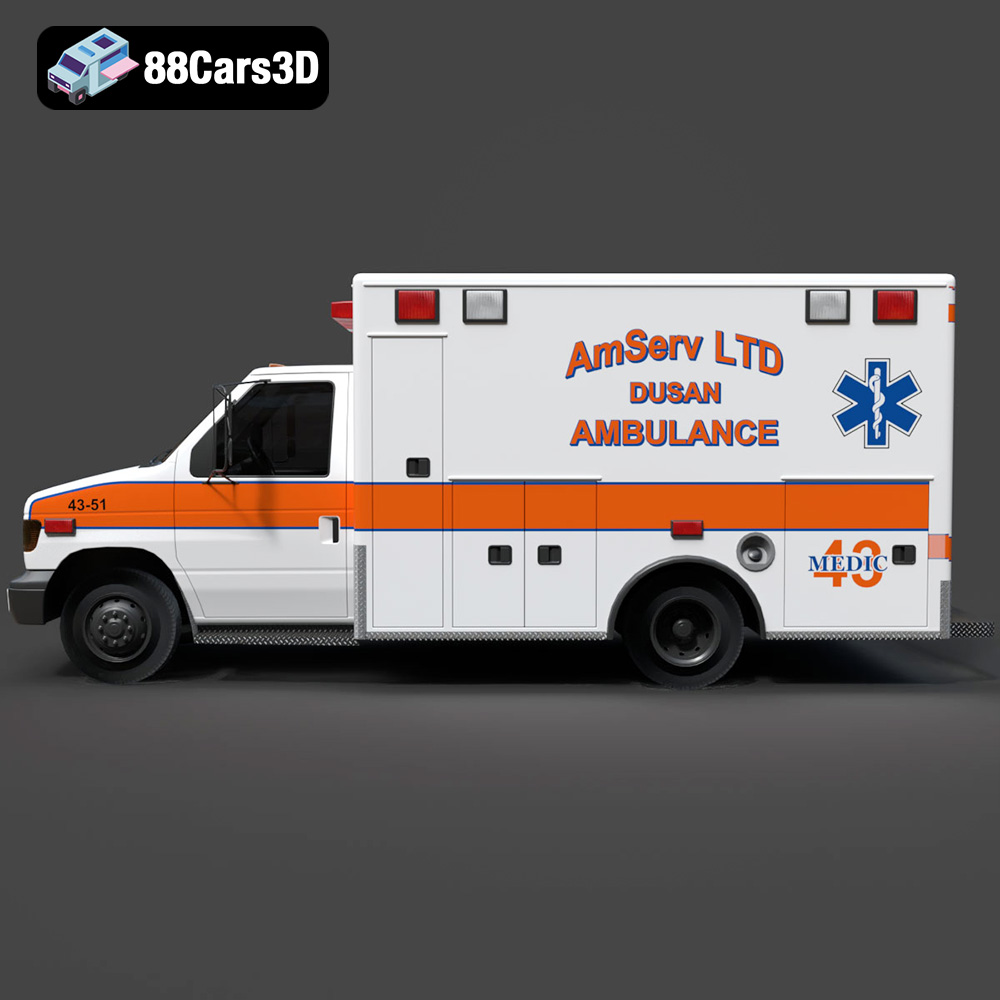
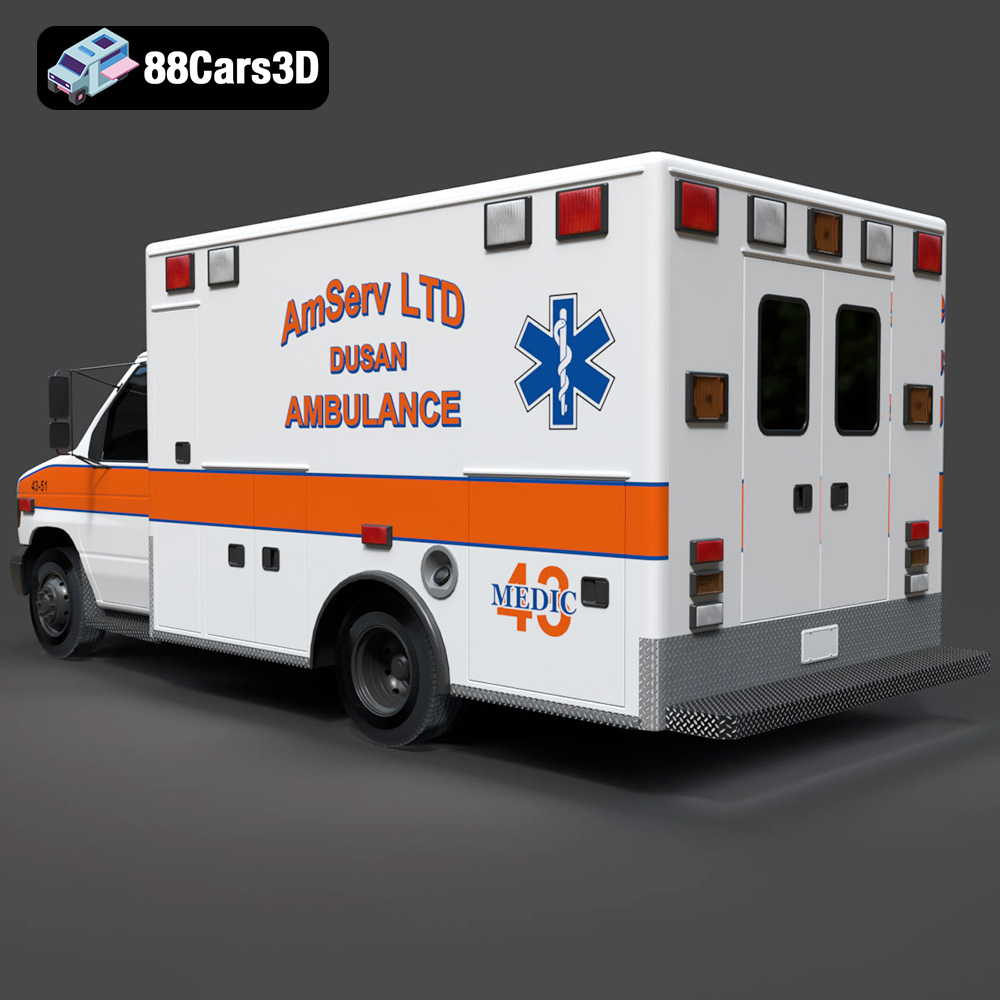
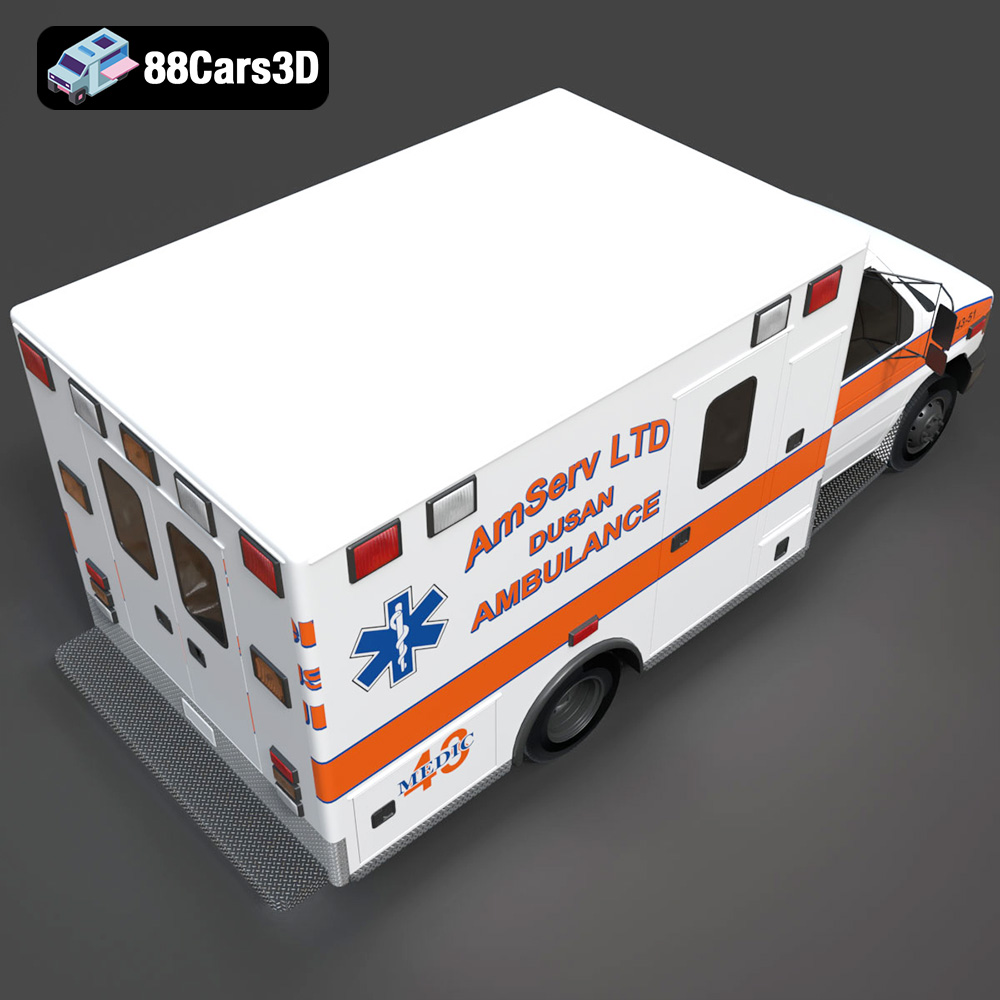
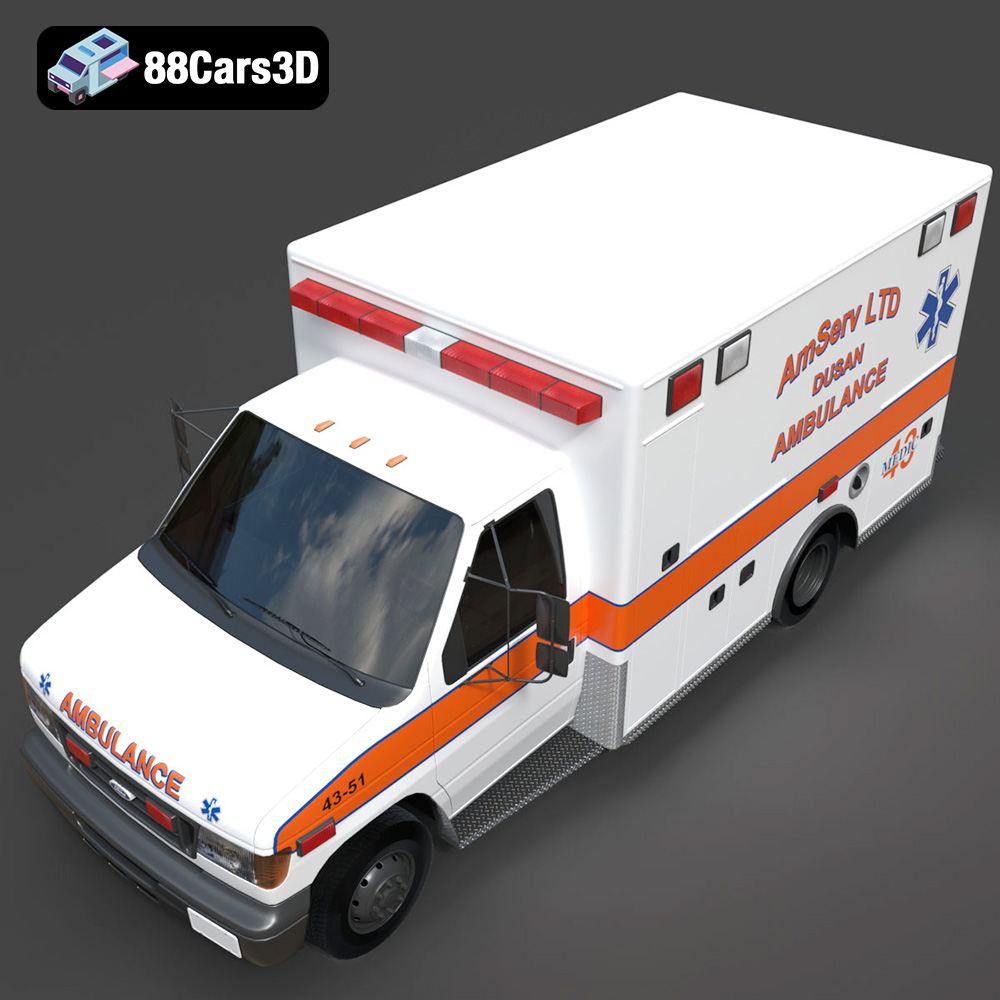
The exterior of the Ford Ambulance AmServ LTD Dusan-002 is a masterclass in balanced detail. It begins with the robust Ford chassis design, meticulously recreated with accurate body panels that reflect the vehicle’s real-world counterpart. But the realism extends far beyond mere shape. Crucial elements like detailed emergency light bars and strobes are crafted with transparent materials, crucial for achieving realistic illumination and light dispersion in renders or real-time environments. Individual components such as doors, windows, mirrors, and handles are modeled separately, not just for visual fidelity but for practical animation purposes. This modularity means animators can easily simulate opening and closing doors, or adjust mirrors, without complex rigging. Even the tires and rims are designed with real-world proportions, ensuring the vehicle sits correctly and interacts realistically within any scene. Authentic AmServ LTD branding and decals are applied with precision, adding that final layer of verifiable realism that distinguishes a generic model from a truly specialized asset available on platforms like 88cars3d.com.
Interior and Mechanical Precision: The Unseen Depths of Detail
While often less visible in external shots, the interior and mechanical details are vital for comprehensive visualization, especially in first-person perspectives, VR experiences, or close-up cinematic renders. The Ford Ambulance features a comprehensive interior cabin, complete with a detailed driver’s cockpit that includes an accurate dashboard, steering wheel, control panels, and seating. This level of detail is crucial for driving simulations or interior scene compositions. The patient compartment is equally elaborate, featuring a stretcher, medical equipment, and storage units, all essential for immersive medical training simulations or storytelling. Beyond the visible interior, partial engine details and a visible undercarriage are incorporated. This not only adds to the model’s structural integrity but also allows for more dynamic camera angles and realism in scenarios where the vehicle might be viewed from underneath or undergoing maintenance. The optimized mesh quality ensures that these intricate details hold up under close inspection without overburdening rendering engines.
Technical Advantages: The Pillars of Professional Production
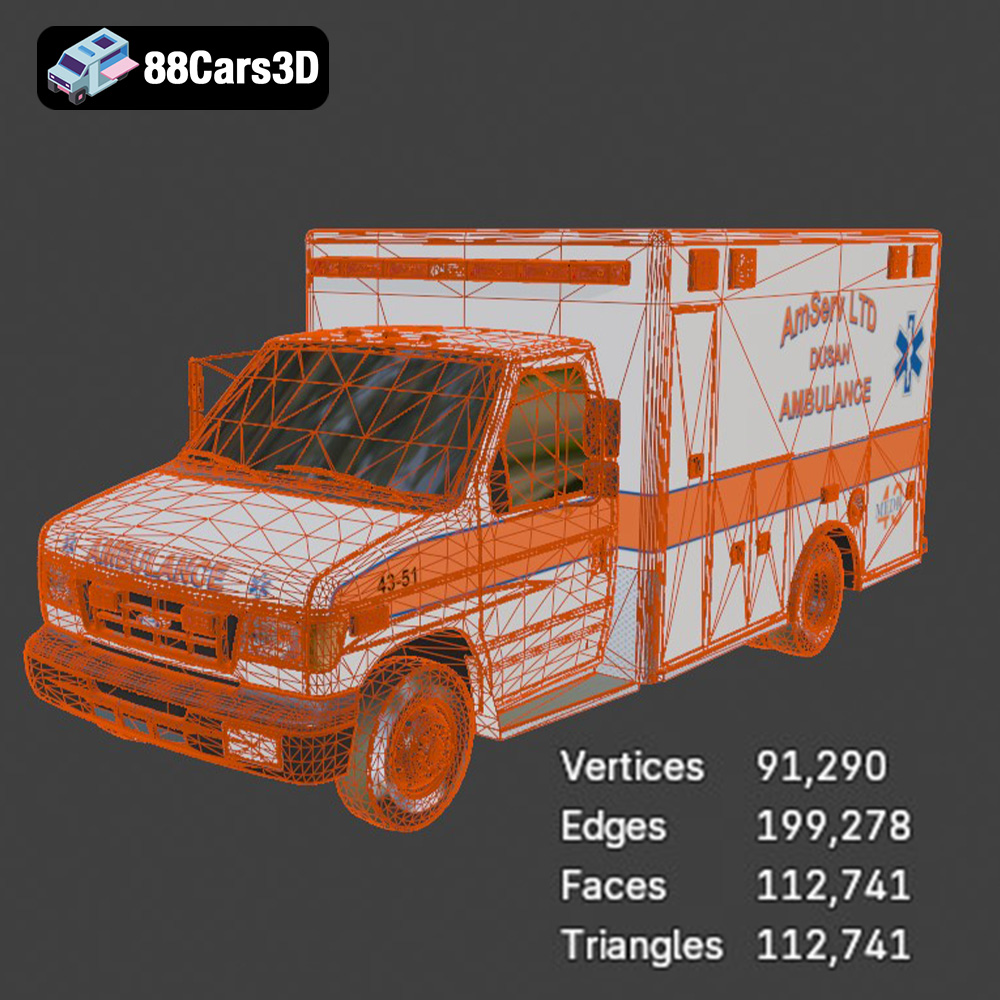
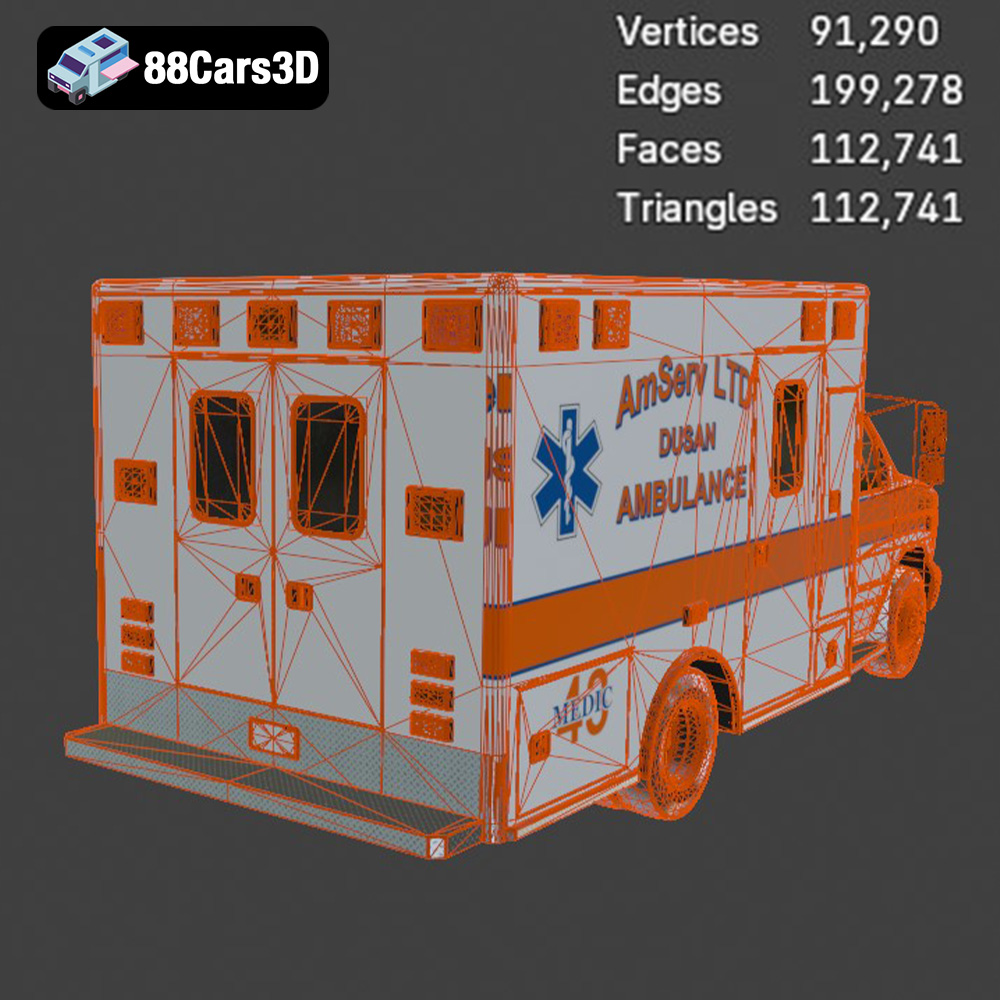
The true power of a 3D model often lies in its underlying technical construction. The Ford Ambulance AmServ LTD Dusan-002 boasts several critical advantages. Firstly, its clean, quad-dominant topology is a hallmark of professional modeling. Quads (four-sided polygons) allow for easy subdivision, deformation, and retopology, making the model highly adaptable for various levels of detail or specific animation needs. Secondly, it is precisely modeled to real-world scale, which is non-negotiable for accurate integration into any scene, ensuring proper proportions when placed alongside other assets or within architectural visualizations. Thirdly, an organized hierarchy with meaningful names and proper pivot points streamlines animation workflows. This means components like wheels, doors, and lights are logically grouped and have their rotation points correctly placed, simplifying the animator’s job. Lastly, the model is optimized for efficiency without sacrificing visual fidelity, ensuring smooth performance in real-time applications and faster rendering times in offline renderers. This balance of detail and performance is what makes assets from 88cars3d.com truly production-ready.
Integrating the Ambulance into Diverse 3D Workflows
The versatility of the Ford Ambulance AmServ LTD Dusan-002 3D Model is evident in its adaptability across numerous professional 3D disciplines. Its robust construction and inclusion of multiple file formats ensure it can serve as a cornerstone asset for various projects, each with its unique technical demands.
High-Fidelity Rendering and Visualization
For rendering and visualization artists, this 3D ambulance model is a dream. Its meticulously crafted details, from the realistic emergency light bars to the authentic branding, shine in studio renders and cinematic sequences. In architectural visualizations, placing this ambulance realistically parked outside a hospital or speeding through a city street adds a layer of dynamic realism and narrative. Artists using software like 3ds Max or Blender can leverage the native file formats (.max, .blend) to access the full scene, adjust material properties for metals, glass, rubber, and plastics to match specific lighting conditions, and even customize paint finishes to suit diverse client needs. The clean geometry supports further subdivision for extreme close-ups, ensuring that every curve and panel looks flawless, whether it’s for a high-res print or a 4K animation sequence.
Game Development: From Open-World to Simulation
In game development, high-quality assets are crucial for creating immersive experiences. The Ford Ambulance AmServ LTD Dusan-002 3D Model is perfectly suited for implementation as a high-quality asset in open-world games, simulation games, or emergency service titles. With .fbx and dedicated .unreal files, developers can rapidly import the model into Unreal Engine or Unity. The optimized mesh quality ensures smooth performance even in graphically intensive environments, while the organized hierarchy and proper pivot points facilitate easy rigging for vehicle physics and animation. Imagine a detailed paramedic simulation where players can drive this ambulance, open its doors, and interact with the interior medical equipment, or an open-world crime game where it serves as a dynamic element of the urban environment. The “engine-ready” nature of the asset significantly reduces development time, allowing teams to focus on gameplay and interaction rather than asset cleanup.
AR/VR: Immersive Training and Interactive Experiences
Augmented Reality (AR) and Virtual Reality (VR) platforms demand highly optimized yet visually compelling assets. The Ford Ambulance is an excellent candidate for developing immersive AR/VR experiences, particularly for training, education, or entertainment. The .glb format, specifically optimized for AR, VR, and web-based display, allows for efficient streaming and rendering on various devices. Imagine a medical training simulation where aspiring paramedics can virtually enter the ambulance’s patient compartment, interact with the stretcher and medical equipment, and practice emergency procedures in a safe, controlled environment. Or a virtual reality tour of an emergency services facility, featuring this detailed vehicle. The real-world scale and accurate interior details provide a crucial sense of presence and authenticity, making these simulations incredibly effective and engaging.
Simulation and Training: Beyond Entertainment
Beyond entertainment, the Ford Ambulance AmServ LTD Dusan-002 offers significant value for professional simulation and training scenarios. It can be utilized for medical training simulations, emergency response scenarios, or even advanced driver training programs. Its comprehensive interior, featuring a detailed patient compartment and driver’s cockpit, allows for highly specific and interactive training modules. For example, emergency services personnel could train on equipment placement, patient handling, or even incident command within a virtual replica of this vehicle. The ability to animate doors and lights, combined with the accurate physical dimensions, makes it an ideal component for creating realistic and impactful learning environments that can save lives in the real world.
Advanced Customization and Real-World Application
A truly professional 3D asset provides not just visual fidelity but also the flexibility for extensive customization. The Ford Ambulance AmServ LTD Dusan-002 3D Model is engineered with this principle in mind, allowing artists and developers to adapt it to an array of specific project requirements and real-world scenarios.
Tailoring Appearance for Specific Scenarios
The ability to modify paint finishes and apply custom emergency service graphics or liveries is paramount for ensuring geographical accuracy and branding consistency. Whether a project requires the ambulance to represent a specific city’s EMS, a military medical unit, or a fictional emergency service, the clean topology and well-defined material zones of this model make customization straightforward. Artists can easily swap out texture maps for new decals, change the base color of the vehicle, or even apply complex weather effects and damage for post-incident scenarios. This flexibility means a single high-quality asset can be repurposed countless times, saving significant production costs and time compared to modeling a new vehicle for each unique requirement. The ability to adjust material properties for metals, glass, rubber, and plastics further refines the aesthetic to match specific lighting conditions and project aesthetics, from gritty realism to stylized renders.
Configuring for Functional Versatility
Beyond exterior aesthetics, the interior of the Ford Ambulance is designed for customization. The detailed patient compartment with its stretcher, medical equipment, and storage units can be reconfigured or augmented as needed. This is particularly valuable for training simulations where specific equipment setups might be required for different medical procedures or regional standards. For instance, a trauma training scenario might require a different equipment layout than a cardiac emergency simulation. The model’s organized hierarchy allows for easy removal or addition of interior props, and customization of interior lighting setups can create varying moods or practical illumination for specific scenes. This functional versatility ensures the model is not a static prop but a dynamic tool that can evolve with the demands of any complex project.
Case Studies: Impacting Real-World Simulations
Consider a national emergency response agency developing a new VR training module for its paramedics. Instead of building a generic ambulance from scratch, they can integrate the Ford Ambulance AmServ LTD Dusan-002 from 88cars3d.com. Its real-world scale and detailed interior allow trainees to virtually step inside an authentic environment, practicing patient assessment, equipment retrieval, and critical decision-making under simulated pressure. The ability to animate doors and lights adds to the realism of arrival and departure sequences. Similarly, an automotive advertising agency tasked with creating a compelling commercial for a new line of emergency vehicle equipment could use this model for stunning product integration shots. Its high fidelity ensures the equipment looks perfectly integrated and realistic, enhancing the overall production value. The clean quad-dominant topology means the model can be subdivided for extreme close-ups, showcasing the new equipment in exquisite detail, a critical factor for automotive rendering.
Optimizing Performance and Fidelity Across Platforms
Achieving both stunning visual fidelity and optimal performance is a perennial challenge in 3D production. A professional-grade asset like the Ford Ambulance AmServ LTD Dusan-002 3D Model is designed to strike this crucial balance, providing foundational optimization while allowing for further platform-specific refinements.
Balancing Detail with Polygon Efficiency
The “balanced level of detail” and “optimized mesh quality” of this ambulance model are key indicators of its production readiness. This means the model has enough polygons to capture its intricate shapes and forms without being excessively dense, which would lead to poor performance in real-time applications or prolonged rendering times. The clean, quad-dominant topology isn’t just for easy editing; it’s also fundamental for creating efficient Levels of Detail (LODs). For game development or AR/VR, multiple versions of the model can be generated – a high-poly version for close-up shots and progressively lower-poly versions for distant views. This technique ensures that graphics hardware only renders the necessary detail, drastically improving frame rates. For the Ford Ambulance, the primary model provides a robust base from which these LODs can be easily derived, making it a truly versatile game asset.
Material and Texture Optimization
Beyond geometry, materials and textures significantly impact both visual quality and performance. The Ford Ambulance AmServ LTD Dusan-002 is designed with efficient material setups. This typically involves using PBR (Physically Based Rendering) workflows, which create incredibly realistic surfaces by accurately simulating how light interacts with different materials. The textures themselves would be logically organized and potentially optimized for various resolutions. For real-time applications, texture atlasing (combining multiple smaller textures into one larger sheet) and texture compression are common techniques to reduce draw calls and memory footprint. For the included .unreal and .blend files, these optimizations are often already implemented or easily configurable, providing a head start for developers integrating the model into their game engines.
Workflow Considerations for High-Performance Integration
When integrating the Ford Ambulance into high-performance environments like Unreal Engine, developers can leverage its well-structured nature. The organized hierarchy with meaningful names means that components can be easily culled, hidden, or swapped out if specific parts are not needed for a particular scene, further boosting performance. Proper pivot points are critical for accurate physics simulations and animation blending. For instance, the wheels of the ambulance will rotate correctly on their axis, and the suspension can be accurately simulated if the pivot points are placed at the wheel’s center. Furthermore, collision meshes (simplified geometric representations used for physics interactions) can be easily generated or are often included with professional assets, preventing complex high-poly meshes from impacting physics calculations. This holistic approach to optimization, from geometry to materials and scene organization, ensures that the Ford Ambulance AmServ LTD Dusan-002 3D Model delivers both stunning visuals and fluid performance across a wide spectrum of platforms and applications.
Conclusion: The Value of Precision in 3D Automotive Assets
The world of 3D modeling thrives on precision, versatility, and efficiency. Whether you’re crafting a cinematic masterpiece, developing the next immersive game, creating an essential training simulation, or producing compelling visualizations, the quality of your assets directly impacts the success of your project. The Ford Ambulance AmServ LTD Dusan-002 3D Model stands as a testament to these principles, offering an unparalleled level of detail, robust technical construction, and extensive format compatibility that makes it an indispensable tool for any professional 3D artist or developer.
From its meticulously recreated exterior and comprehensive interior to its clean quad-dominant topology and optimized mesh quality, every aspect of this model has been engineered for peak performance and visual fidelity. Its readiness for diverse applications—from rendering and game development to AR/VR and specialized training simulations—underscores its value as a truly professional asset. The availability across multiple file formats, including .blend, .fbx, .obj, .glb, .stl, .ply, .unreal, and .max, guarantees seamless integration into virtually any workflow, saving countless hours of manual preparation and ensuring a smooth production pipeline.
Investing in high-quality 3D car models like the Ford Ambulance AmServ LTD Dusan-002 from a trusted source like 88cars3d.com isn’t just about acquiring a digital asset; it’s about empowering your creative vision, enhancing the realism of your projects, and streamlining your workflow. This model is more than just an emergency vehicle; it’s a foundation for innovation, ready to drive your next project to new heights of visual excellence and functional realism. Explore this and many other premium automotive rendering and game assets today, and experience the difference that professional-grade 3D content can make.
Featured 3D Model
Ford Ambulance AmServ LTD Dusan-002 3D Model
Step into the world of emergency services with this meticulously crafted 3D model of the Ford Ambulance AmServ LTD Dusan-002. This professional-grade model captures the robust design and critical functionality of a modern ambulance, ideal for urgent medical transport scenarios. Built with clean geometry and a balanced level of detail, it ensures optimal performance across various applications. Perfect for high-fidelity rendering, realistic animation sequences, immersive simulation environments, and detailed game development projects.
Exterior Features:
- Robust Ford chassis design and detailed body panels
- Detailed emergency light bars and strobes with transparent materials for realistic illumination
- Accurate exterior features including doors, windows, mirrors, and handles
- Realistic tires and rims, designed for real-world proportions
- Separate components for easy animation of doors, wheels, and emergency lights
- Authentic AmServ LTD branding and decals for added realism
Interior / Mechanical Features:
- Comprehensive interior cabin with a detailed driver’s cockpit
- Accurate dashboard, steering wheel, control panels, and seating
- Detailed patient compartment featuring a stretcher, medical equipment, and storage units
- Optimized mesh quality for both close-up renders and distant shots
- Visible undercarriage and partial engine details for added realism and structural integrity
Technical Advantages:
- Clean, quad-dominant topology for easy subdivision, deformation, and retopology
- Precisely modeled to real-world scale for accurate integration into any scene
- Organized hierarchy with meaningful names and proper pivot points for seamless animation workflows
- Optimized for efficiency without sacrificing visual fidelity, ensuring smooth performance
Applications:
- Rendering & Visualization: Create stunning studio renders, cinematic sequences, and architectural visualizations with an authentic emergency vehicle.
- Game Development: Implement as a high-quality asset in open-world games, simulation games, or emergency service titles.
- AR/VR: Develop immersive augmented and virtual reality experiences for training, education, or entertainment.
- Simulation & Training: Utilize for medical training simulations, emergency response scenarios, or driver training programs.
- 3D Printing: Easily convert to .stl for producing detailed physical models and prototypes.
Customization Options:
- Modify paint finishes and apply custom emergency service graphics or liveries to match specific regional requirements.
- Adjust material properties for metals, glass, rubber, and plastics to match specific lighting conditions and aesthetics.
- Customize interior equipment layouts and lighting setups for various scene requirements.
The Ford Ambulance AmServ LTD Dusan-002 3D model delivers exceptional realism and versatility for any project requiring an authentic emergency vehicle. Its professional build and comprehensive details ensure it stands out as a high-value asset in your 3D library.
Included File Formats:
- .blend – Blender project with materials
- .fbx – Compatible with Unreal, Unity, and major 3D engines
- .obj – Universal format for nearly all 3D software
- .glb – Optimized for AR, VR, and web-based visualization
- .stl – Ready for 3D printing
- .ply – Mesh format for analysis and CAD workflows
- .unreal – Unreal Engine project setup
- .max – Editable 3ds Max scene for rendering and animation
$19.99
Product Image Gallery

Related Tags
.ford .ambulanceamservltddusan002 .ambulance .emergencyvehicle .van .rendering .simulation .gameasset .arvr .blend .fbx .obj .glb .stl .ply .unreal .max
