Dive Deep into History: Crafting and Utilizing the German U-Boat U-99 Submarine 1940 3D Model
In the realm of 3D visualization, the power to faithfully recreate history is one of the most compelling applications. Few historical subjects capture the imagination quite like the silent, formidable U-boats of World War II. Among them, the German Type VIIB U-Boat U-99, commanded by the legendary Otto Kretschmer, stands as a symbol of both innovation and the intense naval warfare of the era. Its operational history, marked by daring patrols and significant sinkings, makes it a prime candidate for detailed digital preservation and artistic interpretation.
Today, artists, game developers, simulation engineers, and educators can bring this iconic vessel back to life with a meticulously crafted 3D model, such as the German U-Boat U-99 Submarine 1940 3D Model available at 88cars3d.com. This asset is not merely a visual representation; it is a technical triumph, designed to offer exceptional visual fidelity and performance across a spectrum of professional applications. From high-resolution cinematic sequences to immersive virtual reality experiences, and even detailed historical simulations, this model provides an authentic scale and intricate design, capturing the essence of the historic naval vessel with precision. It serves as a testament to how advanced 3D modeling transforms historical research into tangible, interactive experiences.
Understanding 3D Model File Formats: Choosing the Right Tool for the Job
The versatility of a professional 3D asset, especially one as complex and detailed as the U-99 Submarine, is largely defined by the range and quality of its provided file formats. Each format serves a specific purpose, offering unique advantages for different stages of a creative pipeline, from initial modeling and texturing to final rendering, real-time implementation, or even physical production. Understanding these distinctions is crucial for anyone integrating high-quality assets into their projects.
.blend – The Blender Powerhouse for Full Control
The .blend format is the native file type for Blender, a powerful open-source 3D creation suite. When you acquire a .blend file, you’re gaining access to a fully editable Blender scene. This typically includes not just the raw geometry of the U-99 model, but also its materials, textures, lighting setups, cameras, and even animation rigs if present. This format is ideal for artists who want complete control over every aspect of the asset, allowing for custom modifications, re-texturing, scene assembly, or rendering within Blender’s cycles or Eevee engines. Its comprehensive nature makes it invaluable for those who need to deeply integrate the model into a Blender-centric workflow.
.fbx – The Industry Standard for Interchange and Game Engines
.fbx (Filmbox) is arguably the most widely adopted interchange format in the 3D industry. Developed by Autodesk, it’s a robust format capable of storing not only geometry but also materials, textures, skeletal animation, camera data, and more. This makes it an ideal choice for transferring assets between different 3D software applications (like 3ds Max, Maya, Cinema 4D, and Blender) and, crucially, for importing into game engines such as Unreal Engine and Unity. For a model like the U-99, the .fbx variant would be optimized for real-time pipelines, ensuring clean hierarchies, proper pivots, and efficient mesh data for optimal performance within a game environment.
.obj – The Universal Cross-Software Workhorse
The .obj (Wavefront Object) format is a venerable and universally supported 3D file type. It primarily stores geometric data (vertices, normals, UV coordinates) and can reference external material library files (.mtl) for basic color and texture information. While it doesn’t support complex scene data like animation or lighting, its simplicity and widespread compatibility make it an excellent choice for cross-software sharing when only the core mesh data is needed. If you’re working with an uncommon 3D application or simply need a clean mesh to start from, .obj is often the safest bet for the U-99 model.
.glb – Optimized for AR, VR, and Web-Based Experiences
.glb is the binary version of the glTF (Graphics Language Transmission Format) standard, which is quickly becoming the “JPEG of 3D.” Designed for efficient transmission and loading of 3D scenes and models, .glb files are highly optimized for web-based applications, augmented reality (AR), and virtual reality (VR). They encapsulate all necessary data—geometry, materials, textures, and even animation—into a single, compact file. For deploying the U-99 model in an interactive web viewer, a mobile AR app, or a lightweight VR experience, the .glb format offers unparalleled performance and ease of integration.
.stl – The Go-To for 3D Printing Output
.stl (StereoLithography) is the de facto standard format for 3D printing. It represents a 3D model as a series of connected triangles, defining only the surface geometry without any color, texture, or material information. For designers and engineers looking to produce a physical replica of the U-99 U-Boat, the .stl file provides a direct path from digital model to tangible object. It’s crucial for the .stl file to have a watertight mesh (no holes) to ensure successful 3D printing.
.ply – Precision Mesh for CAD or Analysis
The .ply (Polygon File Format) is another popular format for storing 3D data, particularly known for its ability to store properties such as color, transparency, normals, texture coordinates, and scalar values for each vertex or face. It’s often used for scanned 3D data, scientific visualization, and CAD/CAM applications where precise mesh information and additional data attributes are critical. For detailed analysis or high-precision industrial applications of the U-99 model, .ply offers a robust data structure.
.unreal – Engine-Ready for Real-Time Environments
The .unreal format signifies an asset that has been specifically configured and prepared for direct integration into Unreal Engine projects. This can mean optimized mesh data, pre-configured materials with PBR (Physically Based Rendering) shaders, collision meshes, LODs (Levels of Detail), and potentially even basic blueprints for interactive elements. For game developers or real-time visualization specialists using Unreal Engine, this pre-packaged format for the U-99 offers a significant head start, saving considerable time on asset preparation and optimization.
.max – The 3ds Max Project for Animation and Rendering
Finally, the .max format is the native file type for Autodesk 3ds Max, a leading software for 3D modeling, animation, and rendering. Like .blend, a .max file provides a complete scene, including the U-99 geometry, complex materials, sophisticated lighting setups (e.g., V-Ray or Corona Renderer), cameras, and animation keyframes. This format is preferred by professionals who utilize 3ds Max for high-end architectural visualization, product rendering, or cinematic animation, offering the full range of Max’s powerful toolset for further refinement and artistic expression.
The availability of such a wide array of formats for the German U-Boat U-99 Submarine 1940 3D Model underscores its professional-grade nature and commitment to versatility, ensuring it seamlessly integrates into almost any digital workflow.
The Art and Science of Historical 3D Model Creation
Creating a historically accurate 3D model, especially of a complex vessel like the U-99, is a demanding process that blends meticulous research with advanced 3D modeling techniques. It’s not just about replicating shapes; it’s about capturing the essence, the wear, and the narrative of an artifact.
Meticulous Research and Authenticity
The foundation of any high-quality historical 3D model lies in exhaustive research. For the U-99, this would involve poring over archival blueprints, schematics, period photographs, and even survivor accounts. Every rivet, every pipe, the precise dimensions of the conning tower, the type of deck cannon, and the position of hydroplanes must be verified against historical records. The goal is to achieve not just visual similarity, but structural and functional accuracy. This commitment to detail ensures that the German U-Boat U-99 Submarine 1940 3D Model stands as a credible digital twin, useful for everything from historical documentaries to museum exhibits.
Advanced Modeling Techniques for Intricate Detail
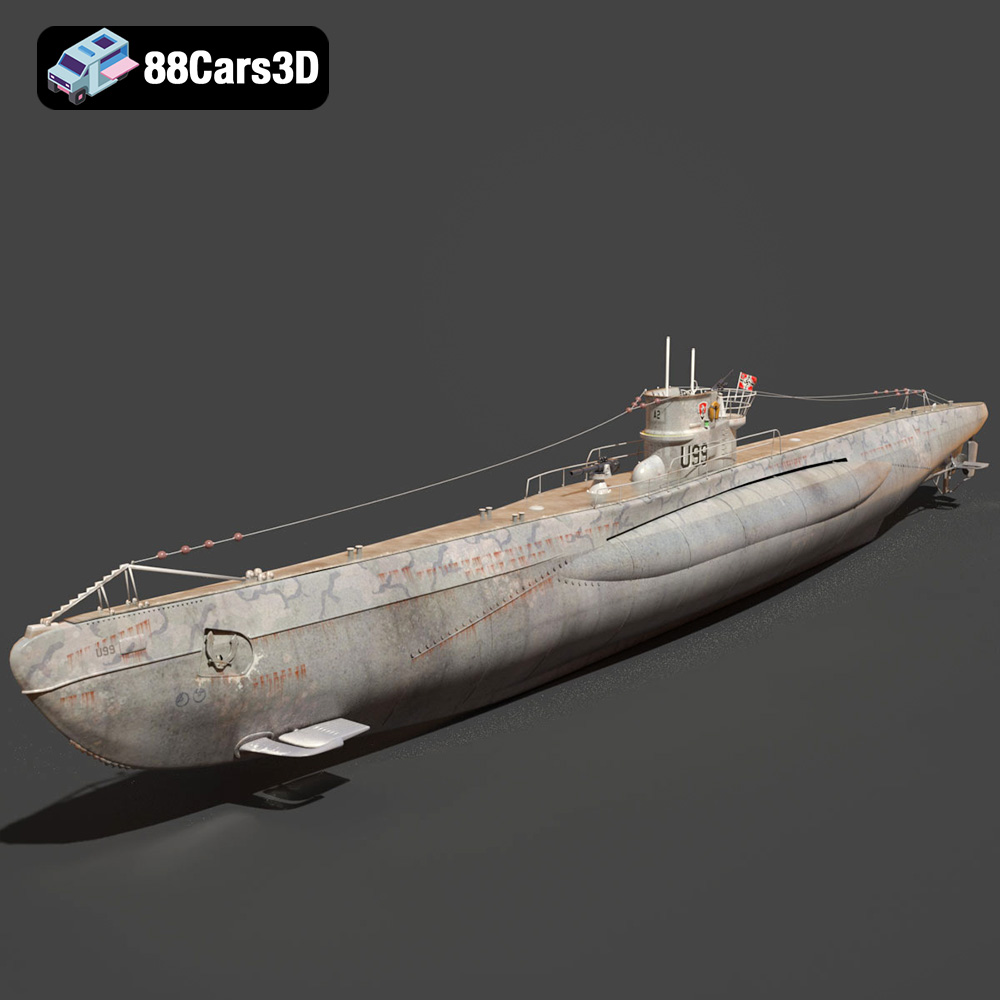
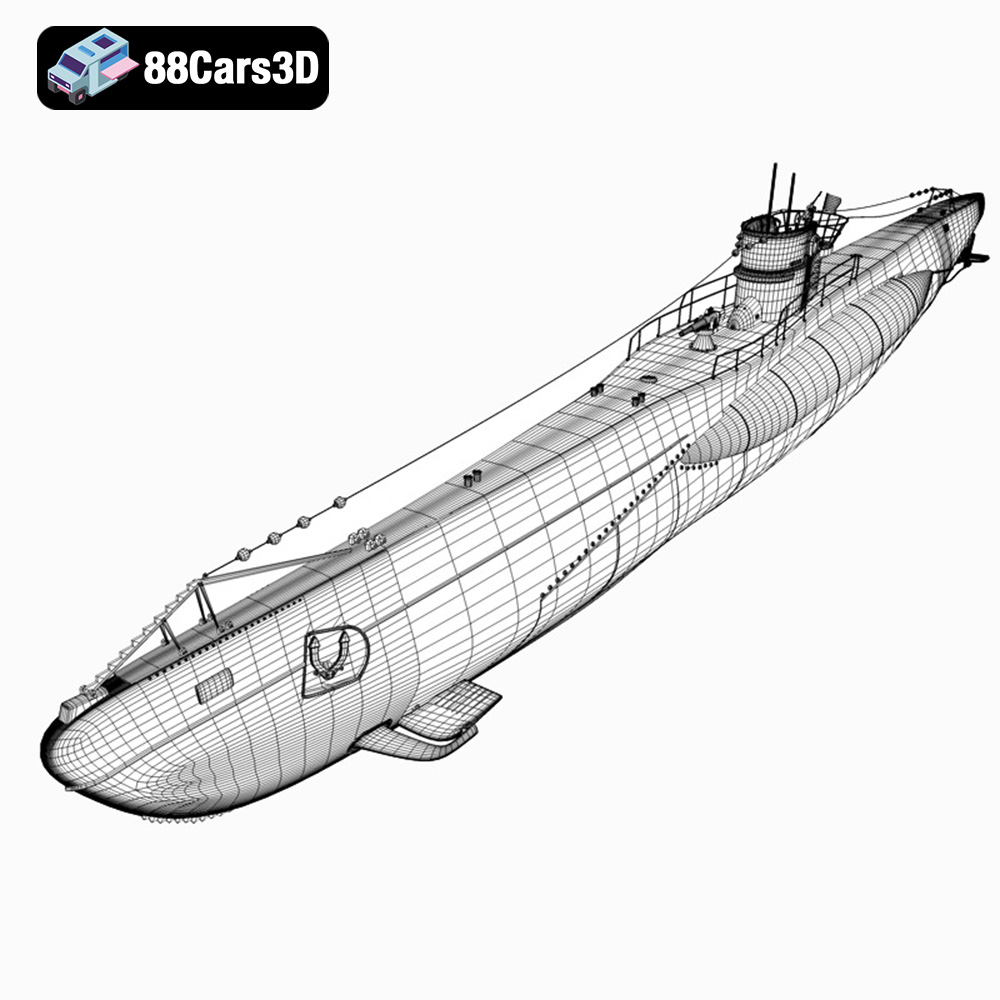
Once research is complete, the modeling begins. Hard-surface modeling techniques are employed to create the U-boat’s rigid, mechanical forms with clean, optimized geometry. This means using precise polygonal modeling, often starting with low-poly base meshes and then adding detail through subdivision surfacing or careful edge manipulation. Attention is paid to the topology, ensuring a clean mesh that can deform well if animated and remains efficient for real-time applications. Critical components like the torpedo tubes, propeller assembly, and the complex superstructure of the conning tower are individually modeled with high fidelity, reflecting the “exceptional visual fidelity suitable for close-up renders” mentioned in the product description.
PBR Texturing and Material Realism
Beyond geometry, materials and textures are what truly bring a 3D model to life. Physically Based Rendering (PBR) workflows are essential for achieving realistic surfaces that react correctly to light in any environment. This involves creating texture maps for base color (albedo), roughness, metallic, normal, and ambient occlusion. For a historic vessel like the U-99, weathering is key. Grunge, rust streaks, paint chips, and general wear and tear are meticulously painted or procedurally generated on high-resolution UV layouts. The aim is to tell a story through the surface, showcasing the vessel’s harsh operational life. The “Realistic materials and professionally created textures” of the U-99 model are designed to convey this level of authenticity, making it a truly immersive experience whether viewed in a game engine or a high-end renderer.
Integrating High-Fidelity 3D Models into Professional Workflows
A versatile 3D asset like the German U-Boat U-99 Submarine 1940 3D Model from 88cars3d.com isn’t just for looking at; it’s a powerful tool that integrates into diverse professional pipelines, accelerating production and elevating quality across industries.
Cinematic Rendering and Visualization
For film, television, or high-end advertising, the U-99 model excels in cinematic rendering scenarios. Using software like 3ds Max (with its .max file) or Blender (with its .blend file) combined with powerful renderers such as V-Ray, Corona, or Cycles, artists can create breathtakingly realistic scenes. Imagine a historical documentary where the U-99 emerges from a stormy sea, its weathered hull glistening, or a dramatic cutscene illustrating a torpedo launch. The model’s clean geometry and PBR textures ensure it holds up under extreme close-ups and varied lighting conditions, allowing directors to stage complex historical narratives with unparalleled visual impact. This detailed asset facilitates the creation of “cinematic sequences” that are both historically accurate and visually stunning.
Real-time Game Development and Simulation
The demand for realistic assets in game development is ever-growing. The U-99 model, with its .fbx and .unreal formats, is explicitly designed to be game-engine ready for platforms like Unreal Engine and Unity. This involves careful optimization: efficient polygon counts, well-structured UVs, and often multiple Levels of Detail (LODs) to ensure smooth performance without sacrificing visual quality at various distances. Game developers can integrate the U-99 into military simulations, historical strategy games, or action titles, providing players with an authentic and immersive experience. Its “clean and optimized geometry” ensures “performance across various platforms,” a critical factor for successful game assets.
Immersive AR/VR Experiences
Augmented Reality (AR) and Virtual Reality (VR) are transforming how we interact with digital content, offering truly immersive experiences. The .glb format, optimized for AR/VR and web-based visualization, makes the U-99 model perfect for creating interactive historical exhibits, virtual museum tours, or educational applications. Users could “walk around” the submarine, examine its details up close, or even virtually pilot it through historical scenarios. The U-99 model’s detailed design and authentic scale make it an exceptional candidate for “immersive AR/VR experiences focused on World War II themes or maritime history,” providing an engaging way to learn and explore history.
Educational and Archival Projects
Beyond entertainment, high-fidelity 3D models like the U-99 play a crucial role in education and digital archiving. Universities, museums, and historical societies can use these models to create interactive learning tools, reconstruct historical events for students, or preserve cultural heritage in digital form. The ability to manipulate, analyze, and visualize the U-boat from any angle provides a deeper understanding of its engineering and operational context than traditional flat media. The model is specifically “ideal for historical simulations, military game development, educational visualization projects,” highlighting its significant academic value.
Technical Specifications and Optimization for Performance
The true value of a professional 3D model extends beyond its aesthetic appeal. It lies in its underlying technical structure and how well it is optimized for various computational demands. The German U-Boat U-99 Submarine 1940 3D Model exemplifies this balance, offering both visual richness and robust performance.
Clean Geometry and Efficient Topology
At the heart of a high-quality 3D asset is its geometry. The U-99 model is built with “clean and optimized geometry,” meaning a thoughtful balance between detail and polygon count. While specific poly counts aren’t provided, professional models ensure that polygons (triangles or quads) are efficiently distributed, avoiding unnecessary density in flat areas while allocating sufficient resolution to intricate curves and details like the conning tower, deck cannon, and hydroplanes. This clean topology prevents rendering artifacts, facilitates smooth deformation if animated, and keeps file sizes manageable, contributing to its performance across different platforms.
Seamless UV Mapping and Rich Texture Sets
Effective UV mapping is non-negotiable for realistic texturing. The U-99 model features professionally created UV layouts that are non-overlapping and optimized for texture space utilization. This allows for the application of “realistic materials and professionally created textures” at high resolutions (e.g., 4K or 8K, common for hero assets). These texture sets typically include:
- Albedo/Base Color: The foundational color of the surface.
- Normal Map: Adds fine surface detail without increasing geometry.
- Roughness Map: Controls the specularity and shininess of the surface.
- Metallic Map: Differentiates metallic from non-metallic surfaces.
- Ambient Occlusion (AO) Map: Simulates soft self-shadowing for added depth.
These PBR-compliant textures ensure the weathered hull and mechanical components react authentically to light in any rendering engine, from a cinematic renderer to a real-time game engine.
Implementing Levels of Detail (LODs) for Scalability
For real-time applications, particularly games and large-scale simulations, Levels of Detail (LODs) are crucial. While not explicitly listed for this specific product, a professional-grade asset designed for “game development” and “AR/VR” will often include multiple versions of the model with progressively lower polygon counts. The highest detail LOD is used when the submarine is close to the camera, while lower detail versions automatically swap in when the vessel is further away. This optimization strategy drastically improves frame rates and overall performance without noticeable visual degradation to the end-user, ensuring the U-99 model performs efficiently in complex virtual environments.
Structured Scene Organization and Asset Management
Ease of integration is a hallmark of a professional 3D asset. The U-99 model is “built to professional standards for reliability and ease of integration.” This implies a well-organized scene hierarchy, logically named objects and materials, and possibly grouped components. This systematic approach ensures that users can quickly navigate the model, select specific parts for animation or modification, and drop it into their projects without needing extensive cleanup or restructuring. This attention to underlying organization saves valuable production time for artists and developers.
Case Studies and Applications of Historical 3D Assets
The German U-Boat U-99 Submarine 1940 3D Model is far more than an aesthetically pleasing digital sculpture; it is a versatile tool with profound applications across various industries, transcending the typical usage of 3D car models or other ground vehicles.
Documentary Films and Historical Recreations
One of the most powerful applications for a historically accurate 3D model like the U-99 is in documentary filmmaking and television series. Before the advent of advanced 3D assets, recreating complex historical events often relied on archival footage, miniatures, or costly live-action sets. Now, digital models allow filmmakers to animate the U-99 in historically accurate scenarios, such as its notorious wolfpack attacks, its silent patrols, or its dramatic encounters. This provides a dynamic visual narrative that enhances historical understanding and emotional impact, showcasing the capabilities of high-fidelity 3D assets in storytelling.
Interactive Museum Exhibits and Educational Platforms
Museums and educational institutions are increasingly turning to interactive digital experiences to engage audiences. Imagine a museum exhibit where visitors can use a touchscreen to explore the U-99 model from every angle, learning about its components, crew life, and historical context through overlaid information. Or a VR experience where students can “stand” on the deck of the U-boat during a simulated patrol. The model’s “authentic scale and detailed design” make it perfect for these applications, offering a dynamic and memorable learning experience far beyond static displays. This expands the scope of what is traditionally considered “visualization projects” in education.
Advanced Simulation and Military Training
For naval academies or military historians, the U-99 model can be integrated into advanced simulation platforms. This could range from historical battlefield recreations to detailed engineering simulations. Trainees could learn about the operation of Type VIIB submarines, understand their vulnerabilities and strengths, or analyze historical tactics. The model’s “clean and optimized geometry” ensures it can run effectively within these complex simulation environments, offering a robust foundation for serious analysis and training, pushing the boundaries of what is possible with “military game development” and simulation.
Expanding the Scope of 3D Vehicle Models
While 88cars3d.com is well-known for its exceptional 3D car models, the availability of a meticulously detailed naval vessel like the U-99 underscores the broader expertise in high-quality vehicle modeling. Whether it’s the sleek lines of a modern supercar or the rugged, historic form of a submarine, the principles of detailed modeling, PBR texturing, and performance optimization remain consistent. This U-boat model demonstrates that the same professional standards applied to automotive rendering can be successfully translated to create compelling assets for air, land, and sea, offering diverse opportunities for creators looking for top-tier 3D assets.
Maximizing Value with 88cars3d.com Assets
In the fast-paced world of 3D production, efficiency and quality are paramount. Sourcing high-quality, pre-made 3D assets, particularly from reputable marketplaces like 88cars3d.com, offers significant advantages over building everything from scratch. The German U-Boat U-99 Submarine 1940 3D Model is a prime example of how such an asset can drastically enhance a project’s timeline and output.
Assured Quality and Professional Standards
When you purchase an asset from 88cars3d.com, you are investing in proven quality. The German U-Boat U-99 model is described as being “built to professional standards for reliability and ease of integration.” This means it has undergone rigorous creation processes, including meticulous research, optimized topology, clean UVs, and PBR-compliant textures. Such an asset minimizes the need for extensive post-purchase cleanup or optimization, allowing artists and developers to integrate it directly into their workflows with confidence. This reliability is critical for maintaining project deadlines and ensuring a polished final product, whether it’s for automotive rendering or a historical simulation.
Time and Cost Efficiency for Production
Developing a complex 3D model from the ground up, especially one requiring historical accuracy like the U-99, demands hundreds of hours of work from skilled artists. This includes research, modeling, sculpting, UV mapping, texturing, and optimization for various platforms. By acquiring a ready-made, professional-grade asset, studios and individual creators can save immense amounts of time and financial resources. Instead of dedicating an artist to create a submarine for months, they can purchase a fully finished, battle-ready asset and immediately focus on scene setup, animation, or game logic. This accelerates project timelines significantly, making ambitious projects more feasible.
Diverse Applications and Versatility
The array of file formats provided with the U-99 model—from .blend and .max for comprehensive scene work to .fbx and .unreal for game engines, and even .glb for AR/VR and .stl for 3D printing—speaks to its exceptional versatility. This means the single purchase can serve multiple project requirements, providing incredible value. Whether your project demands high-resolution renders for a documentary, real-time performance for a game, or a physical prototype, this asset is equipped to handle it. This multi-faceted usability ensures that the investment in the U-99 model is maximized across different phases and types of production.
Conclusion: Charting New Courses with Historical 3D Assets
The meticulous recreation of historical artifacts through 3D modeling offers an unparalleled opportunity to engage with the past in a dynamic and interactive way. The German U-Boat U-99 Submarine 1940 3D Model stands as a shining example of this capability, transforming a legendary naval vessel into a versatile digital asset ready for deployment across a myriad of professional applications. From the exacting details of its conning tower and deck cannon to the weathered realism of its hull, every aspect is crafted to deliver exceptional visual fidelity and performance.
Whether you are a filmmaker seeking to enhance cinematic sequences, a game developer building an immersive WWII experience, an educator developing interactive historical visualizations, or an architect exploring the capabilities of 3D printing, the U-99 model provides a robust foundation. Its availability in a comprehensive suite of file formats – .blend, .fbx, .obj, .glb, .stl, .ply, .unreal, and .max – ensures seamless integration into virtually any workflow, making it a truly universal tool for creators. This level of detail and flexibility underscores the commitment to quality found at 88cars3d.com, where top-tier 3D models, including highly detailed 3D car models and other vehicle types, are made accessible for diverse creative endeavors. By choosing assets like the German U-Boat U-99 Submarine 1940 3D Model, you are not just acquiring a digital file; you are investing in historical authenticity, technical excellence, and the ability to bring compelling narratives to life.
Embrace the power of history and advanced 3D technology to create your next masterpiece. The depths of digital creation await.
Featured 3D Model
German U-Boat U-99 Submarine 1940 3D Model
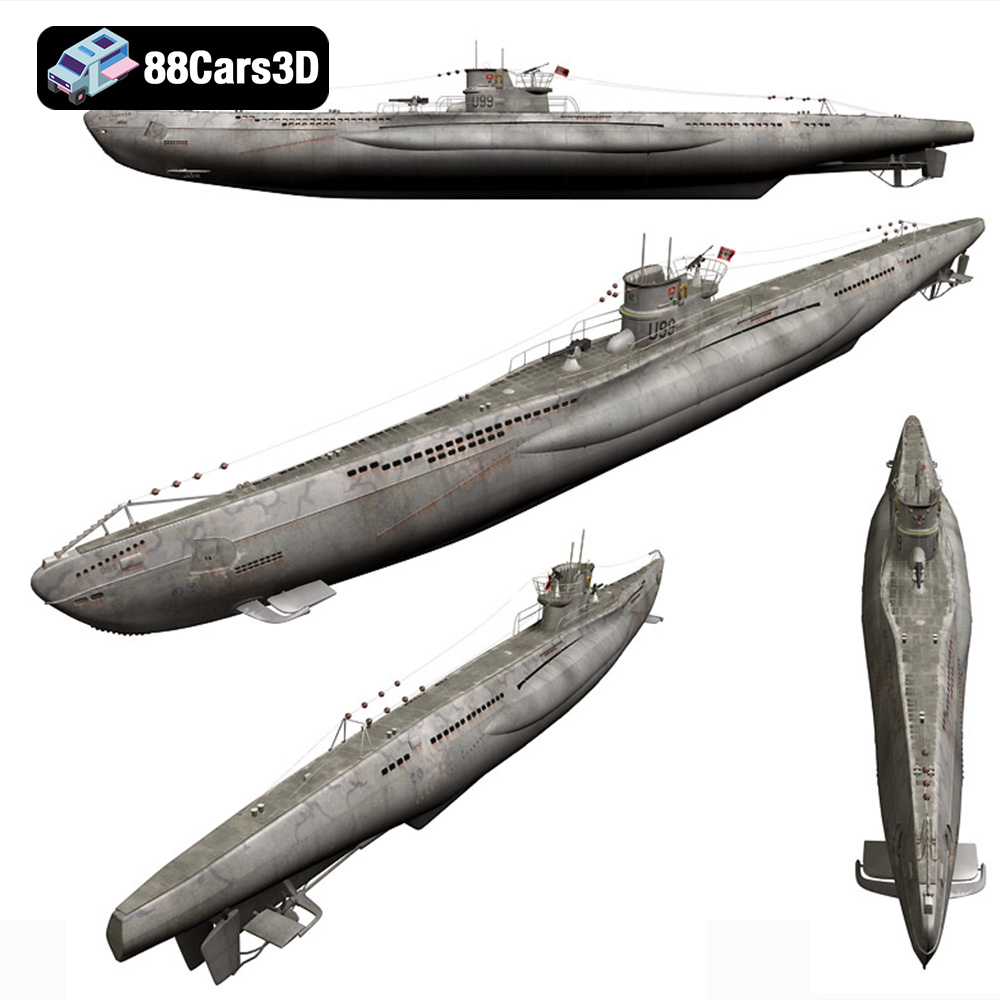
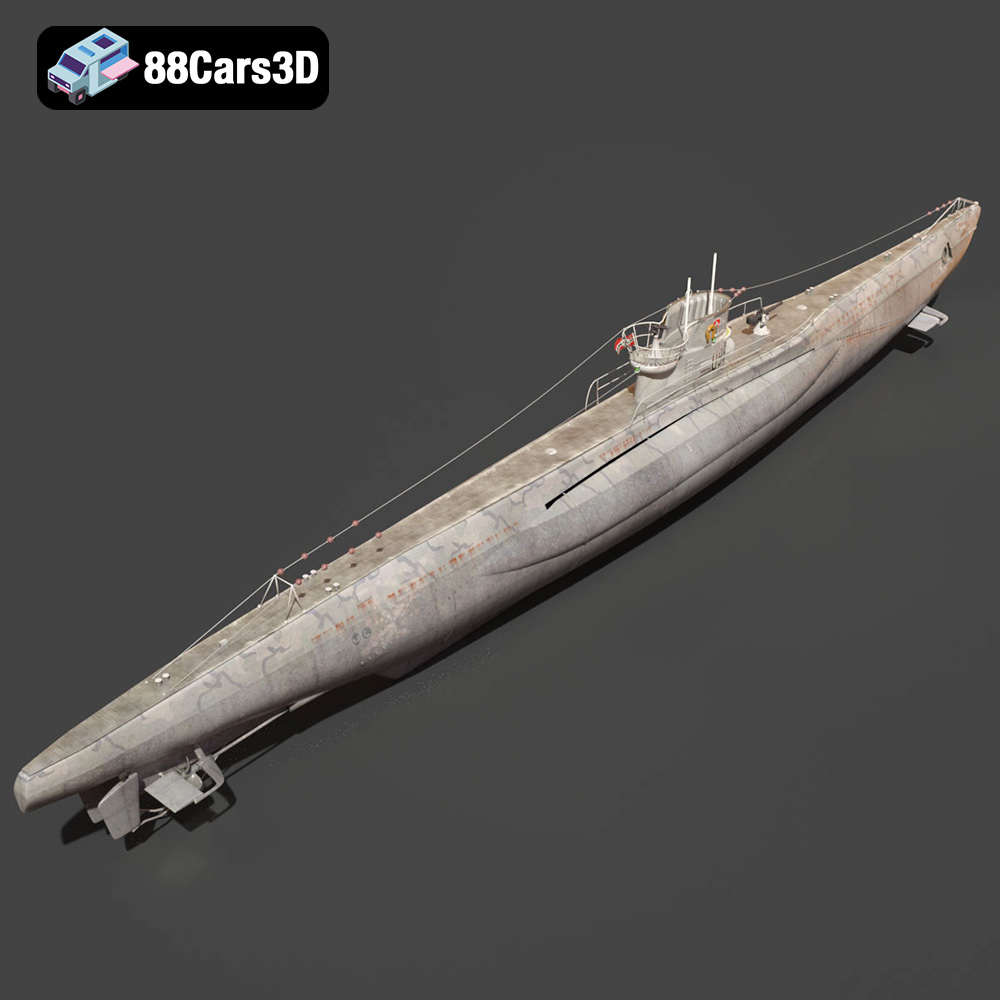
Introducing the meticulously crafted 3D model of the German WWII Type VIIB U-Boat U-99, known for its pivotal role in naval warfare. This asset captures the authentic scale and detailed design of the historic naval vessel, providing exceptional visual fidelity suitable for close-up renders and detailed virtual environments. The geometry is clean and optimized for performance across various platforms while maintaining intricate details, including the conning tower, deck cannon, and hydroplanes. Realistic materials and professionally created textures ensure accurate representation of the weathered hull and mechanical components. This asset is built to professional standards for reliability and ease of integration. This detailed asset is ideal for historical simulations, military game development, educational visualization projects, cinematic sequences, and immersive AR/VR experiences focused on World War II themes or maritime history.
$10
Product Image Gallery