The digital realm offers unprecedented opportunities to recreate history with breathtaking fidelity, bringing past eras and iconic objects to life for new generations. From historical simulations to cinematic masterpieces and immersive virtual reality experiences, the demand for highly accurate and technically robust 3D models is ever-growing. This is particularly true when dealing with subjects of significant historical weight, where authenticity is paramount. Creating such assets requires a deep understanding of both the subject matter and the intricate technical aspects of 3D production.
In the vast ocean of digital assets, some models stand out due to their meticulous craftsmanship and adherence to real-world detail. One such exemplary piece is the German U-Boat U-99 Submarine 1940 3D Model, a stunning recreation available on 88cars3d.com. This model isn’t just a collection of polygons; it’s a digital artifact designed to transport users back to a critical period in naval history, offering an unparalleled level of visual fidelity and technical readiness for a multitude of professional applications. Whether you’re a game developer seeking authentic military game assets, a historian building an educational visualization, or a filmmaker crafting a period-accurate scene, understanding the underlying technical excellence of such a model is crucial for successful integration into your project pipelines.
Understanding 3D Model File Formats
When acquiring a 3D model, especially one as complex and versatile as the U-Boat U-99, the provided file formats are not just arbitrary choices; they are critical gateways to different professional workflows and platforms. Each format serves a specific purpose, offering unique advantages in terms of compatibility, features, and optimization. Understanding these distinctions is fundamental to harnessing the full potential of your 3D assets.
.blend – Fully Editable Blender Scene with Materials
The .blend format is native to Blender, the powerful open-source 3D creation suite. When a model is provided in this format, it typically means a fully editable Blender scene is included. This isn’t just the geometry; it encompasses the complete setup: materials, textures, lighting, camera angles, and potentially even rigging or animation data. For artists and studios primarily working in Blender, this format offers maximum flexibility. You can dissect the model, understand its construction, modify topology, adjust materials, or re-render it directly. It’s ideal for deep customization, educational purposes, or integrating into existing Blender projects without conversion issues.
.fbx – Ideal for Unreal, Unity, and Real-Time Pipelines
The .fbx (Filmbox) format is an industry-standard proprietary file format developed by Autodesk, renowned for its excellent interoperability across various 3D software and game engines. It’s a robust choice for transferring models, animations, and scenes. For real-time applications like game development (Unreal Engine, Unity) or AR/VR, .fbx is often the preferred format due to its efficient handling of mesh data, PBR materials, bone weights, and animation curves. It compresses data well while preserving a wide range of attributes, making it highly optimized for bringing game assets directly into engine environments with minimal setup.
.obj – Universal Format for Cross-Software Compatibility
The .obj (Wavefront Object) format is one of the most widely supported and universal 3D file formats. It’s a simple, text-based format that primarily stores geometric data (vertices, normals, texture coordinates, and faces) and references to material files (.mtl). While it doesn’t support advanced features like animation or rigging, its ubiquitous compatibility makes it a go-to for general 3D model exchange between disparate software packages. If you need a raw, clean mesh that can be imported into almost any 3D application for modeling, sculpting, or re-texturing, .obj is a reliable choice.
.glb – Optimized for AR, VR, and Browser-Based Display
The .glb (GL Transmission Format Binary) is the binary version of the glTF (GL Transmission Format) format. It’s quickly becoming the “JPEG of 3D” due to its efficiency and comprehensive support for PBR materials, animations, and scene graphs in a single, self-contained file. Developed by the Khronos Group, .glb is specifically optimized for web-based 3D applications, augmented reality (AR), virtual reality (VR), and efficient transmission over networks. Its compact size and ease of loading make it perfect for integrating 3D models directly into websites, social media, or mobile AR experiences with minimal performance overhead.
.stl – Suitable for 3D Printing Output
The .stl (Stereolithography) format is the standard for 3D printing. It represents a 3D model as a series of connected triangles, describing only the surface geometry of an object without color, texture, or other CAD attributes. While simple, this format is universally accepted by 3D printing software (slicers) to generate toolpaths for additive manufacturing. If your goal is to physically manifest the German U-Boat U-99 model, perhaps for a desktop display or a scale replica, the .stl file is what you’ll feed into your 3D printer’s slicer.
.ply – Precision Mesh Format for CAD or Analysis
The .ply (Polygon File Format or Stanford Triangle Format) is another format for storing 3D data, particularly known for its ability to save data from 3D scanners. It can store not only the geometry (vertices and faces) but also additional properties like color, transparency, and normals per vertex or per face. While less common for general 3D asset exchange than .obj or .fbx, .ply is valuable in scientific, engineering, and CAD applications where precise mesh data, often with vertex-level attributes, is crucial for analysis or measurement. It offers a more detailed representation than .stl in certain contexts.
.unreal – Engine-Ready Asset for Real-Time Environments
The inclusion of an .unreal file (often referring to a .uasset file or a pre-packaged Unreal Engine project) signifies that the model is delivered specifically tailored for Unreal Engine. This means the asset is likely already imported, configured with appropriate materials, collision meshes, LODs (Levels of Detail), and potentially even Blueprint scripts within an Unreal project. This dramatically reduces setup time for game developers or virtual production artists, allowing for immediate integration into an Unreal Engine scene without the typical import and configuration hurdles. It represents a significant time-saver and ensures the model performs optimally within the engine environment.
.max – Editable 3ds Max Project for Animation and Rendering
Finally, the .max format is the native file format for Autodesk 3ds Max, a leading software for 3D modeling, animation, rendering, and visualization. Similar to the .blend file, a .max file provides a complete, editable scene. For professionals working in architectural visualization, product design, or high-end cinematic rendering who rely on 3ds Max (often paired with renderers like V-Ray or Corona), this format offers the highest level of control. It allows for direct manipulation of the model’s geometry, modifiers, materials, lighting, and animation, making it ideal for custom rendering scenarios and complex animation sequences.
The availability of such a diverse range of formats for the U-Boat U-99 Submarine 3D model underscores its versatility and commitment to professional users across different platforms and disciplines. This careful curation of file types ensures that whether you’re building game assets, creating a museum exhibit in VR, or 3D printing a collectible, you have the right tools at your disposal.
Mastering Historical Accuracy in 3D Modeling
Recreating historical subjects in 3D is a demanding task that goes far beyond artistic talent; it requires rigorous research, meticulous attention to detail, and a commitment to authenticity. For a model like the German U-Boat U-99 Submarine 1940, which played a significant role in World War II, accuracy is not just a preference—it’s a critical component that enhances immersion, educational value, and credibility. This commitment to detail is a hallmark of high-quality 3D car models and other vehicle assets found on 88cars3d.com.
The Role of Reference and Research
Before a single polygon is laid, extensive research forms the bedrock of historical 3D modeling. This involves diving into archives, examining blueprints, historical photographs, survivor accounts, and expert analyses. For the U-99, this would mean studying blueprints of the Type VIIB class, scrutinizing period photos to understand weathering patterns and specific modifications, and consulting naval historians. The goal is to build a comprehensive visual and technical understanding of the vessel as it existed in 1940.
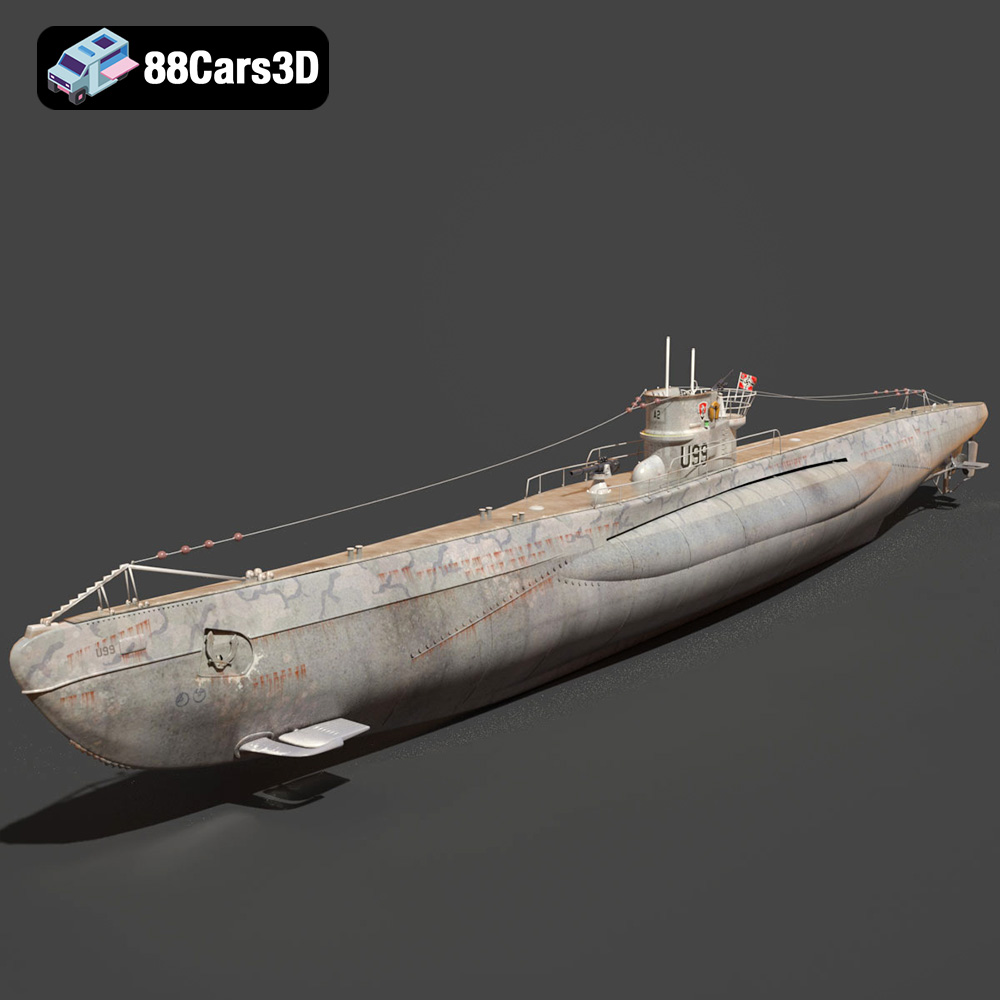
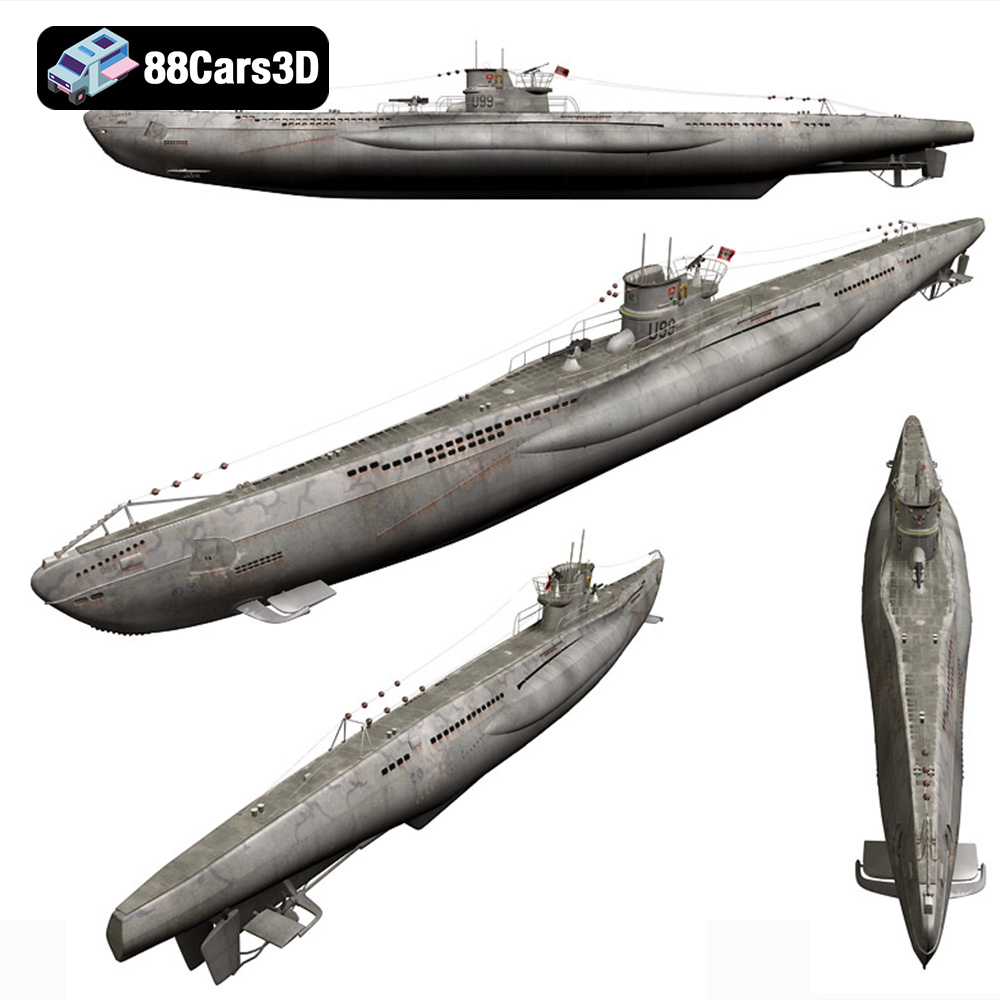
The U-99 model exemplifies this process, capturing the authentic scale and design of the historic naval vessel. Details like the shape of the conning tower, the specific deck cannon used, and the precise angles of the hydroplanes are not arbitrary; they are the result of careful study and faithful reproduction. This level of dedication ensures that the model serves as a reliable visual source, suitable for everything from serious historical documentaries to detailed simulations where every component must ring true.
Translating Detail to Digital Geometry
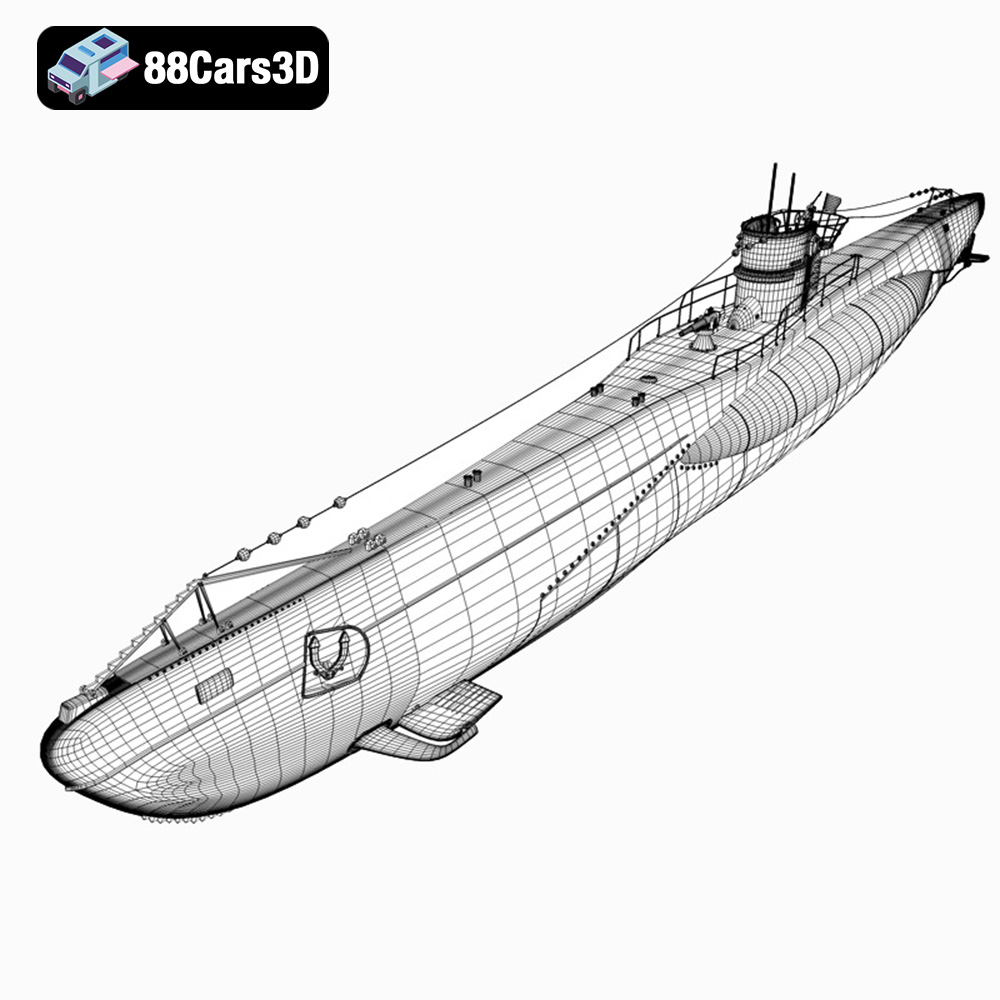
Translating historical research into 3D geometry is an art in itself. It involves a delicate balance of capturing complex shapes and intricate mechanical parts while maintaining clean, optimized topology. For a submarine, this means accurately modeling the distinct hull contours, the complex array of valves and pipes, and the various external fixtures that define its unique silhouette. The U-99 model boasts geometry that is described as “clean and optimized for performance across various platforms while maintaining intricate details.” This is crucial because a historically accurate model must also be functional and performant within diverse digital environments.
Clean geometry implies a well-structured mesh without unnecessary vertices or messy triangulation, which is essential for smooth deformations, efficient UV mapping, and trouble-free integration into game engines or rendering pipelines. Intricate details, such as the periscope mechanisms, the railings on the conning tower, and the distinct torpedo tube covers, must be modeled with precision, not just faked with textures. This approach ensures that the model holds up under close-up renders, allowing viewers to appreciate the granular authenticity of the design.
Optimizing 3D Models for Performance and Fidelity
In the professional 3D world, a model’s aesthetic appeal is only half the story. Its technical integrity and optimization are equally, if not more, important. A stunning model that cripples a game engine or takes hours to render is of limited utility. This is where expertise in balancing visual fidelity with performance comes into play, a core competency reflected in the German U-Boat U-99 Submarine 3D model.
Balancing Polycount and Visual Detail
Polycount, or the number of polygons that make up a 3D model, is a direct indicator of its geometric complexity. While higher polycounts can lead to greater detail, they also demand more computational resources. The challenge, especially for game assets or real-time AR/VR experiences, is to achieve maximum visual detail with the lowest possible polycount. This is typically accomplished through efficient modeling techniques, such as using subdivision surfaces for smooth objects that can be converted to optimized polygonal meshes, or baking high-detail normal maps from high-poly sculpts onto low-poly meshes.
The U-99 model’s description highlights “clean and optimized geometry,” which implies careful attention to this balance. It means the model retains its intricate features—like the deck gun’s mechanics or the hull plating—without being excessively heavy on polygons. This optimization ensures that whether you’re integrating it into a fast-paced military simulation or a detailed cinematic render, the model will perform efficiently without sacrificing visual fidelity.
Advanced Texturing for Realism
Beyond geometry, textures play a monumental role in bringing a 3D model to life. Realistic materials and textures are what give a model its weathered appearance, the metallic sheen of its components, and the subtle variations that tell its story. Modern 3D pipelines heavily rely on Physically Based Rendering (PBR) workflows, which use maps like Albedo (color), Normal (surface detail), Roughness (specularity), Metallic (metalness), and Ambient Occlusion (contact shadows) to accurately simulate how light interacts with surfaces.
The U-99 model features “realistic materials and professionally created textures” that “ensure accurate representation of the weathered hull and mechanical components.” This implies a PBR-compliant texture set that meticulously recreates the look of steel, rust, paint, and grime appropriate for a submarine operating in the North Atlantic in 1940. Such textures are not merely decorative; they are engineered to react correctly to various lighting conditions, making the model appear authentic whether it’s under the harsh glare of a spotlight or the dim ambient light of a historical scene.
Efficient UV Layout for Diverse Workflows
UV mapping is the process of flattening a 3D model’s surface into 2D space, allowing textures to be applied. An efficient and clean UV layout is crucial for several reasons: it prevents texture stretching, optimizes texture memory usage, and makes texturing a more manageable process. For a complex asset like a submarine, a well-thought-out UV strategy might involve multiple UV sets or channels for different parts, ensuring optimal resolution for close-ups and reducing redundancy.
A professional-grade model, like those found on 88cars3d.com, will feature an intelligent UV layout. This facilitates seamless integration for tasks such as baking ambient occlusion, creating custom decals, or even re-texturing the model for different artistic styles or damage states. Proper UVs are often an unseen hero, ensuring the “professionally created textures” mentioned for the U-99 model can be applied effectively across its intricate surfaces without visual artifacts.
Integrating Complex Assets into Professional Pipelines
The true measure of a high-quality 3D model lies in its ease of integration into various professional software and game engines. For developers, artists, and visualization specialists, the ability to quickly and reliably drop an asset like the German U-Boat U-99 into an existing pipeline is invaluable. This section explores how such a model fits into leading industry workflows, particularly within Unreal Engine, Blender, and 3ds Max.
Unreal Engine for Immersive Simulations and Games
Unreal Engine is a powerhouse for creating real-time 3D content, from AAA games to architectural visualizations and virtual production. For game developers working on military simulations or historical titles, the U-99 model is an ideal asset. Its provision in .fbx and specifically .unreal formats streamlines the integration process significantly. The .fbx file, with its embedded material and texture references, imports smoothly, allowing developers to set up PBR materials within Unreal’s robust material editor. The .unreal package, however, takes this a step further, often providing a pre-configured asset that might include collision meshes, LODs (Levels of Detail) for performance scaling, and ready-to-use materials, drastically cutting down development time.
Imagine building a World War II naval battle scene or an interactive submarine tour. With the U-99 model, developers can focus on gameplay mechanics, environment design, and narrative, rather than spending precious hours on asset optimization and setup. The clean geometry and optimized textures ensure stable performance, even in complex scenes, making it a reliable choice for demanding real-time environments. Such high-fidelity game assets are essential for delivering truly immersive experiences.
Blender for Creative Freedom and Open-Source Power
Blender has emerged as a formidable contender in the 3D industry, prized for its comprehensive features and open-source accessibility. For artists who prefer its non-destructive workflows and powerful Cycles or Eevee renderers, the U-99 model’s .blend file is a goldmine. This file typically includes the full Blender scene: the model, its materials, textures, and often a basic lighting setup. This allows for immediate rendering, animation, or further customization. Artists can easily modify the model, experiment with different lighting scenarios, or integrate it into larger scenes.
The editable nature of the .blend file empowers creative professionals to adapt the U-Boat for unique storytelling needs. Perhaps a specific animation sequence requires custom rigging or a specialized shader for underwater effects. Having the native file provides the flexibility to achieve these bespoke requirements without cumbersome format conversions or loss of data, making it a versatile tool for independent creators and studios alike.
3ds Max for High-End Visualization and Animation
Autodesk 3ds Max remains an industry standard, particularly in architectural visualization, product design, and high-fidelity rendering for film and television. The inclusion of a .max file for the U-99 model caters directly to this professional demographic. A native 3ds Max project file allows for complete control over the model, enabling users to leverage Max’s powerful modeling tools, modifier stack, and advanced rendering capabilities (often with V-Ray or Corona Renderer).
For cinematics or detailed visualizations, the .max file provides the foundation for creating stunning, photorealistic renders. Artists can fine-tune every aspect, from the exact reflectivity of the weathered hull to the intricate play of light and shadow on the deck cannon. If you’re creating a historically accurate documentary segment or a high-resolution still image for print, the editable .max file ensures that the U-99 model can be pushed to its absolute visual limit, achieving the highest quality automotive rendering and other vehicle-based projects demand.
Beyond Visualization: The Multifaceted Applications of High-Quality 3D Models
The utility of a meticulously crafted 3D model like the German U-Boat U-99 extends far beyond traditional rendering. Its diverse file formats and inherent detail unlock a wide array of innovative applications, from interactive experiences to physical manufacturing, truly highlighting the versatile nature of professional-grade 3D assets.
AR/VR and Web-Based Experiences with .glb
Augmented Reality (AR) and Virtual Reality (VR) are transforming how we interact with digital content, offering immersive ways to explore historical subjects. The U-99 model, provided in the optimized .glb format, is perfectly suited for these cutting-edge applications. Imagine a museum exhibit where visitors can view a life-sized U-Boat U-99 superimposed onto the real world via a tablet (AR), or a fully interactive VR simulation allowing users to walk the deck and explore the conning tower of the submarine. The .glb format’s efficiency and comprehensive PBR material support make it ideal for delivering high-quality visuals within the performance constraints of real-time AR/VR environments and web browsers. This facilitates easy integration into web-based configurators, educational platforms, or even social media filters, making historical content accessible and engaging to a broader audience.
3D Printing and Prototyping with .stl and .ply
The journey from screen to tangible object is made possible by 3D printing, and the U-99 model’s inclusion of .stl and .ply formats caters precisely to this. The .stl file is the industry standard for 3D printing, enabling users to create physical replicas of the submarine. Whether it’s a small-scale model for a desktop display, a component for a larger diorama, or a prototype for a historical accuracy test, the .stl format ensures geometric integrity for additive manufacturing. The .ply format, with its ability to store precision mesh data, could be used for more analytical prototyping or for models requiring specific vertex attributes, though .stl remains the most common for direct printing.
This capability opens doors for hobbyists, educators, and even prop designers. A historically accurate 3D printable model of the U-99 could become a valuable resource for creating physical educational aids, highly detailed collectible models, or even components for film props, adding another dimension to its utility.
Educational and Cinematic Storytelling
High-fidelity 3D models are invaluable tools for education and cinematic production. For educational visualization projects, a model like the U-99 can provide an unparalleled level of detail for explaining naval history, submarine mechanics, or World War II events. Interactive lessons, animated sequences, or even virtual field trips can be built around such an accurate asset, making complex subjects more engaging and understandable for students of all ages.
In cinematic sequences, the U-99 model offers filmmakers and visual effects artists a ready-to-use, historically accurate asset for period dramas, documentaries, or fictional narratives set during WWII. The “exceptional visual fidelity suitable for close-up renders” means it can withstand the scrutiny of a large screen. With the included .max or .blend files, artists have the flexibility to animate the submarine, customize its appearance for specific scenes (e.g., battle damage, night operations), and integrate it seamlessly into live-action footage, raising the bar for visual storytelling. The robust nature of these 3D car models, or in this case, naval vessels, provides a solid foundation for creative exploration.
Conclusion
In the dynamic world of 3D modeling, the confluence of historical accuracy, technical optimization, and versatile compatibility defines true value. The German U-Boat U-99 Submarine 1940 3D Model exemplifies these qualities, offering an unparalleled asset for a broad spectrum of professional applications. From the meticulous research that underpins its authentic design to the expertly optimized geometry and PBR textures, every aspect of this model speaks to a commitment to excellence.
The comprehensive range of provided file formats—from editable native files like .blend and .max to game-engine ready .fbx and .unreal, and specialized formats like .glb for AR/VR and .stl for 3D printing—ensures that this U-Boat model is not just a visual masterpiece but a highly practical tool. It seamlessly integrates into diverse workflows, empowering game developers, historical researchers, filmmakers, and AR/VR creators to bring their visions to life with speed and precision. This commitment to quality is what sets professional 3D car models and other vehicle assets, like this historical submarine, apart on platforms like 88cars3d.com.
Whether your project demands a historically accurate centerpiece for an immersive game, a detailed visual aid for an educational program, or a stunning element for a cinematic render, the German U-Boat U-99 Submarine 1940 3D Model delivers. It’s more than just a model; it’s a meticulously preserved piece of history, ready to be deployed in your next groundbreaking 3D endeavor.
Featured 3D Model
German U-Boat U-99 Submarine 1940 3D Model
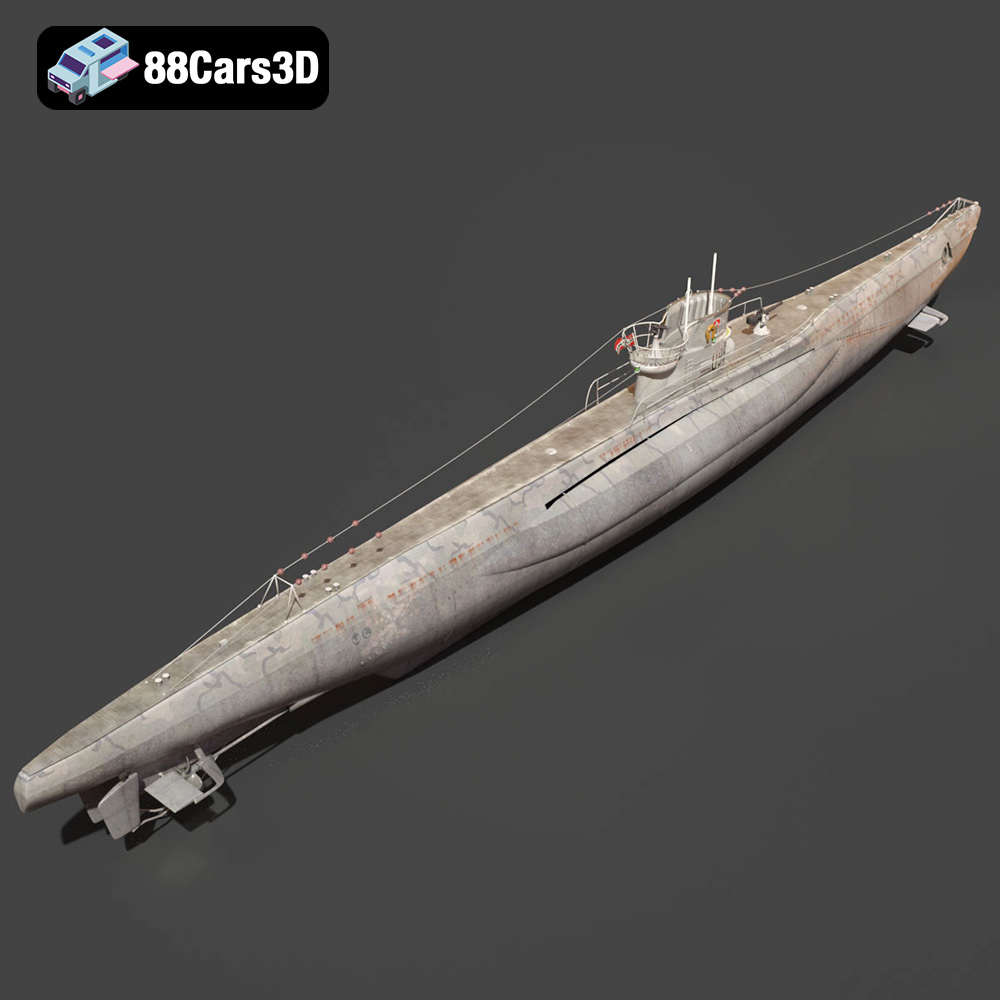
Introducing the meticulously crafted 3D model of the German WWII Type VIIB U-Boat U-99, known for its pivotal role in naval warfare. This asset captures the authentic scale and detailed design of the historic naval vessel, providing exceptional visual fidelity suitable for close-up renders and detailed virtual environments. The geometry is clean and optimized for performance across various platforms while maintaining intricate details, including the conning tower, deck cannon, and hydroplanes. Realistic materials and professionally created textures ensure accurate representation of the weathered hull and mechanical components. This asset is built to professional standards for reliability and ease of integration. This detailed asset is ideal for historical simulations, military game development, educational visualization projects, cinematic sequences, and immersive AR/VR experiences focused on World War II themes or maritime history.
$10
Product Image Gallery