Unleashing Visual Excellence: The Power of High-Fidelity 3D Car Models in Modern Design
In the dynamic realm of digital design, the demand for unparalleled realism continues to drive innovation across industries. From blockbuster game titles and cinematic automotive commercials to immersive architectural visualizations and cutting-edge AR/VR experiences, the quality of 3D assets is paramount. A meticulously crafted 3D model isn’t just an object; it’s a foundation for creative expression, a tool for precise simulation, and a key differentiator in a crowded visual landscape.
Today, we delve into the intricate world of high-quality 3D car models, exploring their technical nuances, diverse applications, and the profound impact they have on professional workflows. At the heart of this discussion is an exemplary asset that embodies these principles: the Chevrolet Corvette Stingray 2023 3D Model. This model is engineered for precision, capturing the dynamic styling and aggressive stance of the iconic sports car, making it perfect for close-up renders and simulations. Its professional-grade design, featuring optimized topology and realistic PBR materials, positions it as an essential resource for AAA game development, architectural visualization (ArchViz), and high-fidelity CGI rendering. As we explore the facets of superior 3D asset creation, we’ll see how such models elevate projects from concept to breathtaking reality.
The Art and Engineering of High-Fidelity 3D Car Models
Creating a compelling 3D car model is a sophisticated blend of artistic vision and engineering precision. It goes far beyond simply replicating shapes; it involves understanding automotive design language, material science, and the technical requirements of various digital platforms. A truly high-fidelity model is built from the ground up to serve multiple purposes, from static beauty shots to dynamic interactive simulations.
Beyond Aesthetics: The Role of Precision in Automotive Visualization
For automotive designers, marketing agencies, and visualization studios, precision is not a luxury, but a necessity. A model like the Chevrolet Corvette Stingray 2023 3D Model must accurately reflect every curve, every panel gap, and every design element of its real-world counterpart. This level of detail allows designers to perform virtual design reviews, test out new color schemes, or integrate the vehicle into marketing materials with absolute confidence. The model’s ability to render flawlessly in various lighting conditions and environments is crucial for conveying the car’s intended aesthetic and performance characteristics.
The Foundation: Mesh Topology and Polycount Considerations
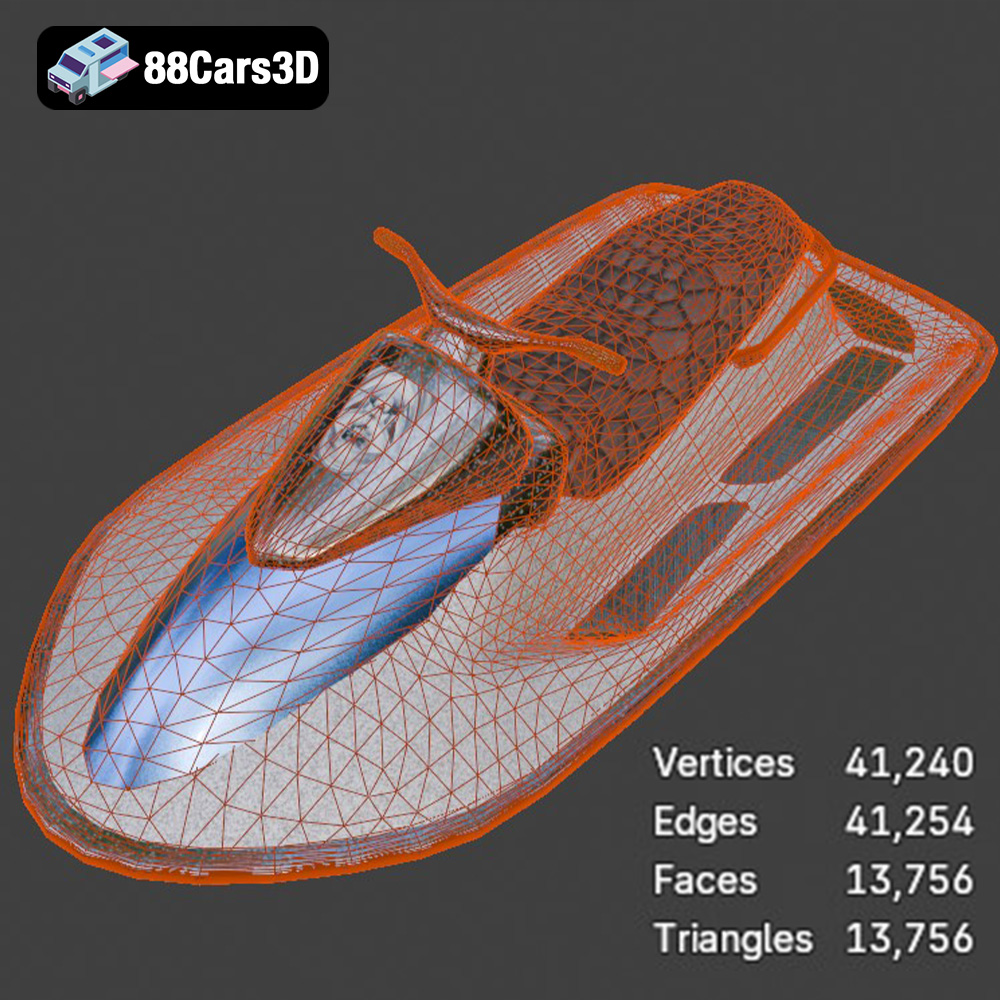
Underneath the stunning visual surface lies the intricate mesh topology, the blueprint of the 3D model. Optimized topology is critical for several reasons: it ensures clean deformations during animation, facilitates efficient UV mapping for texturing, and most importantly, dictates performance in real-time applications like game engines. A “meticulously optimized topology,” as described for the Chevrolet Corvette Stingray 2023 3D Model, means that the polygon count is balanced – high enough to capture intricate details without being overly dense, which could bog down rendering or real-time performance. This balance ensures smooth shading, reduces rendering artifacts, and allows for effective subdivision modeling if further detail is required.
PBR Materials: Bringing Realism to Surfaces
Physical Based Rendering (PBR) materials are the cornerstone of modern photorealistic rendering. Unlike older rendering techniques, PBR materials simulate how light interacts with surfaces in the real world, accounting for properties like albedo (base color), roughness, metallicness, and normal maps. The inclusion of “realistic PBR materials” in the Corvette Stingray model means that its paintwork, chrome accents, glass, and interior textures will respond accurately to light, producing stunning reflections, refractions, and diffuse shading. This delivers “stunning visual results straight out of the box,” significantly reducing post-processing time and enhancing visual fidelity across diverse rendering engines.
Understanding 3D Model File Formats
The choice of a 3D model file format is paramount, dictated by the intended use, target software, and desired level of interoperability. A versatile asset, like the Chevrolet Corvette Stingray 2023 3D Model available on 88cars3d.com, provides a wide array of formats, each serving a specific purpose in the professional pipeline.
Native and Universal Formats for General Use
- .blend – Fully editable Blender scene with materials: Blender is a powerful open-source 3D creation suite, popular among individual artists and studios alike. The .blend file format provides a complete scene, including the model’s geometry, textures, materials, lighting setup, and even animation data. This format is ideal for users working natively in Blender, offering maximum editability and the ability to dissect and modify every aspect of the asset. It’s perfect for those who want to integrate the Corvette into a complex Blender project and customize it extensively.
- .max – Editable 3ds Max project for animation and rendering: Autodesk 3ds Max is an industry standard for architectural visualization, animation, and game development. The .max format encapsulates the entire 3ds Max scene, preserving hierarchies, modifiers, materials, and lighting. Professionals utilizing 3ds Max for high-end rendering with V-Ray or Corona, or for complex animations, will find this format invaluable. It allows for full control over the model within its native environment, ensuring compatibility with established studio pipelines.
- .obj – Universal format for cross-software compatibility: The Wavefront .obj format is one of the most widely supported 3D file formats, making it a true universal standard. It primarily stores geometric data (vertices, normals, texture coordinates) and references to external material files (.mtl). While it doesn’t store advanced PBR material data or animations, its simplicity ensures maximum compatibility across virtually all 3D software packages, from ZBrush to Maya to Substance Painter. It’s a reliable choice for importing raw mesh data for retopology, sculpting, or re-texturing in a different program.
Game Engine Optimization and Real-Time Assets
- .fbx – Ideal for Unreal, Unity, and real-time pipelines: The Filmbox (.fbx) format is an industry-standard proprietary format developed by Autodesk, widely used for exchanging 3D data between various applications, especially in game development. It can store not only geometry but also materials, textures, animations, skinning, and camera data, making it incredibly versatile. For importing the Chevrolet Corvette Stingray into game engines like Unreal Engine or Unity, .fbx is often the go-to choice due to its robust support for skeletal animations and complex scenes, ensuring efficient transfer of production-ready assets.
- .unreal – Engine-ready asset for real-time environments: This specific format often refers to a pre-packaged asset or project file designed directly for Unreal Engine. It means the model, its materials, textures, and possibly LODs (Levels of Detail) have already been configured and optimized within the Unreal Engine environment. This drastically reduces setup time for developers, allowing them to drag and drop the Corvette directly into their scenes with minimal fuss, ensuring it functions optimally within Unreal’s rendering pipeline.
Specialized Formats for AR/VR, Web, and Manufacturing
- .glb – Optimized for AR, VR, and browser-based display: The GL Transmission Format Binary (.glb) is a compact, single-file version of glTF, specifically designed for efficient transmission and loading of 3D scenes and models by engines and applications. It’s the standard for 3D content on the web and in AR/VR experiences due to its small file size, PBR material support, and ability to embed textures. For interactive web configurators or mobile AR apps featuring the Corvette, the .glb format offers superior performance and integration.
- .stl – Suitable for 3D printing output: Stereolithography (.stl) is a widely recognized file format for 3D printing. It represents a 3D model as a series of connected triangles, defining only the surface geometry without color or texture information. While the Chevrolet Corvette is a high-detail render model, providing an .stl allows for physical prototyping or creating miniature replicas, showcasing the vehicle’s form factor in a tangible way. Users can refine the mesh for printability, ensuring a watertight and manifold surface.
- .ply – Precision mesh format for CAD or analysis: The Polygon File Format (.ply) is a flexible format for storing 3D data from 3D scanners, CAD software, and other sources. It can store a wide range of properties, including color, transparency, and often more precise vertex data compared to .obj. It’s often used in applications requiring accurate geometric analysis, reverse engineering, or when exporting from specialized scanning equipment. For the Corvette model, it offers another avenue for precision-focused applications or cross-platform data exchange where exact geometric integrity is critical.
Driving Innovation: Applications of the Corvette Stingray 3D Model
The versatility of a high-quality 3D car model like the Chevrolet Corvette Stingray 2023 extends across numerous professional applications, empowering artists and developers to achieve stunning results and innovative experiences.
Elevating Automotive Rendering and Marketing
In the fiercely competitive automotive industry, visual appeal is everything. Professional 3D car models are indispensable for creating marketing materials, concept art, and high-impact advertisements. The Corvette Stingray model, with its accurate reflections and surface fidelity, allows studios to produce photorealistic images and cinematic animations that are indistinguishable from real-world photography. This is crucial for pre-release campaigns, configurators, and showcasing new features without the cost and logistical challenges of physical prototypes or elaborate photoshoots.
Powering Immersive Game Development
The gaming industry demands incredibly detailed yet highly optimized assets. For AAA titles, the Chevrolet Corvette Stingray 2023 3D Model provides a perfect balance. Its “game-engine ready format for Unreal Engine and Unity” signifies that it’s prepared for real-time environments, featuring optimized poly counts, properly UV-mapped textures, and potentially LODs for performance scalability. From racing simulators to open-world adventures, this model can serve as a primary vehicle, a background prop, or even a customizable asset, enriching the player’s visual experience and immersion.
ArchViz and Beyond: Contextualizing Modern Design
Architectural Visualization (ArchViz) studios often require realistic vehicles to populate their scenes, adding life and scale to proposed buildings and urban environments. Placing a highly detailed vehicle like the Corvette Stingray 2023 in front of a modern home or within an urban streetscape instantly enhances realism and helps clients envision the space. Beyond traditional ArchViz, this model can be integrated into urban planning simulations, traffic flow analyses, or even virtual showrooms for other luxury products, providing a familiar and aspirational element.
Future-Proofing with AR/VR and Simulation
Augmented Reality (AR) and Virtual Reality (VR) are transforming how we interact with digital content. Optimized models like the Corvette Stingray are critical for creating convincing AR/VR experiences, whether it’s a virtual test drive, a design review in a VR headset, or an AR app that lets users “place” the car in their driveway. The model’s readiness for “immersive augmented reality (AR) and virtual reality (VR) environments” ensures smooth performance and visual fidelity in these demanding real-time applications. Furthermore, for detailed vehicle simulations, such a model provides the geometric accuracy needed for physics calculations, crash testing visualizations, or driver training modules.
Integrating the Corvette Model into Professional Workflows
Seamless integration into existing professional pipelines is a hallmark of a truly valuable 3D asset. The Chevrolet Corvette Stingray 2023 3D Model, with its comprehensive suite of file formats, is designed to fit effortlessly into various industry-standard workflows.
Workflow in Blender: Artistic Freedom and Production Efficiency
For Blender artists, the included .blend file provides a native starting point. Users can open the file and find the model, its PBR materials, and potentially a lighting setup already configured. This allows for immediate rendering or further customization. Artists can quickly integrate the Corvette into their own scenes, apply custom animations, or modify specific parts using Blender’s powerful modeling tools. The clean topology also makes it easy to add subdivision surfaces for even higher detail renders without introducing artifacts.
Mastering 3ds Max: Animation, V-Ray, and Advanced Rendering
3ds Max users benefit from the dedicated .max file, which ensures complete compatibility with their software ecosystem. This is particularly advantageous for studios leveraging 3ds Max for complex animations, product visualizations, or architectural flythroughs with renderers like V-Ray or Corona. The native file format preserves all scene data, including hierarchies, materials, and potential studio-specific setups. Artists can quickly light the scene, apply advanced rendering techniques like caustics or depth of field, and integrate the Corvette into large-scale projects with minimal friction.
Unreal Engine Integration: Real-Time Performance and Cinematic Quality
Game developers and real-time visualization artists relying on Unreal Engine will find the .fbx and .unreal formats invaluable. The .fbx file allows for a straightforward import process, where Unreal Engine automatically recognizes mesh data, materials, and textures. For even faster integration, the .unreal file often means the asset is already set up as an Unreal Engine project or content package, with materials instances, texture maps, and possibly LODs correctly configured. This “engine-ready” state dramatically reduces the time spent on asset preparation, allowing developers to focus on scene building, gameplay, or interactive elements, while ensuring the Corvette performs optimally in real-time environments or cinematic sequences.
Streamlining Asset Management for Large Projects
In large-scale productions, efficient asset management is critical. Providing multiple, well-prepared file formats ensures that the Chevrolet Corvette Stingray 2023 3D Model can be easily integrated into different departments and pipelines without extensive conversion or re-setup. This multi-format approach minimizes compatibility issues, reduces overhead, and allows teams to work concurrently on various aspects of a project, from animation to final rendering, all while relying on a consistent, high-quality base model.
Technical Deep Dive: What Makes a Premium 3D Car Model?
Beyond the immediate visual appeal, the true value of a premium 3D car model lies in its underlying technical craftsmanship. These details are what allow the model to perform reliably and efficiently across diverse applications.
Unwrapping Excellence: UV Mapping and Texture Resolution
Effective UV mapping is the invisible backbone of realistic texturing. It’s the process of flattening the 3D model’s surface onto a 2D plane so that 2D textures can be applied without distortion. A premium model like the Corvette Stingray will feature “meticulously optimized topology,” which directly aids in clean UV unwrapping. This ensures that PBR texture maps (albedo, normal, roughness, metallic) wrap seamlessly around the complex curves of the vehicle, avoiding stretched or distorted patterns. High-resolution textures, properly applied through well-organized UV sets, are crucial for detailed close-ups, allowing every scratch, decal, or material imperfection to be rendered with precision.
The Importance of Clean Geometry and Edge Flow
Clean geometry and proper edge flow are fundamental to a robust 3D model. “Clean geometry” refers to a mesh free of ngons (polygons with more than four sides), non-manifold edges, and other topological errors that can cause rendering issues or problems during deformation. “Edge flow” refers to the direction and continuity of edges, which should follow the natural contours and creases of the object. For the Corvette Stingray 2023 3D Model, this means that even complex areas like air intakes, fender flares, or headlight bezels will have smoothly flowing edges, allowing for excellent subdivision, realistic reflections, and trouble-free animation if required. This attention to detail prevents pinching, unwanted hard edges, and ensures consistent surface quality.
Scalability and Optimization for Diverse Platforms
A truly professional-grade asset is designed with scalability in mind. While the Chevrolet Corvette Stingray 2023 3D Model is described as “highly detailed,” its “optimized topology” also implies that it can be adapted for various performance tiers. This might involve providing multiple Levels of Detail (LODs) – lower polygon versions of the model that automatically swap in at a distance to save processing power in games or real-time applications. Similarly, the careful balancing of polygon count ensures that the base model can be used for high-end cinematic renders, while also being suitable for mobile AR experiences with minor adjustments or decimation. This flexibility ensures the model’s longevity and utility across a broad spectrum of projects.
The Competitive Edge: Sourcing Quality 3D Assets from 88cars3d.com
In today’s fast-paced digital production environment, time is a precious commodity. Creating a truly high-fidelity 3D car model from scratch is a massive undertaking, requiring specialized skills, significant time investment, and access to extensive reference materials. This is where marketplaces like 88cars3d.com provide an undeniable advantage.
Time vs. Quality: The Build-or-Buy Decision
For many studios and individual artists, the decision to “build or buy” a 3D asset often comes down to balancing project deadlines with quality expectations. Sourcing a pre-made, professional-grade model like the Chevrolet Corvette Stingray 2023 from 88cars3d.com allows teams to immediately integrate a stunning asset into their pipeline, bypassing the weeks or even months it would take to model, unwrap, texture, and optimize it from the ground up. This accelerates production cycles, reduces labor costs, and frees up internal artists to focus on unique, proprietary content.
Ensuring Production-Ready Assets for Every Project
The guarantee of “professional-grade” quality is a significant benefit. When purchasing assets from a reputable marketplace, creators can expect models that are not only visually impressive but also technically sound. This means clean topology, optimized UVs, correctly configured PBR materials, and a variety of useful file formats. The Chevrolet Corvette Stingray 2023 3D Model exemplifies this, offering comprehensive file formats like .blend, .fbx, .obj, .glb, .stl, .ply, .unreal, and .max, ensuring it’s “an essential resource for a wide range of applications.” This breadth of compatibility and inherent quality minimizes post-purchase adjustments, ensuring that the asset is truly “production-ready” from the moment it’s downloaded, delivering consistent, stunning results across all platforms.
Conclusion
The journey from concept to a visually striking digital reality relies heavily on the quality of underlying 3D assets. As we’ve explored, high-fidelity 3D car models are much more than just pretty pictures; they are complex technical marvels built on optimized topology, realistic PBR materials, and meticulous attention to detail. These assets fuel the automotive industry’s marketing efforts, power immersive game worlds, enhance architectural visualizations, and lay the groundwork for cutting-edge AR/VR experiences and simulations.
The Chevrolet Corvette Stingray 2023 3D Model stands as a prime example of such an asset, embodying the precision and versatility required by modern creative professionals. Its comprehensive file format support ensures seamless integration into diverse workflows, from Blender and 3ds Max to Unreal Engine, allowing artists and developers to focus on creativity rather than compatibility issues. By choosing such expertly crafted 3D car models, designers can significantly elevate their projects, achieve unparalleled realism, and accelerate their production timelines.
For those seeking to infuse their projects with this level of visual excellence and technical reliability, 88cars3d.com offers a curated selection of premium 3D car models, providing the production-ready assets needed to turn ambitious visions into breathtaking realities.
Featured 3D Model
Chevrolet Corvette Stingray 2023 3D Model
Bring unparalleled realism to your projects with the highly detailed Chevrolet Corvette Stingray 2023 3D Model. Engineered for precision, this model captures the dynamic styling and aggressive stance of the iconic sports car, making it perfect for close-up renders and simulations. This professional-grade asset features meticulously optimized topology, ensuring clean geometry and efficient rendering performance across all major platforms. Every detail, from the body panel gaps to the wheel rims and lighting systems, has been accurately modeled. Realistic PBR materials provide accurate reflections and surface fidelity, delivering stunning visual results straight out of the box. The Chevrolet Corvette Stingray 2023 3D Model is an essential resource for a wide range of applications, including AAA game development, architectural visualization (ArchViz), high-fidelity CGI rendering, immersive augmented reality (AR) and virtual reality (VR) environments, and detailed vehicle simulations.
$10
Product Image Gallery