Mastering Automotive 3D: Unlocking Project Potential with Premium 3D Car Models
In the fast-paced world of digital creation, where realism and efficiency are paramount, the demand for high-quality 3D car models has never been greater. Whether you’re an automotive designer visualizing a new concept, a game developer crafting immersive open worlds, an architect populating a scene, or a marketing agency producing a stunning commercial, the foundational asset is often a meticulously crafted vehicle model. These assets serve as the backbone for everything from photorealistic renders to interactive real-time experiences.
The journey from concept to a polished final product is intricate, requiring precision, technical expertise, and an understanding of diverse software environments. A truly exceptional 3D model isn’t just about aesthetics; it’s about clean topology, accurate scale, efficient UVs, and seamless integration into various pipelines. This detailed consideration is precisely what empowers professionals to push creative boundaries without being bogged down by foundational asset creation.
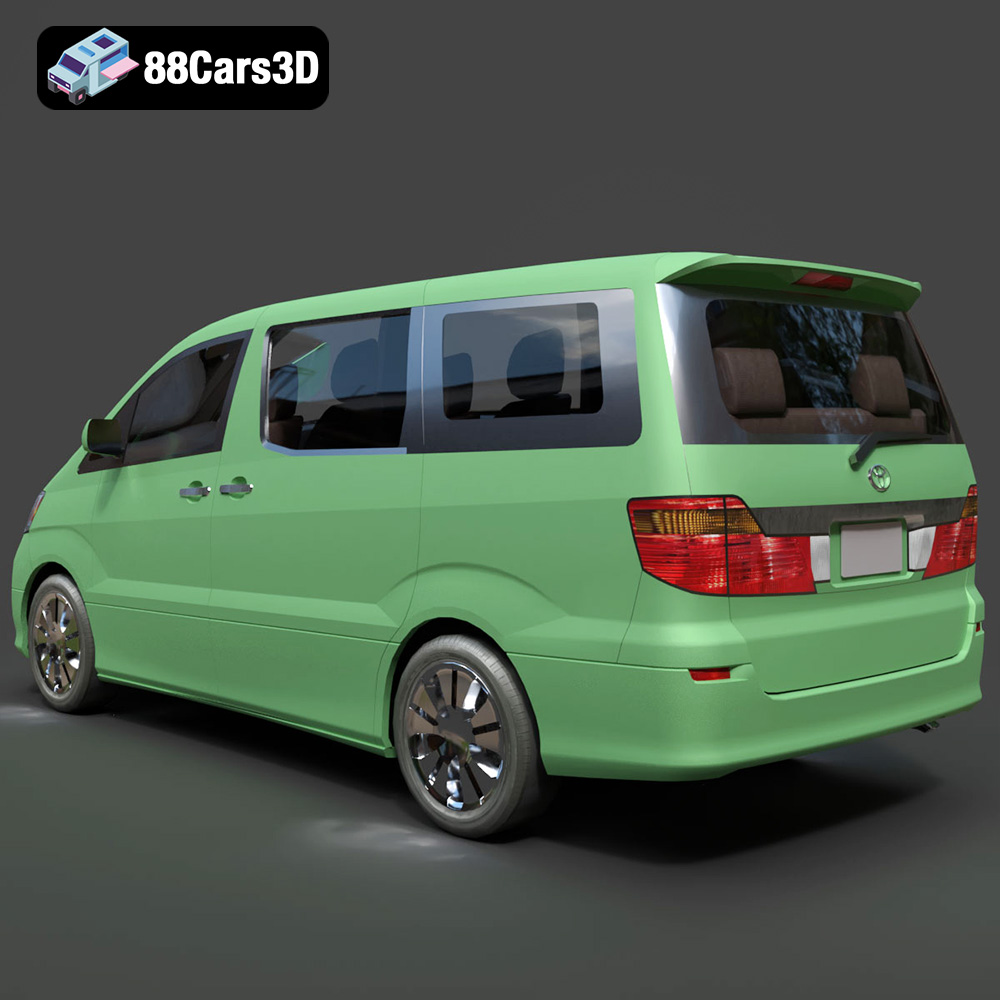
Today, we’re diving deep into the technical prowess and versatility that a premium asset brings to the table, using the Toyota Alphard 3D Model as our prime example. This digital recreation of the iconic luxury minivan, known for its opulent design and commanding road presence, exemplifies the kind of asset that can elevate any project. From its accurately modeled body panels to its comprehensive interior detailing, this model, like many others found on 88cars3d.com, is engineered for optimal performance across a spectrum of professional applications.
The Art and Engineering of High-Fidelity 3D Car Models
Creating a high-fidelity 3D car model is a blend of artistic vision and rigorous technical execution. It goes far beyond simply mimicking a vehicle’s exterior; it involves a deep understanding of geometry, materials, and how these elements interact within a digital environment. The goal is not just a visually appealing model, but one that is also robust, flexible, and ready for any professional challenge.
Precision in Automotive Design Translation
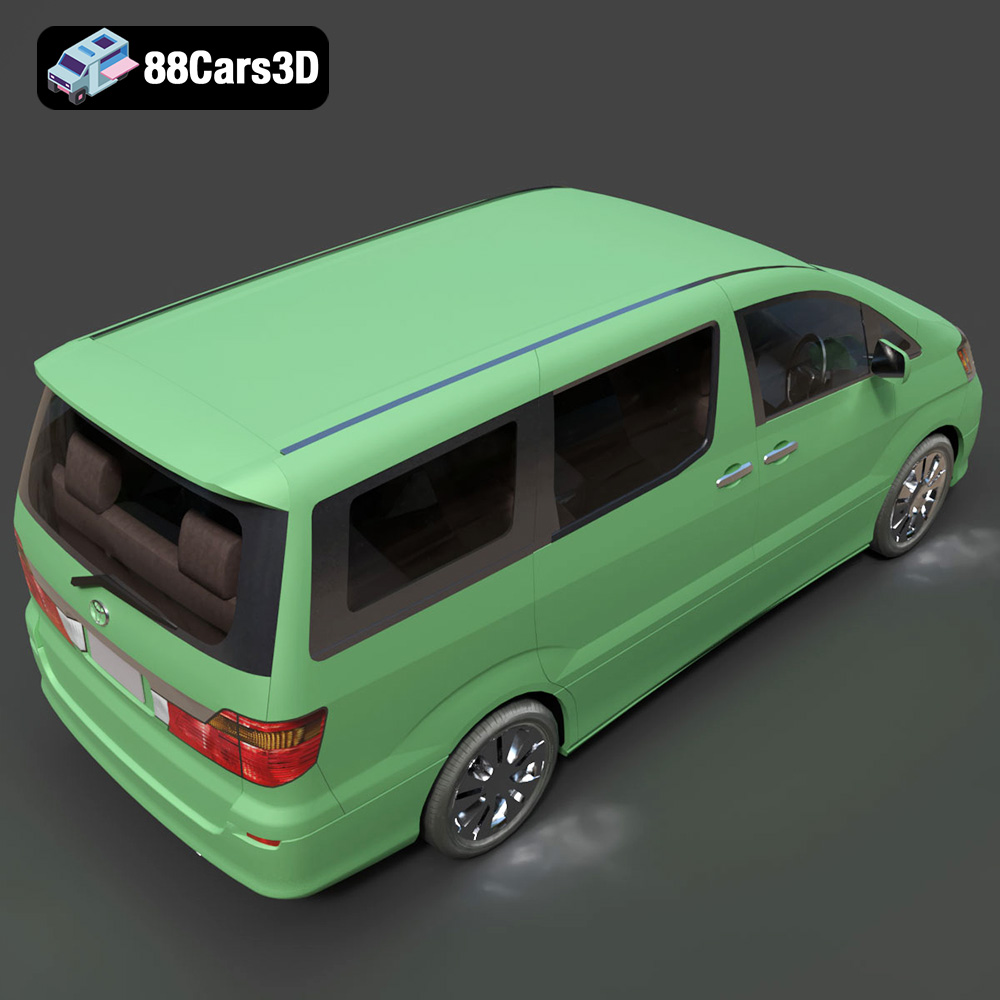
Accuracy is the cornerstone of any professional-grade 3D car model. For the Toyota Alphard 3D Model, this translates to accurately modeled body panels that reflect the vehicle’s signature styling. Every curve, crease, and panel gap is meticulously recreated to capture the Alphard’s distinctive aesthetic. Detailed headlights and taillights with transparent materials are crucial for realistic illumination effects, while precisely crafted wheels and tires enhance the vehicle’s authentic appearance. Furthermore, functional elements like separated doors, a hood, and a trunk are not merely visual details; they are essential for facilitating effortless animation workflows, allowing artists to create dynamic scenes with ease.
Beyond the exterior, the interior is equally critical, especially for a luxury minivan like the Alphard. Comprehensive interior detailing, including the dashboard, steering wheel, seats, and central console, provides the necessary fidelity for close-up renders and immersive experiences. Realistic window glass with appropriate transparency ensures that the interior is visible and interacts correctly with scene lighting, adding another layer of realism.
The Importance of Clean Topology and Real-World Scale
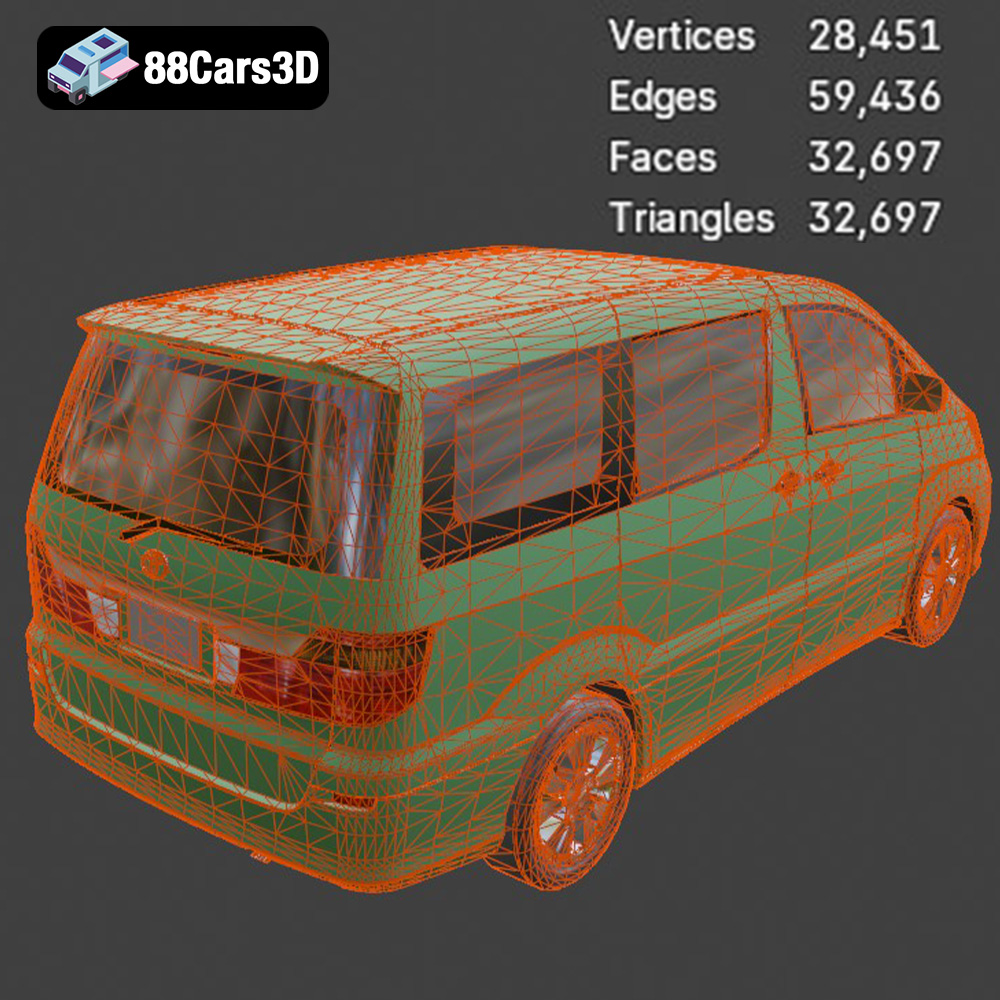
Underneath the stunning visuals lies the geometry, and its quality dictates a model’s performance and versatility. The Toyota Alphard 3D Model boasts clean, quad-dominant topology, which is paramount for smooth subdivision and distortion-free deformation. This technical characteristic ensures that when the model is manipulated, animated, or rendered at different detail levels, it maintains its structural integrity without unsightly artifacts. Furthermore, being modeled to real-world scale is non-negotiable for accurate integration into any scene or project, whether it’s an architectural visualization, a cinematic sequence, or a game environment. It ensures that the vehicle maintains its correct proportions relative to other objects in the scene, eliminating tedious adjustments and ensuring visual credibility. Logically organized hierarchy with properly set pivots is another crucial technical advantage, facilitating effortless animation and manipulation across different 3D software platforms.
Understanding 3D Model File Formats
The choice of file format for a 3D model is not merely a technicality; it’s a strategic decision that dictates compatibility, performance, and the scope of a project. Each format is optimized for specific workflows and software ecosystems, making a multi-format asset like the Toyota Alphard 3D Model incredibly versatile. Understanding these distinctions is crucial for maximizing efficiency and achieving desired outcomes in professional 3D pipelines.
The Versatility of .blend and .max for Studio Work
.blend (Blender project with materials): This format is the native file for Blender, a powerful open-source 3D creation suite. A .blend file typically encapsulates the entire scene, including the 3D model geometry, materials, textures, lighting, cameras, and even animation data. For studio work, having the native Blender project is invaluable. It allows artists to dive deep into the model’s construction, modify its materials with Blender’s node-based shader editor (e.g., Principled BSDF), adjust the mesh, or tweak the rigging if present. Its fully editable nature makes it perfect for heavy customization, re-texturing, or integrating the model seamlessly into existing Blender scenes. Professionals using Blender for rendering, animation, or asset development will find this format to be the most comprehensive starting point.
.max (Editable 3ds Max scene for rendering and animation): Similar to .blend for Blender, .max is the native file format for Autodesk 3ds Max, a long-standing industry standard for architectural visualization, animation, and game development. A .max file contains all scene data, including geometry, modifiers, materials (V-Ray, Corona, Standard), lighting, cameras, and animation keyframes. For professionals heavily invested in the 3ds Max ecosystem, this format offers the highest degree of editability and control. Artists can leverage 3ds Max’s robust modeling tools, its powerful rendering engines (like V-Ray or Corona Renderer), and its animation tools to integrate the Alphard model into complex cinematic sequences, create detailed studio renders, or prepare it for real-time export with specific modifiers applied. It’s the go-to for those who need to work within the 3ds Max environment without any data translation issues.
Real-Time Optimization with .fbx and .unreal
.fbx (Compatible with Unreal, Unity, and major 3D engines): FBX is a proprietary file format developed by Autodesk, widely adopted as the industry-standard interchange format for 3D data. Its strength lies in its ability to store not just mesh data, but also animation, materials (with some limitations), lights, and cameras in a single file. This makes it ideal for game engines like Unreal Engine and Unity, as well as for transferring assets between different 3D software packages (e.g., from 3ds Max to Maya). When using the Toyota Alphard 3D Model for game development, .fbx ensures that the model’s geometry, UVs, and skeletal data (if rigged) are efficiently transferred, maintaining compatibility and minimizing setup time in the target engine. It’s a cornerstone for real-time pipelines due to its robust support for animation and instances.
.unreal (Unreal Engine project setup): This isn’t a single file, but rather a set of files or a configured project optimized specifically for Unreal Engine. It implies that the model has been imported, materials have been set up using Unreal’s physically based rendering (PBR) system, textures applied, and potentially collisions and LODs (Levels of Detail) have been generated. An Unreal-ready asset greatly accelerates development for projects within the engine, bypassing the manual setup often required with generic .fbx imports. For game developers or real-time visualization specialists, having the Alphard pre-configured for Unreal Engine means significant time savings and immediate usability in a high-fidelity environment.
Cross-Platform Accessibility: .obj, .glb, .stl, and .ply
.obj (Universal format for nearly all 3D software): OBJ is one of the oldest and most widely supported 3D file formats. It’s a simple, text-based format that primarily stores geometry (vertices, normals, texture coordinates, and faces) and references to external material files (.mtl). Its universality makes it an excellent choice for basic mesh transfer between virtually any 3D application when complex animations or advanced material definitions aren’t required. For cross-software compatibility, the .obj version of the Toyota Alphard 3D Model guarantees that the core geometry is accessible to almost any artist, regardless of their preferred software.
.glb (Optimized for AR, VR, and web-based visualization): GLB is the binary version of glTF (GL Transmission Format), a modern, royalty-free specification for the efficient transmission and loading of 3D scenes and models by engines and applications. GLB bundles the model, textures, and animations into a single file, making it incredibly easy to use for web-based 3D viewers, AR/VR applications, and mobile platforms. Its optimization for size and runtime processing makes the Alphard .glb ideal for immersive augmented and virtual reality experiences, where quick loading and performance are critical.
.stl (Ready for 3D printing): STL is the standard file format for stereolithography, primarily used for 3D printing. It represents a 3D model as a series of connected triangles (a tessellated surface) without color, texture, or other CAD attributes. While not ideal for rendering, its simplicity makes it universally compatible with 3D printers and slicing software. The .stl version of the Alphard is perfect for creating high-quality physical models, prototypes, or miniature replicas.
.ply (Mesh format for analysis and CAD workflows): PLY, or Polygon File Format, is a format designed to store 3D data from 3D scanners. It can store a wider range of information than OBJ or STL, including color, transparency, normals, texture coordinates, and reliability information for each face and vertex. It’s often used in scientific visualization, reverse engineering, and CAD workflows where precise mesh data, potentially with attributes per vertex or face, is required for analysis or further engineering design. The Alphard in .ply format offers precision for more specialized technical applications.
Professional Workflows: Integrating the Toyota Alphard 3D Model
A premium 3D car model is more than just a static asset; it’s a dynamic tool that integrates seamlessly into diverse professional workflows, accelerating production and enhancing creative output. The Toyota Alphard 3D Model, with its detailed features and multiple file formats, is built to be a production-ready component for various industries.
Mastering Automotive Rendering in 3ds Max and Blender
For cinematic quality renders and high-impact visualizations, 3ds Max and Blender remain dominant forces. In 3ds Max, artists can leverage the included .max file to instantly access the model with its established hierarchy and pivot points. This allows for immediate setup of studio lighting rigs, advanced material adjustments using powerful rendering engines like V-Ray or Corona, and precise camera animation to showcase the Alphard’s opulent design. For instance, an automotive advertising agency might use the .max file to render the Alphard in a luxurious showroom environment, highlighting its chrome accents and detailed interior with photorealistic reflections and global illumination.
Similarly, Blender users benefit from the native .blend file, enabling them to explore and modify the model within their familiar environment. Blender’s Cycles or Eevee render engines can produce stunning results, allowing artists to experiment with different paint finishes, apply custom graphics, or adapt lighting setups to complement various scene environments and moods. A visualization studio might integrate the Alphard into an architectural rendering of a high-end property, using Blender to ensure the vehicle’s materials and reflections perfectly match the scene’s ambiance, turning a simple asset into a focal point of realism.
Driving Immersion with Game Development in Unreal Engine
Game development demands highly optimized assets that balance visual fidelity with real-time performance. The Toyota Alphard 3D Model provides a significant advantage with its .fbx and .unreal formats. The .fbx file offers a clean, game-engine-ready mesh that can be imported directly into Unreal Engine or Unity. Its optimized mesh quality, ensuring a balanced polycount, is critical for maintaining high frame rates in open-world simulations or racing games.
For even greater efficiency, the .unreal project setup means the model is already configured within the engine, complete with materials, textures, and potentially LODs (Levels of Detail) and collision meshes. This allows game developers to drag and drop the Alphard into their virtual environments, immediately ready for driving mechanics, AI integration, or cinematic sequences within the game engine. Imagine an immersive open-world game where players can select the Alphard for luxurious travel, or a simulation where its detailed interior is fully explorable, all powered by an asset designed for robust game development.
Beyond Visualization: AR/VR and Simulation Applications
The versatility of the Toyota Alphard 3D Model extends into cutting-edge fields like Augmented Reality (AR), Virtual Reality (VR), and advanced simulations. The .glb format, optimized for web and mobile, makes the Alphard ideal for AR/VR applications where efficient loading and display are critical. Imagine a car configurator on a dealership website, allowing potential buyers to view the Alphard in AR on their driveway, or a VR showroom where customers can virtually explore its spacious interior.
For simulation and training, the model’s real-world scale and accurately separated components (doors, hood, trunk) are invaluable. This makes it suitable for driving simulators, educational modules, and technical training scenarios. For example, a driver training simulation could use the Alphard to teach safe driving practices, while a mechanic training program could use the model to demonstrate basic undercarriage component layouts or engine bay accessibility (though the model specifies “basic undercarriage,” which would be a starting point for further mechanical detailing if needed for specific training). The ability to convert to .stl format also opens doors for 3D printing high-quality physical models for prototyping or educational aids.
Technical Deep Dive: The Toyota Alphard 3D Model’s Advantages
A truly professional 3D asset distinguishes itself through its underlying technical specifications and meticulous construction. The Toyota Alphard 3D Model embodies these principles, offering significant advantages to artists and developers seeking reliable, high-performance assets.
Geometry, UVs, and Material Craftsmanship
The foundation of any good 3D model is its geometry. The Alphard model boasts clean, quad-dominant topology, which is a critical feature for professional workflows. Quads (four-sided polygons) are preferred over tris (three-sided polygons) because they deform more predictably during animation and facilitate smoother subdivision when adding detail. This ensures that the model can be used across various LODs (Levels of Detail) without introducing artifacts, whether it’s viewed up close in a cinematic render or from a distance in a game. While specific poly counts aren’t provided, the “optimized mesh quality to balance visual fidelity with efficient polycount” suggests a careful approach to model complexity, making it versatile for both high-end rendering and real-time applications.
UV mapping, though not explicitly detailed, is inherently linked to material craftsmanship. A well-UV’d model ensures that textures can be applied without stretching or distortion. For the Alphard, this means that custom paint finishes, detailed badges, or branded graphics can be applied seamlessly, maintaining their visual integrity. The model includes transparent materials for headlights and taillights, and realistic window glass with appropriate transparency, indicating a thoughtful approach to material setup that enhances visual realism right out of the box. Adjustable material properties for metals, chrome accents, rubber, and plastics further empower artists to fine-tune the model’s appearance to specific lighting conditions or creative visions.
Animation Readiness and Scene Integration
One of the standout technical advantages of the Toyota Alphard 3D Model is its animation readiness. The inclusion of separated components such as doors, hood, and trunk, coupled with logically organized hierarchy and properly set pivots, streamlines the animation process significantly. Artists can quickly open and close doors for character entry/exit animations, pop the hood for a service bay scene, or open the trunk for loading scenarios. This pre-rigged (or at least pre-prepared) structure saves countless hours of manual setup, allowing animators to focus on storytelling rather than foundational rigging.
Real-world scale is another critical factor for seamless scene integration. By adhering to the Alphard’s actual dimensions, the model fits naturally into any environment, be it an architectural visualization, an urban game level, or a product showcase. This eliminates the need for scaling adjustments, which can often lead to incorrect proportions and visual inconsistencies. The clean geometry also aids in tasks like collision detection for game engines or physics simulations, ensuring predictable and realistic interactions within a digital space.
Customization for Brand and Creative Vision
The true power of a versatile 3D model lies in its capacity for customization. The Alphard model is designed with this in mind. Artists can easily modify paint finishes, transforming the luxury minivan from a sleek metallic silver to a vibrant custom color. The ability to apply custom graphics allows for branding, livery design, or artistic expression, making the model suitable for advertising campaigns or personalized game assets.
Furthermore, the material properties are adjustable, offering granular control over the look and feel of various surfaces. Fine-tuning the reflections of chrome, the roughness of plastic, or the translucency of rubber allows artists to achieve specific visual effects tailored to their project’s aesthetic. Coupled with the flexibility to adapt lighting setups, this comprehensive customization ensures that the Toyota Alphard 3D Model can be a chameleon, fitting perfectly into any narrative or visual style a professional project demands.
Real-World Applications and Case Studies
The practical application of a high-quality 3D car model like the Toyota Alphard 3D Model spans across a multitude of industries, proving its value in diverse real-world scenarios. Its robust design and versatile file formats make it an indispensable asset for professionals.
Cinematic Production and Advertising
In cinematic productions and high-end automotive advertising, visual fidelity is paramount. A luxury minivan like the Toyota Alphard, with its distinctive aesthetic, often needs to be showcased in various dynamic scenarios. Imagine a luxury car commercial where the Alphard gracefully drives through a cityscape or pulls up to an opulent hotel. Instead of expensive physical shoots, studios frequently rely on 3D models. The Toyota Alphard 3D Model, with its detailed exterior, accurate body panels, and separated components for animation, can be seamlessly integrated into such productions. Using its .max or .blend formats, artists can create photorealistic renders, apply sophisticated lighting, and choreograph complex camera movements to highlight every luxurious detail, saving time and budget while achieving breathtaking results.
Architectural Visualization and Product Showcases
Architectural visualization (ArchViz) frequently requires context vehicles to bring life and scale to a scene. A premium asset like the Alphard, with its real-world scale and realistic materials, can instantly elevate an ArchViz project. An architect presenting a high-end residential complex or a commercial property might place the Alphard in a driveway or parking lot to depict a luxury lifestyle, adding a layer of realism that static images cannot. Similarly, in product showcases, an interior design firm could use the model to demonstrate how the vehicle complements a garage design or a bespoke car port. The ability to easily modify paint finishes and materials allows the Alphard to match specific branding or design palettes, ensuring harmonious integration.
Interactive Experiences and Training Simulations
The demand for interactive 3D content, particularly in AR/VR and simulation, is rapidly growing. The Toyota Alphard 3D Model is perfectly positioned for these applications. In AR, car dealerships could offer customers an augmented reality experience, allowing them to visualize the Alphard parked in their driveway using their smartphone, exploring its features interactively. For VR, an immersive virtual showroom could let prospective buyers sit inside the Alphard’s detailed interior, customize upholstery, and experience its spaciousness. The .glb format is especially suited for these web and mobile-centric interactive experiences due to its optimized performance.
Beyond sales and marketing, the model is invaluable for training simulations. A driving school or a logistics company could use the Alphard in a driving simulator to train new drivers on handling a luxury minivan, or to simulate parking maneuvers. The model’s logical hierarchy and properly set pivots are crucial for these interactive environments, allowing for realistic steering, door opening, and suspension dynamics. Furthermore, educational modules could utilize the model to teach automotive design principles or even basic vehicle maintenance, thanks to its comprehensive detailing and adaptability.
Conclusion
The realm of 3D modeling for automotive projects is one that constantly evolves, driven by the relentless pursuit of realism, efficiency, and versatility. As we’ve explored, a high-quality 3D car model is far more than just a digital representation; it’s a meticulously engineered asset designed to empower professionals across a diverse spectrum of industries, from cinematic rendering to immersive game development and beyond.
The Toyota Alphard 3D Model stands as a prime example of what a premium asset can offer. Its blend of accurate aesthetic capture, clean geometry, animation readiness, and multi-format compatibility makes it an indispensable tool for anyone seeking to create stunning visualizations, engaging interactive experiences, or robust simulations. Whether you’re working in 3ds Max, Blender, Unreal Engine, or developing for AR/VR, this model provides the foundational quality and flexibility to bring your creative visions to life with unparalleled precision.
For professionals who demand excellence and efficiency, investing in production-ready 3D car models like the Toyota Alphard is a strategic choice that pays dividends in saved time, enhanced quality, and broadened creative possibilities. Explore this exceptional model and more high-quality game assets and assets for automotive rendering at 88cars3d.com, and unlock the full potential of your next 3D project.
Featured 3D Model
Toyota Alphard 3D Model
Presenting the highly detailed Toyota Alphard 3D Model, a faithful digital recreation of the iconic luxury minivan. This model captures the Alphard’s distinctive aesthetic, known for its opulent design, spacious interior, and commanding road presence. Built with clean geometry and balanced detailing, it ensures optimal performance across various applications. Ideal for high-quality rendering, realistic animations, immersive simulations, and robust game development projects.
Exterior Features:
- Accurately modeled body panels reflecting the Alphard’s signature styling.
- Detailed headlights and taillights with transparent materials for realistic illumination effects.
- Precisely crafted wheels and tires, enhancing the vehicle’s authentic appearance.
- Separated components such as doors, hood, and trunk for easy animation workflows.
- Realistic window glass with appropriate transparency for clear views of the interior.
Interior / Mechanical Features:
- Comprehensive interior detailing, including dashboard, steering wheel, seats, and central console.
- Optimized mesh quality to balance visual fidelity with efficient polycount.
- Basic undercarriage components for added realism in complex scenes.
Technical Advantages:
- Clean, quad-dominant topology for smooth subdivision and distortion-free deformation.
- Modeled to real-world scale, ensuring accurate integration into any scene or project.
- Logically organized hierarchy with properly set pivots, facilitating effortless animation and manipulation.
Applications:
- Rendering & Visualization: Perfect for studio renders, architectural visualizations, and cinematic scenes.
- Game Development: Optimized as a game asset for racing games, open-world simulations, and virtual environments.
- AR/VR: Ready for immersive augmented and virtual reality experiences.
- Simulation & Training: Suitable for driving simulators, educational modules, and technical training.
- 3D Printing: Convertible to .stl format for creating high-quality physical models.
Customization Options:
- Easily modify paint finishes and apply custom graphics to match branding or personal preferences.
- Adjust material properties for metals, chrome accents, rubber, and plastics to achieve desired visual effects.
- Adapt lighting setups to complement various scene environments and moods.
The Toyota Alphard 3D Model stands as a testament to precision and versatility. It’s an essential asset for professionals seeking a high-quality, production-ready luxury minivan model for any demanding 3D project.
Included File Formats:
- .blend – Blender project with materials
- .fbx – Compatible with Unreal, Unity, and major 3D engines
- .obj – Universal format for nearly all 3D software
- .glb – Optimized for AR, VR, and web-based visualization
- .stl – Ready for 3D printing
- .ply – Mesh format for analysis and CAD workflows
- .unreal – Unreal Engine project setup
- .max – Editable 3ds Max scene for rendering and animation
Tags:
.toyota, .alphard, .minivan, .luxuryvan, .van, .rendering, .simulation, .gameasset, .arvr, .blend, .fbx, .obj, .glb, .stl, .ply, .unreal, .max
$21.99
Product Image Gallery