

The Definitive Guide to Utilizing Professional 3D Car Models for Advanced Visualization and Simulation
In the highly competitive fields of automotive design, AAA game development, and critical training simulations, the quality of a 3D asset is paramount. Low-quality models introduce scaling errors, messy topology, and render artifacts, severely hindering professional workflows. Conversely, a precisely engineered model, such as the Ford Ambulance AmServ LTD Dusan-002 3D Model, serves as a foundation for spectacular cinematic sequences, realistic emergency service simulations, and optimized real-time game assets.
This technical deep dive explores the professional requirements for sourcing and deploying high-fidelity 3D car models. We will examine the specific technical advantages of assets built with clean, quad-dominant topology, discuss the crucial role of multi-format delivery, and outline workflows across leading software like 3ds Max, Blender, and Unreal Engine. Whether you are producing stunning automotive rendering or developing complex simulation training programs, understanding the underlying technical specifications is essential for success. The selection of specialized assets, available on marketplaces like 88cars3d.com, dictates the efficiency and ultimate quality of your final output.
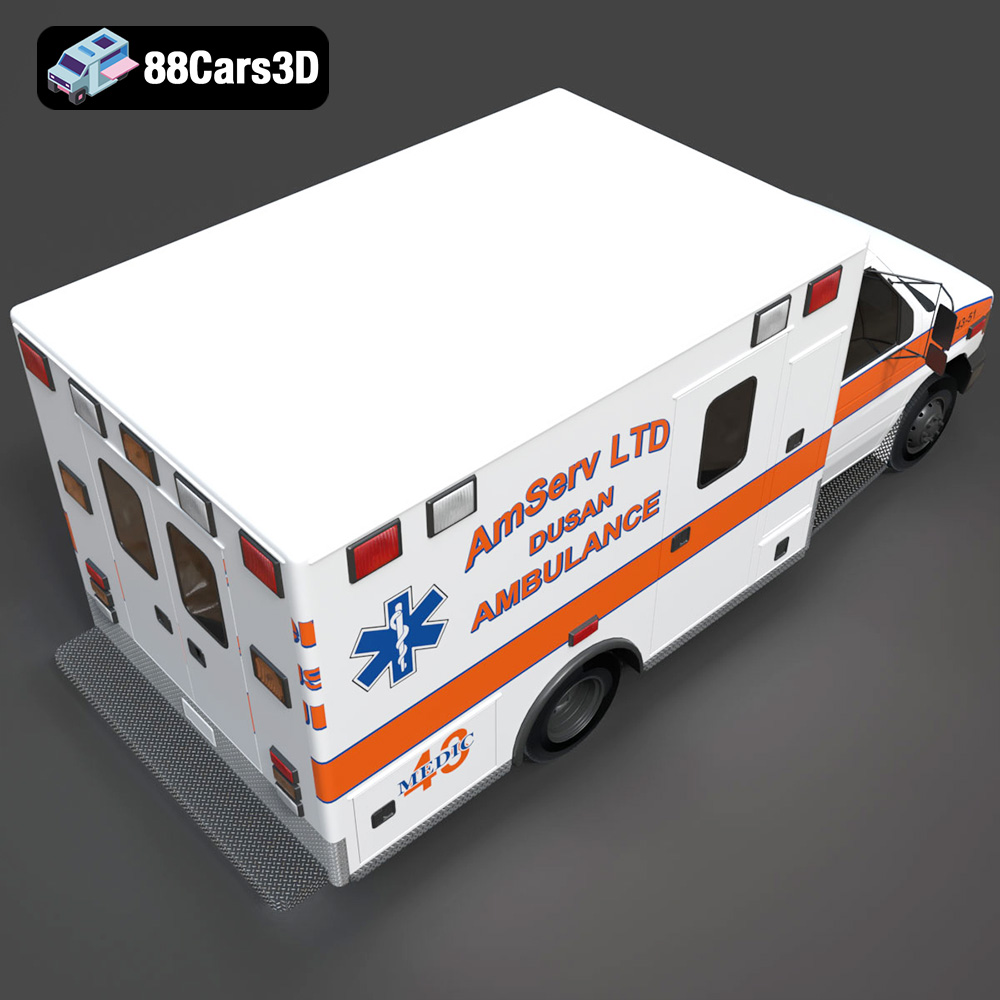
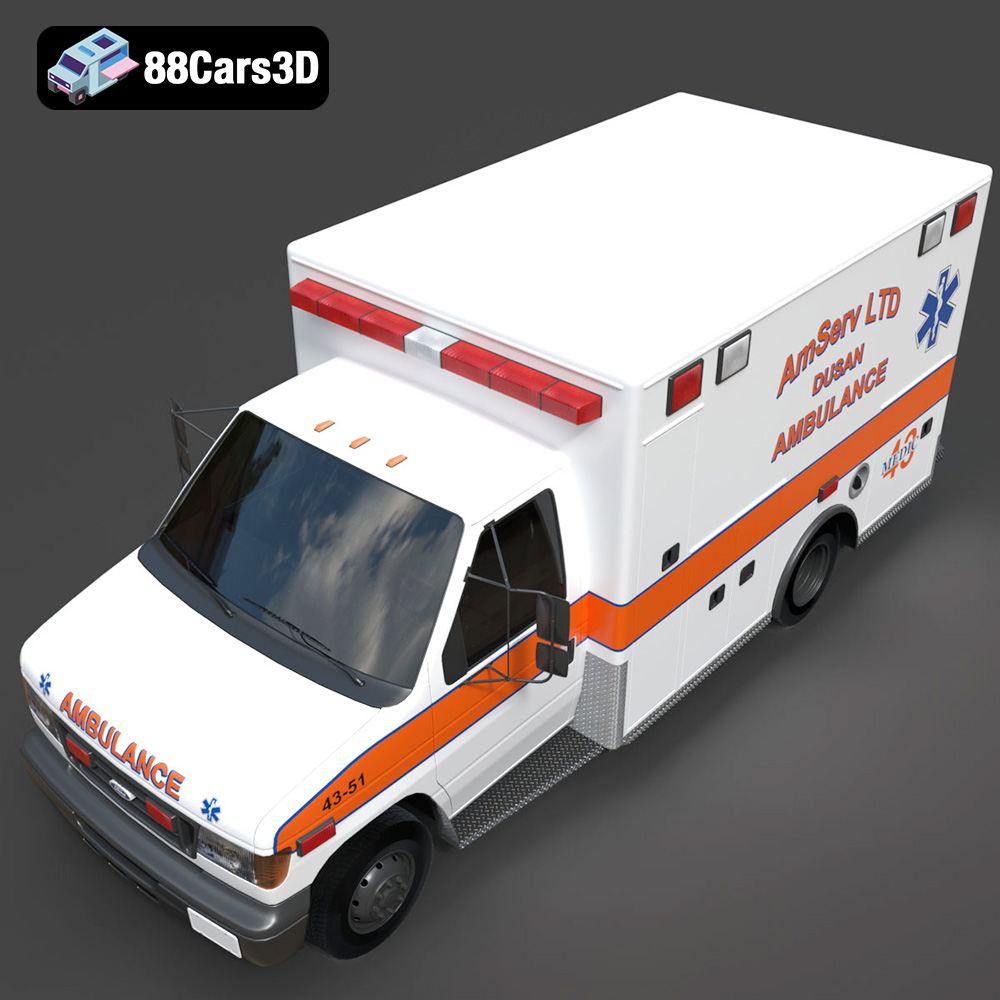
The Ford Ambulance AmServ LTD Dusan-002 is an ideal example of an asset built for versatility. Its meticulous detailing, from the complex emergency light bars to the comprehensive interior patient compartment, ensures it meets the demanding requirements of visualization artists and game developers alike.
Understanding 3D Model File Formats: Selecting the Right Tool for the Job
A crucial differentiator between consumer-grade and professional 3D car models is the breadth and quality of included file formats. When dealing with specialized vehicles like the Ford Ambulance AmServ LTD Dusan-002, the choice of format dictates compatibility, ease of rigging, and final performance across diverse applications ranging from cinematic automotive rendering to real-time game assets. Providers who understand the pipeline complexity, such as 88cars3d.com, offer a full suite of optimized formats.
.blend – The Power of Native Project Files
The .blend format provides the full, editable Blender project scene. This is invaluable for artists prioritizing flexibility. It retains all non-destructive modifiers, node-based materials (Cycles or Eevee), procedural textures, and custom lighting setups. For the Ford Ambulance model, the .blend file allows immediate access to the organized collection structure, making modifications, applying custom liveries, or adjusting the patient compartment configuration straightforward without losing scene integrity.
.fbx – The Universal Pipeline Standard
The FilmBox (.fbx) format remains the industry workhorse for transferring 3D data between DCC (Digital Content Creation) software and game engines (Unity and Unreal). It excels at packaging not just the mesh geometry and UVs, but also hierarchical structure, joint data (for rigged components like doors and wheels), and basic material assignments. When deploying the ambulance model into a game pipeline, the .fbx file ensures that the meticulously separated parts—such as the rotating tires and hinged doors—retain their transformation pivots for seamless animation setup.
.obj – Universal Compatibility and Reliability
The Wavefront .obj format is the most universal and robust interchange format. While it does not support advanced features like animation data or specific shader networks, it reliably transfers geometry, UV maps, and material group assignments. It serves as an excellent fallback or starting point for niche software that may lack support for newer, proprietary formats. Every professional 3D car model should include an .obj version for guaranteed cross-software functionality.
.glb – Optimized for AR, VR, and Web
The GL Transmission Format (.glb) is increasingly vital. It is a binary version of GLTF (Graphics Library Transmission Format), consolidating the mesh, materials, textures, and animation into a single, highly efficient file. This format is crucial for quick loading times in browser-based configurators, augmented reality (AR) experiences on mobile devices, and immersive virtual reality (VR) training environments. The optimized nature of the Ford Ambulance model means it translates smoothly into a performance-friendly .glb asset.
.stl and .ply – Precision for Physical Output and Analysis
For applications outside of screen visualization, .stl (Stereolithography) and .ply (Polygon File Format) are necessary. The .stl format is the standard for additive manufacturing; it triangulates the mesh and ensures it is manifold (watertight), ready for 3D printing detailed physical models of the ambulance. The .ply format is often preferred in engineering, CAD workflows, or analysis, as it can store high-precision data and is commonly used when integrating 3D scan data or verifying mesh integrity.
.unreal and .max – Engine and Studio Specific Mastery
The inclusion of .unreal and .max files indicates a commitment to specialized workflows. The .unreal project setup provides the asset already optimized within the engine environment, potentially including collision meshes (UCX) and pre-configured material instances—significantly cutting down on development time for game assets. Similarly, the .max (3ds Max) file gives expert users full access to the original scene, ideal for high-end V-Ray or Corona Renderer setups tailored for stunning automotive rendering.
Technical Deep Dive: The Anatomy of a High-Fidelity Asset
The true value of a premium 3D vehicle model lies in its underlying construction. For a complex piece of machinery like the Ford Ambulance AmServ LTD Dusan-002, mesh integrity, scale accuracy, and organization are non-negotiable requirements for professional utilization.
Topology and Mesh Integrity for Subdivision
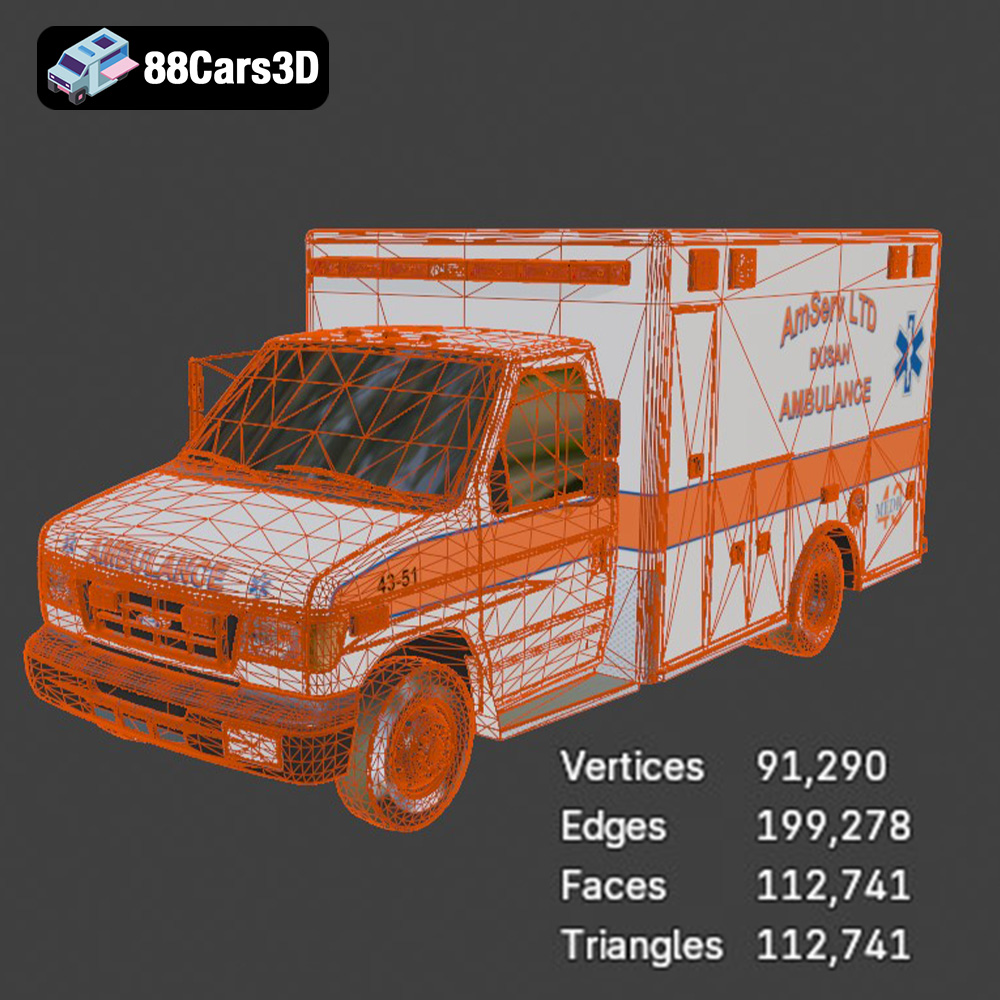
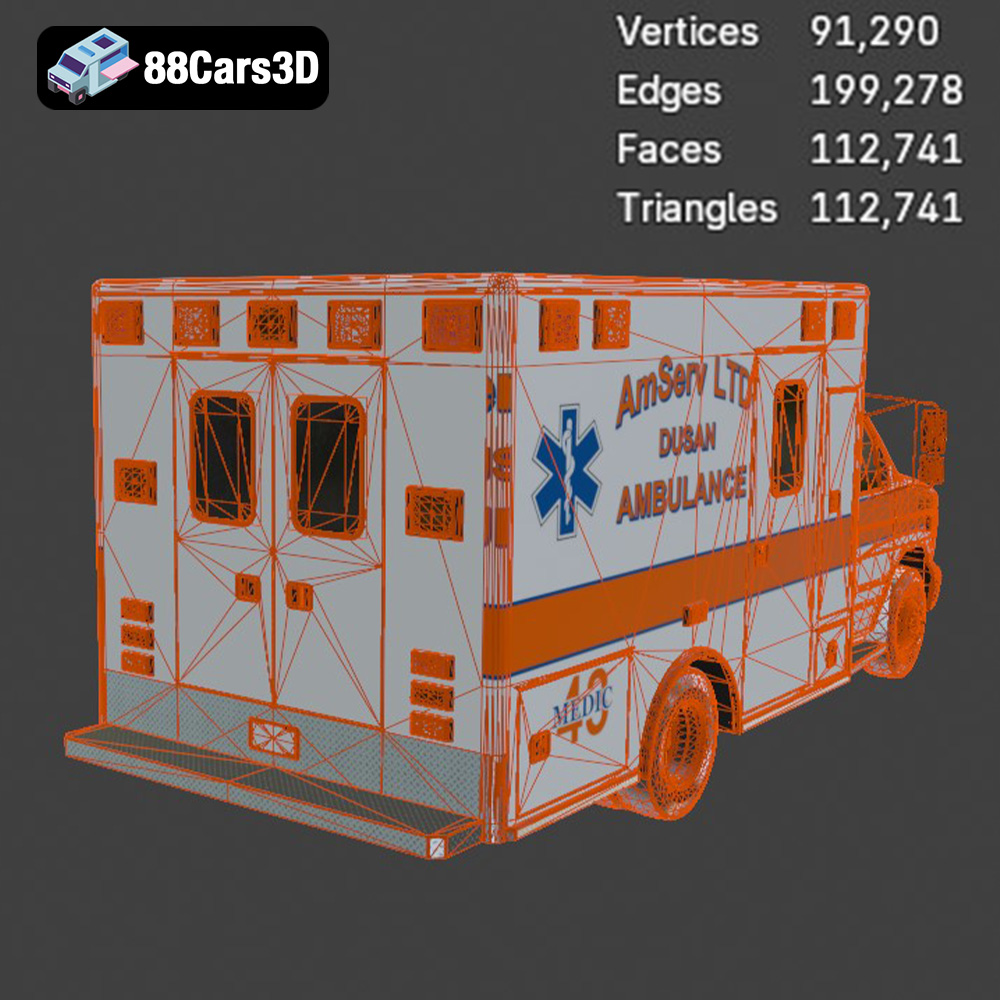
Professional assets rely on quad-dominant topology. This ensures clean, predictable deformation when the model is subdivided (using tools like 3ds Max Turbosmooth or Blender’s Subdivision Surface modifier) for close-up shots. Quads prevent the pinching and stretching that result from dense, messy triangulated meshes. The clean topology of the Ford Ambulance ensures that the complex curvature of the chassis, the smooth lines of the cabin, and the intricate details of the medical equipment inside remain crisp and artifact-free, essential for photorealistic renders.
Hierarchical Structure and Animation Readiness
A poorly organized model requires hours of cleanup before it can be animated. The Ford Ambulance model features an organized hierarchy with meaningful names (e.g., Wheel_FL, Door_Patient_L, Stretcher_Main). More importantly, the pivot points for all rotational and translational elements are correctly placed. This professional preparation allows riggers and animators to immediately begin scripting door opening sequences, wheel rotations, or the activation of the emergency light components without manual pivot alignment, drastically accelerating the production pipeline for animated sequences or dynamic game scenarios.
Real-World Scaling and Precision Proportions
Accuracy of scale is critical for simulation, visualization, and architectural integration. If the ambulance model is scaled incorrectly, it will look disproportionate in an architectural scene or behave incorrectly in a physics engine. The Ford Ambulance AmServ LTD Dusan-002 is precisely modeled to real-world scale. This level of accuracy is vital when using the asset for planning traffic flow, integrating it into large-scale city environments, or developing precise simulation training modules where spatial awareness is key.
Real-Time Integration: Deploying Game Assets in Modern Engines
The demand for high-quality game assets has exploded, particularly in the realm of realistic simulation and open-world environments. Integrating a complex vehicle requires careful optimization and specialized setup, a process made easier by the inclusion of formats like .fbx and .unreal.
Optimizing for Unreal Engine Workflow
When working with Unreal Engine (UE), efficiency and performance are key. Although the ambulance model starts as a high-fidelity mesh, for a real-time environment, artists must ensure proper Level of Detail (LOD) groups are implemented. While the base mesh is used for close-ups, distant views require lower poly versions to maintain high framerates. Utilizing the clean geometry allows for simpler automated LOD generation within UE’s Static Mesh Editor. Furthermore, the model’s structure facilitates the creation of simplified collision meshes (UCX assets) crucial for accurate physics and player interaction within the environment.
Implementing Realistic Emergency Lighting
A key visual feature of any ambulance is its emergency lighting system. Achieving realistic strobes and volumetric light beams in a game engine is a technical challenge. Artists leverage the separated components of the model’s light bars, using emissive materials and pulsed material parameters to drive the flashing. For greater realism, blueprints or C++ code are used to synchronize the strobing pattern, while carefully tuned volumetric fog and particle systems simulate the visible light beams, adding crucial atmosphere to the automotive rendering within the game engine.
Achieving Cinematic Realism: Advanced Automotive Rendering Workflows
For cinematic production, advertising, and high-end visualization, the focus shifts entirely to photorealism. Using the .max or .blend files, artists can leverage industry-leading ray tracing renderers (V-Ray, Corona, Cycles) to produce stunning visuals of the Ford Ambulance.
Shader Development and Material Layering
Authentic vehicle realism hinges on complex material layering. Standard PBR (Physically Based Rendering) workflows are expanded upon to accurately simulate car paint, which consists of multiple layers: the base diffuse coat, metallic flakes, and a high-gloss clear coat layer defined by accurate roughness and IOR (Index of Refraction) values. The Ford Ambulance AmServ LTD Dusan-002 3D Model’s organized UVs and clean material groups make it simple to apply these intricate layered shaders to the chassis, while dedicated texture sets accurately depict rubber, plastics, and the transparent glass materials for the lights and windows.
Studio Lighting Techniques for Showcase Renders
Presenting a high-detail 3D car model requires precise lighting that highlights its shape and features. Professional automotive rendering often employs virtual studio environments, utilizing High Dynamic Range Images (HDRIs) for realistic ambient illumination and reflection, combined with strategic, focused mesh lights or area lights. Artists use softboxes positioned to accentuate the reflections along the vehicle’s body lines (the “keylines”) and ensure the intricate details of the interior patient compartment are visible through the windows, lending depth and storytelling to the final image.
Case Studies: Simulation, Training, and AR/VR Deployment
The utility of specialized 3D car models extends far beyond static rendering or standard game environments. The meticulous detail found in the Ford Ambulance AmServ LTD Dusan-002 makes it an ideal candidate for critical training and simulation applications.
High-Fidelity Medical Training Scenarios
Training emergency medical personnel requires realistic environments that simulate the confined, high-stress conditions of an ambulance. By utilizing the detailed patient compartment geometry, trainers can create immersive VR simulations where trainees practice procedures like intubation, monitoring, and trauma stabilization. The model’s accurate scale and equipment layout are vital, ensuring that muscle memory developed in the simulation translates directly to real-world operational environments. The level of detail in the stretcher, control panels, and storage units is fundamental to the procedural fidelity.
Driver Training and Physics Simulation
Integrating the ambulance model into professional driver training simulators demands accuracy in physics. Because the model is built to real-world scale and features precise component weights (based on geometry volume), it allows simulator developers to accurately calculate mass, center of gravity, and inertia. This provides highly realistic handling characteristics—crucial for simulating high-speed emergency response driving where factors like vehicle roll and braking performance are paramount to safe training. This reliance on technical precision elevates the asset above typical visual models.
The Versatility of the Ford Ambulance in Professional Pipelines
The lifecycle of a high-quality 3D asset should maximize return on investment through versatility. The Ford Ambulance model demonstrates this through its adaptable features and comprehensive file set.
Customization for Regional and Organizational Standards
Emergency services often require region-specific liveries, color schemes, and specialized equipment configurations. The clean separation of mesh components and organized UV layouts allows users to easily modify paint finishes, apply custom emergency service graphics, or swap out medical equipment textures and meshes without complex disassembly. This customization capability ensures the asset can be rapidly adapted for multiple clients or simulation locations globally.
Enhancing Architectural and Infrastructure Visualization
While often used alone, the Ford Ambulance is a perfect contextual asset for visualization projects. Placing a high-quality, recognizable emergency vehicle within an architectural visualization of a hospital, civic center, or highway infrastructure adds immediate realism, scale, and narrative context. It allows viewers to gauge the size and accessibility of docking bays, emergency ramps, or parking areas with a familiar, accurate visual reference. This subtle but effective use demonstrates the necessity of having professional-grade models readily available in the artist’s library.
Conclusion: Investing in Professional-Grade 3D Assets
The deployment of complex, specialized vehicles like the Ford Ambulance AmServ LTD Dusan-002 requires technical precision and multi-format adaptability. From the necessity of quad-dominant topology for smooth automotive rendering to the optimized data contained within the .fbx and .unreal formats required for seamless integration as game assets, professional projects demand models built to the highest technical standards.
Investing in assets that offer clean hierarchy, real-world scale, and a comprehensive suite of file formats drastically reduces production time and increases the fidelity of the final output, whether that be a photorealistic cinematic render or a performance-optimized training simulation. We encourage visualization experts, simulation developers, and game artists to explore the library of high-quality 3D car models available on 88cars3d.com to elevate their next project.
Featured 3D Model
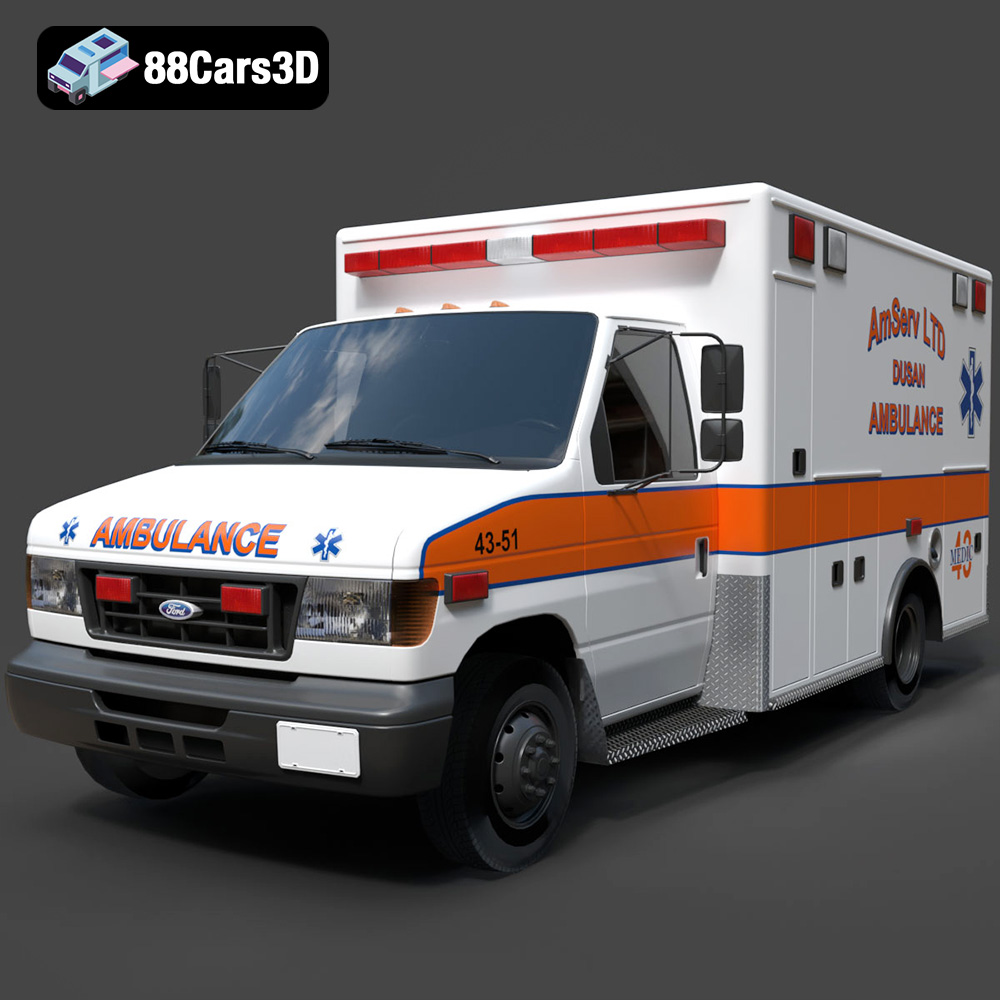
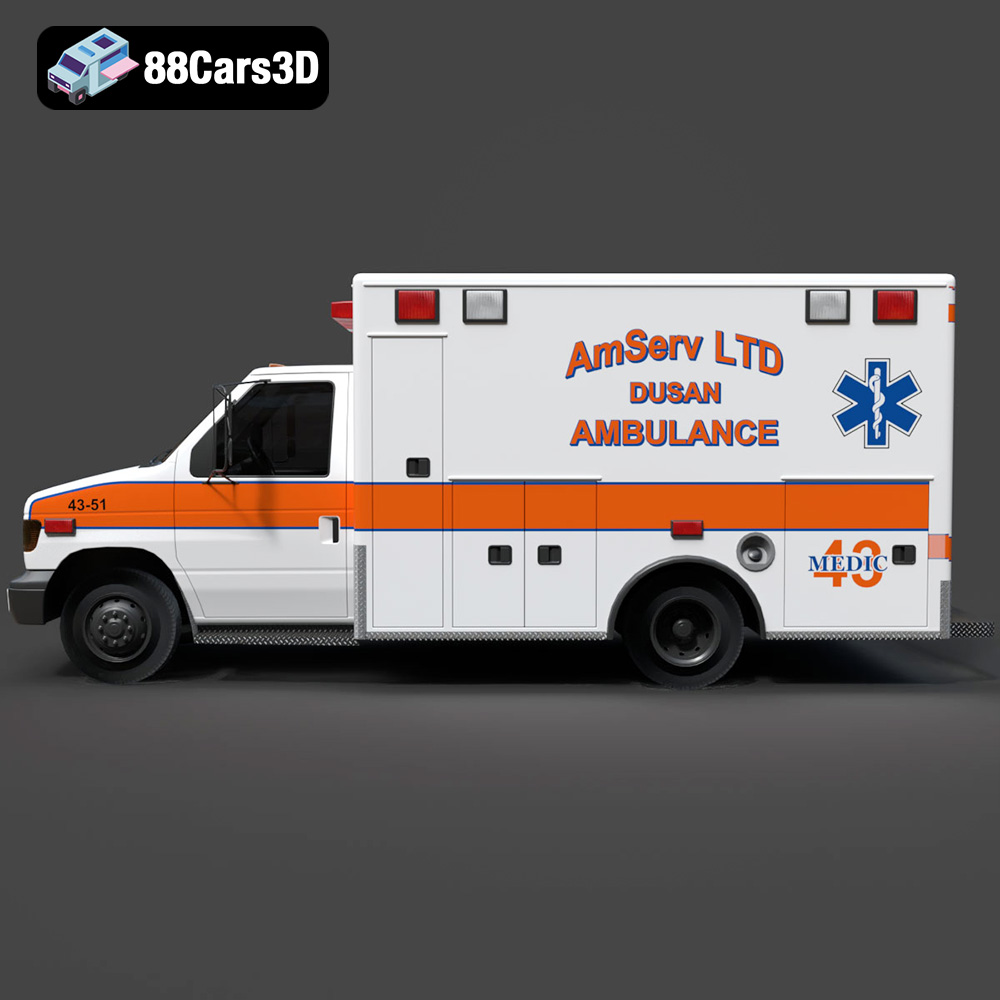
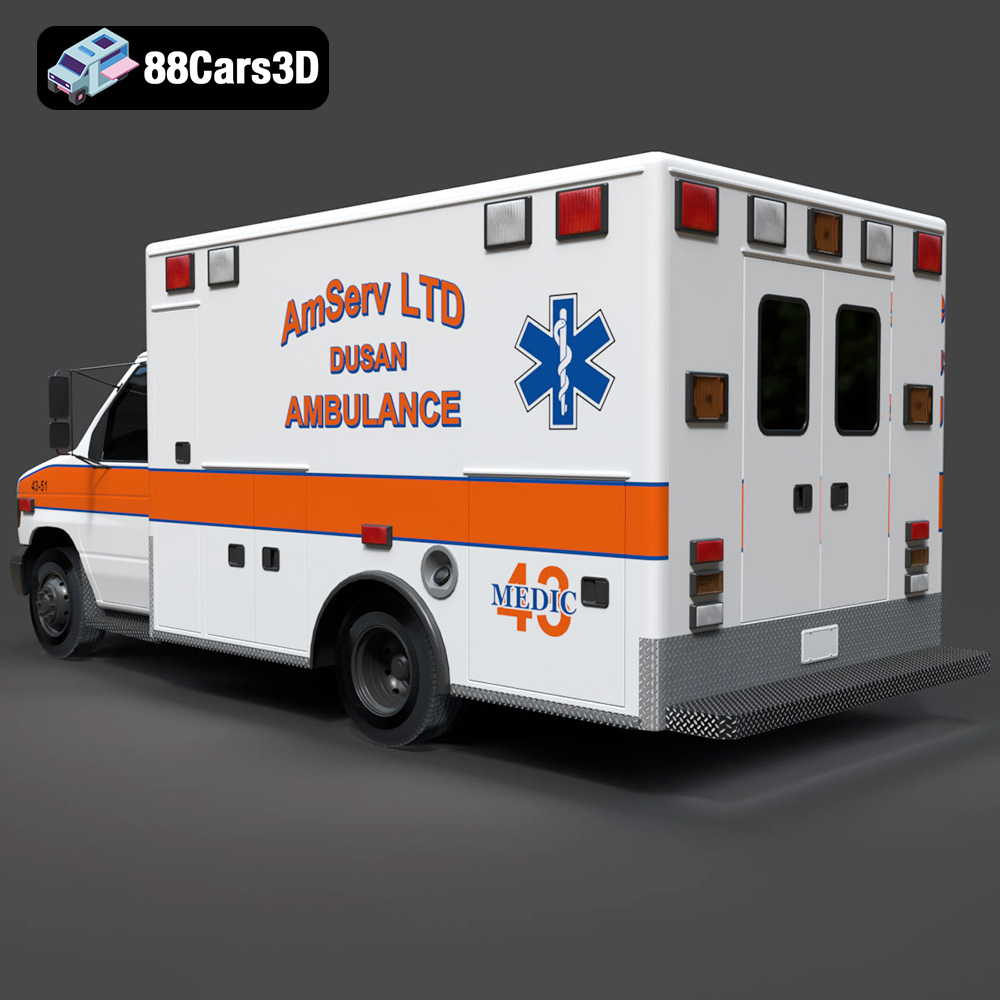
Ford Ambulance AmServ LTD Dusan-002 3D Model
Step into the world of emergency services with this meticulously crafted 3D model of the Ford Ambulance AmServ LTD Dusan-002. This professional-grade model captures the robust design and critical functionality of a modern ambulance, ideal for urgent medical transport scenarios. Built with clean geometry and a balanced level of detail, it ensures optimal performance across various applications. Perfect for high-fidelity rendering, realistic animation sequences, immersive simulation environments, and detailed game development projects.
$19.99
Product Image Gallery

Related Tags
.ford .ambulanceamservltddusan002 .ambulance .emergencyvehicle .van .rendering .simulation .gameasset .arvr .blend .fbx .obj .glb .stl .ply .unreal .max
