Get 20% OFF All Premium 3D & STL Models!

In the dynamic worlds of automotive design, architectural visualization, game development, and real-time simulations, the quality of 3D assets is paramount. A meticulously crafted 3D car model isn’t just a prop; it’s a vital element that can elevate a project from ordinary to extraordinary, lending realism, depth, and undeniable professional polish. From showcasing a new building’s elegance with realistic street traffic to populating immersive virtual environments or even creating physical scale models, the demand for precise and versatile 3D vehicle assets has never been higher.
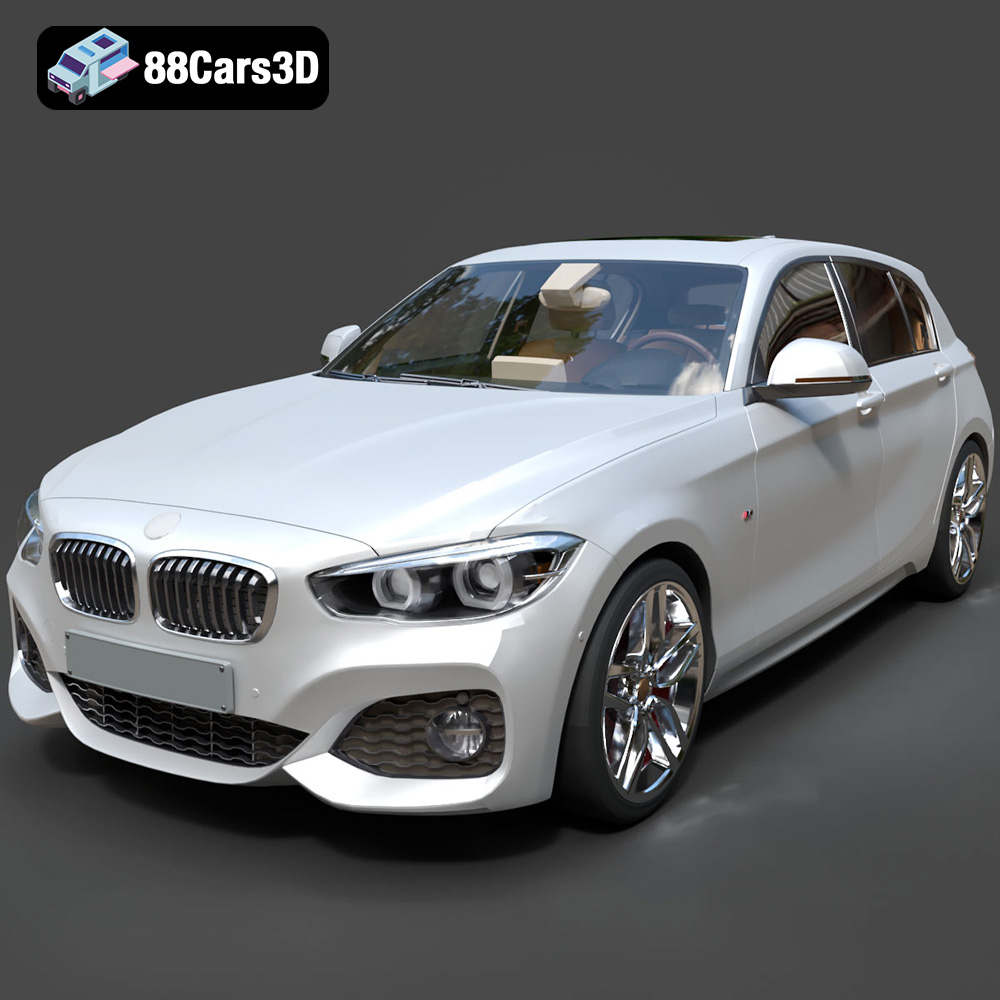
Today, we’re diving deep into the technical intricacies and creative possibilities offered by a prime example of such an asset: the BMW 1 Series 5-Door (2016) 3D Model. This particular model, available at 88cars3d.com, encapsulates the essence of high-fidelity automotive design, offering unparalleled detail and flexibility for a wide array of professional applications. It perfectly represents the F20 LCI generation, capturing the sporty proportions and distinct aesthetic that made this premium compact hatchback a favorite. We’ll explore how such a detailed model can be leveraged across different industries, examining the technical specifications that make it stand out and the workflows required to integrate it seamlessly into your projects.
The journey of a 3D model, from creation to deployment across various platforms, often involves navigating a landscape of diverse file formats. Each format serves specific purposes, offering different levels of flexibility, compatibility, and optimization for particular workflows. Understanding these distinctions is critical for any professional working with 3D assets, ensuring that the chosen format aligns perfectly with the project’s requirements. The BMW 1 Series 5-Door (2016) 3D Model, for instance, is offered in a comprehensive suite of formats, catering to virtually any professional need.
The .blend format is Blender’s native file type. It’s renowned for its ability to store an entire scene, including mesh data, materials, textures, lighting setups, cameras, animations, and even custom scripts. For users working within the Blender ecosystem, a .blend file offers maximum editability and preserves all proprietary Blender features. This means a designer can open the BMW 1 Series model and have immediate access to its original structure, modifiers, and Cycles or Eevee material definitions, allowing for profound customization without loss of quality or data.
Autodesk’s .fbx (Filmbox) format is arguably the most widely adopted interchange format in 3D production. It’s a binary file format that supports mesh data, materials, textures, animations, rigging, and even cameras. Its strength lies in its excellent compatibility across major 3D software packages like 3ds Max, Maya, Blender, and game engines such as Unreal Engine and Unity. When you download the BMW 1 Series as an .fbx, you’re getting a robust, pipeline-ready asset ideal for real-time applications or transferring between different software environments while retaining crucial animation data like separate wheels and doors.
The .obj (Wavefront Object) format is a simple, text-based format primarily used for storing 3D geometry (vertices, normals, texture coordinates, and faces). While it doesn’t typically store advanced features like animation or complex material definitions (these are often stored in a companion .mtl file), its universality makes it an indispensable format for basic mesh transfer between virtually any 3D software. For simple static renders or when starting a project in a new software, the .obj version of the BMW 1 Series provides a clean, compatible base mesh that can be easily imported and re-textured.
.glb (GL Transmission Format Binary) is the binary version of glTF, a royalty-free specification for the efficient transmission and loading of 3D scenes and models by applications. It’s highly optimized for web-based 3D, augmented reality (AR), and virtual reality (VR) applications due to its compact size and efficient parsing. A .glb model integrates textures and materials directly into a single file, making it incredibly convenient for quick previews or deployment in immersive web experiences. The BMW 1 Series in .glb format would be perfect for interactive product viewers on websites or AR apps on mobile devices.
The .stl (Stereolithography) format is the de facto standard for 3D printing. It represents a 3D object as a collection of unconnected triangles, defining only the surface geometry without color, texture, or material information. For designers looking to transform the BMW 1 Series 5-Door into a physical scale model, the .stl file is the starting point. Its simplicity ensures compatibility with all 3D printers and slicer software, making it an excellent base for creating custom RC bodies or display models, provided the mesh is manifold (watertight).
.ply (Polygon File Format or Stanford Triangle Format) is a file format for storing 3D data from 3D scanners. It can store a wider range of information than .obj or .stl, including color, transparency, texture coordinates, normals, and even confidence values for each point or polygon. While less common for general 3D asset exchange, .ply is valuable in scientific, engineering, and CAD applications where precise mesh data and attributes are critical. For highly detailed analysis or specific reverse engineering tasks, the .ply version of the BMW 1 Series could offer additional data fidelity.
While not a standalone file format in the same sense as .fbx or .obj, the inclusion of .unreal in the context of 88cars3d.com typically signifies an asset that has been specifically prepared and optimized for direct import into Unreal Engine projects. This often means pre-configured materials, textures, collision meshes, LODs (Levels of Detail), and sometimes even basic blueprints or setup for vehicles. For game developers or real-time visualization artists using Unreal Engine, this pre-packaged format for the BMW 1 Series can drastically reduce setup time and ensure optimal performance within the engine’s ecosystem.
Similar to .blend for Blender, .max is the native file format for Autodesk 3ds Max. It stores a complete 3ds Max scene, including all geometry, modifiers, materials (V-Ray, Corona, Arnold, etc.), lighting, cameras, and animation data. For professionals whose primary workflow revolves around 3ds Max for architectural visualization or high-end rendering, the .max file provides the most comprehensive and editable version of the BMW 1 Series model. It allows for direct manipulation of the original scene, ensuring full control over every aspect of the asset.
The availability of the BMW 1 Series 5-Door (2016) 3D Model in these diverse formats underscores its versatility and the commitment of 88cars3d.com to provide assets that seamlessly integrate into any professional pipeline.
Automotive rendering is a specialized discipline that blends technical mastery with artistic vision to create images and animations indistinguishable from real-life photographs. High-fidelity 3D car models are the bedrock of this process, and the BMW 1 Series 5-Door (2016) 3D Model provides an exceptional foundation for achieving photorealistic results across various scenarios.
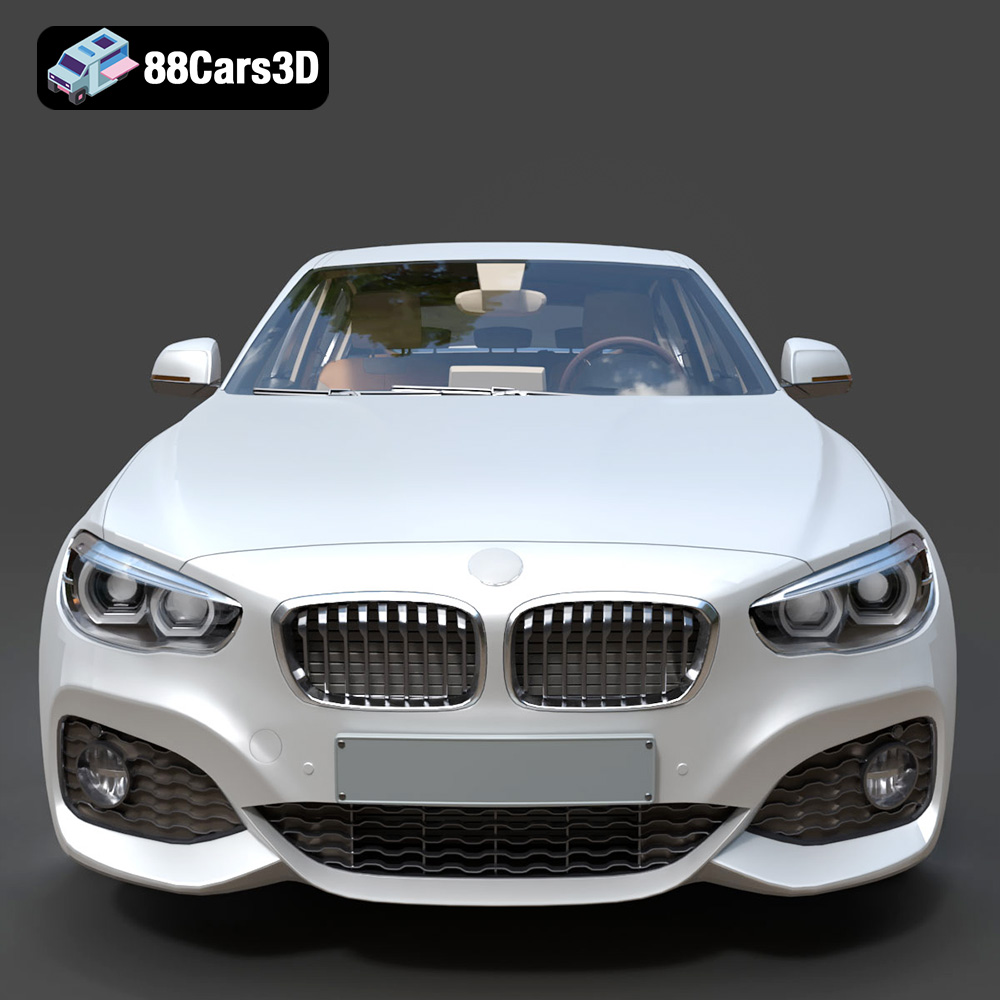
For architectural visualization, the inclusion of realistic vehicles is no longer an option but a necessity. A well-placed, highly detailed car like the BMW 1 Series can instantly ground a rendered building in reality, providing scale, context, and a sense of liveliness. Imagine a luxury condominium complex with the BMW 1 Series parked elegantly in the driveway or navigating a modern European street scene. Its accurate 2016 (F20 LCI) styling, from the distinct kidney grilles to the L-shaped LED taillights, ensures that the vehicle complements contemporary architectural designs perfectly. The model’s clean, quad-heavy topology (approx. 1.17 million triangles) means it holds up under extreme close-ups, making it ideal for hero shots in high-end ArchViz portfolios.
Beyond static renders, the BMW 1 Series 3D model shines in cinematic productions. Whether it’s a high-stakes car commercial, a feature film requiring realistic background traffic, or a motion graphics piece, the model’s detailed geometry and animatable components make it incredibly versatile. Its premium aesthetic aligns well with luxury branding and sophisticated narratives.
For professionals primarily using 3ds Max, the provided .max file offers a complete scene with pre-configured materials, usually optimized for V-Ray or Corona Renderer. This significantly streamlines the rendering process:
The advent of powerful game engines like Unreal Engine and Unity has blurred the lines between real-time graphics and traditional offline rendering. Incorporating high-detail 3D car models into these environments requires strategic planning, balancing visual fidelity with performance optimization. The BMW 1 Series 5-Door (2016) 3D Model, with its 1.17 million triangles, is a premium asset that can shine in these interactive worlds, particularly with modern rendering technologies.
Unreal Engine 5’s Nanite virtualized micro-polygon geometry system is a revolutionary technology that allows artists to import film-quality assets with incredibly high polygon counts directly into the engine without significant performance penalties. This is where a model like the BMW 1 Series truly excels.
While Nanite handles high poly counts with grace, not all game engines or target platforms support it, or projects may have different performance requirements (e.g., mobile VR, older gen consoles). For these scenarios, optimization techniques become crucial.
For any interactive vehicle, basic rigging is essential. The BMW 1 Series 3D Model comes with separate wheels, steering components, and doors, which is a significant advantage.
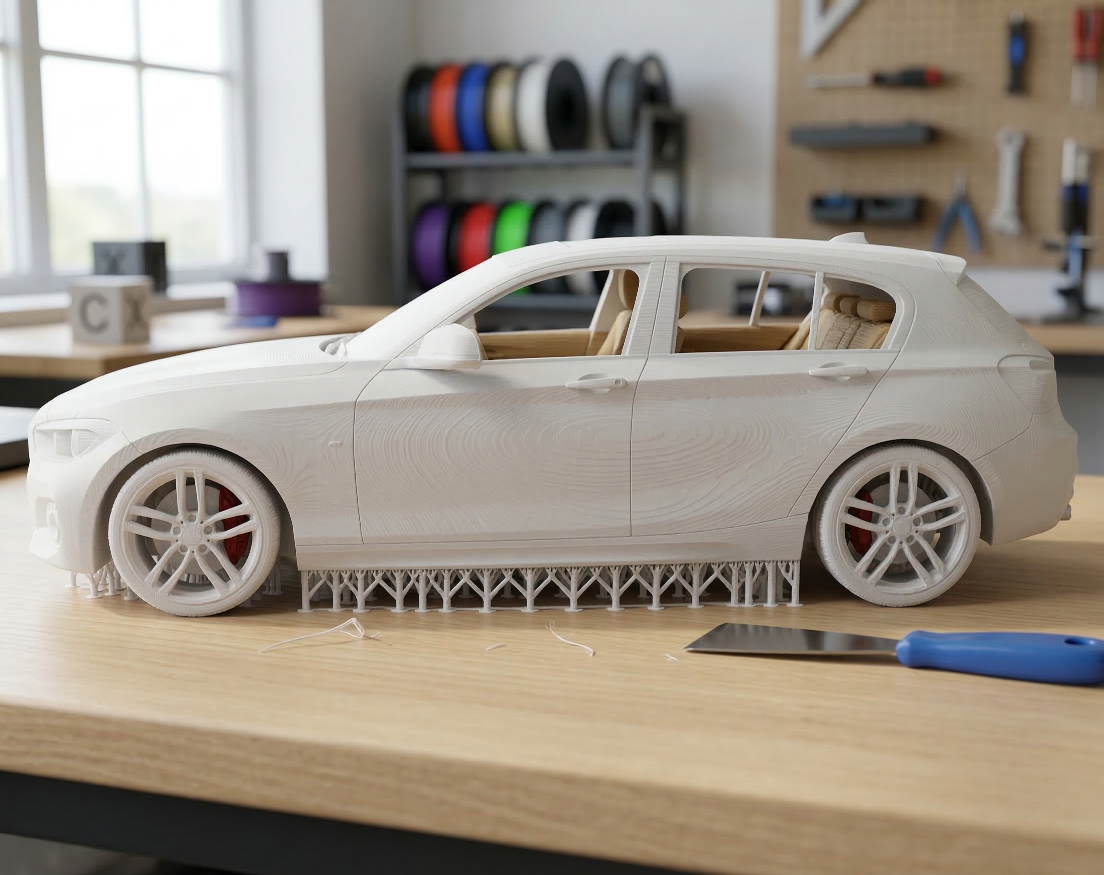
The boundary between digital and physical is increasingly blurred in 3D modeling. A high-quality digital asset like the BMW 1 Series 5-Door (2016) 3D Model can serve as an excellent foundation for creating tangible, real-world objects through 3D printing. This opens up avenues for rapid prototyping, scale model production, and personalized automotive collectibles.
While the BMW 1 Series model is provided in .stl format, understanding the preparation process is vital for any 3D print project.
Achieving a high-quality physical model requires attention to both printing parameters and post-processing steps.
The 3D printable BMW 1 Series 5-Door (2016) model isn’t just for hobbyists; it has significant professional applications:
The true power of a versatile 3D asset lies in its capacity for customization. The BMW 1 Series 5-Door (2016) 3D Model from 88cars3d.com is designed with this flexibility in mind, offering artists and designers numerous avenues to adapt it to their specific project needs, transforming it beyond its default presentation.
The most immediate and impactful customization is often changing the vehicle’s appearance. The model’s clean topology and well-defined material zones allow for seamless modification.
The modular nature of the BMW 1 Series model, with separate wheels, steering components, and doors, provides deeper customization opportunities.
Consider these creative applications enabled by the model’s flexibility:
Beneath the sleek surfaces and intricate details of any professional 3D car model lies a foundation of technical excellence. The quality of a model’s topology, its real-world accuracy, and the precision of its technical setup are what truly distinguish a premium asset from a mediocre one. The BMW 1 Series 5-Door (2016) 3D Model exemplifies this technical prowess, and understanding these elements is key to appreciating its value.
The fundamental building blocks of a 3D model are vertices, edges, and faces (or polygons/triangles). The provided specifications for the BMW 1 Series model are:
A high count in these metrics, especially faces/triangles, indicates a very detailed mesh. For the BMW 1 Series, this means smooth curves, sharp edges, and intricate details are accurately represented without relying solely on normal maps or displacement for definition. This “true geometry” approach is crucial for photorealistic close-up rendering and high-resolution output.
Accuracy in 3D modeling extends beyond visual fidelity to practical, measurable details:
The description highlights “incredibly clean, quad-heavy topology” as seen in the wireframe. This is a hallmark of a professionally built 3D model:
These technical advantages ensure that the BMW 1 Series 5-Door (2016) 3D Model is not just visually appealing but also a robust, production-ready asset, saving artists and developers valuable time and effort in their projects. Such precision and attention to underlying structure are why models from marketplaces like 88cars3d.com are trusted by professionals.
The world of 3D visualization is continually evolving, demanding assets that are not only visually stunning but also technically robust and versatile. The BMW 1 Series 5-Door (2016) 3D Model stands as a shining example of such an asset. From its meticulously crafted exterior and authentic interior to its clean, quad-heavy topology and real-world scale accuracy, it provides an exceptional foundation for a myriad of professional applications. Whether you’re an architect seeking to imbue your visualizations with photorealistic urban realism, a game developer pushing the boundaries of interactive experiences with Nanite in Unreal Engine, a cinematic artist crafting compelling automotive narratives, or even a designer aiming to 3D print a precise scale model, this model delivers.
Its availability across a comprehensive range of file formats—from native .blend and .max to universal .fbx and .obj, and specialized .stl and .unreal formats—ensures seamless integration into virtually any workflow. This flexibility, combined with its high fidelity and careful technical setup, makes it an invaluable addition to any professional’s asset library. Investing in such high-quality 3D car models from trusted sources like 88cars3d.com is not just about acquiring a digital object; it’s about empowering your creative vision and elevating the quality of your final output.
Explore the possibilities and experience the difference that truly professional 3D assets can make in your next project. This BMW 1 Series 3D model is a testament to the fact that detail, accuracy, and versatility are the cornerstones of exceptional 3D content.
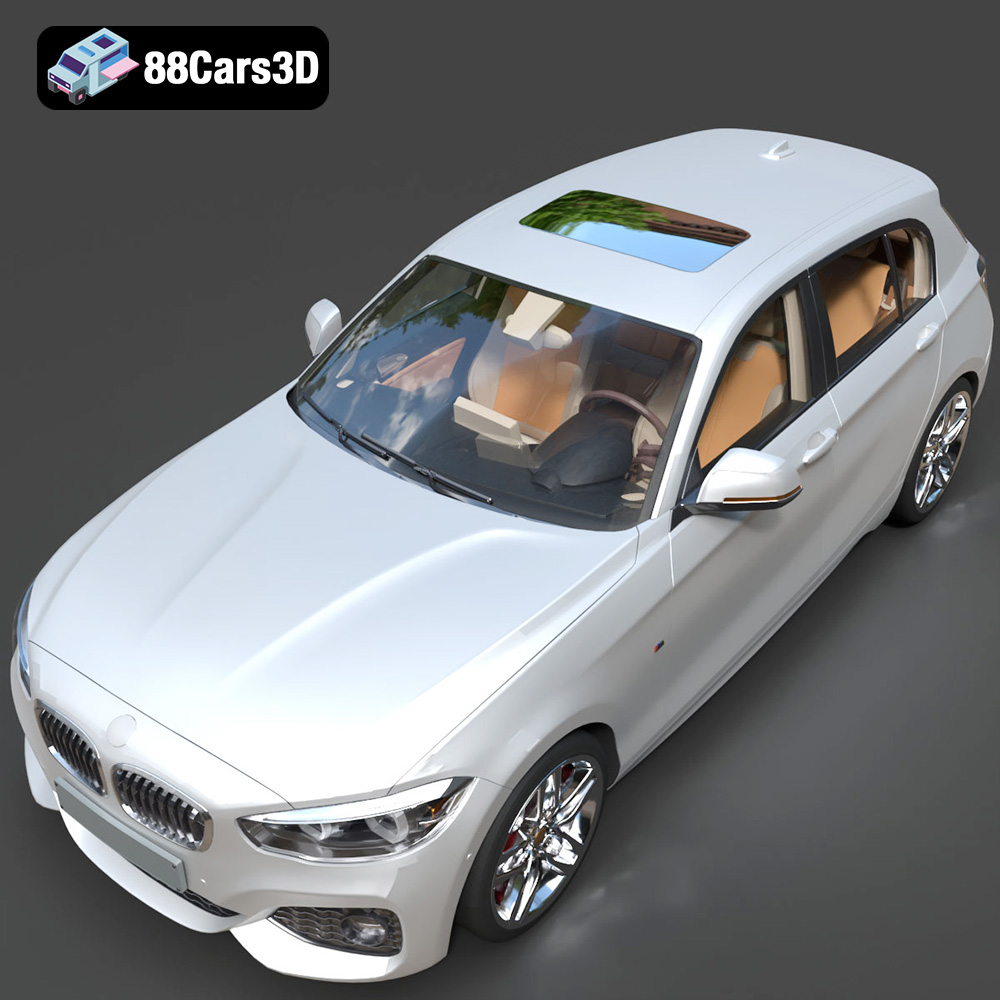
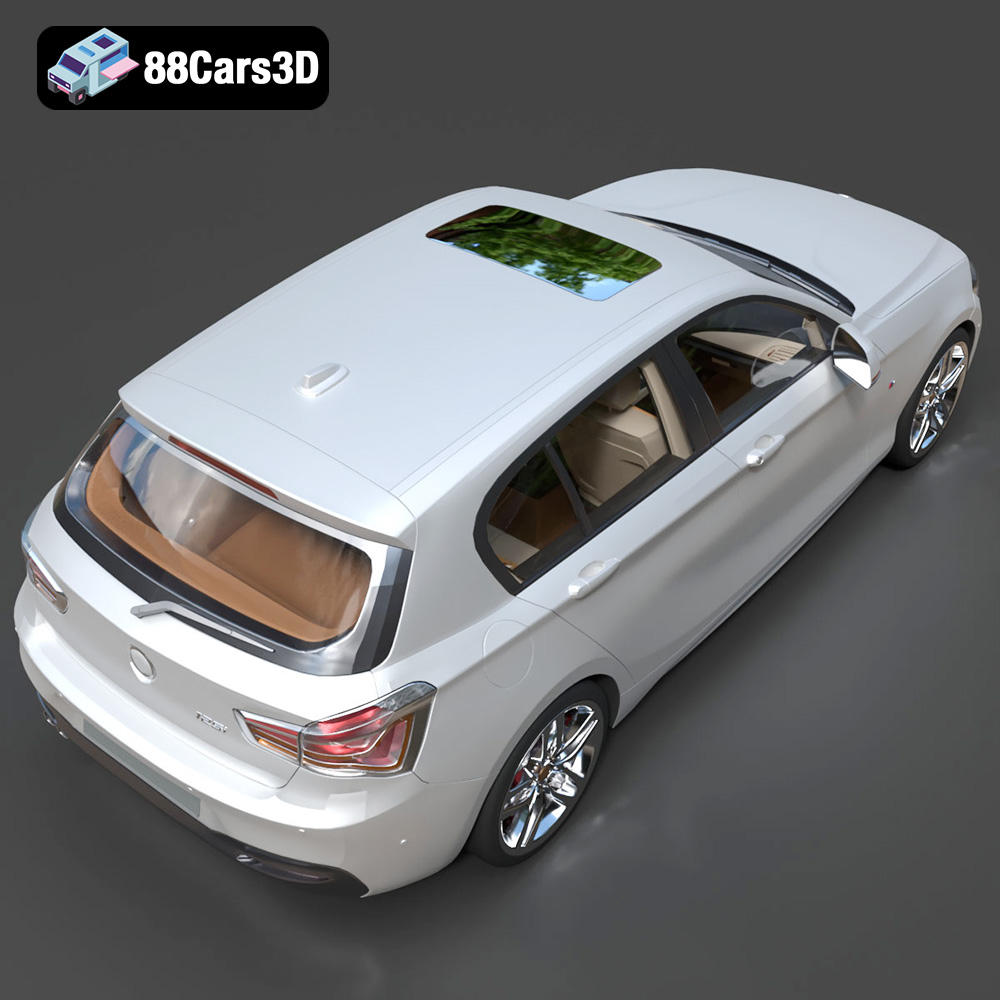
The BMW 1 Series 5-Door (2016) 3D Model is a highly accurate digital recreation of the beloved premium compact hatchback. Representing the widely praised F20 LCI (Life Cycle Impulse / facelift) generation, this model captures the unique sporty proportions, elongated hood, and rear-wheel-drive stance that made this specific 1 Series a standout in its class. This 3D model accurately reflects the modernized 2016 aesthetic, including the sleeker LED headlight clusters, the wider signature BMW kidney grilles, the distinct L-shaped LED taillights that extend into the tailgate, and the refined bumper designs. Built with incredibly clean, quad-heavy topology (approx. 1.17 million triangles), it delivers exceptional visual fidelity for photorealistic close-up rendering, high-end architectural visualization, and automotive animations. Perfect for populating modern European street scenes, upscale urban architectural renders, commercial automotive pitches, and cinematic background traffic.
$45
.archviz
.automotive
.blend
.bmw
.fbx
.hatchback
.obj
.rendering
.stl
1-series
2016-bmw
3d printing
car-3d-model
f20
high poly
premium-compact