Get 20% OFF All Premium 3D & STL Models!

In the vibrant world of 3D modeling and visualization, the demand for exceptionally crafted automotive assets is constant. Whether you’re a game developer striving for photorealistic open worlds, an architectural renderer adding dynamic lifestyle elements, or an AR/VR creator building immersive experiences, the quality of your 3D car models and vehicle assets dictates the impact of your project. This is especially true when it comes to capturing the distinctive character of modern-classic motorcycles – machines that blend heritage with contemporary performance.
Today, we’re delving deep into an asset that perfectly exemplifies this fusion: the Fantic Caballero 500 Scrambler 3D Model. This isn’t just a digital replica; it’s a meticulously engineered asset designed to excel across a multitude of professional applications. From its game-ready topology to its stunning visual fidelity, this model from 88cars3d.com offers an unparalleled foundation for your next creative endeavor, bringing the spirit of Italian retro-scrambler freedom to life in your digital scenes.
The Fantic Caballero 500 Scrambler motorcycle is more than just a bike; it’s a statement. It embodies a rugged, adventurous spirit, combining 1970s dirt-track aesthetics with modern engineering prowess. Translating such a distinctive persona into a digital asset requires not just technical skill, but a deep appreciation for the subject matter. The Fantic Caballero 500 Scrambler 3D Model achieves this with remarkable precision.
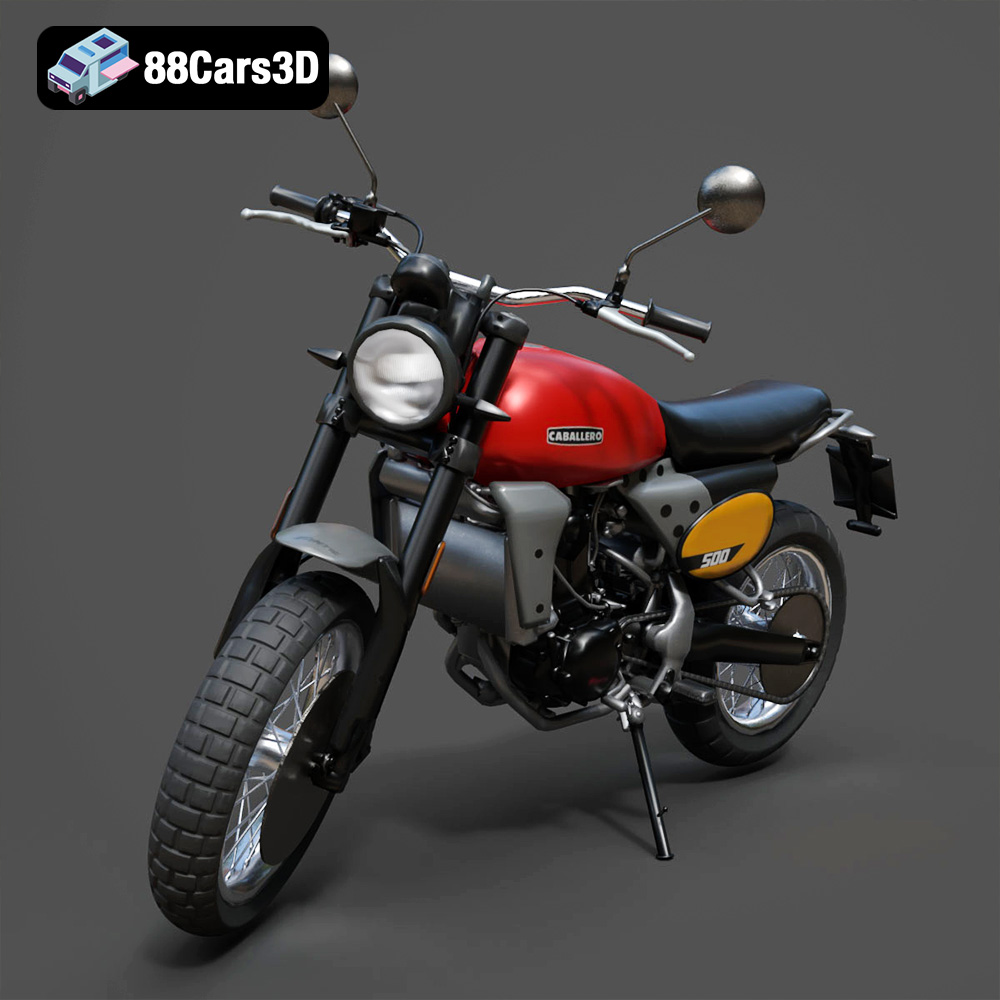
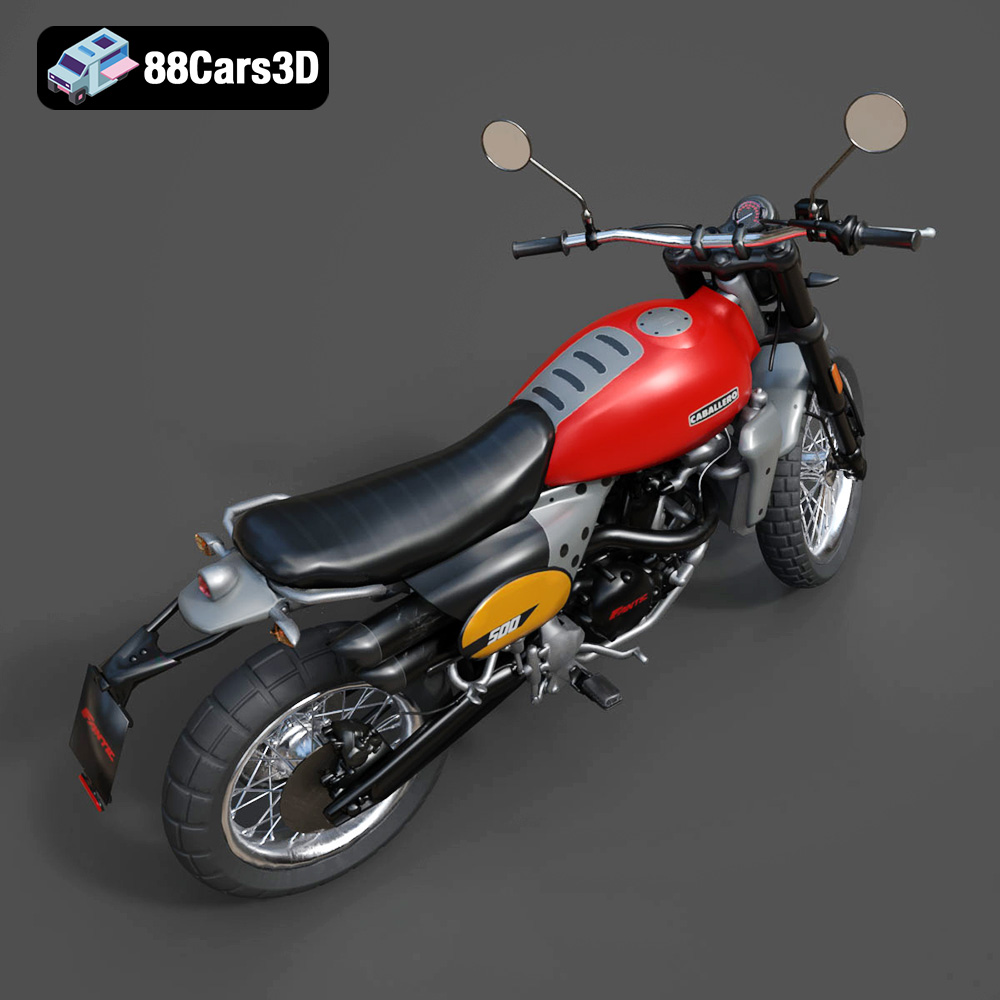
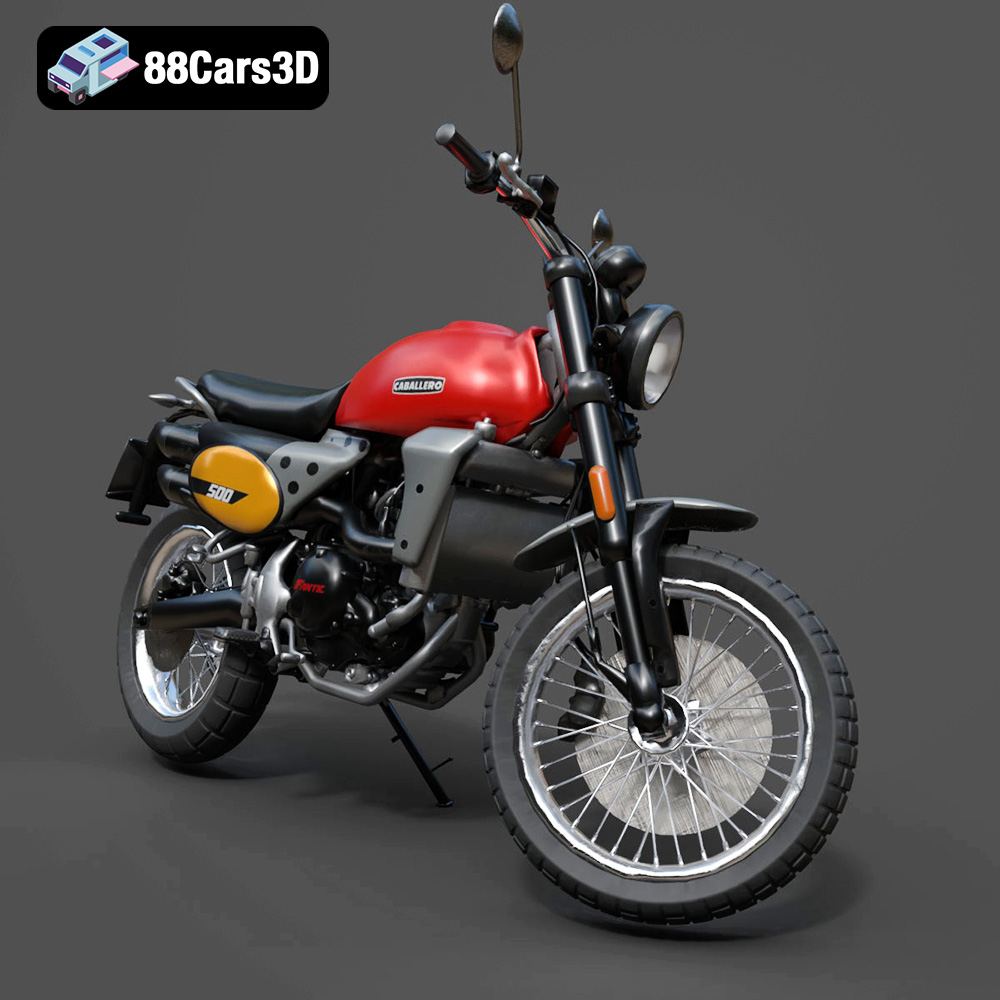
Every detail of the real Caballero 500 Scrambler has been thoughtfully recreated. The model features accurate frame geometry and retro proportions that immediately evoke the scrambler lifestyle. Key exterior elements, such as the exposed, detailed 450cc/500cc single-cylinder engine block and its radiator, are meticulously modeled, showcasing mechanical complexity without sacrificing optimization. The signature dual-exit high-mount Arrow exhaust system, a defining characteristic of the Caballero, is present in all its glory, contributing significantly to the bike’s aggressive stance.
Further enhancing its authenticity are the classic round LED headlight, minimalist taillight assembly, and spoked wheels wrapped in aggressive, chunky knobby tires – essential for that rugged, off-road appeal. Even the suspension details, including the USD (upside-down) front forks, are accurately depicted, ensuring visual credibility from every angle. For animators, the inclusion of separate wheels, suspension forks, and steering components provides the necessary control for realistic motion studies or dynamic gameplay sequences.
Inside the cockpit, the attention to detail continues. The flat retro-style ribbed saddle geometry, wide dirt-track style handlebars with detailed grips and levers, and the minimalist round digital instrument cluster all contribute to an immersive first-person experience. Authentic footpeg and rear brake/shifter pedal placement further reinforce the model’s suitability for interactive applications like video games or VR simulations where player immersion is paramount.
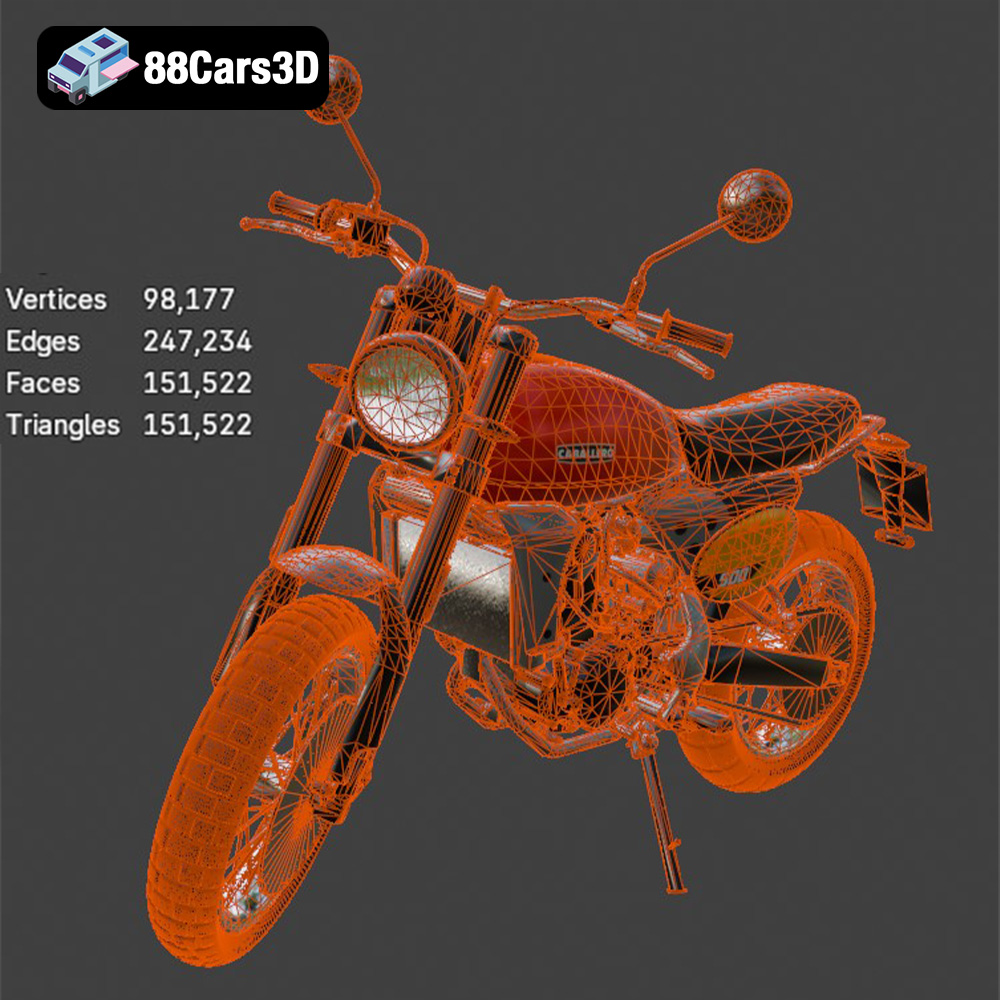
Achieving visual fidelity without compromising performance is a delicate balancing act, especially for real-time applications. The Fantic Caballero 500 Scrambler 3D Model strikes this balance beautifully. With just over 150,000 triangles (specifically, 151,522 triangles), it is remarkably game-ready and optimized. This poly count is perfect for demanding engines like Unreal Engine and Unity, allowing for high-end visual realism without bogging down frame rates. This optimization means less time spent on manual mesh reduction and more time dedicated to creative implementation, making it an invaluable asset for busy development teams.
Beyond the raw poly count, the model boasts clean topology, which is crucial for deformation, UV mapping, and overall stability within any 3D environment. This underlying technical excellence ensures that the premium visual fidelity is not just skin deep, but built on a robust foundation, ready for any challenge you throw at it.
Navigating the diverse landscape of 3D software and applications requires a solid understanding of file formats. The Fantic Caballero 500 Scrambler 3D Model comes with a comprehensive suite of formats, ensuring maximum compatibility and flexibility for virtually any project. Each format serves a specific purpose, offering unique advantages depending on your workflow and end goal.
.fbx (Filmbox): This is arguably the most widely used proprietary format for 3D data exchange, especially prevalent in the game development and animation industries. Developed by Autodesk, FBX files can store a wealth of data beyond just geometry, including animation, rigging, materials (with texture references), cameras, and lights. It’s the go-to format for transferring complex scenes between different 3D applications and into real-time engines like Unreal and Unity. For the Fantic Caballero 500, the .fbx ensures that its separate components for animation, pivot setups, and material assignments are preserved, making it an ideal choice for immediate integration into your game or cinematic pipeline.
.obj (Wavefront OBJ): As one of the oldest and most universally supported formats, .obj is a reliable choice for pure geometric data. It’s ASCII-based (human-readable) and excellent for static meshes, defining vertices, normals, UV coordinates, and faces. While it doesn’t support animation or rigging directly, it’s incredibly robust for transferring mesh data across virtually any 3D software. Materials are usually defined in a separate .mtl file that accompanies the .obj. If you need a clean, unadulterated mesh of the Fantic Scrambler for sculpting, retopology, or simply as a fallback, .obj is a solid option.
.ply (Polygon File Format / Stanford Triangle Format): PLY is a polygon mesh file format developed at Stanford University. It’s designed to store 3D data from 3D scanners, supporting color, transparency, texture coordinates, and other data for each vertex or face. While less common for everyday asset exchange than FBX or OBJ, it’s a precision mesh format often used in CAD, 3D scanning, and scientific visualization where geometric accuracy and additional per-vertex data are critical. If you’re working on advanced simulations or analyses with the Fantic model, .ply could be a valuable asset.
.blend (Blender): This is Blender’s native file format, storing a complete Blender scene including models, materials, textures, animations, scripts, and even UI layouts. For users of Blender, having the .blend file of the Fantic Caballero means full editability. You can dive into the original mesh, modify materials, adjust rigging, or leverage Blender’s powerful rendering engines (Cycles, Eevee) for high-quality renders. It offers the most flexibility for those working within the Blender ecosystem, allowing for deep customization of the motorcycle 3D model.
.max (3ds Max): Similar to .blend for Blender, .max is Autodesk 3ds Max’s native project file format. It contains the entire 3ds Max scene, including all geometry, modifiers, materials, textures, lights, cameras, and animation data. Professionals relying on 3ds Max for architectural visualization, product rendering, or cinematic animation will find the .max file invaluable. It provides native access to the model, allowing for advanced material setups using renderers like V-Ray or Corona, and full control over any included rigging or animation. This allows for seamless integration into existing 3ds Max automotive rendering projects.
.unreal (Unreal Engine Asset): This format signifies an asset specifically packaged and optimized for direct import into Unreal Engine. While typically assets are imported via .fbx, providing an “.unreal” file (often implying a pre-setup Unreal project or asset package) can streamline workflow significantly. It would mean the asset is already set up with proper materials, collisions, LODs (Levels of Detail), and possibly even Blueprints, saving developers considerable time in engine integration. For the Fantic Caballero, an engine-ready asset like this drastically reduces setup time for game developers.
.glb (GLB/glTF Binary): GLB is the binary version of glTF (Graphics Language Transmission Format), designed as an efficient, runtime-agnostic 3D asset delivery format for web, AR, and VR applications. It packages geometry, materials, textures, and animation into a single, self-contained file. GLB is becoming the “JPEG of 3D” due to its optimization for fast loading and rendering in browsers and mobile AR/VR viewers. The Fantic Caballero 500 in .glb format is perfect for embedding in websites, creating web-based configurators, or deploying to mobile AR apps with minimal overhead.
.stl (Stereolithography): STL is the standard file format for 3D printing. It represents a 3D model as a series of connected triangles (a triangulated surface mesh) without color, texture, or other CAD attributes. While it’s a simplified representation, it’s universally recognized by 3D printers and slicing software. The inclusion of an .stl file for the Fantic Caballero 500 means hobbyists and professionals alike can bring this digital model into the physical world, creating display-scale retro motorcycle collectibles. Given its detailed features, resin printing is often recommended to capture the finer elements like spokes and engine fins.
The availability of such a wide array of formats for the Fantic Caballero 500 Scrambler 3D Model at 88cars3d.com underscores its versatility and commitment to supporting diverse professional workflows. It ensures that no matter your preferred software or end-use application, you have the right tool for the job.
The true value of a 3D asset lies in its seamless integration into diverse professional pipelines. The Fantic Caballero 500 Scrambler 3D Model is engineered precisely for this, offering robust support for various creative industries.
For game developers, performance is king, but visual quality cannot be sacrificed. The Caballero 500’s game-ready optimization, with its 151,522 triangle count, is perfectly balanced for modern open-world games, racing titles, and off-road simulators. This poly count is high enough to ensure stunning detail up close, yet efficient enough to integrate into vast environments with many other assets without significant performance impact.
The model’s technical advantages extend to its setup. With proper pivot points established for steering, wheel rotation, and suspension travel, integrating the Fantic into a physics-based game engine is significantly streamlined. Developers can easily hook up animation blueprints, apply realistic vehicle physics, and create compelling player-controlled experiences. Furthermore, the optimized geometry tailored for seamless first-person POV in gaming means players will have an authentic and immersive experience from the rider’s perspective. Textures and materials, often PBR (Physically Based Rendering) ready, ensure the bike looks fantastic under various lighting conditions, from sunny dirt tracks to moody urban night rides.
When it comes to automotive rendering, photorealism is the ultimate goal. The detailed modeling of the Fantic Caballero 500 Scrambler, from its exposed engine block to the subtle contours of its fuel tank, provides an excellent foundation. Artists using 3ds Max, Blender, or other rendering software paired with engines like V-Ray, Corona, or Cycles can leverage these details to create breathtaking visualizations.
Workflows often involve importing the model (via .max, .blend, or .fbx), then focusing on advanced material creation. This includes fine-tuning metallic shaders for the frame and exhaust, creating realistic rubber textures for the knobby tires, and setting up complex paint materials for the fuel tank (e.g., Classic Fantic Red with clear coat reflections). Lighting is critical; artists can set up studio lighting for product showcases, or environmental HDRIs for outdoor scenes. The real-world scale accuracy ensures that the bike looks proportionate when placed alongside other assets or in architectural scenes, making it excellent for lifestyle brand campaigns, rugged outdoor scenes, and studio lighting setups.
The immersive nature of AR/VR demands optimized assets that can run smoothly on a variety of devices. The Fantic Caballero 500 Scrambler 3D Model’s efficient polycount and inclusion of the .glb format make it an ideal candidate for augmented and virtual reality applications. Imagine a virtual motorcycle showroom where customers can explore the Caballero in 360 degrees, customize its colors, and even “sit” on it in VR. Or an AR experience where the bike appears scaled to life-size in your driveway, allowing you to walk around and inspect every detail before purchase.
For interactive configurators, the model’s structure allows for easy customization of components. Users could instantly swap tire types, change fuel tank colors, or adjust seat materials with a few clicks, seeing the changes in real-time. This level of interaction enhances engagement and provides a powerful tool for marketing and sales in the automotive industry.
The core of any high-quality 3D asset lies in its technical foundation. The Fantic Caballero 500 Scrambler 3D Model excels in this regard, ensuring maximum usability and flexibility for professionals.
As noted, the model boasts 98,177 vertices, 247,234 edges, and 151,522 faces/polygons (triangles). This count is a testament to sophisticated optimization. Clean, all-quad topology (or well-triangulated quads where necessary for real-time engines) minimizes rendering artifacts, allows for cleaner subdivision if needed for higher fidelity renders, and ensures proper deformation during animation. The model’s game-ready status is not just about the number of triangles, but how those triangles are distributed and structured to maintain visual quality where it matters most, like the engine details, the iconic exhaust, and the intricate spoked wheels.
Properly unwrapped UV coordinates, while not explicitly detailed in the product description, are implied by the inclusion of textures and materials. Clean UVs are fundamental for applying high-resolution texture maps without stretching or distortion, which is critical for realistic PBR materials that respond accurately to light.
One of the standout technical advantages is the model’s preparation for animation. With separate components such as wheels, suspension forks, and steering, animators have granular control. The correct pivot setup for these parts is crucial. For instance, the wheels need pivots at their centers for rotation, the handlebars for steering, and suspension components for realistic compression and rebound. This thoughtful segmentation and pivot placement mean less rigging work for the end-user and more time spent on crafting compelling animated sequences, whether for a game cutscene, a product advertisement, or an engineering visualization.
The product description confirms that textures and materials are included. This strongly suggests a PBR workflow, which is the industry standard for photorealistic rendering. PBR materials (using maps like Albedo/Base Color, Metallic, Roughness, Normal, and Ambient Occlusion) ensure that the motorcycle reacts physically accurately to light, regardless of the rendering environment. This is vital for achieving consistent, high-quality visuals across different engines and rendering scenarios, making the Fantic Caballero 500 Scrambler 3D Model a truly versatile asset.
The Fantic Caballero 500 Scrambler 3D Model isn’t confined to digital realms; its inclusion of an .stl format opens the door to physical creation through 3D printing. This allows enthusiasts and professionals to manifest the digital design into a tangible collectible or a prototype for further study.
When transitioning from a digital 3D model to a physical 3D print, several considerations come into play. The .stl format is the universal language for 3D printers, representing the model as a triangulated mesh. The recommended scales (1:12 / 1:10 / 1:8) are ideal for creating detailed display models that capture the essence of the real motorcycle. Wall thickness is critical for structural integrity, with 1.2–2.0 mm being a sensible range to ensure parts aren’t too fragile, especially for intricate components like the frame and handlebars.
The product specifically recommends resin printing, particularly for capturing delicate details like the spokes and engine fins. FDM (Fused Deposition Modeling) printers, while more common and affordable, lay down melted plastic in layers, often struggling with very fine features. Resin (SLA/DLP) printers, using UV light to cure liquid resin, can achieve much finer layer heights (0.04–0.12 mm recommended) and reproduce intricate geometries with superior precision. This is crucial for a model as detailed as the Caballero, where tiny bolts, vents, and the thin structure of the exhaust system contribute significantly to its realism.
Supports will be required during printing, especially for overhangs and intricate parts like the handlebars, high-mount exhaust, kickstand, and footpegs. Careful print orientation (e.g., the frame printed angled for structural integrity, spoked wheels separately) is also vital to minimize support material and maximize print quality. Post-processing, including sanding, priming, and painting with classic Fantic Red or matte black finishes, will bring the miniature model to life, echoing the craftsmanship of the original motorcycle.
A high-quality 3D asset should not only be accurate but also adaptable. The Fantic Caballero 500 Scrambler 3D Model provides ample customization options, empowering artists and developers to tailor its appearance to suit any creative vision or project requirement.
The ability to easily modify key visual attributes is a significant advantage. Imagine a game where the player can choose their motorcycle’s aesthetic. With this model, changing fuel tank colors to options like Classic Fantic Red, Stealth Black, or Matte Olive Green is a straightforward process, allowing for varied in-game cosmetics or marketing visuals. The modular design and texture setup would facilitate this with ease.
Furthermore, the product description highlights the option to modify tire textures. This opens up possibilities to swap the aggressive knobby off-road tires for smooth street tires, effectively transforming the scrambler into a ‘Flat Track’ variant. This flexibility extends to interior elements, such as adjusting seat materials from classic black ribbed vinyl to a distressed brown leather, drastically altering the bike’s perceived age and style.
These customization options are not merely aesthetic; they are narrative tools. A Fantic Caballero in matte black with street tires might be featured in an urban rebel story, while the classic Fantic Red with knobby tires could dominate an adventurous off-road campaign. Artists can also adapt lighting setups to match these narratives – from the harsh, bright sun of a dirt track to the moody, neon-lit glow of an urban night ride. This level of creative control ensures that the Fantic Caballero 500 Scrambler 3D Model is not just a prop, but a character that can evolve with your storytelling.
Whether you’re crafting a cinematic, developing a dynamic game, or creating an interactive configurator, the inherent flexibility of this automotive 3D model ensures it can be seamlessly integrated and customized to meet precise project demands, amplifying its value as a premium asset.
The Fantic Caballero 500 Scrambler is more than just a motorcycle; it’s a symbol of freedom and rugged individualism. Capturing that spirit in a digital realm with the fidelity and optimization required by today’s demanding production pipelines is no small feat. The Fantic Caballero 500 Scrambler 3D Model achieves this balance with exceptional skill, offering a truly premium asset for a wide range of applications.
From its meticulously detailed exterior and cockpit, boasting accurate retro-proportions and signature features like the dual Arrow exhaust, to its robust technical specifications – including a game-ready 151k triangle count and crucial pivot setups for animation – this model is built for performance and visual excellence. Its compatibility across an extensive list of file formats like .blend, .fbx, .obj, .glb, .stl, .ply, .unreal, and .max ensures seamless integration into virtually any professional workflow, from game development and high-fidelity automotive rendering to cutting-edge AR/VR experiences and even physical 3D printing.
The customization potential further enhances its versatility, allowing creators to adapt its aesthetics to fit diverse narrative and branding needs. For anyone seeking a high-quality, optimized, and versatile motorcycle 3D model, the Fantic Caballero 500 Scrambler 3D Model available at 88cars3d.com stands out as an indispensable tool. It’s an investment in efficiency, quality, and the boundless creative possibilities it unlocks for your next project.
The Fantic Caballero 500 Scrambler 3D Model is a highly detailed, optimized digital recreation of the iconic Italian modern-classic motorcycle. Blends 1970s retro dirt-track aesthetics with contemporary engineering, the Caballero 500 is famous for its rugged off-road stance, punchy single-cylinder engine, signature dual Arrow exhaust, and aggressive knobby tires. This 3D model accurately captures the essence of the scrambler lifestyle, featuring the classic round LED headlight, teardrop fuel tank with authentic badging, exposed steel tube frame, and flat dirt-style saddle. Built with incredibly clean, game-ready topology (just over 150k triangles), it delivers premium visual fidelity without bogging down real-time engines. It is the perfect asset for game development, AR/VR experiences, animation, and lifestyle automotive visualization. Perfect for rugged off-road scenes, urban retro street environments, biker lifestyle campaigns, and modern open-world video games. Exterior Features: Accurate Fantic Caballero 500 Scrambler frame geometry and retro proportions Exposed, detailed 450cc/500cc single-cylinder engine block and radiator Signature dual-exit high-mount Arrow exhaust system Classic round LED headlight and minimalist taillight assembly Spoked wheels wrapped in aggressive, chunky knobby tires Rugged suspension details including USD (upside-down) front forks Separate wheels, suspension forks, and steering components for animation Cockpit & Rider Interface Features: Flat retro-style ribbed saddle geometry Wide, dirt-track style handlebars with detailed grips and levers Minimalist round digital instrument cluster Authentic footpeg and rear brake/shifter pedal placement Optimized geometry specifically tailored for seamless first-person POV in gaming Technical Specifications & Advantages: Vertices: 98,177 Edges: 247,234 Faces / Polygons: 151,522 Triangles: 151,522 Game-Ready & Optimized: The 151k triangle count strikes the perfect balance for real-time engines (Unreal, Unity) while maintaining high-end visual realism. Real-world scale accuracy based on the real Fantic Caballero chassis Proper pivot setup for steering, wheel rotation, and suspension travel Compatible with major 3D software platforms and real-time rendering engines Applications: Game Development: Absolutely ideal for modern open-world games, racing titles, and off-road simulators due to its highly optimized polycount. AR/VR: Perfect for immersive virtual motorcycle showrooms, configurators, and mobile AR experiences. Rendering & Visualization: Excellent for lifestyle brand campaigns, rugged outdoor scenes, and studio lighting setups. 3D Printing: Convertible to .stl format for display-scale retro motorcycle hobbyists. 3D Print Setting: Recommended scale: 1:12 / 1:10 / 1:8 Layer height: 0.04–0.12 mm (Resin printing recommended to capture the delicate spokes and engine fins) Wall thickness: 1.2–2.0 mm Infill: 20–30% Supports: Required for handlebars, high-mount exhaust, kickstand, and footpegs Print orientation: Frame printed angled for structural integrity; spoked wheels printed separately Post-processing: Sanding, primer, classic Fantic Red for the tank, matte black for the frame, and metallic finishes for the Arrow exhaust Customization Options: Change fuel tank colors (e.g., Classic Fantic Red, Stealth Black, Matte Olive Green) Modify tire textures (swap knobby off-road tires for smooth street tires to create a ‘Flat Track’ variant) Adjust seat materials (classic black ribbed vinyl vs. distressed brown leather) Adapt lighting for sunny dirt tracks or moody urban night rides Included File Formats: .blend, .fbx, .obj, .glb, .stl, .ply, .unreal, .max
$39.99
.blend
.fbx
.obj
.rendering
.scrambler
caballero-500
dirt-bike
fantic
flat-tracker
game asset
game-ready
low-poly
motorcycle-3d-model
optimized
retro-motorcycle
VR/AR