Get 50% OFF All Premium 3D & STL Models!

In the vast landscape of 3D modeling, few creations capture the essence of history and engineering quite like meticulously crafted vintage vehicles. These digital artifacts are more than just models; they are gateways to bygone eras, enabling artists, developers, and designers to infuse their projects with unparalleled authenticity and character. The demand for high-quality 3D car models and other vehicles that stand up to the scrutiny of professional rendering, game development, and even 3D printing is ever-present. This is where the IZ-49 Classic Motorcycle 3D Model distinguishes itself, offering a digital tribute to an iconic piece of mid-20th century Soviet engineering. For anyone looking to add a touch of historical realism to their next project, understanding the technical depth and versatility of such an asset is crucial.
The IZ-49, originally produced between 1951 and 1958, was a symbol of rugged simplicity and durability, a workhorse of its time. This digital recreation captures every nuance, from its distinctive steel frame to its single-cylinder engine configuration, making it a perfect candidate for diverse applications, from historical visualization to immersive game environments. Throughout this post, we will delve into the technical specifications, workflow integration, and creative possibilities that a premium asset like the IZ-49 Classic Motorcycle 3D Model brings to the table, showcasing why it’s an indispensable addition to any professional’s toolkit, and a prime example of the quality available at 88cars3d.com.
The utility of a 3D model is often defined by its compatibility and the specific file formats it supports. For a versatile asset like the IZ-49 Classic Motorcycle 3D Model, having a comprehensive suite of formats is not just a convenience, but a necessity for seamless integration into diverse pipelines. Each format serves a unique purpose, optimized for specific software, engines, or end-use applications. Understanding these distinctions is critical for any professional working with 3D car models or other complex assets.
The .blend file format is the native format for Blender, a powerful open-source 3D creation suite. When you receive an IZ-49 model in .blend format, you’re gaining access to a fully editable Blender scene. This typically includes all modifiers, rigging (if applicable), lighting setups, camera views, and node-based materials. For artists deeply integrated into the Blender ecosystem, this offers maximum flexibility for customization, animation, and rendering with Cycles or Eevee. It’s the ideal starting point for anyone who wants to deconstruct the model, study its topology, or make profound alterations without losing any original scene data.
Autodesk’s .fbx (Filmbox) format is arguably the most widely adopted interchange format in the 3D industry. It excels at transferring entire scenes, including geometry, materials, textures, animations, and rigs, between different 3D software applications like 3ds Max, Maya, Cinema 4D, and Blender. Critically, .fbx is the go-to format for game development, making it ideal for Unreal Engine and Unity. Its robust nature ensures that the IZ-49 model, complete with proper pivot points for wheels and steering, can be smoothly imported into real-time pipelines with minimal setup, preserving hierarchies and animations crucial for game assets.
The .obj (Wavefront Object) format is a universal standard, prized for its simplicity and broad compatibility. It primarily stores geometric data (vertices, normals, texture coordinates, and faces) and can reference external material (.mtl) files for basic material properties. While it doesn’t support animation or rigging, its widespread support across virtually all 3D software makes it an excellent fallback or starting point for cross-software compatibility. For the IZ-49, the .obj version ensures that its core mesh data is accessible to any artist, regardless of their primary software choice, making it perfect for static renders or for re-importing into niche applications.
As the binary version of glTF (GL Transmission Format), .glb is a relatively newer format designed specifically for efficient transmission and loading of 3D scenes and models in AR/VR applications and web browsers. It packages geometry, materials, textures, and animations into a single, self-contained file, making it highly optimized for real-time display and interactive experiences. The IZ-49 in .glb format would be perfect for embedding into an interactive historical museum exhibit online or for augmented reality apps that place the classic motorcycle directly into a user’s environment.
The .stl (Stereolithography) format is the undisputed standard for 3D printing. It represents a 3D model as a series of connected triangles, defining only the surface geometry without color, texture, or material information. For designers looking to convert the IZ-49 Classic Motorcycle into a tangible collectible or a scale model, the .stl file is essential. It provides the manifold (watertight) geometry necessary for 3D printers to accurately build the physical object layer by layer, adhering to specified print settings for scale, layer height, and support structures.
The .ply (Polygon File Format or Stanford Triangle Format) is another common format for storing 3D data, particularly useful for scanned data, CAD, and scientific applications. It can store a variety of properties beyond just geometry, including color, transparency, and often offers better support for non-triangular polygons than .stl. For detailed analysis, reverse engineering, or integrating the IZ-49 into precision engineering simulations, the .ply format offers a robust, high-fidelity mesh representation.
The .unreal format, or more broadly, assets specifically prepared for Unreal Engine, implies that the model has been optimized, textured, and sometimes even set up with basic blueprints or collision meshes directly within the engine’s ecosystem. While not a standalone file type in the same way as .fbx, an “unreal” package often refers to a ready-to-use asset folder or scene that can be directly imported and utilized within Unreal Engine. This means the IZ-49 model would come pre-configured for optimal performance and visual fidelity in Unreal, saving significant development time for game asset artists.
Similar to .blend for Blender, .max is the native file format for Autodesk 3ds Max, a premier software for 3D modeling, animation, and rendering. An IZ-49 model provided in .max format offers the full flexibility of the original project file. This includes scene setup, camera angles, lighting, material definitions (e.g., V-Ray, Corona, Arnold materials), and any complex modifiers or animation rigs. For architectural visualization, high-end automotive rendering, or cinematic projects relying on 3ds Max, this format provides the most direct and uncompromised access to the model’s highest fidelity version.
The inclusion of these diverse formats for the IZ-49 Classic Motorcycle 3D Model underscores its versatility and the foresight of its creators. Whether for a detailed archival render, a fast-paced game, an interactive AR experience, or a physical collectible, the right file format ensures that this historical vehicle can seamlessly integrate into any digital workflow.
The true value of a premium 3D model, especially one representing a historical artifact like the IZ-49 Classic Motorcycle, lies in its fidelity to the original design. This isn’t merely about visual similarity; it’s about capturing the spirit of the engineering and the aesthetic details that define its era. The IZ-49 model from 88cars3d.com demonstrates a deep commitment to this principle, providing a foundation for truly authentic digital experiences.
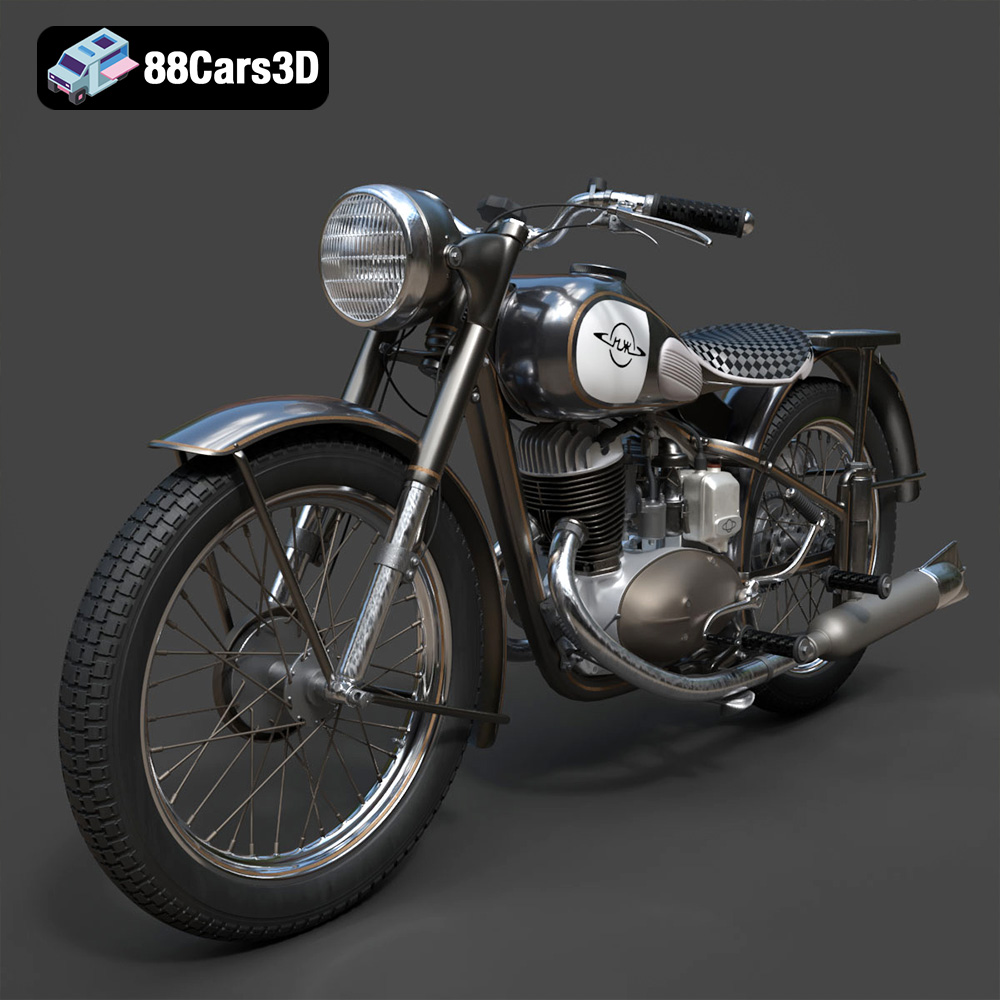
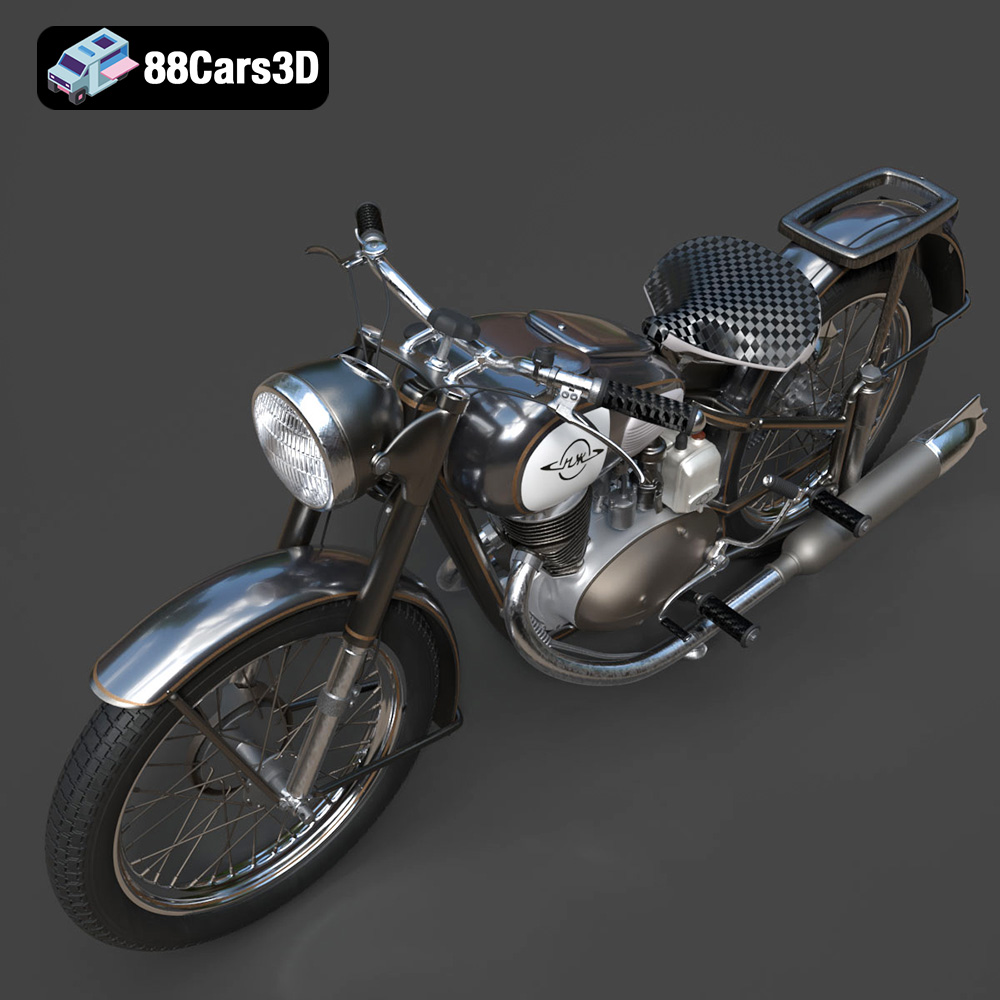
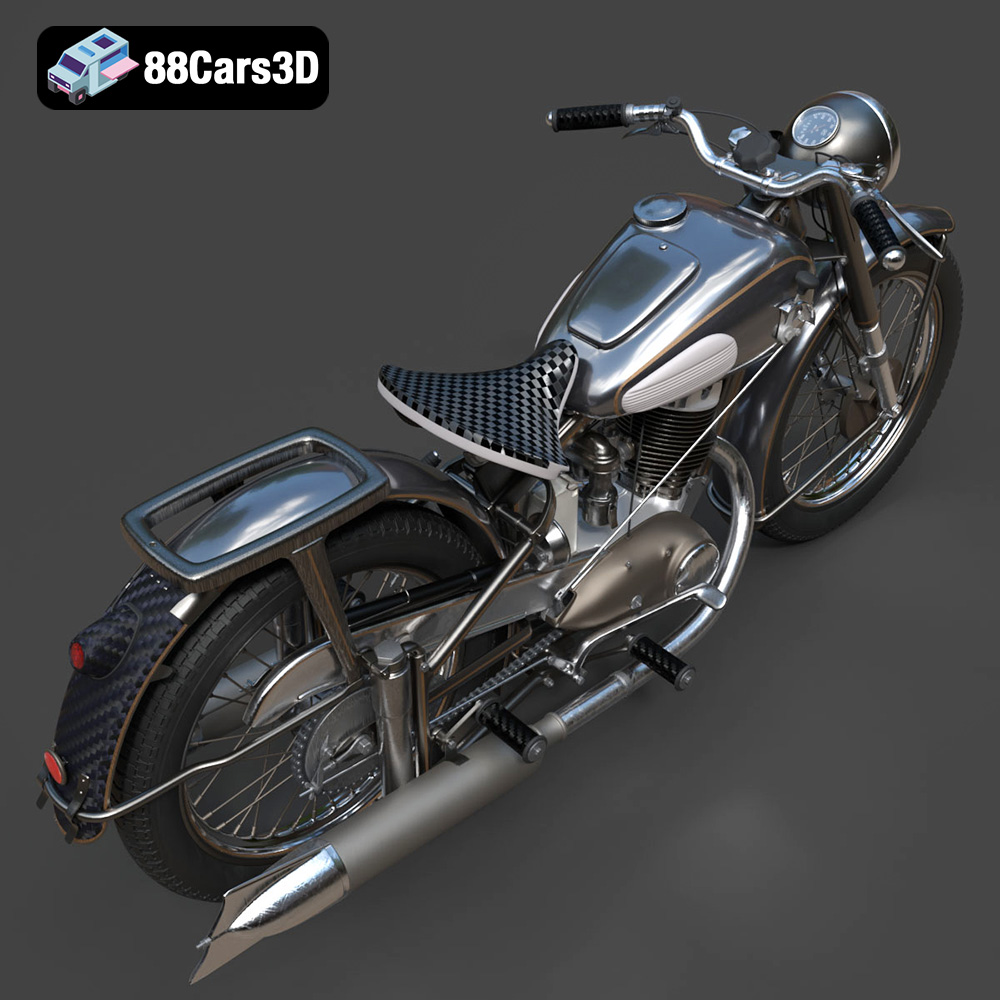
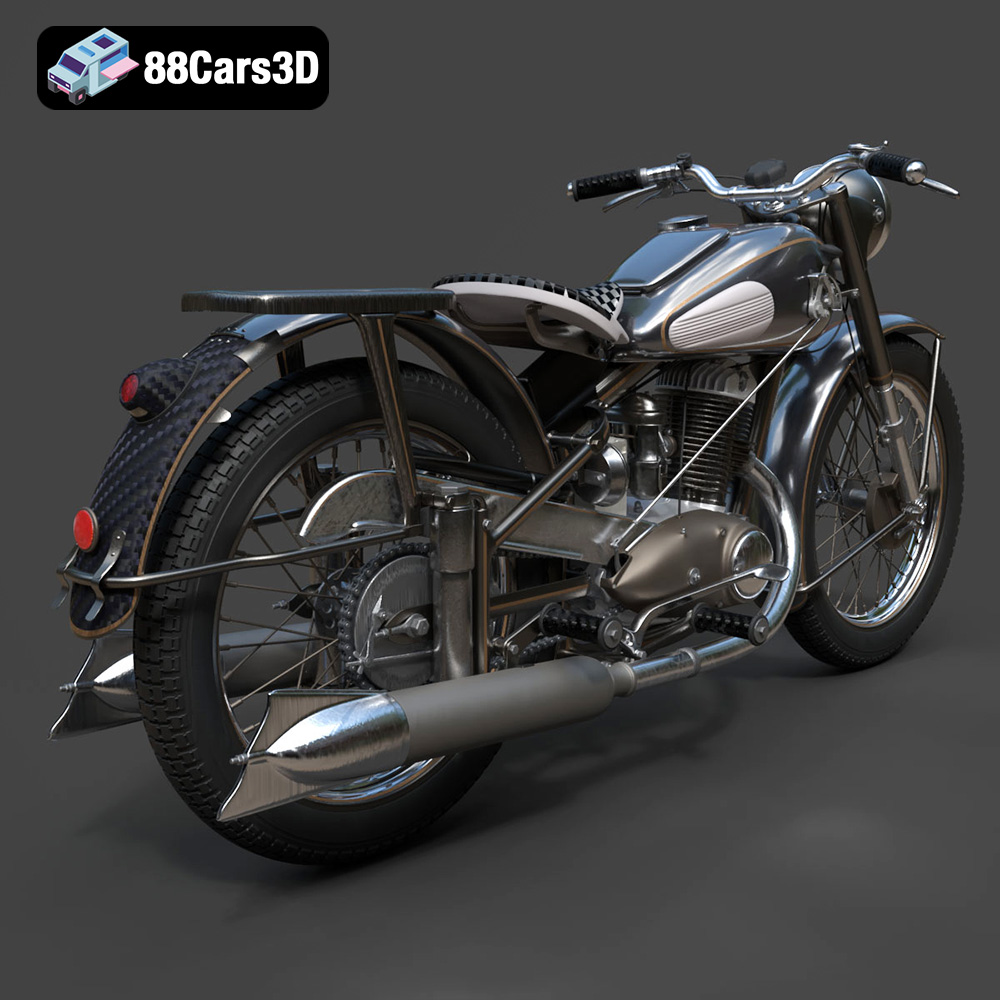
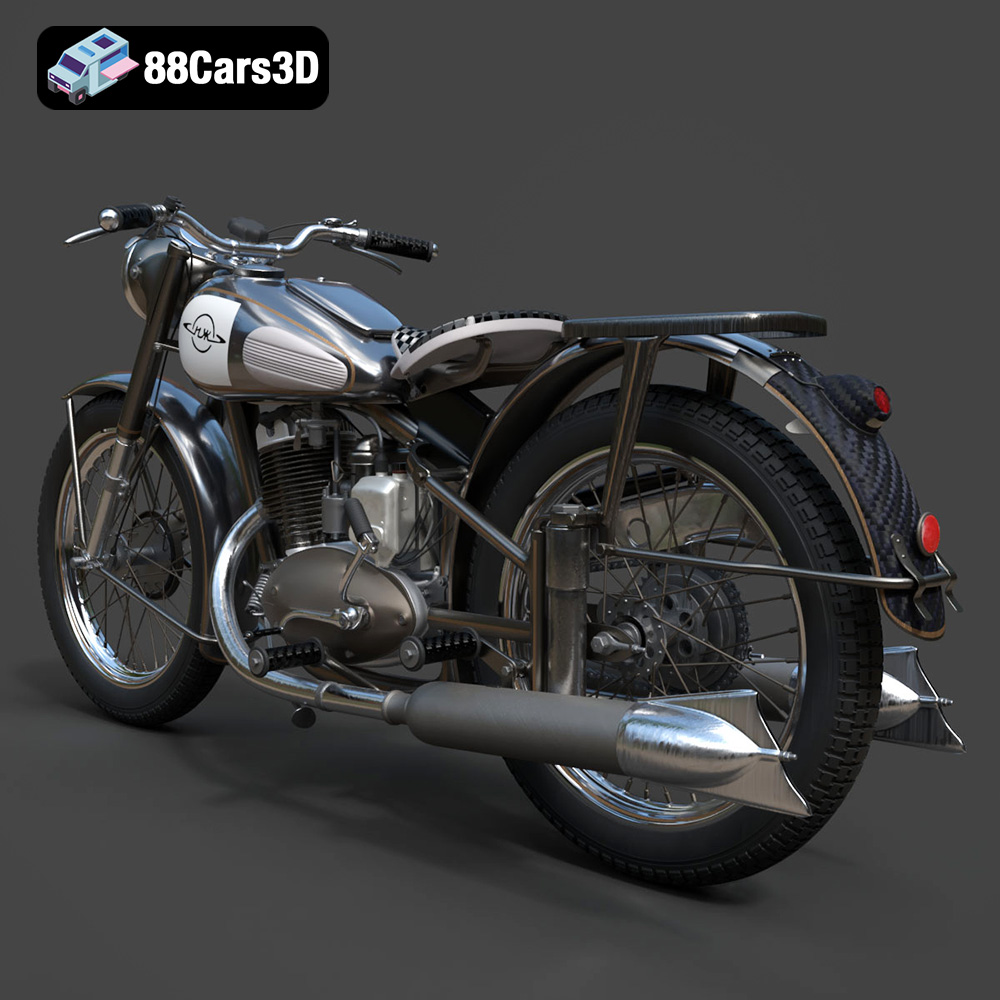
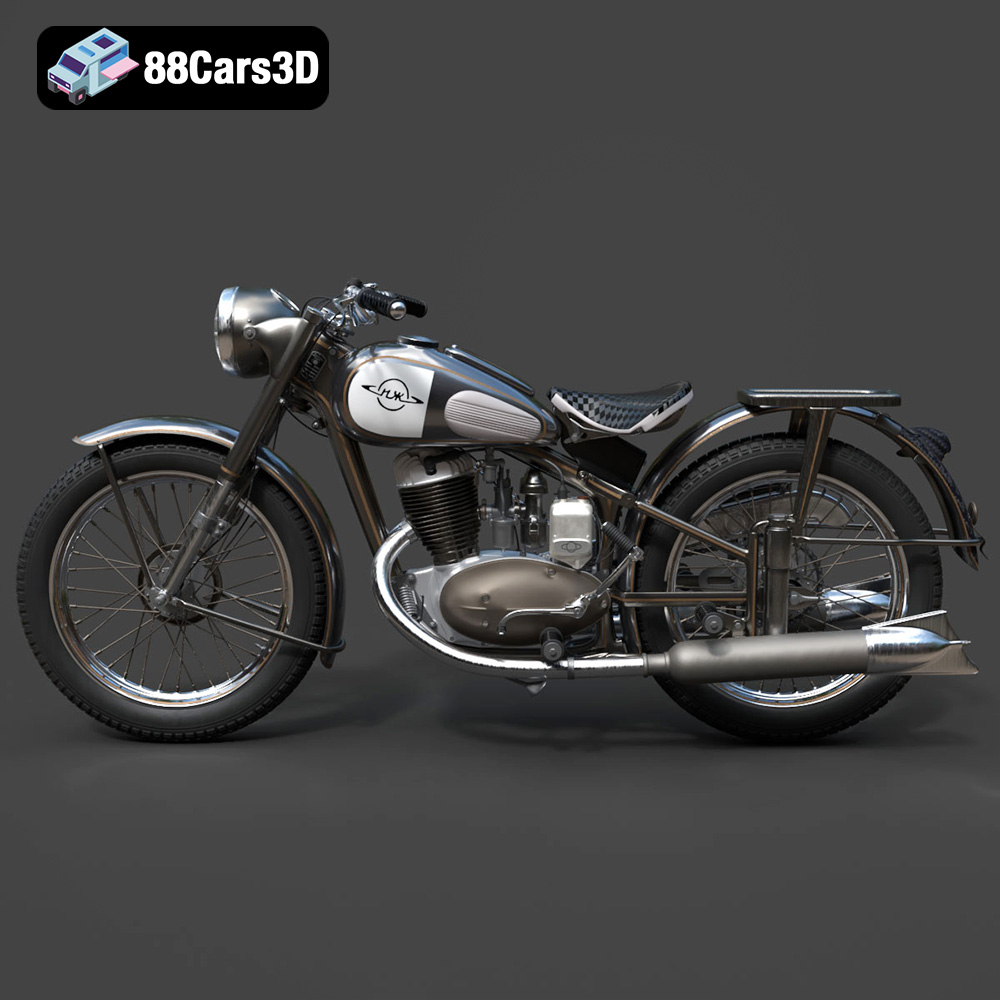
The exterior of the IZ-49 is a masterclass in mid-century industrial design, characterized by its utilitarian form and robust appearance. The 3D model meticulously recreates these elements. The distinct rounded vintage-style fuel tank, a signature feature, is accurately sculpted, reflecting the manufacturing techniques and aesthetic preferences of the 1950s. The classic front and rear fenders, designed for practical function over flashy ornamentation, are replicated with their correct curvature and proportions. Critical details like the period-correct headlamp housing, often a focal point, are modeled with precision. The spoked wheels, a quintessential element of classic motorcycles, are rendered with realistic hub detailing, ensuring that even close-up shots maintain their authenticity. This attention to every visible component makes the model an exceptional resource for automotive rendering and historical visualization, allowing creators to place the IZ-49 convincingly into any retro scene.
Beyond its visible exterior, the IZ-49 Classic Motorcycle 3D Model delves into the underlying mechanical structure, which is crucial for dynamic realism and educational applications. The detailed single-cylinder engine block, the heart of the motorcycle, is not merely a placeholder but a carefully constructed component that reflects the original’s engineering. The modeled suspension system, complete with exposed springs and linkages, is essential for any animation or simulation where the motorcycle interacts with terrain. The chain drive assembly, often overlooked in less detailed models, is present and accurately represented, adding to the mechanical realism. Furthermore, the realistic exhaust pipe routing follows the original’s path, contributing to both aesthetic accuracy and potential for dynamic visual effects like exhaust smoke. This level of mechanical detail ensures that the model is not only visually stunning but also technically sound, capable of supporting complex animations and even engineering analyses.
The versatility of the IZ-49 Classic Motorcycle 3D Model makes it an invaluable asset across various professional domains. Its high-quality construction ensures it can be integrated into demanding projects, from static renders to interactive real-time environments.
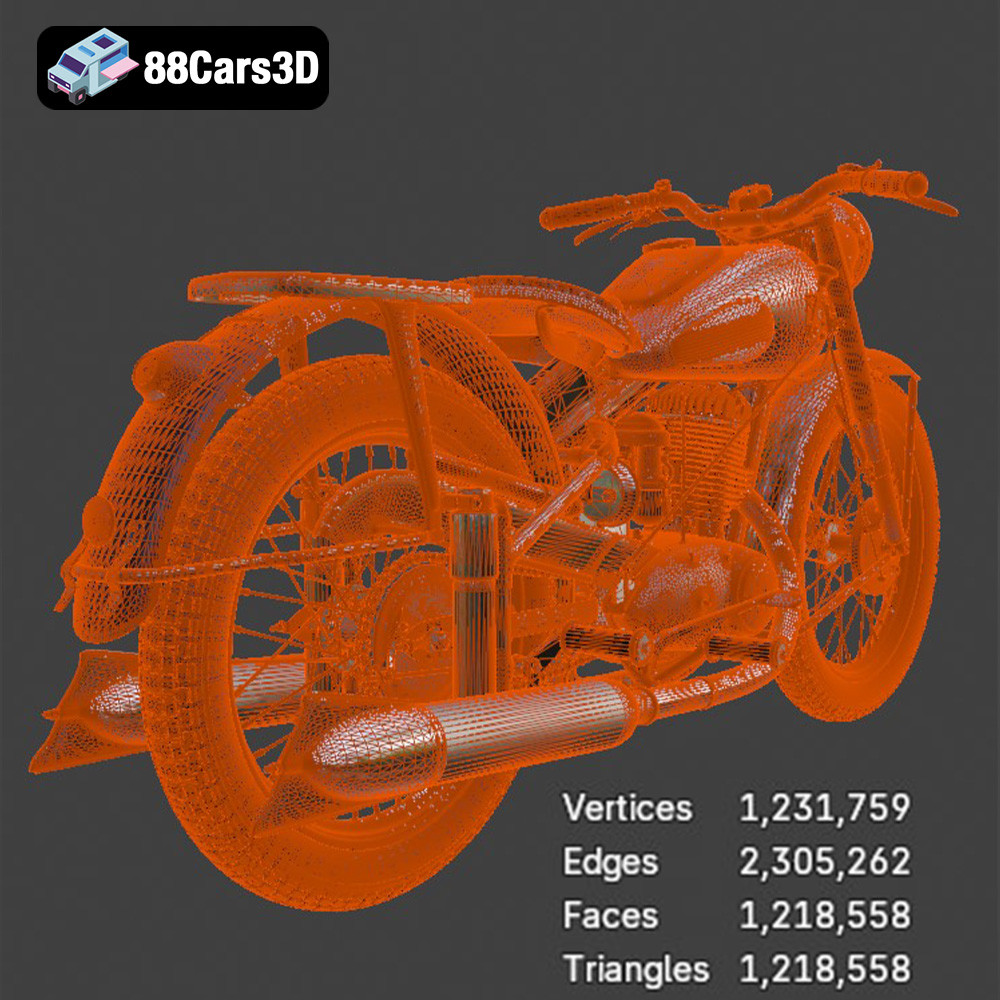
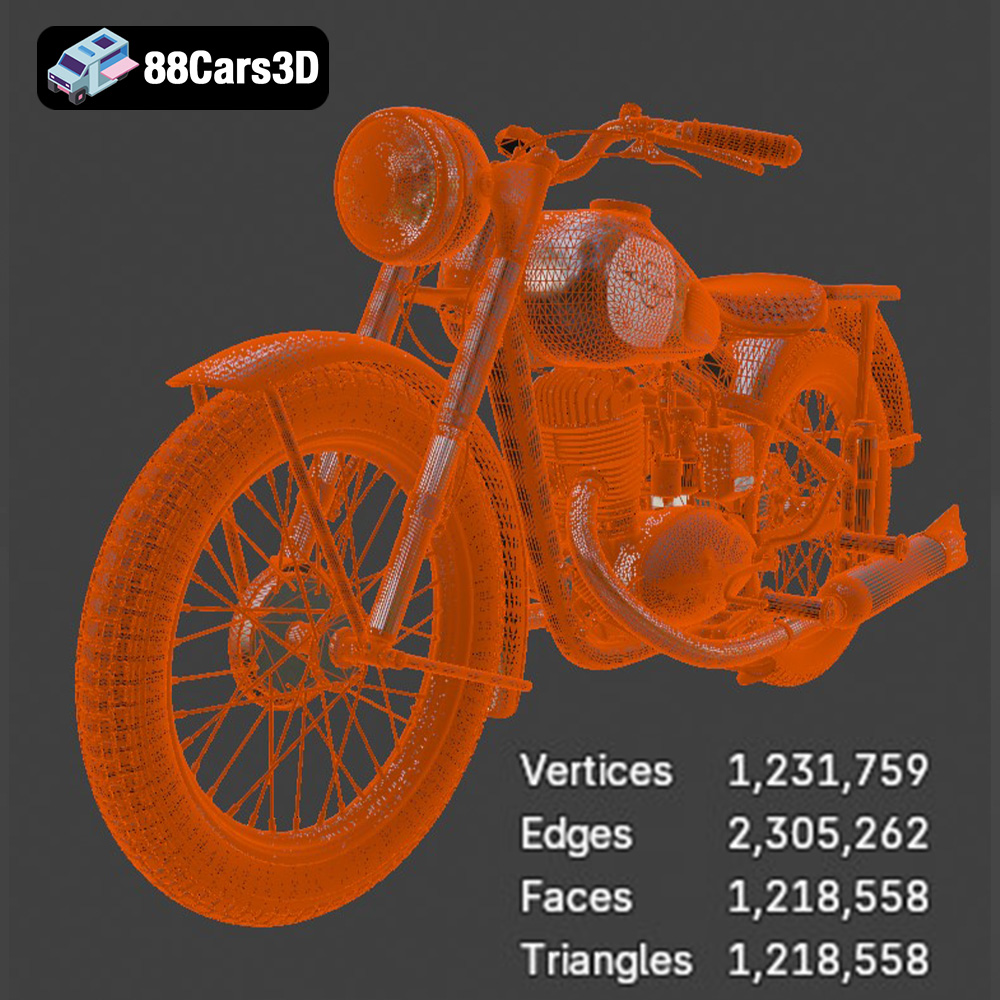
For artists focused on achieving photorealistic results, the IZ-49 model provides an excellent starting point. In software like 3ds Max, paired with renderers such as V-Ray or Corona, or in Blender using Cycles or Eevee, the model’s clean topology and real-world scale are significant advantages. Artists can apply advanced materials, leveraging PBR (Physically Based Rendering) textures for metallic paint, worn leather on the seat, and weathered chrome details. The proper pivot setup for wheels and steering allows for quick posing or even intricate cinematic animations, depicting the motorcycle in motion or as part of a historical narrative. Imagine the IZ-49 as the centerpiece of a vintage advertising campaign, a focal point in a historical documentary’s CGI sequence, or a museum exhibit’s virtual walkthrough. The model’s inherent quality significantly reduces the time spent on mesh cleanup and re-modeling, allowing artists to focus on lighting, texturing, and scene composition to achieve stunning automotive rendering.
The optimization of the IZ-49 Classic Motorcycle 3D Model for real-time engines makes it a powerful asset for game development and AR/VR experiences. The model’s “optimized mesh for real-time engines” (as stated in its description) implies careful poly-count management and efficient UV mapping. When integrated into Unreal Engine or Unity using the .fbx or .unreal formats, developers can quickly set up the model with appropriate LODs (Levels of Detail) to ensure smooth performance across various platforms. Collision meshes can be generated or custom-fit to allow for realistic in-game physics. For historical open-world games or retro driving simulations, the IZ-49 offers an authentic vehicle that can populate environments or serve as a player-controlled asset. In AR/VR, its accurate proportions and optimized geometry facilitate immersive historical demonstrations, allowing users to interact with a life-sized virtual IZ-49, inspect its details, and even hear its imagined engine roar in an interactive museum experience. The focus on technical advantages like “clean and well-organized mesh structure” and “proper pivot setup” directly translates to streamlined workflows in these performance-critical applications, making it a stellar example of game assets for developers.
One of the most exciting applications for high-quality 3D models today is 3D printing, transforming digital designs into tangible objects. The IZ-49 Classic Motorcycle 3D Model is expressly designed for this purpose, offering the unique opportunity to hold a piece of history in your hands.
The journey from a digital .stl file to a physical model involves careful consideration of the 3D print settings. The IZ-49 model’s inherent clean topology and manifold geometry (essential for 3D printing) ensure a smooth translation. Recommended scales of 1:18, 1:12, 1:10, or 1:8 allow for various sizes of collectible vintage motorcycle models, catering to different display preferences. For FDM (Fused Deposition Modeling) printers, a layer height of 0.08–0.16 mm is suggested, striking a balance between detail and print time. Resin printers (SLA/DLP) could achieve even finer detail, particularly for the smaller, intricate components like the engine fins or spokes. The specified wall thickness of 1.5–2.5 mm ensures structural integrity, while an infill of 15–25% provides sufficient strength without excessive material use. The recommendation for separate wheels and steering components for animation (as noted in the product description) is also highly beneficial for 3D printing, allowing these parts to be printed individually for easier post-processing and assembly of a movable replica.
Achieving a truly museum-quality 3D printed model of the IZ-49 goes beyond just the print itself. Post-processing is a critical step. The model’s description recommends supports for challenging areas like the exhaust pipe, handlebars, and fender edges, which are delicate and prone to warping during printing. The suggested print orientation, with the frame angled for optimal detail and wheels printed separately, helps minimize visible layer lines and maximize surface quality. Once printed, steps like sanding, priming, and applying a vintage matte paint finish are essential to mask print imperfections and achieve a realistic aesthetic. Customization options, such as using military green, black, red, or classic cream paint colors, allow for personal touches or historically accurate variations. Optional weathering effects, such as subtle rust, chipped paint, or worn chrome, can further enhance the realism, transforming a plastic print into a convincing miniature replica of a battle-hardened or well-loved classic motorcycle. This detailed guidance ensures that even hobbyists can produce impressive results, making the IZ-49 an accessible and rewarding project for any 3D printing enthusiast.
The true power of a professional 3D asset like the IZ-49 Classic Motorcycle 3D Model lies not just in its initial quality but also in its adaptability. Creators rarely use an asset straight out of the box; instead, they integrate it into unique scenes and narratives. The IZ-49 is built with this flexibility in mind, making it suitable for a wide array of creative endeavors.
The ability to customize materials and textures is paramount for artists. The IZ-49 model allows for extensive modifications to its appearance. Imagine changing its paint color from a standard military green to a deep, glossy black or a vibrant, period-correct red. This simple change can dramatically alter the motorcycle’s character, fitting it into different historical contexts or artistic visions. Beyond color, artists can apply weathered or restored finishes, depicting a motorcycle recently unearthed from a barn or one meticulously brought back to its showroom glory. Modifying the seat texture or material – perhaps from a worn leather to a freshly upholstered vinyl – adds another layer of realism and customization. These options enable the IZ-49 to seamlessly integrate into diverse projects, whether it’s a gritty post-apocalyptic scene or a pristine museum display.
The environment and lighting play a crucial role in bringing any 3D model to life. The IZ-49’s “real-world scale accuracy” and “proper pivot setup” simplify its placement and interaction within any scene. Artists can adjust lighting for studio setups, highlighting its mechanical details with sharp, controlled illumination, perfect for product showcases or engineering visualizations. Alternatively, they can immerse it in historical scene setups, using soft, ambient lighting to evoke a nostalgic mood or dramatic, low-key lighting for a suspenseful cinematic shot. Adding period-correct decals, like manufacturer logos or regulatory stickers, further enhances its authenticity and historical context. This adaptability ensures that the IZ-49 Classic Motorcycle 3D Model is not just a static object but a dynamic narrative element, ready to be molded to the specific needs of any project requiring authentic 3D car models or historical vehicles.
In the fast-paced world of 3D production, time is a valuable commodity. Building highly detailed 3D car models and other complex assets from scratch can be incredibly time-consuming and resource-intensive, often requiring specialized expertise that may not be available for every project. This is where online marketplaces like 88cars3d.com provide immense value, offering a curated selection of professional-grade 3D models.
Choosing assets from 88cars3d.com ensures that you’re starting with a solid foundation. Models like the IZ-49 Classic Motorcycle are developed with “clean and well-organized mesh structure,” “real-world scale accuracy,” and “optimized polygon flow for performance and realism.” These technical advantages mean less time spent on cleaning up geometry, fixing UVs, or optimizing meshes for different platforms. For game developers, this translates to faster iteration cycles for game assets; for automotive rendering specialists, it means more time on artistic direction rather than technical troubleshooting. The extensive file format support, as demonstrated by the IZ-49, guarantees compatibility across major 3D software platforms and engines, streamlining workflows regardless of your preferred tools.
Ultimately, investing in high-quality, pre-made 3D models frees up creative professionals to focus on innovation and storytelling. It empowers smaller studios and individual artists to achieve results comparable to larger productions, making premium assets accessible. When you choose a model from 88cars3d.com, you’re not just buying a file; you’re acquiring a meticulously crafted piece of digital artistry ready to elevate your next project.
The IZ-49 Classic Motorcycle 3D Model is more than just a collection of polygons and textures; it’s a meticulously crafted digital artifact that bridges history with modern technology. Its accurate representation of the iconic mid-20th century Soviet motorcycle provides a versatile asset for a broad spectrum of creative industries. From stunning high-fidelity automotive rendering in cinematic sequences to being a crucial game asset in immersive historical simulations, and even transforming into a tangible collectible through 3D printing, the IZ-49 model exemplifies the potential of high-quality digital assets.
Its comprehensive file format support ensures seamless integration into virtually any professional pipeline, empowering artists and developers with flexibility and efficiency. The attention to historical detail, coupled with technical optimization, makes this model a testament to superior 3D craftsmanship. Whether you are an architectural visualizer, a game designer, an AR/VR content creator, or a 3D printing enthusiast, the IZ-49 Classic Motorcycle 3D Model offers a rich foundation for your creative visions. Explore this and other exceptional 3D car models and vehicles at 88cars3d.com, and bring your historical narratives and digital worlds to life with unparalleled authenticity.
The IZ-49 Classic Motorcycle 3D Model is a high-detail digital recreation of the iconic mid-20th century Soviet motorcycle known for its simplicity, durability, and post-war engineering heritage. Originally produced between 1951 and 1958, the IZ-49 became a symbol of reliable transportation across Eastern Europe. This 3D model accurately represents the vintage steel frame, rounded fuel tank, single-cylinder engine configuration, classic spoked wheels, exposed suspension components, rear luggage rack, and period-correct exhaust system. Designed with clean topology and real-world proportions, it is ideal for rendering, animation, historical visualization, simulation, and game development. Perfect for retro street scenes, museum displays, historical reconstructions, cinematic projects, and vintage motorcycle collections.
$25.9
.arvr
.blend
.classicmotorcycle
.fbx
.gameasset
.glb
.historicalvehicle
.iz49
.max
.motorcycle3dmodel
.obj
.ply
.rendering
.retrovehicle
.simulation
.sovietbike
.stl
.unreal
.vintagemotorcycle