Get 50% OFF All Premium 3D & STL Models!

In the dynamic world of digital content creation, the demand for high-fidelity, performance-optimized 3D models is constantly accelerating. From immersive video games and cutting-edge AR/VR experiences to photorealistic marketing visualizations and even physical 3D prints, the quality of your automotive assets can define the success of your project. Modern-classic motorcycles, with their unique blend of heritage aesthetics and contemporary engineering, offer particularly compelling subjects for digital artists.
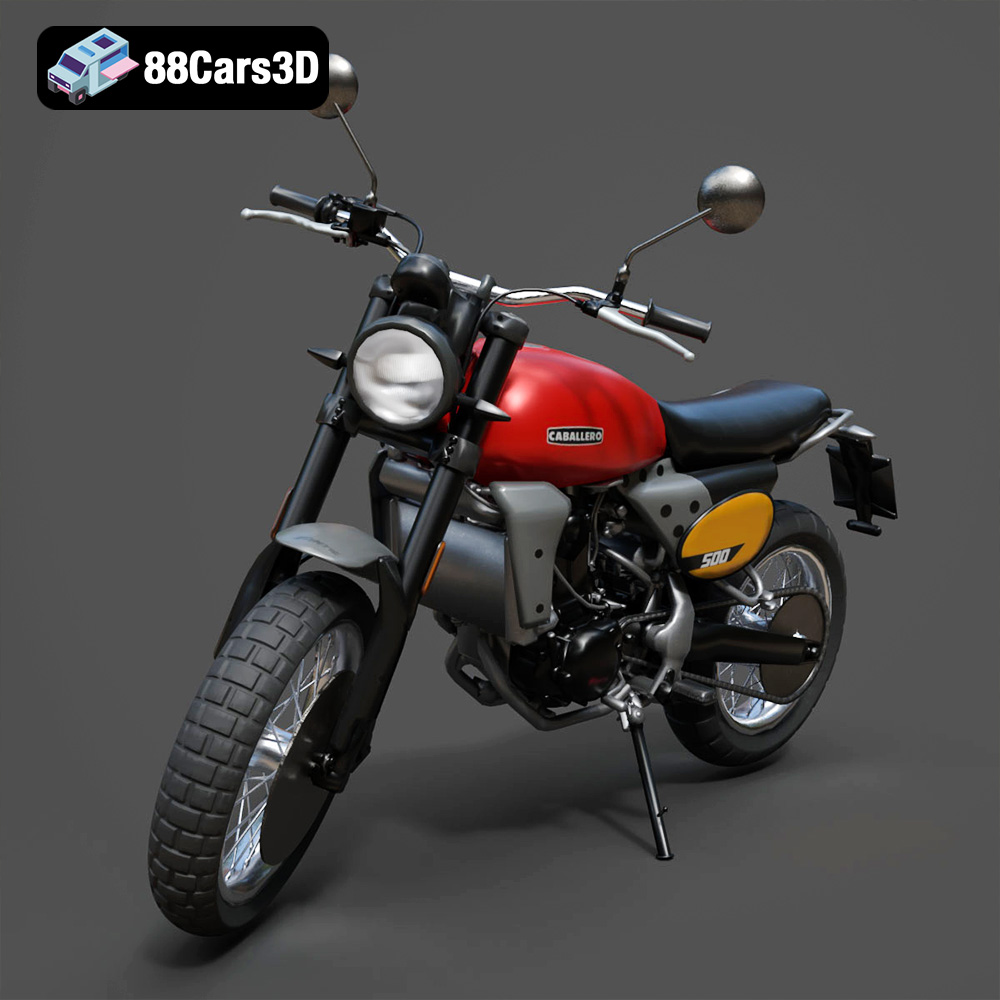
Today, we delve into the intricate details of what makes a truly exceptional 3D automotive asset, using a standout example from 88cars3d.com: the Fantic Caballero 500 Scrambler 3D Model. This asset perfectly embodies the rugged charm of the iconic Italian scrambler, a machine known for its distinctive 1970s retro dirt-track aesthetics, punchy single-cylinder engine, and aggressive stance. We’ll explore its technical prowess, versatile applications, and how such high-quality 3D models can elevate your creative workflows across various industries.
Navigating the landscape of 3D modeling often begins with understanding the myriad of file formats available. Each format serves a specific purpose, offering unique advantages depending on your project’s requirements, software ecosystem, and intended final output. The Fantic Caballero 500 Scrambler 3D Model, for instance, comes equipped in a comprehensive suite of formats, ensuring maximum compatibility and utility. Let’s break down the most crucial ones:
The .blend file is the native format for Blender, a powerful, open-source 3D creation suite. When you acquire a .blend file, you’re getting a complete Blender scene, often including the raw mesh data, materials, textures, lighting setups, cameras, and even animation rigs. This format is ideal for artists deeply integrated into the Blender ecosystem, allowing for full editability, modifications, and seamless integration into existing Blender projects. For the Fantic Caballero, the .blend file would offer unhindered access to every component, perfect for advanced customization, re-texturing, or preparing unique renders within Blender.
Autodesk’s .fbx (Filmbox) format is arguably the most widely adopted interchange format in the 3D industry, particularly popular for game development and animation pipelines. It’s renowned for its robust support of geometry, materials, textures, animations, and skeletal data. This makes it an ideal choice for transferring assets between different DCC (Digital Content Creation) applications like 3ds Max, Maya, Blender, and directly into game engines such as Unreal Engine and Unity. The Fantic Caballero 500 Scrambler 3D Model in .fbx format is therefore perfect for real-time applications, offering a highly compatible and efficient way to integrate the motorcycle into your interactive environments.
The .obj (Wavefront Object) format is a venerable and highly universal standard for representing 3D geometry. It’s a text-based format that primarily stores vertex positions, UV coordinates, normals, and face information. While it doesn’t typically encapsulate advanced features like animation or rigging, its widespread compatibility across virtually all 3D software makes it an indispensable “lowest common denominator” for model exchange. If you need to import the Fantic Caballero into a niche software or require a clean mesh for further sculpting, .obj is a reliable choice for cross-software compatibility.
.glb (GL Transmission Format, binary version) is a relatively newer format specifically designed for efficient transmission and loading of 3D scenes and models in web and immersive environments. It’s a single-file format that bundles geometry, materials, textures, and animations, making it incredibly streamlined for AR, VR, and browser-based 3D displays. For showcasing the Fantic Caballero in a web configurator, a mobile AR application, or a virtual showroom, the .glb variant ensures optimal performance and a seamless user experience, crucial for contemporary digital marketing and interactive product displays.
.stl (Stereolithography) is the de facto standard for 3D printing. This format represents a 3D model as a series of connected triangles, defining its surface geometry without any color, texture, or material information. It’s essentially a blueprint for a physical object. The Fantic Caballero 500 Scrambler 3D Model’s availability in .stl format means it’s ready to be sent to a 3D printer, allowing enthusiasts to bring this digital masterpiece into the physical world as a collectible scale model. Proper manifold geometry is critical for .stl, ensuring a watertight mesh suitable for fabrication.
The .ply (Polygon File Format) is often used for storing 3D scanner data and CAD models. It’s more versatile than .obj, as it can store not only geometry but also properties like color, transparency, normals, texture coordinates, and even reliability information. While less common for general asset exchange than .fbx, .ply offers a robust solution for precision mesh data, often seen in scientific visualization, reverse engineering, or when exact geometric fidelity with additional per-vertex data is paramount. The inclusion of .ply for the Fantic Caballero model underscores its precision and suitability for detailed analysis or specific manufacturing workflows.
While not a standalone file extension in the same vein as .fbx or .obj, “.unreal” in this context typically refers to an asset that has been meticulously prepared and optimized for direct integration into Unreal Engine projects. This usually means an .fbx file that has been imported, had its materials and textures set up, collisions defined, LODs (Levels of Detail) generated, and possibly even Blueprints created within the Unreal Editor. It signifies a “plug-and-play” asset, saving developers considerable time and effort in the setup phase. For the Fantic Caballero 500 Scrambler 3D Model, this means the asset is delivered ready to be dropped into a level, instantly enhancing your game or real-time simulation with minimal fuss.
The .max file is the native project format for Autodesk 3ds Max, a leading software for 3D modeling, animation, rendering, and visualization. Similar to .blend, a .max file contains the complete scene data, including all models, materials, lights, cameras, and animation tracks. For professionals working within a 3ds Max pipeline, this format offers the highest degree of flexibility and control, allowing for detailed modifications, scene setup, and the leverage of 3ds Max’s powerful rendering capabilities. The Fantic Caballero in .max format ensures that artists can tap into all the features of 3ds Max for their architectural renders, product visualizations, or cinematic animations.
The comprehensive range of formats provided for the Fantic Caballero 500 Scrambler 3D Model highlights its adaptability, catering to diverse professional needs and ensuring it’s a valuable addition to any digital artist’s toolkit, regardless of their preferred software or final application.
Creating 3D car models or motorcycles for real-time applications like video games and AR/VR demands a delicate balance between visual fidelity and performance efficiency. The Fantic Caballero 500 Scrambler 3D Model exemplifies this crucial balance, boasting a game-ready optimized topology while retaining a stunning level of detail.
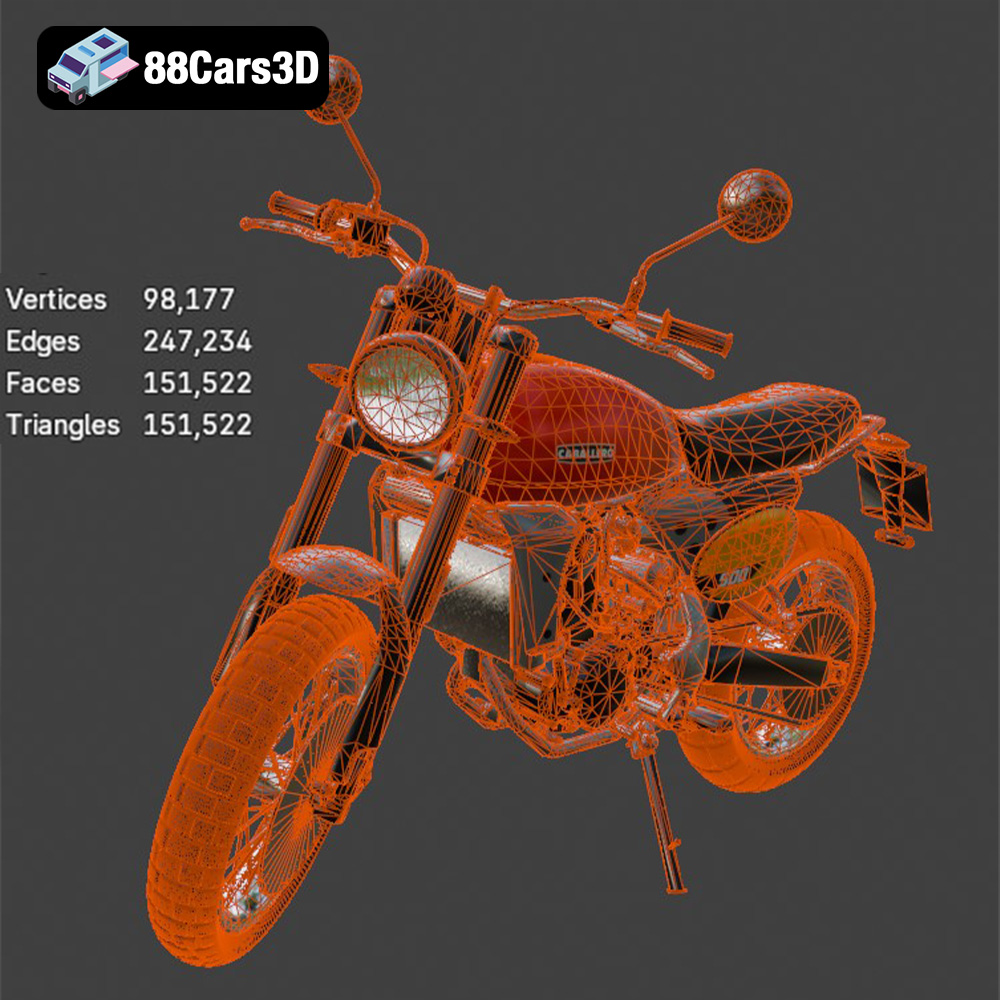
The term “game-ready” is not merely a marketing buzzword; it refers to a meticulous modeling process aimed at creating assets that look great without bogging down a game engine. The Fantic Caballero model, with its impressive 151,522 triangles, is a testament to this principle. For a complex vehicle, this poly count strikes a sweet spot. It’s high enough to capture the intricate curves of the fuel tank, the exposed engine block, and the aggressive knobby tires, yet low enough to be rendered efficiently across multiple instances in an open-world game or a bustling scene without causing performance bottlenecks. Clean edge flow and strategic polygon distribution are key here, ensuring the model deforms correctly if animated and renders smoothly at various distances.
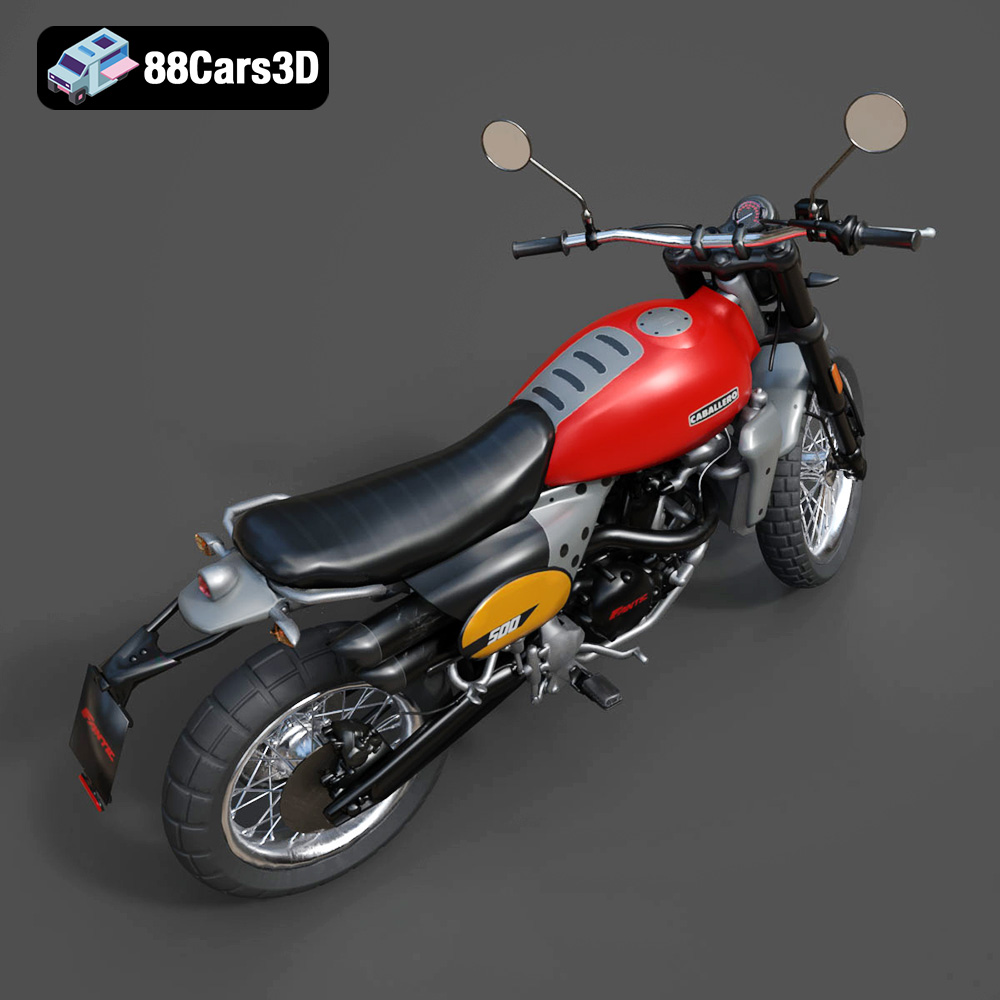
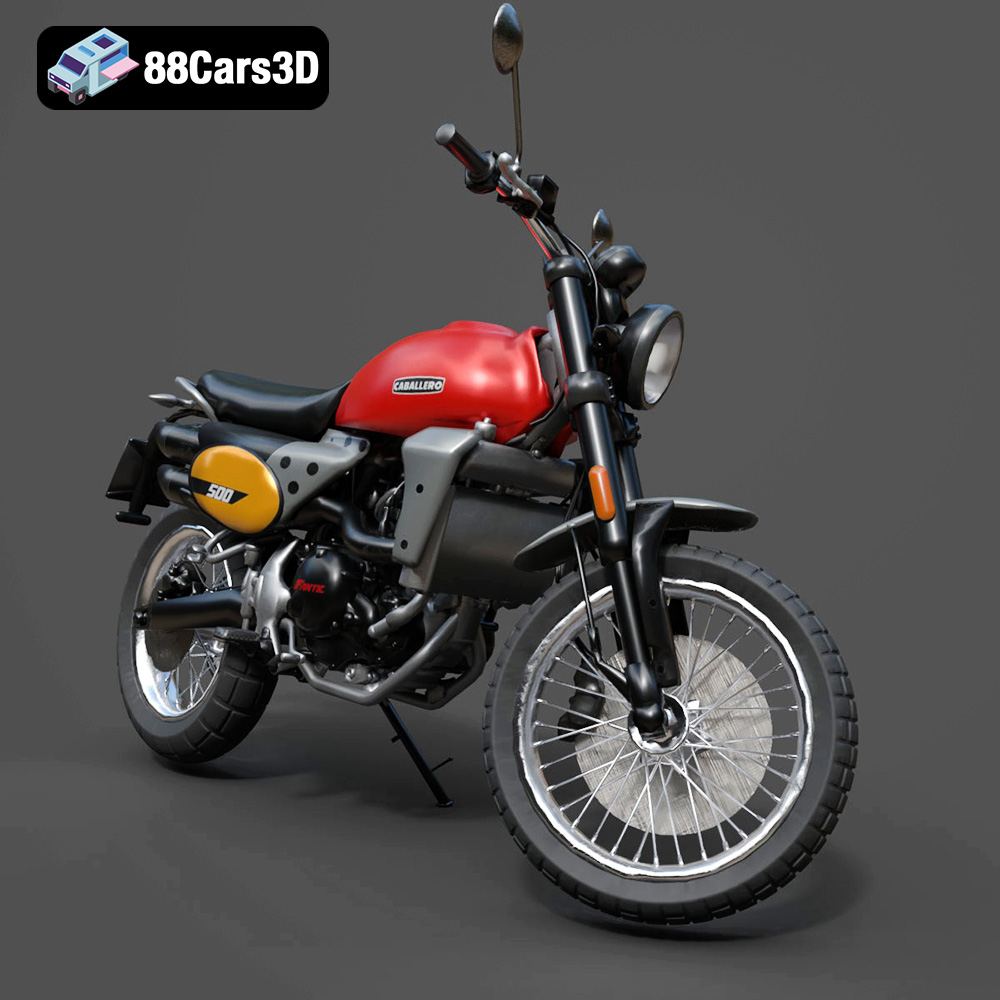
Beyond the raw poly count, true quality lies in the accurate representation of the original design. The Fantic Caballero 500 Scrambler 3D Model excels in this regard, meticulously capturing the motorcycle’s distinctive features: the classic round LED headlight, the signature dual-exit high-mount Arrow exhaust, the detailed USD (upside-down) front forks, and the authentic badging on the teardrop fuel tank. Every component, from the handlebars with their grips and levers to the minimalist digital instrument cluster, is modeled with precision. This attention to detail is critical for automotive rendering, where realism is paramount, ensuring that the digital model is instantly recognizable and evokes the same feeling as its real-world counterpart.
A well-engineered 3D vehicle model isn’t just a static mesh; it’s a collection of interconnected parts designed for dynamic interaction. The Fantic Caballero model features separate components for animation, including individual wheels, suspension forks, and steering elements. This modularity is vital for game development, allowing developers to implement realistic physics for suspension travel, wheel rotation, and responsive steering. For cinematic animations, it means animators have direct control over each moving part, facilitating the creation of engaging sequences that showcase the motorcycle in action. The proper pivot setup for these components further streamlines the animation process, saving valuable production time.
While game development is a major driver for high-quality 3D assets, the utility of models like the Fantic Caballero 500 Scrambler 3D Model extends far beyond interactive entertainment. Its robust design and versatile file formats make it an ideal candidate for various visualization and immersive technology applications.
In the realm of automotive rendering, realism is king. Marketing campaigns, product configurators, and brand showcases rely heavily on photorealistic visuals to capture audience attention. The Fantic Caballero model, with its accurate real-world scale and detailed geometry, is an excellent base for generating stunning renders. Artists can leverage advanced rendering engines (like V-Ray, Octane, or Cycles) to apply sophisticated materials – glossy paints, textured leathers, metallic exhausts, and rubber knobby tires – and set up studio-quality lighting. This allows for the creation of compelling images and animations that highlight the bike’s design, rugged appeal, and lifestyle potential, making it invaluable for lifestyle brand campaigns and product visualization.
Augmented Reality (AR) and Virtual Reality (VR) are transforming how consumers interact with products. Imagine a virtual motorcycle showroom where prospective buyers can walk around the Fantic Caballero, change its color, or even “sit” on it in VR. Or an AR experience where the bike appears in their driveway through a smartphone camera. The Fantic Caballero 500 Scrambler 3D Model is perfectly suited for such applications. Its optimized polycount ensures smooth performance on mobile devices and VR headsets, while the availability of .glb format offers efficient web-based and mobile deployment. This enables businesses to create engaging, interactive experiences that bring the motorcycle to life in a new dimension, driving engagement and sales.
A motorcycle like the Fantic Caballero isn’t just a machine; it represents a lifestyle. 3D models allow brands to tell rich, immersive stories without the cost and logistical challenges of physical photoshoots. With this 3D model, creators can place the Caballero in any conceivable environment – tearing through a rugged off-road track, parked outside a retro urban cafe, or cruising along a scenic coastal highway. Customization options, such as changing fuel tank colors (e.g., Classic Fantic Red, Stealth Black) or adjusting seat materials, further enable tailored visual narratives. These digital environments and customizable assets offer unparalleled creative freedom to craft compelling visual content for advertising, social media, and digital brochures.
The journey of a 3D model doesn’t always end on a digital screen. For many enthusiasts and professionals, the ability to translate a virtual asset into a tangible object is a fascinating and rewarding aspect of 3D design. The Fantic Caballero 500 Scrambler 3D Model is specifically designed with 3D printing in mind, providing an exciting avenue for hobbyists and collectors.
When transitioning from a screen-based model to a physical print, careful preparation is paramount. The .stl format, which captures the model’s geometric surface, is the gateway to 3D printing. A key technical consideration here is ensuring the model’s “manifold geometry,” meaning it has a watertight, closed surface without any gaps or intersecting faces. The Fantic Caballero model is structured to meet these requirements, ensuring a clean export to .stl that can be readily interpreted by slicing software for successful printing. Hobbyists can scale the model to their preferred size (e.g., 1:12, 1:10, 1:8), allowing for various display scales.
Achieving a high-quality physical replica requires precise print settings. For the intricate details of the Fantic Caballero, resin printing (SLA/DLP) is highly recommended. Resin printers excel at capturing fine features like the delicate spokes of the wheels, the cooling fins on the engine, and the aggressive tread on the knobby tires, thanks to their ability to achieve very low layer heights (0.04–0.12 mm). If using FDM (filament) printing, slightly thicker walls (1.2–2.0 mm) and higher infill (20–30%) are suggested for structural integrity. Supports will be necessary for overhangs like the handlebars, high-mount exhaust, kickstand, and footpegs. After printing, post-processing steps such as sanding, priming, and painting (perhaps the classic Fantic Red for the tank or matte black for the frame) are crucial to achieve a showroom-quality miniature.
The ability to 3D print the Fantic Caballero 500 Scrambler 3D Model opens up a world of possibilities for collectors and designers alike. For enthusiasts, it means owning a customized, physical representation of their favorite modern-classic motorcycle, perfect for display on a desk or shelf. For automotive designers and product developers, 3D printing offers a rapid prototyping solution. Before committing to expensive tooling, physical mock-ups can be produced to evaluate proportions, ergonomics, or simply to get a tactile feel for the design. This blend of digital precision and physical tangibility adds another layer of value to a meticulously crafted 3D asset like the Caballero, found on platforms such as 88cars3d.com.
The true power of a high-quality 3D model lies in its seamless integration into various professional workflows. The Fantic Caballero 500 Scrambler 3D Model is designed for maximum compatibility, allowing artists and developers to use it across their preferred software and engines.
For artists leveraging Blender, the included .blend file offers the most direct and efficient integration. Upon opening, the Fantic Caballero will appear with its full material setup, ensuring a quick start for customization. Blender’s powerful modeling tools allow for further modifications, such as changing tire textures from knobby off-road to smooth street tires to create a ‘Flat Track’ variant, or adjusting seat materials for a distressed leather look. Its Cycles and Eevee renderers provide excellent options for producing high-quality stills or animations, from photorealistic studio shots to dynamic outdoor scenes. The proper pivot setup for steering, wheel rotation, and suspension travel simplifies animation tasks within Blender, making it a robust platform for both artistic and technical endeavors.
Game developers and real-time visualization artists will find the Fantic Caballero 500 Scrambler 3D Model exceptionally well-suited for Unreal Engine. The .fbx format is the go-to for importing into Unreal, and with the “engine-ready” designation (often implying a pre-configured Unreal asset package or optimally structured FBX), much of the initial setup is already handled. Developers can import the model, and often, its materials and textures will be recognized, requiring minimal adjustment. The optimized 151k triangle count is crucial here, allowing for the inclusion of multiple bikes in a scene without impacting performance. Artists can then set up dynamic lighting, integrate physics for realistic vehicle movement, and incorporate the bike into complex game levels or interactive architectural visualizations, making it an ideal game asset for any open-world title or racing simulator.
Professionals working within Autodesk 3ds Max can utilize the .max file for comprehensive project integration. This provides access to the native scene, allowing for advanced animation setups, sophisticated material adjustments using V-Ray or Corona renderers, and integration into large-scale environments like urban street scenes or architectural visualizations. 3ds Max’s robust tools for rigging and animation can be used to create highly detailed cinematic sequences, showcasing the Fantic Caballero in dynamic poses or as part of a larger narrative. Its ability to handle complex scene compositions makes it perfect for integrating the motorcycle into detailed environments, ensuring it sits perfectly within any professional production pipeline requiring precision and high-fidelity rendering.
One of the significant advantages of investing in a high-quality 3D model is the creative freedom it provides. The Fantic Caballero 500 Scrambler 3D Model is not just a static representation; it’s a versatile canvas for artistic expression and project-specific adaptation.
The ability to customize materials and textures is fundamental to tailoring a 3D model to unique project requirements. With the Fantic Caballero, artists can easily modify fuel tank colors, experimenting with classic Fantic Red, stealthy matte black, or even a rugged olive green to match different brand aesthetics or scene moods. The flat retro-style ribbed saddle geometry can be re-textured with various materials, from classic black ribbed vinyl to a distressed brown leather, dramatically altering the bike’s character. Swapping the aggressive knobby off-road tires for smooth street tires can transform the scrambler into a ‘Flat Track’ variant, expanding its utility across diverse visual narratives and making it a flexible 3D car model for various styles.
The motorcycle’s detailed modeling allows it to convincingly inhabit a wide array of environments. Whether you need it for a rugged off-road scene, an urban retro street environment, or a moody industrial backdrop, the Fantic Caballero adapts beautifully. Artists can adjust lighting to reflect a sunny dirt track, a dramatic sunset, or a gritty urban night ride, influencing the overall atmosphere. By placing the motorcycle in different contexts, creators can craft distinct narratives, appealing to varied audiences and fulfilling specific project briefs, such as a biker lifestyle campaign or a modern open-world video game sequence.
While the Fantic Caballero 500 Scrambler 3D Model is a complete asset in itself, its realism can be further enhanced by combining it with other elements. Integrating a rider model, adding environmental props like helmets, gear, or toolboxes, and incorporating detailed background assets can transform a simple render into a rich, believable scene. The model’s optimized geometry and real-world scale make it compatible with a vast library of external 3D assets, allowing artists to build intricate dioramas or expansive open worlds where the Caballero plays a central, convincing role. This capability underscores the model’s value as a foundational asset for any project requiring high-impact automotive rendering.
The journey through the intricacies of high-quality 3D motorcycle models reveals the profound impact that meticulously crafted assets can have across various digital and physical domains. The Fantic Caballero 500 Scrambler 3D Model stands as a prime example of this excellence, offering a perfect blend of visual fidelity, technical optimization, and versatile compatibility.
Whether your project demands game-ready assets for an open-world adventure, stunning visuals for automotive rendering and marketing campaigns, immersive experiences for AR/VR, or tangible collectibles through 3D printing, this model delivers. Its thoughtful topology, accurate detailing, and comprehensive range of file formats—from .blend and .max for native editing to .fbx and .unreal for real-time engines, and .stl for fabrication—ensure it fits seamlessly into any professional workflow.
Investing in such high-quality 3D car models and motorcycle assets not only streamlines production but also elevates the final output, providing a foundation for truly captivating digital experiences. For creators seeking exceptional 3D models that meet the highest standards of realism and performance, 88cars3d.com remains a trusted destination. The Fantic Caballero 500 Scrambler 3D Model is ready to power your next creative vision, transforming concepts into stunning realities, both on screen and in print.
The Fantic Caballero 500 Scrambler 3D Model is a highly detailed, optimized digital recreation of the iconic Italian modern-classic motorcycle. Blends 1970s retro dirt-track aesthetics with contemporary engineering, the Caballero 500 is famous for its rugged off-road stance, punchy single-cylinder engine, signature dual Arrow exhaust, and aggressive knobby tires. This 3D model accurately captures the essence of the scrambler lifestyle, featuring the classic round LED headlight, teardrop fuel tank with authentic badging, exposed steel tube frame, and flat dirt-style saddle. Built with incredibly clean, game-ready topology (just over 150k triangles), it delivers premium visual fidelity without bogging down real-time engines. It is the perfect asset for game development, AR/VR experiences, animation, and lifestyle automotive visualization. Perfect for rugged off-road scenes, urban retro street environments, biker lifestyle campaigns, and modern open-world video games.
$39.99
.blend
.fbx
.obj
.rendering
.scrambler
caballero-500
dirt-bike
fantic
flat-tracker
game asset
game-ready
low-poly
motorcycle-3d-model
optimized
retro-motorcycle
VR/AR