Get 50% OFF All Premium 3D & STL Models!

There’s an undeniable allure to the open road, a feeling of freedom encapsulated by the rumble of a V-twin engine and the glint of chrome under the sun. For automotive enthusiasts and digital creators alike, recreating this iconic experience in virtual realms presents both an exciting challenge and a vast opportunity. Whether you’re building a sprawling open-world game, crafting a realistic architectural visualization, or designing an immersive AR/VR experience, the demand for high-quality, performant 3D car models is consistently growing.
In the intricate world of 3D asset development, merely having a visually appealing model isn’t enough. It needs to be technically robust, optimized for its intended use, and versatile enough to integrate into various workflows. This is where precision-engineered assets, such as the Harley-Davidson Road King 3D Model (Game-Ready), truly shine. This particular model isn’t just a digital replica; it’s a meticulously crafted asset designed to deliver the quintessential American touring cruiser aesthetic with an emphasis on performance and flexibility. It serves as an excellent example of how expert 3D modeling bridges the gap between artistic vision and technical necessity, making it an invaluable addition to any professional’s toolkit.
Bringing a real-world icon like the Harley-Davidson Road King into a digital environment requires a deep understanding of its design language and engineering principles. It’s about more than just aesthetics; it’s about translating its essence into polygons and textures while ensuring it functions flawlessly in diverse digital contexts.
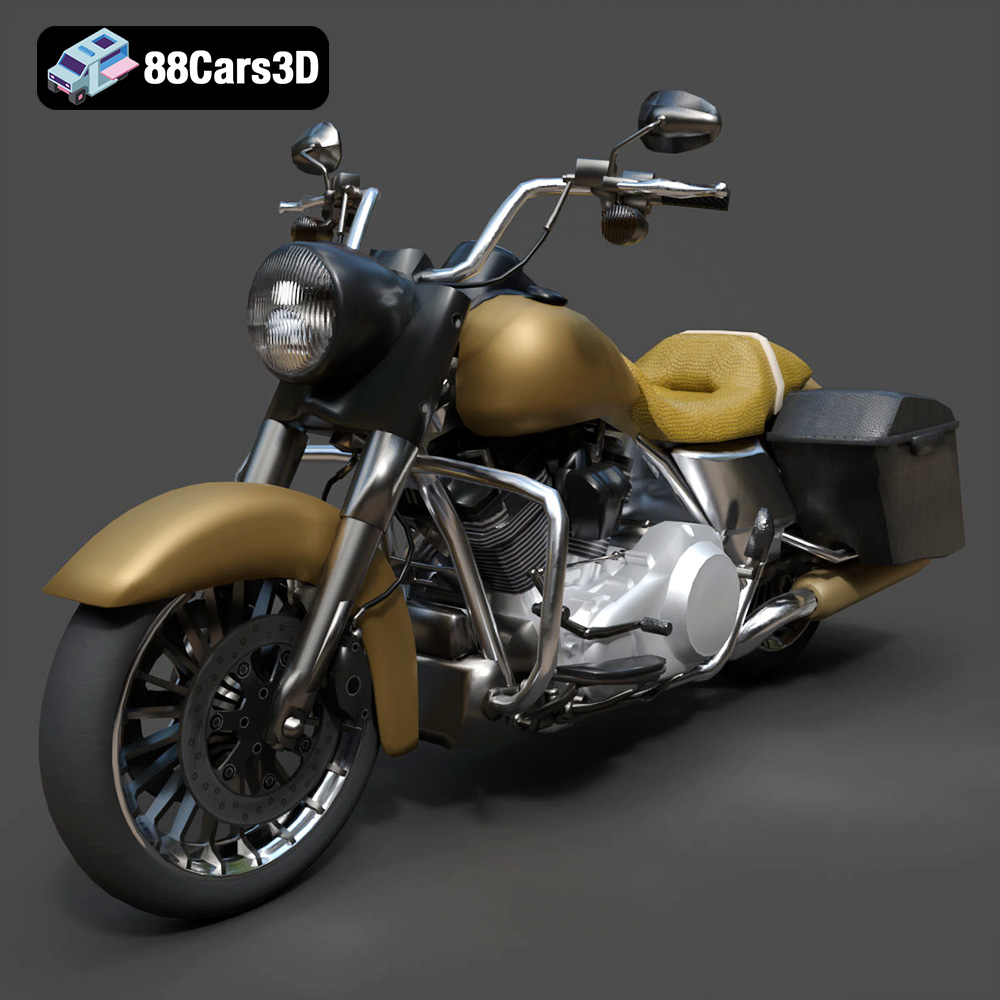
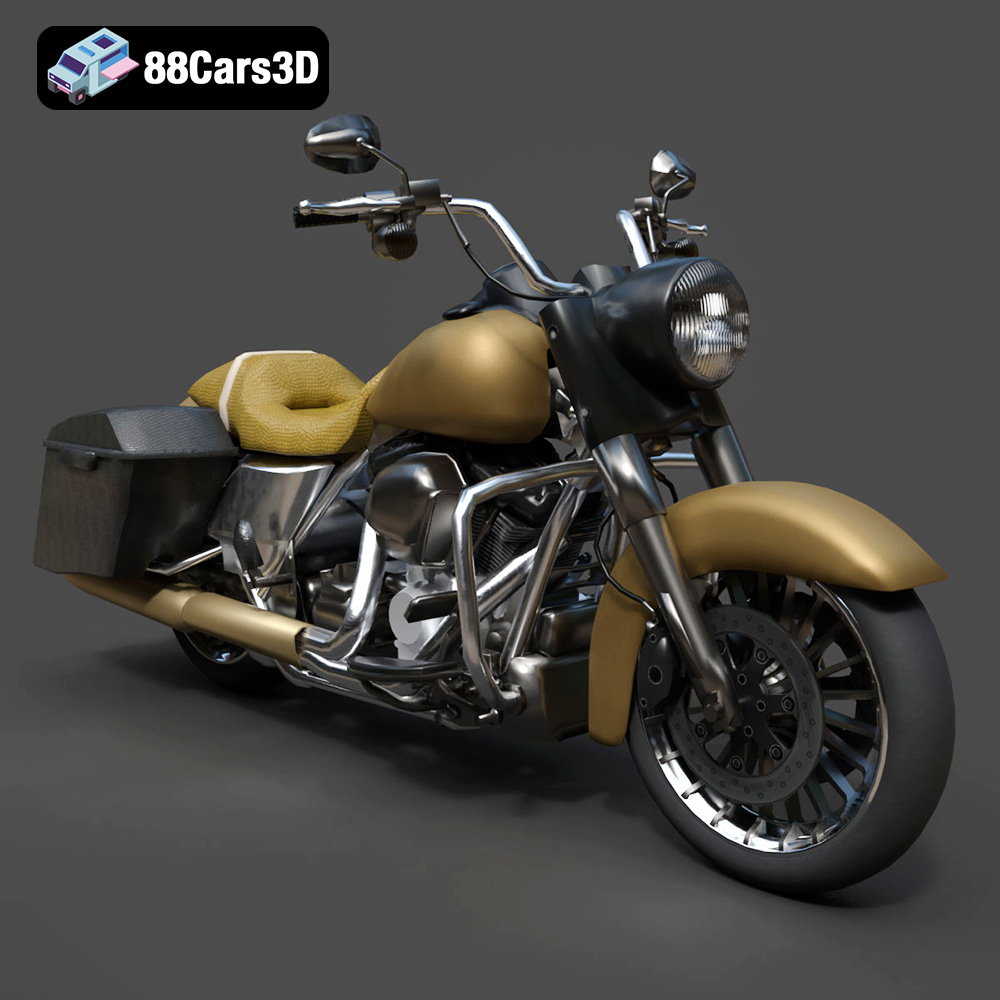
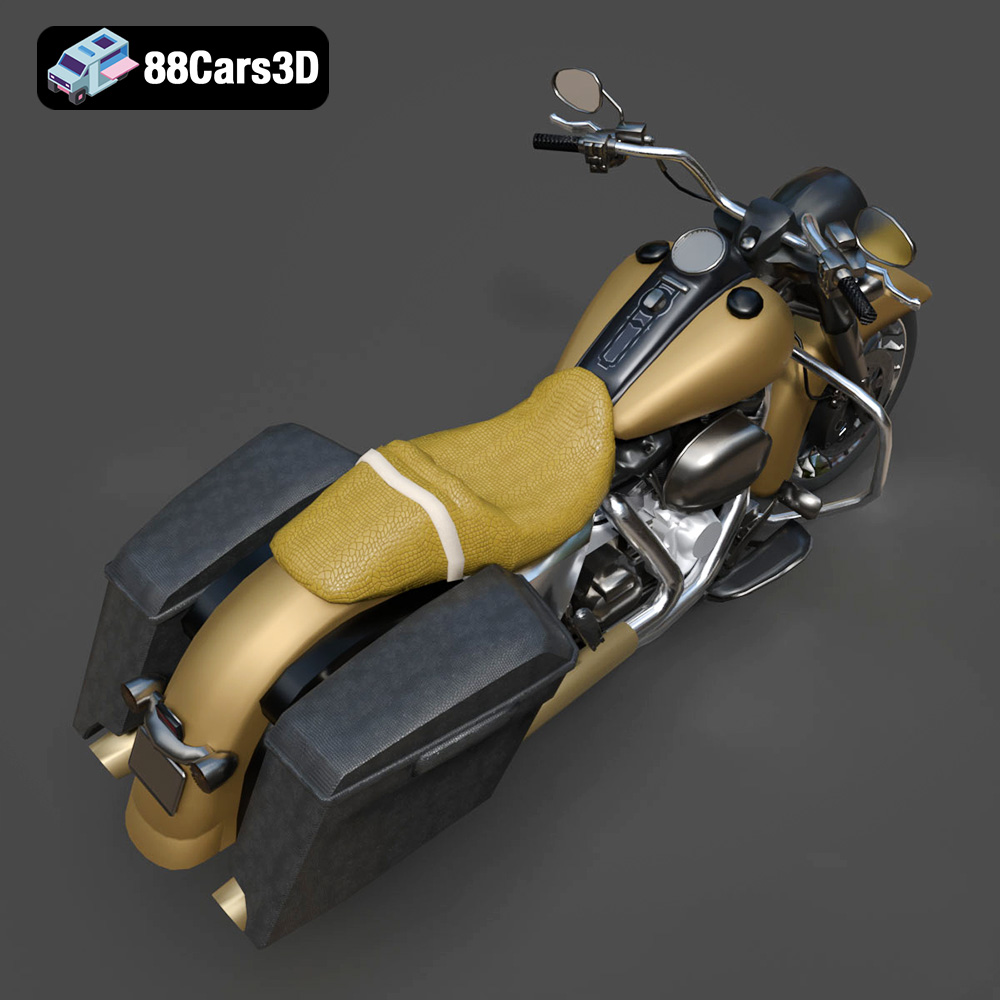
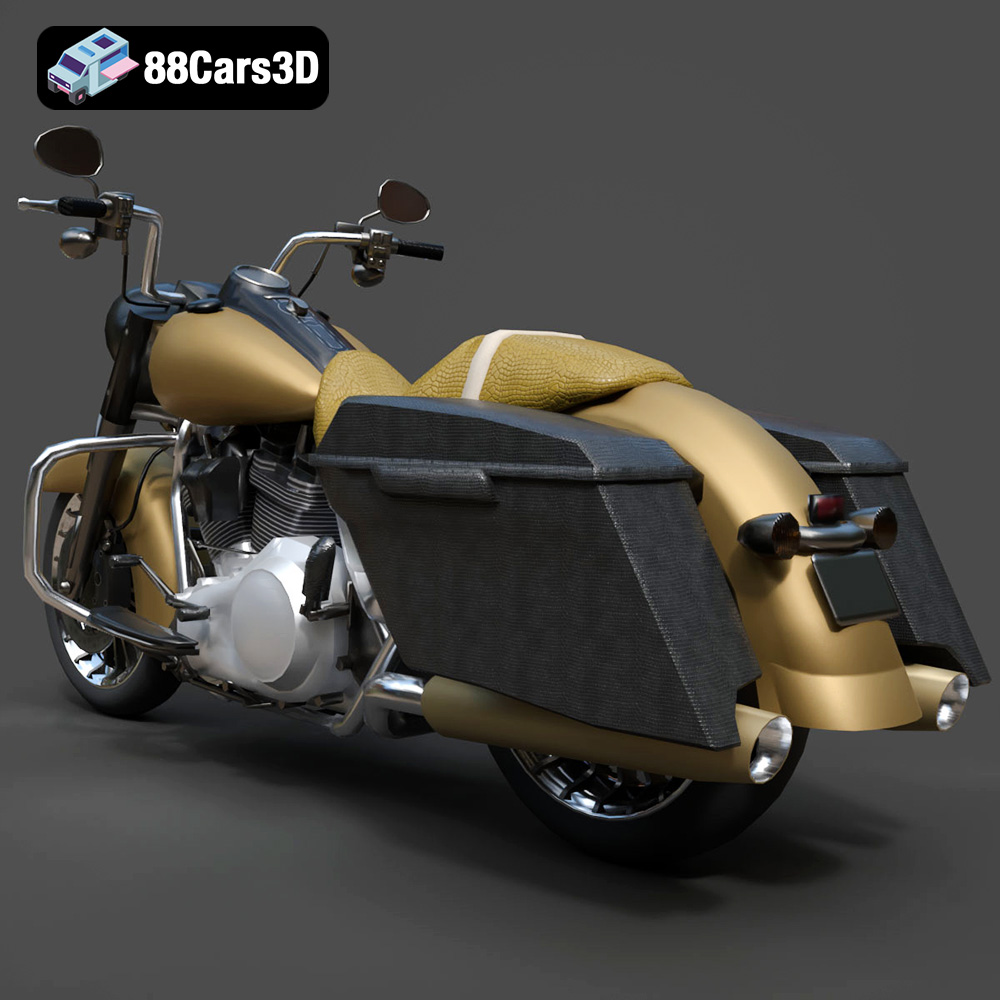
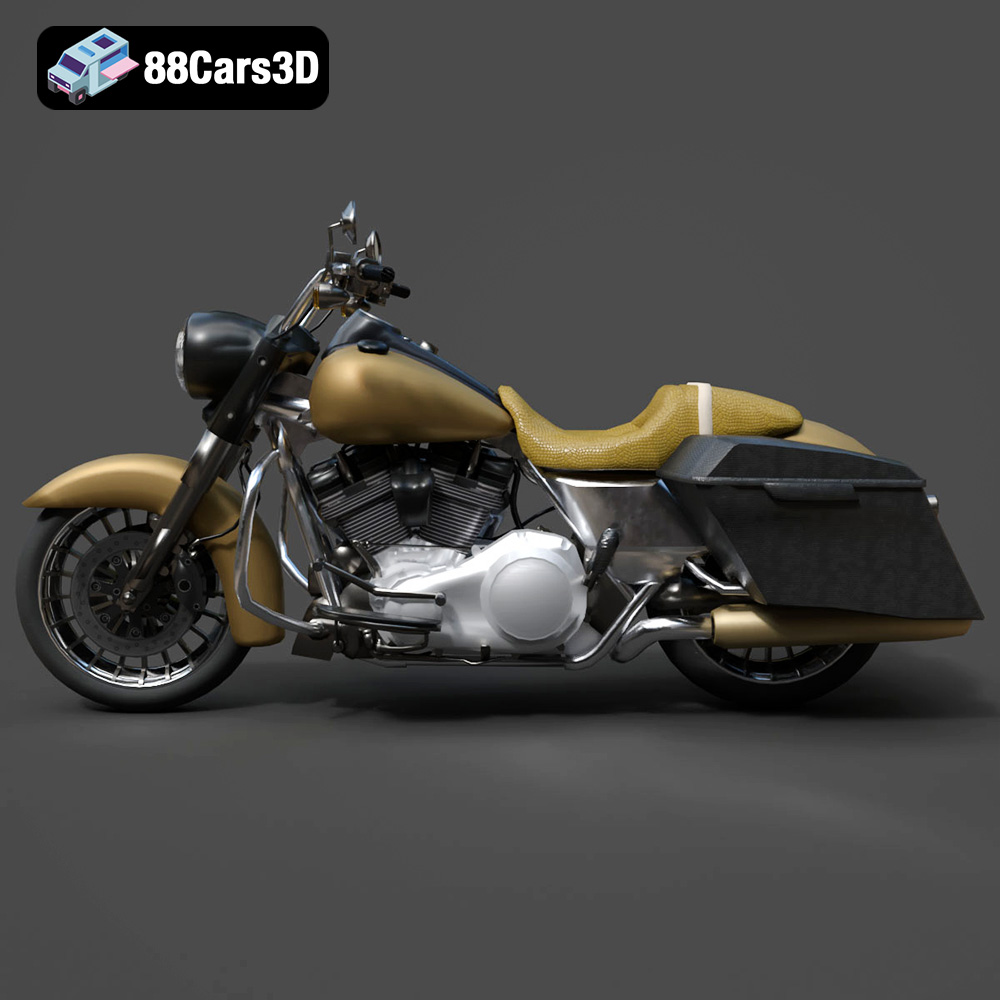
The Harley-Davidson Road King is renowned for its classic, nostalgic silhouette. Unlike other touring models that hide behind heavy fairings, the Road King embraces a minimalist yet powerful presence. Key design elements include its distinctive large chrome headlight nacelle, the prominent V-twin engine, and the iconic hard saddlebags. These features define its legendary highway cruiser aesthetic. The Harley-Davidson Road King 3D Model accurately captures these critical details, from the sweeping dual exhaust system to the wide, swept-back touring handlebars and teardrop fuel tank. Every curve and component is meticulously replicated to ensure instant recognition and an authentic feel, providing a strong foundation for realistic automotive rendering and immersive game assets.
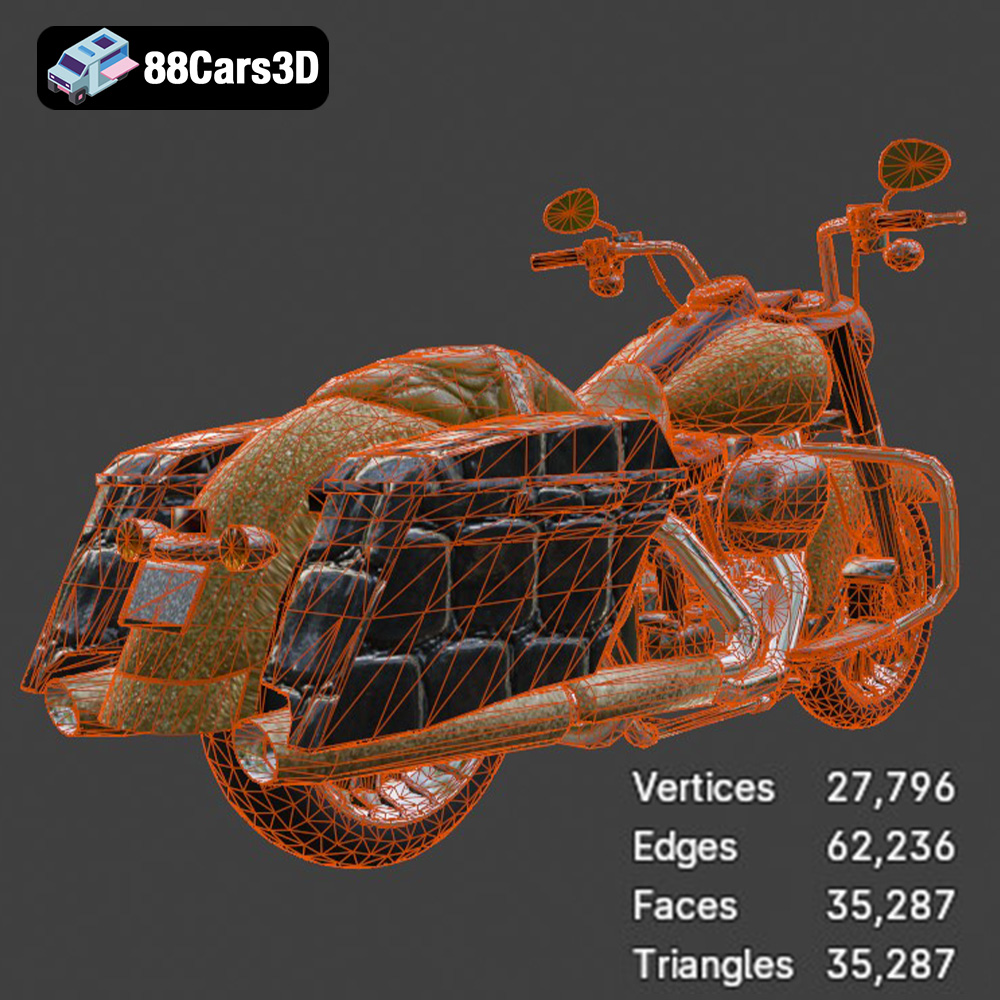
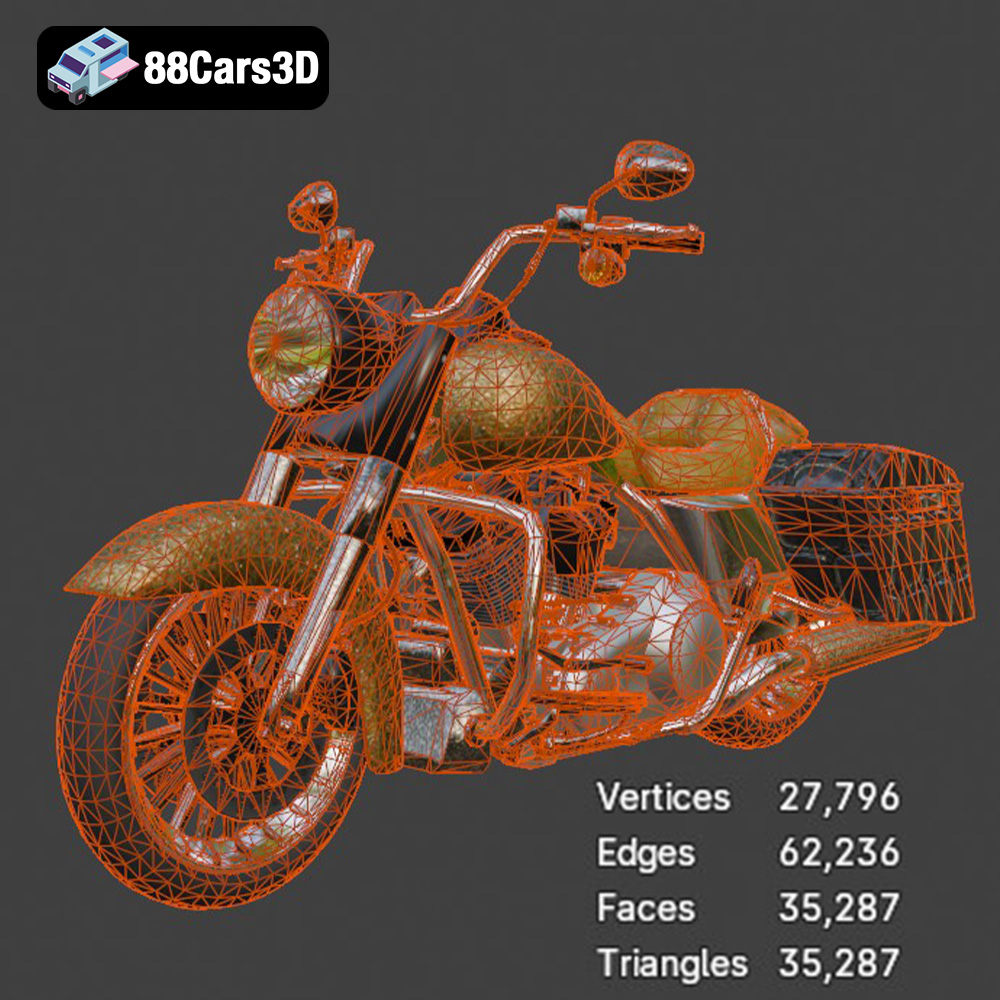
One of the most significant challenges in 3D modeling for real-time applications is balancing visual fidelity with performance. A highly detailed model can be visually stunning but can bring a game engine to its knees. The Harley-Davidson Road King 3D Model exemplifies how to achieve optimization without compromising on the iconic look. With just 27,796 vertices, 62,236 edges, and a remarkably lean 35,287 triangles, this model is a masterclass in efficient topology. This low-polygon count means it demands minimal memory resources and processing power, making it exceptionally suited for demanding environments like mobile game development, open-world traffic systems, and lightweight AR/VR applications. The optimized wheel geometry, for instance, is designed to look impressive while contributing minimally to the overall poly count, showcasing intelligent asset design.
For game developers and animators, flexibility is paramount. A static model, no matter how beautiful, has limited utility in interactive environments. The Harley-Davidson Road King 3D Model addresses this by featuring separate wheels and steering components. This modular approach is crucial for enabling realistic animation, allowing for proper wheel rotation, steering articulation, and the integration of physics rigging. Imagine a custom game where the Road King navigates winding roads, its handlebars turning dynamically, or even a scenario where a kickstand articulates realistically. The proper pivot setup for these elements ensures that developers can easily implement these functionalities, making it a truly game-ready asset for dynamic scenes and physics-driven interactions.
In the diverse landscape of 3D content creation, selecting the correct file format is a foundational decision that impacts workflow, compatibility, and the ultimate utility of a 3D model. Different formats are designed for different purposes, offering varying levels of data preservation, optimization, and interoperability. Understanding these distinctions is crucial for anyone working with 3D car models, game assets, or automotive rendering projects, especially when sourcing high-quality assets from platforms like 88cars3d.com.
The .blend file is the native format for Blender, a powerful and widely used open-source 3D creation suite. When you receive a .blend file, you’re getting a complete Blender scene, including the model’s geometry, materials (with their node setups), textures, lighting, cameras, animations, and even physics simulations. This format is ideal if Blender is your primary software, as it offers full editability and preserves all scene data exactly as the artist created it. It’s perfect for deep customization, adjusting materials, or re-rigging the model within Blender’s ecosystem.
The Filmbox (.fbx) format, owned by Autodesk, has become a de facto standard for exchanging 3D data between various software applications and game engines. It’s incredibly versatile, capable of storing not just geometry, but also materials, textures, animations, skinning information, and rigging data. For real-time pipelines, especially with engines like Unreal Engine and Unity, .fbx is the go-to choice. Its robustness and widespread support make it excellent for transferring complex animated assets efficiently.
The Wavefront Object (.obj) format is one of the oldest and most universally supported 3D file formats. It excels at representing purely geometric data – vertices, faces, normals, and UV coordinates. While it can reference external material files (.mtl), it doesn’t store animation, rigging, or complex material node setups. Its strength lies in its simplicity and unparalleled compatibility across almost all 3D software. It’s perfect for basic geometry exchange, 3D scanning output, or when you need a clean mesh to start a new project in a different application.
GL Transmission Format (.glb) is a binary version of .gltf, an open standard for 3D scenes and models. Designed with efficiency and real-time rendering in mind, .glb packages all necessary data—geometry, materials, textures, animations—into a single, compact file. This makes it incredibly efficient for web-based 3D applications, augmented reality (AR), virtual reality (VR), and browser-based display. Its small file size and quick loading times are crucial for interactive online experiences, making it a key format for modern digital delivery.
Stereolithography (.stl) is the standard file format for 3D printing. It represents a 3D model as a series of interconnected triangles that define its surface geometry. Unlike other formats, .stl contains no color, texture, or material information—it’s purely about the shape. While the Harley-Davidson Road King 3D Model is optimized for screen display, its availability in .stl means it can be converted into a physical object. For low-poly models like this, careful consideration of print scale and layer height (preferably with resin printing) is vital to preserve recognizable details.
The Polygon File Format (.ply) is another format primarily used for storing 3D data from 3D scanners, CAD applications, or for scientific and analytical purposes. It can store a wider range of properties than .obj, including color per vertex, normal information, and often more complex mesh data. While not as common for general game assets, it provides a robust, precision mesh format that can be valuable for specific engineering or reverse-engineering workflows.
The .unreal format (often an asset package or project file containing the asset) indicates that a model has been specifically prepared and configured for direct import and use within Unreal Engine. This often means it has pre-set materials, collision meshes, LODs (Levels of Detail), and proper pivot points, saving developers significant setup time. For users committed to the Unreal ecosystem, this offers the most streamlined integration.
Similar to .blend for Blender, .max is the native project file format for Autodesk 3ds Max. It encompasses all aspects of a 3ds Max scene, including the model’s geometry, modifiers, materials, textures, lighting, animation data, and scene organization. If 3ds Max is your preferred software for automotive rendering or complex scene setup, a .max file provides the fullest level of editability and access to the original artist’s scene configuration.
The availability of the Harley-Davidson Road King 3D Model in this extensive array of formats on 88cars3d.com underscores its versatility and commitment to supporting diverse professional workflows across the industry.
In the fiercely competitive world of game development, performance is paramount. A stunning visual asset is only valuable if it can be rendered smoothly and efficiently, especially on target platforms ranging from high-end PCs to mobile devices. The Harley-Davidson Road King 3D Model is engineered with this reality in mind, making it an ideal choice for developers.
Mobile games operate under strict resource constraints. High polygon counts can quickly lead to dropped frame rates, overheating devices, and a poor user experience. At just 35,287 triangles, the Road King model is a triumph of optimization. This lean topology allows developers to populate scenes with numerous instances of the motorcycle without bogging down the GPU. Imagine a mobile racing game or an open-world title where dozens of these iconic cruisers can appear on screen simultaneously, contributing to a rich, believable environment without sacrificing performance. This level of optimization makes it a perfect fit for indie titles and large-scale mobile projects where efficiency is critical.
Seamless integration into popular game engines like Unreal Engine and Unity is a hallmark of truly game-ready assets. The Harley-Davidson Road King 3D Model is fully compatible with these platforms, typically imported via the versatile .fbx format or, for Unreal users, the dedicated .unreal package. Once imported, developers can quickly set up physically-based rendering (PBR) materials using the included textures, ensuring realistic surface properties under various lighting conditions. Crucially, the model features a proper pivot setup for its steering and wheels, simplifying the process of rigging for animation and physics. This means less time spent on tedious setup and more time focused on gameplay mechanics and creative storytelling.
For open-world games, environmental fidelity often relies on the density and variety of background elements. The Road King model excels in this role, serving as an excellent asset for background traffic, parked vehicles, or even as a rideable asset for non-player characters (NPCs) or players in GTA-style mods. Its optimized nature ensures that even when dozens of these 3D car models are present, they contribute to the visual richness of the world without causing performance bottlenecks. This allows for the creation of truly expansive and believable virtual cross-country highway scenes or bustling urban environments, enhancing immersion without compromise.
The utility of high-quality 3D models extends far beyond the realm of interactive games. The Harley-Davidson Road King 3D Model demonstrates remarkable versatility, making it a valuable asset for various professional applications, from architectural visualization to cutting-edge AR/VR experiences and even tangible 3D prints.
In architectural visualization, context is everything. Placing realistic vehicles in a scene can significantly enhance its believability and sense of scale. While highly detailed, high-poly models are often used for hero shots, the Road King’s optimized geometry makes it excellent for mid-ground or background placement in large-scale urban or highway architectural renders. When paired with sophisticated renderers like V-Ray, Corona Renderer, or Cycles in Blender, even a low-poly model can achieve stunning photorealism through expert material application and lighting. It effectively fills out a scene, suggesting movement and life without adding unnecessary computational overhead, allowing the focus to remain on the primary architectural elements while still delivering a rich visual narrative.
Augmented Reality (AR) and Virtual Reality (VR) applications demand extremely efficient assets due to the real-time processing requirements and the necessity for smooth, uninterrupted experiences. The Harley-Davidson Road King 3D Model’s low-polygon topology and efficient design make it an ideal candidate for these immersive platforms. Its availability in the .glb format further streamlines this process, as .glb files are highly optimized for web-based display, lightweight interactive browser configurators, and mobile AR experiences. Imagine an interactive virtual showroom where customers can explore the Road King in 3D right in their browser, or an AR app that lets them “place” the motorcycle in their driveway – all powered by this highly performant model.
Beyond digital displays, the world of 3D printing allows artists and enthusiasts to transform virtual models into tangible objects. The Harley-Davidson Road King 3D Model includes an .stl format, making it ready for 3D printing. Given its optimized, low-poly nature, careful consideration of print settings is recommended to achieve the best results. For instance, printing at smaller scales like 1:32, 1:43, or 1:64 is advised to preserve detail. Resin printing is highly recommended over FDM for finer details and smoother surfaces. Specific print settings such as layer height (0.04–0.08 mm for resin), wall thickness (1.2–2.0 mm), and infill (20–30%) are provided to guide users. Supports will be necessary for complex geometries like handlebars and exhaust pipes, and post-processing (sanding, priming, painting) offers the opportunity to bring the model to life with classic Harley-Davidson finishes like Vivid Black or two-tone schemes and metallic chrome detailing. This capability opens up possibilities for creating physical prototypes, miniature collectibles, or unique display pieces directly from the digital asset.
A well-designed 3D model provides a solid foundation, but true mastery often lies in its customization and integration into advanced creative workflows. The Harley-Davidson Road King 3D Model offers a flexible canvas for artists to imbue it with their unique vision, leveraging industry-standard techniques to elevate its appearance and utility.
Texturing is where a 3D model truly comes to life. The Road King model provides an excellent base for various texturing approaches. Artists can apply classic two-tone paint schemes to the fuel tank and fenders, replicating iconic Harley-Davidson liveries, or opt for a more contemporary, sinister blacked-out aesthetic. The saddlebags, for example, can be textured to simulate classic hard plastic or swapped for a luxurious leather appearance simply by applying different materials and textures. Its efficient UV mapping ensures that textures wrap seamlessly around the geometry, simplifying the texturing process and allowing for quick iterations and variations, making it versatile for diverse automotive rendering needs.
One of the most powerful techniques for enhancing the visual fidelity of low-polygon models without increasing their vertex count is the use of normal maps. A normal map stores surface detail (like scratches, bolts, or complex panel lines) as color information, which then “fakes” high-resolution geometry when applied to a low-poly mesh in a renderer or game engine. The Harley-Davidson Road King 3D Model is a perfect canvas for this. Artists can create a high-polygon version of specific parts (e.g., the engine, gauges, or chrome details), bake the surface normals from this high-poly version onto the UVs of the low-poly Road King, and then apply this normal map in their material setup. This technique delivers stunning visual realism while maintaining the model’s game-ready performance, an essential skill for creating compelling game assets.
Let’s consider a practical workflow leveraging this model, moving from Blender to Unreal Engine, a common pipeline for many developers:
.blend file of the Harley-Davidson Road King 3D Model into Blender..fbx file, ensuring that mesh, armatures (if rigged), and basic materials are embedded..fbx file into Unreal Engine. The engine’s robust importer will bring in the mesh, basic materials, and potentially rudimentary textures.This comprehensive workflow demonstrates how the Harley-Davidson Road King 3D Model acts as a versatile starting point for complex creative endeavors, enabling professionals to produce stunning results efficiently.
The journey of bringing an iconic vehicle like the Harley-Davidson Road King into the digital realm is a testament to the blend of artistic skill and technical precision in 3D modeling. The Harley-Davidson Road King 3D Model (Game-Ready) exemplifies this perfectly. From its meticulously recreated classic silhouette to its exceptional optimization for real-time performance, it stands as a premium asset designed for the demands of modern digital production.
Whether your project involves crafting immersive game assets for mobile or open-world titles, delivering breathtaking automotive rendering for architectural visualizations, developing interactive AR/VR experiences, or even bringing a miniature physical replica to life through 3D printing, this model offers unparalleled versatility. Its broad compatibility across major 3D software and game engines, coupled with its highly efficient topology, makes it an invaluable addition to any professional toolkit.
Investing in high-quality 3D car models like the Road King from reputable sources such as 88cars3d.com ensures that your projects benefit from meticulous design and technical reliability. It allows artists and developers to focus on creativity and innovation, confident that their foundational assets are built to perform. Explore the possibilities and elevate your next digital creation by leveraging expertly crafted 3D models.
The Harley-Davidson Road King 3D Model is an incredibly optimized, game-ready digital recreation of the quintessential American touring cruiser. Stripping away the heavy fairings of other touring models, the Road King is famous for its classic, nostalgic silhouette, featuring a large chrome headlight nacelle, a prominent V-twin engine, and iconic hard saddlebags. This 3D model accurately captures the legendary highway cruiser aesthetic while being engineered with extreme efficiency in mind. Built with highly optimized, low-polygon topology (just over 35k triangles), it delivers the unmistakable Harley-Davidson profile without consuming heavy memory resources. It is the absolute perfect asset for mobile game development, open-world background traffic, GTA-style mods, and lightweight AR/VR applications. Perfect for virtual cross-country highway scenes, biker lifestyle mobile games, and optimized interactive web showrooms.
$15.9
.blend
.cruiser
.fbx
.obj
.rendering
.stl
35k-polygons
car-3d-model
game-ready
harley-davidson
low-poly
mobile-game-asset
optimized
road-king
touring-motorcycle
VR/AR