Get 50% OFF All Premium 3D & STL Models!

In the realm of automotive engineering, few vehicles command the same reverence and admiration as the Porsche 918 Spyder. As one-third of the modern “Holy Trinity” of hypercars, it shattered preconceived notions, seamlessly blending blistering performance with groundbreaking hybrid technology. Its sleek lines, aggressive stance, and innovative engineering made it an instant legend, defining a new era for supercars. For 3D artists, game developers, architectural visualizers, and designers, capturing the essence of such an icon demands a 3D model that is as meticulously crafted as the car itself.
Today, we delve into a prime example of digital automotive excellence: the Porsche 918 Spyder (With Detachable Roof) 3D Model. This extraordinary asset transcends mere representation, offering a fully optimized and feature-rich package designed to integrate flawlessly into a myriad of professional workflows. Whether your ambition is to create stunning automotive renders, build an immersive game environment, or produce a precise 3D print, this model provides the foundation for unparalleled realism and flexibility. It represents the pinnacle of 3D car models, ensuring that every curve and component of this legendary hypercar is faithfully brought to life in the digital domain.
When working with complex 3D car models, especially those as detailed as the Porsche 918 Spyder, understanding the various file formats is paramount. Each format serves a specific purpose, offering unique advantages for different stages of the production pipeline, from initial design to final rendering, real-time deployment, or physical output. The Porsche 918 Spyder (With Detachable Roof) 3D Model from 88cars3d.com thoughtfully includes a comprehensive suite of these formats, ensuring maximum compatibility and utility for professionals.
The .blend format is the native file type for Blender, a powerful and widely used open-source 3D creation suite. For users working in Blender, this format provides the most complete and editable scene. It includes not just the mesh data, but also all materials, textures, lighting setups, cameras, animations, and even rigging information as they were configured by the original artist. This makes it ideal for anyone looking to dive deep into the model, make extensive modifications, re-texture, re-rig, or simply render within the Blender Cycles or Eevee engines. It offers unparalleled flexibility for customization and advanced scene development.
.fbx (Filmbox) is arguably the most common and versatile 3D interchange format in the industry. Developed by Autodesk, it excels at preserving complex scene data, including geometry, materials, textures, animations, and skeletal structures, across different software applications. This makes it the go-to format for transferring assets between 3ds Max, Maya, Cinema 4D, and critically, into game engines like Unreal Engine and Unity. For the Porsche 918 Spyder model, the .fbx is ideal for ensuring that all movable parts (like the detachable roof, wheels, and steering components) retain their pivot information and are ready for rigging and animation within a real-time pipeline.
The .obj (Wavefront OBJ) format is a simple, universal geometry definition file. It’s highly compatible across virtually all 3D software due to its text-based nature, making it excellent for basic mesh transfer. While it supports UV mapping and material references (via an accompanying .mtl file), it typically doesn’t carry animation, rigging, or advanced material node setups. For users needing a clean mesh to start fresh with materials in a new environment or for legacy software, .obj is a reliable choice. Its simplicity ensures broad compatibility, albeit with less comprehensive data transfer than .fbx.
.glb (GL Transmission Format Binary) is an increasingly important format, especially in the burgeoning fields of Augmented Reality (AR), Virtual Reality (VR), and web-based 3D applications. It’s a binary version of the glTF format, designed for efficient transmission and loading of 3D scenes and models. A key advantage of .glb is that it bundles all assets (geometry, materials, textures, animations) into a single file, optimizing it for delivery over the internet and real-time display in browsers or mobile AR/VR viewers. The Porsche 918 Spyder model in .glb format is perfect for interactive digital showrooms or quick integration into mobile AR experiences.
.stl (STereoLithography) is the de facto standard file format for 3D printing. It represents 3D surfaces as a series of connected triangles (a tessellated mesh) without any color, texture, or material information. Its strength lies in defining the geometry for additive manufacturing, providing instructions for a 3D printer to build an object layer by layer. When preparing the Porsche 918 Spyder for physical replication, the .stl format is essential for converting the digital asset into a tangible collectible or prototype, ensuring manifold geometry suitable for printing.
The .ply (Polygon File Format, or Stanford Triangle Format) is often used in scientific and academic fields for storing 3D data from 3D scanners, CAD software, and other mesh generation tools. It can store various properties beyond just geometry, such as color, transparency, surface normals, and even confidence values for each vertex. While less common for general-purpose asset distribution than .fbx or .obj, it offers a robust solution for precision mesh data, useful for engineering analysis, reverse engineering, or specialized rendering pipelines where high fidelity and additional data per vertex are critical.
While not a universal file extension in the same vein as .fbx or .obj, the inclusion of an .unreal specific file or a package optimized for Unreal Engine implies an asset that is pre-configured and ready for direct import and use within the engine. This often means optimized meshes, PBR (Physically Based Rendering) materials already set up, collision meshes, LODs (Levels of Detail), and blueprint configurations for functionality. For the Porsche 918 Spyder, an “engine-ready asset” designation highlights its seamless integration into Unreal’s powerful real-time rendering pipeline, making it a true plug-and-play solution for game developers and real-time visualization specialists.
Finally, the .max format is the native file type for Autodesk 3ds Max, a leading software for 3D modeling, animation, and rendering. Similar to .blend for Blender, the .max file contains the complete scene, including geometry, materials, lights, cameras, modifiers, and animation data specific to 3ds Max. This provides users of 3ds Max with the full editable project file, allowing for detailed modifications, advanced rendering with V-Ray or Corona, and sophisticated animation workflows. For professionals accustomed to the 3ds Max environment, this format ensures they can leverage all their existing tools and plugins with the Porsche 918 Spyder model.
Translating a real-world automotive marvel like the Porsche 918 Spyder into a high-fidelity 3D model is an undertaking that demands a keen eye for detail, an understanding of automotive design principles, and technical modeling prowess. This model successfully navigates these complexities, delivering a digital twin that resonates with the original’s prestige and performance.
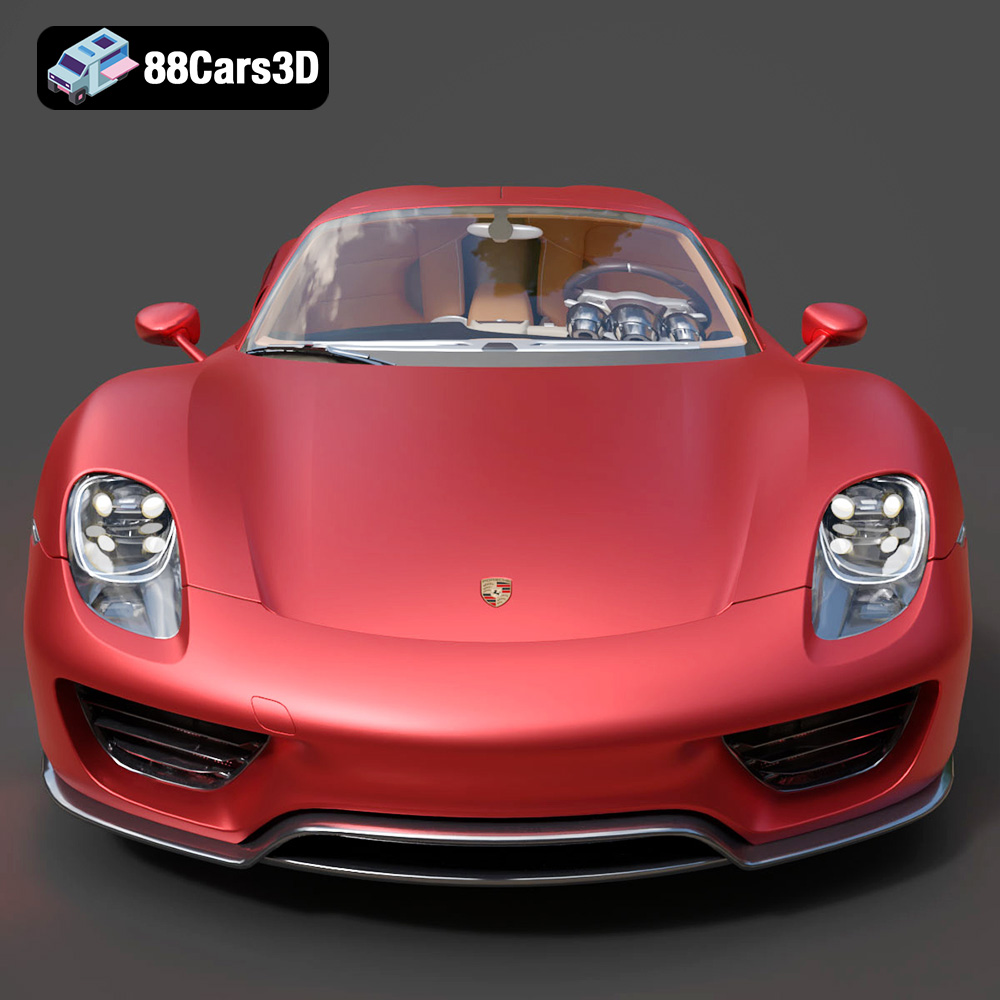
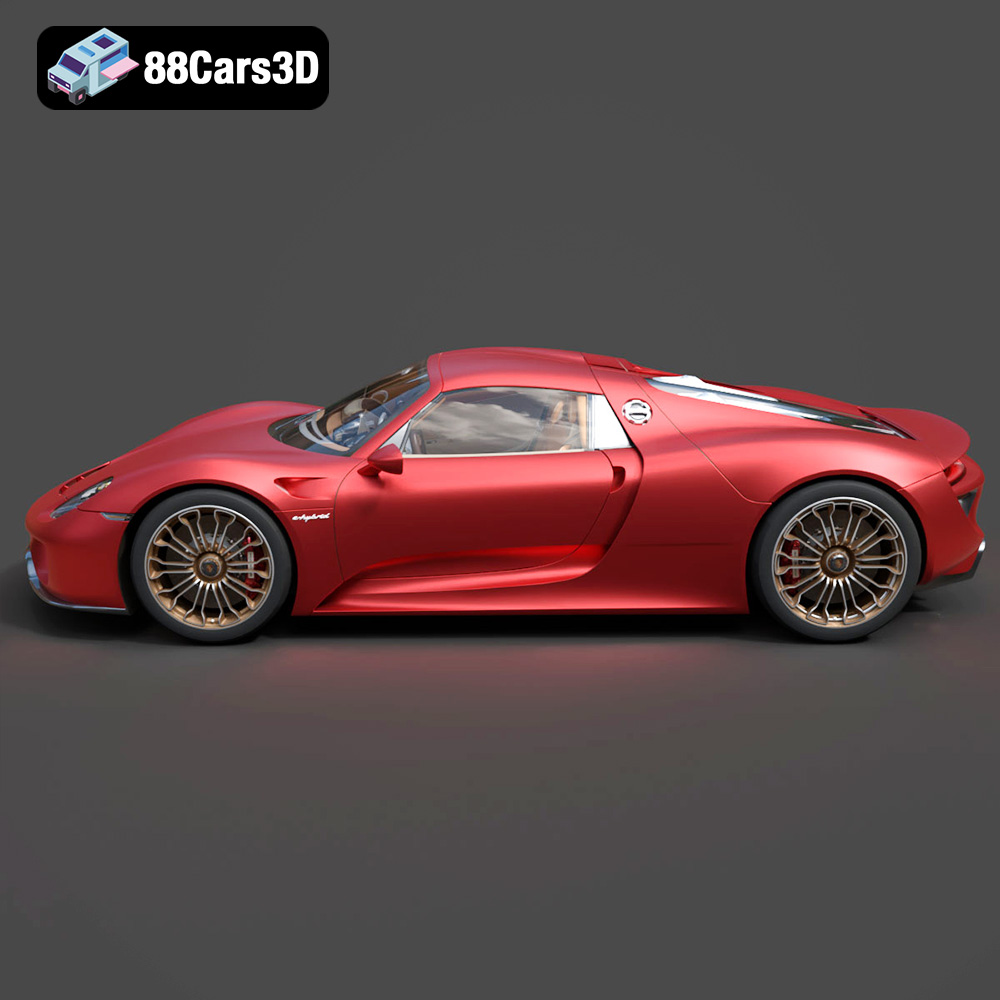
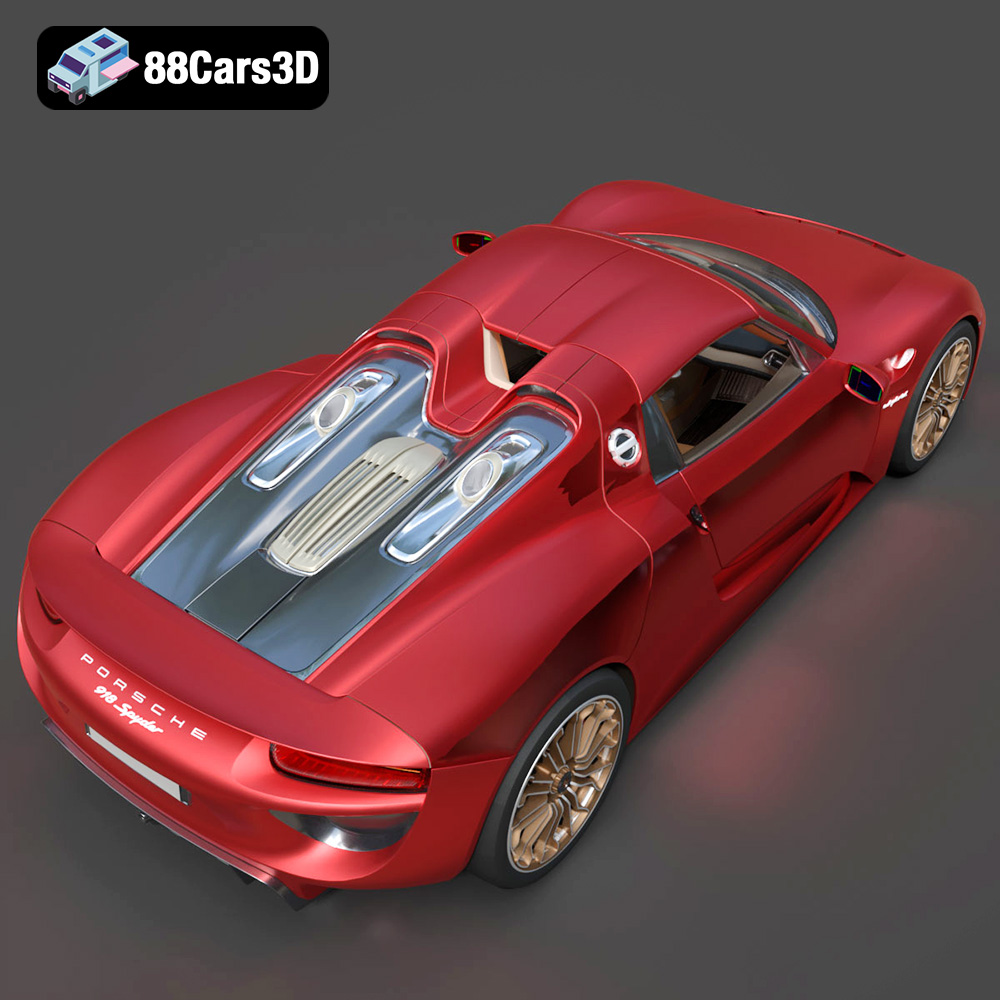
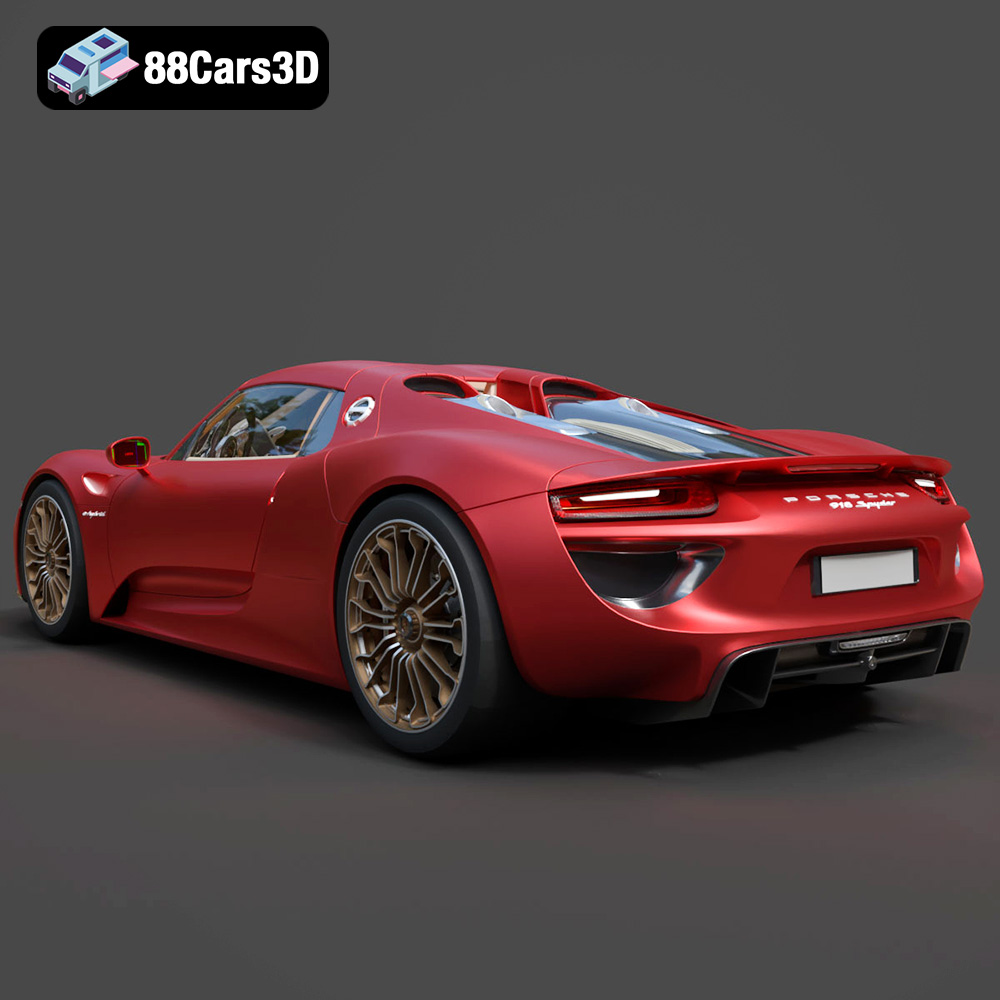
The Porsche 918 Spyder’s exterior is a symphony of form meeting function, every curve and vent meticulously engineered for aerodynamic efficiency and visual drama. This 3D model captures that perfectly. From the accurate proportions that define its aggressive stance to the cutting-edge aerodynamic geometry that channels air around its carbon-fiber monocoque, the fidelity is breathtaking. The signature top-exit exhaust system, mounted directly behind the engine bay, is replicated with precision, a key distinguishing feature that hints at the powerful V8 within. The distinctive four-point LED headlights and sleek 3D taillight blades are rendered with acute accuracy, contributing to its unmistakable presence. Furthermore, the detailed lightweight forged alloy wheels, performance tires, and massive carbon-ceramic brake calipers are all individually modeled, providing stunning realism even in extreme close-up automotive renders. Crucially, the model features fully detachable Targa-style roof panels, configured for easy removal and animation. This single feature unlocks significant creative potential, allowing artists to effortlessly switch between the focused closed-coupe track profile and the exhilarating open-air Spyder configuration.
The interior of the 918 Spyder is a masterclass in blending luxury with high-tech performance, all centered around the driver. The 3D model meticulously recreates this authentic driver-centric cockpit layout. The sweeping, elevated center console geometry, complete with its digital displays, is faithfully reproduced, showcasing the car’s advanced interface. Premium sport bucket seat geometry is designed with care, perfect for applying Alcantara and leather texture mapping to achieve a luxurious finish. The signature sport steering wheel, featuring its distinctive driving mode selector dial, is also accurately modeled. For applications like game development or VR/AR experiences, the optimized interior geometry is tailored for a smooth first-person point-of-view, ensuring that players or users feel fully immersed in the hypercar’s exclusive environment.
Beyond visual accuracy, a truly professional 3D model, especially one intended for high-stakes projects, must be technically robust. The Porsche 918 Spyder (With Detachable Roof) 3D Model demonstrates exemplary technical specifications, making it a versatile asset for any demanding pipeline.
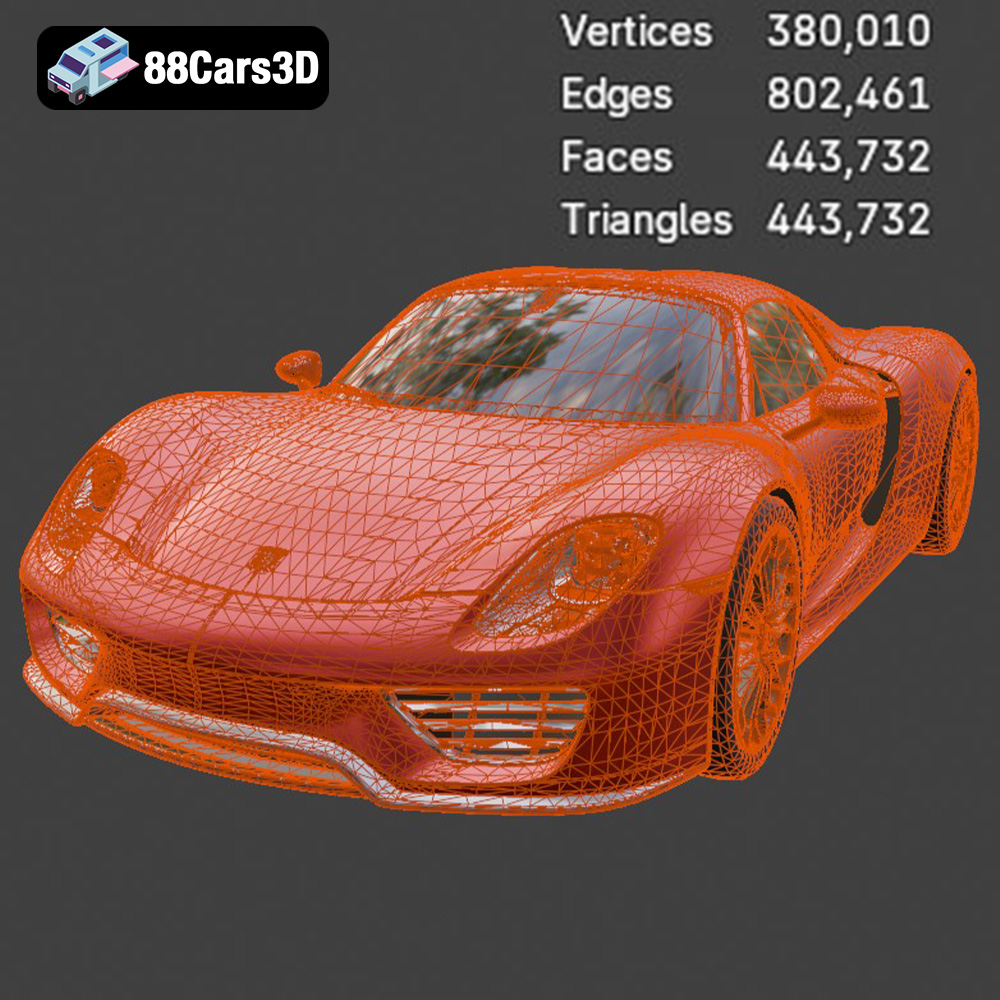
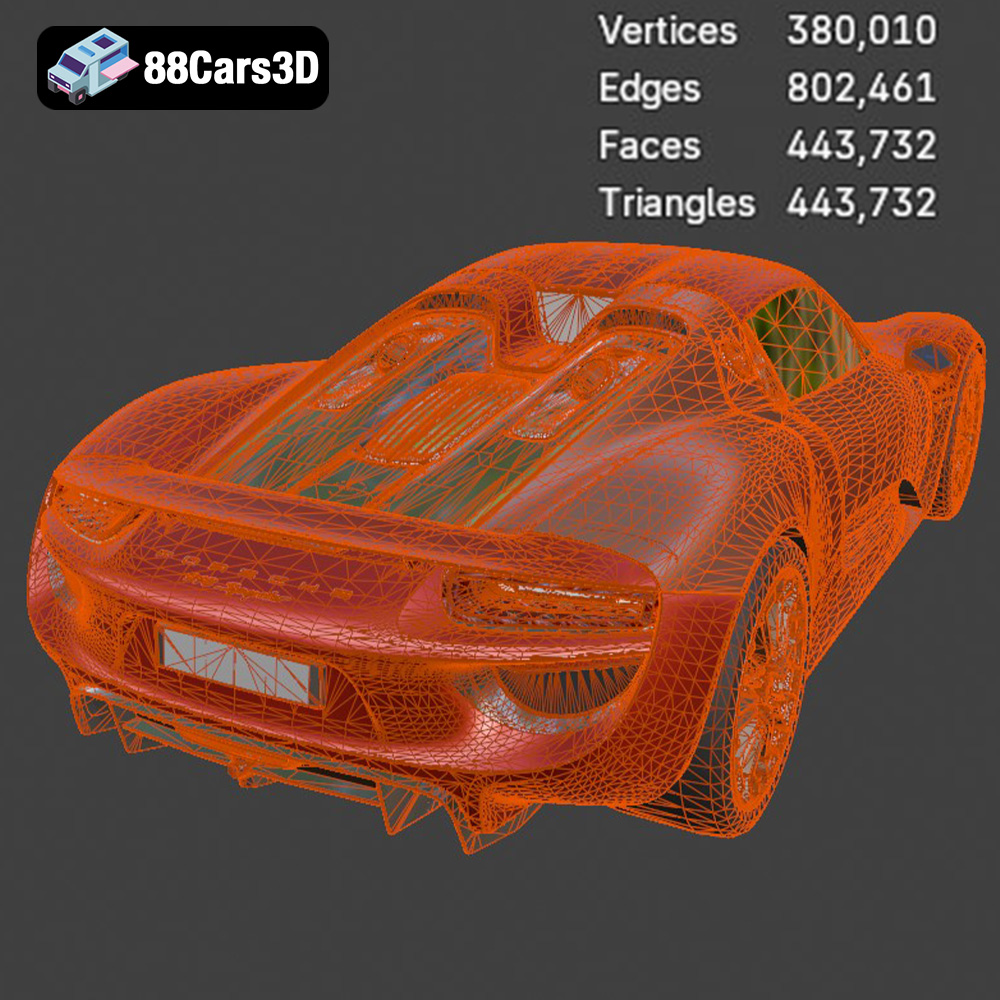
The core of any high-quality 3D model lies in its topology. This Porsche 918 Spyder model boasts an incredibly efficient and clean mid-polygon topology, striking a perfect balance between visual fidelity and performance. With 380,010 vertices, 802,461 edges, and 443,732 triangles, it hits the “sweet spot” for modern 3D production. This careful optimization means it’s detailed enough to withstand the scrutiny of high-end cinematic close-ups and dramatic automotive renders, showcasing flawless visual fidelity. Simultaneously, its optimized nature ensures it remains perfectly lightweight and performant for real-time game engines like Unreal Engine or Unity, serving as a “hero” car asset without bogging down scene performance. The wireframe renders confirm a beautifully clean, quad-based flow, which is crucial for deformation, subdivision, and efficient rendering.
Accuracy is not just about aesthetics; it’s also about physical integrity. This model is built with real-world scale accuracy, based on precise Porsche factory dimensions, ensuring that it integrates seamlessly into architectural visualizations or simulations where accurate scale is critical. Furthermore, its design incorporates proper pivot setups for all key movable components: steering, wheel rotation, and the detachable roof panels. This foresight simplifies the rigging and animation process considerably, allowing animators to quickly bring the hypercar to life, whether it’s navigating a track or showcasing its unique roof removal mechanism. Its inherent compatibility with major 3D software platforms and modern real-time engines further underscores its utility, making it a truly adaptable asset for any professional studio.
The true value of a premium 3D asset lies in its practical application across various professional domains. The Porsche 918 Spyder (With Detachable Roof) 3D Model is engineered to elevate projects in several key industries, from interactive experiences to passive visualizations.
For game developers, finding a high-quality, optimized 3D car model that can serve as a “hero” vehicle is paramount. This Porsche 918 Spyder model is the perfect choice for current-gen racing games, open-world titles, and sophisticated driving simulators. Its balanced polygon count (just over 443k triangles) means it’s detailed enough to be a focal point on screen while remaining performant within a real-time engine. The meticulously modeled exterior and optimized interior geometry are ideal for both third-person gameplay and immersive first-person cockpit views. With separate components for wheels, steering, and the roof, it’s primed for realistic rigging, physics, and animation, enabling developers to create compelling, high-speed driving experiences that leverage the hypercar’s legendary performance.
In the world of automotive rendering and visualization, stunning visuals are non-negotiable. This 3D model excels in environments demanding the highest visual fidelity. It is ideal for creating dramatic studio lighting setups that accentuate the Spyder’s exquisite lines, or for high-octane automotive commercials where every reflection and detail matters. Luxury architectural renders can be significantly enhanced by placing this iconic hypercar in a contemporary garage or driveway scene, adding an unparalleled touch of prestige. The model’s clean topology and accurate surface details ensure that it will look impeccable under any lighting condition, allowing render artists to produce photorealistic imagery that captures the essence of this German masterpiece.
As Augmented Reality (AR) and Virtual Reality (VR) continue to grow, the demand for optimized, high-quality 3D assets is skyrocketing. The Porsche 918 Spyder (With Detachable Roof) 3D Model is an excellent candidate for interactive digital showrooms, where users can explore the hypercar up close in a virtual space, or for mobile AR experiences that bring the car into the real world. Its optimized poly count makes it suitable for running smoothly on mobile devices and VR headsets, minimizing performance bottlenecks. Imagine a customer walking around a virtual 918 Spyder in their living room, detaching the roof with a simple gesture, or changing its paint color in real-time. This model facilitates such cutting-edge interactive visualization, pushing the boundaries of how we experience automotive design.
The versatility of a well-crafted 3D model extends beyond digital screens. For enthusiasts, collectors, and prototyping specialists, the ability to translate a digital asset into a physical object opens up new avenues for appreciation and utility. The Porsche 918 Spyder model is also prepared for this physical manifestation.
The inclusion of the .stl format, alongside detailed 3D printing settings, makes this Porsche 918 Spyder model an exceptional candidate for 3D printing. Hobbyists and professionals can create stunning display-scale replicas, perfect for 1:24, 1:18, or even 1:12 scale diecast enthusiasts. The recommended layer height of 0.04–0.12 mm, combined with a strong recommendation for resin printing, ensures that the sharp aerodynamic edges, intricate top exhausts, and delicate wheel spokes are captured with stunning precision. Proper wall thickness (1.2–2.0 mm) and infill (15–25%) guarantee a robust print. Crucial details like supports for side mirrors, the aggressive front splitter, rear wing, and detached roof panels are explicitly outlined, guiding users toward a successful print. Post-processing steps like sanding, priming, and applying striking Porsche colors—such as Liquid Metal Silver or Guards Red, accented with Acid Green hybrid brake caliper details—allow for a truly personalized and professional finish, bringing the digital hypercar into the physical realm.
A truly adaptable 3D model provides ample scope for creative expression. The Porsche 918 Spyder (With Detachable Roof) 3D Model offers robust customization options that empower artists and designers. You can configure the scene with the roof panels securely on for a sleek, closed-cockpit look, or artfully placed in the virtual background to showcase the distinctive Spyder profile. Beyond this functional customization, the model serves as an excellent canvas for applying the legendary “Weissach Package” wraps, such as the iconic Martini Racing or Salzburg liveries, celebrating Porsche’s rich racing heritage. Changing exterior paint colors to match striking factory PTS (Paint to Sample) options allows for unique personalization, while adapting lighting setups can dramatically alter the mood – from the dramatic, neon-lit ambiance of nighttime city streets to the bright, clinical environment of a race track. This level of customization ensures that the model can be tailored to any project’s aesthetic demands.
The Porsche 918 Spyder stands as a testament to automotive innovation, and its digital counterpart, the Porsche 918 Spyder (With Detachable Roof) 3D Model, is an equally impressive feat of digital craftsmanship. From its meticulously recreated exterior and interior details to its highly optimized mid-polygon topology, this 3D car model offers a comprehensive solution for professionals seeking uncompromising quality.
Its versatility across numerous industries—be it game development, high-end automotive rendering, immersive AR/VR experiences, or even precision 3D printing—makes it an indispensable asset. The careful consideration given to various file formats ensures seamless integration into virtually any workflow, while the focus on real-world accuracy and animation readiness streamlines production pipelines. For studios and individual artists looking to elevate their projects with a truly iconic and technically superior hypercar, this model delivers on all fronts.
Discover the potential of truly exceptional 3D car models and bring your creative visions to life. Explore this and other premium assets available at 88cars3d.com, your trusted source for high-quality 3D models.
The Porsche 918 Spyder 3D Model is a breathtaking digital recreation of one of the most legendary German hypercars ever produced. Forming one-third of the automotive world’s modern “Holy Trinity,” the 918 Spyder redefined the supercar landscape by pairing a high-revving naturally aspirated V8 with advanced dual electric motors. This 3D model accurately captures the sleek, aerodynamically sculptured aesthetic of the hybrid hypercar. Most notably, this model features the signature fully detachable Targa-style roof panels, allowing you to seamlessly switch between the closed-coupe track profile and the open-air Spyder configuration. It also features the iconic top-exit exhaust pipes, four-point LED headlights, aggressive rear diffuser, and active aerodynamic rear wing. Built with an incredibly efficient, clean mid-polygon topology (just over 443k triangles), it provides flawless visual fidelity for stunning close-up automotive renders while remaining perfectly lightweight for real-time game engines. Perfect for high-speed racing simulators, luxury automotive galleries, cinematic commercial visualizations, and AR/VR supercar showrooms.
$55