Get 50% OFF All Premium 3D & STL Models!

The landscape of film and television production is undergoing a profound transformation, driven by the relentless march of real-time rendering technology. At the forefront of this revolution is Unreal Engine, a powerful platform that has transcended its gaming origins to become an indispensable tool for filmmakers, cinematographers, and visual effects artists. For automotive visualization, in particular, Unreal Engine offers an unparalleled toolkit, enabling creators to produce stunning, photorealistic car sequences, interactive experiences, and dynamic virtual sets with unprecedented speed and fidelity.
This comprehensive guide delves into the intricate workflows of leveraging Unreal Engine for cinematic automotive content. From preparing high-fidelity 3D car models – the kind you’d find on platforms like 88cars3d.com – to crafting lifelike materials, implementing advanced lighting, and orchestrating complex virtual productions, we’ll explore the technical intricacies that empower studios to push creative boundaries. Whether you’re a seasoned VFX artist, an automotive designer, or a game developer eyeing cinematic applications, you’ll discover how to harness the full potential of Unreal Engine to bring automotive visions to the silver screen and beyond.
Unreal Engine has firmly established itself as a cornerstone in modern film and television production, fundamentally altering how visual content is conceived, created, and finalized. Its core strength lies in providing real-time feedback, allowing directors and artists to iterate rapidly, make creative decisions on the fly, and achieve a level of visual fidelity previously reserved for lengthy offline rendering pipelines. For automotive projects, this means being able to preview complex car chases, showroom presentations, or intricate mechanical animations within a live, interactive environment, dramatically streamlining the production cycle. The engine’s robust toolset supports a wide array of cinematic requirements, from high-resolution output for final pixel delivery to interactive real-time environments for virtual production.
The journey begins with proper project setup, ensuring that your Unreal Engine environment is configured for the demands of film and TV. This involves careful consideration of rendering settings, color management, and team collaboration protocols. Neglecting these foundational steps can lead to inefficiencies down the line or compromise the final visual quality.
Achieving cinematic quality in Unreal Engine requires meticulous attention to project settings. Start by setting your project’s renderer to a high-quality preset within the Project Settings under ‘Engine – Rendering.’ For final output, the Movie Render Queue is your go-to solution. It offers advanced features like temporal anti-aliasing (TAA) override, warm-up frames, console variables, and multi-sample rendering, ensuring crisp, high-quality images with minimal artifacts. Crucially, embracing an ACES (Academy Color Encoding System) workflow is paramount for maintaining color accuracy and consistency across various stages of production and different display devices. This means configuring your project’s color space settings, often requiring specific plugins or manual adjustments to the engine’s color management system, ensuring that the visual intent is preserved from creation to delivery. For collaborative environments typical in film production, robust version control systems like Perforce or Git LFS are essential to manage large asset libraries and track changes across multiple artists simultaneously.
The computational demands of real-time rendering for cinematic quality are significant. A high-end GPU (e.g., NVIDIA RTX series) with ample VRAM (24GB or more) is non-negotiable for smooth viewport performance and efficient rendering with features like Nanite, Lumen, and Ray Tracing. A powerful multi-core CPU, substantial RAM (64GB+), and fast SSD storage are equally vital to handle complex scenes, compile shaders, and manage large datasets efficiently. Beyond hardware, seamless integration with traditional Digital Content Creation (DCC) tools is critical. Unreal Engine’s Datasmith plugin is a game-changer, facilitating the import of complex scenes, CAD data, and assets from applications like Autodesk Maya, 3ds Max, Blender, and SolidWorks, preserving hierarchies, UVs, and PBR materials. This interoperability ensures that artists can leverage their existing pipelines while harnessing Unreal Engine’s real-time capabilities.
The visual centerpiece of any automotive visualization project in film and television is, of course, the car itself. These models demand extreme precision and detail, far exceeding the requirements of typical game assets. High-fidelity 3D car models are characterized by their accurate topology, meticulously crafted details (interior, engine bay, undercarriage), proper UV mapping, and realistic material definitions. Sourcing these assets from specialized marketplaces like 88cars3d.com ensures that you start with a foundation built for cinematic quality, optimized for Unreal Engine and ready for advanced rendering techniques. However, even the best models require careful preparation and optimization to perform efficiently within the engine’s real-time environment, particularly when dealing with the immense polygon counts often found in CAD-derived automotive data.
Datasmith is the recommended workflow for importing complex architectural, design, and manufacturing (AEC/DCC) data into Unreal Engine, and it’s particularly invaluable for automotive assets. When importing a detailed car model, Datasmith intelligently processes the scene, preserving crucial elements like scene hierarchy, metadata, UV channels, and basic materials, which significantly reduces setup time compared to traditional FBX imports. It can handle massive datasets, converting CAD surfaces into optimized mesh geometry. Before import, ensure your source files (e.g., native CAD, FBX, USD) are clean: remove unnecessary elements, fix non-manifold geometry, and ensure consistent scaling. During import, Datasmith offers options to tessellate geometry, combine meshes, and apply basic material translations. Always verify normals are facing the correct direction to avoid lighting artifacts. The cleaner the source data from the onset, the less post-import cleanup you’ll need to do in Unreal Engine, ensuring optimal performance and visual integrity.
Nanite, Unreal Engine’s virtualized geometry system introduced in Unreal Engine 5, is a revolutionary technology for handling extraordinarily high polygon counts, making it ideal for cinematic-grade 3D car models. With Nanite, artists can import assets consisting of millions or even billions of polygons without performance degradation, as the engine only renders the pixel-level detail necessary for a given camera view. This effectively eliminates the traditional need for manual Level of Detail (LOD) creation for static meshes, allowing models to retain their full geometric detail at all distances.
To enable Nanite, simply select your static mesh asset in the Content Browser, right-click, and choose ‘Enable Nanite’ from the menu. Once enabled, Nanite meshes are automatically streamed and processed by the engine. For automotive assets, this means you can import incredibly detailed CAD models or high-resolution sculpts directly, allowing for breathtaking close-ups and intricate surface details on the vehicle body, interior components, and even tire treads. While Nanite vastly simplifies high-poly workflows, it’s still good practice to ensure your source geometry is clean and watertight to avoid rendering artifacts. Nanite also comes with specific considerations for materials (e.g., no WPO or per-vertex calculations on Nanite meshes directly affecting geometry without a fallback mesh), but these are generally well-documented within the Unreal Engine learning resources: https://dev.epicgames.com/community/unreal-engine/learning.
The true magic of automotive visualization in film and television lies not just in the geometry but in how light interacts with the surfaces. Achieving photorealistic results requires a deep understanding of Physically Based Rendering (PBR) materials and sophisticated lighting techniques. Unreal Engine’s Material Editor provides an incredibly powerful and flexible environment for creating complex shaders, while its advanced lighting systems, particularly Lumen and Ray Tracing, deliver breathtaking real-time global illumination and reflections. The meticulous detail in the UV mapping and material ID setup found in quality 3D car models from sources like 88cars3d.com significantly streamlines this process, providing a robust foundation for your material work.
For automotive models, creating realistic materials involves more than just plugging in base color, metallic, and roughness maps. Car paint, for instance, is a multi-layered material requiring a clear coat layer with its own set of properties (roughness, normal, tint, IOR) over a metallic or diffuse base. Unreal Engine’s Material Editor allows for the construction of such complex shaders using nodes, blending different layers and properties to simulate real-world phenomena. Glass shaders require careful consideration of refraction, absorption, and reflection, often employing techniques like thin translucent materials for windows or more complex setups for headlights and taillights. Tire materials can benefit from anisotropic shading to capture the directional brushed look of rubber, combined with displacement maps for realistic tread patterns.
Software like Substance Designer and Substance Painter are invaluable companions, enabling artists to author intricate textures and PBR maps with procedural precision or direct painting, which can then be seamlessly imported into Unreal Engine. Ensure your materials utilize 8-bit or 16-bit textures where appropriate, and leverage texture compression settings in Unreal Engine to balance visual fidelity with performance. Proper UV unwrapping is critical; clean, non-overlapping UVs are essential for consistent texture application, something high-quality assets from reputable sources already provide.
Lumen, Unreal Engine’s fully dynamic global illumination and reflection system, is a game-changer for lighting automotive scenes. It delivers believable indirect lighting and reflections without the need for baked lightmaps, adapting instantly to changes in geometry, lights, and materials. This is invaluable for cinematic production where every light can be animated or changed on the fly, offering unprecedented flexibility. To set up Lumen for cinematic quality, enable it in your Project Settings under ‘Rendering – Global Illumination’ and ‘Reflections,’ then adjust ‘Final Gather Quality’ and ‘Reflection Quality’ to higher values.
Combine Lumen with high-dynamic-range image (HDRI) skyboxes or SphereCapture actors to provide realistic environmental lighting and reflections, simulating real-world outdoor or studio conditions. For precision lighting, traditional methods involving directional lights (sun), spot lights, and point lights are still essential. For the ultimate in visual fidelity, particularly for reflections and intricate shadows, Unreal Engine’s integrated Ray Tracing features can be enabled. Ray Tracing offers accurate reflections, refractions, ambient occlusion, and global illumination, though it comes with a higher performance cost, making it often reserved for final Movie Render Queue outputs or high-end virtual production stages. Mastering the balance between Lumen’s dynamic capabilities and the precision of traditional lights and Ray Tracing is key to crafting truly photorealistic automotive scenes.
Beyond static renders, modern film and TV often demand dynamic, interactive elements, especially in pre-visualization, virtual production, or even final deliverables like interactive commercials. Unreal Engine excels in this domain, providing powerful tools like Blueprint visual scripting for interactivity and Sequencer for orchestrating complex cinematic timelines. These tools enable artists and filmmakers to create compelling narratives and immersive experiences around 3D car models, bridging the gap between passive viewing and engaging interaction.
Blueprint visual scripting allows artists without traditional programming backgrounds to create complex logic and interactive functionalities. For automotive visualization, Blueprint can drive interactive configurators, allowing viewers or clients to change car colors, swap out wheel designs, modify interior trims, or cycle through different accessories in real-time. This is achieved by creating Blueprint classes for the car model, with events triggered by user input or cinematic cues that swap out mesh components or material instances.
Beyond configurators, Blueprint can control vehicle animations such as opening and closing doors, trunks, or hoods, starting and stopping engines (including sound cues), or deploying spoilers. You can also script sophisticated camera controls for virtual tours, allowing directors to explore the vehicle from any angle or create predefined cinematic camera paths that respond to user input. For more detailed instructions on building interactive elements, refer to the extensive Blueprint documentation available on the official Unreal Engine learning platform: https://dev.epicgames.com/community/unreal-engine/learning. This powerful tool unleashes endless possibilities for creating dynamic and engaging automotive presentations, whether for client review, promotional content, or interactive film extensions.
Sequencer is Unreal Engine’s non-linear, multi-track editor designed specifically for creating cinematic sequences, cutscenes, and animated content. It functions much like a traditional video editing suite but operates directly within the 3D environment, offering unparalleled control over every aspect of your scene. For automotive visualization, Sequencer is essential for choreographing stunning car commercials, action sequences, or even detailed instructional videos.
Within Sequencer, you can keyframe camera movements with Cine Camera Actors, controlling focus, aperture, focal length, and other cinematic properties to achieve professional-grade cinematography. You can animate your 3D car models along splines, control material parameters (e.g., paint sheen, headlight intensity), and orchestrate complex lighting changes over time. Sequencer also integrates seamlessly with other Unreal Engine features like Niagara for particle effects (e.g., exhaust smoke, dust trails, rain) and audio tracks for sound design. For truly intuitive camera control, consider integrating virtual camera systems using Live Link VCAM with an iPad or similar device. This allows a cinematographer to physically move a tablet, and have that movement translated in real-time to a Cine Camera Actor within the Unreal Engine scene, offering an organic and familiar way to block out shots.
One of the most groundbreaking applications of Unreal Engine in film and television is Virtual Production, particularly with the rise of LED volume stages. This workflow revolutionizes traditional filmmaking by merging physical sets with real-time digital environments, allowing for in-camera visual effects (ICVFX) that drastically reduce post-production time and increase creative flexibility on set. For automotive productions, this means shooting a physical car against dynamic, photorealistic digital backdrops rendered in real-time by Unreal Engine, providing instant feedback and final-pixel quality directly on set.
The core technology behind LED wall virtual production is nDisplay, Unreal Engine’s multi-display rendering solution. nDisplay allows a single Unreal Engine project to be rendered across multiple synchronized display devices, such as an LED wall and ceiling, creating a seamless, immersive environment around the physical set. This setup typically involves a powerful server cluster, each running a segment of the Unreal Engine scene and feeding into the LED processors. Accurate camera tracking (e.g., using systems from Mo-Sys, Stype, or Ncam) is paramount. The tracking data is fed into Unreal Engine via Live Link, allowing the digital background on the LED wall to shift perspective in real-time based on the physical camera’s position and orientation. This parallax adjustment creates the illusion that the digital environment truly exists behind the foreground elements.
Challenges include meticulous color calibration between the LED wall and the camera, managing latency for smooth real-time performance, and designing environments that hold up to extreme close-ups and varied lighting conditions. The use of robust 3D car models and high-resolution textures is critical to maintain fidelity across the expansive LED canvas.
The benefits of LED wall virtual production for automotive content are immense. Directors and cinematographers gain real-time visual feedback, allowing them to make immediate creative decisions on lighting, composition, and even set extensions without waiting for lengthy renders. This significantly reduces the need for costly reshoots and extensive green screen compositing in post-production. Imagine shooting an automotive commercial where the car drives through various cityscapes, mountain passes, or futuristic landscapes – all rendered dynamically on the LED wall, reacting to the physical car’s movement and on-set lighting.
This workflow is also highly effective for pre-visualization, enabling entire sequences to be blocked out and rehearsed virtually before physical production begins. It facilitates precise alignment of digital and physical elements, enhancing the realism of interaction between the car and its environment. Furthermore, it allows for dynamic background changes, giving unparalleled flexibility to modify the setting of an automotive shoot instantly. Virtual production with Unreal Engine is not just a technological advancement; it’s a paradigm shift, empowering filmmakers to tell automotive stories with unprecedented creativity and efficiency.
While Unreal Engine’s real-time capabilities are impressive, achieving cinematic visual quality at fluid frame rates, especially for film and TV deliverables, still requires smart optimization and the deployment of advanced techniques. Balancing visual fidelity with performance is an ongoing challenge, particularly when dealing with highly detailed 3D car models and complex environments. Understanding how to profile your scene, manage assets, and leverage Unreal Engine’s built-in features efficiently is crucial for a smooth production pipeline.
Optimizing an Unreal Engine scene for film and TV involves a multi-faceted approach. Even with Nanite handling high-poly static meshes, other elements can impact performance. For non-Nanite meshes or scenarios where Nanite isn’t suitable, implementing Level of Detail (LODs) is essential. Manually created or automatically generated LODs reduce polygon counts for objects further from the camera, ensuring efficient rendering. Employ effective culling techniques: frustum culling (objects outside the camera view are not rendered) and occlusion culling (objects hidden behind others are not rendered).
Efficient texture streaming is vital; ensure textures are appropriately sized and compressed. Large, uncompressed textures can quickly deplete VRAM and impact performance. Where possible, bake static lighting (using Lightmass or GPU Lightmass) for non-dynamic elements to offload real-time calculations. Regularly profile your scene using Unreal Engine’s built-in commands like `Stat Unit` (for CPU/GPU/Game thread timings), `Stat GPU` (for detailed GPU performance), and `Stat RHI` (for render hardware interface statistics) to identify bottlenecks. These metrics provide actionable insights into where performance improvements are most needed.
To truly bring automotive scenes to life, advanced techniques in physics, particles, and post-processing are indispensable. Unreal Engine’s Chaos Physics engine provides a robust framework for simulating realistic vehicle dynamics, including suspension, tire friction, collision deformation, and more. Developing a custom vehicle Blueprint with Chaos can result in incredibly lifelike car behaviors, from subtle weight shifts during cornering to dramatic crashes.
Niagara, Unreal Engine’s modular particle system, allows for the creation of stunning visual effects such as realistic exhaust smoke, dust clouds kicked up by tires, water splashes, rain, or even stylized energy effects. Niagara’s node-based interface offers immense creative control over particle behavior, emission, and rendering, making it ideal for cinematic visual flourishes.
Finally, post-processing is where the final cinematic polish is applied. Post Process Volumes allow artists to control a myriad of effects: color grading, exposure, bloom, lens flares, depth of field for selective focus, motion blur for dynamic movement, and film grain for a classic aesthetic. Carefully tune these parameters to achieve the desired mood and visual style, mimicking real-world camera artifacts and grading techniques used in film productions. For instance, a subtle chromatic aberration can add to a gritty, action-packed look, while controlled depth of field can highlight specific details on a 3D car model, directing the viewer’s eye.
The integration of Unreal Engine into film and television production workflows has been nothing short of transformative, ushering in an era of unprecedented creative freedom, iterative speed, and visual fidelity. For automotive visualization, this translates into the ability to craft breathtaking, photorealistic sequences that not only meet but exceed the demanding standards of the big and small screen. We’ve explored the journey from meticulous project setup and the efficient import of high-quality 3D car models – leveraging resources like 88cars3d.com – to the art of material and lighting design, the power of Blueprint and Sequencer for interactive storytelling, and the groundbreaking world of virtual production with LED walls.
By embracing features like Nanite for unparalleled geometric detail, Lumen for dynamic global illumination, and the comprehensive suite of cinematic tools, artists and filmmakers can unlock new dimensions of storytelling. The continuous evolution of real-time rendering empowers teams to work faster, collaborate more effectively, and deliver results that were once the exclusive domain of protracted post-production pipelines. The future of automotive content creation in film and television is undeniably real-time, interactive, and powered by the cutting-edge capabilities of Unreal Engine. Dive in, experiment, and transform your automotive visions into cinematic reality.
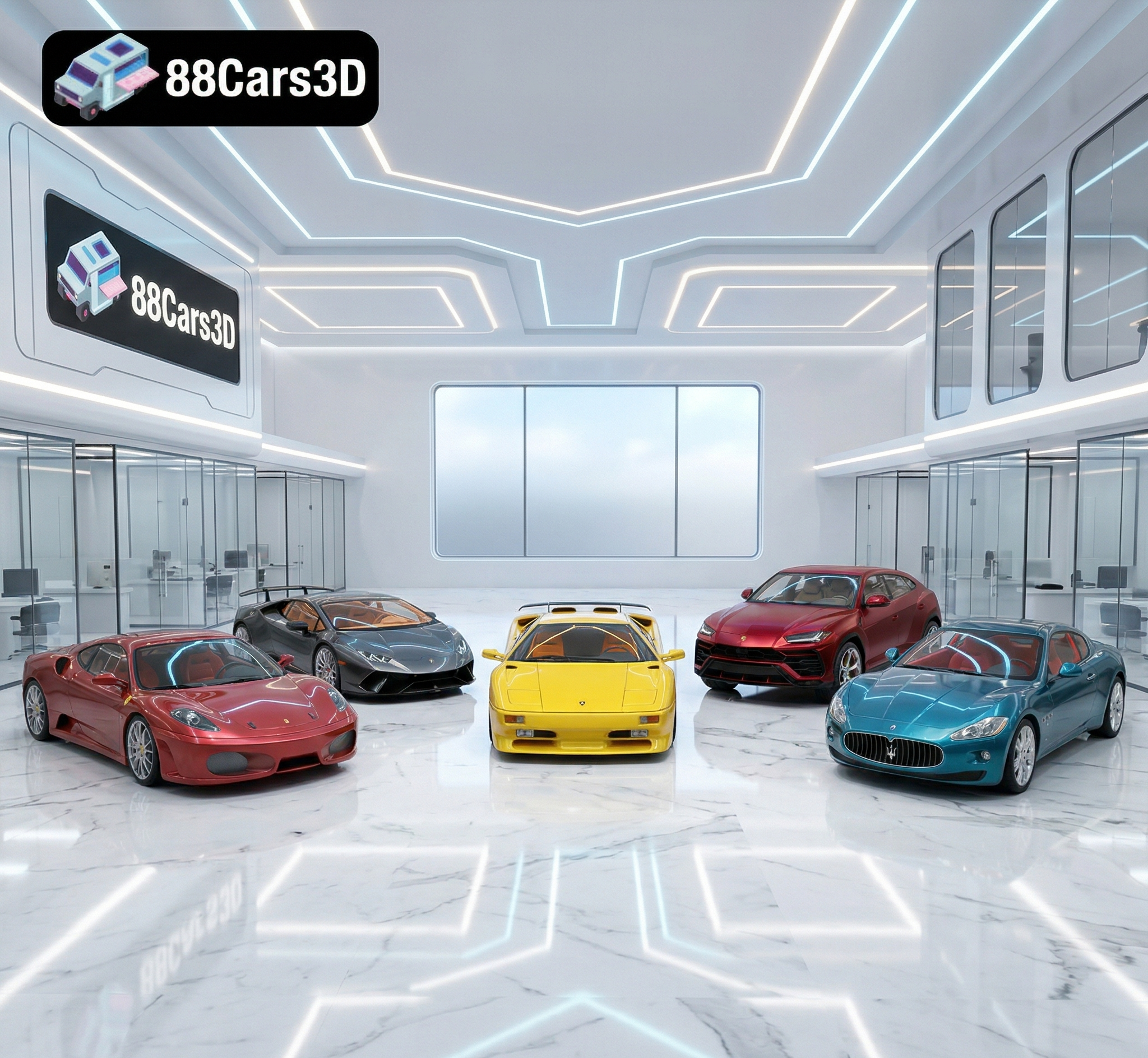
Texture: Yes | Material: Yes | 3D Printable: Yes. Download the Italian Thoroughbreds Bundle featuring 5 iconic 3D models: Lamborghini Huracán Performante, Ferrari 458 Italia, Lamborghini Urus, Diablo SV, and Maserati GT. Optimized for 4K rendering and 3D printing (STL included). Save 50% with this ultimate Italian vehicle collection.
Price: $199.99

Download the Elite Future Mobility Bundle featuring 4 highly optimized 3D models: Tesla Model S, Avatr 11, Li L9, and Zoox Robotaxi. Perfect for ArchViz, Smart City renders, and game dev. Optimized for Unreal Engine and Blender. Includes .fbx, .obj, and .max formats.
Price: $99

🚗 5 Iconic German Cars (BMW M4 G82, M5 CS, X3, 1 Series & Mercedes E-Class). ✅ Optimized for ArchViz: Ready for Corona & V-Ray. 💰 Save €71 with this limited-time collection! 🚀 Instant Download after purchase.
Price: $119
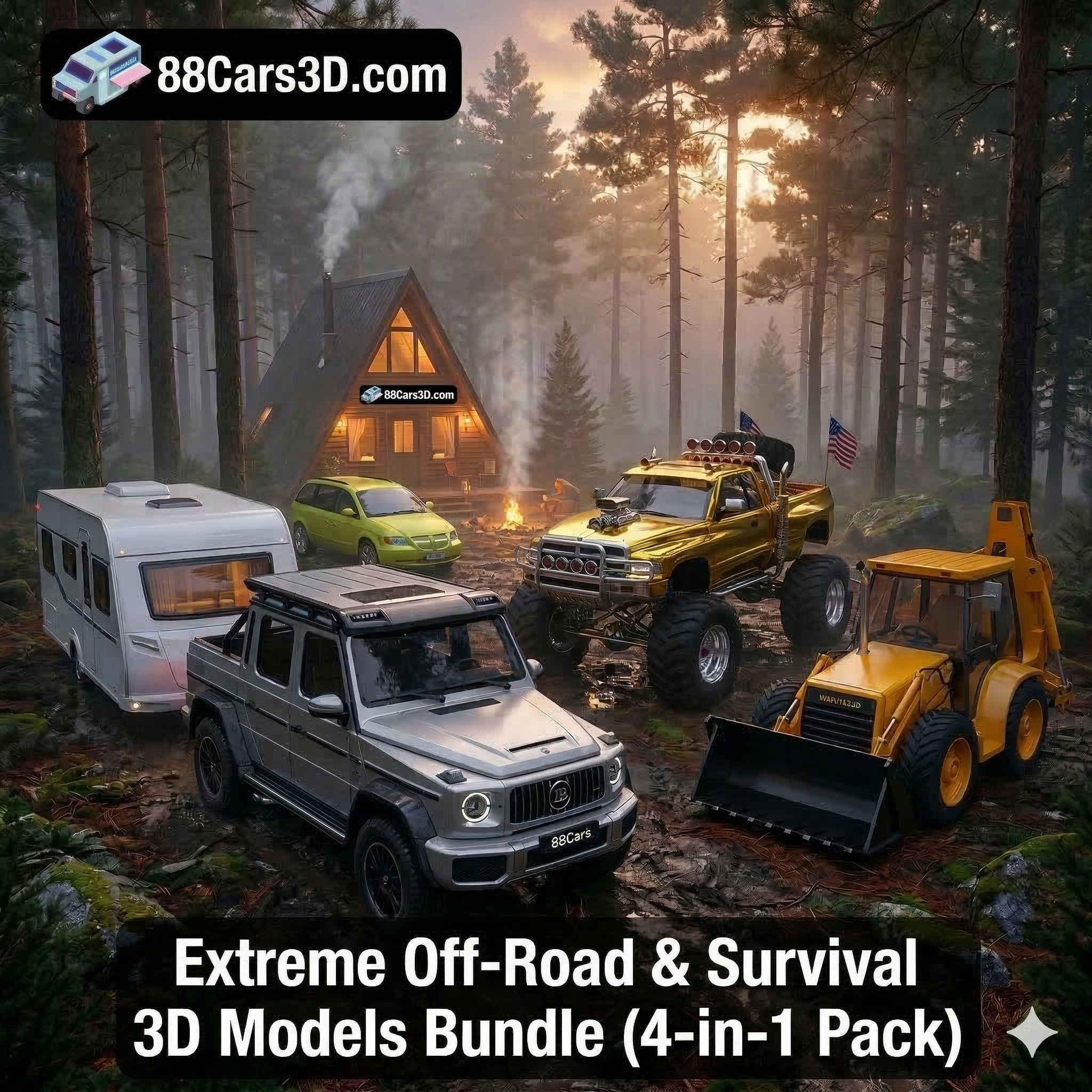
Download the Extreme Off-Road & Survival 3D Models Bundle! Includes the Brabus 800 Adventure, Dodge Ram Bigfoot, Spec Truck, and a Caravan. Save over €210 on this premium 4-in-1 off-grid vehicle pack for ArchViz and game development.
Price: $149.99
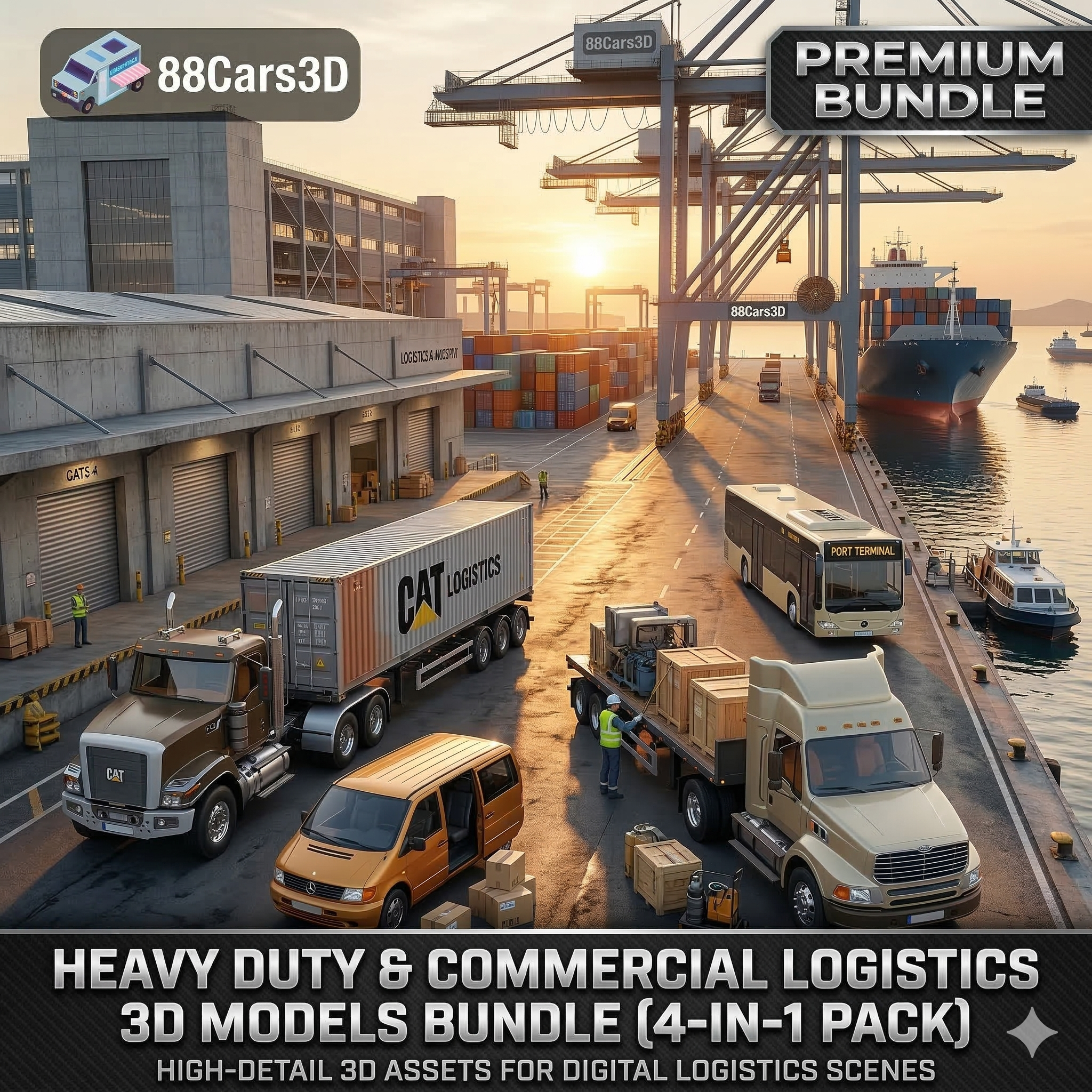
Download the Heavy Duty & Commercial Logistics 3D Models Bundle! Includes the Ford Sterling, Caterpillar CT680, Mercedes Citaro Bus, and Vito Van. Save over €130 on this massive, game-ready 4-in-1 industrial vehicle pack.
Price: $109.99

Download the Ultimate Custom Motorcycles 3D Models Bundle. Includes a Custom Chopper, Ducati 916 Café Fighter, Harley XR1200X, and BMW K100. Perfect premium props for luxury ArchViz garages. Save over €250 today!
Price: $159.99

Download the ultimate JDM Street Racing 3D Models Bundle! Includes the Nissan GT-R, Toyota Supra, Mazda RX-7, Lancer Evo IX, and Honda NSX. Save big on this highly optimized, game-ready 5-in-1 Japanese legend car pack.
Price: $129.99

Download the ultimate American Muscle & Cinematic Classics 3D Models Bundle! Includes the Dodge Charger ’68, Mustang Eleanor GT500, Camaro Z28 ’79, and a custom ’69 Mustang. Save over €240 on this game-ready, premium 4-in-1 pack.
Price: $149.99
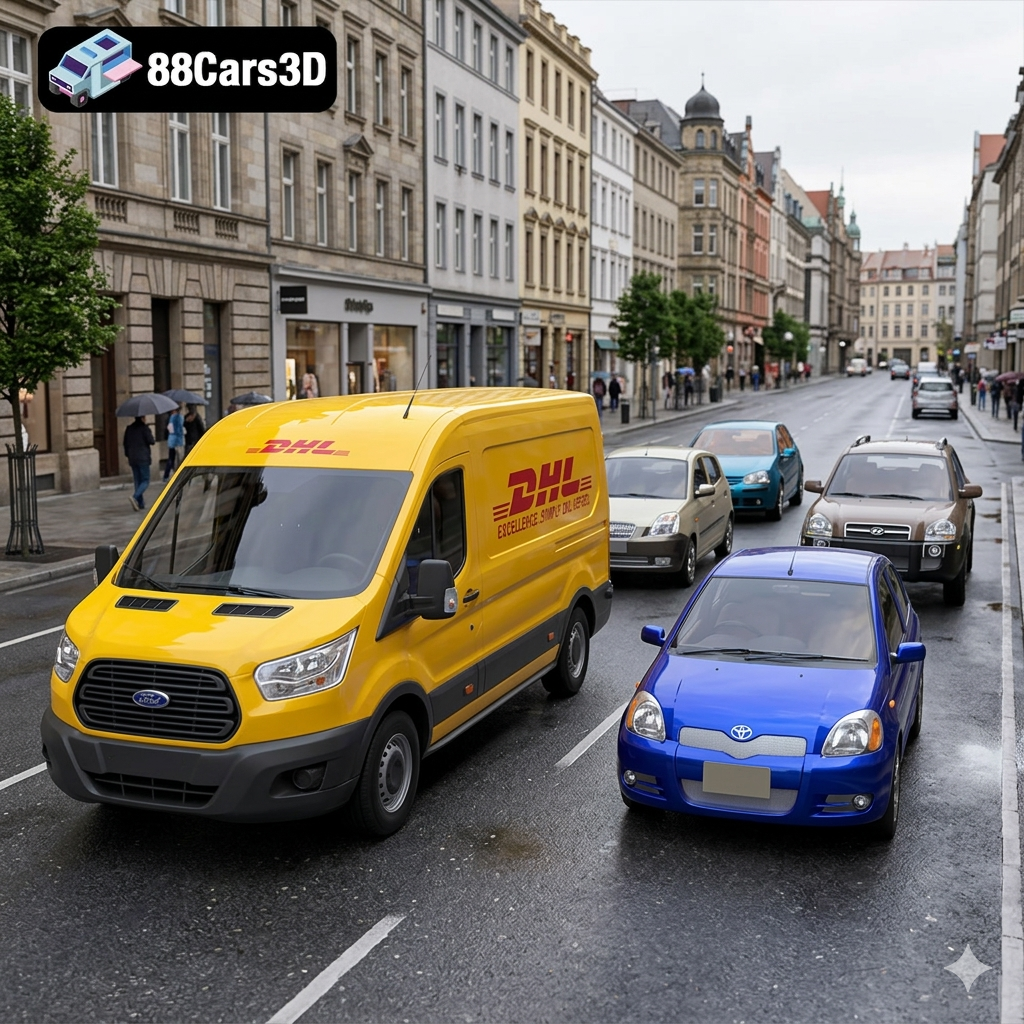
Download the Everyday City Traffic 3D Models Bundle. Includes the VW Golf, Kia Picanto, Hyundai Tucson, Toyota Yaris, and a DHL Ford Transit Van. Save big on this 5-in-1 pack, perfectly optimized for realistic ArchViz streets and game traffic.
Price: $99.99
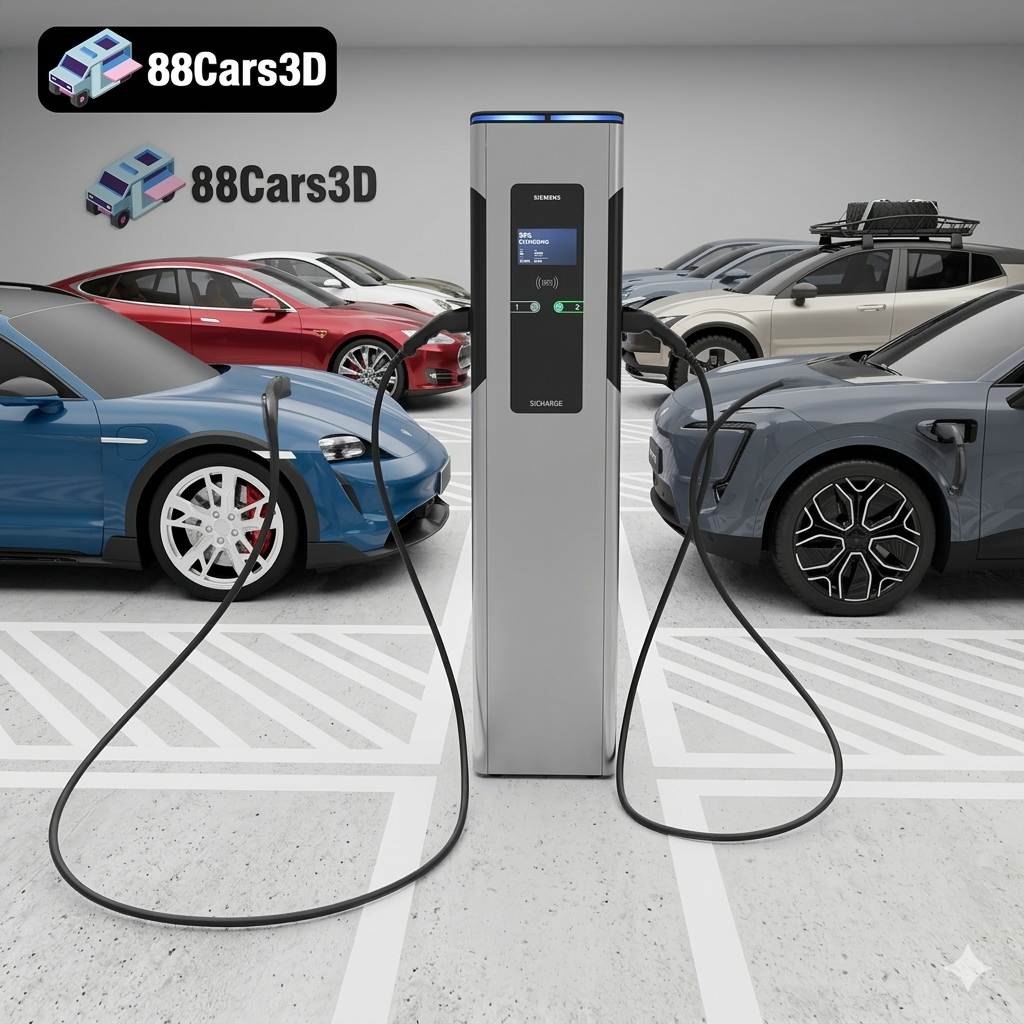
Download the Future of Mobility EV 3D Models Bundle. Includes the Volvo EX30, Tesla Model S, AVATR 11, Porsche Taycan, and a Siemens EV Charger. Save big on this highly optimized 5-in-1 pack for ArchViz and game development!
Price: $89.99

