Get 50% OFF All Premium 3D & STL Models!

The automotive industry has always been at the forefront of technological innovation, and its visualization sector is no exception. With the advent of real-time rendering engines like Unreal Engine, coupled with advanced graphics technologies such as real-time ray tracing, the fidelity and immersive quality of automotive visualization have reached unprecedented levels. From photorealistic product configurators to breathtaking cinematic virtual productions and interactive design reviews, real-time ray tracing transforms how we experience and interact with 3D car models.
For Unreal Engine developers, 3D artists, and automotive design professionals, understanding how to harness the power of real-time ray tracing is no longer a luxury but a necessity. This comprehensive guide will deep dive into the practical aspects of setting up and optimizing real-time ray tracing in Unreal Engine for automotive visualization. We’ll explore everything from initial project configuration and material calibration to advanced lighting techniques, performance optimization, and creating compelling interactive experiences. By the end, you’ll have a robust understanding of how to leverage Unreal Engine’s cutting-edge capabilities to bring your automotive visions to life with unparalleled realism.
Embarking on a journey into real-time ray tracing in Unreal Engine begins with the correct project setup and a fundamental understanding of what ray tracing entails. This powerful rendering technique simulates the physical behavior of light, tracing individual light rays through a scene to accurately calculate reflections, refractions, shadows, and global illumination. The result is an astonishing level of realism that was once only achievable with offline renderers.
To begin, ensure your Unreal Engine project is configured to support ray tracing. This requires a graphics card that supports Microsoft DirectX 12 (DX12) and the DXR (DirectX Raytracing) API, such as NVIDIA’s RTX series or AMD’s RX 6000 series and newer. In Unreal Engine, navigate to Edit > Project Settings > Platforms > Windows and set the Default RHI to DirectX 12. After restarting the editor, go to Engine > Rendering and enable Ray Tracing. You’ll need to restart the editor again for these changes to take effect. It’s crucial to verify your display drivers are up-to-date, as performance and stability are highly dependent on driver optimization. Remember that ray tracing can be demanding, so a robust hardware setup is key to a smooth development experience.
Once enabled, Unreal Engine provides specific Ray Tracing options within various lighting and post-processing volumes. Ray Traced Reflections offer highly accurate, pixel-perfect reflections that react realistically to surfaces, ideal for the glossy finishes of 3D car models. Ray Traced Shadows provide physically accurate soft shadows with precise penumbras, adding immense depth and realism to your scene. Ray Traced Global Illumination (RTGI) calculates how light bounces off surfaces, illuminating indirect areas and providing a more natural light distribution. Finally, Ray Traced Ambient Occlusion (RTAO) enhances contact shadows and adds subtle depth to crevices, further grounding objects in the scene. Each of these features can be toggled and fine-tuned within their respective settings, often found in the Post Process Volume or individual light sources, allowing for granular control over visual fidelity and performance trade-offs. For more in-depth technical details on enabling and configuring these features, refer to the official Unreal Engine documentation at https://dev.epicgames.com/community/unreal-engine/learning.
The quality of your source 3D car models is paramount to achieving stunning real-time ray traced results. Even with the most advanced rendering techniques, a poorly optimized or incorrectly set up model will fall short. High-quality assets form the bedrock of any successful automotive visualization project. Platforms like 88cars3d.com offer pre-optimized, high-fidelity 3D car models specifically designed for demanding real-time applications like Unreal Engine.
When sourcing automotive assets from marketplaces such as 88cars3d.com, look for models with clean quad-based topology and efficient polygon counts. While ray tracing can handle high geometric detail, well-structured meshes are always easier to work with and optimize. Crucially, your models must have proper UV mapping. Each material needs its own UV set, with no overlapping UVs, especially for baked lighting, lightmaps (if using hybrid lighting), or specific texture projections. Overlapping UVs will lead to artifacts and incorrect texture sampling. For ray tracing, precise UVs ensure reflections and refractions map correctly and materials respond accurately to light.
Equally vital is the calibration of Physically Based Rendering (PBR) materials. PBR is the foundation of realism in modern rendering, mimicking how light interacts with real-world surfaces. In Unreal Engine’s Material Editor, define your car paint, glass, rubber, and metal materials using base color, metallic, roughness, and normal maps. For car paint, consider using a layered material approach to simulate clear coat reflections and metallic flakes accurately. Glass materials require careful setup with appropriate transmission and refraction properties to work effectively with ray tracing. Ensure your textures are high-resolution (e.g., 2K or 4K) for close-up detail, and leverage the SRGB and linear color space settings correctly within the texture properties. Incorrect PBR values can lead to materials that look dull, overly shiny, or simply “off” when illuminated by ray-traced light.
Even with ray tracing handling much of the rendering, performance optimization remains critical, especially for interactive experiences or large scenes. Level of Detail (LOD) management is essential. Create multiple LODs for your car models, allowing Unreal Engine to swap lower-polygon versions at a distance, significantly reducing rendering overhead for objects far from the camera. This is particularly important for models used in open-world environments or large showrooms. For static meshes, Unreal Engine’s automatic LOD generation can be a good starting point, but manual optimization often yields superior results.
For incredibly detailed, high-polygon car models, Unreal Engine 5’s Nanite virtualized geometry system is a game-changer. Nanite allows you to import film-quality assets with millions or even billions of polygons without significant performance loss. It intelligently streams and renders only the necessary detail, making it perfect for highly detailed 3D car models from 88cars3d.com that boast intricate details like engine bays or interiors. When importing your high-poly meshes, simply enable Nanite support. This feature works seamlessly with ray tracing for reflections and shadows, offering unparalleled visual fidelity without requiring traditional LODs for the static mesh itself. However, be aware that Nanite currently has some limitations with translucent materials and certain forms of deformation, so careful planning is still necessary for complex interactive elements.
Lighting is arguably the most critical component in achieving photorealism in automotive visualization. Real-time ray tracing, especially when combined with Unreal Engine 5’s Lumen global illumination system, provides an incredibly powerful toolkit for creating dynamic and believable lighting scenarios. Understanding how to leverage these technologies is key to showcasing your 3D car models in their best light.
While ray tracing offers unparalleled accuracy, it can be computationally intensive. For certain static environments or specific performance targets, a hybrid lighting approach might be beneficial. This involves combining traditional baked lighting (using Lightmass) for static global illumination and shadows, and then layering real-time ray tracing for dynamic elements like reflections, character shadows, or specific areas of interest. Baked lighting provides excellent performance and quality for static light bounces, but it doesn’t react to dynamic changes. Ray-traced features, on the other hand, update in real-time, making them perfect for moving vehicles or changing lighting conditions. For example, a showroom environment might use baked global illumination for the static walls and floor, while the car itself benefits from ray-traced reflections and dynamic shadows cast by an interactive spotlight. This balance allows artists to achieve high visual quality while maintaining acceptable frame rates.
Unreal Engine 5 introduced Lumen, a revolutionary real-time global illumination and reflection system designed to work seamlessly with dynamic lighting and geometry. Lumen provides incredibly realistic indirect lighting and reflections that react instantly to changes in the scene, removing the need for baked lightmaps in many scenarios. For automotive visualization, Lumen is a game-changer, allowing you to move lights, change materials, and swap out car models, with the environment’s lighting responding immediately and accurately. When working with Lumen, ensure it’s enabled in Project Settings under Engine > Rendering > Global Illumination > Lumen and Reflections > Lumen. While Lumen is a screen-space technique with fallback options, combining it with hardware ray tracing for high-quality reflections (controlled via the Post Process Volume) offers the absolute best of both worlds, providing robust global illumination and pixel-perfect reflections where needed. This combination delivers stunning visual fidelity for car exteriors and interiors, highlighting every curve and material nuance.
Ray Traced Shadows (RTS) are a significant visual upgrade over traditional shadow maps. They produce soft, realistic shadows with accurate penumbras, directly influenced by light source size and distance. To optimize RTS, adjust the Samples Per Pixel setting in the Post Process Volume or individual light sources. Lower values improve performance but can introduce noise; higher values increase quality at a greater cost. Utilize the Ray Tracing Max Distance setting to limit shadow calculation range for distant objects, using cheaper shadow maps as a fallback. For directional lights, enabling Contact Shadows can further enhance small details.
Ray Traced Ambient Occlusion (RTAO) adds subtle contact shadows to corners and crevices, significantly enhancing depth and realism without being overly performance-intensive. In the Post Process Volume, adjust the Intensity and Radius of RTAO to achieve the desired effect. A common practice is to use a moderate RTAO alongside subtle global illumination to prevent scenes from looking too flat or washed out. For optimal results, ensure your static meshes have accurate bounding boxes and clean geometry, as RTAO relies on scene geometry to calculate occlusion correctly. Properly configured, these ray-traced features will make your 3D car models feel physically present and grounded within your virtual environments.
Beyond static renders, Unreal Engine excels at creating dynamic and interactive automotive experiences. Leveraging tools like Blueprint visual scripting and Sequencer for cinematics allows developers and artists to build engaging product configurators, immersive showrooms, and compelling virtual productions where 3D car models truly come to life.
Blueprint visual scripting is a cornerstone of interactive design in Unreal Engine. For automotive configurators, Blueprint enables artists to create sophisticated systems without writing a single line of C++ code. You can use Blueprints to:
Each interaction can trigger events that update the car’s appearance or behavior in real-time, with ray tracing instantly showcasing the visual changes. This provides an immediate and satisfying feedback loop for the user, essential for a compelling product configuration experience.
Unreal Engine’s Sequencer is a powerful multi-track editor for creating cinematic sequences, animations, and gameplay events. Combined with real-time ray tracing, Sequencer allows for the production of stunning, photorealistic automotive marketing videos, design reviews, or product reveal trailers entirely within the engine. Here’s how you can leverage it:
Sequencer seamlessly integrates with ray tracing, ensuring that all animated elements, lighting changes, and camera movements are rendered with consistent, physically accurate visual fidelity, perfect for high-end automotive marketing.
The ultimate application of these interactive tools is the automotive configurator. This typically involves a user interface (often built with Unreal Engine’s UMG – Unreal Motion Graphics) that allows users to select various options for a 3D car model, with instant visual feedback. Consider these technical aspects:
By combining robust 3D car models (like those found on 88cars3d.com) with Blueprint’s flexibility and ray tracing’s visual power, developers can create configurators that not only look incredible but also provide a genuinely immersive and informative purchasing experience.
While real-time ray tracing delivers unparalleled visual fidelity, managing its performance footprint is crucial for interactive applications and broader accessibility. Optimization isn’t a one-time task; it’s an ongoing process that requires profiling, smart asset management, and leveraging advanced Unreal Engine features. Achieving that sweet spot between visual quality and performance is the mark of a skilled developer.
Understanding where your performance bottlenecks lie is the first step in optimization. Unreal Engine provides robust profiling tools to help you identify these areas. Key tools include:
stat gpu into the console provides a live overlay of GPU performance, including ray tracing costs.r.RayTracing.Reflections.MaxBounces, r.RayTracing.GlobalIllumination.SamplesPerPixel). Experiment with these to see their impact on performance. Start by reducing bounces and samples, then incrementally increase them until visual quality is acceptable while performance remains within target.r.RayTracing.DebugMode 1 (and incrementing values) to visualize ray tracing passes, helping you understand how rays are being traced and if any geometry issues are causing unnecessary complexity.By systematically profiling and adjusting settings, you can pinpoint the most impactful changes to optimize your scene.
Not every user will have a top-tier DXR-capable GPU. Designing for scalability allows your automotive visualization to reach a wider audience. Unreal Engine’s Scalability Settings are your ally here. You can:
The goal is to provide a good experience across a spectrum of hardware, ensuring that ray tracing is enabled only when the hardware can support it gracefully, while still offering a visually appealing experience for those without DXR-capable systems.
One of the most significant advancements for bridging the gap between ray tracing quality and real-time performance is the advent of upscaling technologies. NVIDIA’s Deep Learning Super Sampling (DLSS) and AMD’s FidelityFX Super Resolution (FSR) are prime examples:
To enable these, navigate to Project Settings > Engine > Rendering > Upscaling and select your desired method. These technologies allow you to push ray tracing quality settings higher, render at a lower internal resolution, and then upscale to your target display resolution, effectively giving you “free” performance. When combined with optimized 3D car models and thoughtful scene management, DLSS or FSR can make highly ray-traced automotive scenes interactive and smooth, even at demanding resolutions like 4K.
Real-time ray tracing in Unreal Engine extends its utility far beyond static renders or even interactive configurators. It’s revolutionizing virtual production workflows and offering new possibilities for augmented and virtual reality automotive experiences, pushing the boundaries of what’s achievable in real-time visualization.
Virtual production, particularly with LED walls, is transforming filmmaking and high-end advertising. Unreal Engine, with its real-time ray tracing capabilities, is at the heart of this revolution. For automotive brands, this means:
This workflow offers incredible flexibility, cost savings, and the ability to iterate on creative decisions rapidly, all while maintaining the highest visual fidelity thanks to real-time ray tracing.
Augmented Reality (AR) and Virtual Reality (VR) offer immersive ways to experience automotive designs, from virtual test drives to interactive design reviews. However, the performance demands of AR/VR are even more stringent than traditional screen-based rendering due to the need for high frame rates (90+ FPS) to prevent motion sickness and maintain immersion. Integrating ray tracing requires careful consideration:
Achieving ray-traced realism in AR/VR is challenging but increasingly feasible, offering truly groundbreaking interactive experiences for automotive design and marketing.
The applications of real-time ray tracing for automotive visualization are vast and continue to expand:
Looking ahead, we can expect continued advancements in ray tracing hardware, further integration of AI-powered rendering techniques (like neural rendering for even faster upscaling or denoising), and increasing adoption in cloud-based streaming solutions, making photorealistic automotive visualization accessible on a broader range of devices. The convergence of these technologies promises an exciting future where the line between digital and physical automotive experiences blurs even further.
Real-time ray tracing in Unreal Engine represents a monumental leap forward for automotive visualization, enabling artists and developers to craft scenes with unparalleled photorealism and immersion. From meticulously prepared 3D car models, like those available on 88cars3d.com, to the intricate dance of ray-traced reflections, shadows, and global illumination, every element contributes to bringing a vehicle to life in the digital realm. We’ve explored the essential steps from project setup and material calibration to leveraging advanced features like Lumen and Nanite, alongside critical performance optimization strategies and the exciting frontiers of virtual production and AR/VR.
The journey to mastering real-time ray tracing is one of continuous learning and experimentation. By understanding the underlying principles and diligently applying best practices, you can unlock the full potential of Unreal Engine to create breathtaking automotive experiences. Embrace the tools, push the boundaries of visual fidelity, and transform how the world interacts with the vehicles of tomorrow. The future of automotive visualization is real-time, and with ray tracing, it’s more brilliant than ever before.

Texture: Yes | Material: Yes | 3D Printable: Yes. Download the Italian Thoroughbreds Bundle featuring 5 iconic 3D models: Lamborghini Huracán Performante, Ferrari 458 Italia, Lamborghini Urus, Diablo SV, and Maserati GT. Optimized for 4K rendering and 3D printing (STL included). Save 50% with this ultimate Italian vehicle collection.
Price: $199.99

Download the Elite Future Mobility Bundle featuring 4 highly optimized 3D models: Tesla Model S, Avatr 11, Li L9, and Zoox Robotaxi. Perfect for ArchViz, Smart City renders, and game dev. Optimized for Unreal Engine and Blender. Includes .fbx, .obj, and .max formats.
Price: $99

🚗 5 Iconic German Cars (BMW M4 G82, M5 CS, X3, 1 Series & Mercedes E-Class). ✅ Optimized for ArchViz: Ready for Corona & V-Ray. 💰 Save €71 with this limited-time collection! 🚀 Instant Download after purchase.
Price: $119

Download the Extreme Off-Road & Survival 3D Models Bundle! Includes the Brabus 800 Adventure, Dodge Ram Bigfoot, Spec Truck, and a Caravan. Save over €210 on this premium 4-in-1 off-grid vehicle pack for ArchViz and game development.
Price: $149.99

Download the Heavy Duty & Commercial Logistics 3D Models Bundle! Includes the Ford Sterling, Caterpillar CT680, Mercedes Citaro Bus, and Vito Van. Save over €130 on this massive, game-ready 4-in-1 industrial vehicle pack.
Price: $109.99

Download the Ultimate Custom Motorcycles 3D Models Bundle. Includes a Custom Chopper, Ducati 916 Café Fighter, Harley XR1200X, and BMW K100. Perfect premium props for luxury ArchViz garages. Save over €250 today!
Price: $159.99

Download the ultimate JDM Street Racing 3D Models Bundle! Includes the Nissan GT-R, Toyota Supra, Mazda RX-7, Lancer Evo IX, and Honda NSX. Save big on this highly optimized, game-ready 5-in-1 Japanese legend car pack.
Price: $129.99

Download the ultimate American Muscle & Cinematic Classics 3D Models Bundle! Includes the Dodge Charger ’68, Mustang Eleanor GT500, Camaro Z28 ’79, and a custom ’69 Mustang. Save over €240 on this game-ready, premium 4-in-1 pack.
Price: $149.99

Download the Everyday City Traffic 3D Models Bundle. Includes the VW Golf, Kia Picanto, Hyundai Tucson, Toyota Yaris, and a DHL Ford Transit Van. Save big on this 5-in-1 pack, perfectly optimized for realistic ArchViz streets and game traffic.
Price: $99.99
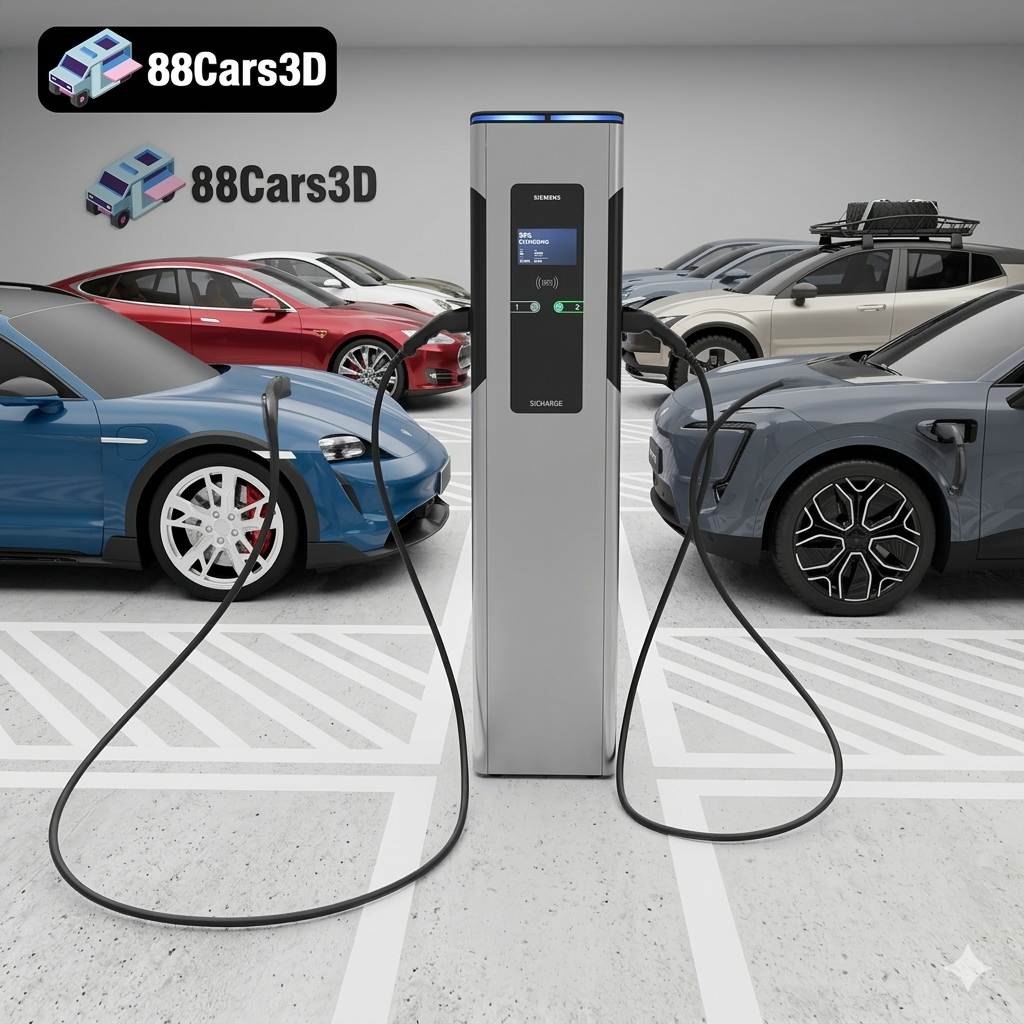
Download the Future of Mobility EV 3D Models Bundle. Includes the Volvo EX30, Tesla Model S, AVATR 11, Porsche Taycan, and a Siemens EV Charger. Save big on this highly optimized 5-in-1 pack for ArchViz and game development!
Price: $89.99

