Get 50% OFF All Premium 3D & STL Models!

In the rapidly evolving digital landscape, the demand for photorealistic 3D car models has never been higher. From breathtaking cinematic automotive renders to immersive open-world game environments and cutting-edge AR/VR experiences, high-fidelity vehicle assets are the cornerstone of visual excellence. Whether you’re a professional visualizer, an indie game developer, or an architectural firm looking to populate a scene, understanding the intricacies of these digital creations is paramount. This comprehensive guide will delve deep into the technical aspects, workflows, and diverse applications of premium 3D car models, helping you unlock their full potential. For those seeking top-tier assets ready for any project, 88cars3d.com offers an extensive collection designed to meet the most stringent industry standards.
Choosing the correct file format for your 3D car models is a critical decision that impacts workflow, compatibility, and final output quality. Each format is designed with specific use cases in mind, offering different levels of flexibility, optimization, and feature retention. Understanding these nuances is essential for any professional working with 3D assets.
The .blend format is Blender’s native file type, offering a fully editable scene with all associated materials, textures, lighting, cameras, and animations intact. It’s the ideal choice if you are a Blender user, as it preserves every aspect of the project for continued development. This format ensures that all custom node setups, physics simulations, and modifiers are fully accessible and editable. For those who model in Blender, a .blend file from 88cars3d.com provides maximum flexibility for customization and integration into existing Blender projects.
Autodesk’s .fbx (Filmbox) format is arguably the most widely adopted interchange format in the 3D industry, particularly favored for game development pipelines. It efficiently carries geometry, materials, textures, animations, and skeletal data across different 3D applications like Maya, 3ds Max, Blender, and directly into game engines such as Unreal Engine and Unity. Its robustness makes it ideal for real-time applications where performance and accurate data transfer are crucial. When you need to move a detailed 3D car model from a modeling package to a rendering engine or game engine, .fbx is often the go-to format due to its excellent support for complex scene data.
The .obj (Wavefront Object) format is one of the oldest and most universally supported 3D file formats. It’s a simple, text-based format primarily used for transferring geometric data (vertices, normals, UVs, faces) between different software applications. While it doesn’t typically store animation or rigging information, it excels at providing clean, compatible mesh data. Most 3D software can import and export .obj files, making it a reliable choice for cross-software compatibility when the focus is purely on the model’s geometry and basic material assignments (often through an accompanying .mtl file). For basic geometric transfer, .obj remains an indispensable tool.
.glb (GL Transmission Format Binary) is a relatively newer format designed for the efficient transmission and loading of 3D scenes and models in web and real-time applications, especially for Augmented Reality (AR) and Virtual Reality (VR). It’s a binary version of glTF, embedding textures and other data directly within the single file. This self-contained nature makes .glb incredibly efficient for streaming and display in browser-based viewers, mobile AR apps, and lightweight VR experiences. If you’re showcasing a 3D car model on a website or developing an AR app for product visualization, .glb offers superior performance and ease of integration.
The .stl (Stereolithography) format is the ubiquitous standard for 3D printing. It represents a 3D model as a series of connected triangles, defining only the surface geometry without color, texture, or other attributes. For a 3D car model to be printable, it must be a “watertight” manifold mesh without gaps or inverted normals. While not suitable for rendering or animation, .stl is absolutely essential when preparing a physical prototype or miniature of your automotive design. Many of the intricate details present in high-quality 3D car models need careful preparation for accurate .stl export.
.ply (Polygon File Format) is another format for storing 3D data, particularly popular in academic and research settings for scanned data, CAD applications, and analysis. It can store not only geometry but also color, transparency, normals, and even confidence values for each vertex or face. While less common for general rendering or game development compared to .fbx or .obj, .ply provides a more precise and detailed representation of mesh properties, making it valuable for scientific visualization, point cloud data, or when dealing with highly accurate scanned automotive components.
While not a universal file extension in the same way as .fbx or .obj, “unreal” typically refers to assets that have been specifically prepared and optimized for direct import into Unreal Engine. This often means an .fbx file that adheres to Unreal Engine’s naming conventions, material setup, and LOD (Level of Detail) structure, ready to be dropped into a project. It implies that the asset is already configured for optimal performance, with correct scaling, collision meshes, and PBR (Physically Based Rendering) materials ready for real-time environments. Such assets, often found on marketplaces like 88cars3d.com, streamline the development process significantly.
The .max format is the native file type for Autodesk 3ds Max, a powerful 3D modeling, animation, and rendering software widely used in the architectural visualization, product design, and automotive industries. Similar to .blend, a .max file contains the complete scene, including geometry, materials, textures, lighting, cameras, animation data, and modifiers specific to 3ds Max. This format provides full editability and control over the asset within its native environment, making it ideal for users working primarily in 3ds Max who require maximum flexibility for animation, complex rigging, or high-end automotive rendering setups.
Choosing the right format is a strategic decision. A versatile asset from 88cars3d.com will often come in multiple formats, ensuring broad compatibility and suitability for diverse project requirements, from cinematic rendering to game development and AR experiences.
What truly distinguishes a mediocre 3D car model from an exceptional one lies in its underlying construction. High-quality assets are not just visually appealing; they are technically sound, optimized for various pipelines, and built with precision and efficiency. This foundation is critical whether you’re aiming for photorealistic automotive rendering or performance-driven game assets.
The topology, or the arrangement of polygons, is the skeleton of any 3D model. For a high-quality 3D car, this means clean, organized quad-based geometry with proper edge flow. Good topology is essential for smooth subdivision, deformation during animation, and efficient UV unwrapping. A common technique for automotive models is to start with a lower-resolution base mesh and then use subdivision surface modifiers (like TurboSmooth in 3ds Max or Subdivision Surface in Blender) to achieve a smooth, high-poly result for rendering. For real-time applications, multiple Levels of Detail (LODs) are crucial. A hero asset might have 200,000-500,000 polygons, while a distant LOD might be reduced to 5,000-10,000 polygons, ensuring optimal performance without sacrificing visual integrity at closer ranges. Models from 88cars3d.com are often supplied with carefully optimized mesh densities and sometimes pre-configured LODs.
UV mapping is the process of flattening the 3D surface of a model into a 2D space, allowing textures to be applied accurately. For a high-quality car model, meticulous UV unwrapping is non-negotiable. This involves creating clean, non-overlapping UV islands, maximizing texture space, and minimizing distortion.
The texturing process then leverages Physically Based Rendering (PBR) workflows, which mimic how light interacts with real-world materials. This involves creating a suite of texture maps:
These maps, combined with carefully crafted shaders, are what give car paint its depth, glass its transparency, and tires their grittiness.
True photorealism in 3D car models stems from an obsessive attention to detail and accuracy. This means modeling every curve, vent, seam, and emblem precisely as it appears on the real vehicle, often using extensive reference images, blueprints, and even CAD data. Interiors are just as crucial as exteriors, with meticulously modeled dashboards, seats, steering wheels, and door panels. Even small components like brake calipers, suspension elements, and engine details (if visible) contribute to the overall authenticity. Precision modeling ensures that the model holds up under extreme close-ups, essential for high-end automotive rendering and visualization projects where every pixel counts.
Creating a truly stunning automotive render goes far beyond having a great 3D car model. It involves a sophisticated interplay of lighting, materials, camera work, and post-production. The goal is to evoke emotion and communicate the essence of the vehicle with breathtaking realism.
The environment and lighting are paramount to a realistic render. High Dynamic Range Imagery (HDRI) maps are a staple, providing both realistic ambient lighting and reflections, often used in conjunction with dedicated dome lights or spherical projections. For studio-style renders, an array of physically accurate area lights, often in softbox or strip light configurations, are strategically placed to highlight the car’s curves and form. Key lighting principles like three-point lighting (key, fill, back) are adapted to automotive forms, emphasizing contours and creating dramatic highlights and shadows. The placement of a large, soft light source for the main reflection across the car’s body is crucial for defining its shape and material properties.
Achieving realistic materials is a complex art. Car paint, in particular, requires a nuanced approach, often involving a multi-layered shader to simulate metallic flakes, clear coat reflections, and underlying base color. Advanced shaders can include fresnel reflections, clear coat thickness, and even subtle orange peel effects. Glass materials need to accurately refract light, display reflections, and potentially show subtle imperfections. Chrome and other metallic surfaces demand highly reflective shaders with appropriate roughness values. Tires require detailed displacement or normal maps for tread patterns, and their rubber material should exhibit specific diffuse and roughness characteristics. Every material, from leather to plastic, is meticulously crafted using PBR textures and physically accurate shader nodes within renderers like V-Ray, Octane Render, or Corona Renderer.
The render straight out of your 3D software is often just the beginning. Post-production in tools like Adobe Photoshop or Affinity Photo adds the final layer of polish. This includes:
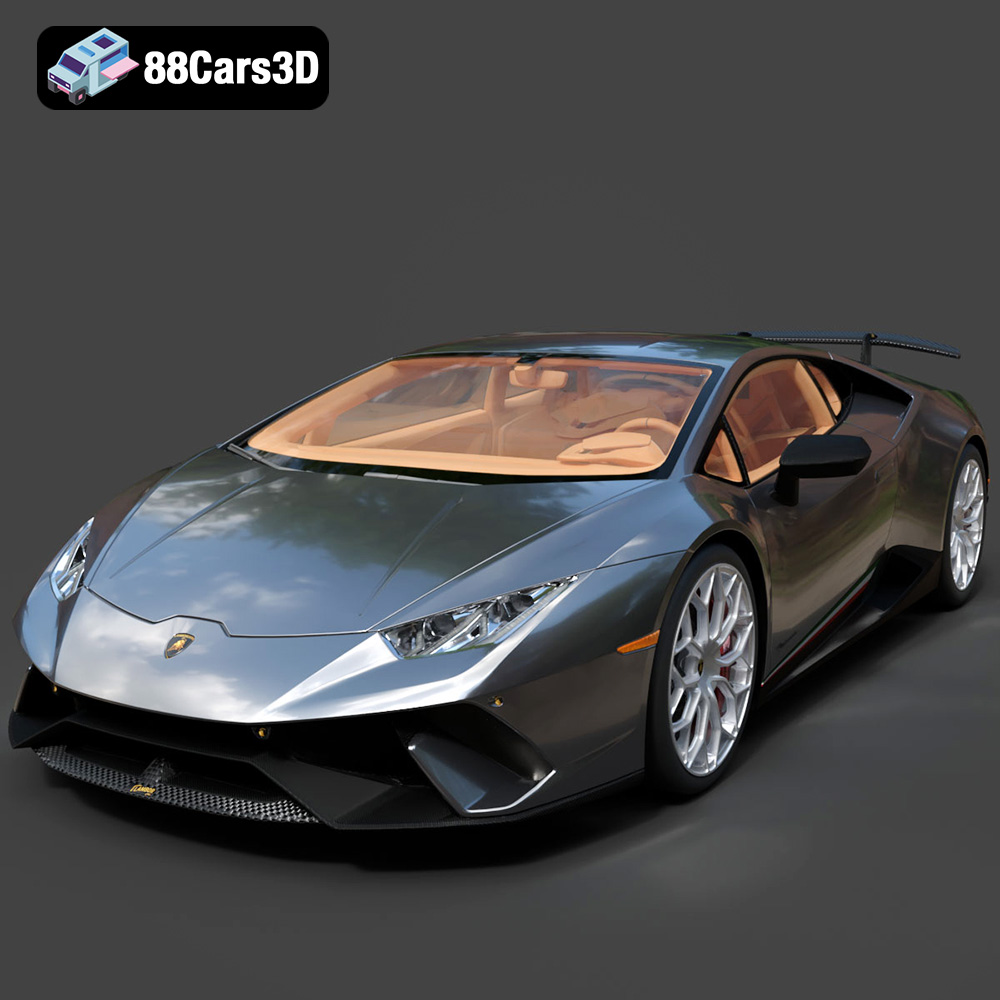
These techniques, when applied judiciously, transform a raw render into a captivating visual masterpiece. For example, taking a highly detailed vehicle model from 88cars3d.com, like a modern supercar, and setting it against a vibrant HDRI cityscape in 3ds Max, then rendering it with V-Ray, would produce a stunning image. A final pass in Photoshop to enhance reflections and add subtle atmospheric haze would truly make the image pop, showcasing the power of high-quality assets combined with expert rendering techniques.
Game development places unique demands on 3D car models. While photorealism is still a goal, it must be balanced with performance and interactivity. Integrating vehicles into game engines like Unreal Engine or Unity requires specific optimizations and workflows to ensure a smooth, immersive player experience.
The primary challenge in game development is rendering complex scenes at high frame rates. This necessitates rigorous optimization of 3D car models. Key techniques include:
These optimizations are crucial for maintaining a smooth frame rate, especially in open-world games with many vehicles.
Once optimized, 3D car models are imported into game engines. The .fbx format is the most common choice due to its excellent support for meshes, materials, and animations. In Unreal Engine, this involves:
Unity follows a similar process, with materials being set up using the Standard (Metallic Workflow) or Universal Render Pipeline (URP) / High Definition Render Pipeline (HDRP) shaders.
Beyond visuals, game 3D car models need robust physics. This involves configuring wheel colliders, suspension parameters, engine torque curves, and braking forces within the game engine’s physics system. Damage models, whether simple mesh deformation or more complex modular destruction, add to the realism and player engagement. Animation integration is also key, from opening doors and trunks to dynamic suspension movement. A common workflow might see a game developer acquire a detailed 3D car model from 88cars3d.com, import the .fbx into Unreal Engine, set up the PBR materials, add a simplified collision mesh, and then integrate it into a C++ or Blueprint-based vehicle physics system. This allows for a high-fidelity car to be driven realistically within the game world, complete with tire smoke and engine sounds, demonstrating the seamless transition from high-quality asset to interactive game element.
The utility of high-quality 3D car models extends far beyond traditional rendering and game development. They are increasingly becoming indispensable tools across a multitude of emerging technologies and visualization applications, offering new ways to interact with and experience automotive design.
AR and VR are transforming how we interact with products, and 3D car models are at the forefront of this revolution. In AR, virtual cars can be superimposed onto real-world environments via smartphone apps or specialized headsets, allowing users to “place” a new vehicle in their driveway or explore its features interactively. For VR, entire virtual showrooms or driving experiences can be created, offering unparalleled immersion. The key challenge here is optimization; AR/VR models need to be extremely lightweight to run smoothly on mobile devices or achieve high frame rates for comfortable VR experiences. Formats like .glb are perfectly suited for these applications due to their efficiency and self-contained nature. A meticulously crafted model from 88cars3d.com, optimized for mobile AR, could allow potential buyers to explore a new car’s interior, change its color, and even watch it “drive” on their living room floor.
For designers and enthusiasts, 3D printing offers the exciting prospect of bringing their digital car models into the physical world. However, transitioning from a rendering-optimized model to a print-ready one requires specific technical considerations. The model must be “watertight” (manifold), meaning it has no holes or internal geometry that could confuse the printer. All surfaces must be correctly oriented (no inverted normals), and the mesh needs to be free of self-intersecting geometry. Scale is also crucial, and intricate details might need to be exaggerated slightly to be visible at smaller print sizes. Support structures often need to be planned to prevent overhangs from collapsing during printing. The .stl format is the standard for 3D printing, and preparing a complex automotive model for this output demands careful attention to mesh integrity.
Interactive product configurators are becoming standard on automotive websites, allowing customers to customize a vehicle’s color, wheels, interior options, and accessories in real-time. These tools rely heavily on high-quality, modular 3D car models that can be dynamically assembled and rendered in a browser. This requires not only excellent base models but also a systematic approach to modularity, where individual components (e.g., different wheel designs, interior trim packages) can be swapped out seamlessly. Beyond configurators, 3D models are used in interactive product tours, animated exploded views for engineering analysis, and compelling marketing materials that go beyond static images. The ability to present a vehicle in a dynamic, user-controlled environment, showcasing every angle and customizable option, is a powerful sales and marketing tool facilitated by expertly crafted 3D car models.
The world of 3D car models is a vibrant intersection of art and engineering, offering limitless possibilities for visual storytelling, immersive experiences, and innovative product development. From the foundational importance of precise topology and PBR texturing to the intricate workflows of automotive rendering and the rigorous optimization required for game assets, every detail contributes to the final impact. Understanding file formats, mastering lighting techniques, and adapting models for AR/VR or 3D printing are essential skills for anyone operating in this domain. As digital demands continue to grow, the need for exceptional 3D vehicle assets will only intensify. By choosing meticulously crafted models from reliable sources like 88cars3d.com, artists, developers, and designers can ensure their projects are built upon a foundation of quality, enabling them to drive innovation and create truly captivating digital experiences.

Price: $129.99

Price: $99.99

Price: $89.99