Get 50% OFF All Premium 3D & STL Models!

In the dynamic world of 3D visualization, game development, and advanced simulation, the demand for exceptionally detailed and versatile 3D car models is constant. From crafting hyper-realistic automotive renders for marketing campaigns to populating expansive open-world games, the quality of your digital assets can significantly impact the final output. Achieving this level of excellence requires not only artistic skill but also a deep understanding of technical specifications, file formats, and optimized workflows.
Today, we’re taking a closer look at what makes a truly professional 3D vehicle asset stand out, using a prime example: the Jeep Commander 3D Model available on 88cars3d.com. This model serves as an excellent case study for dissecting the critical elements that empower creators across diverse industries. We will explore its intricate design, technical advantages, and how it seamlessly integrates into various professional pipelines, from high-end rendering to functional 3D printing.
The choice of file format is often as critical as the model’s geometry itself, dictating compatibility, feature support, and ease of integration into different software and platforms. The Jeep Commander 3D Model, recognizing the diverse needs of professionals, comes equipped with a comprehensive suite of formats, each serving distinct purposes. Understanding these is key to optimizing your workflow and achieving your creative goals.
The .blend format is the native file type for Blender, an incredibly powerful and popular open-source 3D creation suite. When you receive a .blend file, you’re getting the complete scene as it was created in Blender. This means fully editable geometry, meticulously set up materials with all their textures and nodes, lighting rigs, camera setups, and any animation data. For users working within the Blender ecosystem, this format offers unparalleled flexibility for customization, rigging, animation, and high-quality rendering using Cycles or Eevee.
.fbx (Filmbox) stands as one of the most widely adopted proprietary file formats for 3D data exchange, especially prevalent in game development and animation pipelines. Its strength lies in its ability to store not just geometry and UV data, but also materials (though often simplified), textures, animations, skinning, and even camera and light information. This makes the .fbx format ideal for transferring the Jeep Commander 3D Model into real-time engines like Unreal Engine and Unity, where its organized hierarchy and optimized meshes can be readily utilized for interactive experiences or cinematic sequences.
The .obj (Wavefront OBJ) format is a venerable and highly compatible format known for its simplicity and universality. It primarily stores geometric data (vertices, normals, texture coordinates, and faces) and references external material files (.mtl) for appearance. While it doesn’t typically support animation or rigging, its widespread acceptance across virtually all 3D software makes it an excellent choice for straightforward mesh exchange. When you need to bring the Jeep Commander into a niche renderer or a CAD program that might not support .fbx, .obj is a reliable fallback, ensuring broad cross-software compatibility.
.glb (GL Transmission Format Binary) is the binary version of glTF, a royalty-free specification for the efficient transmission and loading of 3D scenes and models by applications. This format is specifically optimized for web-based 3D, augmented reality (AR), and virtual reality (VR) applications. A single .glb file can encapsulate model geometry, materials, textures, animations, and even skeletal information, making it incredibly streamlined for interactive configurators, virtual showrooms, and browser-based deployments of the Jeep Commander 3D Model.
The .stl (Stereolithography) format is the de facto standard for 3D printing. It represents the surface geometry of a 3D object using a collection of interconnected triangles, creating a manifold (watertight) mesh. Crucially, .stl files do not contain color, texture, or material information – they are purely about form. For those looking to bring the Jeep Commander into the physical realm as a miniature or prototype, the .stl version provides a ready-to-print mesh, ensuring structural integrity for manufacturing.
The .ply (Polygon File Format) is another popular format for storing 3D data, particularly useful for applications involving 3D scanning, scientific visualization, and CAD/CAM. It can store a wide range of data beyond simple geometry, including color, transparency, normals, texture coordinates, and even properties per face or vertex. While less common for general animation, its precision and flexibility make it valuable for detailed analysis or specific manufacturing processes, offering a robust representation of the Jeep Commander’s intricate design.
The inclusion of an .unreal file type indicates an asset specifically prepared or exported for the Unreal Engine. This often implies that the model has been optimized with Unreal’s specific requirements in mind, potentially including pre-configured materials, LOD (Level of Detail) meshes, collision geometry, and an organized hierarchy designed for seamless integration into a game project. For developers leveraging Unreal Engine, this format can significantly reduce setup time for the Jeep Commander, allowing immediate deployment into a virtual world.
Finally, the .max format is the native scene file for Autodesk 3ds Max, a leading software for 3D modeling, animation, rendering, and visualization. Like .blend, a .max file provides the complete project environment, including all geometry, modifiers, materials (V-Ray, Corona, Arnold, etc.), textures, lighting setups, cameras, and animation keyframes. For professionals deeply embedded in 3ds Max workflows, having the native file offers maximum flexibility for scene adjustments, advanced rendering techniques, and integration into complex architectural or product visualization projects.
The availability of these diverse formats for the Jeep Commander 3D Model underscores its versatility and the foresight of its creators, making it an invaluable asset for any professional toolkit.
What truly elevates a 3D car model from a mere polygonal representation to a professional-grade asset? It’s a confluence of meticulous design, technical precision, and thoughtful optimization. The Jeep Commander 3D Model from 88cars3d.com exemplifies these qualities, making it suitable for a broad spectrum of high-end applications.
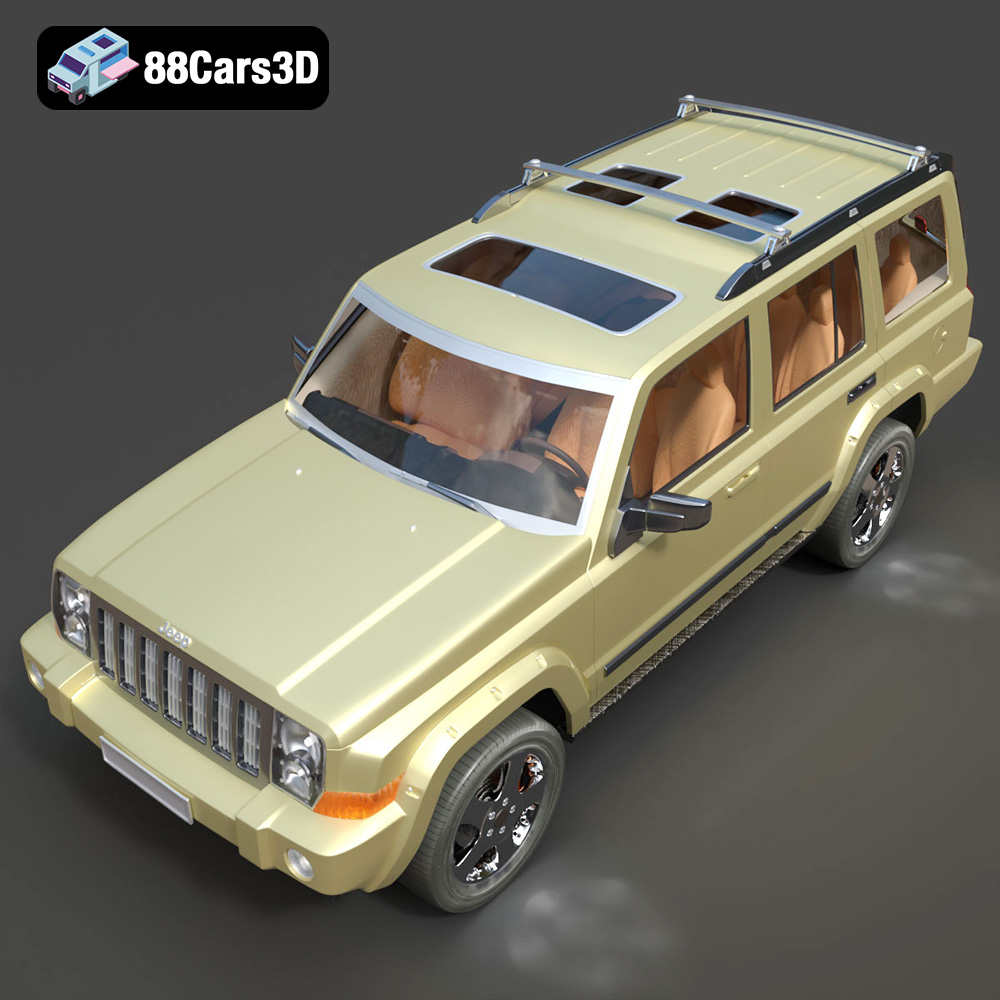
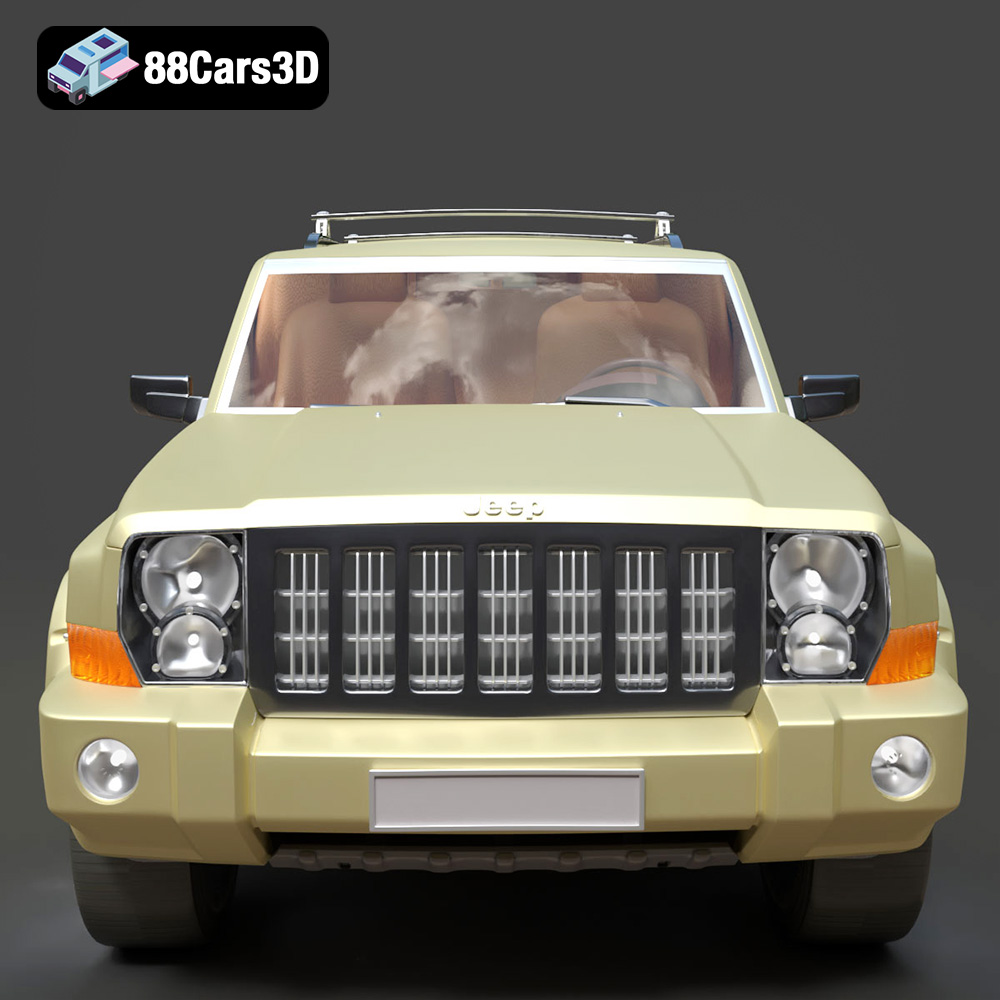
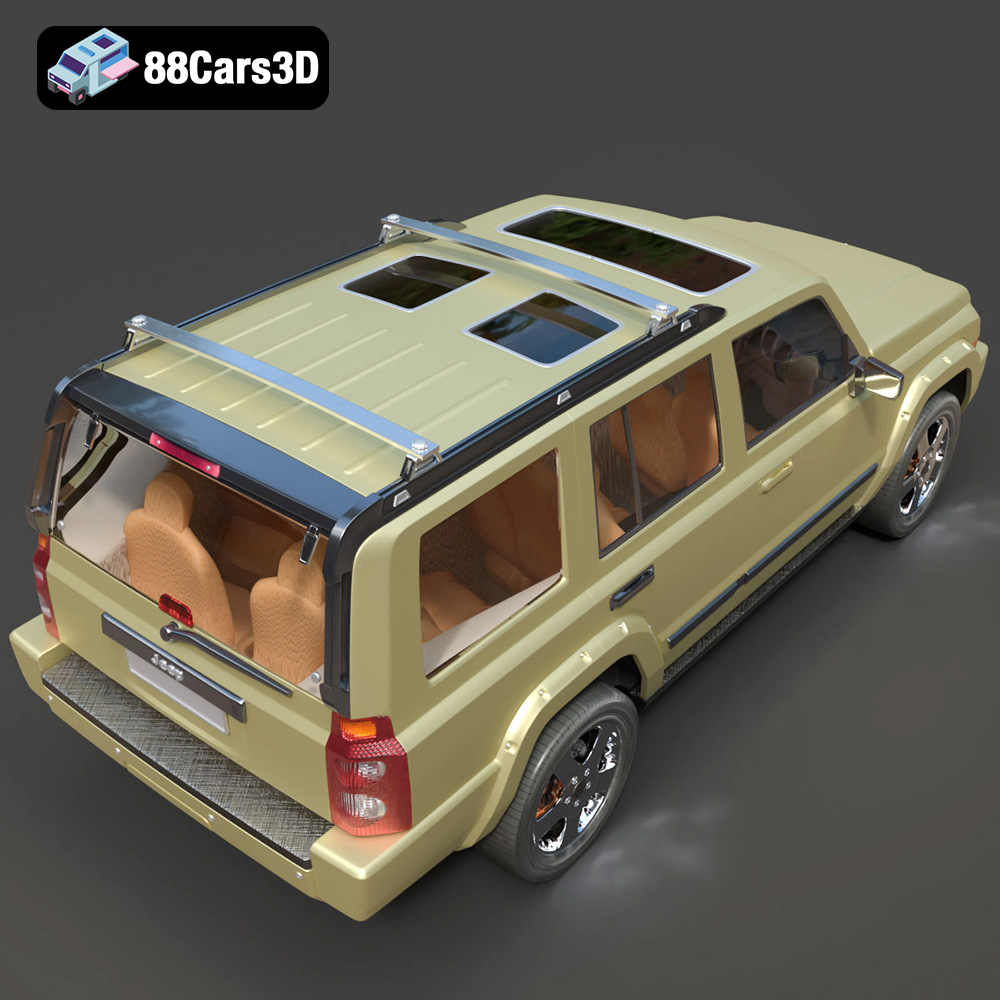
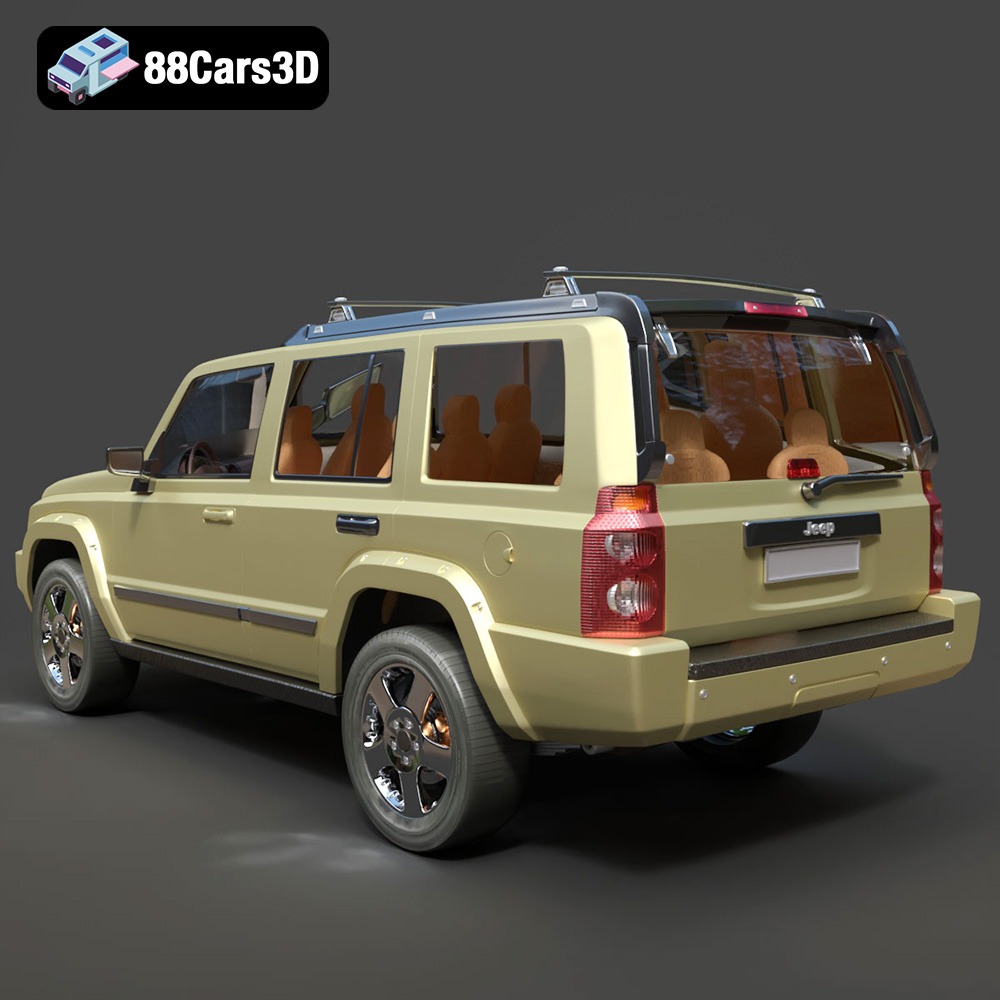
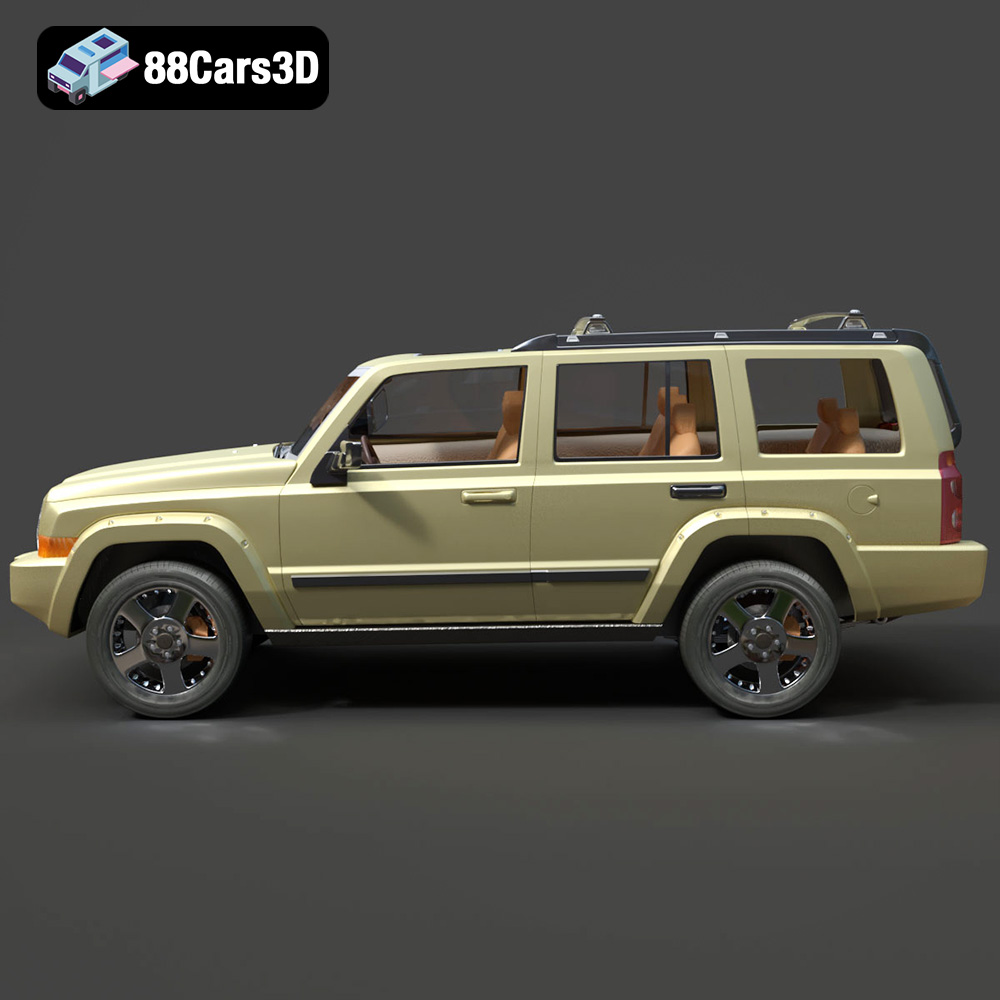
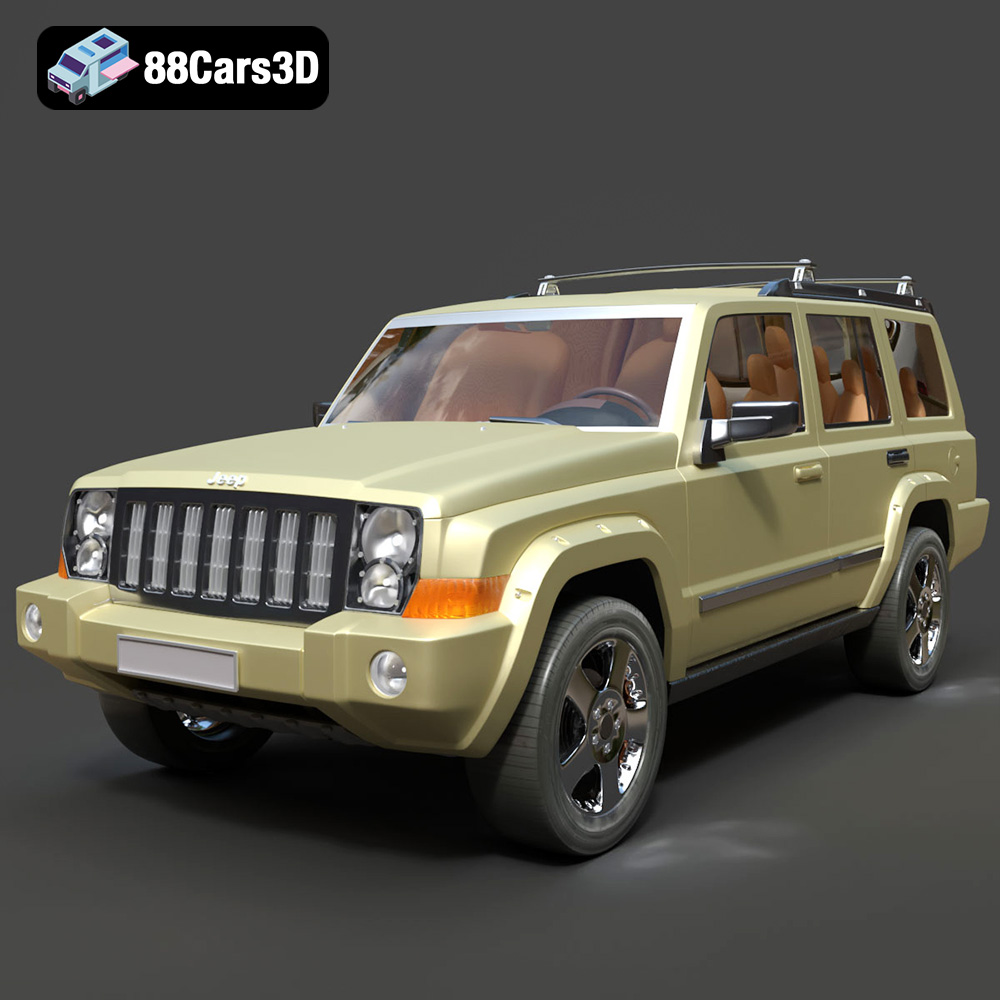
The foundation of any compelling automotive render or simulation is an accurate exterior. The Jeep Commander model captures the SUV’s distinctive characteristics with remarkable fidelity. We see the exact body proportions of the full-size SUV, ensuring that it looks right from every angle, whether in a static render or a dynamic animation. Its signature seven-slot grille and rectangular headlight styling are faithfully recreated, immediately identifying the vehicle. Attention to detail extends to the textured front and rear bumpers, complete with integrated fog light areas, and functional elements like realistic roof rails, side mirrors, door handles, and window trims. Even the modeled wheels, tires, suspension clearance, and underbody structure are present, essential for believable close-up shots or off-road scenarios. The strategic decision to include separate mesh components for doors, hood, tailgate, and wheels is crucial for animation workflows, allowing for realistic opening and closing sequences without complex rigging challenges.
For applications demanding a peek inside – such as virtual showrooms, driving simulators, or cinematic close-ups – interior detailing is paramount. The Jeep Commander 3D Model does not disappoint. It features a modeled dashboard with a center console and infotainment area, steering wheel, and instrument cluster detailing. The three-row seating layout is accurately represented, offering a true sense of scale and practicality. Door panels and interior trim elements further enhance the immersive quality. Importantly, this interior geometry is optimized, ensuring it’s suitable for real-time engines where performance is key, without sacrificing visual integrity.
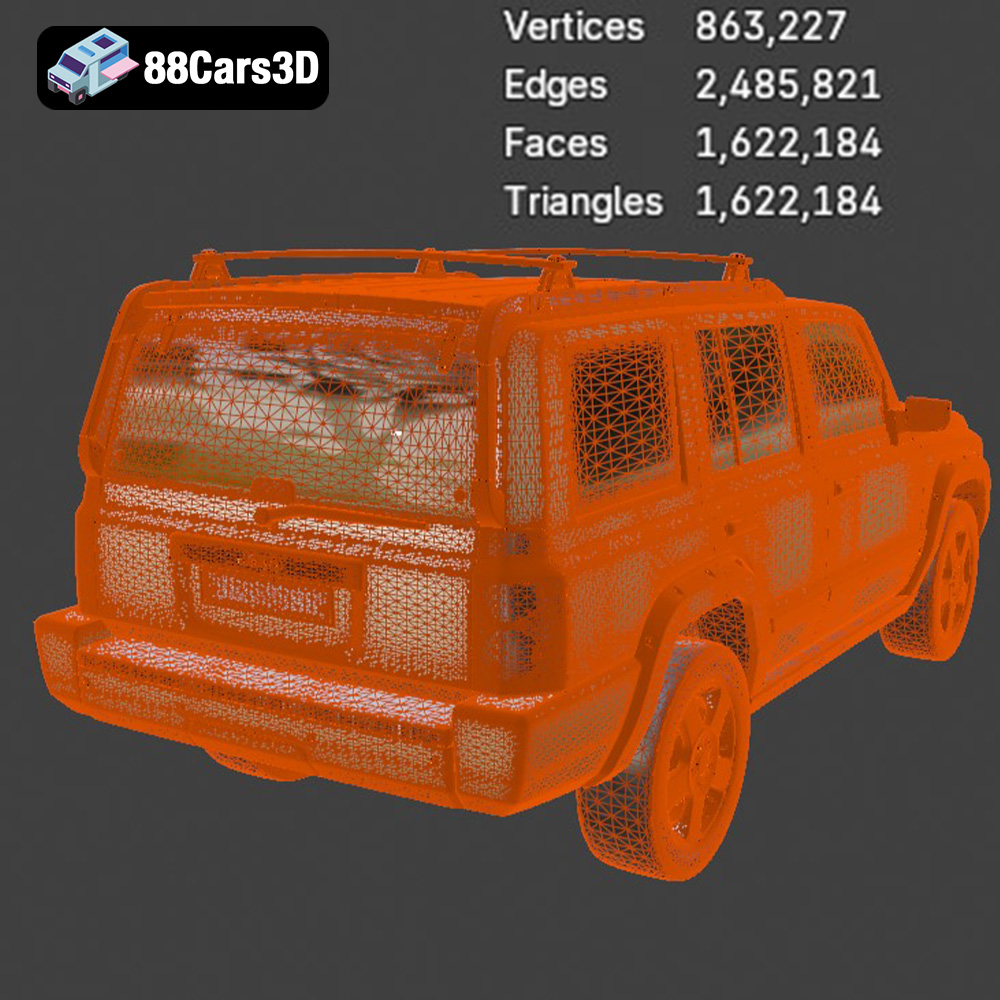
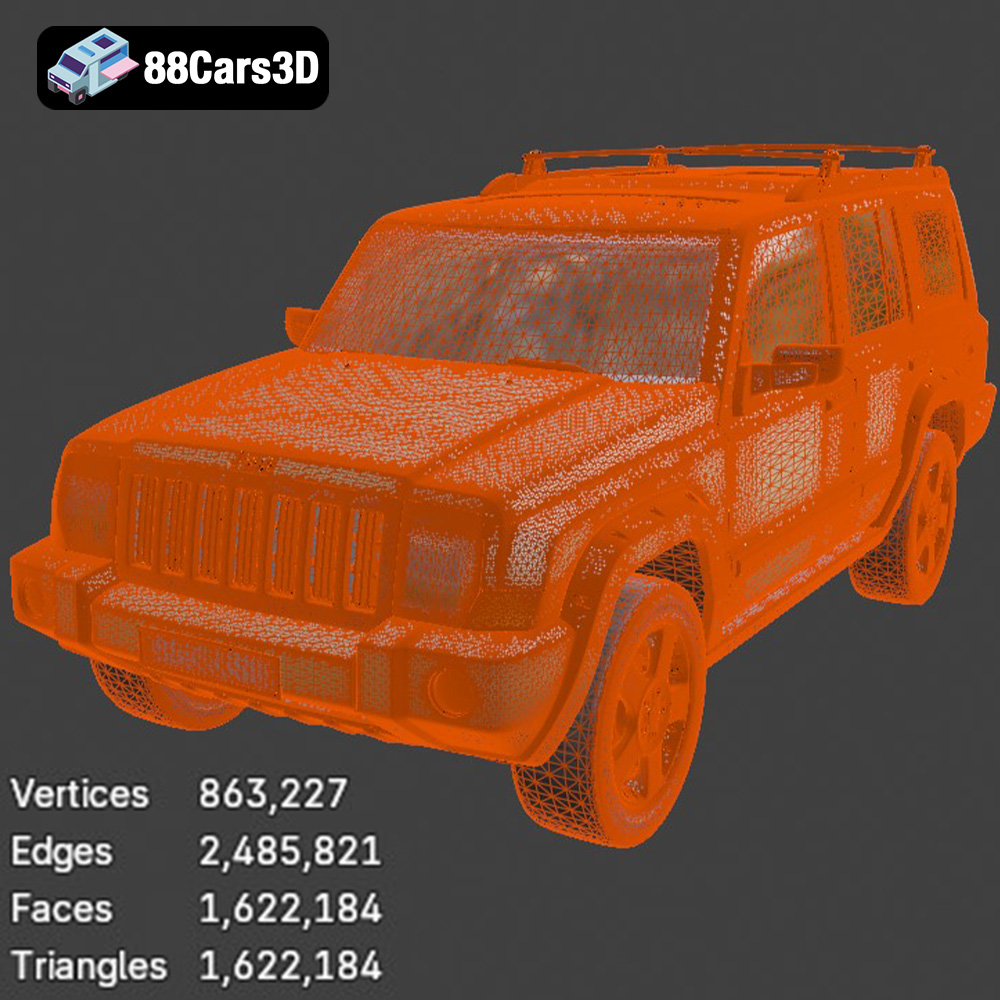
Beyond visual accuracy, the technical structure of a 3D model dictates its usability and performance. The Jeep Commander model boasts a clean mesh structure with proper edge flow, which is fundamental for smooth deformations during animation and for clean subdivision surfacing when rendering at higher resolutions. Its real-world scale accuracy ensures seamless integration into architectural scenes or simulations without requiring tedious resizing. An organized hierarchy facilitates animation workflows, making it easy to isolate and manipulate specific parts of the vehicle. Crucially, the model strikes an optimal balance with its polygon count – it’s dense enough for high-quality rendering while remaining optimized for demanding game engines, reflecting a professional approach to asset creation.
The true value of a versatile 3D asset lies in its ability to adapt to various professional workflows. The Jeep Commander 3D Model is engineered for seamless integration across a spectrum of industries, providing a solid foundation for diverse creative projects.
For high-fidelity automotive presentations and architectural visualization, the Jeep Commander excels. In software like 3ds Max or Blender, designers can leverage the native .max and .blend files to their full potential. This involves setting up realistic materials using advanced render engines such as V-Ray, Corona Renderer, or Cycles. Implementing intricate lighting setups – from studio environments to dynamic outdoor scenes – allows artists to showcase the Commander’s rugged elegance. Imagine placing this model into an architectural parking scene, a serene natural landscape for an overlanding visual, or a sleek showroom for marketing visuals. The clean topology and accurate proportions ensure that reflections are crisp, shadows are realistic, and every surface detail contributes to a photorealistic image. This workflow is critical for advertising, product showcases, and any scenario demanding visual perfection.
The game industry places immense demands on 3D car models for performance and visual quality. The Jeep Commander 3D Model, with its optimized polygon count and well-structured geometry, is an ideal game asset. Developers can import the .fbx or the dedicated .unreal format into engines like Unreal Engine or Unity. Here, the organized hierarchy simplifies the process of creating LODs (Levels of Detail) to ensure optimal performance at varying distances, setting up accurate collision meshes for realistic physics, and configuring vehicle blueprints for driving mechanics. Whether populating an expansive open-world game, creating a dedicated SUV driving simulator, or building realistic vehicle environments, the Commander offers a robust and ready-to-use asset that minimizes development time and maximizes visual impact without bogging down real-time performance.
Augmented Reality (AR) and Virtual Reality (VR) are transforming how we interact with products. The Jeep Commander 3D Model is perfectly suited for these immersive platforms, particularly with its .glb format. Developers can use this lightweight, optimized format to create compelling virtual showrooms where customers can explore the vehicle in 3D, customize paint colors and wheel designs in real-time, or even place the SUV in their own driveway using AR applications. These interactive configurators provide an engaging, hands-on experience that static images simply cannot match, offering powerful tools for sales, marketing, and product education.
While digital visualization is powerful, the ability to transition a 3D car model from the virtual to the physical realm opens up new avenues for product prototyping, collectibles, and educational tools. The Jeep Commander 3D Model’s design, particularly its availability in .stl format, makes it an excellent candidate for 3D printing.
Converting a high-detail rendering model into a 3D printable asset requires careful consideration. The .stl format provided ensures the geometry is watertight and ready for slicing software. For the Jeep Commander, specific recommendations are provided to ensure a successful print. Suggested scales of 1:32, 1:24, 1:18, or 1:12 allow for various miniature sizes, catering to different display needs or collector preferences. Optimal layer heights (0.12–0.20 mm) are crucial for capturing the Commander’s distinctive lines and details, while recommended wall thickness (2–3 mm) and infill (15–30%) ensure structural integrity without excessive material usage. Supports are explicitly noted as required for features like mirrors, roof rails, and underbody details, preventing common printing failures. A clever printing orientation – body printed upside-down – is suggested to achieve a smoother roof finish, a detail often overlooked in less professional models.
Both FDM (Fused Deposition Modeling) and resin (SLA/DLP) 3D printers can be used, with resin offering finer details for smaller scales. The advice to print wheels separately for better detailing is a professional touch, allowing for sharper spokes and tire treads. Once printed, the journey continues with post-processing. This includes essential steps like sanding to smooth layer lines, priming to create an even surface for paint, and then applying automotive-style paint. An optional clear coat can add a professional sheen and protect the finish, resulting in a miniature Jeep Commander that looks factory-fresh. This detailed guidance ensures that hobbyists and professionals alike can transform the digital asset into a tangible, high-quality collectible or prototype.
A truly valuable 3D asset provides not just a static representation, but a foundation for boundless creativity and customization. The Jeep Commander 3D Model is built with this versatility in mind, empowering artists and designers to tailor it to their specific project requirements.
The ability to easily customize the model is a significant advantage. Imagine a client requires the Jeep Commander in a specific shade of metallic silver, black, white, or dark green for a marketing campaign. With the provided file formats like .blend or .max, changing paint colors is a straightforward process within your preferred 3D software. Beyond color, the model allows for modifications to wheel designs and tire styles, letting you adapt it from a sophisticated urban SUV to a rugged off-road beast. Further customization can include adding roof cargo boxes, off-road accessories like winches or light bars, or even custom decals and branding specific to a project. Adjusting lighting setups is also key for conveying different moods – from a sun-drenched day scene to a dramatic night shot, or a crisp, professional studio render for a product launch.
This level of adaptability means the Jeep Commander 3D Model isn’t limited to a single use. It can be a protagonist in cinematic productions, bringing a touch of realism to film or animation. For game developers, it can become a player-controlled vehicle or part of an AI traffic system, seamlessly blending into diverse environments. Architectural visualizers can use it to inject life and scale into building renders. The model’s inherent versatility means it can be the starting point for a myriad of creative endeavors, saving countless hours of modeling from scratch and allowing artists to focus on the storytelling and aesthetic refinement of their projects. This extensive range of customization ensures that the Jeep Commander remains relevant and useful across countless unique artistic visions.
The journey through the capabilities of the Jeep Commander 3D Model underscores the crucial role that high-quality, technically sound 3D car models play in today’s digital landscape. From the precision of its exterior and interior detailing to its optimized mesh structure, this asset is built to meet the rigorous demands of professional workflows. The comprehensive range of included file formats – from .blend and .max for native software flexibility, to .fbx for game engines, .glb for AR/VR, and .stl for tangible 3D prints – ensures unparalleled adaptability for virtually any creative project.
Whether you’re an automotive renderer aiming for photorealism, a game developer crafting immersive open worlds, an AR/VR innovator building interactive experiences, or a designer looking to prototype a physical model, the Jeep Commander 3D Model provides a robust and versatile foundation. Its blend of accurate design, technical advantages, and extensive customization potential makes it an invaluable addition to any professional toolkit. For those seeking premium automotive rendering and game assets that deliver on both quality and flexibility, resources like 88cars3d.com continue to be a vital source for exceptional 3D car models.
The Jeep Commander 3D Model is a precise digital recreation of the full-size SUV produced by Jeep. Known for its boxy styling, three-row seating configuration, and rugged 4×4 capability, the Commander blends classic Jeep DNA with family-oriented practicality. This 3D model captures the Commander’s distinctive squared body design, seven-slot grille, roof rails, elevated stance, and strong off-road character. Designed with clean topology and accurate proportions, it is ideal for rendering, animation, simulation, AR/VR applications, and game development.
$39.99
.4x4vehicle
.arvr
.blend
.car3dmodel
.commander
.familySUV
.fbx
.gameasset
.glb
.jeep
.max
.obj
.ply
.rendering
.simulation
.stl
.suv3dmodel
.unreal
.vehicleasset