Get 50% OFF All Premium 3D & STL Models!

In the demanding world of 3D automotive design, where every curve, vent, and rivet must convey a sense of tangible realism, normal maps stand as an indispensable technology. These seemingly simple texture maps are the unsung heroes behind the hyper-realistic vehicles seen in high-end renders, immersive video games, and cutting-edge AR/VR experiences. They allow artists to simulate incredibly fine surface detail – scratches, panel lines, intricate grilles – without burdening the 3D model with millions of polygons. This not only dramatically improves rendering performance but also streamlines the modeling pipeline, allowing for more efficient asset creation and deployment across diverse platforms. Without normal maps, achieving the visual fidelity expected from modern 3D car models would be an impossible task, leading to either unacceptably high poly counts or disappointingly flat visuals.
This comprehensive guide will delve deep into the technical intricacies of normal maps, specifically tailored for 3D car models. We’ll explore their fundamental principles, walk through the detailed workflows of creating them, integrate them into advanced PBR material systems, and optimize them for real-time applications like game engines and AR/VR. Whether you’re a seasoned 3D artist aiming for photorealistic renders, a game developer striving for optimized assets, or an automotive designer pushing the boundaries of visualization, understanding normal maps is crucial. Prepare to unlock the full potential of your automotive 3D models and achieve breathtaking visual realism without sacrificing performance.
At its core, a normal map is a special type of texture map that stores directional information about a surface’s normal vector. Instead of representing color, each pixel (or texel) in a normal map encodes the XYZ direction of the surface normal at that specific point. This information is typically stored in the Red, Green, and Blue channels, corresponding to X, Y, and Z axes respectively. When a 3D rendering engine or game engine processes this map, it alters how light reflects off the surface, making low-polygon geometry appear to have high-polygon detail. This technique is incredibly powerful because it creates the illusion of depth and intricate surface variations without adding a single extra polygon to the underlying mesh.
For car models, this is transformative. Imagine a complex car grille with hundreds of tiny perforations, or a dashboard with fine stitching details. Modeling every single one of these elements with actual geometry would result in a model with astronomical polygon counts, making it impractical for real-time applications and cumbersome for rendering. Normal maps provide an elegant solution, allowing artists to create a simpler, low-polygon mesh that represents the basic form of the car, and then project all the intricate details onto it via a normal map. This not only dramatically reduces the polygon count, often by orders of magnitude (e.g., from millions down to tens or hundreds of thousands), but also significantly speeds up rendering times and improves real-time performance, making high-quality automotive models accessible across a broader range of hardware and applications.
Normal maps come in two primary types: tangent space and object space. The vast majority of normal maps used in game development, real-time rendering, and PBR (Physically Based Rendering) workflows are **tangent space normal maps**. These maps store normal information relative to the local tangent basis of each vertex on the low-polygon model. This means that the normals are encoded relative to the surface itself, allowing the map to be reused across different orientations of the same model and even across different models, as long as the underlying topology is similar. They are characterized by their predominantly blue appearance, with subtle red and green variations indicating bumps and depressions. Tangent space maps are crucial for animation and deformation, as the normal direction correctly follows the moving surface.
Object space normal maps, on the other hand, store normal information relative to the object’s absolute coordinate system (world space or object space). They are less common for deformable meshes but can be useful for static objects that will never move or deform. They tend to have a wider range of colors because they capture the absolute direction of the normal. While they might offer slightly more precise lighting for static objects in some niche scenarios, their inability to adapt to deformation makes them less versatile for complex automotive models that might be animated (e.g., doors opening, wheels turning) or require flexible integration into different scenes. Understanding this distinction is vital for choosing the correct normal map type for your specific project and ensuring proper rendering and animation fidelity.
The advantages of normal maps for 3D car models are twofold: unparalleled visual realism and dramatically improved performance. Visually, normal maps enable the creation of minute details that would be impractical or impossible to model geometrically. This includes panel gaps with razor-sharp edges, intricate headlight textures, tire treads with subtle grooves, engine bay components, interior stitching, and even the imperfections like micro-scratches and dents that contribute to a car’s character. These details are essential for achieving the photorealistic quality expected in high-end automotive rendering and visualization. A car model without proper normal maps often looks plasticky and lacks depth, even with excellent textures.
From a performance perspective, normal maps are game-changers. By offloading complex surface detail from geometry to texture maps, they allow 3D artists and game developers to keep polygon counts manageable. A complex vehicle that might require several million polygons if fully modeled with geometry can be represented by a low-polygon mesh of, say, 50,000 to 200,000 polygons, with the remaining detail provided by normal maps. This reduction in polygon count directly translates to faster rendering times in offline renderers (like Corona or V-Ray), higher frame rates in game engines (Unity, Unreal Engine), and smoother experiences in AR/VR applications. For platforms like 88cars3d.com, offering models that balance stunning visual fidelity with optimal performance is paramount, and normal maps are at the heart of this balance.
The creation of normal maps typically involves a process called “baking,” where the detailed surface information from a high-polygon model is transferred onto a lower-polygon model. This workflow is central to modern 3D asset creation, especially for complex objects like car models. The fundamental idea is to model all the intricate details on a high-poly mesh – think millions of polygons for every curve, cut, and groove – and then use specialized software to project these details onto a simplified, game-ready or render-optimized low-poly mesh. This ensures that the visual fidelity is maintained while reducing the computational overhead significantly. The success of this process hinges on careful preparation of both the high and low-poly models, as well as precise baking settings.
Many professional 3D artists prefer dedicated texturing software like Substance Painter or Marmoset Toolbag for baking normal maps due to their robust toolsets and preview capabilities. However, powerful 3D modeling packages such as Blender, 3ds Max, and Maya also offer excellent baking functionalities. Regardless of the software, the core principles remain the same: accurate mesh preparation, proper alignment, and careful adjustment of baking parameters are key to achieving clean, artifact-free normal maps that faithfully reproduce the high-poly detail. For example, when baking a car’s fender, the high-poly version would include all the subtle bulges, panel lines, and edges, which are then “baked” onto a much simpler low-poly fender mesh.
The high-poly to low-poly baking workflow is a precise, multi-step process. First, you need a meticulously detailed high-polygon model, often created through sculpting in ZBrush or detailed polygonal modeling in 3ds Max/Blender/Maya. This model contains all the aesthetic nuances you want to capture. Second, create a clean, optimized low-polygon version of the same object. This low-poly mesh should closely follow the main silhouette of the high-poly model and have clean, efficient topology with appropriate UV mapping. Ensure that both models are positioned at the exact same origin and orientation. For car models, consistent scaling is absolutely critical to avoid distortion.
Once both models are ready, you’ll use a baking tool. In software like Substance Painter, you load both meshes and then define the baking parameters. Key settings include:
After baking, carefully inspect the normal map for artifacts such as seams, distorted normals, or areas where details were missed. Iteration and adjustment of the cage or ray distance are often necessary to achieve a perfect bake.
Correctly handling hard edges and smooth groups (also known as smoothing groups in 3ds Max or sharp edges in Blender) is paramount for normal map baking, especially on mechanical objects like cars. Improper setup can lead to shading errors, visible seams, or incorrect lighting transitions. When baking, the low-poly model needs to explicitly define where hard edges should occur. These are usually areas where the surface normal changes abruptly, such as the sharp corner of a car’s headlight housing or the edge of a panel line. For these areas, the UV seams on your low-poly model should ideally align with the hard edges, and the normals along those edges need to be “split” or “hardened.”
In Blender, this is managed with the “Edge Split” modifier or by marking edges as “Sharp” and then enabling “Auto Smooth” with a specific angle threshold. When baking, the tangent space calculation relies on these split normals to correctly orient the normal map’s data. If you don’t define hard edges properly, the baking process might smooth across them, resulting in a rounded look where a sharp edge should be, or introduce shading artifacts. Conversely, if you split too many edges, you increase vertex count and can introduce other issues. It’s a delicate balance: use hard edges only where physically necessary to define a sharp corner, ensuring your UVs also have seams along these edges to prevent normal information from bleeding across distinct surface angles. For more detailed information on Blender’s normal map baking and tangent space considerations, consult the official Blender 4.4 documentation.
Once your normal maps are baked, the next crucial step is integrating them into your material setup within your chosen 3D software and renderer. This is where the illusion truly comes to life, as the rendering engine interprets the normal map data to simulate detailed surface interaction with light. The process typically involves setting up a PBR (Physically Based Rendering) material, which accurately simulates how light behaves in the real world. PBR materials rely on a suite of texture maps – Albedo (or Base Color), Metallic, Roughness, and Normal maps being the most common – to define the surface properties. For automotive models, which often feature highly reflective and metallic surfaces, accurate PBR setup with normal maps is essential for photorealistic results.
Most modern 3D renderers, including Corona Renderer, V-Ray, Cycles (Blender), and Arnold (3ds Max, Maya), offer robust support for PBR workflows and specific nodes or slots for normal maps. The general principle involves connecting the normal map texture to a dedicated “Normal Map” or “Bump” input within the material’s shader network. It’s critical to ensure the normal map is interpreted correctly, often requiring the texture’s color space to be set to “Non-Color Data” or “Raw” to prevent gamma correction from distorting the directional information. Incorrect gamma can lead to subtle but noticeable shading errors.
Creating a compelling PBR material for a car model involves assembling a network of textures and parameters. The normal map is a central component, but it works in concert with others:
In renderers like Corona or V-Ray, you’d typically use a universal PBR material node (e.g., Corona Physical Material, V-Ray PBR Material). You connect your Base Color to the Albedo slot, your Metallic map to the Metallic slot, Roughness to Roughness, and your Normal map to the “Normal” or “Bump” slot. Most renderers have a dedicated “Normal Map” node or converter that takes the raw normal map texture and correctly interprets it for the shader. This converter is crucial for handling tangent space conversions and ensuring the normals are applied with the correct strength. For example, in Blender’s Cycles or Eevee, you would use an “Image Texture” node for your normal map, set its Color Space to “Non-Color,” and then connect it to a “Normal Map” node, which then connects to the “Normal” input of a Principled BSDF shader. Adjusting the strength value in the Normal Map node allows you to control the intensity of the fake detail.
Advanced material setups often require blending multiple normal maps to achieve complex surface effects. For instance, a car body might have a primary normal map baked from a high-poly sculpt, but you might also want to add a secondary “detail normal map” to simulate fine dust, scratches, or manufacturing imperfections at a higher frequency. Another common scenario is layering different types of damage, such as a large dent’s normal map combined with a more general fine scratch map.
To achieve this, you typically use a “Normal Map Mixer” or “Blend Normals” node within your shader graph. These nodes allow you to combine two or more normal maps while maintaining correct tangent space calculations. The process usually involves feeding the output of one normal map node into the mixer, then feeding a second normal map into another input, and finally connecting the mixer’s output to the material’s main normal input. Some mixers offer different blend modes (e.g., Overlay, Add, Height Blend) to control how the details from each map interact. This layering capability is incredibly powerful for adding granular detail and breaking up perfectly clean surfaces, which is essential for creating believable wear and tear on automotive models. This technique is often seen in high-quality game assets or cinematic renders, allowing artists to procedurally add grunge or specific damage effects without re-baking the entire model.
When transitioning 3D car models into real-time environments like game engines (Unity, Unreal Engine) or AR/VR applications, normal maps become even more critical for optimizing performance without sacrificing visual quality. In these scenarios, every millisecond of rendering time and every kilobyte of memory counts. Normal maps allow game developers to maintain high visual fidelity on complex automotive assets while keeping polygon counts low enough to run smoothly on diverse hardware, from high-end PCs to mobile devices. The optimization strategies surrounding normal maps in game engines are focused on efficient texture management, appropriate compression, and intelligent streaming.
A key aspect is understanding that game engines process normal maps differently than offline renderers. They are optimized for speed, often employing highly specialized shaders and texture compression algorithms. Therefore, proper export settings and import configurations are vital to ensure your normal maps render correctly and efficiently in the target engine. Misconfigured normal maps can lead to incorrect lighting, visible seams, or a complete loss of detail, breaking the visual integrity of your carefully crafted car models.
The game asset pipeline for normal maps in engines like Unity and Unreal Engine involves specific steps to ensure optimal performance and visual accuracy:
Ensuring consistency in tangent space calculation between your modeling software and the game engine is paramount. MikkTSpace is the industry standard for tangent space generation because it provides consistent results across different software and engines, minimizing shading discrepancies. Platforms like 88cars3d.com often provide models pre-configured with consistent tangent spaces and optimized normal maps for direct engine integration.
Texture compression is vital for reducing memory footprint and improving loading times in game engines. Normal maps, like other textures, benefit significantly from specialized compression algorithms. For normal maps, standard image compression like JPEG is unsuitable as it introduces artifacts that distort the directional information. Instead, game engines use block-based lossy compression specifically designed for normal maps:
Choosing the right resolution is also a balancing act between fidelity and performance. Common resolutions for car parts in games include 1024×1024 (1K) for smaller components, 2048×2048 (2K) for general body panels, and 4096×4096 (4K) for highly detailed or hero vehicles. Using texture atlases to combine multiple normal maps into a single, larger texture can also reduce draw calls and memory overhead by optimizing texture sampling. For example, all the normal maps for a car’s interior components might be packed into one 2K atlas.
Level of Detail (LOD) systems are crucial for optimizing complex models like cars in real-time environments. As a car moves further away from the camera, it requires less geometric detail. LODs involve creating multiple versions of the same model, each with progressively lower polygon counts. Normal maps play a key role here. For the highest LOD (LOD0), a full-resolution normal map is used. For subsequent LODs (LOD1, LOD2, etc.), which have significantly fewer polygons, you might use lower-resolution normal maps or even simplified normal maps that only capture major forms, effectively reducing texture memory and bandwidth.
Texture streaming is another critical optimization. Instead of loading all normal maps into memory at once, game engines can stream them in as needed, based on proximity to the camera or other priority settings. This prevents excessive memory consumption, especially with multiple high-resolution normal maps. For a complex car model with multiple 4K normal maps, intelligent streaming ensures only the immediately relevant textures are loaded, keeping the game performant. Proper planning of your UV layouts and normal map resolutions across LODs is essential for an optimized and visually consistent experience in game engines.
Beyond the fundamental high-to-low poly baking, normal maps offer a wealth of advanced techniques and applications that push the boundaries of visual realism and optimization. These methods allow artists to add even finer detail, create dynamic surface effects, and adapt models for emerging technologies like AR/VR and even 3D printing. Mastering these advanced techniques enables unparalleled control over surface appearance and significantly enhances the versatility of 3D automotive assets.
Detail normal maps, also known as micro normal maps or tileable normal maps, are used to add very fine, repeating surface textures that would be impractical to bake into a primary normal map. Imagine a subtle brushed metal texture on an interior trim piece, or a fine leather grain on a car seat. These are often small, tileable textures that are blended on top of the main normal map, adding high-frequency detail that becomes visible only upon close inspection. They are invaluable for breaking up perfectly smooth surfaces and adding extra realism without requiring additional geometry or excessively large primary normal maps.
Parallax Occlusion Mapping (POM) takes the illusion of depth a step further than normal mapping. While normal maps only affect how light reflects off a surface, POM uses a height map (which can often be derived from a normal map or baked alongside it) to displace texture coordinates, creating the appearance of actual depth and self-occlusion. For automotive models, POM can be used for things like deep tire treads, intricate vent patterns, or rough road surfaces to add convincing depth without modifying the underlying mesh. It’s more computationally expensive than standard normal mapping but offers a more convincing sense of depth, especially at glancing angles. While POM is primarily a game engine technique, its applications in real-time visualization are growing.
Augmented Reality (AR) and Virtual Reality (VR) environments demand extremely high performance and optimized assets due to their immersive and real-time nature. High frame rates are crucial to prevent motion sickness and ensure a comfortable user experience. Normal maps are absolutely critical for AR/VR optimization of 3D car models. By keeping polygon counts exceptionally low while maintaining visual fidelity through normal maps, artists can create detailed vehicles that run smoothly on mobile AR devices or VR headsets.
When preparing car models for AR/VR, prioritize clean topology, efficient UV layouts, and well-optimized normal maps. Platforms like 88cars3d.com often provide models specifically prepared for these environments, ensuring compatibility and performance.
While normal maps primarily create an illusion of detail for rendering, they can indirectly influence 3D printing preparation. For 3D printing, actual geometric detail is required. However, for visual reference or if a subtle bump is desired that cannot be geometrically modeled at a certain scale, normal maps can sometimes be used to guide the artist in adding actual geometry through displacement or sculpting before printing. More commonly, normal maps are used to visualize how a finished model will look once it has been processed and painted after printing, often featuring details that were too fine to be printed physically.
Conversely, the process of creating a clean low-poly mesh for normal map baking can also aid in mesh repair for 3D printing. A good low-poly model used for baking typically has watertight geometry and clean topology, which are fundamental requirements for successful 3D printing. If a high-poly sculpt is too messy or contains non-manifold geometry unsuitable for printing, retopologizing it into a clean low-poly mesh (which will later receive normal maps for rendering) can be a crucial first step in preparing a printable version. This clean low-poly mesh can then be subdivided or displaced to add the necessary geometric detail for the physical print.
Normal maps are an indispensable tool in the arsenal of any 3D artist working with automotive models, bridging the gap between breathtaking visual realism and critical performance optimization. From simulating intricate panel gaps and tire treads to achieving subtle material imperfections, they empower creators to imbue their vehicles with unparalleled depth and character without the crippling burden of excessive polygon counts. We’ve explored their fundamental principles, the meticulous process of baking them from high-poly detail, their seamless integration into advanced PBR material workflows across various 3D software and renderers, and their paramount role in optimizing assets for demanding real-time environments like game engines and AR/VR.
Mastering normal maps is not just about technical proficiency; it’s about understanding how light interacts with surfaces to tell a story of realism and detail. By diligently applying the workflows and best practices outlined in this guide – from precise cage adjustments during baking to careful compression choices for game engines – you can elevate your 3D car models to new heights of visual fidelity and efficiency. Remember that attention to detail in every step, from topology to texture resolution, contributes to the final, stunning result. For those seeking to jumpstart their projects with ready-to-use, high-quality 3D car models that feature meticulously crafted normal maps and optimized PBR materials, explore the extensive collection available at 88cars3d.com. Invest in your craft, refine your techniques, and let normal maps unlock the true potential of your automotive visualizations.

Texture: Yes | Material: Yes | 3D Printable: Yes. Download the Italian Thoroughbreds Bundle featuring 5 iconic 3D models: Lamborghini Huracán Performante, Ferrari 458 Italia, Lamborghini Urus, Diablo SV, and Maserati GT. Optimized for 4K rendering and 3D printing (STL included). Save 50% with this ultimate Italian vehicle collection.
Price: $199.99

Download the Elite Future Mobility Bundle featuring 4 highly optimized 3D models: Tesla Model S, Avatr 11, Li L9, and Zoox Robotaxi. Perfect for ArchViz, Smart City renders, and game dev. Optimized for Unreal Engine and Blender. Includes .fbx, .obj, and .max formats.
Price: $99

🚗 5 Iconic German Cars (BMW M4 G82, M5 CS, X3, 1 Series & Mercedes E-Class). ✅ Optimized for ArchViz: Ready for Corona & V-Ray. 💰 Save €71 with this limited-time collection! 🚀 Instant Download after purchase.
Price: $119

Download the Extreme Off-Road & Survival 3D Models Bundle! Includes the Brabus 800 Adventure, Dodge Ram Bigfoot, Spec Truck, and a Caravan. Save over €210 on this premium 4-in-1 off-grid vehicle pack for ArchViz and game development.
Price: $149.99

Download the Heavy Duty & Commercial Logistics 3D Models Bundle! Includes the Ford Sterling, Caterpillar CT680, Mercedes Citaro Bus, and Vito Van. Save over €130 on this massive, game-ready 4-in-1 industrial vehicle pack.
Price: $109.99

Download the Ultimate Custom Motorcycles 3D Models Bundle. Includes a Custom Chopper, Ducati 916 Café Fighter, Harley XR1200X, and BMW K100. Perfect premium props for luxury ArchViz garages. Save over €250 today!
Price: $159.99

Download the ultimate JDM Street Racing 3D Models Bundle! Includes the Nissan GT-R, Toyota Supra, Mazda RX-7, Lancer Evo IX, and Honda NSX. Save big on this highly optimized, game-ready 5-in-1 Japanese legend car pack.
Price: $129.99

Download the ultimate American Muscle & Cinematic Classics 3D Models Bundle! Includes the Dodge Charger ’68, Mustang Eleanor GT500, Camaro Z28 ’79, and a custom ’69 Mustang. Save over €240 on this game-ready, premium 4-in-1 pack.
Price: $149.99

Download the Everyday City Traffic 3D Models Bundle. Includes the VW Golf, Kia Picanto, Hyundai Tucson, Toyota Yaris, and a DHL Ford Transit Van. Save big on this 5-in-1 pack, perfectly optimized for realistic ArchViz streets and game traffic.
Price: $99.99
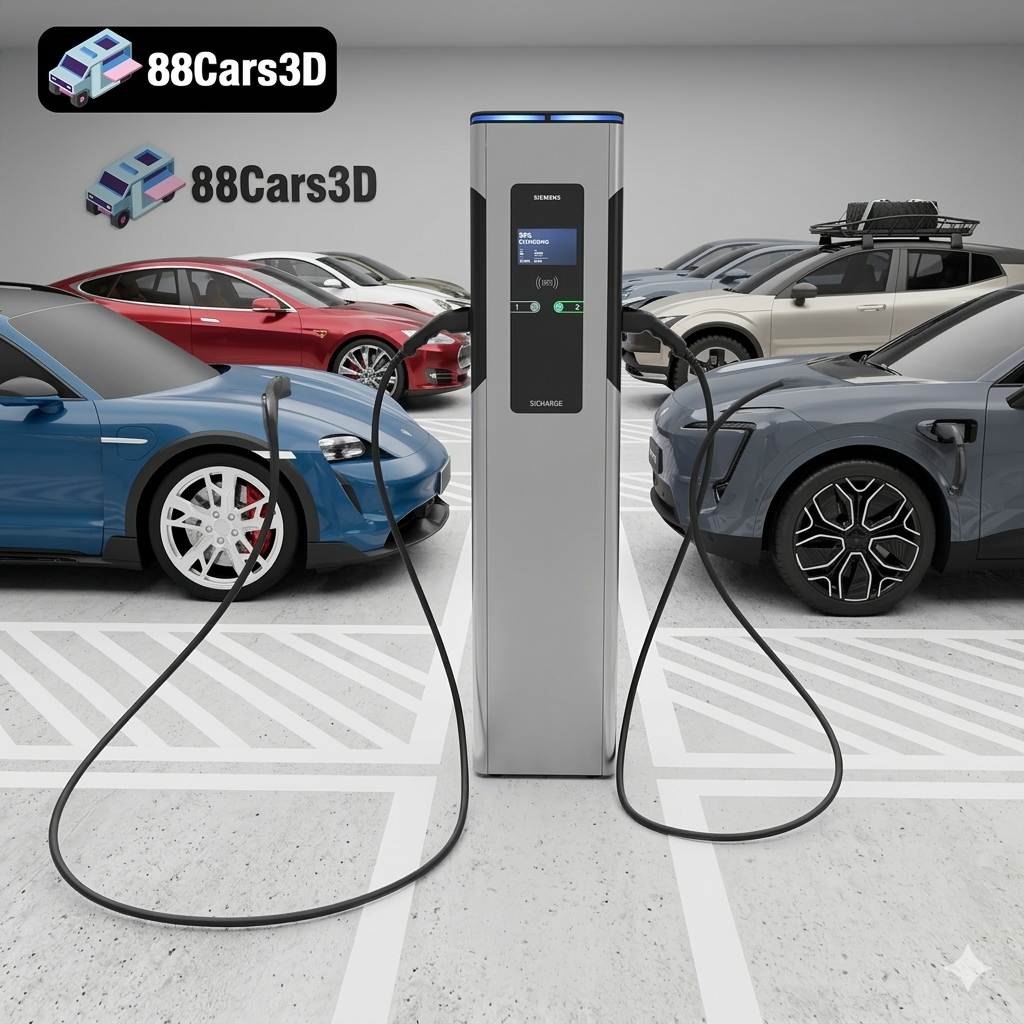
Download the Future of Mobility EV 3D Models Bundle. Includes the Volvo EX30, Tesla Model S, AVATR 11, Porsche Taycan, and a Siemens EV Charger. Save big on this highly optimized 5-in-1 pack for ArchViz and game development!
Price: $89.99

