Get 50% OFF All Premium 3D & STL Models!

The world of 3D printing has opened up unprecedented possibilities for automotive enthusiasts and model makers. From intricate scale replicas to functional prototypes, the ability to bring detailed car designs to life from the comfort of your workshop is truly remarkable. At 88cars3d.com, we’re passionate about providing high-quality, print-ready STL car models that serve as the perfect foundation for your projects. However, realizing the full potential of these models goes beyond just a great design file; it hinges significantly on selecting the right materials. This guide will take you on a technical journey through the best resins and filaments for your automotive 3D printing endeavors, exploring their properties, applications, and how to leverage them for stunning results.
We’ll delve into the nuances of material science as it applies to 3D printing, covering everything from the mechanical properties of common filaments and resins to the specific requirements for creating detailed car bodies, chassis, and intricate interior components. Whether you’re a seasoned maker with an FDM printer or a hobbyist exploring the world of resin printing, understanding these materials is key to achieving professional-quality prints. Get ready to unlock new levels of detail, durability, and aesthetic appeal in your next automotive 3D printing project.
Before diving into specific materials, it’s crucial to grasp the fundamental properties that make a filament or resin suitable for automotive 3D prints. These properties directly influence the final print’s appearance, durability, and ease of post-processing. For detailed car models, we often prioritize high resolution for surface detail, good dimensional accuracy to ensure parts fit together correctly, and sufficient strength to handle occasional manipulation or display. The choice between FDM (Fused Deposition Modeling) and resin printing (SLA/DLP/MSLA) also plays a significant role in material selection, as each technology has its own set of compatible materials and inherent strengths.
Consider the scale and purpose of your model. A small, purely decorative 1:64 scale replica might benefit from the fine detail achievable with resin, while a larger, more robust display model or even a functional part might be better suited to certain FDM filaments. Understanding these trade-offs will guide your material choices and ultimately lead to more successful prints. For instance, capturing the subtle curves of a classic car body or the sharp edges of a modern supercar demands materials that can faithfully reproduce fine geometric features without warping or deforming during or after the printing process.
The mechanical properties of a material are paramount for automotive models. Tensile strength, the ability to withstand pulling forces, is important if your model will have parts under stress or requires assembly with tight tolerances. Flexural strength (or bending strength) is vital for components that might experience minor flexing, such as thin spoilers or wheel spokes. Impact resistance is a consideration for models that might be handled frequently or are prone to accidental drops. Different materials excel in different areas: some are rigid and strong but brittle, while others offer more flexibility and toughness.
For FDM printing, materials like ABS and PETG offer superior strength and temperature resistance compared to standard PLA, making them suitable for parts that might be exposed to higher temperatures or require more durability. However, they can be more challenging to print due to warping. PLA, while less mechanically robust, offers excellent ease of printing and dimensional stability, making it a go-to for highly detailed models where strength is not the primary concern. In the realm of resin printing, standard resins offer a good balance of detail and rigidity, while tougher or flexible resins can mimic properties closer to ABS or TPU, respectively.
The aesthetic appeal of an automotive model is often defined by its surface finish and the fidelity with which fine details are reproduced. Resin printers, particularly those with higher resolution (XY resolution for SLA/DLP and pixel size for MSLA), excel at capturing incredibly fine details like panel lines, emblems, and intricate interior textures that can be challenging for FDM printers to achieve consistently. This is due to the layer-by-layer curing of liquid resin, which can produce smoother surfaces and sharper edges.
FDM printers, on the other hand, inherently produce visible layer lines. While these can be minimized with careful printer calibration, smaller nozzle sizes, and optimized slicing settings (e.g., using a smaller layer height), they often require post-processing like sanding and priming to achieve a smooth, paint-ready surface. The choice of filament also impacts surface finish; some filaments, like certain PLA formulations, can produce a smoother finish straight off the printer than others.
Fused Deposition Modeling (FDM) remains the most accessible and widely adopted 3D printing technology for hobbyists and makers. The variety of available filaments offers a broad spectrum of properties, making it adaptable to many automotive modeling needs. When choosing an FDM filament for car models, consider the trade-offs between ease of printing, detail, strength, and post-processing requirements. Platforms like 88cars3d.com provide STL files that are designed to be printable on a wide range of FDM machines, but your material choice will significantly impact the final outcome.
The “best” FDM filament is subjective and depends heavily on the specific project. For instance, a highly detailed exterior body panel might prioritize a filament known for its smooth finish and dimensional stability, while a chassis component requiring structural integrity would benefit from a stronger, more rigid material. Understanding the typical printing parameters for each material – temperature, bed adhesion, print speed, and cooling – is essential for success. For complex FDM prints, ensuring your sliced file is optimized for the chosen filament, including appropriate support structures and layer heights, is crucial.
PLA is the workhorse of FDM printing for a reason. It’s easy to print, offers good dimensional accuracy, and is available in a vast array of colors and formulations, including some that mimic metallic finishes. Its low melting point and minimal warping make it ideal for beginners and for models where extreme mechanical strength isn’t a primary concern. For highly detailed car models, PLA allows for printing intricate parts with relative ease, producing sharp edges and fine features. Using a 0.1mm or 0.15mm layer height with PLA can yield excellent surface detail.
Key benefits for automotive models: Excellent detail reproduction, minimal warping, wide availability, eco-friendlier than many petroleum-based plastics.
Considerations: Lower temperature resistance (can deform in direct sunlight or hot cars), can be brittle.
Typical Settings: Nozzle: 190-220°C, Bed: 50-60°C, Print Speed: 40-60 mm/s, Layer Height: 0.1-0.2mm.
PETG bridges the gap between PLA and more demanding filaments like ABS. It offers significantly better layer adhesion, impact resistance, and temperature resistance than PLA, making it a great choice for automotive models that might need to be more robust or handle slightly higher temperatures. It exhibits some flexibility, reducing brittleness. However, PETG can be stringier than PLA and may require more careful tuning of retraction settings and print speed. It’s also more prone to absorbing moisture, so proper storage is key.
Key benefits for automotive models: Good strength, better temperature resistance than PLA, less brittle, good layer adhesion.
Considerations: Can be stringy, requires careful retraction tuning, can be slightly less rigid than PLA, absorbs moisture.
Typical Settings: Nozzle: 230-250°C, Bed: 70-80°C, Print Speed: 40-50 mm/s, Layer Height: 0.15-0.2mm.
ABS is known for its excellent mechanical properties: high impact resistance, good temperature resistance, and a smooth, sandable surface finish. It’s the material used in many commercial injection-molded parts. However, ABS is notoriously difficult to print due to significant warping. It requires a heated bed (ideally 90-110°C) and often an enclosed printer to maintain a stable ambient temperature. Proper ventilation is also necessary due to fumes released during printing. For professional-grade automotive models requiring high durability and a paint-ready surface after minimal post-processing, ABS is a strong contender.
Key benefits for automotive models: High strength, excellent temperature resistance, good impact resistance, smooth finish after sanding.
Considerations: Significant warping requires enclosure and heated bed, fumes require ventilation, can be more challenging to print.
Typical Settings: Nozzle: 240-260°C, Bed: 90-110°C, Print Speed: 40-50 mm/s, Layer Height: 0.15-0.2mm.
Resin 3D printing technologies like SLA (Stereolithography), DLP (Digital Light Processing), and MSLA (Masked Stereolithography) offer unparalleled detail and surface finish, making them exceptionally well-suited for highly intricate automotive models. The process involves curing layers of liquid photopolymer resin with a light source (laser or projector). This results in prints with extremely fine feature resolution and minimal visible layer lines, perfect for capturing the nuances of car designs downloaded from marketplaces like 88cars3d.com.
The variety of resins available allows for tailoring prints to specific needs, from standard detail resins to tough, flexible, or even castable options. However, resin printing involves handling liquid chemicals and requires more meticulous post-processing, including washing and UV curing. Safety precautions, such as wearing gloves and working in a well-ventilated area, are essential.
Standard or “model” resins are the most common choice for detailed prints. They offer a good balance of resolution, rigidity, and ease of printing. These resins are formulated to capture fine details accurately, making them perfect for intricate car bodies, interior elements, and accessories. When printing with standard resins, utilizing finer layer heights (e.g., 0.025mm to 0.05mm) will maximize the level of detail visible.
Key benefits for automotive models: Exceptional detail capture, smooth surface finish, good rigidity for display models.
Considerations: Can be brittle, requires post-processing (washing and curing), safety precautions needed.
Typical Settings: Layer Height: 0.025-0.05mm, Exposure Time: Varies significantly by resin and printer (requires calibration), Bed Adhesion: Medium to High.
For automotive models that require more mechanical resilience, such as parts that need to withstand assembly forces or might be handled more frequently, tough or ABS-like resins are an excellent choice. These resins are formulated to offer increased impact resistance and durability, mimicking some of the properties of ABS plastic. They are ideal for functional components, chassis parts, or any element where breakage is a concern.
Key benefits for automotive models: Enhanced durability and impact resistance, suitable for functional parts or models that will be handled often.
Considerations: May have slightly lower resolution than standard resins, can be more expensive, often requires longer exposure times.
Typical Settings: Layer Height: 0.03-0.05mm, Exposure Time: Typically longer than standard resins, requiring calibration. Bed Adhesion: Medium to High.
While less common for general automotive display models, flexible resins (often mimicking TPU) can be incredibly useful for specific applications. Think of printing flexible tires for scale models, soft interior components like seats, or even flexible aerodynamic elements. These resins introduce a degree of elasticity and shock absorption to your prints, opening up new possibilities for realism and functionality.
Key benefits for automotive models: Ability to print flexible parts like tires, suspension components, or soft interior details.
Considerations: Lower rigidity means less suitable for structural parts, can be challenging to print successfully and require specific post-processing.
Typical Settings: Layer Height: 0.05-0.1mm (often thicker layers are preferred), Exposure Time: Requires careful calibration as flex resins can be sensitive. Bed Adhesion: Medium.
Choosing the right material is an iterative process that involves understanding your project’s goals, your printer’s capabilities, and the specific characteristics of each filament and resin. For automotive models, especially those sourced from sites like 88cars3d.com, the intended level of detail and potential for post-processing heavily influence this decision. A systematic approach ensures you select a material that not only prints well but also meets the aesthetic and functional requirements of your finished model.
Always start by considering the intended use of the printed part. Is it a static display piece requiring maximum detail and a smooth finish, or is it a part that needs to be durable and withstand handling? Your printer type (FDM vs. Resin) is also a primary constraint. If you’re using FDM, your available hotend and bed temperatures will dictate which filaments are practical. For resin printers, the build volume and resolution capabilities will play a role. Experimentation is key; don’t be afraid to test different materials with small calibration prints before committing to a large, complex model.
Not all parts of an automotive model need the same material. Consider the specific component you are printing:
This modular approach allows you to leverage the strengths of different materials within a single complex model.
Once you’ve selected a material, optimizing your printer’s settings is crucial. For automotive models, achieving fine details often means using a smaller layer height. For FDM, this can range from 0.08mm to 0.15mm. For resin printers, layer heights of 0.025mm to 0.05mm are common. Remember that finer layer heights significantly increase print time.
Print Speed: Slower print speeds generally lead to better detail and layer adhesion, especially with FDM. For intricate car models, reducing speed to 40-50 mm/s for outer walls is often beneficial. Resin printers have significantly faster “print speeds” in terms of layer curing time, but the overall print time is dictated by the number of layers and the height of the model.
Temperature: Material manufacturers provide recommended temperature ranges. Always perform temperature towers to find the optimal nozzle (FDM) or exposure time (Resin) for your specific filament/resin and printer.
Cooling (FDM): Adequate part cooling is essential for PLA to maintain sharp details and overhangs, but excessive cooling can weaken layer adhesion. ABS often requires minimal or no part cooling.
Regardless of the material chosen, post-processing is often essential for achieving a professional finish on automotive 3D prints. This can include support removal, sanding, filling, priming, and painting. Resin prints typically require washing in IPA or a similar solvent and UV curing. FDM prints may need supports removed carefully, followed by sanding to smooth out layer lines. For FDM, primer is crucial to reveal imperfections and provide a uniform surface for paint. Specialty tools like files, sandpaper of various grits (from 120 to 2000+), hobby knives, and airbrushes are invaluable. For resin prints, care must be taken during sanding to avoid damaging the fine details.
The choice of material can influence post-processing. For example, ABS and certain resins sand more easily than PLA. Some materials may also be more receptive to specific paints or adhesives. Always research the best methods for the material you are using. Remember, the goal is to enhance the already excellent geometry provided by files from sources like 88cars3d.com, transforming a raw print into a show-quality model.
Selecting the correct resin or filament is a critical step in transforming a digital STL car model into a tangible, high-quality replica. FDM printers offer versatility and cost-effectiveness with materials like PLA for ease of use and detail, PETG for durability, and ABS for strength and a professional finish, each requiring specific print settings and post-processing considerations. Resin printers, on the other hand, provide unparalleled detail and smoothness with standard resins for intricate components, tough resins for enhanced durability, and flexible resins for specialized applications like tires.
By understanding the unique properties of each material and matching them to the specific needs of your automotive model components, you can overcome common printing challenges and achieve exceptional results. Experiment with different materials, optimize your printer settings, and embrace the post-processing techniques necessary to bring your vision to life. Whether you’re building a detailed display piece, a functional prototype, or a cherished collectible, the thoughtful selection of your printing material is your first and most crucial step towards automotive 3D printing mastery. Happy printing!
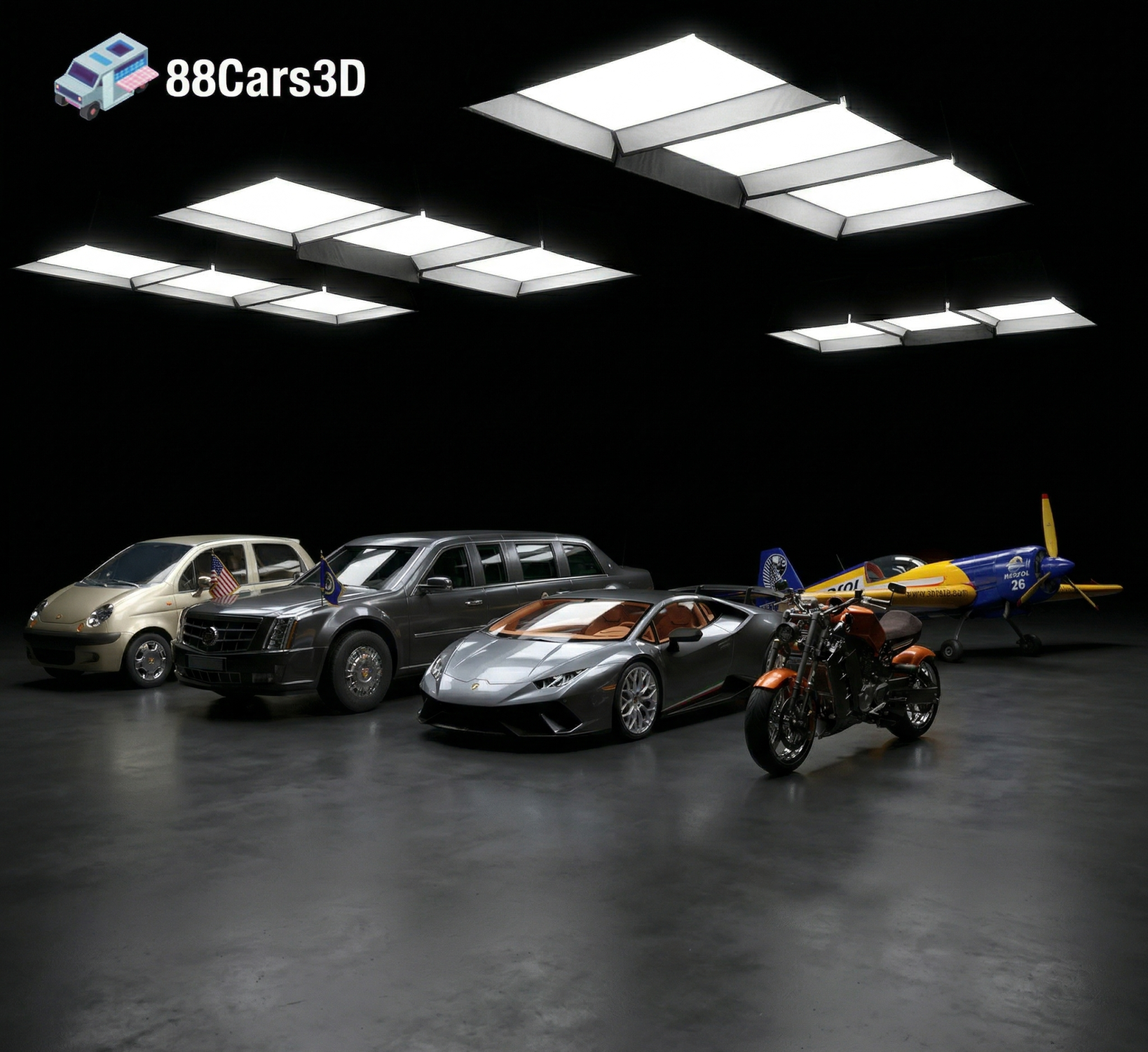
Texture: Yes | Material: Yes | 3D Printable: Yes. Download the Ultimate Creators’ Showcase featuring 5 premium 3D models: Lamborghini Huracan, ZAV Concept Motorcycle, Sukhoi SU-26, Presidential Limousine, and Daewoo Damas. Optimized for 4K CGI rendering and 3D printing. Save massive with this exclusive multi-category bundle!
Price: $99.99

Texture: Yes | Material: Yes | 3D Printable: Yes. Download the Italian Thoroughbreds Bundle featuring 5 iconic 3D models: Lamborghini Huracán Performante, Ferrari 458 Italia, Lamborghini Urus, Diablo SV, and Maserati GT. Optimized for 4K rendering and 3D printing (STL included). Save 50% with this ultimate Italian vehicle collection.
Price: $199.99

Download the Elite Future Mobility Bundle featuring 4 highly optimized 3D models: Tesla Model S, Avatr 11, Li L9, and Zoox Robotaxi. Perfect for ArchViz, Smart City renders, and game dev. Optimized for Unreal Engine and Blender. Includes .fbx, .obj, and .max formats.
Price: $99

🚗 5 Iconic German Cars (BMW M4 G82, M5 CS, X3, 1 Series & Mercedes E-Class). ✅ Optimized for ArchViz: Ready for Corona & V-Ray. 💰 Save €71 with this limited-time collection! 🚀 Instant Download after purchase.
Price: $119

Download the Extreme Off-Road & Survival 3D Models Bundle! Includes the Brabus 800 Adventure, Dodge Ram Bigfoot, Spec Truck, and a Caravan. Save over €210 on this premium 4-in-1 off-grid vehicle pack for ArchViz and game development.
Price: $149.99

Download the Heavy Duty & Commercial Logistics 3D Models Bundle! Includes the Ford Sterling, Caterpillar CT680, Mercedes Citaro Bus, and Vito Van. Save over €130 on this massive, game-ready 4-in-1 industrial vehicle pack.
Price: $109.99

Download the Ultimate Custom Motorcycles 3D Models Bundle. Includes a Custom Chopper, Ducati 916 Café Fighter, Harley XR1200X, and BMW K100. Perfect premium props for luxury ArchViz garages. Save over €250 today!
Price: $159.99

Download the ultimate JDM Street Racing 3D Models Bundle! Includes the Nissan GT-R, Toyota Supra, Mazda RX-7, Lancer Evo IX, and Honda NSX. Save big on this highly optimized, game-ready 5-in-1 Japanese legend car pack.
Price: $129.99

Download the ultimate American Muscle & Cinematic Classics 3D Models Bundle! Includes the Dodge Charger ’68, Mustang Eleanor GT500, Camaro Z28 ’79, and a custom ’69 Mustang. Save over €240 on this game-ready, premium 4-in-1 pack.
Price: $149.99

Download the Everyday City Traffic 3D Models Bundle. Includes the VW Golf, Kia Picanto, Hyundai Tucson, Toyota Yaris, and a DHL Ford Transit Van. Save big on this 5-in-1 pack, perfectly optimized for realistic ArchViz streets and game traffic.
Price: $99.99

