Get 50% OFF All Premium 3D & STL Models!

In the dynamic world of 3D design, bringing your digital creations into the physical realm through 3D printing is an incredibly rewarding experience. For automotive enthusiasts and professional designers alike, transforming a meticulously crafted 3D car model into a tangible object requires more than just hitting the “print” button. It demands a specialized understanding of mesh integrity, scale, printability, and software-specific preparations. This comprehensive guide will take you through the essential technical steps and considerations to ensure your 3D car models are perfectly optimized for 3D printing, whether you’re creating scale models, prototypes, or custom parts.
From understanding fundamental printer technologies to finessing mesh topology and selecting the right file formats, we’ll cover everything you need to know to achieve pristine physical prints. We’ll dive deep into practical workflows using industry-standard software and share best practices that professional artists and engineers employ. By the end of this article, you’ll be equipped with the knowledge to troubleshoot common printing issues, maximize print quality, and confidently bring your automotive visions to life, leveraging the high-quality 3D car models available on platforms like 88cars3d.com. Let’s transform pixels into plastic, resin, or metal with precision and expertise.
Before diving into software-specific preparations, it’s crucial to grasp the fundamental principles of 3D printing, as these dictate how a digital model must be structured. Different printing technologies have varying requirements for mesh density, wall thickness, and model orientation, directly influencing how you prepare your 3D car models. Understanding these nuances from the outset can save significant time and material by preventing failed prints and ensuring optimal quality.
The three most common 3D printing technologies are FDM (Fused Deposition Modeling), SLA (Stereolithography), and SLS (Selective Laser Sintering), each with unique characteristics pertinent to car models:
* **FDM (Filament-based):** FDM printers build models layer by layer by extruding molten plastic filament. They are excellent for larger, functional prototypes and models where precision is important but not necessarily microscopic. For car models, FDM typically requires careful consideration of **minimum wall thickness**, often around 0.8mm to 1.2mm, to ensure features like door handles, mirrors, or thin spoilers don’t break during printing or post-processing. Layer lines are visible, so surface quality may not be as smooth as other methods. **Overhangs** are also a major concern, necessitating support structures that must be carefully designed and removed without damaging the model.
* **SLA (Resin-based):** SLA printers use a UV laser to cure liquid resin, producing highly detailed and smooth models. This technology is ideal for highly intricate car models, showcasing fine details like grilles, interior components, or even tire treads. SLA typically supports much thinner wall thicknesses, often down to 0.2mm to 0.4mm, making it suitable for delicate parts. However, models need to be **hollowed** to save on expensive resin and require **drainage holes** to allow uncured resin to escape. Support structures are still necessary but are generally finer and easier to remove.
* **SLS (Powder-based):** SLS printers use a laser to sinter powdered material (like nylon), creating strong and functional parts with excellent surface finish and no need for support structures (the unsintered powder acts as support). This makes SLS ideal for complex geometries and functional prototypes of car parts. Wall thicknesses are similar to FDM, but the process allows for more intricate internal structures. The downside is the higher cost and limited material palette for hobbyists.
The way a model is oriented on the build plate significantly impacts print quality, material usage, and the need for support structures. For automotive models, which often feature complex curves, undercuts, and delicate protrusions, careful orientation is paramount.
* **Minimizing Supports:** Orienting your car model to minimize contact with the build plate and reduce overhanging sections will decrease the amount of support material needed. For instance, printing a car body at a slight angle can reduce steep overhangs, distributing stress and improving surface finish on critical areas. However, this may increase the overall print time and model height.
* **Surface Quality:** Areas that require the highest surface quality should ideally face upwards or be away from support structures. For a car body, the roof and hood typically benefit from being printed without direct support contact.
* **Build Plate Adhesion:** Ensuring good adhesion prevents models from detaching mid-print, which is particularly critical for large, complex car bodies. Using brims, rafts, or specialized build plate coatings can enhance adhesion. For resin prints, ensuring a large initial contact area can help.
The journey from a digital 3D car model to a physical 3D print begins with a robust and “watertight” mesh. Unlike rendering, which can often overlook minor mesh imperfections, 3D printing slicers are unforgiving. Any topological flaw can lead to errors, failed prints, or physical weaknesses in your model. Ensuring mesh integrity is the single most critical step in preparing your automotive models for printing.
A “watertight” mesh is one that is completely enclosed, with no open edges or holes, much like a perfectly sealed balloon. For 3D printing, this is non-negotiable because the slicer software needs to determine the exact volume of material to print.
* **Identifying Holes:** Holes typically appear when faces are accidentally deleted or edges are not properly joined. In most 3D software (e.g., Blender, 3ds Max, Maya), you can use mesh analysis tools to detect open edges or non-manifold geometry. For instance, in Blender, you can navigate to **Edit Mode**, select all vertices, and use `Mesh > Clean Up > Fill Holes` or `Select > Select All by Trait > Non Manifold` to highlight problem areas. Refer to the official Blender 4.4 documentation on mesh editing for detailed instructions on using these tools: Blender Mesh Cleanup.
* **Repairing Non-Manifold Geometry:** Non-manifold geometry refers to edges shared by more than two faces, or vertices not connected to a face, creating ambiguous volumes for the slicer. These often arise from modeling errors like internal faces, duplicated faces, or overlapping geometry. Software typically offers “Cleanup” functions to automatically attempt to resolve these, or you may need to manually inspect and delete/recreate faces.
* **Inverted Normals:** Normals define the “outside” and “inside” of a face. If some faces have inverted normals (pointing inwards), the slicer may interpret the model incorrectly or skip those sections. Visualizing normals in your 3D software (often with a blue/red color scheme) helps identify issues. Most programs have a “Recalculate Normals Outside” function, which is a crucial step before export.
Overlapping or intersecting geometry, especially within complex car models (e.g., tires intersecting wheel wells, interior components clipping through the body), can confuse slicer software. While seemingly enclosed, these intersections can create internal volumes or define ambiguous surfaces.
* **Booleans and Merging:** For models composed of multiple parts, ensuring they are properly joined into a single, cohesive mesh is vital. Boolean operations (union) can merge overlapping geometries, but they must be used carefully as they can introduce messy topology. Alternatively, you can manually merge vertices and clean up connecting geometry.
* **Manual Inspection and Cleanup:** Use wireframe views and section cuts in your 3D software to visually inspect for internal faces or overlapping elements. For instance, if a car’s dashboard model clips through the windshield, you’ll need to adjust or trim the geometry to prevent internal intersections.
* **Software Repair Tools:** Many dedicated 3D printing preparation tools (like Meshmixer, Netfabb, or even built-in slicer features) can detect and attempt to repair these complex issues automatically. However, it’s always best to fix them at the source in your primary modeling software to maintain control over your mesh.
High-polygon count models designed for rendering often contain intricate details and smooth curves. While this is desirable for visual fidelity, an excessively dense mesh can sometimes lead to overly large file sizes, slow slicing times, and even introduce printing errors due to microscopic imperfections. For 3D printing, especially FDM, simplifying topology can be beneficial.
* **Decimation/Retopology:** Techniques like decimation (reducing polygon count while preserving visual shape) or manual retopology can create a cleaner, lighter mesh that’s easier for slicers to process. However, for car models, care must be taken not to lose crucial details like sharp body lines or small vents.
* **Maintaining Feature Integrity:** When simplifying, ensure that critical features like emblems, grilles, or window frames retain enough polygons to be accurately represented by the printer’s nozzle or laser. A general rule of thumb for FDM is to ensure that the smallest feature is at least twice the size of your nozzle diameter (e.g., 0.8mm for a 0.4mm nozzle).
The transition from a virtual model to a physical object involves crucial decisions regarding scale and the physical limitations of the printing process. Automotive models are particularly sensitive to these parameters, as they often feature intricate details that can easily be lost or rendered unprintable if not properly accounted for.
One of the most common pitfalls in 3D printing is incorrect scaling. Your 3D software’s internal units (meters, centimeters, millimeters) must correspond accurately to the scale expected by your slicer and ultimately, the physical world.
* **Consistent Unit Setup:** Before modeling or preparing for print, establish a consistent unit system in your 3D software. For instance, if you are designing a 1:24 scale model car, and your slicer expects measurements in millimeters, a 5-meter long car (5000mm) at 1:24 scale would be approximately 208.33mm long. Ensure your scene units are set accordingly. In Blender, you can configure scene units under `Scene Properties > Units`.
* **Exporting with Correct Scale:** When exporting, confirm that your chosen file format (e.g., STL, OBJ) retains the scale information, or that you specify the correct export scale. Many slicers will import an STL assuming units like “mm” or “inches” and allow you to scale it, but starting with the correct proportions in your native software is always best practice. Always double-check the imported model’s dimensions in your slicer before proceeding.
* **Scaling for Specific Printer Build Volumes:** Consider the maximum build volume of your target 3D printer. While you might design a full-scale car part, you may need to scale it down significantly or even slice it into multiple parts to fit your printer. For example, creating a highly detailed 1:18 scale model of a classic car might require dividing the chassis, interior, and body into separate print jobs, which then need to be assembled.
Perhaps the most critical parameter for successful 3D printing, especially for detailed automotive models, is the minimum wall thickness. This dictates how thin a feature can be before it becomes unprintable, fragile, or simply disappears.
* **Technology-Specific Guidelines:**
* **FDM:** As mentioned, typically 0.8mm to 1.2mm for features like side mirrors, window frames, or thin spoilers. Thinner walls might fuse incorrectly or be too weak. For very fine details, ensure they are at least twice the nozzle diameter to ensure proper material deposition.
* **SLA:** Can go down to 0.2mm to 0.4mm, allowing for incredible detail on intricate parts like grilles, badges, or interior dashboard details.
* **SLS:** Similar to FDM, often 0.8mm to 1.0mm, but due to material properties, these thinner walls are generally stronger.
* **Designing for Durability:** Beyond printability, consider the structural integrity of your printed car model. Will a thin spoiler snap off during post-processing? Reinforce critical areas by slightly increasing their thickness or adding subtle fillets where they join the main body. For example, a delicate antenna might need to be designed with a base thickness of 1.5mm even if your printer can handle 0.4mm, just to ensure it survives handling.
* **Detail Loss:** Small features below the minimum resolution of your printer will not be reproduced. This means tiny embossed logos, fine mesh patterns on grilles, or extremely thin panel lines might simply become smooth surfaces. Evaluate your model for these ultra-fine details and decide whether to enlarge them, simplify them, or omit them for printing.
For resin-based 3D printing, hollowing out your model is a vital step that significantly reduces material costs, decreases print time, and minimizes stress on the build plate during printing, preventing potential failures.
* **The Benefits of Hollowing:** Solid resin prints are not only expensive but also prone to internal stresses during curing, which can lead to warping or cracking over time. Hollowing creates a shell, often with a consistent wall thickness (e.g., 1.5mm to 2.5mm for a typical car model), saving resin and improving print reliability.
* **Creating Drainage Holes:** When hollowing, it’s essential to create at least two drainage holes (e.g., 2-4mm diameter) in inconspicuous locations on your model (e.g., on the underside of the chassis, or in areas that will be hidden during assembly). These holes allow uncured liquid resin trapped inside the hollow model to escape during the cleaning process, preventing internal pressure buildup and reducing material waste. Without drainage holes, trapped resin can continue to cure over time, leading to bulging, cracking, or even a messy burst.
* **Strategic Placement:** Place drainage holes in areas that won’t compromise the aesthetic of the final car model. Consider areas that will be hidden by other components, or on flat, easily sandable surfaces.
The underlying structure of your 3D car model – its topology – and the file format you choose for export are critical determinants of a successful 3D print. Even a visually perfect model can fail to print if its mesh is messy or it’s exported in an incompatible format. This section delves into the best practices for optimizing topology and navigating the various file formats available for 3D printing.
While often discussed in the context of animation and rendering, clean topology is equally vital for 3D printing. A well-structured mesh translates directly into a more robust and printable model.
* **Quadrilateral-dominant Meshes:** Models built with predominantly quadrilateral (four-sided) polygons are generally preferred in modeling software. While the final STL for printing will be triangulated, starting with quads provides better control over edge flow, makes cleaning up geometry easier, and helps prevent artifacts when triangulated.
* **Avoiding Triangles in Initial Modeling (Where Possible):** Excessive triangulation during the modeling phase can lead to uneven surface tessellation and make it harder to identify and repair non-manifold geometry. Aim for clean quad flow, especially on curved surfaces like car bodies, to ensure smooth transitions and predictable surface output from the printer.
* **Mesh Density and Detail Preservation:** For complex automotive models, striking a balance between mesh density and detail is key. A mesh that is too sparse might not capture fine details like panel lines or slight curves, resulting in a blocky print. Conversely, an overly dense mesh can introduce micro-errors or make file handling cumbersome. Use smooth shading to visualize how your mesh will appear. Apply modifiers (like Subdivision Surface in Blender) sparingly and convert them to actual geometry only when satisfied with the detail level required for the print, taking into account the minimum feature size your printer can achieve.
Choosing the correct file format is a critical last step before sending your model to the slicer. While many formats exist, a few are dominant in the 3D printing ecosystem.
* **STL (Standard Tessellation Language): The Industry Standard**
* **Pros:** STL is the most widely supported file format for 3D printing. It represents a 3D model as a series of connected triangles, defining the surface geometry. It’s simple, universally accepted by virtually all slicers and printers.
* **Cons:** STL is a “dumb” format; it doesn’t store color, texture, material, or unit information. This means you need to ensure your model is correctly scaled and watertight *before* exporting to STL. The lack of unit information means you often need to confirm or adjust scale in your slicer. For multi-material or color prints, STL is not suitable.
* **Exporting from Software:** In Blender, you can export to STL via `File > Export > Stl (.stl)`. Ensure `Selection Only` is checked if you only want to export specific objects. Confirm `Scale` and `Unit` settings. In 3ds Max, it’s `File > Export > Export Selected` or `Export` and choose STL. Ensure ASCII vs. Binary is chosen (Binary is smaller).
* **OBJ (Object): Versatile but with Caveats**
* **Pros:** OBJ can store geometry (vertices, faces, normals), UV mapping, and material references (MTL files). This makes it more versatile than STL for general 3D assets. Some advanced slicers can process OBJ files and their associated material data for color printing.
* **Cons:** Not as universally supported as STL for basic 3D printing. The associated MTL files are often ignored by standard slicers. It can lead to larger file sizes.
* **Relevance for Printing:** Primarily useful if you’re using a full-color 3D printer that can interpret color/texture information, otherwise, it’s typically converted to STL internally by the slicer.
* **3MF (3D Manufacturing Format): The Modern Alternative**
* **Pros:** 3MF is designed to be a more comprehensive 3D printing format, addressing many limitations of STL. It can encapsulate not just geometry, but also colors, textures, materials, and even support structures and slicer settings. It’s becoming increasingly supported by newer slicers and printers.
* **Cons:** Still not as universally adopted as STL, though its adoption is growing.
* **Relevance for Printing:** Excellent for complex projects, especially those involving color or multiple materials, which might be relevant for specialized automotive models with detailed paint schemes.
* **GLB/USDZ (AR/VR-focused): Limited Direct Printing Use**
* **Pros:** GLB (Binary GLTF) and USDZ are highly optimized formats for AR/VR applications, storing geometry, materials, animations, and more in a single, compact file.
* **Cons:** These are generally *not* direct 3D printing formats. Slicers do not typically support them.
* **Relevance for Printing:** While not directly used for printing, high-quality models sourced from platforms like 88cars3d.com often come in these formats for visualization. You would need to import them into your 3D modeling software, clean them up, and then export them as an STL or 3MF for printing.
When preparing models from 88cars3d.com, you might encounter various formats. Always ensure you import into your preferred 3D software, perform the necessary print preparation steps, and then export to a suitable printing format like STL.
Once the core mesh integrity and scale are addressed, the next phase involves refining details, intelligently designing for support structures, and effectively using your slicer software for final validation. These advanced techniques are particularly important for complex automotive models, where intricate features and smooth surfaces are paramount.
Automotive models are renowned for their intricate details, from finely sculpted body lines to delicate grilles and badging. Ensuring these details translate accurately into a physical print requires careful planning.
* **Exaggerating Small Features:** Very fine details, such as etched logos, thin antennae, or subtle panel lines, might not register on a 3D print, especially with FDM technology. Consider slightly exaggerating these features in your 3D model. For example, a panel line that is 0.1mm deep in a render might need to be 0.4mm deep and 0.5mm wide to be visibly distinct on an FDM print. Similarly, a thin antenna might need a base diameter of 1.0mm to withstand printing and handling.
* **Chamfers and Fillets:** Sharp edges in digital models can become brittle or produce inconsistent lines when printed. Applying small chamfers (for sharp edges) or fillets (for rounded edges) to your model not only enhances realism but also adds strength to printed parts. A small 0.5mm chamfer on a window frame, for instance, can prevent it from being too sharp and fragile.
* **Separating Complex Parts:** For extremely delicate features (e.g., windshield wipers, mirrors, or intricate grilles), it’s often more effective to model and print them separately, then assemble them onto the main car body after printing. This allows you to orient each small part optimally for printing, minimizing supports and achieving higher detail. This modular approach is common in high-quality scale model kits.
Support structures are a necessary evil for 3D printing, especially for car models with overhangs and intricate geometries. The key is to design them strategically to be effective yet easy to remove without damaging the model.
* **Slicer-Generated vs. Manual Supports:** Most slicer software can automatically generate supports. However, for complex automotive models, manually adding or refining support placement in your 3D software or advanced slicers can yield better results. For instance, in Blender, you can create custom support structures by adding simple geometry (like thin pillars) where needed, ensuring they are easily breakable and positioned only where critical.
* **Optimizing Contact Points:** Reduce the size of contact points where supports meet the model to minimize surface blemishes. For FDM, using a small contact Z distance and a low support density can help. For SLA, smaller tip diameters for supports are preferable.
* **Post-Processing Plan:** Anticipate the post-processing required for support removal. For FDM, this involves careful breaking and sanding. For SLA, it’s washing, curing, and then carefully snipping supports. Plan your support placement to avoid critical aesthetic surfaces (like the car’s paintable body panels) as much as possible, or place them on surfaces that will be hidden or easily sanded.
Your slicer software (e.g., Ultimaker Cura, PrusaSlicer, Chitubox, Lychee Slicer) is your last line of defense before committing to a print. It’s here that you can perform final checks and fine-tune print settings.
* **Loading and Initial Inspection:** Always load your exported model into your slicer and perform an initial visual inspection. Look for any obvious holes, missing faces, or strange artifacts that might have been missed in your 3D modeling software.
* **Mesh Repair Tools:** Many slicers have built-in mesh repair tools that can automatically fix minor issues like inverted normals or small gaps. While it’s always better to fix these in your modeling software, these tools can be a lifesaver for last-minute adjustments.
* **Layer Preview Analysis:** The most critical step is to use the layer preview function. This allows you to virtually “print” your model layer by layer, identifying potential problems:
* **Unsupported Overhangs:** Look for any parts of the model that float in mid-air without support.
* **Thin Walls/Missing Features:** Zoom in to verify that all the fine details of your car model, like grilles or emblems, are being rendered as distinct layers and not disappearing. If they are, you might need to increase the wall thickness or feature size in your 3D model.
* **Internal Gaps/Intersections:** Ensure the internal structure (if hollowed) is clean and that there are no unexpected voids or overlapping sections within the shell.
* **Print Settings Optimization:** Adjust settings like layer height (thinner layers for finer details, thicker for faster prints), infill density (for FDM), exposure times (for SLA), and retraction settings to optimize print quality and efficiency for your specific car model.
Despite meticulous preparation, 3D printing can present unforeseen challenges. Understanding common issues and knowing how to troubleshoot them effectively is a crucial skill for any 3D artist or designer bringing automotive models to life. Many problems can be traced back to preparation errors, reinforcing the importance of the steps outlined above.
Warping (when edges lift from the print bed) and layer delamination (when layers fail to stick together) are common issues that can ruin an otherwise perfect car model.
* **Causes of Warping:** Often due to uneven cooling, especially with FDM plastics like ABS. As the plastic cools, it contracts, pulling corners upwards.
* **Solutions:** Ensure proper build plate adhesion (brims, rafts, adhesive sprays). Control ambient temperature (enclosures for FDM printers). Use materials less prone to warping (e.g., PLA over ABS for FDM, specific resins for SLA). Orienting the model to minimize the footprint touching the build plate can also help.
* **Causes of Layer Delamination:** Can be caused by printing too cold, too fast, or insufficient material extrusion. For SLA, it might be due to incorrect exposure settings or insufficient support.
* **Solutions:** Increase extrusion temperature slightly (FDM). Reduce print speed (FDM). Ensure adequate layer time, especially for small, thin features on car models. For SLA, recalibrate exposure times and ensure supports are robust enough to prevent suction forces from pulling layers apart. In your 3D model, ensure no overly sharp angles create weak points for delamination.
Sometimes, a printed model doesn’t quite match the digital version in terms of size or the clarity of its fine details.
* **Dimensional Accuracy:**
* **Calibration:** Ensure your 3D printer is properly calibrated for dimensional accuracy (E-steps, steps/mm).
* **Shrinkage Compensation:** Materials like resin and some filaments shrink slightly during curing/cooling. High-quality slicers offer shrinkage compensation settings.
* **Model Scale:** Double-check your export and import scales in your 3D software and slicer, as discussed in Section 3.1. An incorrectly assumed unit can lead to wildly different print sizes.
* **Feature Loss:**
* **Minimum Wall Thickness:** Revisit Section 3.2. If fine details are missing, they likely fall below your printer’s minimum wall thickness or nozzle resolution. Either thicken them in your 3D model or choose a printer capable of finer detail (e.g., SLA).
* **Insufficient Polygons:** Ensure that the original 3D model has enough geometric detail to define the small features. If a curve is represented by too few polygons, it will print as a faceted surface.
Removing support structures often leaves marks on the model’s surface, which can be particularly noticeable on the smooth body panels of a car.
* **Minimizing Contact Points:** Use smaller support contact points in your slicer settings. For FDM, experiment with “tree” or “branch” supports that attach minimally. For SLA, adjust tip diameter and density.
* **Strategic Placement:** As mentioned in Section 5.2, place supports in less visible areas, or on surfaces that will be sanded, painted, or covered by other components. For example, placing supports on the underside of a car chassis is preferable to the roof.
* **Post-Processing Techniques:** Careful removal (snips, pliers), followed by sanding (starting with coarse, moving to fine grit), filling (with Bondo or similar fillers), and priming/painting can smooth out support scars. For resin prints, a quick wet-sanding after initial curing can often remove minor nubs.
Occasionally, your slicer might refuse to load a file, report “non-manifold edges,” or crash during slicing.
* **Mesh Repair Software:** Before blaming the slicer, run your model through dedicated mesh repair software like Meshmixer, Netfabb, or 3D Builder (Windows) for an automated fix. These tools are often more robust at identifying and repairing complex topological errors than built-in slicer functions.
* **Re-exporting:** Sometimes a simple re-export from your 3D modeling software, ensuring all settings are correct (especially for STL, binary vs. ASCII), can resolve issues.
* **Check for Internal Geometry:** Use a clipping plane or section view in your 3D software to look for any hidden internal faces or overlapping geometries that could confuse the slicer. These often aren’t visible on the surface but create ambiguous volumes.
By systematically addressing these common challenges, you can significantly improve your success rate in 3D printing complex automotive models, turning digital designs into pristine physical representations.
The journey from a high-quality 3D car model to a perfectly realized 3D print is a detailed one, demanding precision, patience, and a deep understanding of both digital design and physical fabrication. We’ve explored the critical stages of preparing your automotive models for printing, from understanding the fundamental differences in printer technologies to ensuring the absolute integrity of your mesh. We’ve delved into the intricacies of scaling, minimum wall thickness, and the strategic hollowing of models for resin printing, along with optimizing topology and selecting the correct file formats like STL and 3MF.
The technical skills covered – meticulously checking for watertight meshes, repairing non-manifold geometry, managing scale, designing for delicate features, and leveraging slicer software for final validation – are indispensable. These best practices will not only save you time and material but also elevate the quality of your printed car models from good to exceptional. Remember that resources like 88cars3d.com provide a fantastic starting point with high-quality 3D car models, but the final leap into the physical world rests on your preparation prowess.
By embracing these comprehensive preparation techniques and systematically troubleshooting common printing challenges, you are now equipped to confidently transform your digital automotive visions into tangible, stunning physical creations. The satisfaction of holding a meticulously detailed 3D printed car model, knowing every curve and panel line was intentionally prepared for its physical manifestation, is truly unparalleled. Continue to experiment, learn, and refine your techniques, and watch your 3D car models accelerate from screen to reality.
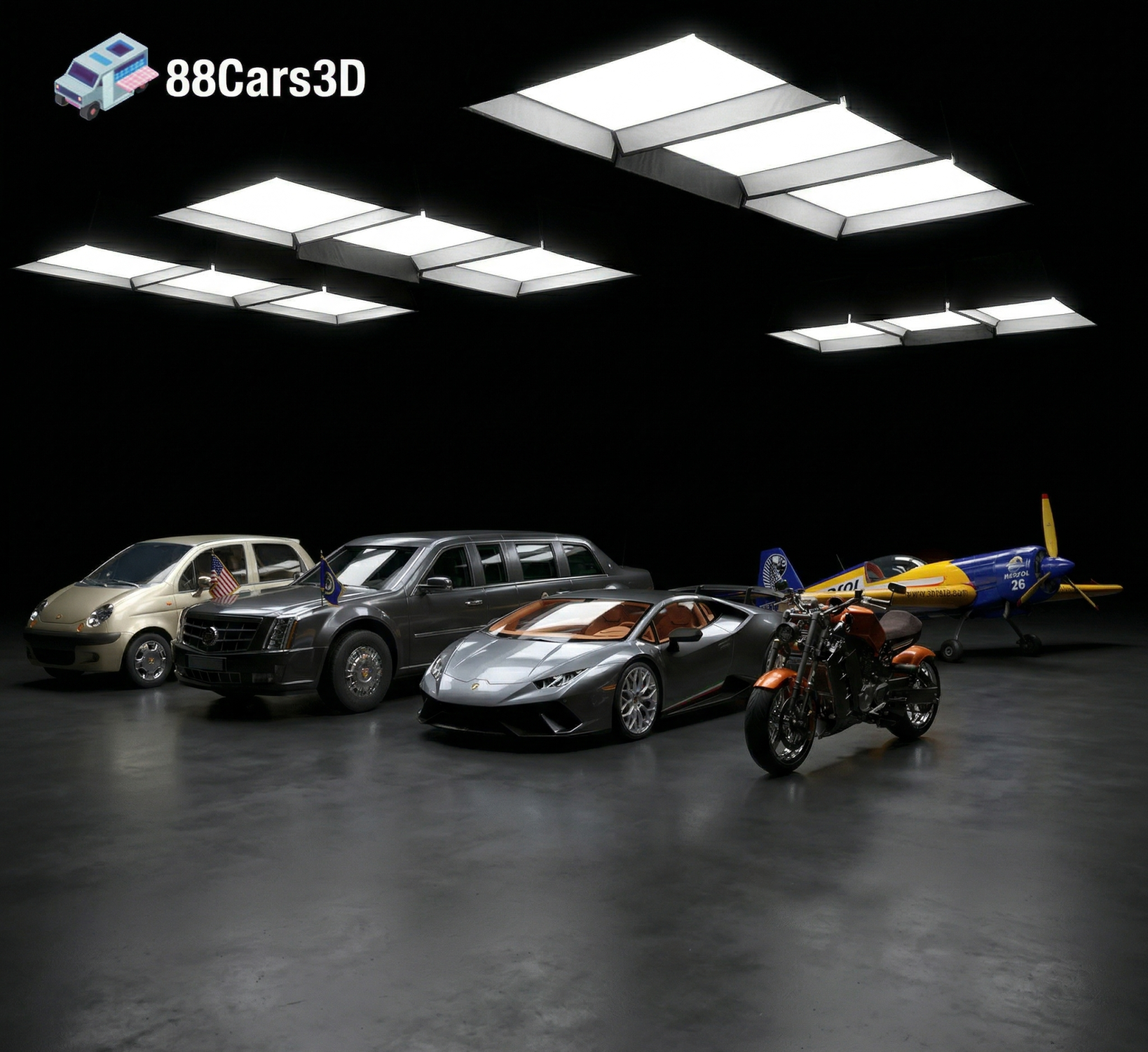
Texture: Yes | Material: Yes | 3D Printable: Yes. Download the Ultimate Creators’ Showcase featuring 5 premium 3D models: Lamborghini Huracan, ZAV Concept Motorcycle, Sukhoi SU-26, Presidential Limousine, and Daewoo Damas. Optimized for 4K CGI rendering and 3D printing. Save massive with this exclusive multi-category bundle!
Price: $99.99

Texture: Yes | Material: Yes | 3D Printable: Yes. Download the Italian Thoroughbreds Bundle featuring 5 iconic 3D models: Lamborghini Huracán Performante, Ferrari 458 Italia, Lamborghini Urus, Diablo SV, and Maserati GT. Optimized for 4K rendering and 3D printing (STL included). Save 50% with this ultimate Italian vehicle collection.
Price: $199.99

Download the Elite Future Mobility Bundle featuring 4 highly optimized 3D models: Tesla Model S, Avatr 11, Li L9, and Zoox Robotaxi. Perfect for ArchViz, Smart City renders, and game dev. Optimized for Unreal Engine and Blender. Includes .fbx, .obj, and .max formats.
Price: $99

🚗 5 Iconic German Cars (BMW M4 G82, M5 CS, X3, 1 Series & Mercedes E-Class). ✅ Optimized for ArchViz: Ready for Corona & V-Ray. 💰 Save €71 with this limited-time collection! 🚀 Instant Download after purchase.
Price: $119

Download the Extreme Off-Road & Survival 3D Models Bundle! Includes the Brabus 800 Adventure, Dodge Ram Bigfoot, Spec Truck, and a Caravan. Save over €210 on this premium 4-in-1 off-grid vehicle pack for ArchViz and game development.
Price: $149.99

Download the Heavy Duty & Commercial Logistics 3D Models Bundle! Includes the Ford Sterling, Caterpillar CT680, Mercedes Citaro Bus, and Vito Van. Save over €130 on this massive, game-ready 4-in-1 industrial vehicle pack.
Price: $109.99

Download the Ultimate Custom Motorcycles 3D Models Bundle. Includes a Custom Chopper, Ducati 916 Café Fighter, Harley XR1200X, and BMW K100. Perfect premium props for luxury ArchViz garages. Save over €250 today!
Price: $159.99

Download the ultimate JDM Street Racing 3D Models Bundle! Includes the Nissan GT-R, Toyota Supra, Mazda RX-7, Lancer Evo IX, and Honda NSX. Save big on this highly optimized, game-ready 5-in-1 Japanese legend car pack.
Price: $129.99

Download the ultimate American Muscle & Cinematic Classics 3D Models Bundle! Includes the Dodge Charger ’68, Mustang Eleanor GT500, Camaro Z28 ’79, and a custom ’69 Mustang. Save over €240 on this game-ready, premium 4-in-1 pack.
Price: $149.99

Download the Everyday City Traffic 3D Models Bundle. Includes the VW Golf, Kia Picanto, Hyundai Tucson, Toyota Yaris, and a DHL Ford Transit Van. Save big on this 5-in-1 pack, perfectly optimized for realistic ArchViz streets and game traffic.
Price: $99.99

