Get 50% OFF All Premium 3D & STL Models!

The world of 3D printing thrives on digital blueprints, and among the myriad of file formats available, the humble STL (STereoLithography) file reigns supreme. Whether you’re a seasoned hobbyist crafting intricate car models from marketplaces like 88cars3d.com, an engineer prototyping a new component, or a beginner taking your first steps into additive manufacturing, you’ve undoubtedly encountered STL. But why this particular format? Why has it become the de facto standard for transferring 3D models to 3D printers, despite its age and apparent simplicity? This comprehensive guide will delve into the technical underpinnings and practical advantages that solidify STL’s position. We’ll explore its fundamental structure, the critical role it plays in the slicing process, its universal compatibility, and the reasons behind its enduring popularity, even as newer formats emerge. By the end of this article, you’ll gain a deep understanding of why STL is the cornerstone of digital fabrication and how to leverage its strengths for your 3D printing projects.
At its core, the STL format is remarkably straightforward, which is a significant part of its widespread adoption. It represents a 3D object as a collection of interconnected triangles, forming a surface mesh. Unlike more complex formats that can store intricate data like color, texture, or material properties, STL focuses solely on the geometric definition of the object’s surface. This simplicity is both its greatest strength and its primary limitation.
Every STL file describes an object’s surface by breaking it down into small, flat triangles. Each triangle is defined by three vertices (points in 3D space) and a normal vector. The normal vector points outwards from the surface and is crucial for determining which side of the triangle is “inside” and which is “outside” the object. This outward-pointing normal convention is fundamental for ensuring the watertightness of a 3D model – a critical requirement for 3D printing.
The collection of all these triangles forms a tessellated representation of the original 3D model. The density of these triangles dictates the resolution and smoothness of the digital model. A higher triangle count generally results in a more detailed and smoother surface but also leads to larger file sizes. For printable car models, for instance, a good balance is struck between capturing fine details like panel lines and curves, and maintaining manageable file sizes for efficient slicing and printing.
STL files can be saved in two formats: ASCII and binary. The ASCII format is human-readable, making it useful for debugging or manual editing, although it’s significantly larger. Each triangle’s data (normal vector and vertices) is represented by text strings. The binary format, on the other hand, is much more compact and efficient for storage and processing. It uses binary representations for all data, making it the preferred choice for most 3D printing applications. When downloading files from a source like 88cars3d.com, you’ll almost always receive binary STL files due to their efficiency.
The choice between ASCII and binary is largely handled by the software you use, but understanding the difference highlights the format’s evolution towards practicality in the digital manufacturing workflow.
The magic of 3D printing happens in the “slicer” software. This is where a 3D model, typically an STL file, is translated into a series of thin, horizontal layers, and then further converted into machine instructions (G-code) that a 3D printer can understand and execute. STL’s simplicity is precisely what makes it so well-suited for this crucial step.
Slicer software (like Cura, PrusaSlicer, or Simplify3D) takes the triangular mesh data from an STL file and computationally “slices” it into hundreds or thousands of individual layers. For each layer, the slicer determines the exact path the print head needs to follow to deposit material. This process involves:
The clean, unambiguous surface definition provided by STL ensures that slicer software can accurately perform these intersection calculations. Without this well-defined boundary, the slicing process would be far more complex and prone to errors. For example, when printing a detailed model from 88cars3d.com, the slicer needs to precisely interpret the curves and edges defined by the STL’s triangles to generate smooth, printable layers.
One of the most critical functions of slicer software is generating support structures. These are temporary elements printed alongside the main object to hold up overhangs and bridges that would otherwise collapse during printing. The slicer analyzes the geometry defined by the STL file to identify areas requiring support. The triangular facets of the STL are essential for this analysis, allowing the software to detect overhang angles and calculate the necessary support placement and density.
The quality of the STL file directly impacts the effectiveness of support generation. A manifold (watertight) STL with clean geometry ensures that the slicer can correctly identify overhangs and create robust, yet removable, supports. Conversely, a flawed STL can lead to insufficient or excessive supports, complicating post-processing.
A significant reason for STL’s ubiquity is its widespread support across the entire 3D printing ecosystem. From the initial design software to the slicing programs and finally the 3D printers themselves, STL is the common language.
Nearly all 3D modeling and CAD (Computer-Aided Design) software, whether professional-grade like SolidWorks, Fusion 360, or Blender, or more hobbyist-oriented tools, offer STL export capabilities. This means that no matter how a 3D model is created, it can be easily converted into a format that is compatible with the 3D printing workflow. This broad compatibility ensures that designers and creators can work with their preferred tools without worrying about file format lock-in.
The ease with which you can export from virtually any 3D creation tool to STL makes it an accessible format for everyone, from beginners to seasoned professionals. When you download a printable car model, the STL is the universal key to unlocking its potential on your 3D printer.
As mentioned earlier, all major slicer programs support STL files as their primary input format. This means that regardless of your chosen slicing software, you can almost certainly import and process an STL. Furthermore, the vast majority of 3D printer firmware includes instructions for interpreting G-code generated from STL files. This universal adoption means that an STL file created today will likely be printable on hardware released years from now.
This network effect, where the format is supported by virtually every piece of software and hardware in the pipeline, creates a self-reinforcing loop that solidifies STL’s dominance. It removes a significant barrier to entry for new users and ensures smooth interoperability between different stages of the 3D printing process.
While STL’s simplicity is its strength, it also means the format lacks inherent error-checking or rich geometric information. This can lead to “non-manifold” or “watertight” issues, where the mesh has holes, inverted faces, or intersecting triangles, which can cause problems during slicing and printing. Fortunately, tools exist to repair and optimize STL files.
Flaws in an STL file can manifest in several ways:
These errors can result in prints with missing sections, distorted shapes, incorrect solid areas, and failed prints altogether. For intricate models like those found on 88cars3d.com, ensuring the STL is clean is paramount for achieving high-quality results.
Fortunately, several software tools are designed to identify and fix these common STL issues:
The general workflow involves importing the STL into one of these tools, running an automated repair function, and then visually inspecting the model for any remaining issues. For complex repairs, manual editing might be necessary. The goal is always to achieve a “watertight” and manifold mesh where all faces connect correctly, forming a continuous, enclosed surface.
While STL defines the geometry, achieving a successful and high-quality print involves careful consideration of numerous parameters within the slicer software, informed by the STL’s characteristics. Understanding these parameters and their relationship with the STL file is key to maximizing print success.
The layer height setting in your slicer directly dictates the vertical resolution of your print. A smaller layer height (e.g., 0.1mm) results in finer detail and smoother curves, ideal for showcasing the intricate details of a car model. However, this also significantly increases print time as the printer has to lay down many more individual layers. A larger layer height (e.g., 0.3mm) prints much faster but results in more visible “stair-stepping” on curved or angled surfaces, as defined by the underlying STL facets.
The STL file’s triangle density plays a role here. If the STL has very low resolution, increasing the layer height beyond a certain point won’t degrade quality further, as the underlying geometry is already coarse. Conversely, a high-resolution STL benefits from smaller layer heights to truly capture the modeled detail.
The infill is the internal structure printed within the outer walls of an object. The density (percentage) and pattern of the infill significantly affect the print’s strength, weight, and material consumption. For display models, a lower infill (e.g., 10-20%) is often sufficient for structural integrity and saves considerable print time and material. For functional parts or models that need to withstand stress, higher infill percentages (e.g., 50-100%) might be necessary.
The choice of infill pattern and density is independent of the STL geometry itself but is a critical slicer setting that leverages the enclosed volume defined by the STL’s outer shell.
The orientation in which an object is placed on the print bed is crucial for print success. It affects:
When preparing to print a car model, consider orienting it to minimize supports on visible surfaces like the hood or roof, and ensure a stable base for bed adhesion. The STL’s geometry dictates the available surfaces for adhesion and overhangs that require support, making orientation a strategic decision based on the STL’s form.
The STL format, despite its age, remains the undisputed king of 3D printing file formats due to a powerful combination of simplicity, universality, and robust support within the entire additive manufacturing ecosystem. Its fundamental principle of representing 3D geometry as a mesh of triangles makes it an ideal input for slicer software, enabling the conversion of digital designs into the layer-by-layer instructions required by 3D printers. From the initial CAD design to the final G-code, STL acts as a consistent bridge, ensuring compatibility across a vast array of software and hardware.
While its inherent simplicity can lead to mesh errors, readily available tools for STL repair and optimization ensure that even complex models, like the high-quality printable car models found on 88cars3d.com, can be prepared for flawless printing. Understanding the underlying mesh structure, the slicing process, and crucial settings like layer height, infill, and orientation allows creators to leverage the STL format to its fullest potential. As additive manufacturing continues to evolve, the foundational role of the STL file format is likely to endure, serving as the reliable digital blueprint for the tangible creations of tomorrow.

Texture: Yes | Material: Yes | 3D Printable: Yes. Download the Italian Thoroughbreds Bundle featuring 5 iconic 3D models: Lamborghini Huracán Performante, Ferrari 458 Italia, Lamborghini Urus, Diablo SV, and Maserati GT. Optimized for 4K rendering and 3D printing (STL included). Save 50% with this ultimate Italian vehicle collection.
Price: $199.99

Download the Elite Future Mobility Bundle featuring 4 highly optimized 3D models: Tesla Model S, Avatr 11, Li L9, and Zoox Robotaxi. Perfect for ArchViz, Smart City renders, and game dev. Optimized for Unreal Engine and Blender. Includes .fbx, .obj, and .max formats.
Price: $99

🚗 5 Iconic German Cars (BMW M4 G82, M5 CS, X3, 1 Series & Mercedes E-Class). ✅ Optimized for ArchViz: Ready for Corona & V-Ray. 💰 Save €71 with this limited-time collection! 🚀 Instant Download after purchase.
Price: $119

Download the Extreme Off-Road & Survival 3D Models Bundle! Includes the Brabus 800 Adventure, Dodge Ram Bigfoot, Spec Truck, and a Caravan. Save over €210 on this premium 4-in-1 off-grid vehicle pack for ArchViz and game development.
Price: $149.99

Download the Heavy Duty & Commercial Logistics 3D Models Bundle! Includes the Ford Sterling, Caterpillar CT680, Mercedes Citaro Bus, and Vito Van. Save over €130 on this massive, game-ready 4-in-1 industrial vehicle pack.
Price: $109.99

Download the Ultimate Custom Motorcycles 3D Models Bundle. Includes a Custom Chopper, Ducati 916 Café Fighter, Harley XR1200X, and BMW K100. Perfect premium props for luxury ArchViz garages. Save over €250 today!
Price: $159.99

Download the ultimate JDM Street Racing 3D Models Bundle! Includes the Nissan GT-R, Toyota Supra, Mazda RX-7, Lancer Evo IX, and Honda NSX. Save big on this highly optimized, game-ready 5-in-1 Japanese legend car pack.
Price: $129.99

Download the ultimate American Muscle & Cinematic Classics 3D Models Bundle! Includes the Dodge Charger ’68, Mustang Eleanor GT500, Camaro Z28 ’79, and a custom ’69 Mustang. Save over €240 on this game-ready, premium 4-in-1 pack.
Price: $149.99

Download the Everyday City Traffic 3D Models Bundle. Includes the VW Golf, Kia Picanto, Hyundai Tucson, Toyota Yaris, and a DHL Ford Transit Van. Save big on this 5-in-1 pack, perfectly optimized for realistic ArchViz streets and game traffic.
Price: $99.99
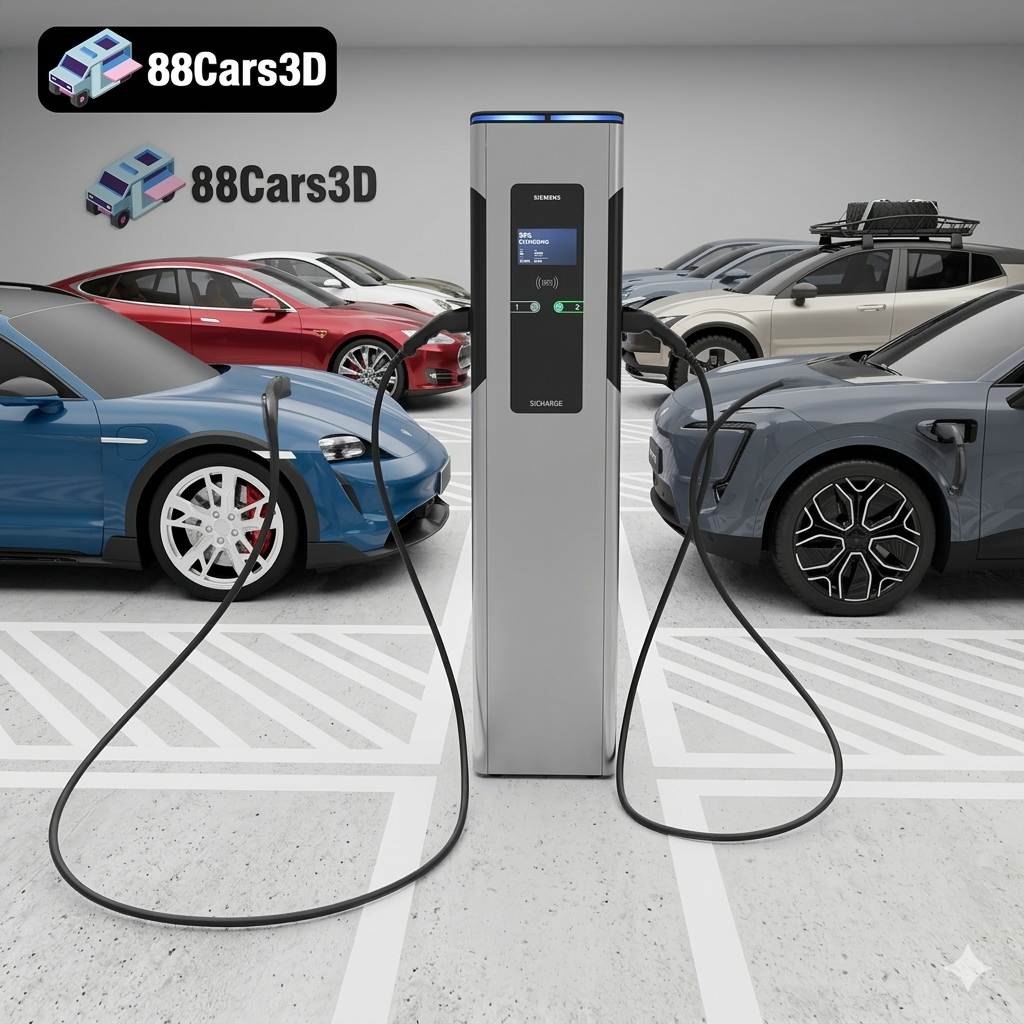
Download the Future of Mobility EV 3D Models Bundle. Includes the Volvo EX30, Tesla Model S, AVATR 11, Porsche Taycan, and a Siemens EV Charger. Save big on this highly optimized 5-in-1 pack for ArchViz and game development!
Price: $89.99

