Unreal Engine Workflow for High-Quality Automotive Visualization and Interactive Experiences
In the rapidly evolving landscape of real-time rendering and virtual experiences, Unreal Engine stands as an unparalleled platform for bringing automotive visions to life. From photorealistic marketing visuals to immersive configurators and cutting-edge virtual production, the demand for high-fidelity 3D car models and efficient workflows has never been greater. Whether you’re a seasoned game developer, a 3D artist specializing in visualization, or an automotive designer pushing the boundaries of interactive design, mastering Unreal Engine for vehicle projects is crucial.
This comprehensive guide delves deep into the essential workflows, technical best practices, and innovative features that empower you to create breathtaking automotive content in Unreal Engine. We’ll explore everything from setting up your project and optimizing high-polygon car models, to crafting physically accurate materials, implementing dynamic lighting, and building compelling interactive experiences using Blueprint. Prepare to unlock the full potential of your automotive projects, delivering unparalleled visual quality and interactive performance.
Setting Up Your Unreal Engine Project for Automotive Excellence
Embarking on an automotive visualization project in Unreal Engine requires a meticulous setup to ensure optimal performance and visual fidelity from the outset. Choosing the right project template and configuring key settings are foundational steps that will influence every subsequent stage of development.
Project Templates and Initial Configuration
When creating a new project, selecting the appropriate template can save significant setup time. For automotive visualization, the “Film, Television, and Live Events” template is often an excellent starting point due to its focus on high-fidelity rendering, cinematic tools, and virtual production readiness. Alternatively, the “Games” template with “Blank” or “Third Person” can be adapted if your primary goal is a playable experience, but be prepared to enable relevant rendering features manually.
Key initial configurations include:
- Target Hardware: Select “Desktop/Console” for high-end visualization or “Mobile/Tablet” if targeting AR/VR on mobile devices, though this might involve significant compromises in visual quality.
- Starter Content: Usually, it’s best to omit Starter Content to keep the project clean, especially when working with high-quality, custom assets like those found on 88cars3d.com.
- Ray Tracing: For the ultimate in realism, ensure Ray Tracing is enabled in Project Settings under “Rendering.” This will unlock features like hardware-accelerated ray-traced reflections, shadows, and ambient occlusion, which are vital for polished automotive renders.
- Lumen and Nanite: For Unreal Engine 5 projects, Lumen (global illumination and reflections) and Nanite (virtualized geometry) should be enabled by default. Verify this in Project Settings > Engine > Rendering. These features are game-changers for automotive realism and performance.
Beyond these, consider setting your default Post Process Volume to unbounded and configuring it with initial exposure settings to ensure a visually consistent starting point. A typical setup might involve disabling auto-exposure to gain full manual control over scene brightness.
Scalability Settings and Performance Targets
While aiming for photorealism, it’s essential to consider the performance implications. Unreal Engine’s Scalability Settings (located under Settings > Engine Scalability Settings) allow you to define different quality levels for your project, catering to various hardware specifications. For high-end cinematic renders, you’ll likely target “Epic” or “Cinematic” settings, but for interactive experiences, you might need to find a balance.
It’s good practice to:
- Establish a baseline FPS target: For real-time applications, 30 FPS is often the minimum acceptable, with 60 FPS being ideal for smooth interaction.
- Monitor performance regularly: Use the `stat fps`, `stat unit`, and `stat gpu` console commands to monitor frame rate, game thread, draw thread, and GPU performance.
- Configure specific scalability groups: Adjust settings for Anti-Aliasing, Global Illumination, Reflections, Shadow Quality, and Post-Processing. High-quality reflections and global illumination are paramount for cars.
Understanding the interplay between visual fidelity and performance is key to delivering a successful automotive project. For more details on project setup and rendering features, consult the official Unreal Engine documentation at https://dev.epicgames.com/community/unreal-engine/learning.
Importing and Optimizing High-Fidelity 3D Car Models
The foundation of any stunning automotive visualization is a high-quality 3D car model. Importing these assets into Unreal Engine correctly, and optimizing them for real-time performance, is a critical step that determines the final visual quality and interactivity of your project.
Efficient Asset Acquisition and Import Settings
Sourcing professional-grade 3D car models is the first step. Platforms like 88cars3d.com offer meticulously crafted models with clean topology, PBR materials, and optimized UVs, often provided in formats like FBX, USD, or USDZ that are highly compatible with Unreal Engine. When importing these assets, several settings are crucial:
- File Format: FBX is the most common and robust format for static meshes. USD/USDZ offer additional benefits for collaboration and non-destructive workflows, especially with the latest Unreal Engine versions.
- Scale: Ensure your model’s scale is correct upon import. Unreal Engine uses 1 unit = 1 centimeter by default. Verify the export scale from your 3D modeling software (e.g., Blender, 3ds Max, Maya) to match.
- Normals and Tangents: Ensure “Import Normals” and “Import Tangents” are enabled. This preserves the finely detailed surface shading. “Recompute Normals” should generally be off if the source model has good normals.
- Material Import Method: Choose “Do Not Create Materials” if you plan to create PBR materials from scratch in Unreal Engine, or “Create New Materials” if the FBX contains basic material assignments you wish to use as a starting point.
- Collision: For static visualization, disable “Create Collision.” For interactive or physics-based projects, generate basic collision or import custom collision meshes.
For complex car models, consider importing separate components (body, wheels, interior, glass) as individual meshes. This allows for greater control over materials, LODs, and potential interactivity.
Nanite Virtualized Geometry for High-Poly Models
Unreal Engine 5’s Nanite virtualized geometry system revolutionizes how high-polygon models are handled. Traditional game development required painstaking poly-reduction, but Nanite allows you to import models with millions of polygons directly, enabling unprecedented geometric detail without significant performance penalties. This is a game-changer for automotive assets, where every curve and detail matters.
- Enabling Nanite: After importing a mesh, open its Static Mesh Editor and enable “Enable Nanite” in the Details panel. It will automatically convert the mesh.
- Performance: Nanite intelligently streams and renders only the necessary geometry based on screen size and distance, dramatically reducing draw calls and memory footprint. This means you can have a highly detailed car model in your scene and still maintain excellent frame rates.
- Limitations: While powerful, Nanite has some limitations. It doesn’t support skinned meshes, custom UVs for lightmaps (though Lumen alleviates this for GI), or specific rendering features like World Position Offset. Transparent materials also require careful handling with Nanite, often needing to be rendered as traditional meshes.
Even with Nanite, some optimization is still beneficial. Clean topology from your source model ensures efficient Nanite processing and better shading. For transparent parts like glass, which often don’t benefit from Nanite, traditional LODs and efficient material setup remain crucial.
Crafting Realistic PBR Materials and Textures
Achieving photorealistic automotive rendering in Unreal Engine hinges on the quality and accuracy of your Physically Based Rendering (PBR) materials. PBR ensures that materials react realistically to light, regardless of the lighting conditions, making them essential for convincing car renders.
Understanding PBR Principles for Automotive Surfaces
PBR materials mimic how light interacts with real-world surfaces. The core components of a PBR material include:
- Base Color (Albedo): Represents the diffuse color of the surface, stripped of any lighting information. For car paint, this will be the base color of the vehicle.
- Metallic: A grayscale map (0 to 1) indicating if a surface is metallic (1) or dielectric (0). Car paints often have metallic flakes, while chrome trim is fully metallic.
- Roughness: A grayscale map (0 to 1) defining the microscopic surface irregularities. Low roughness (close to 0) means a smooth, shiny surface (like polished chrome or clear coat), while high roughness (close to 1) indicates a matte or rough surface.
- Normal Map: Provides high-frequency surface detail without adding actual geometry, simulating bumps, scratches, or panel gaps.
- Ambient Occlusion (AO): A grayscale map indicating areas that receive less ambient light due to occlusion from nearby surfaces, adding depth.
For car paint, a complex material setup often involves multiple layers: a base color layer, a metallic flake layer, and a clear coat layer. The clear coat is typically a very smooth, transparent, dielectric material that reflects the environment, giving car paint its signature depth and shine.
Advanced Material Creation in Unreal Engine’s Material Editor
Unreal Engine’s Material Editor is a powerful node-based system for building complex PBR materials. Here’s a typical workflow for car paint:
- Base Paint: Start with a `Vector3` parameter for the primary color. Connect a `ScalarParameter` for metallic (e.g., 0.8-1.0 for metallic paints) and another for roughness (e.g., 0.3-0.5 for a satin finish).
- Metallic Flakes: Introduce a `Fresnel` node to simulate angle-dependent reflectivity. Combine this with a subtle noise texture or a dedicated flake normal map (multiplied by a small scalar) to mimic metallic flakes. Use a `Lerp` node to blend this with the base paint’s metallic and roughness, often driven by a `Power` node to control flake intensity.
- Clear Coat: This is a crucial layer. Enable the `Clear Coat` and `Clear Coat Roughness` inputs in the Material’s Details panel. Connect a `ScalarParameter` for `Clear Coat` (typically 1.0) and `Clear Coat Roughness` (e.g., 0.05-0.15 for a glossy finish). The `IOR` (Index of Refraction) for clear coat is typically around 1.5.
- Additional Maps: Incorporate normal maps for panel lines or subtle surface imperfections. Use `Texture Sample` nodes for Base Color, Metallic, Roughness, and Normal maps, ensuring they are correctly assigned to their respective channels.
For glass, use a translucent material with a low Base Color, high Metallic (0), very low Roughness (0.01-0.1), and adjust Opacity. For interiors, use a mix of fabrics, leathers, and plastics, each with their specific PBR values. When sourcing models from 88cars3d.com, you often receive well-prepared texture sets, simplifying this process significantly.
Mastering Real-Time Lighting with Lumen and Advanced Techniques
Lighting is arguably the most critical element in creating believable automotive visualizations. Unreal Engine’s real-time lighting solutions, especially Lumen, offer unprecedented control and realism, allowing artists to achieve studio-quality renders directly in the engine.
Lumen Global Illumination and Reflections for Dynamic Scenes
Lumen, Unreal Engine 5’s default global illumination and reflections system, fundamentally changes how light behaves in real-time. It provides dynamic, high-quality GI and reflections without the need for baked lightmaps, making it ideal for scenes where cars might change color, move, or interact with different environments.
- How Lumen Works: Lumen traces rays to gather indirect lighting and reflections from surfaces, providing realistic bounce light and diffuse interreflection. This means your car’s paint will accurately pick up the colors of its surroundings, and reflections will dynamically update as the vehicle moves or as environment lighting changes.
- Optimizing for Lumen:
- Ensure all significant meshes that contribute to GI or reflections have “Affects Global Illumination” enabled.
- For performance, consider the “Software Ray Tracing Mode” versus “Hardware Ray Tracing Mode” in Project Settings, balancing quality with GPU capabilities. Hardware ray tracing offers superior quality.
- Adjust Lumen’s “Final Gather Quality” and “Scene Lighting Tracing” in the Post Process Volume for higher quality results, understanding the performance impact.
- Emissive Materials: Lumen accurately propagates light from emissive materials, allowing you to create glowing dashboards, headlights, and tail lights that contribute to the scene’s illumination.
Lumen’s dynamic nature is perfect for automotive configurators, where environmental changes or vehicle color swaps need immediate, realistic lighting updates. For more in-depth Lumen insights, refer to the official Unreal Engine documentation.
Advanced Lighting Techniques: HDRI, Directional, and Area Lights
While Lumen handles global illumination, it needs primary light sources to feed it. Combining Lumen with other lighting tools creates a compelling scene:
- HDRI Skybox: High Dynamic Range Image (HDRI) skyboxes are essential for realistic outdoor or studio lighting. An HDRI mapped to a `Sky Sphere` or `Sky Light` provides both direct light (from the sun in the HDRI) and environmental reflections/GI. Use a `Sky Light` set to “Real Time Capture” for Lumen to effectively sample the HDRI.
- Directional Light: Represents the sun. Its angle and intensity dramatically influence shadows and highlights on the car. Use a `Directional Light` with “Cast Ray Traced Shadows” enabled for razor-sharp, realistic shadows, especially with Lumen.
- Rect Lights (Area Lights): Crucial for studio setups and interior lighting. Rect Lights simulate large light sources, producing soft, flattering light and reflections. Position them to highlight the car’s curves and reflections. With Ray Tracing enabled, these lights produce incredibly accurate soft shadows and reflections.
- Spot Lights: Useful for accentuating specific details or creating focused highlights. Combine them with light functions for textured light patterns if needed.
Remember to adjust light temperatures (in Kelvin) to match real-world lighting conditions for greater authenticity. Experiment with different combinations of lights to achieve the desired mood and emphasize the vehicle’s design.
Building Interactive Automotive Experiences with Blueprint and UI
Beyond static renders, Unreal Engine excels at creating fully interactive automotive experiences. Blueprint visual scripting empowers artists and designers to build complex functionalities without writing a single line of code, enabling dynamic configurators, virtual showrooms, and engaging simulations.
Blueprint for Dynamic Vehicle Configurators
A car configurator is a prime example of Blueprint’s power. Users can change paint colors, wheel designs, interior trims, and even toggle accessories in real-time. Here’s how Blueprint facilitates this:
- Component-Based Setup: Your 3D car model should be modular (e.g., body, wheels, calipers, interior elements). Each changeable part should be a separate Static Mesh Component or Skeletal Mesh Component within a main Blueprint Actor for the car.
- Material Swapping: Create an array of `Material Instances` for each configurable part (e.g., an array of paint colors). Use a Blueprint function to `Set Material` on the relevant mesh component based on user input, indexing into the array. For dynamic color changes, expose a `VectorParameter` in your material instance and modify it directly via Blueprint.
- Mesh Swapping: For changing wheels or body kits, create multiple `Static Mesh Assets`. Use a Blueprint function to `Set Static Mesh` on the wheel components, switching between different wheel designs.
- Event Handling: Tie user interface (UI) elements (buttons, sliders, dropdowns) to Blueprint events. When a UI button is clicked, it triggers an event in the car’s Blueprint, which then executes the material or mesh swapping logic.
This modular approach allows for scalable configurators, handling numerous options and combinations efficiently. You can also add logic for pricing updates, feature descriptions, and camera movements to showcase different angles of the configured vehicle.
UI/UX Design for Immersive Virtual Showrooms
A well-designed User Interface (UI) and User Experience (UX) are crucial for an immersive virtual showroom. Unreal Engine’s UMG (Unreal Motion Graphics) UI Designer is the tool of choice for this.
- Widget Blueprints: Create separate `Widget Blueprints` for different UI elements (main menu, options panel, color picker, information display).
- Layout and Anchoring: Design your UI with responsiveness in mind. Use “Anchors” to ensure UI elements scale and position correctly across different screen resolutions and aspect ratios.
- Interactivity: Connect UI elements to your car’s Blueprint. For example, a color swatch button in UMG triggers a custom event in the car Blueprint, which then changes the paint material.
- Feedback and Animation: Provide visual feedback for user actions (e.g., button hover states, selection highlights). Use UMG’s animation system to create smooth transitions, fades, and pop-ups for a polished experience.
- Camera Controls: Implement Blueprint logic for camera movement and rotation, allowing users to orbit around the car or snap to predefined “hero” angles, further enhancing the interactive experience.
By carefully planning your UI/UX, you can guide users through the customization process seamlessly, making the virtual showroom both informative and enjoyable. This level of interaction is invaluable for sales, marketing, and design review processes.
Leveraging Nanite, LODs, and Performance Optimization
While Unreal Engine offers incredible visual fidelity, maintaining optimal performance for real-time applications, especially with high-detail automotive models, requires diligent optimization. A combination of Nanite, Level of Detail (LODs), and strategic performance practices is essential.
Intelligent LOD Management for Scalability
Even with Nanite handling much of the geometry complexity for static meshes, LODs (Levels of Detail) remain critically important for non-Nanite meshes (e.g., transparent materials, skeletal meshes) and for ensuring scalability across different hardware. LODs are simplified versions of your mesh that are automatically swapped in at greater distances from the camera, reducing polygon count and draw calls.
- Generating LODs: Unreal Engine can automatically generate LODs for Static Meshes (in the Static Mesh Editor, under “LOD Settings”). You can specify the number of LODs and the “Screen Size” at which each LOD is activated.
- Manual vs. Auto: For critical parts like the car body, manually creating LODs in your 3D modeling software and importing them is often preferred for precise control over simplification. For less critical parts, auto-generated LODs can be sufficient.
- Optimized LOD Count: A typical setup might involve 3-5 LODs. LOD0 (the highest detail) is for close-up views, while LOD1, LOD2, and so on progressively simplify the mesh for mid-range and far distances.
- Combining LODs with Nanite: For parts that can utilize Nanite (e.g., the car body), use Nanite for LOD0, and potentially traditional LODs for distant views if further optimization is required, though Nanite itself is very efficient at distant geometry. Transparent elements, like glass, will always require traditional LODs and careful material setup.
Effective LOD management ensures that your scene renders efficiently without sacrificing visual quality where it matters most.
Texture Streaming, Culling, and GPU Optimization
Beyond geometry, textures and rendering features significantly impact performance. Strategic optimization across these areas is crucial:
- Texture Resolution and Streaming: Use appropriate texture resolutions. While 4K and 8K textures are desirable for close-ups, ensure they are only loaded when needed. Unreal Engine’s texture streaming system manages this automatically, but you can adjust `Streaming Distance Multipliers` in the texture editor for fine control. Compress textures efficiently using the correct compression settings (e.g., DXT1/5 for diffuse, BC5 for normal maps).
- Occlusion Culling: Unreal Engine automatically culls (doesn’t render) objects that are hidden by other objects (e.g., the engine block inside the car body). Ensure your scene has sufficient occluders.
- Distance Culling: Set `Min Draw Distance` and `Max Draw Distance` on meshes to prevent very small or very distant objects from being rendered, further optimizing performance.
- Material Complexity: Complex materials with many instructions can be GPU-intensive. Profile your materials using the “Shader Complexity” view mode (Alt+8) and simplify where possible, especially for distant objects. Material Instances are also more efficient as they reuse the base material’s shader.
- Post-Process Effects: While stunning, heavy post-processing effects like Screen Space Reflections (SSR), Ambient Occlusion (SSAO), and Bloom can be performance hungry. Tweak their intensity and quality settings in the Post Process Volume or disable them selectively for lower scalability settings.
- Draw Calls and Instancing: Minimize draw calls by using fewer, larger meshes instead of many small ones. Where possible, use instanced static meshes for identical objects (e.g., bolts, small repetitive details), though Nanite largely alleviates draw call concerns for high-poly static meshes.
Regular profiling using tools like the Unreal Engine Profiler and GPU Visualizer is essential to identify and address performance bottlenecks effectively. Remember to consult the official documentation for advanced optimization techniques.
Cinematics, Virtual Production, and AR/VR Applications
Unreal Engine extends beyond interactive experiences, offering robust tools for cinematic content, virtual production, and immersive AR/VR applications, making it a versatile hub for automotive projects.
Sequencer for Cinematic Automotive Narratives
Sequencer is Unreal Engine’s powerful multi-track editor for creating cinematic sequences, animations, and camera moves. It’s the go-to tool for producing high-quality automotive commercials, promotional videos, and even animated design showcases.
- Camera Animation: Create realistic camera movements using keyframes, camera rigs (like Cranes or Rails), and even path animation. Sequencer allows precise control over focal length, aperture (depth of field), and camera shake for a cinematic feel.
- Object Animation: Animate car doors opening, wheels turning, or lights flashing. You can import external animations (e.g., from Maya/3ds Max) or keyframe transformations directly in Sequencer.
- Lighting and Effects: Keyframe changes in light intensity, color, or position. Add visual effects like Niagara particle systems for exhaust smoke, dust, or rain, synchronized with your sequence.
- Audio Tracks: Integrate sound effects and music to enhance the emotional impact of your cinematic.
- Render Output: Sequencer can render out high-resolution image sequences (EXR, PNG) or video files (AVI, MP4) with various compression settings, ideal for post-production or direct delivery. The Movie Render Queue offers even more advanced rendering options, including anti-aliasing methods, motion blur, and render passes for compositing.
For high-end marketing content, Sequencer combined with Lumen and Ray Tracing can produce renders indistinguishable from offline renderers, all in real-time or near real-time.
Virtual Production and AR/VR for Automotive Design and Marketing
Unreal Engine is at the forefront of virtual production, enabling new possibilities for automotive design review, marketing, and training. For real-time production, integrating physical cameras and motion tracking systems with virtual environments is transformative.
- LED Wall Integration: For car commercials or photo shoots, vehicles can be placed in front of large LED walls displaying a virtual environment rendered in Unreal Engine. This allows for dynamic backgrounds that react to camera movement, providing realistic reflections and lighting on the physical car, minimizing green screen use and maximizing creative control on set.
- AR Applications: Develop AR experiences where users can place a virtual car into their real-world environment (e.g., their driveway) using their smartphone or AR headset. Tools like ARCore and ARKit plugins for Unreal Engine facilitate this. Optimization for mobile AR includes aggressive LODs, texture compression, and simplified materials to ensure smooth performance on mobile hardware.
- VR Showrooms: Create fully immersive VR experiences where customers can “walk around” and “sit inside” a virtual car, interacting with its features. VR optimization demands very high frame rates (at least 90 FPS) to prevent motion sickness. This means even more aggressive optimization: baked lighting (if scenes are static), forward rendering, careful poly budgets, and highly optimized materials. Using models from 88cars3d.com, which often come optimized, provides a strong foundation for such projects.
These advanced applications underscore Unreal Engine’s versatility, positioning it as an indispensable tool for the modern automotive industry.
Conclusion
Unreal Engine provides an incredibly robust and versatile ecosystem for automotive visualization and interactive experiences. By meticulously setting up your projects, importing and optimizing high-fidelity 3D car models (perhaps from curated marketplaces like 88cars3d.com), mastering physically accurate materials, and leveraging advanced lighting techniques like Lumen, you can achieve stunning photorealism in real-time.
Furthermore, Blueprint visual scripting empowers you to build rich interactive configurators and virtual showrooms, while Sequencer allows for the creation of breathtaking cinematic content. With the power of Nanite, smart LOD management, and diligent performance optimization, you can ensure your projects run smoothly across various platforms, from high-end virtual production studios to immersive AR/VR applications.
The journey to mastering Unreal Engine for automotive projects is an ongoing one, filled with continuous learning and experimentation. Embrace the tools and techniques discussed, stay updated with the latest engine features, and don’t shy away from pushing the boundaries of what’s possible in real-time. The automotive industry is increasingly relying on virtual solutions, and with Unreal Engine, you are equipped to lead that charge, delivering compelling and visually spectacular experiences that captivate and inform.
Featured 3D Car Models
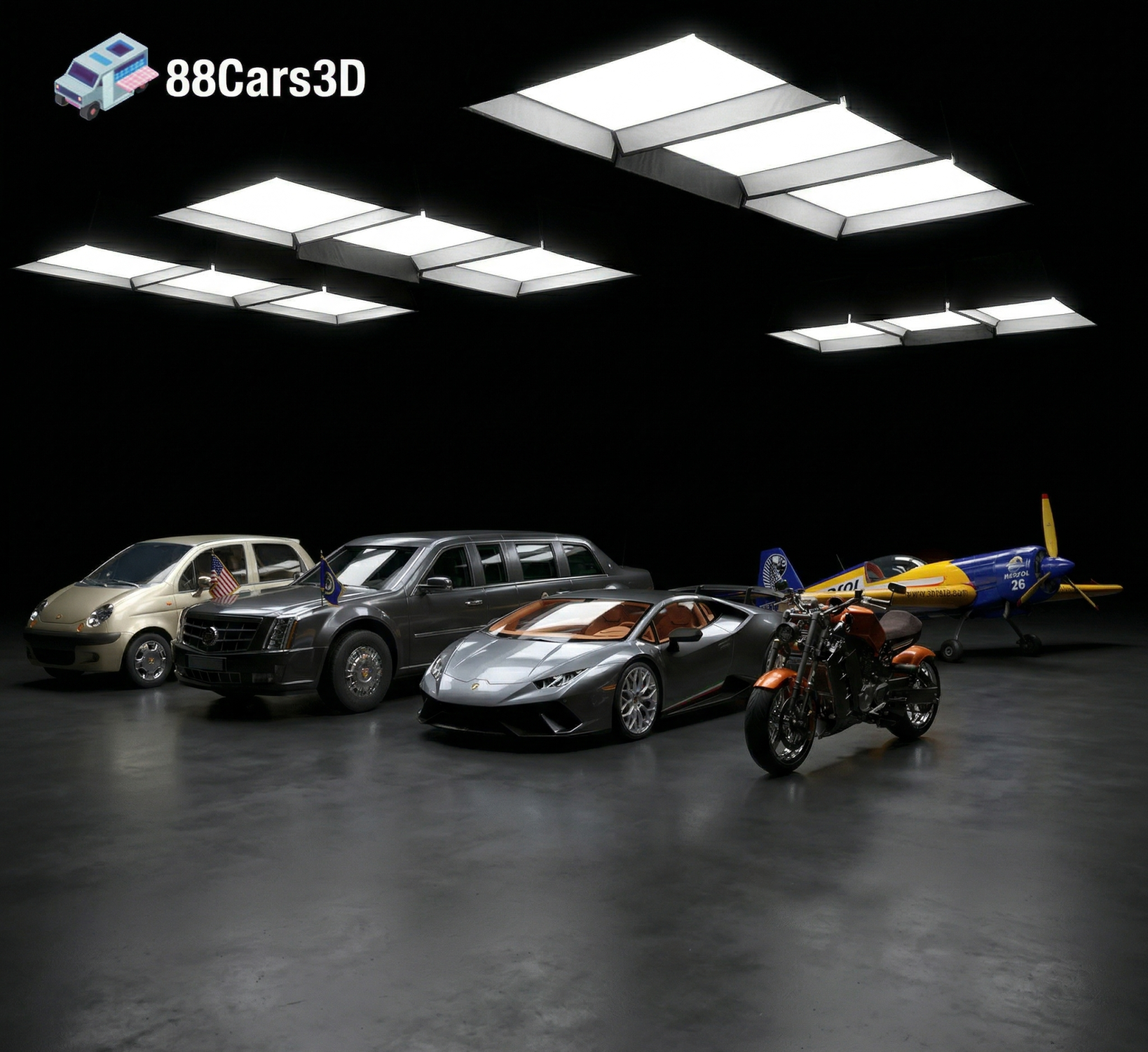
Texture: Yes | Material: Yes | 3D Printable: Yes. Download the Ultimate Creators’ Showcase featuring 5 premium 3D models: Lamborghini Huracan, ZAV Concept Motorcycle, Sukhoi SU-26, Presidential Limousine, and Daewoo Damas. Optimized for 4K CGI rendering and 3D printing. Save massive with this exclusive multi-category bundle!
Price: $99.99
View Product

Texture: Yes | Material: Yes | 3D Printable: Yes. Download the Italian Thoroughbreds Bundle featuring 5 iconic 3D models: Lamborghini Huracán Performante, Ferrari 458 Italia, Lamborghini Urus, Diablo SV, and Maserati GT. Optimized for 4K rendering and 3D printing (STL included). Save 50% with this ultimate Italian vehicle collection.
Price: $199.99
View Product

Download the Elite Future Mobility Bundle featuring 4 highly optimized 3D models: Tesla Model S, Avatr 11, Li L9, and Zoox Robotaxi. Perfect for ArchViz, Smart City renders, and game dev. Optimized for Unreal Engine and Blender. Includes .fbx, .obj, and .max formats.
Price: $99
View Product

🚗 5 Iconic German Cars (BMW M4 G82, M5 CS, X3, 1 Series & Mercedes E-Class). ✅ Optimized for ArchViz: Ready for Corona & V-Ray. 💰 Save €71 with this limited-time collection! 🚀 Instant Download after purchase.
Price: $119
View Product

Download the Extreme Off-Road & Survival 3D Models Bundle! Includes the Brabus 800 Adventure, Dodge Ram Bigfoot, Spec Truck, and a Caravan. Save over €210 on this premium 4-in-1 off-grid vehicle pack for ArchViz and game development.
Price: $149.99
View Product

Download the Heavy Duty & Commercial Logistics 3D Models Bundle! Includes the Ford Sterling, Caterpillar CT680, Mercedes Citaro Bus, and Vito Van. Save over €130 on this massive, game-ready 4-in-1 industrial vehicle pack.
Price: $109.99
View Product

Download the Ultimate Custom Motorcycles 3D Models Bundle. Includes a Custom Chopper, Ducati 916 Café Fighter, Harley XR1200X, and BMW K100. Perfect premium props for luxury ArchViz garages. Save over €250 today!
Price: $159.99
View Product

Download the ultimate JDM Street Racing 3D Models Bundle! Includes the Nissan GT-R, Toyota Supra, Mazda RX-7, Lancer Evo IX, and Honda NSX. Save big on this highly optimized, game-ready 5-in-1 Japanese legend car pack.
Price: $129.99
View Product

Download the ultimate American Muscle & Cinematic Classics 3D Models Bundle! Includes the Dodge Charger ’68, Mustang Eleanor GT500, Camaro Z28 ’79, and a custom ’69 Mustang. Save over €240 on this game-ready, premium 4-in-1 pack.
Price: $149.99
View Product

Download the Everyday City Traffic 3D Models Bundle. Includes the VW Golf, Kia Picanto, Hyundai Tucson, Toyota Yaris, and a DHL Ford Transit Van. Save big on this 5-in-1 pack, perfectly optimized for realistic ArchViz streets and game traffic.
Price: $99.99
View Product


