Get 50% OFF All Premium 3D & STL Models!

In the vibrant world of 3D design, where realism meets imagination, the demand for meticulously crafted assets is ever-growing. From breathtaking cinematic sequences to immersive game environments and precise architectural visualizations, the quality of a 3D model can significantly elevate a project. Automotive models, in particular, present unique challenges due to their complex curves, intricate mechanical details, and the need to evoke a sense of history or modernity. This is where truly exceptional 3D car models stand apart, offering artists and developers a foundation of excellence.
Today, we’re taking a deep dive into an outstanding example of such craftsmanship: the Vespa VNB 125-B 3D Model. This digital recreation of the iconic early 1960s Italian scooter is more than just a collection of polygons; it’s a testament to detailed historical accuracy, technical precision, and versatility. Whether you’re an automotive renderer aiming for photorealism, a game developer building a retro urban scene, or an AR/VR enthusiast creating interactive experiences, understanding the journey from concept to a production-ready asset like the Vespa VNB 125-B is crucial. We’ll explore the technical specifications that make such models indispensable, the workflows they support, and how investing in high-quality assets can transform your projects.
The flexibility of a 3D asset often hinges on the file formats it supports. A truly versatile model, like the Vespa VNB 125-B 3D Model, is made available in a variety of industry-standard formats, each optimized for different purposes and software environments. Understanding these formats is paramount for any professional working with 3D content, ensuring seamless integration and optimal performance across diverse pipelines.
Let’s break down the key formats:
The .blend format is Blender’s native file type. It encapsulates an entire Blender scene, including all 3D objects, materials (with their node setups), textures, animations, rigging, lighting, cameras, physics simulations, and even custom scripts. For artists primarily working in Blender, receiving a model in .blend format means instant access to a fully editable scene, often with production-ready materials and shaders, allowing for direct tweaking and rendering without loss of data or conversion artifacts. The Vespa VNB 125-B 3D Model, provided in this format, offers Blender users an unparalleled starting point.
Autodesk’s .fbx (Filmbox) format is perhaps the most widely used interchange format in 3D production, especially in game development and animation. It’s excellent for transferring 3D models, skeletal animation, morph targets, and PBR (Physically Based Rendering) materials between different software packages like 3ds Max, Maya, Blender, Unity, and Unreal Engine. Its robust support for scene hierarchy, cameras, and lights makes it ideal for real-time pipelines where complex scenes need to be efficiently ported and maintained.
Wavefront .obj is one of the oldest and most universally compatible 3D file formats. It’s a text-based format that primarily stores mesh geometry (vertices, normals, UV coordinates, and faces) and references to external material files (.mtl). While it doesn’t support animation or advanced scene data, its simplicity and widespread adoption make it a reliable choice for transferring static meshes across virtually any 3D software. For archival purposes or when only the raw geometry is needed, .obj remains an indispensable format.
The GL Transmission Format (.glb) is a binary version of glTF, specifically designed for efficient transmission and loading of 3D scenes and models in web browsers, augmented reality (AR), and virtual reality (VR) applications. A single .glb file contains all geometry, materials, textures, and animations, making it highly portable and ideal for interactive 3D content on the web without requiring complex external dependencies. Its optimization for real-time viewing makes it perfect for displaying models like the Vespa VNB 125-B in interactive online showrooms or mobile AR experiences.
.stl (Stereolithography) is the de facto standard for 3D printing. It represents only the surface geometry of a 3D object as a collection of unconnected triangles, without color, texture, or other model attributes. For 3D printing, the mesh must be “manifold” or “watertight,” meaning it has no holes or intersecting geometry. The Vespa VNB 125-B 3D Model’s availability in .stl format means it’s ready to be converted into a physical collectible or a scale model, demonstrating its utility beyond digital screens.
The Polygon File Format (.ply), also known as the Stanford Triangle Format, is capable of storing a wide range of data, including color, transparency, texture coordinates, and data reliability information. Unlike .stl, .ply can handle more complex vertex and face properties. It’s often used in scientific applications, CAD, and for storing raw 3D scan data where precision and additional data attributes are crucial. Its use for the Vespa VNB 125-B suggests a high level of geometric integrity, suitable for detailed analysis or specific manufacturing processes.
While not a direct file extension like .fbx or .obj, “.unreal” typically signifies an asset that has been specifically prepared and optimized for direct import into Unreal Engine. This often means the model has appropriate scaling, collision meshes, level of detail (LODs), and PBR material setups configured to meet the engine’s requirements, ensuring optimal performance and visual fidelity within real-time environments. An asset designated “.unreal” implies a streamlined workflow for game developers.
The .max format is the native file type for Autodesk 3ds Max. Similar to .blend, it stores a complete 3ds Max scene, including geometry, materials, textures, lighting, cameras, animation, modifiers, and rendering settings. For professionals working within the 3ds Max ecosystem, having the Vespa VNB 125-B 3D Model in .max format ensures full editability and compatibility with established rendering workflows, such as those involving V-Ray or Corona Renderer.
The inclusion of the Vespa VNB 125-B 3D Model in this comprehensive suite of formats from 88cars3d.com underscores its adaptability, ensuring that regardless of your preferred software or project type, you have a high-quality asset ready to integrate.
Recreating classic vehicles in 3D demands a deep appreciation for history, meticulous attention to detail, and advanced modeling skills. The Vespa VNB 125-B 3D Model stands as a prime example of how digital artistry can faithfully revive automotive heritage, making it accessible for modern applications. This isn’t just a generic scooter; it’s a specific, revered variant, and its digital twin reflects that commitment to authenticity.
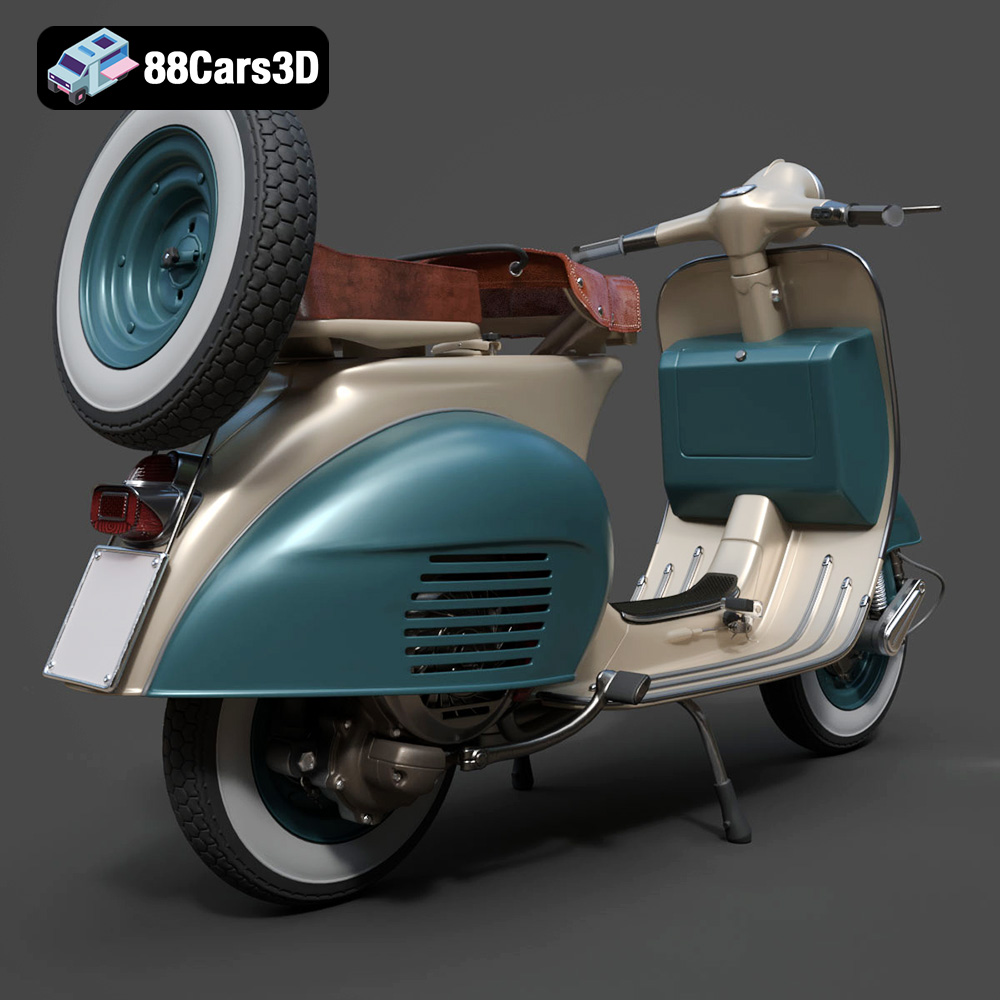
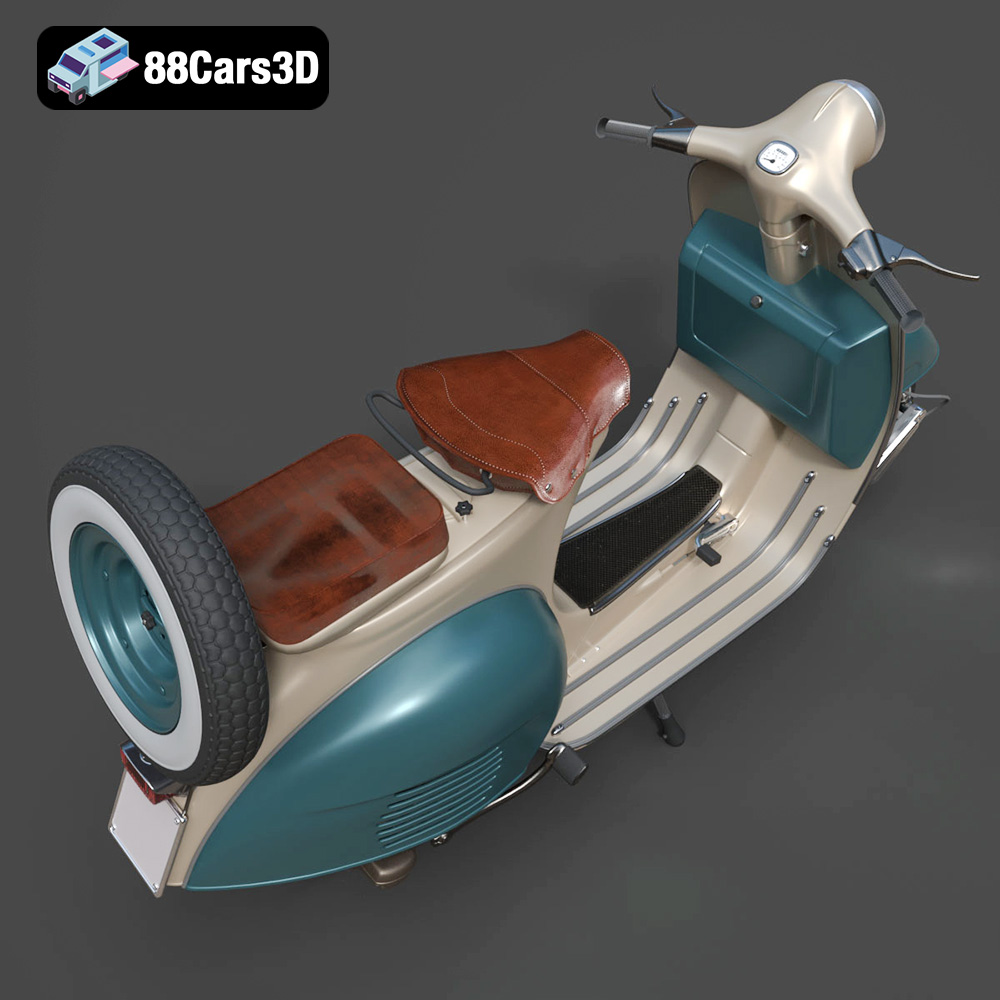
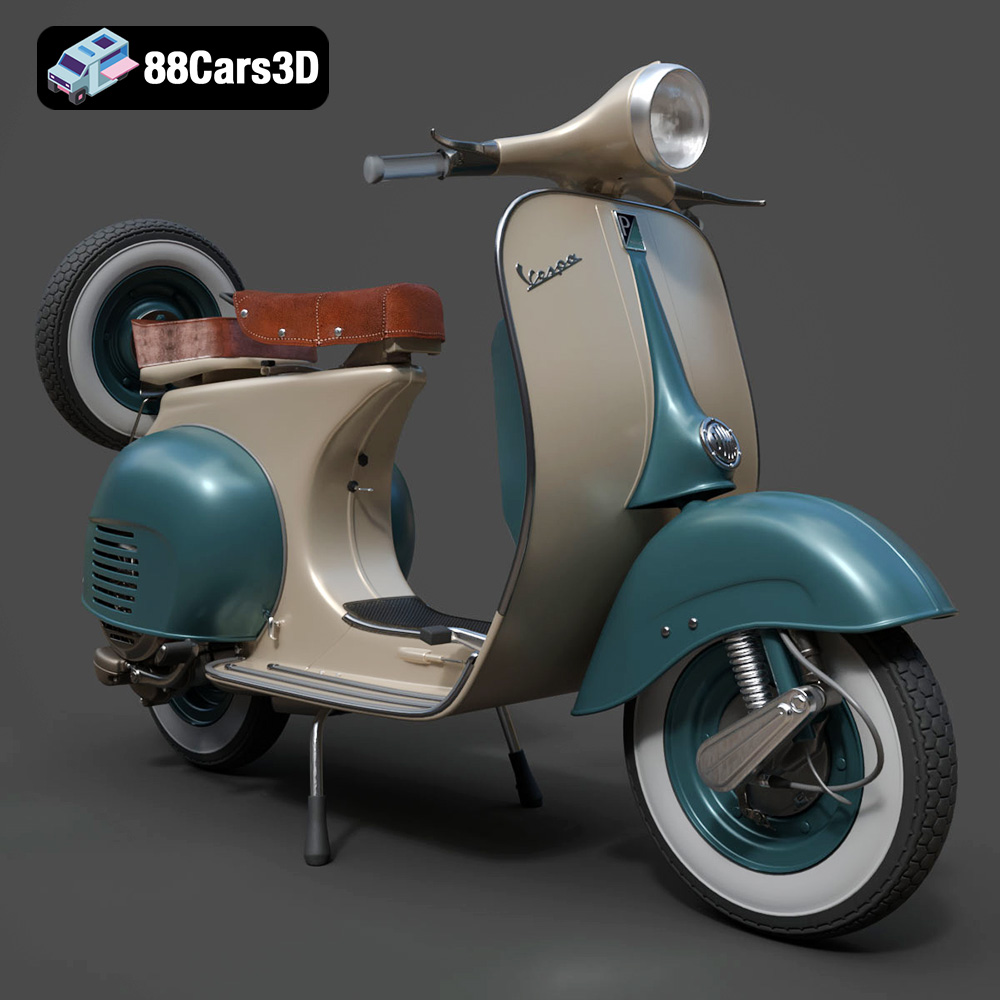
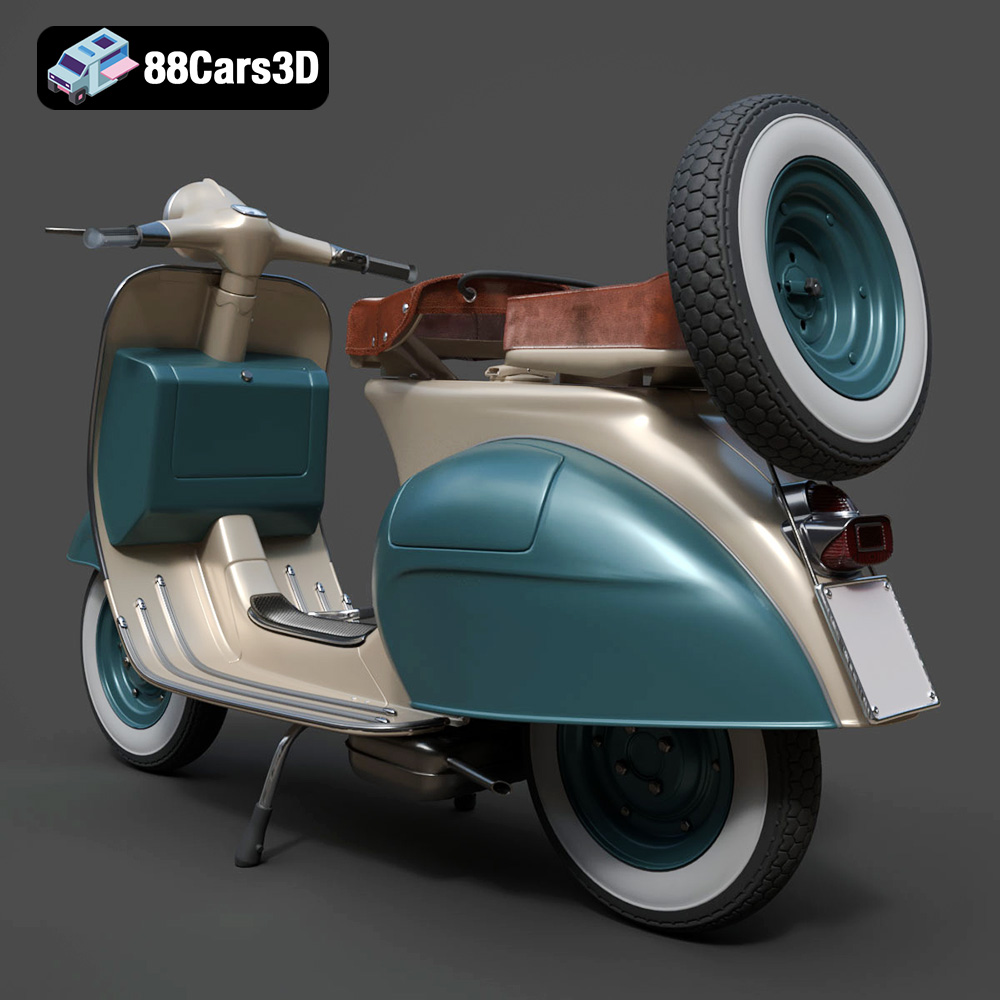
The Vespa VNB 125-B, originating from the early 1960s, is characterized by its timeless silhouette and subtle refinements. The 3D model meticulously captures these distinguishing features. Its monocoque steel body construction, a hallmark of Vespa design, is accurately represented, flowing into the rounded front leg shield and curved front fender. The chrome-trimmed circular headlamp, detailed side panel vents, and engine cover are all faithfully replicated, down to the classic rear engine placement layout and vintage exhaust. Even the handlebar assembly with its integrated speedometer, throttle, brake lever, and the ribbed footboard design are precisely modeled. These are the kinds of details that transport viewers to a specific era, making the model ideal for retro European streets, café scenes, coastal promenades, lifestyle branding, and cinematic period productions. The period-correct wheels and tire proportions further cement its historical accuracy, making it a compelling piece for any project requiring an authentic touch.
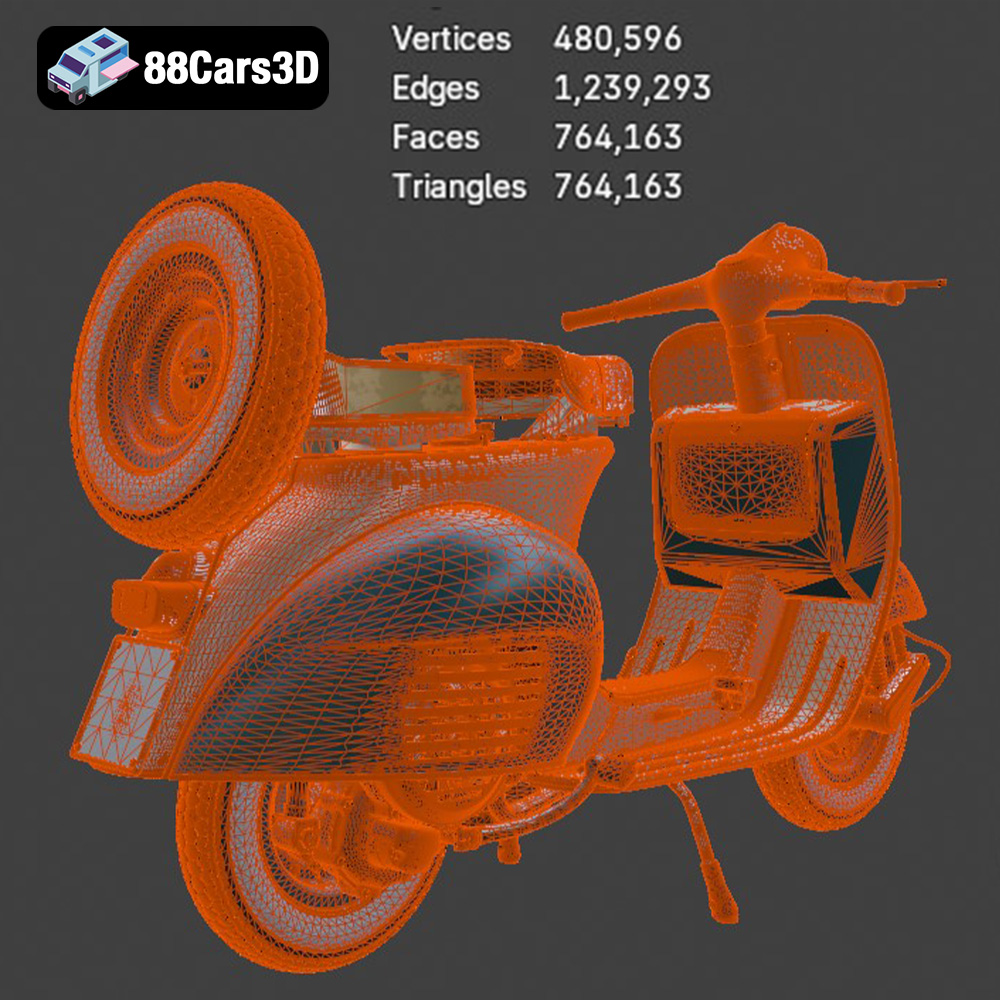
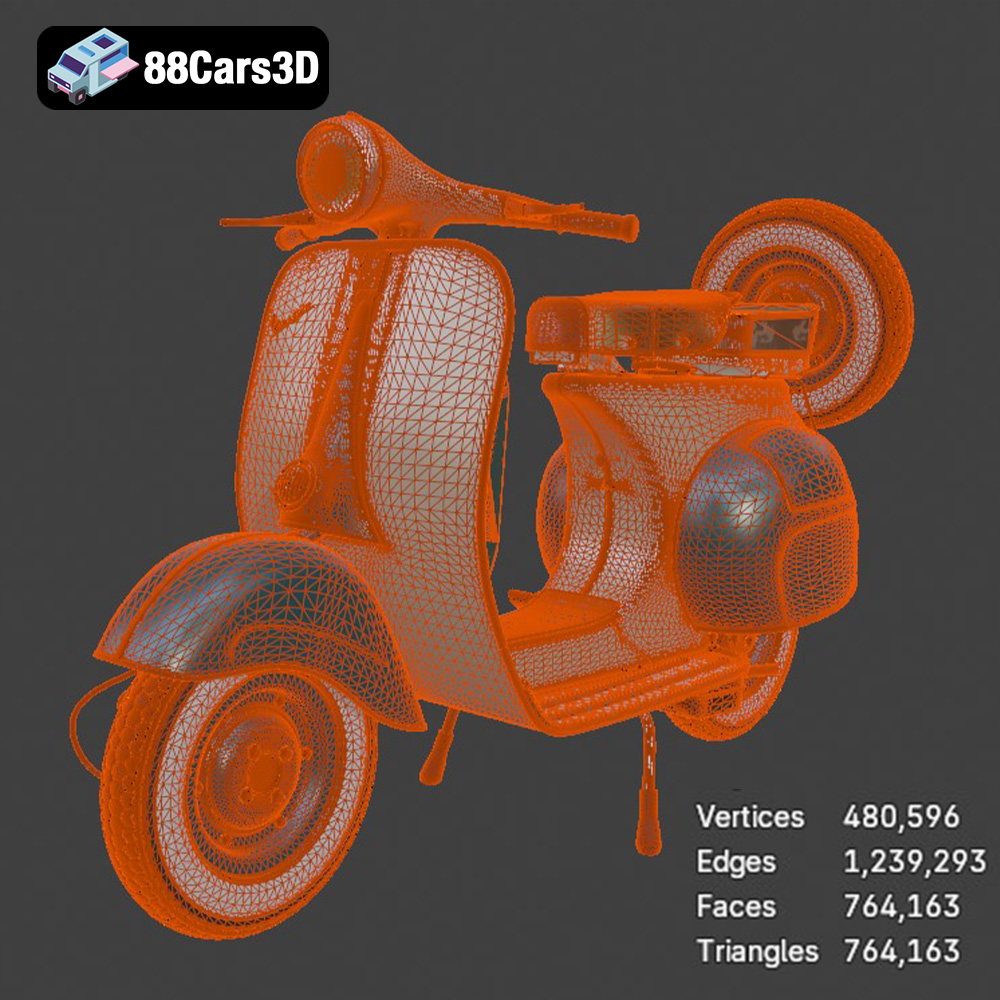
Beyond aesthetic accuracy, a professional 3D model requires exceptional technical foundation. The Vespa VNB 125-B 3D Model boasts clean and well-organized mesh structure, which is critical for smooth deformations during animation and artifact-free rendering. Real-world scale accuracy ensures that when the model is imported into any scene, it fits perfectly alongside other assets without needing adjustments. Crucially, the model features optimized polygon flow, balancing visual fidelity with performance, making it suitable for both high-end rendering and real-time game engines. The proper pivot setup for steering and wheel rotation further demonstrates its animation-readiness, allowing animators to quickly and easily bring the scooter to life without wrestling with complex rigging. This level of technical craftsmanship ensures the model is not only beautiful but also highly functional for professional use.
The value of a high-quality 3D asset lies in its seamless integration into diverse professional workflows. The Vespa VNB 125-B 3D Model from 88cars3d.com is designed to be a production-ready component, whether your focus is on creating stunning visuals or building interactive digital worlds.
For automotive rendering specialists and visualization artists, the Vespa VNB 125-B offers an exceptional base. Its clean geometry and accurate details make it perfect for photorealistic renders. In workflows utilizing software like **3ds Max** (with renderers like V-Ray or Corona) or **Blender** (with Cycles or Eevee), artists can effortlessly apply advanced PBR materials to recreate the scooter’s metallic paint, chrome accents, and leather seat textures. The model’s well-structured UVs ensure that textures map cleanly and realistically. Imagine this Vespa positioned on a cobbled Italian street scene, with sunlight glinting off its polished surfaces, casting soft shadows. The ability to customize body colors with classic pastel schemes, add vintage registration plates, or configure single/dual seat variations further enhances its utility for unique branding campaigns or historical automotive showcases. This model streamlines the process, allowing artists to focus on lighting, composition, and storytelling rather than intricate modeling corrections.
In the realm of game development, efficiency and optimization are paramount. The Vespa VNB 125-B 3D Model is explicitly optimized for real-time engines like Unreal Engine and Unity. Its clean geometry and balanced polygon count contribute to excellent frame rates, even in bustling open-world environments. The separate wheels and steering assembly, coupled with proper pivot setup, are game-changer for animators and developers, facilitating easy implementation of vehicle physics and player control. Game designers can drop this model into urban open-world games, 1960s-themed environments, or European street simulations, confident in its visual quality and performance. The “.unreal” file compatibility further suggests that the asset has been pre-configured or tested for optimal integration, potentially including pre-made collision meshes and LODs (Levels of Detail) to ensure smooth performance across various hardware specifications, from high-end PCs to consoles.
While digital visualization is a core application, the versatility of a well-crafted 3D model extends into the physical world through 3D printing. The Vespa VNB 125-B 3D Model is designed with this capability in mind, allowing enthusiasts and professionals to transform digital assets into tangible collectibles or prototypes.
The inclusion of the .stl format for the Vespa VNB 125-B 3D Model is a critical feature for anyone interested in 3D printing. The .stl file represents the model’s geometry as a series of triangles, a format universally understood by 3D slicer software. For successful printing, the model must be “manifold,” meaning it’s a solid, watertight mesh without any gaps or intersecting polygons. A well-constructed model like the Vespa ensures fewer errors during slicing. The recommended scales (1:18, 1:12, 1:10) provide flexibility for different printer capabilities and desired levels of detail for collectible scooter miniatures and scale display models. Specific print settings, such as a layer height of 0.08–0.16 mm and wall thickness of 1.2–2.0 mm, offer a starting point for achieving a high-quality print. Supports are advised for intricate parts like the handlebar, exhaust, and center stand, ensuring structural integrity during the printing process.
The journey from a digital file to a physical object doesn’t end with printing. The Vespa VNB 125-B 3D Model, once printed, opens up a world of post-processing and customization. The recommended print orientation, with the body printed upright for a smooth curved finish and wheels printed separately, helps in achieving optimal aesthetic results. Post-processing steps like sanding, priming, and painting are crucial for bringing the model to life. Imagine applying a gloss pastel or cream paint finish, accented with chrome detailing, to perfectly mimic the original VNB 125-B aesthetic. This hands-on process allows for a unique blend of digital precision and traditional craftsmanship, resulting in a personalized, high-quality physical replica that stands as a testament to both the 3D model’s fidelity and the printer’s skill.
The breadth of applications for sophisticated 3D car models like the Vespa VNB 125-B extends far beyond conventional rendering and game development. Their inherent detail and technical robustness make them indispensable tools across numerous emerging and specialized fields, proving the immense value of professional-grade assets.
Augmented Reality (AR) and Virtual Reality (VR) are transforming how we interact with digital content, and high-quality 3D car models are at the forefront of this revolution. The Vespa VNB 125-B 3D Model is perfectly suited for creating immersive retro vehicle showrooms or interactive classic scooter experiences. Imagine placing the Vespa virtually in your living room via an AR app, walking around it, and examining its intricate details from every angle. In VR, users could “sit” on the scooter, experience a virtual ride through a historical European city, or even interact with its components in a simulated garage environment. The model’s clean geometry and optimized performance, particularly when delivered in formats like .glb, ensure smooth, low-latency interactions crucial for a believable and engaging AR/VR experience. This capability extends to educational platforms, virtual museums, and innovative marketing campaigns.
Beyond entertainment, accurate 3D models play a vital role in simulation, training, and digital preservation. The Vespa VNB 125-B 3D Model can be a powerful asset for restoration visualization, allowing enthusiasts or professionals to plan and test restoration strategies digitally before touching a physical object. It can be used for mechanical demonstrations, helping students or technicians understand the internal workings and assembly of a vintage scooter. In a broader sense, such detailed models contribute to digital archiving efforts, preserving the exact form and aesthetic of historical vehicles for future generations, irrespective of the physical item’s fate. For urban planning simulations, the Vespa could populate street scenes, adding historical context and realism to traffic flow analysis or architectural impact studies. The ability to adjust lighting for daylight, sunset, or cinematic scenes further enhances its utility in varied simulation scenarios, making it a truly versatile tool for a wide array of professional applications.
From the intricate details of its classic design to its technical versatility across multiple digital platforms, the Vespa VNB 125-B 3D Model exemplifies the pinnacle of professional 3D asset creation. We’ve explored how its meticulous craftsmanship allows for stunning automotive rendering, seamless integration into demanding game development pipelines, and even the fascinating transition into the physical world through 3D printing. The availability of this model in a comprehensive suite of file formats – .blend, .fbx, .obj, .glb, .stl, .ply, .unreal, and .max – underscores its adaptability and readiness for any project, from AR/VR immersive experiences to detailed simulations and beyond.
Investing in high-quality 3D car models like the Vespa VNB 125-B is not merely about acquiring a digital object; it’s about leveraging a foundation of precision, efficiency, and artistic integrity that accelerates your creative workflow and elevates the final output. For artists, developers, and designers seeking assets that truly stand out, resources like 88cars3d.com provide a curated selection of meticulously crafted 3D models that meet the highest industry standards. Whether you’re aiming to evoke nostalgia, build an engaging game world, or bring a piece of history to life, the right 3D model makes all the difference.
The Vespa VNB 125-B 3D Model is a high-detail digital recreation of the classic Italian scooter variant from the early 1960s. The VNB 125-B maintained the timeless Vespa silhouette while incorporating subtle production refinements, improved mechanical components, and refined detailing that defined the era of practical European urban mobility. This 3D model accurately captures the monocoque steel body construction, rounded front leg shield, chrome-trimmed circular headlamp, vented side panels, exposed handlebar assembly, and vintage wheel configuration. Built with clean topology and real-world scale accuracy, it is ideal for rendering, animation, simulation, game development, and AR/VR classic vehicle environments. Includes .blend, .fbx, .obj, .glb, .stl, .ply, .unreal, and .max formats for rendering, simulation, AR/VR, game development, and 3D printing.
$19.9
.arvr
.blend
.classicscooter
.fbx
.gameasset
.glb
.italianscooter
.max
.motorcycle3dmodel
.obj
.ply
.rendering
.retro
.simulation
.stl
.twowheeler
.unreal
.urbanvehicle
.vespa
.vintagevehicle
.vnb125b