Get 50% OFF All Premium 3D & STL Models!

In the world of real-time rendering, creating immersive and believable environments is paramount. For automotive visualization, game development, and high-fidelity simulations, the ability to portray dynamic weather is not just an aesthetic choice but a critical component for conveying realism, mood, and even gameplay mechanics. Imagine showcasing a meticulously crafted 3D car model, such as those available on 88cars3d.com, not just in a static, perfect studio setting, but under the dramatic downpour of a tropical storm, the gentle kiss of snowfall, or the golden hour glow following a clearing shower. These dynamic conditions elevate the entire experience, drawing viewers deeper into the scene and enhancing the perceived quality of the automotive assets. Unreal Engine provides an incredibly powerful suite of tools to bring these complex weather systems to life, from volumetric clouds and atmospheric effects to intricate particle systems and interactive material responses. This comprehensive guide will walk you through the technical intricacies of building compelling dynamic weather in Unreal Engine, ensuring your automotive visualizations and real-time projects stand out with unparalleled realism and atmospheric depth.
We’ll delve into the foundational setup, explore advanced particle effects with Niagara, master dynamic lighting and PBR material responses, leverage Blueprint for interactive control, and optimize performance for various real-time applications, including AR/VR. By the end of this journey, you’ll possess the knowledge to transform your virtual worlds with breathtaking meteorological phenomena, giving your 3D car models the dynamic backdrops they deserve.
The bedrock of any convincing weather system in Unreal Engine lies in its core atmospheric and lighting components. Before diving into complex precipitation, it’s crucial to establish a robust and flexible environment that can naturally adapt to changing conditions. Unreal Engine’s modern rendering architecture, particularly with features like Lumen and Nanite, provides an excellent canvas for this. Setting up a project correctly from the outset ensures scalability and visual fidelity.
The interplay between the Sky Atmosphere, Volumetric Clouds, and the Directional Light is fundamental. These elements are not merely static backdrops; they are dynamic actors that respond to each other, creating a cohesive and physically plausible sky. For instance, increasing cloud density should naturally diminish direct sunlight, diffuse the ambient light, and alter the overall color temperature of the scene. Understanding these dependencies is key to crafting truly dynamic weather patterns that enhance the realism of your scene, whether it’s for showcasing 88cars3d.com‘s highly detailed 3D car models or building an immersive game world.
Starting a new Unreal Engine project for dynamic weather typically benefits from the “Games” or “Film, Television, and Live Events” templates, as they often include pre-configured settings conducive to high-fidelity rendering. Once your project is open, the first step is to ensure that key rendering features like Lumen Global Illumination and Reflections, alongside Nanite Virtualized Geometry, are enabled in your Project Settings under “Engine > Rendering.” While Nanite might not directly apply to a 3D car model (due to deformation needs), it’s invaluable for handling high-detail environmental assets like trees, rocks, and buildings that will be affected by your weather system without significant performance overhead.
Next, populate your scene with the essential atmospheric actors. Begin by adding a Sky Atmosphere actor. This computationally simulates the Earth’s atmosphere, handling Rayleigh and Mie scattering, which are responsible for the sky’s color and the appearance of haze. Then, add a Directional Light, which will represent the sun. Crucially, ensure that “Atmosphere Sun Light” is enabled on your Directional Light. For realistic cloud coverage, introduce a Volumetric Clouds actor. Link these components together in their respective details panels (e.g., specifying the Directional Light as the “Sun Light” source in the Sky Atmosphere settings). Finally, an Exponential Height Fog actor can greatly enhance depth and mood, allowing for misty conditions or ground-level atmospheric scattering that interacts with the overall sky.
Once the core actors are in place, the real power of dynamic weather comes from manipulating their parameters over time. The Sky Atmosphere provides controls for values like “Rayleigh Scattering Scale” and “Mie Scattering Scale” which affect the blue tint of the sky and the appearance of haze or dust, respectively. Adjusting “Multi Scattering Contribution” can make the sky appear brighter or darker. The Volumetric Clouds actor is incredibly versatile, allowing you to control cloud density, coverage, height, and even animate their movement using material parameters like UV offsets or noise textures. A common technique involves creating a cloud material with multiple layers of noise textures that pan and rotate, feeding into the Volumetric Cloud actor’s “Layer Bottom” and “Layer Top” values.
For a basic day/night cycle, you can drive the Directional Light’s rotation (particularly its pitch) via Blueprint or Sequencer. As the sun dips below the horizon, the Sky Atmosphere will naturally transition from bright blue to warm oranges and reds, then to deep blues and purples. Simultaneously, the Volumetric Clouds will dynamically light up from below, showcasing stunning crepuscular rays and dramatic silhouettes. For weather changes, you would primarily manipulate the Volumetric Clouds’ material parameters (e.g., increasing density for overcast conditions) and potentially the Exponential Height Fog’s density and color. Remember to reference the official Unreal Engine documentation at https://dev.epicgames.com/community/unreal-engine/learning for in-depth explanations of these atmospheric systems.
While a dynamic sky sets the stage, precipitation truly defines many weather systems. Rain, snow, and even dust storms are critical for transforming a scene’s visual and auditory mood. Unreal Engine’s Niagara particle system is the tool of choice for creating these complex and visually rich effects, offering unparalleled flexibility and performance for real-time applications.
A successful precipitation system goes beyond just falling particles; it encompasses the interaction with surfaces, the accumulation of moisture, and the subtle visual cues that sell the effect. When showcasing high-quality assets like 3D car models from 88cars3d.com, these nuanced details become even more important, as they directly impact how the vehicle integrates into the dynamic environment. A car’s surface realistically accumulating raindrops or snowflakes significantly enhances its presence and believability within the scene.
Creating a Niagara system for rain or snow begins by defining emitters that generate particles within a specified volume. For rain, you’d typically use a “Box Location” or “Cylinder Location” module to emit particles from above the scene. Key modules to configure include:
To simulate rain streaks on camera or glass surfaces (like a car windshield), you can employ a separate Niagara system that uses camera-aligned sprites or even a post-process material that blends a rain streak normal map over the screen. For snow, consider adding modules for “Curl Noise Force” to create a more natural, swirling descent, rather than just straight fall.
When creating the particle material, consider using a translucent blend mode. For rain, a slightly refractive material with a subtle normal map can add realism, making individual drops appear to distort the view behind them. For snow, a simple unlit, translucent material with a soft, circular texture often suffices, allowing it to glow subtly if lit from behind.
Beyond falling particles, the true realism of precipitation emerges from its interaction with surfaces. This requires a combination of Niagara, Blueprint, and advanced material setups.
The quality of your 3D car models from platforms like 88cars3d.com, with their clean topology and realistic PBR materials, will significantly benefit from these advanced interactions. Imagine the glint of light on a wet car body, or the subtle reflections in the water accumulating on its hood – these details bring the scene to life.
Weather isn’t just about what falls from the sky; it profoundly influences how light behaves and how materials appear. A sunny scene gives way to diffuse, cool light during an overcast day, and materials that were once matte become reflective and saturated when wet. Mastering these lighting and shading changes is paramount for achieving true weather realism in Unreal Engine, ensuring that your 3D car models react convincingly to the environment.
Unreal Engine’s rendering features, particularly Lumen for global illumination and reflections, combined with a robust PBR material pipeline, are essential for simulating these complex interactions. The way light scatters through clouds, reflects off wet surfaces, or diffuses through fog adds layers of depth and mood that elevate an ordinary scene into a truly immersive experience. Without these considerations, even the most detailed precipitation effects can fall flat.
Lumen is Unreal Engine’s default Global Illumination and Reflections system for real-time rendering. It is incredibly powerful for dynamic environments because it accurately calculates how light bounces around a scene, updating in real-time as lighting conditions change. This is critical for weather effects:
To optimize Lumen for dynamic weather, ensure your scenes have enough reflective and emissive surfaces to contribute to the global illumination. While Lumen is performant, heavy reliance on very opaque volumetric effects can sometimes impact performance. Adjusting “Lumen Scene Lighting Quality” and “Reflection Quality” in Project Settings can help balance fidelity with frame rate. Always ensure your directional light has “Cast Shadow” and “Cast Ray Traced Shadows” enabled for accurate shadow interactions with Lumen.
Physically Based Rendering (PBR) is the cornerstone of realistic material appearance in Unreal Engine. PBR materials ensure that surfaces react to light in a physically plausible manner, regardless of lighting conditions. For dynamic weather, this means creating “wetness shaders” that seamlessly blend into your existing PBR materials.
A typical wetness shader involves a Material Function that can be incorporated into any Master Material. This function usually takes a “Wetness Amount” parameter (a scalar from 0 to 1) and blends several key PBR parameters:
For more advanced puddles, you can combine this with a “World Position Z” or height map check to only apply wetness and displacement to lower areas of the mesh. This creates the illusion of water pooling naturally. When working with 3D car models, applying a dedicated wetness shader to the car paint, glass, and tire materials will dramatically enhance the realism of a rainy scene. The high-quality PBR textures on models from 88cars3d.com are perfectly suited for these advanced material blending techniques, allowing for seamless transitions between dry and wet states.
While visual effects create the weather, Blueprint Visual Scripting in Unreal Engine is what brings it to life and makes it dynamic and interactive. Blueprint allows developers to orchestrate complex transitions between different weather states, respond to user input, and even tie weather conditions to gameplay mechanics or cinematic sequences. This level of control is essential for creating truly immersive experiences, especially in automotive configurators or interactive architectural visualizations where users expect to manipulate their environment.
The true power of Blueprint lies in its ability to interpolate between various parameters of your atmospheric, lighting, and particle systems. Instead of abrupt changes, you can script smooth, believable transitions from a clear sky to a torrential downpour, or from a misty morning to a crisp, sunny afternoon. This dynamic control ensures that your highly detailed 3D car models from 88cars3d.com are always showcased in a living, breathing environment.
A common and effective approach to managing dynamic weather is to implement a state machine in Blueprint. This involves defining distinct “weather states” (e.g., Clear, Cloudy, Light Rain, Heavy Rain, Snow) and then scripting the transitions between these states. Each state would have a set of target parameters for various actors:
When transitioning from one state to another (e.g., “Clear” to “Light Rain”), your Blueprint script would interpolate these parameters over a specified duration (e.g., 30 seconds). A “Timeline” node in Blueprint is ideal for smoothly animating these values. For instance, you would drive the “Wetness Amount” from 0 to 0.5, increase the cloud density, and gradually activate the rain Niagara system’s spawn rate. Events can trigger these transitions—either a time-of-day system, a random probability, or direct user input.
Blueprint also allows for custom events that can be called from different parts of your project, creating a centralized weather manager. This manager would handle all the logic for updating weather effects, ensuring consistency across your entire scene. For more information on implementing Blueprint logic, refer to the official Unreal Engine documentation on https://dev.epicgames.com/community/unreal-engine/learning.
The ability for users to interact with and change the weather in real-time adds immense value, particularly for automotive visualization and configurator applications. Imagine a potential car buyer being able to cycle through different weather conditions to see how their chosen vehicle paint finish or material scheme looks under various lighting scenarios.
Blueprint can facilitate this by exposing weather state changes to a UI widget. For example, a simple button click could call a custom event in your weather manager Blueprint, triggering a transition to a “Snowy” state. You could even implement sliders to control individual parameters, such as “Rain Intensity” or “Cloud Coverage,” allowing for fine-grained customization. This level of dynamic control not only enhances immersion but also serves a practical purpose in product showcasing.
Beyond direct control, Blueprint can also be used to create more subtle interactions. For example, if a player drives a car into a heavy rain shower, Blueprint could trigger the car’s windshield wipers to activate automatically, enhancing the simulation’s realism. It could also dynamically adjust tire grip physics based on wet ground conditions, adding another layer of depth to the driving experience. This integration of weather logic with vehicle dynamics creates a truly holistic and believable virtual environment for any high-fidelity 3D car model.
Creating stunning dynamic weather systems often comes with a significant computational cost. Volumetric effects, numerous particle systems, complex lighting, and advanced material shaders can quickly strain performance, especially when targeting real-time applications like games, AR/VR experiences, or virtual production. Therefore, thoughtful optimization is not an afterthought but an integral part of the development process. Balancing visual fidelity with a smooth frame rate is crucial for delivering a high-quality user experience, particularly when showcasing intricate assets like high-polygon 3D car models.
Unreal Engine offers a variety of tools and strategies to manage performance, from Level of Detail (LODs) and culling techniques to scalable rendering features like Nanite and specific optimization tips for volumetric effects. Understanding where performance bottlenecks occur and how to mitigate them is essential for any real-time artist or developer.
Effective performance optimization for weather systems relies heavily on intelligent management of visual complexity:
Nanite Virtualized Geometry plays a crucial role in managing the complexity of environments impacted by weather. While not typically used for deformable meshes like vehicles (as mentioned, models from 88cars3d.com are usually high-quality traditional meshes optimized for deformation), Nanite excels at rendering vast, highly detailed static elements. This means you can have a hyper-realistic forest or a complex urban scene with billions of polygons, all reacting to your weather system with wetness and snow accumulation, without the massive performance hit of traditional rendering. This leaves more performance budget for the dynamic weather effects themselves.
For Virtual Production (VP) and LED Wall Workflows, performance is even more critical due to the extremely high resolutions and frame rates required. Dynamic weather in VP demands careful optimization:
Once you’ve mastered the fundamentals of dynamic weather, Unreal Engine’s capabilities allow you to push the boundaries further, creating truly unique meteorological phenomena and orchestrating them into stunning cinematic sequences. Beyond basic rain and snow, the engine can simulate wind, lightning, and even specific atmospheric conditions, adding layers of immersion and narrative depth to your projects. This level of advanced detail is particularly impactful when showcasing the exquisite craftsmanship of 3D car models, providing a dramatic backdrop for their photorealistic rendering.
Whether you’re crafting an automotive commercial, a game cutscene, or a high-fidelity visualization, integrating these advanced weather elements with Unreal Engine’s Sequencer tool can elevate your content from a simple demonstration to a captivating visual story. The synchronization of environmental changes with camera movements, vehicle animations, and sound design creates a cohesive and believable experience.
Adding wind to your weather system breathes life into the environment:
Blueprint can orchestrate the timing and randomness of these lightning strikes, ensuring they appear natural and impactful.
Unreal Engine’s Sequencer is a powerful, non-linear editor for creating cinematic sequences, animations, and interactive cutscenes. It is the perfect tool for orchestrating complex weather transitions and integrating them seamlessly into your narrative or promotional content. For high-end automotive visualization, Sequencer allows you to direct every aspect of a scene, including its weather.
Here’s how to leverage Sequencer for cinematic weather:
Sequencer provides intuitive curves (F-curves) for fine-tuning the interpolation between these keyframes, allowing for smooth, organic transitions.
By using Sequencer, you gain precise control over the emotional impact of your weather, making it an integral part of your storytelling. This is particularly valuable for showcasing 88cars3d.com‘s highly detailed 3D car models in compelling, narrative-driven scenarios, elevating them beyond simple renders.
Dynamic weather systems in Unreal Engine are a powerful tool for transforming static scenes into living, breathing worlds. From the subtle nuances of a misty morning to the dramatic intensity of a thunderous downpour, the ability to control and animate environmental conditions adds unparalleled depth, mood, and realism to any real-time project. For automotive visualization, game development, and architectural renders, this level of environmental fidelity directly enhances the perceived quality and immersion of your 3D car models and other assets.
We’ve journeyed through the foundational elements of atmospheric setup, delved into the intricacies of creating realistic precipitation with Niagara, mastered the art of dynamic lighting with Lumen, and harnessed the power of PBR materials for believable wetness. We then explored how Blueprint scripting enables interactive control and sophisticated state transitions, and how meticulous optimization strategies are essential for maintaining performance across various platforms, including demanding AR/VR applications. Finally, we looked at how advanced phenomena and cinematic orchestration with Sequencer can elevate your projects to a professional, storytelling level.
The journey to mastering dynamic weather is one of continuous experimentation and technical refinement. By embracing Unreal Engine’s comprehensive toolset and leveraging high-quality assets like the meticulously crafted 3D car models found on 88cars3d.com, you can create truly unforgettable visual experiences. Continue to explore, innovate, and refer to the official Unreal Engine documentation at https://dev.epicgames.com/community/unreal-engine/learning to deepen your understanding. The next time you embark on a new project, remember the profound impact that a perfectly simulated storm or a golden hour glow can have on your audience, bringing your virtual worlds to life in astonishing detail.
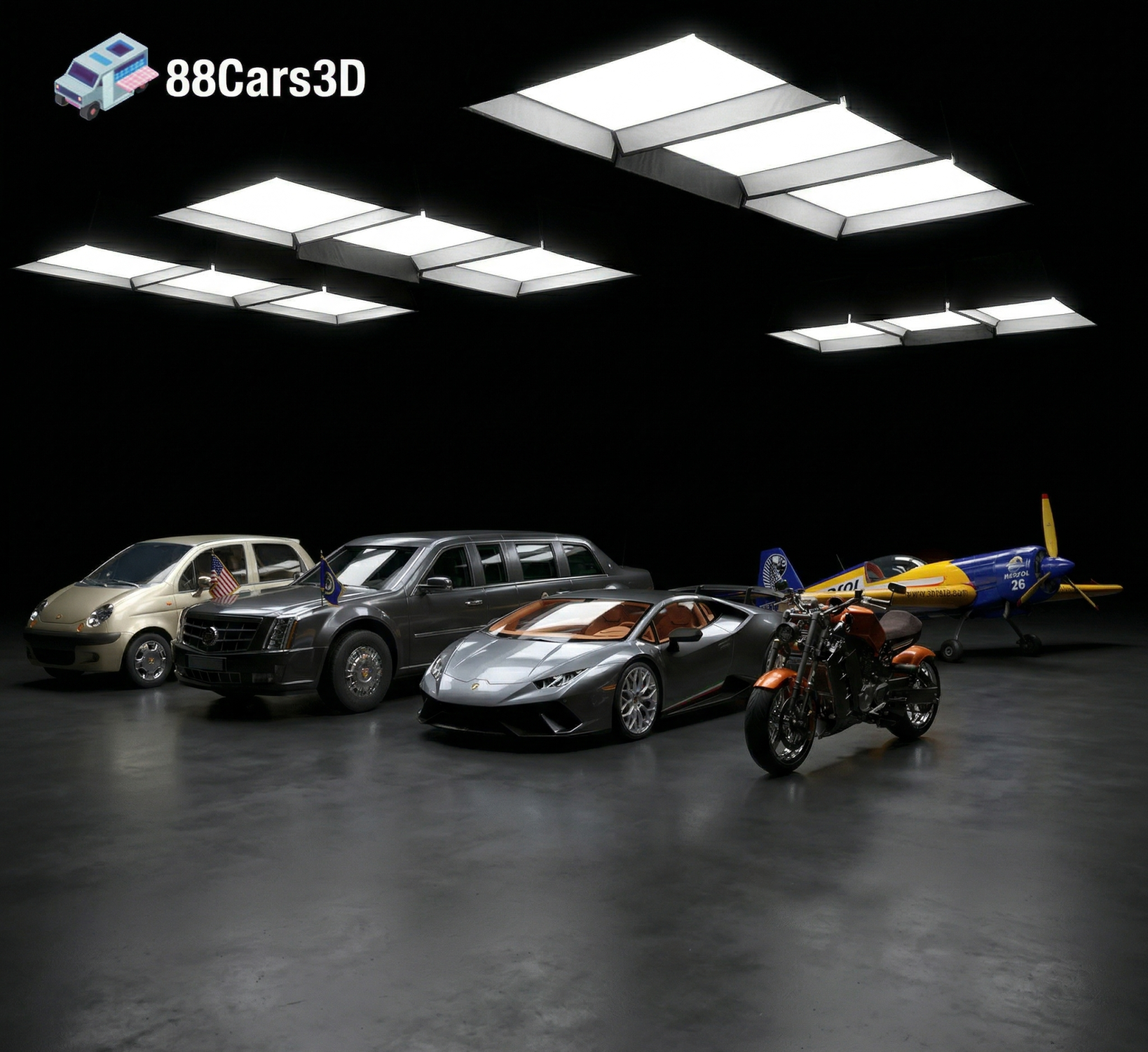
Texture: Yes | Material: Yes | 3D Printable: Yes. Download the Ultimate Creators’ Showcase featuring 5 premium 3D models: Lamborghini Huracan, ZAV Concept Motorcycle, Sukhoi SU-26, Presidential Limousine, and Daewoo Damas. Optimized for 4K CGI rendering and 3D printing. Save massive with this exclusive multi-category bundle!
Price: $99.99

Texture: Yes | Material: Yes | 3D Printable: Yes. Download the Italian Thoroughbreds Bundle featuring 5 iconic 3D models: Lamborghini Huracán Performante, Ferrari 458 Italia, Lamborghini Urus, Diablo SV, and Maserati GT. Optimized for 4K rendering and 3D printing (STL included). Save 50% with this ultimate Italian vehicle collection.
Price: $199.99

Download the Elite Future Mobility Bundle featuring 4 highly optimized 3D models: Tesla Model S, Avatr 11, Li L9, and Zoox Robotaxi. Perfect for ArchViz, Smart City renders, and game dev. Optimized for Unreal Engine and Blender. Includes .fbx, .obj, and .max formats.
Price: $99

🚗 5 Iconic German Cars (BMW M4 G82, M5 CS, X3, 1 Series & Mercedes E-Class). ✅ Optimized for ArchViz: Ready for Corona & V-Ray. 💰 Save €71 with this limited-time collection! 🚀 Instant Download after purchase.
Price: $119

Download the Extreme Off-Road & Survival 3D Models Bundle! Includes the Brabus 800 Adventure, Dodge Ram Bigfoot, Spec Truck, and a Caravan. Save over €210 on this premium 4-in-1 off-grid vehicle pack for ArchViz and game development.
Price: $149.99

Download the Heavy Duty & Commercial Logistics 3D Models Bundle! Includes the Ford Sterling, Caterpillar CT680, Mercedes Citaro Bus, and Vito Van. Save over €130 on this massive, game-ready 4-in-1 industrial vehicle pack.
Price: $109.99

Download the Ultimate Custom Motorcycles 3D Models Bundle. Includes a Custom Chopper, Ducati 916 Café Fighter, Harley XR1200X, and BMW K100. Perfect premium props for luxury ArchViz garages. Save over €250 today!
Price: $159.99

Download the ultimate JDM Street Racing 3D Models Bundle! Includes the Nissan GT-R, Toyota Supra, Mazda RX-7, Lancer Evo IX, and Honda NSX. Save big on this highly optimized, game-ready 5-in-1 Japanese legend car pack.
Price: $129.99

Download the ultimate American Muscle & Cinematic Classics 3D Models Bundle! Includes the Dodge Charger ’68, Mustang Eleanor GT500, Camaro Z28 ’79, and a custom ’69 Mustang. Save over €240 on this game-ready, premium 4-in-1 pack.
Price: $149.99

Download the Everyday City Traffic 3D Models Bundle. Includes the VW Golf, Kia Picanto, Hyundai Tucson, Toyota Yaris, and a DHL Ford Transit Van. Save big on this 5-in-1 pack, perfectly optimized for realistic ArchViz streets and game traffic.
Price: $99.99

