Get 50% OFF All Premium 3D & STL Models!

In the demanding world of real-time rendering and interactive experiences, performance is paramount. For professionals working with Unreal Engine, especially in the realm of automotive visualization and game development, balancing breathtaking visual fidelity with smooth, responsive frame rates is an ongoing challenge. High-quality 3D car models, while essential for realism, often come with significant polygon counts and complex material setups, making optimization a critical skill.
This comprehensive guide dives deep into advanced strategies for optimizing your Unreal Engine projects, specifically focusing on integrating and showcasing detailed automotive assets. We’ll explore everything from initial project setup and efficient asset importation to leveraging cutting-edge Unreal Engine features like Nanite and Lumen, crafting intelligent materials, and implementing performance-driven interactivity. Whether you’re building a photorealistic car configurator, a high-fidelity racing game, or a virtual production scene, mastering these techniques will empower you to deliver stunning visuals without compromising on performance. Prepare to unlock the full potential of your real-time rendering projects and transform your automotive visions into optimized, immersive realities.
The journey to an optimized Unreal Engine project begins long before you import your first 3D car model. Strategic project setup and meticulous asset preparation lay the groundwork for efficient real-time rendering, preventing bottlenecks down the line. A well-configured project provides the right environment, while thoughtfully prepared assets ensure minimal processing overhead when integrated.
When starting a new project, especially one focused on automotive visualization, selecting the correct template and configuring initial settings can significantly impact performance. For instance, the "Automotive" or "Archviz" templates often come pre-configured with relevant post-processing volumes and lighting setups that serve as excellent starting points. Understanding and adjusting scalability settings early on allows you to target your desired performance profile across different hardware specifications. This involves configuring global shader quality, shadow resolutions, and anti-aliasing methods, which directly influence rendering costs.
Furthermore, establishing a robust naming convention and folder structure is crucial for maintaining organization, especially when dealing with hundreds of textures, materials, and static meshes associated with complex 3D car models. A cluttered content browser can lead to duplicated assets and wasted time, both of which indirectly impact project efficiency and overall performance. Adhering to standards like "SM_" for static meshes, "T_" for textures, and "M_" for materials simplifies asset management and makes collaborative development smoother.
Before importing any assets, fine-tuning your Unreal Engine project settings is key. Navigate to Edit > Project Settings and focus on rendering-specific options. Disabling unnecessary plugins can free up resources; for example, if you’re not using VR, disable the associated plugins. Under the Rendering section, consider adjusting default settings for features like Global Illumination (if not using Lumen exclusively), Reflections, and Shadows. For high-end automotive visualization, you might increase the default view distance and shadow quality, but always with an eye on the performance impact. Enabling ray tracing early, if your target hardware supports it and your project requires it, ensures that your asset pipeline is aligned with its requirements from the start. Remember to explore the official Unreal Engine documentation for in-depth details on specific settings and their impact: dev.epicgames.com/community/unreal-engine/learning.
The quality of your source 3D car models is paramount. When sourcing assets from marketplaces such as 88cars3d.com, you can expect professionally modeled assets with clean topology, proper UV mapping, and PBR-ready materials. However, even the best assets can benefit from pre-processing before importing into Unreal Engine. Ensure your models are exported in a compatible format like FBX or USD, ideally with embedded media and correct unit scaling. Before importing, check the mesh for non-manifold geometry, overlapping faces, or excessive edge loops that don’t contribute to visual fidelity. Decimation tools in your 3D software can reduce polygon counts for less critical parts without losing too much detail. For parts that *do* require high fidelity, ensuring proper smoothing groups or normals is vital for flawless shading in Unreal Engine. During the import process, pay close attention to options like "Combine Meshes," "Generate Missing Collision," and "Convert Scene Unit." For very detailed models, consider splitting them into logical components (e.g., body, wheels, interior) to allow for more granular optimization and LOD control within Unreal Engine.
Materials and textures are the soul of visual realism in Unreal Engine, especially for showcasing the intricate details and luxurious finishes of 3D car models. However, they are also significant performance hogs if not managed efficiently. Crafting optimized Physically Based Rendering (PBR) materials means finding the perfect balance between photorealism and rendering cost. This involves understanding how texture resolutions, material complexity, and shader instructions contribute to GPU load.
For automotive assets, materials like painted metal, chrome, glass, and leather require specific PBR setups. Each of these typically involves multiple textures (Albedo, Normal, Roughness, Metallic, Ambient Occlusion) and complex shader logic to achieve realistic reflections, refractions, and surface properties. The goal is to maximize visual impact while minimizing draw calls and shader complexity. This often translates into intelligent texture packing, where multiple grayscale textures (like Roughness, Metallic, and AO) are combined into different channels of a single RGB texture, reducing texture lookups and memory footprint.
Beyond texture packing, understanding the different material blending modes (Opaque, Masked, Translucent) and their performance implications is crucial. Transparent materials, such as car glass, are notoriously expensive to render due due to overdraw and sorting issues. Optimizing them often involves using masked materials where possible or simplifying translucency passes. Additionally, leveraging material instances is a powerful technique for efficiency. Instead of creating a new material for every slight variation (e.g., different paint colors), a master material can be created, and instances can be generated to adjust parameters without recompiling the shader, leading to faster iteration and reduced memory.
Creating efficient PBR materials for 3D car models starts with the Material Editor. A "Master Car Paint" material, for example, can encapsulate common properties like metallic sheen, clear coat, and flake effects. Input parameters for color, metallic value, roughness, and normal maps can then be exposed, allowing for countless variations through Material Instances. For car paint, consider using a layered material approach. A base metal layer provides the metallic properties, followed by a clear coat layer with its own normal map (for orange peel effect) and roughness. Fresnel effects are critical for realistic reflections at glancing angles. Avoid excessive math operations within the material graph; pre-calculating values or using texture lookups when possible can save precious shader instructions. Employing a "Masked" blend mode for emblems or decals where transparency is binary is more performant than a "Translucent" blend mode. Always use the "Shader Complexity" view mode (Alt+8) to visualize and reduce the rendering cost of your materials. Green is good, red is bad.
Texture memory can quickly become a performance bottleneck. For high-detail areas of 3D car models, such as the body paint or interior dashboard, 4K (4096×4096) or even 8K textures might be justified. However, for less critical elements or those viewed from a distance, 2K or 1K textures are often sufficient. It’s about smart allocation. Utilize Unreal Engine’s texture compression settings (e.g., DXT1, DXT5, BC7) to find the best balance between quality and file size. Packing textures (e.g., using the Red channel for Metallic, Green for Roughness, Blue for Ambient Occlusion) into a single RGB texture reduces the number of texture samples and memory footprint. This is a standard practice for most game assets and real-time rendering projects. Ensure your UV maps are non-overlapping to prevent texture bleeding and allow for optimal lightmap generation. For parts like tire treads or interiors, consider using tiling textures with unique decal overlays to add variation without needing massive, unique texture sets. Always preview your textures in-engine to ensure they look as intended after compression and scaling.
Handling extremely high-polygon 3D car models has historically been one of the biggest challenges in real-time rendering. Traditional methods often involved painstaking manual decimation and Level of Detail (LOD) generation, a process that consumed significant artist time and could compromise visual fidelity. Unreal Engine 5’s Nanite virtualized geometry system has fundamentally changed this paradigm, allowing artists to import film-quality assets directly into the engine with minimal performance overhead. Combined with intelligent LOD management for non-Nanite assets, this approach ensures visual richness across your entire scene.
Nanite effectively removes polygon count as a primary optimization concern for static meshes. It intelligently streams and processes only the necessary mesh data at pixel-level detail, meaning distant objects require far less geometry than close-up ones. This makes it ideal for highly detailed car bodies, interiors, and engine components, allowing artists to maintain sculpted details without aggressive poly reduction. However, not all meshes are suitable for Nanite; animated meshes, translucent materials, and specific mesh types like foliage still require traditional optimization techniques. Understanding when and where to apply Nanite is key to maximizing its benefits.
For assets not compatible with Nanite, or for ensuring optimal performance on lower-end hardware or specific platforms like AR/VR, traditional Level of Detail (LOD) management remains crucial. LODs are simplified versions of a mesh that are swapped in based on the object’s distance from the camera. Properly configured LODs can significantly reduce vertex and triangle counts, leading to substantial performance gains without noticeable visual degradation when implemented correctly. Unreal Engine provides powerful tools for automatic LOD generation, but manual refinement often yields the best results, particularly for intricate 3D car models where silhouette and key features must be preserved.
Nanite is a game-changer for automotive visualization in Unreal Engine 5. To enable Nanite for your imported 3D car models, simply select the static mesh in the Content Browser, right-click, and choose "Nanite > Enable Nanite." For best results, import meshes that are already dense and highly detailed (e.g., millions of polygons from CAD data or high-poly sculpts). Nanite excels at rendering complex, static geometry. It intelligently streams only the necessary triangles, optimizing draw calls and dramatically reducing memory footprint, particularly for distant objects. This means you can have multiple high-fidelity cars in a scene without the performance hit associated with traditional meshes. While Nanite supports most material types, be aware that it does not currently support translucent materials or meshes with World Position Offset, which may require separate non-Nanite versions or alternative approaches. Use the "Nanite Visualization" modes (like Overdraw, Triangles, or Clusters) in the viewport to analyze its performance and ensure optimal configuration for your real-time rendering environment.
Even with Nanite, LODs are indispensable for meshes that don’t support it or for ensuring scalability across various platforms. For example, animated car doors, interiors with many small interactive parts, or scenes targeting mobile AR/VR for automotive applications will still benefit from LODs. In Unreal Engine, you can automatically generate LODs for a static mesh by opening it in the Static Mesh Editor, going to the "Details" panel, and finding the "LOD Settings" section. Here, you can specify the number of LODs and choose the "Auto Generate LODs" option. For intricate 3D car models, manual refinement is often necessary. You can import custom LOD meshes created in your 3D software, which gives you precise control over detail reduction while preserving essential silhouettes. Configure the "Screen Size" for each LOD to dictate at what distance (relative to screen coverage) each LOD level will switch. A common practice is to have LOD0 as the full-detail mesh, LOD1 at 50% polygons, LOD2 at 25%, and LOD3 at 10% for distant views. Always check the visual transitions between LODs to prevent popping artifacts, especially for reflective surfaces common in automotive visualization.
Lighting is the cornerstone of realism, especially for making 3D car models truly shine in an Unreal Engine environment. Achieving photorealistic reflections, accurate shadows, and nuanced global illumination is essential for high-fidelity automotive visualization. While traditional baked lighting methods offer superior performance, dynamic global illumination solutions like Lumen in Unreal Engine 5 provide unprecedented flexibility and realism, crucial for interactive experiences and virtual production workflows where lighting needs to change in real-time.
Lumen, Unreal Engine’s fully dynamic global illumination and reflections system, allows light to bounce infinitely, simulating real-world light behavior with remarkable accuracy. This means changes to light sources, materials, or geometry are instantly reflected in the scene, which is invaluable for applications like car configurators where users might change paint colors or environment settings. Lumen handles diffuse interreflection and specular reflections from infinite bounces, providing incredibly realistic lighting that reacts to every detail of your 3D car models. However, Lumen comes with a performance cost, requiring powerful hardware and careful scene optimization.
For projects where Lumen’s performance might be prohibitive, or for specific effects, a hybrid approach combining baked lightmaps with dynamic lighting remains a powerful strategy. Baked lighting, typically generated using Lightmass, pre-calculates global illumination and shadows directly onto textures (lightmaps). This is extremely performant at runtime as the lighting data is simply sampled from a texture. Dynamic lights are then layered on top for direct illumination, specular highlights, and moving shadows. This combination offers a balance of visual quality and performance, particularly useful for fixed environments or projects targeting broader hardware specifications, including AR/VR applications where every millisecond counts.
Lumen in Unreal Engine 5 is transformative for automotive visualization. To enable Lumen, navigate to Project Settings > Rendering > Global Illumination and set "Dynamic Global Illumination Method" to "Lumen." Do the same for "Reflection Method." Lumen works best with modern GPUs and requires careful consideration of scene complexity. For 3D car models, Lumen accurately captures the bounce light and reflections, making paint, chrome, and glass materials incredibly convincing. Ensure your scene lights (directional, point, spot, rect lights) have "Use Emissive for GI" enabled if you want emissive materials to contribute to global illumination. For optimal performance, try to keep the number of dynamic lights contributing to Lumen to a reasonable minimum. Use the "Lumen Visualization" modes (e.g., "Overview," "Scene View," "Reflections") to debug and optimize. Pay attention to the "Lumen Final Gather Quality" in your Post Process Volume; higher values improve quality but increase cost. For more detailed instructions on Lumen setup and optimization, refer to the Unreal Engine documentation.
While Lumen offers unparalleled real-time dynamism, a hybrid lighting approach combining baked lightmaps with dynamic elements is often the best compromise for performance-critical projects or scenarios where dynamic GI isn’t strictly necessary. For a static garage scene showcasing a 3D car model, baking ambient occlusion and indirect lighting with Lightmass can provide high-quality, performant global illumination. To bake lighting, ensure your meshes have properly generated UVs for lightmaps (often a second UV channel), and set their mobility to "Static." After building lighting, these static lightmap data will be used. Then, dynamic lights (e.g., a spotlight following the car, or a dynamically adjustable key light) can be layered on top, set to "Movable." This allows for some real-time interaction while keeping the base indirect lighting highly optimized. For movable objects like the car itself, dynamic shadows from the main light source will be critical. This strategy minimizes real-time GI calculations, freeing up GPU resources for other aspects of real-time rendering, such as higher post-processing quality or more complex effects, which is crucial for achieving high frame rates in automotive visualization.
Beyond static renders, Unreal Engine excels at bringing 3D car models to life through interactive experiences and captivating cinematic sequences. Whether it’s a dynamic car configurator allowing users to customize every detail in real-time or a stunning marketing animation, these applications demand powerful tools. Unreal Engine provides a robust ecosystem, from its visual scripting language, Blueprint, to its integrated non-linear editor, Sequencer, that empowers artists and developers to create engaging automotive content.
Blueprint visual scripting is a cornerstone for creating interactive functionality without writing a single line of code. For automotive visualization, Blueprint can drive complex systems: changing paint colors and materials, opening doors and hoods, switching wheel types, controlling camera movements, or even simulating basic vehicle physics. Its intuitive node-based interface allows rapid prototyping and iteration, making it accessible even for artists with limited programming experience. Coupled with efficient event dispatchers and well-structured logic, Blueprint can create highly responsive and performant interactive demos.
For creating high-quality, pre-rendered or real-time cinematic content, Sequencer is Unreal Engine’s professional non-linear editor. It allows artists to orchestrate complex scenes involving camera movements, character animations, visual effects, lighting changes, and even dynamic 3D car models. Sequencer is integral to virtual production workflows, enabling real-time feedback on LED walls or traditional green screen stages. Its deep integration with other Unreal Engine systems like Niagara (for particle effects) and Control Rig (for procedural animation) makes it an incredibly powerful tool for crafting compelling narratives around automotive products.
Blueprint is indispensable for building interactive automotive configurators. Start by creating a "Master Car Blueprint" that references your static mesh components (body, wheels, interior). Expose variables for parameters like paint color, wheel material, interior trim, and even dynamic elements like door open/close states. For paint color, create a dynamic material instance for the car body and use Blueprint to set a "Base Color" parameter, allowing users to select from a palette. To change wheels, Blueprint can swap static mesh components or modify wheel materials. Event Dispatchers can trigger actions based on user input (e.g., clicking a button for "Open Door"). For example, a simple Blueprint sequence might involve an "On Clicked" event on a UI button triggering a "Set Relative Rotation" or "Set Relative Location" node to animate a door opening. Use Blueprint Interfaces for cleaner communication between widgets and your car’s Blueprint. Optimize your Blueprint logic by minimizing "Event Tick" usage and preferring event-driven programming, which significantly enhances performance for real-time rendering and interactive game assets.
Sequencer offers a robust environment for creating stunning automotive cinematics, from product reveals to marketing animations. Drag your 3D car models, cameras, lights, and effects into the Sequencer timeline. You can animate virtually any property: camera paths, light intensity and color changes, material parameter changes (e.g., car paint gloss cycling), and even complex vehicle movements. For a detailed car reveal, use a "Cine Camera Actor" and keyframe its transform properties to create smooth, dramatic camera moves. Link material parameters to control tracks to dynamically change the car’s paint color or roughness over time, highlighting different features. Virtual production workflows, utilizing Sequencer, allow real-time composition on LED walls. This means you can render your Unreal Engine scene, including the 3D car model, on a physical LED wall, with a live camera feeding into the engine to adjust perspective in real-time, creating seamless in-camera visual effects. This greatly streamlines post-production. For accurate vehicle physics in cinematics, integrate Unreal Engine’s Chaos Physics system with Sequencer tracks, allowing for realistic bounces, skids, and impacts.
Achieving truly optimized performance in Unreal Engine for complex automotive visualization projects requires a comprehensive approach that extends beyond individual assets and features. It involves a deep understanding of rendering pipelines, systematic profiling, and tailoring your project for its specific deployment target. Whether you’re aiming for high-end PC experiences, robust AR/VR applications, or even mobile configurators, advanced techniques are essential to squeeze out every drop of performance while maintaining visual fidelity.
Performance optimization isn’t just about reducing polygon counts; it encompasses efficient handling of physics simulations, particle effects, and post-processing volumes. Each of these elements, while crucial for immersion and realism, can introduce significant overhead if not managed carefully. Understanding how to profile your scene using Unreal Engine’s built-in tools is critical for identifying bottlenecks and making targeted optimizations. Tools like the Stat commands (e.g., ‘stat unit’, ‘stat fps’, ‘stat gpu’) and the "Session Frontend" profiler provide invaluable data on CPU and GPU usage, draw calls, and memory consumption.
Furthermore, deploying Unreal Engine projects to various platforms, particularly for AR/VR and mobile, introduces unique optimization challenges. These platforms often have strict hardware limitations concerning CPU, GPU, and memory. Tailoring your assets, materials, and lighting strategies to meet these constraints is not optional – it’s a necessity. This involves aggressive LOD usage, simplified materials, baked lighting, and often disabling or significantly reducing the quality of computationally intensive features like Lumen or complex screen-space effects. The goal is to deliver a compelling experience that runs smoothly on the target hardware without sacrificing the core visual appeal of the 3D car models.
Even small details can impact performance. For vehicle dynamics, Unreal Engine’s Chaos Physics system offers robust simulation. However, for automotive visualization or less demanding game scenarios, simplifying collision meshes for your 3D car models can yield significant performance gains. Instead of per-poly collisions, use simple primitive shapes (boxes, capsules, spheres) where possible. For particle effects (e.g., tire smoke, dust), use Niagara. Optimize Niagara systems by reducing particle counts, limiting overdraw (e.g., using masked rather than translucent materials for particles), and controlling emission rates. Consider using "Distance Culling" or "Per-Component Custom Data" to fade out or reduce the complexity of particle effects based on camera distance. Post-processing volumes, while crucial for cinematic looks (e.g., bloom, depth of field, color grading), can be very expensive. Carefully adjust settings in your Post Process Volume. Reduce "Bloom" intensity, increase "Exposure" compensation to avoid overly bright scenes requiring heavy tone mapping, and use "Screen Space Reflections" (SSR) only when absolutely necessary, as Lumen or baked reflections are often more performant and accurate for car surfaces. Disabling "Screen Space Ambient Occlusion" (SSAO) if you’re using higher quality GI can also save performance. Constantly profile your scene using stat gpu and stat unit to identify and address bottlenecks.
Developing for AR/VR and mobile platforms demands rigorous optimization, especially for detailed 3D car models. These environments have significantly tighter budgets for polygon counts, draw calls, and texture memory. For AR/VR, maintaining a consistent high frame rate (e.g., 90 FPS per eye for VR) is critical to prevent motion sickness. Aggressively utilize LODs, potentially creating more aggressive lower LODs than for PC projects. Simplify materials, opting for fewer texture samples and minimal shader instructions. Often, baked lighting is preferred over dynamic solutions like Lumen, or a simplified "Forward Rendering" path might be used instead of "Deferred Rendering" for mobile. Reduce texture resolutions dramatically for less critical assets. For UIs, use "Widget Component" wisely, as they can be render-heavy. Disable or simplify computationally intensive post-processing effects. For vehicle physics, consider lighter-weight solutions or simplified physics models if complex simulations are not central to the experience. When sourcing game assets or specific 3D car models, platforms like 88cars3d.com often provide optimized versions or different quality tiers, which can be a huge time-saver for AR/VR and mobile development. Always test performance directly on the target device, as editor performance can be misleading.
Mastering Unreal Engine for automotive visualization is a delicate dance between achieving stunning visual fidelity and maintaining robust real-time rendering performance. This guide has traversed the critical pathways to optimization, from the initial project setup and meticulous asset preparation to leveraging cutting-edge features like Nanite and Lumen, crafting intelligent PBR materials, and employing advanced techniques for interactivity and cinematic production. We’ve explored how a holistic approach, encompassing everything from polygon and texture management to lighting strategies and Blueprint scripting, contributes to a highly performant and visually captivating experience.
The journey to an optimized project is iterative. It involves continuous profiling, testing, and refinement, always with your target platform and audience in mind. By strategically applying Nanite for high-poly 3D car models, streamlining your PBR materials and textures, making informed decisions about dynamic versus baked lighting, and efficiently scripting interactivity with Blueprint, you can create immersive automotive experiences that truly stand out. Remember that sourcing high-quality, pre-optimized game assets and 3D car models from reputable platforms like 88cars3d.com provides a solid foundation, allowing you to focus your efforts on scene optimization and unique artistic touches.
Ultimately, achieving peak performance is about making smart trade-offs and understanding the impact of every decision. Embrace Unreal Engine’s powerful toolset, combine technical expertise with creative vision, and you’ll unlock the full potential of your automotive visualization projects. Continue to explore, experiment, and refine your workflows to push the boundaries of real-time realism and deliver unparalleled experiences.
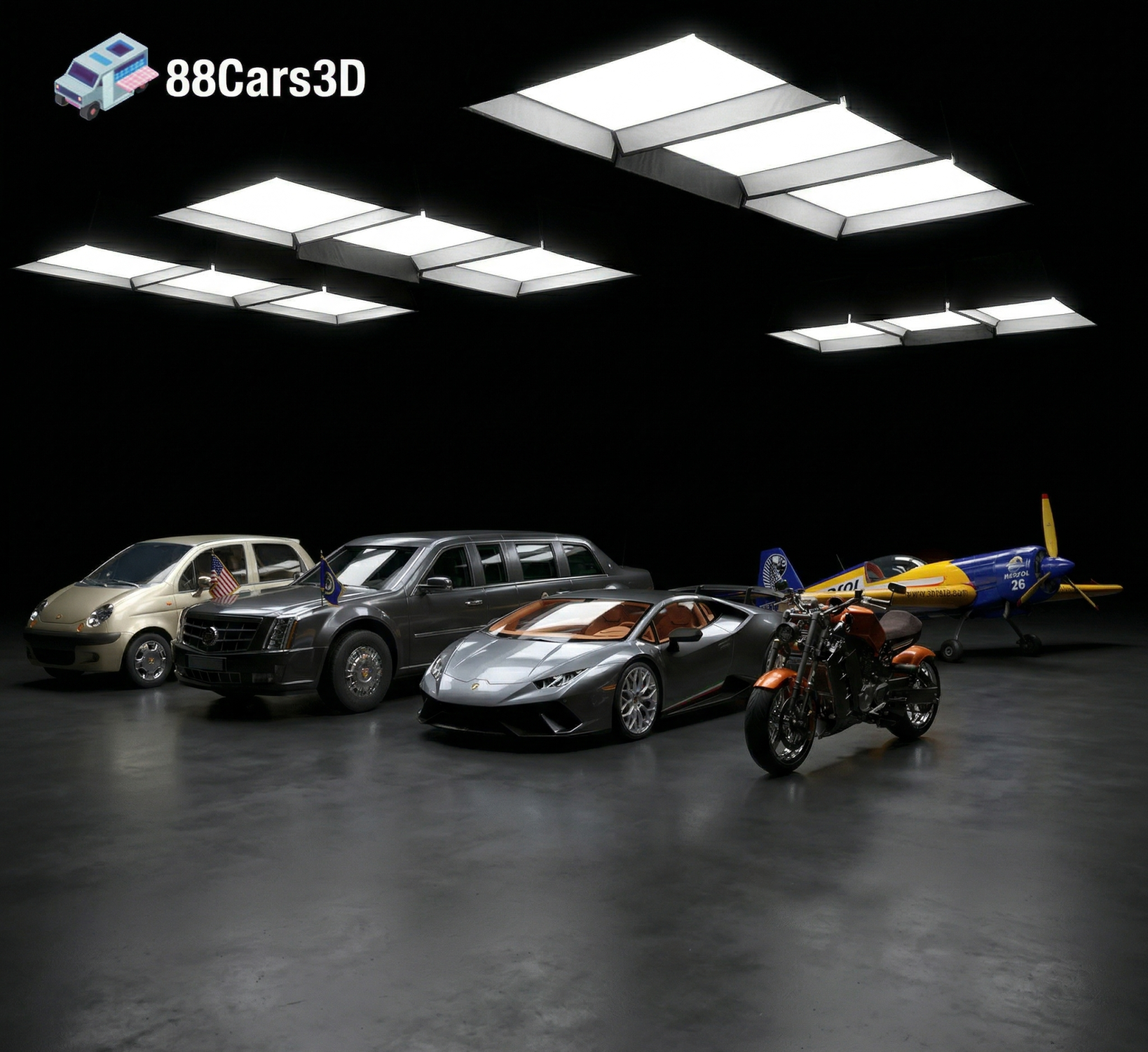
Texture: Yes | Material: Yes | 3D Printable: Yes. Download the Ultimate Creators’ Showcase featuring 5 premium 3D models: Lamborghini Huracan, ZAV Concept Motorcycle, Sukhoi SU-26, Presidential Limousine, and Daewoo Damas. Optimized for 4K CGI rendering and 3D printing. Save massive with this exclusive multi-category bundle!
Price: $99.99

Texture: Yes | Material: Yes | 3D Printable: Yes. Download the Italian Thoroughbreds Bundle featuring 5 iconic 3D models: Lamborghini Huracán Performante, Ferrari 458 Italia, Lamborghini Urus, Diablo SV, and Maserati GT. Optimized for 4K rendering and 3D printing (STL included). Save 50% with this ultimate Italian vehicle collection.
Price: $199.99

Download the Elite Future Mobility Bundle featuring 4 highly optimized 3D models: Tesla Model S, Avatr 11, Li L9, and Zoox Robotaxi. Perfect for ArchViz, Smart City renders, and game dev. Optimized for Unreal Engine and Blender. Includes .fbx, .obj, and .max formats.
Price: $99

🚗 5 Iconic German Cars (BMW M4 G82, M5 CS, X3, 1 Series & Mercedes E-Class). ✅ Optimized for ArchViz: Ready for Corona & V-Ray. 💰 Save €71 with this limited-time collection! 🚀 Instant Download after purchase.
Price: $119

Download the Extreme Off-Road & Survival 3D Models Bundle! Includes the Brabus 800 Adventure, Dodge Ram Bigfoot, Spec Truck, and a Caravan. Save over €210 on this premium 4-in-1 off-grid vehicle pack for ArchViz and game development.
Price: $149.99

Download the Heavy Duty & Commercial Logistics 3D Models Bundle! Includes the Ford Sterling, Caterpillar CT680, Mercedes Citaro Bus, and Vito Van. Save over €130 on this massive, game-ready 4-in-1 industrial vehicle pack.
Price: $109.99

Download the Ultimate Custom Motorcycles 3D Models Bundle. Includes a Custom Chopper, Ducati 916 Café Fighter, Harley XR1200X, and BMW K100. Perfect premium props for luxury ArchViz garages. Save over €250 today!
Price: $159.99

Download the ultimate JDM Street Racing 3D Models Bundle! Includes the Nissan GT-R, Toyota Supra, Mazda RX-7, Lancer Evo IX, and Honda NSX. Save big on this highly optimized, game-ready 5-in-1 Japanese legend car pack.
Price: $129.99

Download the ultimate American Muscle & Cinematic Classics 3D Models Bundle! Includes the Dodge Charger ’68, Mustang Eleanor GT500, Camaro Z28 ’79, and a custom ’69 Mustang. Save over €240 on this game-ready, premium 4-in-1 pack.
Price: $149.99

Download the Everyday City Traffic 3D Models Bundle. Includes the VW Golf, Kia Picanto, Hyundai Tucson, Toyota Yaris, and a DHL Ford Transit Van. Save big on this 5-in-1 pack, perfectly optimized for realistic ArchViz streets and game traffic.
Price: $99.99

