Get 50% OFF All Premium 3D & STL Models!

The automotive industry is undergoing a profound digital transformation, and at the heart of this revolution is real-time rendering. Unreal Engine has emerged as the leading platform, empowering designers, marketers, and game developers to create stunningly realistic and interactive automotive experiences. From visualizing concept cars with unparalleled fidelity to building immersive virtual showrooms and high-octane racing games, Unreal Engine offers an expansive toolkit for every need. Its photorealistic capabilities, coupled with robust interactivity features, allow for dynamic exploration and engagement that static renders simply cannot match.
For beginners venturing into this exciting domain, the journey might seem daunting, given the engine’s vast feature set. However, with the right guidance and high-quality assets, creating professional-grade automotive visualizations is well within reach. This comprehensive guide will walk you through the essential steps, from setting up your Unreal Engine project to mastering advanced rendering techniques and building interactive experiences. We’ll explore how to leverage industry best practices and powerful Unreal Engine features like Nanite and Lumen, ensuring you build a solid foundation for your automotive projects. Whether you’re aiming for a photorealistic configurator or an engaging driving simulator, prepare to unlock the full potential of real-time automotive visualization with Unreal Engine.
Embarking on your Unreal Engine journey begins with a properly configured project. While Unreal Engine is versatile, optimizing its settings from the outset for automotive visualization can significantly streamline your workflow and enhance performance. For those new to the engine, downloading Unreal Engine through the Epic Games Launcher is the first step. Always ensure you are using a stable, production-ready version, ideally the latest LTS (Long Term Support) release, to benefit from the most recent features and optimizations relevant to automotive rendering.
When creating a new project, select the “Games” category, and then choose either a “Blank” template or the “Automotive Product Design” template if available in your version. The Blank template offers maximum control, allowing you to add only the necessary components, which is ideal for performance-conscious projects. For target platforms, prioritize “Desktop” and “Maximum Quality” settings. Ensure “Starter Content” is deselected to avoid unnecessary assets cluttering your project. Once created, navigate to your Project Settings (Edit > Project Settings) to fine-tune crucial rendering and engine parameters. This initial setup lays the groundwork for importing high-quality 3D car models, such as those found on 88cars3d.com, and ensures they perform optimally within your scene.
Within Project Settings, several key adjustments are vital for automotive visualization. Under “Engine > Rendering,” enable “Lumen Global Illumination” and “Lumen Reflections” for cutting-edge real-time lighting. For even greater fidelity, consider enabling “Hardware Ray Tracing” if your hardware supports it, which offers unparalleled realism for reflections, shadows, and global illumination. Adjusting the “Frame Rate” under “Engine > General Settings” can also be beneficial; while unlimited is default, capping it to 60fps can provide a smoother experience without overtaxing your GPU. Crucially, establish a clean and logical folder structure from the start. A typical structure might include folders like ‘Cars’ (for your imported models), ‘Materials,’ ‘Textures,’ ‘Blueprints,’ ‘Maps,’ and ‘Cinematics.’ This organizational discipline is paramount for managing complex projects and working efficiently, especially when dealing with numerous assets and iterations.
Unreal Engine’s functionality can be extended significantly through its plugin system. For automotive visualization, several plugins are highly recommended or even essential. Go to Edit > Plugins and search for these:
Enabling these plugins provides access to a broader range of tools, from advanced data ingestion to sophisticated animation and production capabilities, ensuring your Unreal Engine setup is robust enough for any automotive challenge you might encounter. Refer to the official Unreal Engine documentation at dev.epicgames.com/community/unreal-engine/learning for detailed instructions on specific plugin functionalities.
Once your project is set up, the next critical step is to bring your high-quality 3D car models into Unreal Engine. Whether you’ve purchased meticulously crafted assets from platforms like 88cars3d.com or created them yourself, proper import and optimization are paramount for both visual fidelity and real-time performance. The most common file formats for importing static meshes into Unreal Engine are FBX and USD (Universal Scene Description), with USD gaining significant traction for its robust support of scene description, material definitions, and asset interchangeability. When sourcing 3D car models, always look for clean topology, logically grouped meshes, and proper UV mapping, as these characteristics significantly ease the integration process.
Before importing, ensure your model’s scale is correct in your 3D modeling software (e.g., 1 unit = 1cm, consistent with Unreal Engine’s default scale). Unreal Engine’s FBX import dialogue offers a range of options, including generating lightmap UVs, combining meshes, and importing materials and textures. For car models, it’s often best to import individual components (e.g., body, wheels, interior) as separate meshes to allow for easier material assignments and future interactivity. Pay close attention to the “Normal Import Method” (often “Import Normals and Tangents” is suitable) and ensure “Convert Scene Unit” and “Transform Vertex to Absolute” are checked if you suspect scale issues. Post-import, always verify the model’s scale within Unreal Engine by comparing it to a known reference object like the default mannequin.
The import process itself is straightforward: simply drag and drop your FBX or USD file into the Content Browser, or use the “Import” button. In the FBX Import Options dialog:
For USD, the process is similar but offers more robust scene graph capabilities. USD imports can maintain complex hierarchies, material assignments, and even basic animations, making it a powerful choice for collaborative workflows and iterative design. After import, organize your new assets into their respective folders (e.g., ‘Cars/[CarModelName]/Meshes’, ‘Cars/[CarModelName]/Textures’).
Optimizing your 3D car model is crucial for real-time performance. While high-quality assets from 88cars3d.com are typically optimized, understanding the principles is key. Traditional optimization involves reducing polygon counts through decimation or manual retopology and creating Level of Detail (LOD) meshes. A detailed car model might have a primary mesh (LOD0) ranging from 150,000 to 500,000 triangles, with progressively lower poly counts for LOD1, LOD2, etc., which load based on distance from the camera.
However, Unreal Engine 5’s Nanite virtualized geometry system has revolutionized this. Nanite allows you to import models with millions or even billions of polygons directly into Unreal Engine without significant performance degradation. For highly detailed car bodies, interiors, and components where every nuance matters, Nanite is a game-changer. To enable Nanite on a static mesh, simply open the mesh editor, navigate to the “Nanite Settings” section, and check “Enable Nanite.” Unreal Engine will then process the mesh, allowing it to be rendered incredibly efficiently, regardless of its poly count. While Nanite excels for static, complex geometry, other elements like wheels (for potential animation), or smaller props might still benefit from traditional LODs or simply lower poly counts if they are not the primary visual focus. Combine Nanite for the main body with carefully managed LODs for smaller, less prominent parts to achieve the best balance of visual quality and performance.
A car model’s realism is not solely determined by its geometric detail but, more significantly, by its materials and textures. Unreal Engine’s Physically Based Rendering (PBR) system is designed to simulate how light interacts with surfaces in the real world, producing incredibly lifelike results. Understanding the core principles of PBR – Base Color (Albedo), Metallic, Roughness, Normal, and Ambient Occlusion – is fundamental to creating convincing car materials. High-quality PBR textures are often provided with models from marketplaces, but knowing how to tweak and create them from scratch gives you unparalleled artistic control.
The Unreal Engine Material Editor is a node-based interface where you construct your materials. For a car, you’ll typically need several distinct materials: car paint (often with multiple layers like clear coat and metallic flakes), glass, tire rubber, interior fabrics, chrome, and various plastics. Each of these requires a specific PBR setup to react correctly to light. The goal is to define how reflective, smooth, metallic, and colored each surface is, using a combination of textures and numerical values.
Let’s break down the key PBR channels for automotive applications:
For complex materials like car paint, you’ll leverage a layered material approach within the Material Editor, combining multiple PBR setups to achieve effects like clear coats over a metallic base layer. Always aim for physically plausible values; for instance, pure white (1) and pure black (0) for roughness and metallic are typically reserved for extreme cases.
Creating compelling car paint in Unreal Engine is a multi-step process. A common technique involves a “two-layer” material: a metallic base coat (the color and metallic flakes) covered by a clear coat.
Glass materials require transparency and accurate refraction. Set the material’s Blend Mode to “Translucent” and the Shading Model to “Default Lit” or “Clear Coat.” Input a low roughness value (0.01-0.05), a low metallic value (0), and then manipulate the Opacity and Refraction inputs. The “Refraction” input uses an Index of Refraction (IOR) value (e.g., 1.5 for standard glass). For automotive glass, consider subtle imperfections via a normal map to break up perfect reflections. For more advanced glass, especially in real-time ray tracing scenarios, exploring the “Thin Translucency” shading model can provide superior results without the performance cost of full volumetric refraction, as detailed in the official Unreal Engine documentation.
Lighting is arguably the most crucial element in achieving photorealism in any 3D scene, especially for automotive visualization where reflective surfaces and intricate details demand precise illumination. Unreal Engine offers a suite of advanced lighting solutions, with Lumen and Hardware Ray Tracing leading the charge in delivering dynamic, globally illuminated environments. These technologies allow light to behave naturally, bouncing off surfaces, creating soft shadows, and producing accurate reflections in real-time, eliminating the need for time-consuming pre-baked lightmaps for many scenarios.
Lumen, Unreal Engine 5’s default global illumination and reflections system, dynamically calculates indirect lighting for infinite bounces, providing truly cinematic lighting without manual intervention. This is particularly beneficial for automotive scenes where complex car bodies interact with environmental light, reflecting ambient colors and generating realistic bounced light. Combined with traditional light sources like Directional Lights for sun/moon, Sky Lights for ambient skylight, and Rect Lights for studio setups, Lumen empowers artists to craft breathtakingly realistic lighting that adapts instantly to scene changes, essential for interactive configurators or dynamic cinematics.
To leverage Lumen, ensure it’s enabled in your Project Settings under “Engine > Rendering > Global Illumination” and “Reflections.” Once active, all dynamic lights in your scene will contribute to Lumen’s global illumination calculations.
For ray-traced reflections, if you have a compatible GPU, enable “Hardware Ray Tracing” in Project Settings, then in the Post Process Volume, set “Reflections > Type” to “Ray Tracing.” This provides incredibly accurate reflections, crucial for shiny car surfaces, but comes with a higher performance cost than Lumen’s software-based reflections.
Beyond natural outdoor lighting, automotive visualization frequently uses studio setups or specific environmental contexts.
Remember that the interplay between your materials and lighting is key. A perfectly polished car paint material will only shine if illuminated correctly, and Lumen ensures that light interacts with your vehicle in a physically accurate, breathtaking manner.
While stunning visuals are paramount, the true power of real-time automotive visualization in Unreal Engine lies in its capacity for interactivity. Blueprint Visual Scripting is Unreal Engine’s powerful, node-based scripting system that allows artists and designers to create complex gameplay mechanics and interactive features without writing a single line of code. For automotive projects, Blueprint can transform static models into dynamic, explorable experiences – from changing paint colors and opening doors to full-fledged virtual configurators and driveable vehicles.
The core concept involves creating Actor Blueprints for your car components and then defining their behaviors and interactions. For instance, you can create a Blueprint that encapsulates your entire car, allowing you to control all its sub-components (doors, wheels, lights, materials) from a single logical hub. This modular approach makes your project scalable, maintainable, and incredibly flexible. By connecting events (like a mouse click or a keyboard press) to actions (like rotating a door or swapping a material), you can craft immersive experiences that engage your audience far beyond passive viewing.
A car configurator is an excellent example of Blueprint’s power. Here’s how you might approach it:
This framework provides a robust foundation for building complex, interactive configurators, allowing users to personalize vehicles in real-time. You can find more details on UMG and Blueprints on the official Unreal Engine learning portal.
Beyond visual customization, Blueprint can power basic vehicle dynamics and animations. Unreal Engine’s Chaos Physics system offers a robust framework for simulating realistic vehicle movement.
For more specific animations, such as opening doors or raising/lowering windows, you can use “Timeline” nodes within Blueprint. A Timeline allows you to animate a value over time, which can then be used to drive the rotation or translation of a mesh component. For example, a “Play” node on a Timeline could smoothly rotate a door mesh from closed to open, providing a visually appealing and interactive experience.
Achieving stunning visuals in Unreal Engine often comes with the challenge of maintaining optimal performance, especially when targeting real-time applications like games, interactive configurators, or augmented/virtual reality (AR/VR). For automotive projects, where high-fidelity models and realistic environments are key, advanced optimization techniques are not merely beneficial but essential. Unreal Engine provides a powerful suite of tools to manage asset complexity and render efficiency, ensuring your experiences run smoothly across various hardware platforms.
We’ve touched upon Nanite for handling high-polygon models, but it’s crucial to understand its role within a broader optimization strategy. While Nanite virtualized geometry can render incredibly complex static meshes with ease, not all assets are suited for it, and other optimization techniques remain vital for overall scene performance. Combining Nanite with traditional Level of Detail (LOD) systems, effective culling strategies, and careful material optimization creates a robust performance framework. Furthermore, optimizing specifically for AR/VR presents unique challenges and requires tailored approaches to meet the stringent performance demands of immersive headsets.
Nanite: As discussed, Nanite is revolutionary for static, high-detail meshes like the car body or intricate interior components. By converting meshes into a virtualized micro-polygon format, it only streams and renders the detail necessary for each pixel, significantly reducing draw calls and memory footprint. This means you can import an incredibly detailed 3D car model from 88cars3d.com, enable Nanite, and largely forget about traditional polygon budgets for those specific assets. However, remember that Nanite is primarily for static meshes; animated meshes (like spinning wheels) or meshes requiring complex custom shaders (which often need specific rendering passes) may not be suitable. For these, traditional LODs are still the preferred method.
Level of Detail (LODs): For meshes not suitable for Nanite (e.g., complex Blueprint-driven car components, animated parts, or simpler props), LODs are indispensable. LODs are simplified versions of your mesh that automatically swap in based on the camera’s distance.
Adjust the “Screen Size” threshold for each LOD to control when they swap.
Combining Nanite for critical high-poly static parts and manual/auto-generated LODs for other elements ensures your entire vehicle ecosystem is optimized for scalability across different viewing distances.
AR/VR experiences demand extremely high and consistent frame rates (e.g., 72fps or 90fps per eye) to prevent motion sickness and ensure immersion. This leaves very little headroom for performance bottlenecks.
By combining these strategies, you can deliver high-fidelity automotive experiences in AR/VR that are both visually stunning and performant, maintaining the illusion of presence and comfort for the user.
Unreal Engine extends far beyond interactive experiences; it’s a powerhouse for creating stunning cinematic content and pioneering virtual production workflows in the automotive sector. From compelling marketing videos showcasing a new model’s sleek design to real-time pre-visualization for commercials, Unreal Engine provides filmmakers, designers, and marketers with the tools to produce broadcast-quality media with unprecedented speed and flexibility. These advanced applications leverage sophisticated features like Sequencer for animation and camera control, advanced post-processing, and integration with cutting-edge virtual production technologies.
The ability to render cinematic sequences in real-time opens up new avenues for iteration and creativity. Imagine making a lighting change and seeing its effect on your entire cinematic in an instant, or tweaking camera angles on the fly during a virtual shoot. This dynamic workflow dramatically shortens production cycles and allows for more experimentation than traditional linear rendering pipelines. For automotive brands and visualization studios, this means bringing ideas to market faster, exploring more creative concepts, and delivering hyper-realistic content that captivates audiences.
Sequencer is Unreal Engine’s non-linear cinematic editor, providing a powerful timeline-based interface for creating cutscenes, trailers, and animated sequences.
Exporting your sequence is straightforward via the “Render Movie” feature, allowing you to output high-resolution video files (e.g., EXR, PNG sequences, or H.264) with various compression and quality settings.
Virtual production, particularly with LED volumes, is transforming filmmaking and automotive visualization by merging physical sets with real-time 3D environments. Instead of green screens, actors and physical vehicles are placed in front of massive LED screens displaying Unreal Engine environments. This provides real-time in-camera visual effects, accurate reflections on reflective surfaces (like car paint), and natural lighting interaction, eliminating complex post-production compositing.
This cutting-edge approach delivers highly realistic results directly in-camera, making the integration of physical and digital assets seamless. For automotive marketing and film, virtual production with Unreal Engine offers an unparalleled pathway to producing breathtaking visual content with efficiency and creative freedom.
Unreal Engine stands as an unrivaled platform for automotive visualization, game development, and real-time rendering. From setting up your first project to mastering advanced PBR materials, dynamic lighting with Lumen, and building interactive configurators with Blueprint, you now possess a comprehensive understanding of the core workflows. The ability to leverage cutting-edge features like Nanite for handling incredibly detailed models and optimizing performance for demanding AR/VR applications positions you to create truly immersive and photorealistic automotive experiences.
The journey into Unreal Engine is continuous, with new features and best practices constantly evolving. Embrace experimentation, explore the vast resources available on dev.epicgames.com/community/unreal-engine/learning, and never stop pushing the boundaries of what’s possible. Remember that the foundation of any great project lies in high-quality assets; marketplaces like 88cars3d.com provide meticulously crafted 3D car models that are optimized for Unreal Engine, giving you a head start in achieving professional results.
Whether your goal is to design the next generation of interactive car configurators, produce stunning cinematic automotive advertisements, or develop the ultimate racing game, Unreal Engine offers the tools and flexibility to bring your vision to life. Dive in, experiment, and prepare to transform your automotive concepts into breathtaking real-time realities.
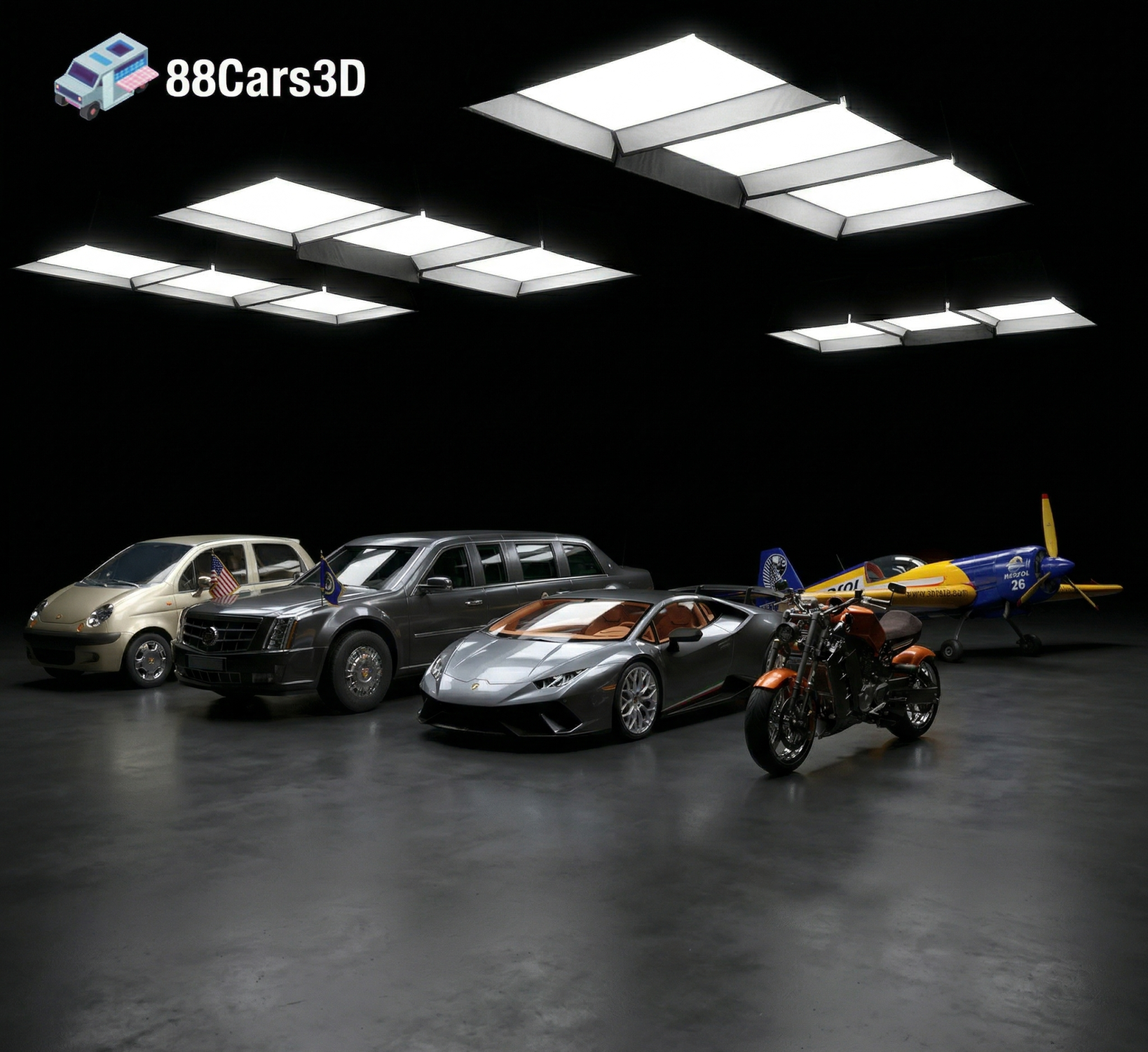
Texture: Yes | Material: Yes | 3D Printable: Yes. Download the Ultimate Creators’ Showcase featuring 5 premium 3D models: Lamborghini Huracan, ZAV Concept Motorcycle, Sukhoi SU-26, Presidential Limousine, and Daewoo Damas. Optimized for 4K CGI rendering and 3D printing. Save massive with this exclusive multi-category bundle!
Price: $99.99

Texture: Yes | Material: Yes | 3D Printable: Yes. Download the Italian Thoroughbreds Bundle featuring 5 iconic 3D models: Lamborghini Huracán Performante, Ferrari 458 Italia, Lamborghini Urus, Diablo SV, and Maserati GT. Optimized for 4K rendering and 3D printing (STL included). Save 50% with this ultimate Italian vehicle collection.
Price: $199.99

Download the Elite Future Mobility Bundle featuring 4 highly optimized 3D models: Tesla Model S, Avatr 11, Li L9, and Zoox Robotaxi. Perfect for ArchViz, Smart City renders, and game dev. Optimized for Unreal Engine and Blender. Includes .fbx, .obj, and .max formats.
Price: $99

🚗 5 Iconic German Cars (BMW M4 G82, M5 CS, X3, 1 Series & Mercedes E-Class). ✅ Optimized for ArchViz: Ready for Corona & V-Ray. 💰 Save €71 with this limited-time collection! 🚀 Instant Download after purchase.
Price: $119

Download the Extreme Off-Road & Survival 3D Models Bundle! Includes the Brabus 800 Adventure, Dodge Ram Bigfoot, Spec Truck, and a Caravan. Save over €210 on this premium 4-in-1 off-grid vehicle pack for ArchViz and game development.
Price: $149.99

Download the Heavy Duty & Commercial Logistics 3D Models Bundle! Includes the Ford Sterling, Caterpillar CT680, Mercedes Citaro Bus, and Vito Van. Save over €130 on this massive, game-ready 4-in-1 industrial vehicle pack.
Price: $109.99

Download the Ultimate Custom Motorcycles 3D Models Bundle. Includes a Custom Chopper, Ducati 916 Café Fighter, Harley XR1200X, and BMW K100. Perfect premium props for luxury ArchViz garages. Save over €250 today!
Price: $159.99

Download the ultimate JDM Street Racing 3D Models Bundle! Includes the Nissan GT-R, Toyota Supra, Mazda RX-7, Lancer Evo IX, and Honda NSX. Save big on this highly optimized, game-ready 5-in-1 Japanese legend car pack.
Price: $129.99

Download the ultimate American Muscle & Cinematic Classics 3D Models Bundle! Includes the Dodge Charger ’68, Mustang Eleanor GT500, Camaro Z28 ’79, and a custom ’69 Mustang. Save over €240 on this game-ready, premium 4-in-1 pack.
Price: $149.99

Download the Everyday City Traffic 3D Models Bundle. Includes the VW Golf, Kia Picanto, Hyundai Tucson, Toyota Yaris, and a DHL Ford Transit Van. Save big on this 5-in-1 pack, perfectly optimized for realistic ArchViz streets and game traffic.
Price: $99.99

