Get 50% OFF All Premium 3D & STL Models!

“`html
The thrill of seeing a meticulously crafted 3D car model come to life is unparalleled. Whether you’re a seasoned maker, a budding automotive enthusiast, or an engineer exploring rapid prototyping, the journey from digital file to tangible object is deeply rewarding. However, the success of this transformation hinges critically on one crucial step: proper 3D model preparation. A seemingly perfect digital mesh can harbor hidden flaws that lead to frustrating print failures, wasted filament, and disappointing results. This guide is your comprehensive roadmap to navigating the intricacies of 3D model preparation. We’ll delve into the core principles of STL file structure, explore advanced slicing techniques for both FDM and resin printing, demystify support generation, and provide actionable strategies for achieving the highest quality prints. By the end of this article, you’ll possess the knowledge and confidence to tackle any 3D printable car model, ensuring your creations are as impressive in reality as they are in the digital realm.
At the heart of 3D printing lies the STL (STereoLithography) file format. While simple in concept, its underlying structure is vital for successful slicing and printing. An STL file represents a 3D object’s surface geometry as a collection of triangular facets. Each triangle is defined by its three vertices (points in 3D space) and a normal vector, which indicates the outward-facing direction of the surface. This seemingly basic representation is the universal language for most 3D printers and slicers. However, the way these triangles are arranged – the mesh topology – can significantly impact printability. Issues like non-manifold geometry, inverted normals, or intersecting triangles can confuse the slicer, leading to gaps, holes, or solid blocks in your print.
The most critical characteristic of a printable 3D model is that it must be “watertight” or “manifold.” This means the mesh must represent a closed, solid volume with no holes or gaps. Imagine filling the digital model with water; if it leaks, it’s not watertight. Every edge in the mesh must be shared by exactly two triangles. If an edge is shared by only one, it signifies a hole. If it’s shared by more than two, it indicates overlapping or intersecting geometry, which can also cause issues. Equally important are the normal vectors. Each triangle must have a normal vector pointing consistently outwards from the solid volume. If some normals are inverted (pointing inwards), the slicer may interpret parts of the model as being inside-out or missing, leading to printing errors. Tools like Meshmixer, Blender, or Netfabb have built-in functions to diagnose and repair these mesh integrity issues, making them indispensable for anyone working with 3D printable files.
Several common flaws can plague STL files, especially those downloaded from various sources or generated through complex modeling processes. These include:
Software like Autodesk Netfabb offers powerful automated repair capabilities, while Blender provides more manual control for complex situations. For users downloading models from marketplaces such as 88cars3d.com, it’s good practice to run a quick mesh check even on seemingly clean files before slicing.
The slicer is your crucial intermediary, converting the 3D model (usually an STL) into layer-by-layer instructions (G-code) that your 3D printer can understand. The settings you choose within your slicer directly dictate the quality, strength, and print time of your object. For intricate models like those found on 88cars3d.com, selecting the right slicing parameters is paramount. This involves a delicate balance between detail resolution, structural integrity, and efficient printing. Understanding the impact of each setting – from layer height and print speed to infill and supports – empowers you to achieve professional-grade results consistently.
Layer height is perhaps the most impactful setting for print quality and time. It defines the thickness of each individual layer deposited by the printer. For FDM printers, common layer heights range from 0.05mm for extremely fine detail to 0.3mm for faster, less detailed prints. For highly detailed car models, especially those with delicate features like spoilers, mirrors, or intricate grilles, a lower layer height (e.g., 0.1mm to 0.15mm) is often preferred. This results in smoother curves and finer surface finish, minimizing the visible “stair-stepping” effect on angled surfaces. However, printing at lower layer heights significantly increases print time. A model that takes 10 hours at 0.2mm might take 30-40 hours at 0.1mm. It’s a trade-off you must consciously manage based on the model’s complexity and your desired outcome.
Infill refers to the internal support structure printed within the model’s outer shells. It provides rigidity and strength without adding excessive material or print time. The most common parameters are infill density (percentage) and infill pattern. For decorative car models, a low infill density (5-15%) is often sufficient, mainly to provide a stable base for the outer walls. If the model needs to withstand some handling or is intended for functional prototyping, a higher density (20-50%) might be necessary. The infill pattern also plays a role. Grid, lines, and gyroid are common choices. Gyroid offers good strength in all directions and is often favored for its efficient material usage and reduced print time compared to rectilinear patterns at the same density. For most display models, a simple grid or lines pattern at 10-15% density is usually adequate.
Print speed dictates how quickly the print head moves while extruding material. Faster speeds reduce print time but can compromise quality, especially on complex geometries with overhangs or fine details. For highly detailed car models, it’s advisable to slow down print speeds, particularly for outer walls and travel moves. A common starting point for outer walls might be 30-40 mm/s, while infill can be printed faster (50-60 mm/s). Travel speed (when the nozzle isn’t extruding) can be increased significantly (100-150 mm/s) to save time. Print temperature needs to be calibrated for the specific filament being used. Always refer to the filament manufacturer’s recommendations and perform temperature towers to find the optimal temperature for strong layer adhesion and minimal stringing. Similarly, bed temperature is crucial for adhesion; typically ranging from 50°C for PLA to 110°C for ABS.
Many 3D printable car models feature overhangs, bridges, and other challenging geometries that cannot be printed in mid-air. This is where support structures come in. Supports are temporary scaffolding printed beneath these features, providing a solid base for the material to adhere to. Generating effective supports is a blend of art and science, requiring careful consideration of the model’s geometry, the chosen printing technology (FDM vs. resin), and the desired ease of removal. Poorly generated or difficult-to-remove supports can mar the surface finish or even damage the delicate parts of your model.
For FDM printing, slicers like Cura and PrusaSlicer offer extensive support options. Key settings include:
Experimentation is key. Start with default settings and adjust the Z distance and density to find the sweet spot for your printer and material.
Resin 3D printing (SLA/DLP/MSLA) requires a different approach to supports. Because resin cures layer by layer with UV light, supports are essential to anchor the model to the build plate and prevent suction forces from detaching it or causing print failures. Resin supports are typically much thinner and more numerous than FDM supports. Key considerations include:
Software like Lychee Slicer, ChiTuBox, and PreForm (for Formlabs printers) offers advanced support generation tools specifically tailored for resin printing, often with automated features that suggest optimal placement and size.
How you position your 3D model on the print bed (orientation) and ensuring it sticks firmly (bed adhesion) are foundational to a successful print. The orientation affects overhangs, support requirements, surface quality, and even the strength of the final part. Bed adhesion is the guarantee that your print will stay put throughout the entire printing process. A print that detaches from the bed halfway through is a common and disheartening failure mode.
For car models, orientation choices can dramatically impact the print. Consider these factors:
Take time in your slicer to rotate and experiment with different orientations. Often, the optimal position isn’t immediately obvious.
A first layer that adheres well is non-negotiable. Several factors contribute to good bed adhesion:
For challenging prints or materials prone to warping (like ABS), a combination of a clean PEI sheet, proper Z-offset, and a brim is often the most reliable approach.
The printing process is only part of the journey. Post-processing is where a good print becomes a great model. This involves removing supports, sanding, filling, and painting to achieve a professional, finished look. For detailed 3D printable car models, meticulous post-processing can elevate them from hobbyist creations to display-worthy pieces.
Carefully removing supports is the first step.
For resin prints, cleaning off uncured resin with isopropyl alcohol (IPA) and then curing the part under UV light (either sunlight or a dedicated UV curing station) is essential before sanding or painting.
Painting is where your car model truly comes alive.
Taking the time for these finishing steps transforms a raw 3D print into a museum-quality replica.
The choice of material and the calibration of your 3D printer are fundamental to achieving high-quality prints, especially for detailed models. Different materials have unique properties, and a well-calibrated printer ensures consistent and accurate extrusion and movement.
The material you choose impacts printability, durability, and finish.
For high-detail car models from platforms like 88cars3d.com, standard resins or high-resolution PLA/PETG are excellent choices, offering a balance of detail capture and printability.
A calibrated printer is essential for reliable results. Key calibration steps include:
Regular printer maintenance, including cleaning the nozzle, build plate, and lubricating moving parts, also contributes significantly to consistent print quality.
Mastering 3D model preparation is an ongoing journey, but one that yields immense satisfaction. By understanding the nuances of STL files, leveraging the power of your slicer, mastering support strategies, and paying attention to orientation and adhesion, you lay the groundwork for flawless prints. Platforms like 88cars3d.com provide access to an incredible library of detailed car models, designed with printability in mind. Remember that patience, experimentation, and attention to detail are your greatest allies. Whether you’re printing a single-piece display model or a complex multi-part replica, applying these principles will significantly enhance your success rate and the quality of your final creations. So, dive in, experiment with settings, and enjoy the rewarding process of bringing these incredible automotive designs to life, one layer at a time.
“`
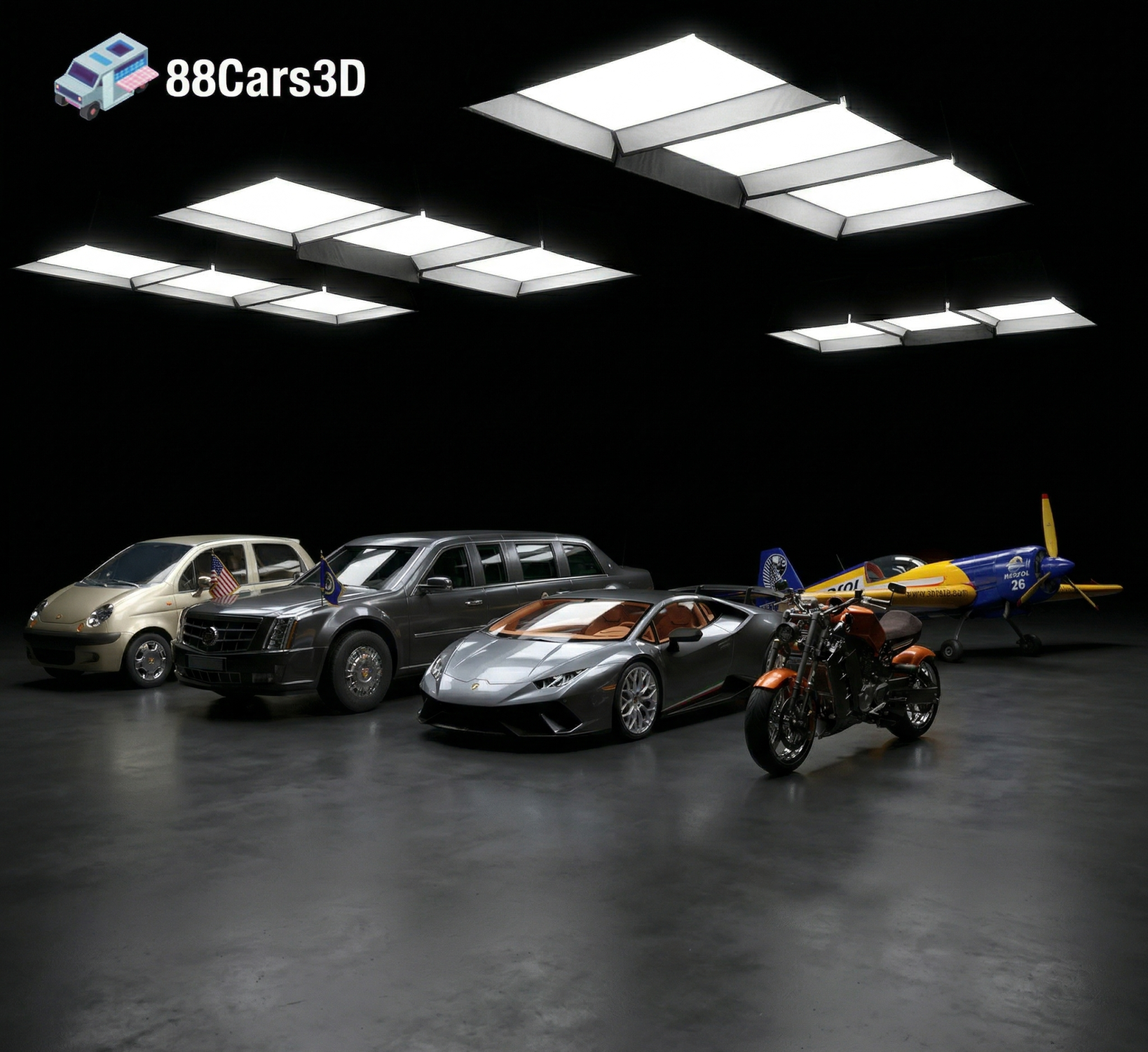
Texture: Yes | Material: Yes | 3D Printable: Yes. Download the Ultimate Creators’ Showcase featuring 5 premium 3D models: Lamborghini Huracan, ZAV Concept Motorcycle, Sukhoi SU-26, Presidential Limousine, and Daewoo Damas. Optimized for 4K CGI rendering and 3D printing. Save massive with this exclusive multi-category bundle!
Price: $99.99

Texture: Yes | Material: Yes | 3D Printable: Yes. Download the Italian Thoroughbreds Bundle featuring 5 iconic 3D models: Lamborghini Huracán Performante, Ferrari 458 Italia, Lamborghini Urus, Diablo SV, and Maserati GT. Optimized for 4K rendering and 3D printing (STL included). Save 50% with this ultimate Italian vehicle collection.
Price: $199.99

Download the Elite Future Mobility Bundle featuring 4 highly optimized 3D models: Tesla Model S, Avatr 11, Li L9, and Zoox Robotaxi. Perfect for ArchViz, Smart City renders, and game dev. Optimized for Unreal Engine and Blender. Includes .fbx, .obj, and .max formats.
Price: $99

🚗 5 Iconic German Cars (BMW M4 G82, M5 CS, X3, 1 Series & Mercedes E-Class). ✅ Optimized for ArchViz: Ready for Corona & V-Ray. 💰 Save €71 with this limited-time collection! 🚀 Instant Download after purchase.
Price: $119

Download the Extreme Off-Road & Survival 3D Models Bundle! Includes the Brabus 800 Adventure, Dodge Ram Bigfoot, Spec Truck, and a Caravan. Save over €210 on this premium 4-in-1 off-grid vehicle pack for ArchViz and game development.
Price: $149.99

Download the Heavy Duty & Commercial Logistics 3D Models Bundle! Includes the Ford Sterling, Caterpillar CT680, Mercedes Citaro Bus, and Vito Van. Save over €130 on this massive, game-ready 4-in-1 industrial vehicle pack.
Price: $109.99

Download the Ultimate Custom Motorcycles 3D Models Bundle. Includes a Custom Chopper, Ducati 916 Café Fighter, Harley XR1200X, and BMW K100. Perfect premium props for luxury ArchViz garages. Save over €250 today!
Price: $159.99

Download the ultimate JDM Street Racing 3D Models Bundle! Includes the Nissan GT-R, Toyota Supra, Mazda RX-7, Lancer Evo IX, and Honda NSX. Save big on this highly optimized, game-ready 5-in-1 Japanese legend car pack.
Price: $129.99

Download the ultimate American Muscle & Cinematic Classics 3D Models Bundle! Includes the Dodge Charger ’68, Mustang Eleanor GT500, Camaro Z28 ’79, and a custom ’69 Mustang. Save over €240 on this game-ready, premium 4-in-1 pack.
Price: $149.99

Download the Everyday City Traffic 3D Models Bundle. Includes the VW Golf, Kia Picanto, Hyundai Tucson, Toyota Yaris, and a DHL Ford Transit Van. Save big on this 5-in-1 pack, perfectly optimized for realistic ArchViz streets and game traffic.
Price: $99.99

