Get 50% OFF All Premium 3D & STL Models!

“`html
The world of 3D printing, particularly when delving into intricate models like those found on 88cars3d.com, is a fascinating blend of art and engineering. While the appeal of a perfectly rendered 1:18 scale Lamborghini or a detailed classic muscle car in STL file format is undeniable, achieving that perfect print often hinges on mastering the fundamental settings of your 3D printer. Among the most crucial, yet sometimes overlooked, parameters are your nozzle size and your printer’s build volume (bed size). These two seemingly simple aspects profoundly impact print quality, speed, detail resolution, and even the feasibility of printing certain complex designs. This guide will delve deep into the technical considerations for selecting the optimal nozzle diameter and understanding the implications of your printer’s build volume, ensuring your automotive masterpieces emerge flawlessly from the print bed, whether you’re using FDM or resin technology.
The nozzle on your FDM printer is where the magic happens – it’s the conduit through which molten filament is precisely deposited layer by layer to build your object. The diameter of this opening is a critical variable that dictates the width of the extruded line, often referred to as the “extrusion width” or “line width.” This, in turn, directly influences the level of detail you can achieve, the speed at which you can print, and the mechanical properties of your final print. Standard nozzle sizes typically range from 0.2mm to 1.0mm, with 0.4mm being the most common default found on many consumer-grade printers. Understanding the trade-offs associated with different nozzle sizes is paramount for achieving optimal results, especially when printing intricate printable car models that demand fine details and smooth surfaces.
The most significant impact of nozzle diameter lies in the trade-off between detail resolution and print speed. Smaller nozzles, such as 0.2mm or 0.25mm, allow for incredibly fine extrusion widths. This translates directly into the ability to reproduce minuscule details, sharp edges, and intricate textures that are crucial for realistic automotive models. For instance, printing delicate trim, grille details, or even tire treads on a scaled-down vehicle becomes significantly easier and more accurate with a smaller nozzle. However, this comes at a cost: print time. Extruding filament through a smaller opening is a slower process. Each layer must be traced with a finer line, requiring more individual extrusion paths. This can dramatically increase the overall print duration, sometimes by a factor of 2x or even 3x compared to a larger nozzle. Furthermore, printing with very small nozzles can be more prone to clogging, especially if the filament is not perfectly clean or if the printer’s retraction settings are not finely tuned. A 0.4mm nozzle offers a good balance for general-purpose printing, capable of handling a decent level of detail while maintaining reasonable print speeds.
Beyond detail, nozzle size also plays a role in the mechanical strength and layer adhesion of your prints. Larger nozzles (e.g., 0.6mm, 0.8mm, or 1.0mm) produce wider extrusion lines. When printing solid parts or components that require high strength, a wider extrusion width can lead to better inter-layer adhesion. This is because the wider line effectively “melts” and fuses more effectively with the previous layer, creating a stronger bond. For functional parts or larger models where structural integrity is key, a larger nozzle might be preferable. The wider extrusion path also means fewer lines need to be laid down to fill an area, which speeds up printing significantly. However, for highly detailed models from sources like 88cars3d.com, using a nozzle larger than 0.4mm will likely result in a loss of fine geometric features, making the print appear less refined and potentially compromising the aesthetic appeal of the automotive replica.
When selecting a nozzle for your specific print job, consider the following:
Remember that changing your nozzle size requires adjusting your slicer settings accordingly. Your extrusion width should typically be set slightly larger than your nozzle diameter (e.g., 120% of nozzle diameter is a common starting point) and your line width settings within the slicer software (like Cura or PrusaSlicer) must be updated to reflect the new nozzle size. Failure to do so can result in under-extrusion (gaps between lines) or over-extrusion (blobbing and poor surface finish).
Your 3D printer’s build volume, commonly referred to as its “bed size,” defines the maximum dimensions of an object you can print in a single piece. This specification, typically expressed in millimeters (e.g., 220x220x250mm), dictates the physical space within which your printer can deposit material. For hobbyists and makers, understanding the constraints and possibilities offered by their build volume is crucial for planning print jobs, especially when dealing with larger or multi-part models. The size of your build plate directly influences whether a model can be printed as a single unit or if it needs to be sectioned, and it also impacts how many objects can be printed simultaneously, affecting overall efficiency.
The most obvious implication of your build volume is the maximum size of a single-piece print. If you have a particularly large automotive model, perhaps a full-size steering wheel or a significant portion of a car’s chassis, and your build volume is insufficient, you have two primary options. The first is to find a smaller-scale version of the model or a different model altogether. However, for enthusiasts who have downloaded a specific vehicle STL file, the more practical approach is to split the model into multiple smaller parts that can fit within your printer’s build area. This requires using 3D modeling software (like Blender, Meshmixer, or even features within some slicers) to digitally cut the model. Each section is then printed separately and later assembled using adhesives, screws, or interlocking joints. This technique is incredibly powerful, allowing you to print objects far larger than your printer’s native capacity. However, it introduces the complexity of alignment, assembly, and potential seam lines that need post-processing.
Your build volume also dictates how efficiently you can utilize your printer’s time through batch printing. For smaller scale car models or individual components of a larger project, you can often fit multiple copies onto the build plate simultaneously. This is a highly effective way to maximize print throughput, especially when you need several identical parts or want to print a batch of different small models. When arranging multiple objects on the build plate, consider:
Software like Cura and PrusaSlicer offers features to automatically arrange models on the build plate, which can be a great starting point for optimizing space utilization.
While the concept of build volume is similar for resin printers (SLA, DLP, LCD), the implications can differ slightly. Resin printers often have smaller build volumes compared to many FDM printers, but they build objects layer by layer from the bottom up, meaning the height of the print is often more constrained than the X/Y dimensions. Resin printing excels at intricate details, so even with a smaller build plate, you can achieve impressive results on models downloaded from sites like 88cars3d.com. However, the Z-axis height limitation is critical, and the cost of resin per volume means that larger prints can become expensive. Similar to FDM, splitting large models or batch printing smaller ones is a common strategy to maximize the use of the build plate and manage costs effectively.
Moving beyond the fundamentals, there are advanced strategies and considerations that can further refine your printing process when it comes to nozzle size and build volume. These techniques often involve deeper dives into slicer settings, printer maintenance, and material science, allowing you to push the boundaries of what’s possible with your 3D printer and achieve professional-grade results for even the most demanding F1 car STL files.
Switching nozzle sizes on an FDM printer isn’t just a physical change; it necessitates recalibration of specific slicer settings. Most slicers have a “Nozzle Size” setting that should be updated whenever you physically swap the nozzle. This setting influences the default extrusion width calculation. For optimal results, you’ll often want to fine-tune the “Initial Layer Line Width” and “Perimeters/Wall Line Width” settings. For example, with a 0.4mm nozzle, a common extrusion width might be 0.45mm to 0.5mm. When switching to a 0.2mm nozzle, you might start with an extrusion width of 0.22mm and potentially increase it slightly if you encounter under-extrusion, but be mindful of pushing it too far, which can lead to Z-seam issues or surface defects. Perform “drip tests” or print small calibration cubes with different line width settings to dial in the perfect extrusion for each nozzle size. Also, ensure your E-steps calibration is accurate, as this determines how much filament the extruder pushes for a given command, and it can be affected by different nozzle resistances.
Given that your build volume is the foundation of your print, ensuring a perfectly level and adherent surface is non-negotiable. For larger prints that occupy a significant portion of your build plate, even minor imperfections in bed leveling can lead to print failures. Regularly calibrate your bed using your printer’s auto-leveling routine or manual leveling process. For printers without auto-leveling, consider using a feeler gauge or a piece of paper to ensure consistent Z-height across the entire build surface. Bed adhesion is also crucial. Common methods include using a clean glass bed with a glue stick, PEI sheets, or specialized build surfaces. For particularly challenging materials like ABS or large prints prone to warping, consider using a brim or raft in your slicer settings. A brim adds a single layer of material around the base of your print, increasing the surface area contact with the bed, while a raft prints a disposable grid beneath your object, providing a stable base. For resin printers, ensuring the build plate is perfectly clean and free from cured resin is vital for successful first layers and preventing print detachment.
The type of filament you use can also influence the ideal nozzle choice. Standard filaments like PLA and PETG generally perform well with most nozzle sizes. However, abrasive materials such as carbon fiber-filled filaments, wood-filled filaments, or metallic-filled filaments can rapidly wear down standard brass nozzles. For printing these materials regularly, investing in hardened steel nozzles is highly recommended. These nozzles are significantly more durable and resist abrasive wear, preventing the nozzle orifice from enlarging over time, which would lead to inconsistent extrusion and degraded print quality. When using hardened steel nozzles, remember that they have lower thermal conductivity than brass, meaning they may require slightly higher printing temperatures to achieve the same melt flow rate. Always check the manufacturer’s recommendations for specific filament types and nozzle materials.
The journey to achieving flawless 3D prints, especially for detailed automotive models found on platforms like 88cars3d.com, is a continuous learning process. Mastering the interplay between your nozzle size and your printer’s build volume is a fundamental step towards unlocking superior print quality, efficiency, and creativity. By understanding the trade-offs between detail resolution and print speed associated with different nozzle diameters, you can select the appropriate size for your specific project, whether it demands the microscopic precision of a 0.2mm nozzle or the rapid output of a 0.6mm one. Similarly, a thorough comprehension of your build volume’s constraints allows you to plan ambitious projects, strategically split large models, and optimize your printing workflow through efficient batch printing.
Remember that successful 3D printing is not just about having a high-quality 3D car model; it’s about understanding and meticulously configuring the tools at your disposal. Regularly calibrate your printer, experiment with slicer settings tailored to your chosen nozzle and desired outcome, and pay close attention to bed adhesion. Investing a little extra time in understanding these core parameters will pay dividends in the form of cleaner, stronger, and more visually stunning prints. So, before you hit ‘print’ on your next automotive masterpiece, take a moment to consider your nozzle and your bed – the canvas upon which your digital creations will take physical form.
“`
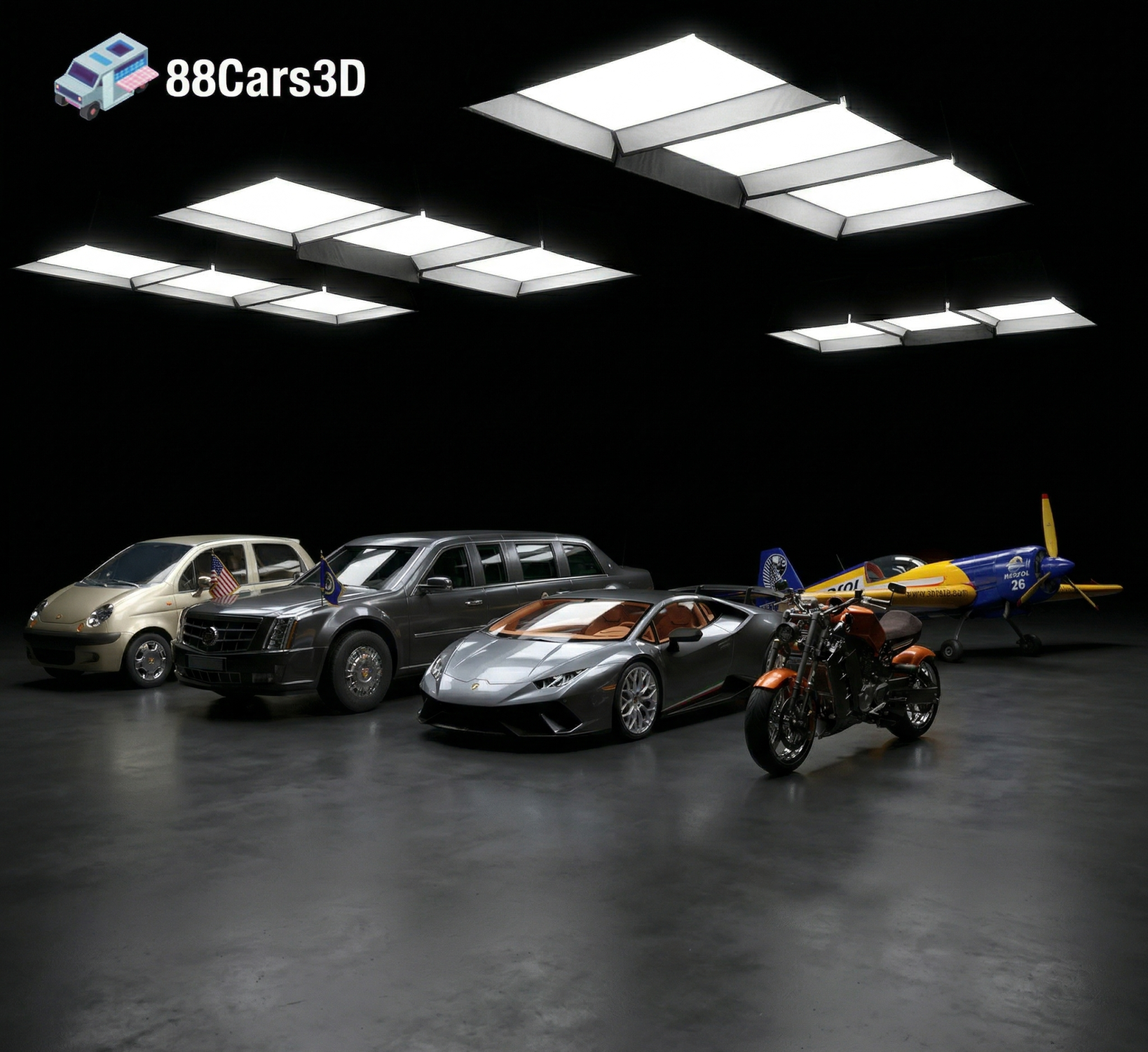
Texture: Yes | Material: Yes | 3D Printable: Yes. Download the Ultimate Creators’ Showcase featuring 5 premium 3D models: Lamborghini Huracan, ZAV Concept Motorcycle, Sukhoi SU-26, Presidential Limousine, and Daewoo Damas. Optimized for 4K CGI rendering and 3D printing. Save massive with this exclusive multi-category bundle!
Price: $99.99

Texture: Yes | Material: Yes | 3D Printable: Yes. Download the Italian Thoroughbreds Bundle featuring 5 iconic 3D models: Lamborghini Huracán Performante, Ferrari 458 Italia, Lamborghini Urus, Diablo SV, and Maserati GT. Optimized for 4K rendering and 3D printing (STL included). Save 50% with this ultimate Italian vehicle collection.
Price: $199.99

Download the Elite Future Mobility Bundle featuring 4 highly optimized 3D models: Tesla Model S, Avatr 11, Li L9, and Zoox Robotaxi. Perfect for ArchViz, Smart City renders, and game dev. Optimized for Unreal Engine and Blender. Includes .fbx, .obj, and .max formats.
Price: $99

🚗 5 Iconic German Cars (BMW M4 G82, M5 CS, X3, 1 Series & Mercedes E-Class). ✅ Optimized for ArchViz: Ready for Corona & V-Ray. 💰 Save €71 with this limited-time collection! 🚀 Instant Download after purchase.
Price: $119

Download the Extreme Off-Road & Survival 3D Models Bundle! Includes the Brabus 800 Adventure, Dodge Ram Bigfoot, Spec Truck, and a Caravan. Save over €210 on this premium 4-in-1 off-grid vehicle pack for ArchViz and game development.
Price: $149.99

Download the Heavy Duty & Commercial Logistics 3D Models Bundle! Includes the Ford Sterling, Caterpillar CT680, Mercedes Citaro Bus, and Vito Van. Save over €130 on this massive, game-ready 4-in-1 industrial vehicle pack.
Price: $109.99

Download the Ultimate Custom Motorcycles 3D Models Bundle. Includes a Custom Chopper, Ducati 916 Café Fighter, Harley XR1200X, and BMW K100. Perfect premium props for luxury ArchViz garages. Save over €250 today!
Price: $159.99

Download the ultimate JDM Street Racing 3D Models Bundle! Includes the Nissan GT-R, Toyota Supra, Mazda RX-7, Lancer Evo IX, and Honda NSX. Save big on this highly optimized, game-ready 5-in-1 Japanese legend car pack.
Price: $129.99

Download the ultimate American Muscle & Cinematic Classics 3D Models Bundle! Includes the Dodge Charger ’68, Mustang Eleanor GT500, Camaro Z28 ’79, and a custom ’69 Mustang. Save over €240 on this game-ready, premium 4-in-1 pack.
Price: $149.99

Download the Everyday City Traffic 3D Models Bundle. Includes the VW Golf, Kia Picanto, Hyundai Tucson, Toyota Yaris, and a DHL Ford Transit Van. Save big on this 5-in-1 pack, perfectly optimized for realistic ArchViz streets and game traffic.
Price: $99.99

