Get 50% OFF All Premium 3D & STL Models!

“`html
3D printing is a fantastic way to bring your favorite car models to life, but what happens when your dream car exceeds the build volume of your printer? The solution lies in strategically splitting the model into smaller, manageable parts. This guide will walk you through the process of splitting large 3D car models, specifically STL files, for successful 3D printing. Whether you’re using FDM or resin printing, mastering this technique opens up a world of possibilities, allowing you to create larger, more intricate models than ever before. We’ll cover software options, best practices for splitting, optimizing print orientation, and crucial post-processing steps to ensure a seamless final assembly. This article is tailored for hobbyists and professionals alike, providing both fundamental concepts and advanced techniques for tackling complex 3D printing projects. For those seeking high-quality, print-ready STL files, platforms like 88cars3d.com offer a vast selection of car models perfect for this technique.
Selecting the appropriate software is crucial for efficiently splitting your 3D car model. Several excellent options are available, each with its own strengths and weaknesses. We’ll focus on three popular choices: Meshmixer, Blender, and Netfabb. Meshmixer is a free and user-friendly option, ideal for beginners. Blender, while more complex, offers powerful sculpting and editing tools. Netfabb is a professional-grade software with advanced features for mesh repair and optimization. Understanding the capabilities of each software will help you choose the best tool for your specific needs and skill level. Remember that clean geometry is essential for successful splitting and printing, so ensure your STL files are well-prepared before proceeding.
Meshmixer is a free software from Autodesk that excels in mesh manipulation and editing. Its intuitive interface and user-friendly tools make it an excellent choice for splitting STL files, especially for those new to 3D modeling. To split a model in Meshmixer, import your STL file and use the “Edit” > “Plane Cut” tool. Position the cutting plane where you want to split the model and execute the cut. Meshmixer automatically separates the model into two parts, which can then be exported individually as STL files. The “Separate Shells” tool is also useful for isolating individual components within the model before splitting. Be sure to create a clean, flat cut to facilitate easy joining during post-processing.
Blender is a free and open-source 3D creation suite that offers a wide range of tools for modeling, sculpting, and editing. Its advanced features provide greater control over the splitting process, allowing for complex cuts and customized separations. To split a model in Blender, import your STL file and enter “Edit Mode.” Use the “Knife Tool” (K) to create custom cutting lines. Select the vertices along the desired split line and use “Mesh” > “Vertices” > “Separate” > “By Loose Parts” to create separate objects. Blender’s sculpting tools can also be used to refine the cut edges and create interlocking features for easier assembly. This approach allows for more organic and intricate splitting strategies compared to Meshmixer’s simple plane cuts.
Before you even think about splitting your 3D car model, it’s vital to ensure the STL file is clean, manifold, and free of errors. A flawed STL file can lead to printing issues, failed prints, and frustration. This section covers essential pre-splitting steps, including mesh repair, manifold verification, and orientation optimization. Using software like Netfabb or online STL repair services can significantly improve the printability of your model. Proper preparation will save you time and resources in the long run, ensuring a smoother and more successful 3D printing experience. Remember that the quality of your input directly affects the quality of your output.
Mesh repair is the process of fixing errors in the STL file, such as holes, non-manifold edges, and self-intersections. Non-manifold geometry refers to edges or faces that are connected in a way that violates the rules of a solid object, which can confuse the slicer and lead to printing errors. Software like Netfabb can automatically detect and repair these issues. Manifold verification ensures that the mesh is watertight and represents a closed volume. Online STL repair services, like those offered by MakePrintable, provide a quick and easy way to fix common mesh errors. Addressing these issues before splitting is crucial for a successful outcome.
Consider the print orientation before splitting the model. Orienting the model to minimize overhangs and maximize bed adhesion can significantly improve print quality. Identify areas that require support structures and strategically position the splitting planes to minimize their impact. For example, splitting along a natural seam or panel line can hide the support marks after assembly. This planning stage is critical for reducing post-processing time and achieving a clean, professional finish. When downloading models from marketplaces such as 88cars3d.com, examine the model carefully and plan your splitting strategy accordingly.
The key to successful splitting lies in careful planning and strategic execution. Avoid arbitrary cuts that create complex or difficult-to-align sections. Instead, focus on splitting along natural seams, panel lines, or existing features of the car model. Consider the orientation of each part on the print bed and how support structures will be generated. Think about the assembly process and design interlocking features or alignment pins to simplify the final build. A well-planned splitting strategy will minimize post-processing, improve print quality, and ensure a seamless final assembly. This is where experience and careful observation of the model’s geometry truly shine.
One of the most effective strategies is to split the model along existing seams or panel lines. This approach minimizes the visibility of the split lines after assembly and often simplifies the splitting process. For example, splitting the body of a car along the door lines or hood lines creates natural divisions that are easy to align and blend. This technique requires careful consideration of the model’s design and an understanding of how the different panels fit together in the real car. When possible, incorporate small overlaps or interlocking features to further enhance the strength and alignment of the assembled parts.
To ensure a strong and accurate assembly, incorporate interlocking features or alignment pins into the split surfaces. These features help to align the parts correctly and prevent slippage or misalignment during gluing or bonding. Simple interlocking features, such as tabs and slots, can be easily created in Meshmixer or Blender. Alternatively, you can design separate alignment pins that are inserted into corresponding holes in each part. The size and placement of these features should be carefully considered to ensure they provide sufficient support without compromising the aesthetic appearance of the model. Consider using a slightly different material for the alignment pins, such as a flexible filament, to provide a tighter fit.
Once you’ve split your model, the next crucial step is optimizing the slicing parameters for each part. Different sections of the car model may require different settings to achieve optimal print quality and strength. Consider factors like layer height, infill density, support structures, and print speed. Experiment with different settings in your slicer software (Cura, PrusaSlicer, etc.) to find the ideal balance between print time, material usage, and print quality. Paying attention to these details will significantly improve the final outcome of your 3D printed car model. Don’t be afraid to run test prints to dial in the perfect settings for each component.
Layer height directly affects the resolution and surface finish of your 3D print. Lower layer heights result in smoother surfaces but increase print time. For detailed areas, such as the car’s body panels, a layer height of 0.1mm to 0.15mm is recommended. For less critical areas, such as the interior, a layer height of 0.2mm to 0.25mm can be used to reduce print time. Print speed also plays a significant role in print quality. Slower print speeds generally result in better adhesion and reduced warping, especially for larger parts. Experiment with different print speeds to find the optimal balance between speed and quality for each section of the model.
Infill density determines the internal strength and weight of your 3D printed part. Higher infill densities result in stronger but heavier parts, while lower densities result in lighter but weaker parts. For car models, a balance between strength and weight is often desired. A good starting point is an infill density of 15% to 25%, using a gyroid or honeycomb infill pattern. These patterns provide good strength and stability while minimizing material usage. For parts that require higher strength, such as the chassis or suspension components, increase the infill density to 30% or higher. Consider using different infill patterns for different sections of the model to optimize both strength and weight.
Even with the best splitting and slicing techniques, some post-processing is usually required to achieve a flawless final result. This includes removing support structures, sanding down imperfections, filling gaps, and painting the model. The assembly process is also critical, requiring careful alignment and secure bonding of the individual parts. Choosing the right adhesive and employing proper clamping techniques are essential for a strong and seamless assembly. With patience and attention to detail, you can transform your 3D printed parts into a stunning replica of your favorite car.
Removing support structures carefully is crucial for preserving the surface finish of your 3D printed parts. Use sharp tools, such as hobby knives or pliers, to gently detach the supports without damaging the underlying model. For areas that are difficult to access, consider using specialized support removal tools. After removing the supports, sand down any remaining imperfections with progressively finer grits of sandpaper. Start with a coarse grit (e.g., 220) to remove larger bumps and scratches, and then gradually move to finer grits (e.g., 400, 600, 800) to achieve a smooth, polished surface. Wet sanding can also help to reduce dust and improve the surface finish.
Choosing the right adhesive is essential for a strong and durable bond between the different parts of your 3D printed car model. Cyanoacrylate (CA) glue, also known as super glue, is a popular choice for its fast bonding time and strong adhesion. However, it can be brittle and may not be suitable for parts that are subjected to stress. Epoxy resin provides a stronger and more durable bond but requires a longer curing time. Apply the adhesive sparingly to avoid excess glue squeezing out from the seams. Use clamps or tape to hold the parts together securely while the adhesive cures. After the adhesive has fully cured, sand down any remaining gaps or imperfections. Prime the model with a suitable primer to prepare it for painting. Use acrylic paints or automotive-grade paints to achieve a realistic and durable finish. Apply multiple thin coats of paint for best results, and allow each coat to dry completely before applying the next.
Even with careful planning and execution, you may encounter some challenges during the splitting and printing process. Common issues include splitting errors, warping, poor bed adhesion, and assembly problems. This section provides troubleshooting tips and solutions for addressing these common problems. By understanding the potential pitfalls and knowing how to overcome them, you can minimize frustration and maximize your chances of success. Remember that 3D printing is a learning process, and experimentation is key to mastering the art.
If you encounter errors during the splitting process, such as gaps or overlaps in the mesh, revisit your splitting strategy and ensure that the cutting planes are properly aligned. Use mesh repair tools to fix any imperfections in the resulting parts. Non-manifold edges or faces can cause slicing errors and printing problems. If the model is too complex to repair manually, consider simplifying the geometry or using a different splitting technique. For example, splitting the model into more parts can sometimes resolve complex mesh issues. Always double-check the resulting parts for errors before proceeding to slicing.
Warping is a common problem with FDM printing, especially for large parts with flat surfaces. To prevent warping, ensure that your print bed is properly leveled and heated. Use a bed adhesive, such as glue stick or hairspray, to improve bed adhesion. Enclosing the printer can also help to maintain a consistent temperature and reduce warping. For parts that are prone to warping, consider adding a brim or raft to the base of the model. These features provide a larger contact area with the print bed and help to prevent the corners from lifting. If warping persists, try reducing the print speed and increasing the bed temperature.
Splitting large 3D car models for printing is a valuable skill that opens up a world of possibilities for 3D printing enthusiasts. By mastering the techniques outlined in this guide, you can overcome printer size limitations, optimize material usage, and create intricate, high-quality models. Remember to choose the right software, prepare your STL files carefully, employ strategic splitting techniques, optimize slicing parameters, and pay attention to post-processing and assembly. Don’t be afraid to experiment and learn from your mistakes. With practice and patience, you’ll be able to create stunning 3D printed car models that showcase your skills and passion. Platforms like 88cars3d.com provide excellent resources for high-quality STL files, enabling you to bring your dream car to life, one printed part at a time. Now it’s time to pick your favorite car model, download the STL files, and start splitting!
“`
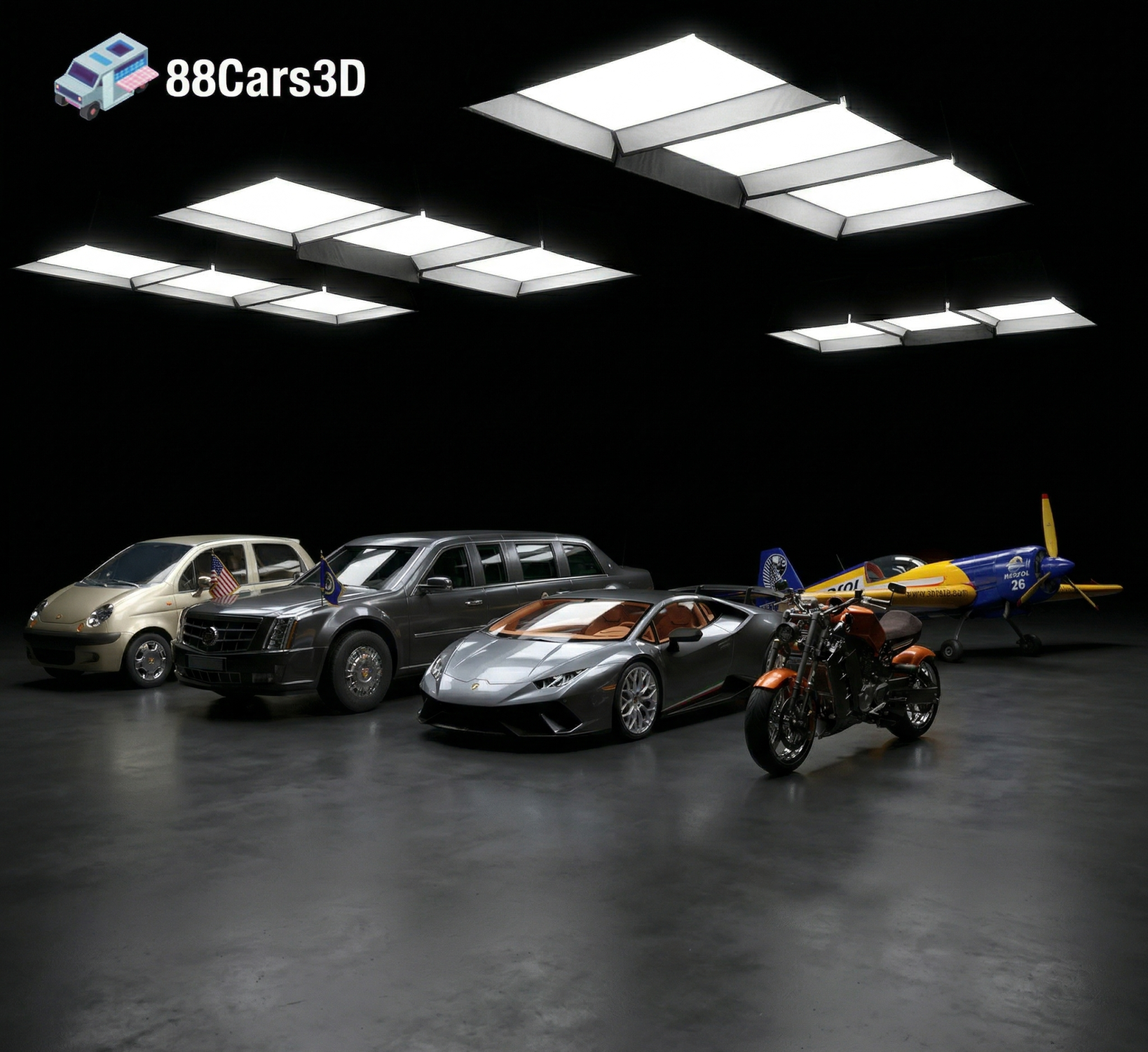
Texture: Yes | Material: Yes | 3D Printable: Yes. Download the Ultimate Creators’ Showcase featuring 5 premium 3D models: Lamborghini Huracan, ZAV Concept Motorcycle, Sukhoi SU-26, Presidential Limousine, and Daewoo Damas. Optimized for 4K CGI rendering and 3D printing. Save massive with this exclusive multi-category bundle!
Price: $99.99

Texture: Yes | Material: Yes | 3D Printable: Yes. Download the Italian Thoroughbreds Bundle featuring 5 iconic 3D models: Lamborghini Huracán Performante, Ferrari 458 Italia, Lamborghini Urus, Diablo SV, and Maserati GT. Optimized for 4K rendering and 3D printing (STL included). Save 50% with this ultimate Italian vehicle collection.
Price: $199.99

Download the Elite Future Mobility Bundle featuring 4 highly optimized 3D models: Tesla Model S, Avatr 11, Li L9, and Zoox Robotaxi. Perfect for ArchViz, Smart City renders, and game dev. Optimized for Unreal Engine and Blender. Includes .fbx, .obj, and .max formats.
Price: $99

🚗 5 Iconic German Cars (BMW M4 G82, M5 CS, X3, 1 Series & Mercedes E-Class). ✅ Optimized for ArchViz: Ready for Corona & V-Ray. 💰 Save €71 with this limited-time collection! 🚀 Instant Download after purchase.
Price: $119

Download the Extreme Off-Road & Survival 3D Models Bundle! Includes the Brabus 800 Adventure, Dodge Ram Bigfoot, Spec Truck, and a Caravan. Save over €210 on this premium 4-in-1 off-grid vehicle pack for ArchViz and game development.
Price: $149.99

Download the Heavy Duty & Commercial Logistics 3D Models Bundle! Includes the Ford Sterling, Caterpillar CT680, Mercedes Citaro Bus, and Vito Van. Save over €130 on this massive, game-ready 4-in-1 industrial vehicle pack.
Price: $109.99

Download the Ultimate Custom Motorcycles 3D Models Bundle. Includes a Custom Chopper, Ducati 916 Café Fighter, Harley XR1200X, and BMW K100. Perfect premium props for luxury ArchViz garages. Save over €250 today!
Price: $159.99

Download the ultimate JDM Street Racing 3D Models Bundle! Includes the Nissan GT-R, Toyota Supra, Mazda RX-7, Lancer Evo IX, and Honda NSX. Save big on this highly optimized, game-ready 5-in-1 Japanese legend car pack.
Price: $129.99

Download the ultimate American Muscle & Cinematic Classics 3D Models Bundle! Includes the Dodge Charger ’68, Mustang Eleanor GT500, Camaro Z28 ’79, and a custom ’69 Mustang. Save over €240 on this game-ready, premium 4-in-1 pack.
Price: $149.99

Download the Everyday City Traffic 3D Models Bundle. Includes the VW Golf, Kia Picanto, Hyundai Tucson, Toyota Yaris, and a DHL Ford Transit Van. Save big on this 5-in-1 pack, perfectly optimized for realistic ArchViz streets and game traffic.
Price: $99.99

