Get 50% OFF All Premium 3D & STL Models!

“`html
The world of 3D printing is built on the foundation of digital models, and at its core, the widely adopted STL file format reigns supreme. While many 3D model repositories and design software offer models in various polygon-based formats like OBJ, FBX, or even native CAD files, the journey to the print bed often requires a conversion to STL. This is especially true for intricate designs such as detailed automotive models, where precision and manifold geometry are paramount. Whether you’re a hobbyist downloading your next favorite printable car from a marketplace like 88cars3d.com, a designer looking to prototype, or an educator guiding students, understanding the nuances of converting polygon models to STL is crucial for achieving successful, high-quality prints. This comprehensive guide will delve deep into the technical aspects of this conversion process, covering everything from mesh topology and repair to slicing strategies and printer-specific considerations. Get ready to transform your polygon models into print-ready STL files and unlock the full potential of your 3D printer.
Before we dive into the conversion process, it’s essential to grasp what makes an STL file suitable for 3D printing. The Stereolithography (STL) format, despite its age, remains the de facto standard for additive manufacturing. Its simplicity is its strength: it represents a 3D model’s surface geometry as a collection of triangular facets. Each triangle is defined by the coordinates of its three vertices and a normal vector, which indicates the outward-facing direction of the surface. This seemingly basic structure carries significant implications for printability.
The “topology” of a 3D mesh refers to how its vertices, edges, and faces are connected. For 3D printing, the most critical requirement is that the mesh must be “watertight” or “manifold.” This means the model must represent a solid, closed volume with no holes, gaps, or self-intersections. Imagine a balloon; it has a continuous surface with no openings. A non-manifold mesh is like a balloon with a leak or a patch; the printer’s slicer software cannot determine which side is inside and which is outside, leading to errors during the slicing process. Common non-manifold issues include:
When converting from other formats, especially those with more complex data like NURBS surfaces or polygonal models with internal structures, ensuring a clean, manifold mesh is the primary goal. This often involves significant mesh repair.
STL files come in two flavors: ASCII and Binary. ASCII STLs are human-readable text files, making them easier to inspect and sometimes to edit manually for small issues. However, they are significantly larger in file size. Binary STLs are much more compact and efficient, storing vertex and normal data as raw binary numbers. For 3D printing, especially for complex models like those found on 88cars3d.com, binary STL is generally preferred due to its smaller footprint and faster processing by slicer software. Most conversion tools will default to binary, but it’s good to be aware of the distinction.
The conversion process from other polygon formats (like OBJ, FBX, PLY) to STL is typically handled by 3D modeling software or specialized mesh editing utilities. The choice of tool often depends on the complexity of the original model, the extent of potential issues, and your familiarity with the software. For many users, integrating this step into their existing 3D modeling workflow is the most efficient approach.
Autodesk Meshmixer (now largely integrated into Fusion 360, but still available as a standalone download for older versions) is a powerful and accessible tool specifically designed for preparing 3D models for printing. It excels at mesh repair, simplification, and manipulation. Its “Inspector” tool can automatically identify and often fix non-manifold errors, holes, and intersecting planes. The “Make Solid” feature is particularly useful for converting surface models into watertight objects.
Blender, a free and open-source 3D creation suite, is another incredibly capable option. While it has a steeper learning curve than Meshmixer, its robust modeling and mesh editing tools are second to none. You can import OBJ, FBX, and many other formats directly. Blender’s “3D-Print Toolbox” add-on (which needs to be enabled in preferences) provides invaluable functions for checking manifold errors, wall thickness, and non-flat faces, and offers tools to repair these issues. For instance, using the “Solidify” modifier can add thickness to thin meshes, and Boolean operations can merge or subtract parts to create a watertight volume.
If your original model is in a CAD format (like STEP or IGES), you’ll typically need to export it as a mesh first. Most professional CAD packages (e.g., SolidWorks, Fusion 360, Inventor) have robust export options that allow you to convert NURBS surfaces into polygonal meshes. During this export, you can often control the mesh density and quality – a balance is needed here. Too low a density can result in a faceted, low-resolution approximation of the original curves, while excessively high density can create massive files that are difficult to handle. After exporting as an OBJ or similar format, you can then use Meshmixer or Blender for further repair and conversion to STL.
Dedicated mesh repair software like Netfabb (now part of Fusion 360) offers advanced automated repair algorithms and detailed analysis tools, often used in professional settings for complex industrial parts. While powerful, these tools can be overkill for simpler hobbyist projects but are invaluable for ensuring the highest level of printability for critical components.
Let’s outline a typical workflow using Blender:
Even models intended for 3D printing can sometimes have subtle errors that prevent successful slicing. Robust mesh repair is a critical step in the STL conversion pipeline. It’s not just about making the file a valid STL; it’s about ensuring the geometry is correctly interpreted by the slicer to produce a physically sound object.
Holes are perhaps the most common issue. In Meshmixer, select the model, go to Edit > Select Non-Manifold, which will highlight boundary loops (holes). Then, use Edit > Close Holes. Meshmixer offers different algorithms for closing holes; start with the default and experiment if the result isn’t satisfactory. In Blender, you can enter Edit Mode, select the edge loop of a hole (Alt-click on an edge), and press ‘F’ to fill it with a single face, or use Grid Fill for more complex holes if the topology allows. The 3D-Print Toolbox’s “Make Manifold” button can also attempt automatic hole filling.
Non-manifold edges and vertices are tricky. They can arise from intersecting internal geometry or faces that have been collapsed improperly. Meshmixer’s “Inspector” is excellent at finding these. You can often select the problematic area and use “Remove Doubles” or “Mesh > Reduce.” In Blender, entering Edit Mode and using Mesh > Clean Up > Merge by Distance can often resolve vertices that are too close together, effectively removing non-manifold edges. Sometimes, manually deleting offending faces and recreating the surface correctly is the only solution.
A critical factor for successful prints, especially with FDM printers, is ensuring that all parts of the model have a sufficient wall thickness. Extremely thin walls might not be captured by the slicer’s extrusion path or may be too fragile to print reliably. Software like Meshmixer has a “Thickness” analysis tool that visualizes areas of the mesh that are too thin. The “Solidify” modifier in Blender is indispensable for adding uniform thickness to surfaces that might be single-sided or have insufficient depth. When converting from CAD, pay close attention to the mesh export settings to avoid creating overly thin features.
Self-intersecting geometry means parts of the mesh cross over themselves, creating internal volumes that confuse the slicer. Meshmixer’s “Inspector” can flag these. Often, the “Make Solid” function can resolve many self-intersection issues by creating a new, clean outer shell. In Blender, using Boolean operations carefully, or manually editing the mesh to untangle intersecting planes, is usually necessary.
Once you have a clean, manifold STL file, the next crucial step is slicing. Slicer software (like Cura, PrusaSlicer, Simplify3D) takes your STL model and converts it into layer-by-layer instructions (G-code) that your 3D printer can understand. The settings you choose here have a direct impact on print quality, strength, and print time.
The way you orient your model on the virtual build plate in the slicer is vital. For car models, consider the primary forces they will experience. Printing a car body upright might require significant support structures, leading to difficult removal and potential surface scarring. Often, printing the model on its side or even upside down can minimize supports on detailed surfaces. Experiment with different orientations to find the best balance between support needs and surface finish. Bed adhesion is equally important. For larger models or materials like ABS, using a brim or raft can prevent warping and ensure the print stays firmly attached to the build plate throughout the process. Adhesion settings like bed temperature (e.g., 50-60°C for PLA, 90-110°C for ABS) and initial layer speed are critical.
Layer height is a fundamental setting that dictates the vertical resolution of your print. A smaller layer height (e.g., 0.1mm) results in finer detail, smoother curves, and a better finish, ideal for intricate car models. However, it also significantly increases print time. A larger layer height (e.g., 0.2mm or 0.3mm) prints much faster but can lead to more visible layer lines and less detail on curved surfaces. For most detailed automotive models, a layer height between 0.1mm and 0.15mm offers a good balance. Fine-tuning this setting based on the specific model’s details and your priorities (detail vs. speed) is key.
Infill provides internal support for the outer walls and top layers, contributing to the model’s strength and reducing material usage. For display models, a low infill density (10-15%) is often sufficient, using patterns like Grid or Gyroid. If the model needs to be durable or functional, increase the density (20-50% or higher) and consider stronger patterns like Cubic or Triangles. For hollow parts like car bodies, ensure you have adequate top layers (e.g., 4-5) to bridge the infill and create a solid roof.
Overhangs and bridges that exceed your printer’s capabilities (typically around 45-60 degrees) will require support structures. Modern slicers offer various support types (normal, tree/organic) and densities. Tree supports, in particular, can be very effective for complex shapes like car models, as they use less material and are often easier to remove. Crucially, adjust the support interface settings. A dense interface layer between the support and the model makes for a smoother surface finish on the overhang but can be harder to remove. Experiment with different support densities, Z-gaps (the vertical distance between the support and the model), and interface settings to find the optimal balance for clean removal and good surface quality. For very delicate or intricate models, consider enabling “Support on build plate only” if applicable.
The choice of 3D printing technology (FDM vs. Resin) and the material used will significantly influence the required preparation and the final outcome of your printed car models. Each has its own set of advantages and challenges.
Fused Deposition Modeling (FDM) printers build objects by extruding melted plastic filament layer by layer. They are common, affordable, and capable of printing larger models. Materials like PLA are easy to print and widely available, offering a good balance of detail and durability for display models. PETG offers increased strength and temperature resistance, while ABS provides excellent durability but requires higher temperatures and often an enclosure to prevent warping. When printing FDM car models, focus on achieving clean outer surfaces with minimal layer lines by optimizing print speed (typically 40-60 mm/s for quality prints), temperature, and cooling. Using a smaller nozzle size (e.g., 0.2mm or 0.25mm) can significantly improve detail on smaller prints but will increase print time.
Stereolithography (SLA) and Digital Light Processing (DLP) printers use UV-curable resins to build objects. They offer incredibly high resolutions, capturing fine details that are often impossible with FDM. This makes them ideal for highly detailed miniature car models, intricate wheels, or complex engine components. However, resin prints often require more extensive post-processing, including washing in isopropyl alcohol (IPA) to remove uncured resin and a final UV cure to achieve full strength. Support structures are mandatory and often finer and more numerous than with FDM. Careful support placement is critical to avoid damaging delicate details during removal. Resin types vary greatly: standard resins are good for general use, while tough or ABS-like resins offer enhanced durability. Always wear appropriate personal protective equipment (gloves, eye protection) when handling uncured resins.
Regardless of the technology, a well-calibrated printer is essential. For FDM, ensure your bed is leveled perfectly, and calibrate your extruder’s steps/mm (E-steps) to guarantee accurate filament extrusion. Check and clean your nozzle regularly. For resin printers, ensure the build plate is clean and level, and perform calibration tests (like the AmeraCube test) to dial in exposure times for optimal layer adhesion and detail reproduction. Regularly clean the resin vat and replace the FEP film if it becomes scratched or damaged.
The journey doesn’t end when the print finishes. Post-processing is where you transform a raw 3D print into a polished, display-worthy model. This stage is particularly important for automotive models where aesthetics are key.
Carefully remove support structures using flush cutters, hobby knives, or pliers. For FDM prints, a bit of sanding might be necessary to smooth out areas where supports were attached. Start with coarser grit sandpaper (e.g., 150-220 grit) and progress to finer grits (400, 600, 800, or even higher) for a smooth finish. For resin prints, supports often leave smaller marks, but careful sanding and, if desired, a coat of primer can hide them effectively. Tools like needle files are excellent for cleaning up small imperfections.
Gaps or small imperfections can be filled using modeling putty (like Tamiya Putty or Milliput) or a spot putty commonly used in automotive bodywork. Apply the filler, let it cure, and then sand it smooth. For an exceptionally smooth surface, especially before painting, applying a few thin coats of primer can reveal even minor imperfections that can then be filled and sanded again. This iterative process is key to achieving a professional finish.
Painting is where your 3D printed car model truly comes alive. Use acrylic paints, spray paints, or airbrushing techniques. Masking tape is essential for achieving clean lines between different colors (e.g., body color, trim, windows). Consider applying a clear coat (gloss or matte) at the end to protect the paint job and achieve the desired finish. If your model is designed to be printed in multiple parts (like a body and chassis, or separate wheels), ensure you have a good adhesion method for assembly, such as super glue (cyanoacrylate), epoxy, or plastic cement.
“`
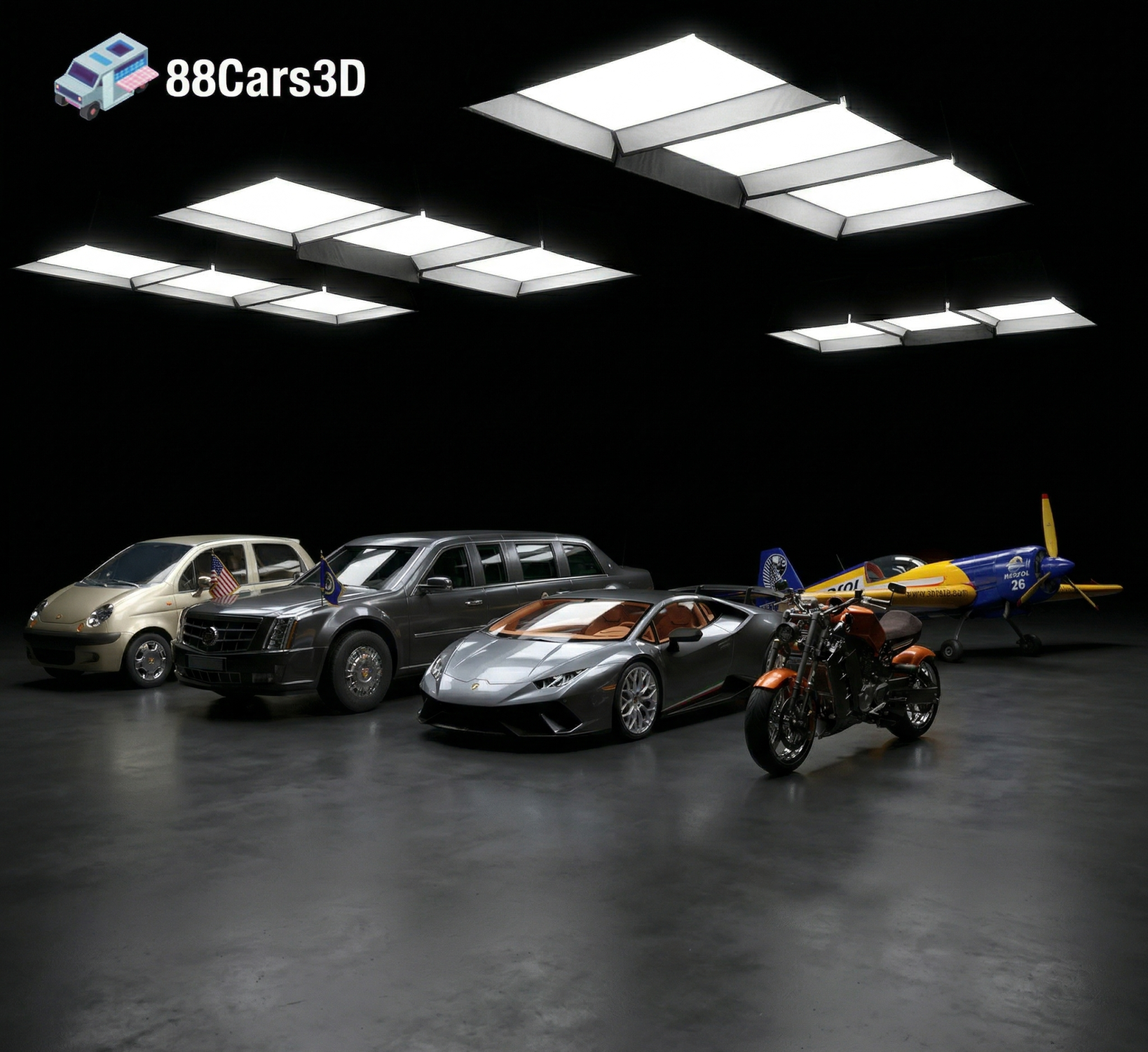
Texture: Yes | Material: Yes | 3D Printable: Yes. Download the Ultimate Creators’ Showcase featuring 5 premium 3D models: Lamborghini Huracan, ZAV Concept Motorcycle, Sukhoi SU-26, Presidential Limousine, and Daewoo Damas. Optimized for 4K CGI rendering and 3D printing. Save massive with this exclusive multi-category bundle!
Price: $99.99

Texture: Yes | Material: Yes | 3D Printable: Yes. Download the Italian Thoroughbreds Bundle featuring 5 iconic 3D models: Lamborghini Huracán Performante, Ferrari 458 Italia, Lamborghini Urus, Diablo SV, and Maserati GT. Optimized for 4K rendering and 3D printing (STL included). Save 50% with this ultimate Italian vehicle collection.
Price: $199.99

Download the Elite Future Mobility Bundle featuring 4 highly optimized 3D models: Tesla Model S, Avatr 11, Li L9, and Zoox Robotaxi. Perfect for ArchViz, Smart City renders, and game dev. Optimized for Unreal Engine and Blender. Includes .fbx, .obj, and .max formats.
Price: $99

🚗 5 Iconic German Cars (BMW M4 G82, M5 CS, X3, 1 Series & Mercedes E-Class). ✅ Optimized for ArchViz: Ready for Corona & V-Ray. 💰 Save €71 with this limited-time collection! 🚀 Instant Download after purchase.
Price: $119

Download the Extreme Off-Road & Survival 3D Models Bundle! Includes the Brabus 800 Adventure, Dodge Ram Bigfoot, Spec Truck, and a Caravan. Save over €210 on this premium 4-in-1 off-grid vehicle pack for ArchViz and game development.
Price: $149.99

Download the Heavy Duty & Commercial Logistics 3D Models Bundle! Includes the Ford Sterling, Caterpillar CT680, Mercedes Citaro Bus, and Vito Van. Save over €130 on this massive, game-ready 4-in-1 industrial vehicle pack.
Price: $109.99

Download the Ultimate Custom Motorcycles 3D Models Bundle. Includes a Custom Chopper, Ducati 916 Café Fighter, Harley XR1200X, and BMW K100. Perfect premium props for luxury ArchViz garages. Save over €250 today!
Price: $159.99

Download the ultimate JDM Street Racing 3D Models Bundle! Includes the Nissan GT-R, Toyota Supra, Mazda RX-7, Lancer Evo IX, and Honda NSX. Save big on this highly optimized, game-ready 5-in-1 Japanese legend car pack.
Price: $129.99

Download the ultimate American Muscle & Cinematic Classics 3D Models Bundle! Includes the Dodge Charger ’68, Mustang Eleanor GT500, Camaro Z28 ’79, and a custom ’69 Mustang. Save over €240 on this game-ready, premium 4-in-1 pack.
Price: $149.99

Download the Everyday City Traffic 3D Models Bundle. Includes the VW Golf, Kia Picanto, Hyundai Tucson, Toyota Yaris, and a DHL Ford Transit Van. Save big on this 5-in-1 pack, perfectly optimized for realistic ArchViz streets and game traffic.
Price: $99.99

