Get 50% OFF All Premium 3D & STL Models!

In the dynamic world of real-time rendering and automotive visualization, the quest for ultimate realism extends beyond meticulously crafted vehicle models. It encompasses the entire narrative, the environment, and, critically, the characters who inhabit these digital spaces. For years, populating virtual scenes with believable humans was a monumental task, demanding immense artistic skill, time, and computational resources. This challenge often meant compromising on character quality, leaving a noticeable gap in the otherwise stunning automotive presentations.
Enter MetaHuman Creator, Epic Games’ revolutionary cloud-based application that empowers developers and artists to generate photorealistic digital humans in minutes. Paired with the robust capabilities of Unreal Engine, MetaHumans offer an unprecedented level of fidelity, bringing a new dimension of immersion to automotive visualization, game development, virtual production, and interactive experiences. Imagine showcasing a high-fidelity car model, perhaps sourced from 88cars3d.com, not just in a pristine studio setting, but with a lifelike driver interacting with the interior, a virtual salesperson explaining features, or a family enjoying a scenic drive. This is the paradigm shift MetaHumans enable.
This comprehensive guide will delve into the seamless integration of MetaHuman Creator with Unreal Engine, exploring every facet from creation to optimization and advanced applications. We’ll uncover how to harness the power of these digital humans to elevate your automotive projects, ensuring your narratives are as compelling and realistic as the vehicles themselves. Prepare to unlock a new era of immersive storytelling and visualization.
The pursuit of photorealism in real-time rendering has always been a driving force behind technological advancements in game engines. While environments and vehicle models have reached astonishing levels of detail, human characters often remained the “uncanny valley” hurdle. MetaHuman Creator addresses this head-on, providing a solution that delivers exceptional fidelity with remarkable speed and accessibility. For the automotive industry, where precision and visual appeal are paramount, MetaHumans offer a transformative advantage.
MetaHuman Creator is a cloud-streamed application that leverages a vast library of scanned data and an intuitive interface to allow users to sculpt, style, and texture hyper-realistic digital humans. Each MetaHuman comes fully rigged, complete with a comprehensive set of facial and body animation controls, intricate hair and skin systems, and a robust LOD (Level of Detail) system. The underlying technology is built upon industry-leading techniques for realistic skin rendering, strand-based hair, and advanced rigging, all pre-configured for optimal performance within Unreal Engine.
The speed of creation is arguably its most significant benefit. What once took weeks or months for a dedicated character artist can now be achieved in a matter of minutes or hours, even for non-specialists. This democratizes high-fidelity character creation, allowing more resources to be allocated to other critical aspects of automotive projects, such as perfecting vehicle aerodynamics or refining interactive features.
For platforms offering high-quality 3D car models like 88cars3d.com, the integration of MetaHumans means more than just a pretty face; it means enhanced storytelling and increased immersion. In automotive visualization, realistic characters can:
By integrating MetaHumans, automotive studios and visualization professionals can move beyond static renders and create dynamic, emotionally resonant experiences that truly engage their audience. The emphasis shifts from merely presenting a car to telling a compelling story about its place in people’s lives.
The seamless integration between MetaHuman Creator and Unreal Engine is a testament to Epic Games’ commitment to streamlined workflows. The process, primarily handled through Quixel Bridge, is designed to be user-friendly while offering deep customization options once the MetaHuman is in your Unreal Engine project. This section will guide you through the essential steps to get your MetaHumans ready for prime time.
Before bringing your MetaHuman into Unreal Engine, you first need to create it. Access MetaHuman Creator via metahuman.com. The interface allows for extensive customization:
Once satisfied, give your MetaHuman a name and click “Download” in the top right corner. This prepares the asset for transfer to your Unreal Engine project via Quixel Bridge. Remember that each MetaHuman comes with 8 LODs (Levels of Detail), ensuring scalability across different platforms and performance targets.
The bridge between MetaHuman Creator and Unreal Engine is Quixel Bridge, a powerful application for accessing and managing Megascans assets, including MetaHumans. Ensure you have the Quixel Bridge application installed and logged in with your Epic Games account. Within your Unreal Engine project, you’ll need the “MetaHuman” and “Quixel Bridge” plugins enabled. You can find more details on enabling plugins in the official Unreal Engine documentation at dev.epicgames.com/community/unreal-engine/learning.
Here’s the workflow:
Your MetaHuman will appear as a Blueprint asset (e.g., BP_YourMetaHumanName) in the Content Browser, ready to be dragged into your scene. This Blueprint encapsulates all components – body, face, hair, clothing – and their associated materials and logic. This modular design makes them incredibly flexible for customization and animation.
While MetaHumans are designed for high fidelity, integrating them into complex automotive scenes or deploying them on performance-sensitive platforms like AR/VR requires careful optimization. Understanding their underlying structure and Unreal Engine’s rendering capabilities is key to striking the perfect balance between visual quality and real-time performance. This section focuses on making your MetaHumans performant without sacrificing their stunning realism.
Each MetaHuman comes pre-configured with 8 Levels of Detail (LODs), ranging from cinematic quality (LOD0) to highly optimized versions for distant views or mobile platforms (LOD7). The MetaHuman Blueprint automatically handles LOD switching based on screen space, but you have full control over this behavior. To inspect and adjust LODs:
When working with automotive configurators or interactive demos where characters might be close-up, LOD0 or LOD1 might be acceptable. For background characters in a large virtual production set or for AR/VR applications, forcing higher LODs (e.g., Min LOD 3 or 4) can significantly improve performance. The official Unreal Engine documentation provides excellent guidance on optimizing skeletal meshes for various scenarios.
MetaHuman materials are a masterclass in PBR (Physically Based Rendering), meticulously crafted to replicate the nuances of human skin, hair, and fabric. They leverage advanced features such as subsurface scattering (SSS) for skin, anisotropic shading for hair, and virtual textures for high-resolution details. To customize these materials without breaking their complex PBR setup:
Understanding these material parameters allows you to fine-tune the look of your MetaHuman to perfectly match the lighting and aesthetic of your automotive scene. For example, adjusting the reflectivity of clothing can make a virtual salesperson’s attire appear more luxurious, complementing a high-end vehicle from a marketplace like 88cars3d.com.
A static, photorealistic character, while impressive, only tells part of the story. The true power of MetaHumans in automotive visualization lies in their ability to animate and interact with their surroundings and the vehicles themselves. Unreal Engine provides a comprehensive suite of tools to breathe life into these digital actors, from subtle facial expressions to complex body movements and interactive logic.
MetaHumans come equipped with a sophisticated facial rig that supports a vast range of expressions and phonemes, making them ideal for realistic dialogue and emotional portrayal. Their body rig is also robust, compatible with standard animation workflows. Here’s how to animate them:
Combining these tools enables you to create everything from subtle head turns of a passenger admiring a car’s interior to a full-blown dialogue sequence with a virtual demonstrator.
Unreal Engine’s Blueprint visual scripting system is invaluable for making your MetaHumans interactive within an automotive context. You can script complex behaviors without writing a single line of C++ code. Consider these possibilities:
Blueprint allows for rapid prototyping and iteration, making it easy to test different interactive scenarios and refine the user experience. By connecting character animations with vehicle functions and user input, you can create truly engaging and memorable automotive showcases.
Pushing the boundaries of MetaHuman integration means mastering advanced lighting techniques, leveraging their capabilities in virtual production pipelines, and optimizing them for immersive AR/VR experiences. These areas represent the pinnacle of real-time visualization, where MetaHumans can truly shine alongside high-quality automotive assets.
Achieving convincing realism for MetaHumans is heavily dependent on accurate and artistic lighting. Unreal Engine’s advanced lighting features are essential:
Careful attention to lighting will make your MetaHumans feel truly present and grounded within your automotive visualization, enhancing the overall perceived quality.
Virtual production, particularly with LED volumes, is transforming automotive advertising and film. MetaHumans fit perfectly into this workflow:
The ability to iterate rapidly with photorealistic characters in a real-time environment makes MetaHumans an invaluable asset for modern virtual production pipelines.
Bringing MetaHumans into AR/VR for interactive automotive experiences introduces specific performance challenges due to the stringent frame rate requirements and processing limitations of headsets. Optimization is paramount:
With careful optimization, MetaHumans can deliver highly immersive and interactive experiences in AR/VR, allowing users to feel a genuine connection with virtual cars and digital companions in these cutting-edge applications.
The integration of MetaHuman Creator with Unreal Engine marks a significant leap forward for real-time visualization, particularly within the automotive sector. No longer are developers and artists constrained by the immense time and skill previously required to create believable digital characters. With MetaHumans, photorealistic digital humans are accessible, customizable, and production-ready, transforming the way we tell stories and present products.
Throughout this guide, we’ve explored the journey from crafting your MetaHuman in the cloud-based Creator, seamlessly importing and optimizing them within Unreal Engine, to animating them with sophisticated tools like Control Rig and Live Link. We’ve delved into the intricacies of PBR materials, efficient LOD management, and the power of Blueprint scripting for dynamic interactions. Furthermore, we’ve highlighted advanced applications in real-time lighting with Lumen, virtual production workflows, and critical optimization strategies for immersive AR/VR experiences, ensuring your MetaHumans look and perform flawlessly alongside high-quality vehicle assets from marketplaces like 88cars3d.com.
By leveraging MetaHumans, you can imbue your automotive visualizations with unparalleled realism and emotional depth. Your car models will no longer exist in a vacuum but will be surrounded by living, breathing digital characters, creating more engaging configurators, immersive marketing campaigns, and compelling cinematic content. The future of automotive visualization is interactive, immersive, and, thanks to MetaHumans, undeniably human. Dive in, experiment, and bring your automotive visions to life with characters that resonate.
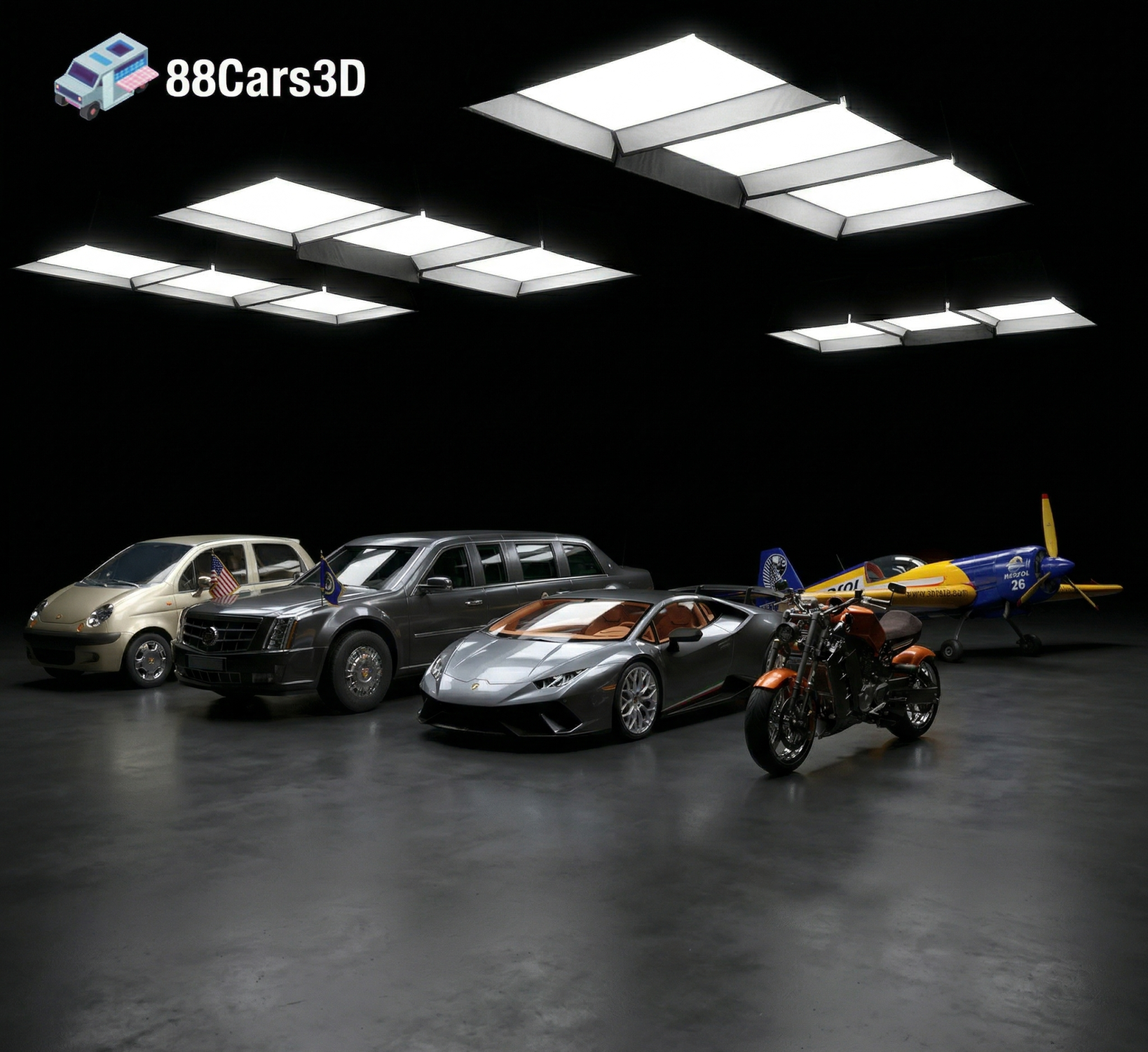
Texture: Yes | Material: Yes | 3D Printable: Yes. Download the Ultimate Creators’ Showcase featuring 5 premium 3D models: Lamborghini Huracan, ZAV Concept Motorcycle, Sukhoi SU-26, Presidential Limousine, and Daewoo Damas. Optimized for 4K CGI rendering and 3D printing. Save massive with this exclusive multi-category bundle!
Price: $99.99

Texture: Yes | Material: Yes | 3D Printable: Yes. Download the Italian Thoroughbreds Bundle featuring 5 iconic 3D models: Lamborghini Huracán Performante, Ferrari 458 Italia, Lamborghini Urus, Diablo SV, and Maserati GT. Optimized for 4K rendering and 3D printing (STL included). Save 50% with this ultimate Italian vehicle collection.
Price: $199.99

Download the Elite Future Mobility Bundle featuring 4 highly optimized 3D models: Tesla Model S, Avatr 11, Li L9, and Zoox Robotaxi. Perfect for ArchViz, Smart City renders, and game dev. Optimized for Unreal Engine and Blender. Includes .fbx, .obj, and .max formats.
Price: $99

🚗 5 Iconic German Cars (BMW M4 G82, M5 CS, X3, 1 Series & Mercedes E-Class). ✅ Optimized for ArchViz: Ready for Corona & V-Ray. 💰 Save €71 with this limited-time collection! 🚀 Instant Download after purchase.
Price: $119

Download the Extreme Off-Road & Survival 3D Models Bundle! Includes the Brabus 800 Adventure, Dodge Ram Bigfoot, Spec Truck, and a Caravan. Save over €210 on this premium 4-in-1 off-grid vehicle pack for ArchViz and game development.
Price: $149.99

Download the Heavy Duty & Commercial Logistics 3D Models Bundle! Includes the Ford Sterling, Caterpillar CT680, Mercedes Citaro Bus, and Vito Van. Save over €130 on this massive, game-ready 4-in-1 industrial vehicle pack.
Price: $109.99

Download the Ultimate Custom Motorcycles 3D Models Bundle. Includes a Custom Chopper, Ducati 916 Café Fighter, Harley XR1200X, and BMW K100. Perfect premium props for luxury ArchViz garages. Save over €250 today!
Price: $159.99

Download the ultimate JDM Street Racing 3D Models Bundle! Includes the Nissan GT-R, Toyota Supra, Mazda RX-7, Lancer Evo IX, and Honda NSX. Save big on this highly optimized, game-ready 5-in-1 Japanese legend car pack.
Price: $129.99

Download the ultimate American Muscle & Cinematic Classics 3D Models Bundle! Includes the Dodge Charger ’68, Mustang Eleanor GT500, Camaro Z28 ’79, and a custom ’69 Mustang. Save over €240 on this game-ready, premium 4-in-1 pack.
Price: $149.99

Download the Everyday City Traffic 3D Models Bundle. Includes the VW Golf, Kia Picanto, Hyundai Tucson, Toyota Yaris, and a DHL Ford Transit Van. Save big on this 5-in-1 pack, perfectly optimized for realistic ArchViz streets and game traffic.
Price: $99.99

