Get 50% OFF All Premium 3D & STL Models!

“`html
The world of 3D printing offers unparalleled opportunities to personalize and customize your projects. For automotive enthusiasts, this means bringing your favorite car models to life with impeccable detail, including accurate logos, emblems, and other custom features. At 88cars3d.com, we understand the importance of these details, as they are often what sets a model apart. This comprehensive guide will walk you through the process of adding these crucial elements to your STL files, ensuring your 3D printed car models are as authentic and visually appealing as possible. We’ll cover everything from understanding STL file structure to using various software tools, optimizing your designs for both FDM and resin printing, and troubleshooting common issues. Whether you’re a seasoned 3D printing veteran or a beginner, this guide will provide you with the knowledge and techniques to elevate your car model projects to the next level.
Before diving into the process of adding logos and emblems, it’s crucial to understand the fundamentals of the STL (Stereolithography) file format. STL files represent 3D models as a collection of triangular facets, essentially approximating the surface of the object. The density of these triangles directly impacts the resolution and smoothness of the final printed model. A higher triangle count results in a smoother surface but also increases file size and processing time.
When adding details like logos and emblems, it’s vital to ensure that the area where you’re adding the details has sufficient mesh density. This allows for a more accurate representation of the added geometry. If the existing mesh is too coarse, the logo or emblem might appear blocky or distorted. Consider using mesh editing software like Blender or Meshmixer to locally refine the mesh in the areas where you’ll be adding details. A good starting point is to aim for triangles that are approximately 0.5mm in size in the detail areas.
STL files must adhere to certain rules to be printable. The most important is that the mesh must be “manifold,” meaning it’s a closed, watertight surface without any holes, self-intersections, or non-manifold edges. Adding details incorrectly can introduce these errors. Software like Netfabb Basic or Meshmixer can automatically detect and repair these issues. Always run a mesh analysis after modifying your STL file to ensure it’s printable. Look for issues like flipped normals, open edges, and degenerate triangles. Repairing these issues before slicing will save you time and frustration down the line. When downloading models from marketplaces such as 88cars3d.com, you can expect properly prepared manifold STL files to begin with, but modifications always need checking.
Several software options are available for adding logos and emblems to STL files, each with its strengths and weaknesses. The best choice depends on your skill level, budget, and the complexity of the modifications you want to make.
Meshmixer is a free software from Autodesk that is excellent for basic mesh editing and modification. Its sculpting tools are particularly useful for blending in logos and emblems. You can import STL files, use the “Sculpt” tool to create recesses or protrusions for your details, and then import a separate STL file of the logo or emblem to merge with the main body. Meshmixer’s “Make Solid” function is also valuable for ensuring the final mesh is manifold and printable. However, it is no longer supported by Autodesk, so updates are unavailable.
Blender is a powerful, open-source 3D creation suite that offers a wide range of tools for mesh editing, sculpting, and rendering. While it has a steeper learning curve than Meshmixer, Blender provides greater control and flexibility. You can use Blender’s “Boolean” modifiers to subtract or add the logo or emblem geometry from the car model. Blender’s remeshing tools can also help optimize the mesh for 3D printing. Additionally, Blender is great for creating your own custom logos and emblems from scratch.
For users with a background in CAD (Computer-Aided Design), software like SolidWorks, Fusion 360, or AutoCAD can be used to modify STL files. These programs excel at precise geometric modeling, making them ideal for creating accurate and detailed logos and emblems. However, working with STL files in CAD software can be challenging, as they are inherently different from the parametric models that CAD programs typically use. Some CAD software require conversion of the STL to a solid body which can distort the original model. If using CAD, it is generally recommended to design the car body and emblem together natively.
Once you’ve chosen your software, the next step is to import the STL files of your car model and the logo or emblem you want to add. The positioning of the logo or emblem is crucial for achieving the desired aesthetic and ensuring printability. Careful consideration of the print orientation and support structures is necessary.
Boolean operations (Union, Difference, Intersection) are commonly used to integrate the logo or emblem with the car model. If you want the logo to be raised, you can use the “Union” operation to merge the two meshes. If you want the logo to be recessed, use the “Difference” operation to subtract the logo’s geometry from the car model. Before performing Boolean operations, ensure that the meshes are properly aligned and scaled. It’s often helpful to create temporary reference geometry to aid in the alignment process. If your Boolean operation is unsuccessful, try increasing the mesh density in the area of operation or simplifying the logo mesh. Overly complex logo geometries can sometimes cause Boolean operations to fail.
Adding logos and emblems to curved surfaces requires extra care. Ensure that the logo conforms to the curvature of the surface. Some software, like Blender, has tools that can help you wrap geometry around a curved surface. Alternatively, you can manually adjust the logo’s shape to match the curvature. When printing on a curved surface, the layer lines may be more visible. Consider using a smaller layer height to minimize this effect. Also, be aware of potential overhangs that may require support structures.
The choice between FDM (Fused Deposition Modeling) and resin printing significantly impacts how you should prepare your STL files. FDM printing is generally better for larger parts and functional prototypes, while resin printing excels at producing highly detailed and accurate models. Platforms like 88cars3d.com offer models optimized for both types of printing.
For FDM printing, the orientation of the model is critical. Choose an orientation that minimizes the need for support structures, especially in areas with fine details. Overhangs greater than 45 degrees typically require support. Use slicing software like Cura or PrusaSlicer to generate support structures automatically. Experiment with different support patterns and densities to find the optimal balance between support strength and ease of removal. Consider using dissolvable support material for complex geometries or when printing with multiple materials. A common FDM setting for car models is a layer height between 0.1mm and 0.2mm, an infill density of 15-25%, and a print speed of 40-60mm/s. Bed adhesion is crucial, so ensure a clean print bed and consider using a brim or raft.
Resin printing allows for incredibly fine details, making it ideal for reproducing intricate logos and emblems. However, large solid resin parts can be prone to warping and cracking due to internal stresses during the curing process. Hollowing the model is crucial for reducing resin consumption and improving print success. Use software like Chitubox or Lychee Slicer to hollow the model and add drainage holes. These holes allow uncured resin to escape from the inside of the model. Ensure that the holes are strategically placed in inconspicuous locations. When printing hollow models, increase the wall thickness to provide sufficient strength. A common resin setting for car models is a layer height between 0.025mm and 0.05mm, and an exposure time of 6-8 seconds. Support structures are essential in resin printing to hold the model in place and prevent warping. Use automatic support generation features in your slicer but also manually add supports to critical areas like overhangs and thin features.
Even with optimized STL files and careful printing, post-processing is often necessary to achieve a professional finish. Sanding, painting, and assembly can significantly enhance the appearance of your 3D printed car models.
Sanding is essential for removing layer lines and smoothing the surface of FDM printed parts. Start with coarse sandpaper (e.g., 220 grit) and gradually move to finer grits (e.g., 400, 600, 800, 1000). Wet sanding can help prevent the sandpaper from clogging and produce a smoother finish. For resin prints, sanding is typically less necessary due to the finer layer resolution, but it can still be used to remove any imperfections. Apply a primer after sanding to create a uniform surface for painting. Multiple thin coats of primer are better than one thick coat.
Painting is where your car model truly comes to life. Use automotive-grade paints for the best results. Apply multiple thin coats of paint, allowing each coat to dry completely before applying the next. Masking tape is essential for creating clean lines and separating different colored areas. Consider using airbrushing for a more professional finish. After painting, apply a clear coat to protect the paint and add shine. Decals and transfers can be used to add even more detail to your model. Numerous online retailers sell automotive decals in various scales. When applying decals, use a decal setting solution to help them conform to the surface.
Many car models consist of multiple parts that need to be assembled after printing. Use super glue or epoxy to join the parts together. Ensure that the parts are properly aligned before the glue sets. Fill any gaps or seams with putty or filler. Sand the filler smooth before painting. Final touches can include adding small details like mirrors, wipers, and antennas. These can be 3D printed or purchased from model car supply stores. Remember that car models available from platforms like 88cars3d.com are designed for simple assembly.
3D printing is not always a straightforward process, and you may encounter various issues along the way. Troubleshooting these problems is a crucial part of the learning experience.
Poor bed adhesion is a common problem, especially with FDM printing. Ensure that the print bed is level and clean. Use a bed adhesive like glue stick or hairspray. Adjust the nozzle height to ensure that the first layer is properly squished onto the bed. For materials like ABS, an enclosed build chamber can help prevent warping and improve bed adhesion. Check the temperature settings: The bed needs to be at the right temperature for proper adhesion. For PLA, 60°C is usually sufficient, but ABS requires a hotter bed, around 100-110°C.
Support structures can sometimes fail, leading to print failures. Increase the support density or thickness to make them stronger. Ensure that the supports are properly attached to the model and the print bed. Experiment with different support patterns to find the best balance between strength and ease of removal. For complex geometries, consider using dissolvable support material.
Warping and cracking are common problems with large prints, especially with materials like ABS and ASA. Use an enclosed build chamber to maintain a consistent temperature. Reduce the print speed to allow the plastic to cool more slowly. Increase the bed temperature to improve adhesion. Hollowing resin prints is important to avoid cracking.
Adding logos, emblems, and custom details to your 3D printed car models can significantly enhance their realism and visual appeal. By understanding the intricacies of STL file structure, mastering the use of various software tools, optimizing your designs for both FDM and resin printing, and employing effective post-processing techniques, you can create stunning and unique models. Remember to always ensure that your STL files are manifold and printable, and don’t be afraid to experiment with different settings and techniques. With practice and patience, you’ll be able to achieve professional-quality results. Whether you’re downloading pre-made models or designing your own from scratch, the possibilities are endless. Take advantage of the resources available online, and share your creations with the 3D printing community. Now, armed with this knowledge, go forth and create the car model of your dreams!
“`
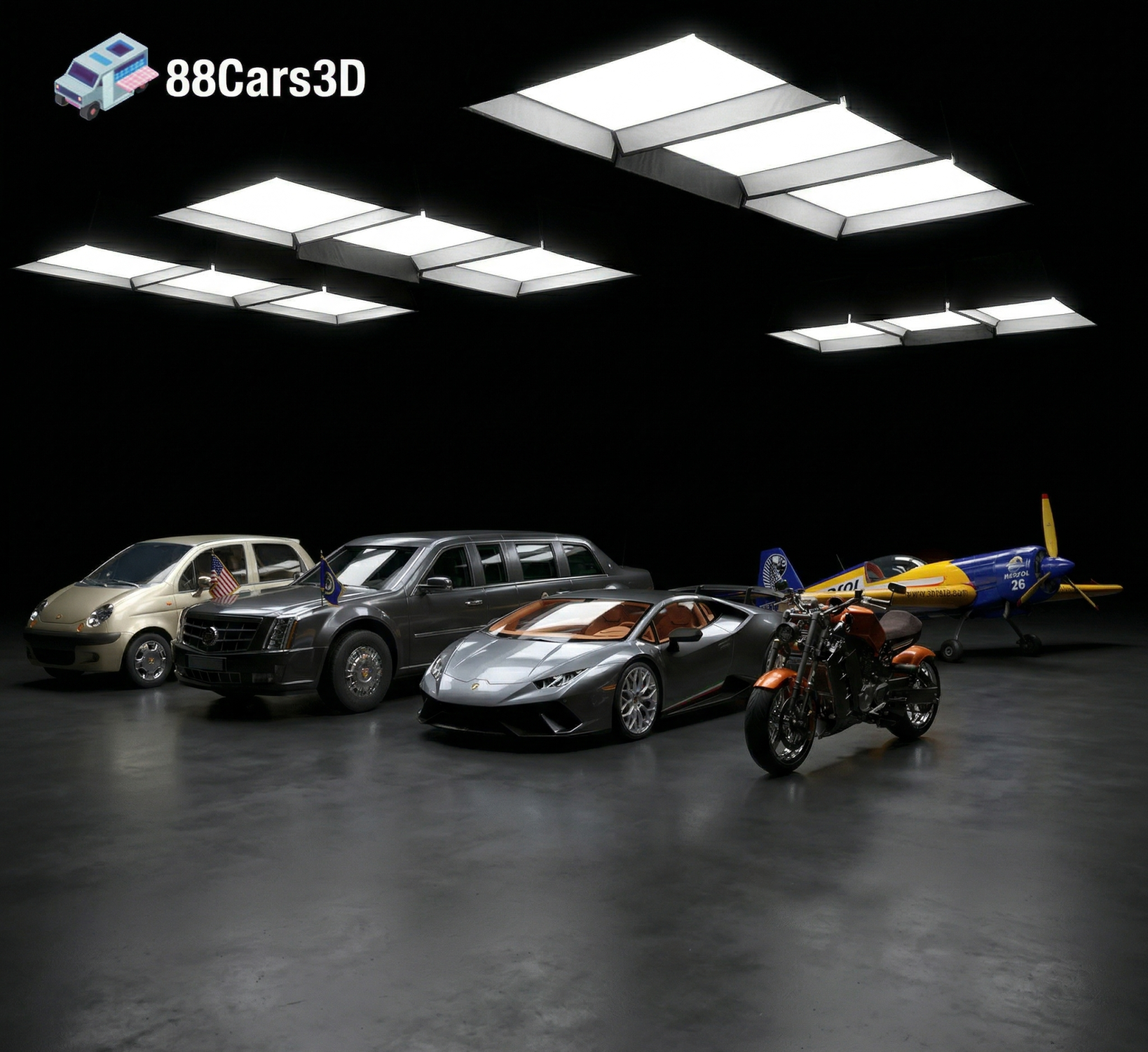
Texture: Yes | Material: Yes | 3D Printable: Yes. Download the Ultimate Creators’ Showcase featuring 5 premium 3D models: Lamborghini Huracan, ZAV Concept Motorcycle, Sukhoi SU-26, Presidential Limousine, and Daewoo Damas. Optimized for 4K CGI rendering and 3D printing. Save massive with this exclusive multi-category bundle!
Price: $99.99

Texture: Yes | Material: Yes | 3D Printable: Yes. Download the Italian Thoroughbreds Bundle featuring 5 iconic 3D models: Lamborghini Huracán Performante, Ferrari 458 Italia, Lamborghini Urus, Diablo SV, and Maserati GT. Optimized for 4K rendering and 3D printing (STL included). Save 50% with this ultimate Italian vehicle collection.
Price: $199.99

Download the Elite Future Mobility Bundle featuring 4 highly optimized 3D models: Tesla Model S, Avatr 11, Li L9, and Zoox Robotaxi. Perfect for ArchViz, Smart City renders, and game dev. Optimized for Unreal Engine and Blender. Includes .fbx, .obj, and .max formats.
Price: $99

🚗 5 Iconic German Cars (BMW M4 G82, M5 CS, X3, 1 Series & Mercedes E-Class). ✅ Optimized for ArchViz: Ready for Corona & V-Ray. 💰 Save €71 with this limited-time collection! 🚀 Instant Download after purchase.
Price: $119

Download the Extreme Off-Road & Survival 3D Models Bundle! Includes the Brabus 800 Adventure, Dodge Ram Bigfoot, Spec Truck, and a Caravan. Save over €210 on this premium 4-in-1 off-grid vehicle pack for ArchViz and game development.
Price: $149.99

Download the Heavy Duty & Commercial Logistics 3D Models Bundle! Includes the Ford Sterling, Caterpillar CT680, Mercedes Citaro Bus, and Vito Van. Save over €130 on this massive, game-ready 4-in-1 industrial vehicle pack.
Price: $109.99

Download the Ultimate Custom Motorcycles 3D Models Bundle. Includes a Custom Chopper, Ducati 916 Café Fighter, Harley XR1200X, and BMW K100. Perfect premium props for luxury ArchViz garages. Save over €250 today!
Price: $159.99

Download the ultimate JDM Street Racing 3D Models Bundle! Includes the Nissan GT-R, Toyota Supra, Mazda RX-7, Lancer Evo IX, and Honda NSX. Save big on this highly optimized, game-ready 5-in-1 Japanese legend car pack.
Price: $129.99

Download the ultimate American Muscle & Cinematic Classics 3D Models Bundle! Includes the Dodge Charger ’68, Mustang Eleanor GT500, Camaro Z28 ’79, and a custom ’69 Mustang. Save over €240 on this game-ready, premium 4-in-1 pack.
Price: $149.99

Download the Everyday City Traffic 3D Models Bundle. Includes the VW Golf, Kia Picanto, Hyundai Tucson, Toyota Yaris, and a DHL Ford Transit Van. Save big on this 5-in-1 pack, perfectly optimized for realistic ArchViz streets and game traffic.
Price: $99.99

