Get 50% OFF All Premium 3D & STL Models!

In the dynamic world of real-time rendering and immersive experiences, Unreal Engine stands as a powerhouse, enabling developers and artists to craft breathtaking virtual worlds. For those working with high-fidelity automotive assets – whether for game development, virtual production, marketing, or advanced visualization – efficient asset management and robust project organization are not just good practices; they are critical foundations for success. Without a clear structure, even the most stunning 3D car models can become unmanageable, leading to performance bottlenecks, convoluted workflows, and significant collaboration challenges. Imagine trying to navigate a vast garage filled with hundreds of vehicles, each with its unique components and specifications, but with no labeling or logical arrangement. That’s the challenge many face in Unreal Engine projects without proper organization.
This comprehensive guide will demystify the process, offering actionable strategies for setting up, managing, and optimizing your Unreal Engine projects, with a particular focus on the unique demands of automotive visualization. We’ll explore everything from establishing logical folder hierarchies and naming conventions to leveraging Unreal Engine’s cutting-edge features like Nanite and Lumen, mastering PBR materials, and building interactive experiences with Blueprint. By the end of this article, you’ll possess the knowledge to streamline your workflow, maximize performance, and unleash the full potential of high-quality 3D car models, ensuring your projects are not only visually stunning but also scalable and maintainable for the long haul.
The journey to a successful Unreal Engine project begins long before you import your first 3D model. It starts with a well-thought-out project structure and consistent naming conventions. These foundational elements are the bedrock upon which efficiency, scalability, and collaboration are built. Without them, even a small project can quickly devolve into a chaotic mess of unidentifiable assets, making it difficult to locate, modify, or share content. A clear structure acts like a meticulously organized library, allowing everyone on a team to understand where everything lives and what each asset represents at a glance. This becomes especially vital when dealing with numerous intricate components typical of high-fidelity automotive models, where each car might have dozens of meshes, textures, and materials.
A logical folder hierarchy within your Unreal Engine Content Browser is paramount. It dictates how assets are grouped and stored, simplifying navigation and maintenance. A common and highly effective approach is to categorize assets by type and then by specific content, like individual car models or environments. For example, your root ‘Content’ folder might contain:
Content/88Cars/: This top-level folder is ideal for all marketplace assets, especially premium 3D car models sourced from platforms like 88cars3d.com. Within this, create subfolders for each vehicle model (e.g., 88Cars/SedanX/, 88Cars/SportsCarY/).Content/Blueprints/: For all your Blueprint classes, actors, and interfaces.Content/Environments/: Contains subfolders for different scene elements (e.g., Environments/StudioA/, Environments/CityStreet/), each holding its meshes, textures, and materials.Content/Materials/: Master materials, material functions, and base material instances that might be shared across multiple assets.Content/Maps/: Your primary level maps for different scenes or showcase environments.Content/Meshes/: Generic static meshes not tied to a specific vehicle or environment.Content/Textures/: Generic textures, or textures used by master materials.Content/VFX/: Niagara particle systems, flipbook textures.Content/Audio/: Sound cues and audio files.Within specific vehicle folders (e.g., 88Cars/SedanX/), further subdivide to maintain granularity: Meshes/ (for body, wheels, interior components), Materials/ (for unique paints, fabrics, metallics), Textures/, Blueprints/ (for configurator logic specific to that car), and Animations/ (for door opening, wheel rotation). This structure ensures that all assets related to a specific car model are encapsulated, making it easy to migrate, update, or troubleshoot without impacting other parts of your project.
Alongside a logical folder structure, standardized naming conventions are non-negotiable. They enable quick identification of an asset’s type and purpose without needing to open it. Consistency across all assets in your project, from meshes to materials to Blueprints, saves countless hours in the long run. The general convention involves a prefix indicating the asset type, followed by a descriptive name, and optionally a suffix for specific variations:
SM_: Static Mesh (e.g., SM_SedanX_Body, SM_Wheel_Sport)SK_: Skeletal Mesh (e.g., SK_Driver_Character)T_: Texture (e.g., T_SedanX_Body_Albedo, T_SedanX_Body_Normal, T_SedanX_Body_ORM (Occlusion, Roughness, Metallic)M_: Master Material (e.g., M_CarPaint_Metallic, M_Interior_Leather)MI_: Material Instance (e.g., MI_SedanX_Paint_Blue, MI_Interior_Leather_Black)BP_: Blueprint Class (e.g., BP_SedanX_Configurator, BP_Door_Interactive)C_: Curve (e.g., C_Engine_RPM)SC_: Sound Cue (e.g., SC_Engine_Start)DT_: Data Table (e.g., DT_Vehicle_Specs)DA_: Data Asset (e.g., DA_SedanX_Data)Using these conventions, an asset like MI_SedanX_Paint_RedMetallic immediately tells you it’s a material instance for the SedanX model, specifically a red metallic paint. This level of clarity significantly reduces the cognitive load during development, prevents naming conflicts, and ensures that when a new team member joins, they can quickly understand the project’s content.
Once your project structure is ready, the next critical step is to bring your high-fidelity 3D car models into Unreal Engine. This process isn’t just about dragging and dropping files; it involves careful configuration and initial optimization to ensure visual fidelity, performance, and compatibility with Unreal Engine’s advanced features. High-quality 3D car models, such as those found on 88cars3d.com, often come with intricate details and high polygon counts, making the import and optimization phase crucial for real-time applications.
Unreal Engine primarily supports FBX and USD (Universal Scene Description) formats for importing 3D assets. Both offer robust capabilities, but their strengths lie in different areas. FBX is a mature, widely supported format excellent for static and skeletal meshes with animation. USD, on the other hand, is gaining traction as an open and extensible format, particularly beneficial for collaborative, non-destructive workflows in complex automotive design pipelines. USD facilitates the transfer of entire scenes, including hierarchies, materials, and variants, making it ideal for managing multiple configurations of a car model.
When importing an FBX mesh, pay close attention to the import dialog options:
For USD imports, Unreal Engine’s USD importer offers advanced features like variant sets and layer support, which are incredibly powerful for automotive visualization. You can import a USD stage containing different car configurations (e.g., different wheel types, interior trims) as variants, allowing you to switch between them directly within Unreal Engine. For more detailed information on Unreal Engine’s import processes and best practices, refer to the official documentation on Importing Assets into Unreal Engine.
High-quality 3D car models often feature incredibly dense geometry, easily exceeding tens of millions of polygons for a fully detailed vehicle. Traditionally, managing such high poly counts in real-time engines was a monumental task, requiring extensive manual optimization and LOD creation. Unreal Engine 5’s Nanite virtualized geometry system has revolutionized this, allowing you to import and render film-quality assets directly without significant performance overhead.
Enabling Nanite: For static meshes (which most car components will be), simply open the Static Mesh Editor, locate the “Nanite Settings” section, and check “Enable Nanite.” This instantly converts your mesh to a Nanite mesh. Nanite intelligently processes geometry, rendering only the detail necessary for each pixel on screen, dramatically reducing draw calls and memory footprint. This means you can have a car body with millions of triangles and several highly detailed interior components, all leveraging Nanite, running smoothly in real-time.
Nanite Considerations: While Nanite is a game-changer, it’s essential to understand its nuances. It works best with static meshes and currently doesn’t support skeletal meshes (though this is a future goal). For components that need to be animated via skeletal animation (e.g., an opening hood if rigged), traditional skeletal mesh workflows still apply, and you’ll need to manage their polygon counts more carefully. For performance-critical areas or where Nanite might not be applicable, you might still consider built-in Mesh Simplification tools within Unreal or external DCC applications to reduce triangle counts. When sourcing automotive assets from marketplaces such as 88cars3d.com, it’s wise to look for models explicitly designed with Unreal Engine’s features in mind, or those providing multiple LODs for maximum flexibility across various project types, including those that might not fully utilize Nanite.
Visual fidelity in automotive visualization hinges significantly on the quality of your materials and textures. Physically Based Rendering (PBR) is the industry standard for achieving photorealistic results, accurately simulating how light interacts with surfaces. In Unreal Engine, mastering the PBR workflow in the Material Editor is essential for making your 3D car models truly shine, whether they are sleek metallic paints, luxurious leather interiors, or intricate carbon fiber weaves.
PBR materials rely on a set of standardized texture maps that define a surface’s properties, rather than simply its color. The core PBR maps include:
In Unreal Engine’s Material Editor, you’ll typically create a Master Material that encapsulates common PBR logic (e.g., clear coat layers for car paint, shared parameters for wear and tear). From this master, you then create numerous Material Instances. Material Instances are incredibly powerful for automotive projects as they allow you to easily create variations (e.g., different car paint colors, varying leather finishes) by simply adjusting exposed parameters without recompiling the entire shader. This approach is memory-efficient and significantly speeds up workflow.
For a typical metallic car paint, your master material might include nodes for a base color, metallic and roughness, then blend a clear coat layer on top using custom shaders. The clear coat would have its own roughness and normal map input, mimicking the layered nature of real-world car finishes. Ensure your texture maps are correctly imported: Base Color should be sRGB, while Normal, Roughness, Metallic, and AO maps should have sRGB unchecked (imported as linear) and often use the “Masks (No sRGB)” compression setting for optimal quality and memory usage.
Effective texture management is crucial for balancing visual quality and performance. High-resolution textures are necessary for detailed automotive models, but they also consume significant memory. Strategic decisions regarding resolution, tiling, and atlasing are key.
Careful planning in the Material Editor, coupled with intelligent texture resolution choices and packing, ensures that your 3D car models from 88cars3d.com look stunning while maintaining optimal real-time performance.
Lighting is the soul of any real-time scene, and nowhere is this more evident than in automotive visualization. Realistic lighting can transform a static 3D model into a captivating, living object, highlighting its design and material properties. Unreal Engine offers powerful tools for dynamic, photorealistic lighting, but achieving optimal results requires a deep understanding of these systems and robust performance optimization strategies, especially when working with complex car models in real-time environments.
Unreal Engine 5’s Lumen is a revolutionary fully dynamic global illumination and reflections system designed to deliver photorealism without the need for lightmaps or pre-baked lighting. For automotive visualization, Lumen is a game-changer:
To set up Lumen, ensure “Global Illumination” and “Reflections” are set to “Lumen” in your Project Settings under “Rendering.” Combine Lumen with the Sky Atmosphere system for realistic outdoor environments or an HDRI Backdrop actor for studio-like setups. Placing your car model in a scene with a directional light (sun), a Sky Light (capturing the sky’s ambient light), and optionally some fill lights, Lumen will dynamically propagate light throughout the scene, reacting to every change in the environment or the car’s position. While Lumen is dynamic, it does have a performance cost. Optimizing your scene by keeping triangle counts reasonable (even with Nanite, some overhead exists) and adjusting Lumen quality settings can help maintain target frame rates.
Despite advancements like Nanite, traditional Level of Detail (LODs) and culling techniques remain vital for performance optimization, especially for non-Nanite meshes, target platforms like mobile/VR, or complex scenes with many objects. LODs are simplified versions of a mesh that are swapped in at varying distances from the camera, reducing the polygon count and draw calls for objects that are far away.
By effectively combining Lumen for global illumination, meticulous LOD management, and intelligent culling, you can achieve stunning visual quality for your 3D car models in Unreal Engine while maintaining a smooth and responsive real-time experience. Monitoring performance metrics like draw calls, triangle counts, and GPU frame time using the built-in profiling tools (e.g., ‘stat unit’, ‘stat rhi’) is essential to identify and address bottlenecks.
Beyond static visualization, Unreal Engine excels at creating dynamic and interactive experiences. For automotive projects, this often translates into configurators where users can customize a car in real-time, interactive showrooms, or animated sequences. Blueprint visual scripting and Data Assets are the backbone of building such scalable and maintainable interactive features, allowing artists and designers to create complex logic without writing a single line of code.
Blueprint is Unreal Engine’s powerful visual scripting system, enabling rapid prototyping and complex game logic development. For automotive configurators, Blueprint is invaluable. You can build systems that allow users to:
Structuring your Blueprint logic is crucial for maintainability. Use clear naming, organize nodes into functions and macros, and leverage interfaces and event dispatchers for communication between different Blueprints (e.g., a UI Blueprint communicating with a Car Blueprint). This modular approach ensures that your configurator remains robust and easy to update as your project evolves.
As the number of car models, color options, and configurable features grows, managing all this data directly within Blueprints can become cumbersome. This is where Data Assets come into play. A Data Asset (inheriting from UDataAsset) is a simple UObject that can store structured data, separate from specific Blueprint logic. They are ideal for:
The workflow involves creating a custom C++ struct or Blueprint Structure to define the data schema (e.g., FCarPaintOption with a name and a FLinearColor). Then, create a custom Data Asset type based on this structure. You can then create multiple instances of this Data Asset in the Content Browser, each representing a unique option (e.g., “RedPaint_DA”, “BluePaint_DA”). Your Blueprint logic would then load and apply data from these Data Assets. This decouples your data from your code, making it easy to add new options, modify existing ones, or collaborate on content without touching core Blueprint logic, significantly improving scalability and content management for complex automotive projects.
Unreal Engine’s capabilities extend far beyond simple real-time rendering. For automotive applications, integrating advanced workflows like virtual production for cinematic content and optimizing for demanding platforms like AR/VR can unlock new levels of creativity and reach. These advanced scenarios require specific strategies for asset management and performance to ensure a seamless and high-quality experience.
Virtual production, leveraging tools like Unreal Engine, is transforming how cinematic content, marketing videos, and even live broadcasts are created. For automotive projects, this means producing stunning, photorealistic car commercials, animated product reveals, or interactive brand experiences with unparalleled efficiency.
The ability to iterate on cinematic content in real-time within Unreal Engine, making instant changes to lighting, camera angles, or animations, drastically cuts down production time and costs compared to traditional linear workflows.
Extending automotive visualization to Augmented Reality (AR) and Virtual Reality (VR) platforms offers incredibly immersive experiences, but also introduces stringent performance requirements. Maintaining high frame rates (typically 72-90fps) and low latency is crucial to prevent motion sickness and ensure comfort for the user. This demands meticulous optimization and careful performance budgeting.
When purchasing 3D car models for AR/VR from platforms like 88cars3d.com, it is crucial to verify their poly count and optimization for these specific use cases, or to ensure they provide source files that allow for your own optimization passes. Meticulous planning and constant profiling are key to delivering a smooth and visually compelling automotive experience in AR and VR.
Navigating the complexities of Unreal Engine for high-fidelity automotive visualization demands more than just artistic talent; it requires a strategic approach to asset management and project organization. We’ve journeyed through the essential steps, from laying down the groundwork with logical folder structures and consistent naming conventions, to efficiently importing and leveraging the power of Nanite for high-poly 3D car models. We explored the intricacies of crafting photorealistic PBR materials, bringing scenes to life with advanced real-time lighting like Lumen, and ensuring smooth performance through meticulous LOD management and culling techniques.
Furthermore, we delved into building interactive experiences using Blueprint and scalable content management with Data Assets, opening doors to dynamic configurators and engaging showrooms. Finally, we touched upon advanced workflows like virtual production with Sequencer and critical optimization strategies for delivering immersive AR/VR automotive applications. Each of these components, when properly implemented, contributes to a streamlined workflow, enhanced collaboration, superior visual fidelity, and crucially, long-term project scalability.
By diligently applying these principles, you empower yourself to harness the full potential of Unreal Engine, transforming high-quality 3D car models from sources like 88cars3d.com into captivating real-time experiences. Embrace these best practices not just as technical requirements, but as creative enablers that allow you to focus on innovation and design, knowing your project is built on a solid, optimized foundation. The world of real-time automotive visualization is constantly evolving, and a well-organized project is your most powerful tool to stay ahead and create truly remarkable virtual journeys.
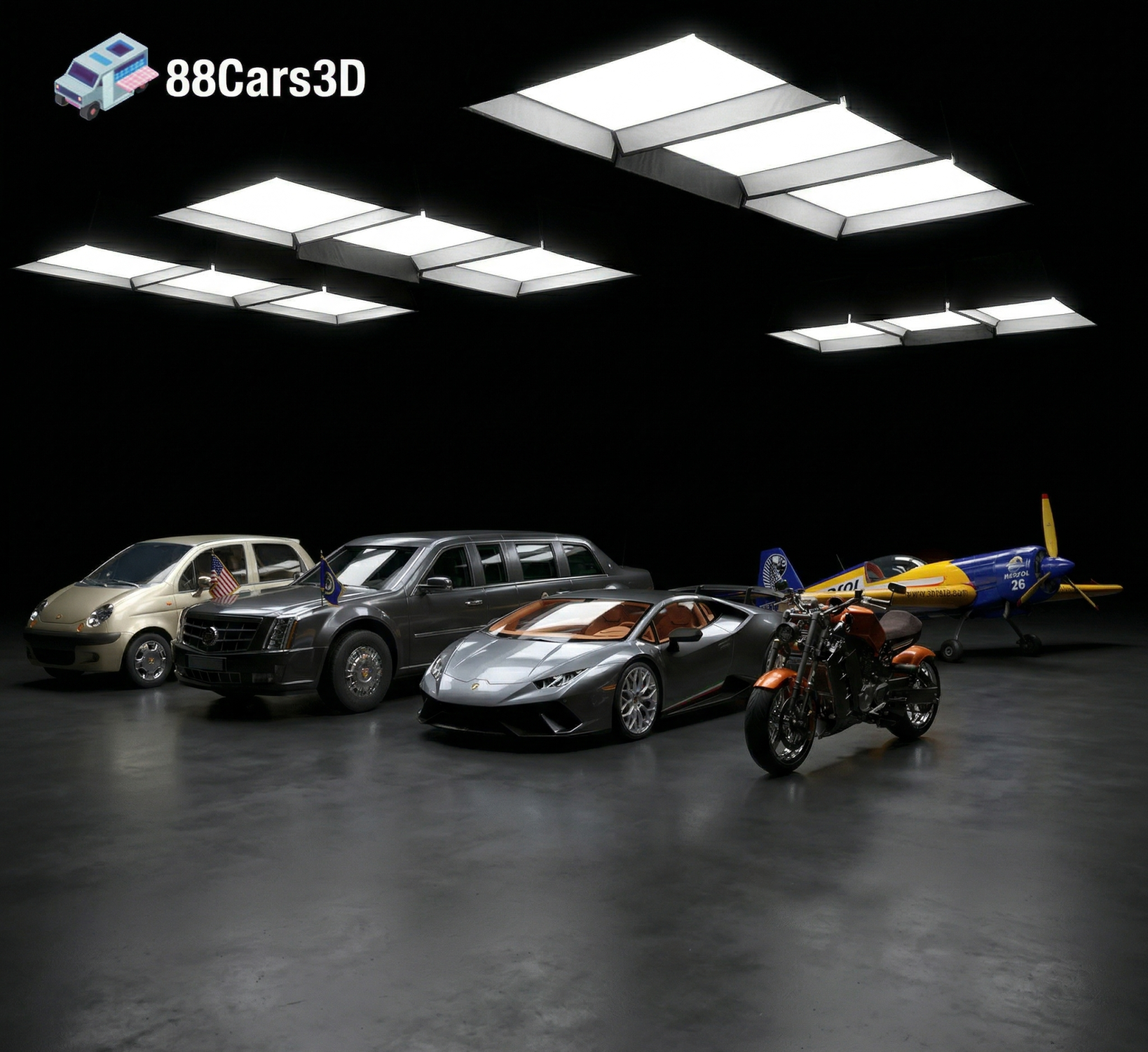
Texture: Yes | Material: Yes | 3D Printable: Yes. Download the Ultimate Creators’ Showcase featuring 5 premium 3D models: Lamborghini Huracan, ZAV Concept Motorcycle, Sukhoi SU-26, Presidential Limousine, and Daewoo Damas. Optimized for 4K CGI rendering and 3D printing. Save massive with this exclusive multi-category bundle!
Price: $99.99

Texture: Yes | Material: Yes | 3D Printable: Yes. Download the Italian Thoroughbreds Bundle featuring 5 iconic 3D models: Lamborghini Huracán Performante, Ferrari 458 Italia, Lamborghini Urus, Diablo SV, and Maserati GT. Optimized for 4K rendering and 3D printing (STL included). Save 50% with this ultimate Italian vehicle collection.
Price: $199.99

Download the Elite Future Mobility Bundle featuring 4 highly optimized 3D models: Tesla Model S, Avatr 11, Li L9, and Zoox Robotaxi. Perfect for ArchViz, Smart City renders, and game dev. Optimized for Unreal Engine and Blender. Includes .fbx, .obj, and .max formats.
Price: $99

🚗 5 Iconic German Cars (BMW M4 G82, M5 CS, X3, 1 Series & Mercedes E-Class). ✅ Optimized for ArchViz: Ready for Corona & V-Ray. 💰 Save €71 with this limited-time collection! 🚀 Instant Download after purchase.
Price: $119

Download the Extreme Off-Road & Survival 3D Models Bundle! Includes the Brabus 800 Adventure, Dodge Ram Bigfoot, Spec Truck, and a Caravan. Save over €210 on this premium 4-in-1 off-grid vehicle pack for ArchViz and game development.
Price: $149.99

Download the Heavy Duty & Commercial Logistics 3D Models Bundle! Includes the Ford Sterling, Caterpillar CT680, Mercedes Citaro Bus, and Vito Van. Save over €130 on this massive, game-ready 4-in-1 industrial vehicle pack.
Price: $109.99

Download the Ultimate Custom Motorcycles 3D Models Bundle. Includes a Custom Chopper, Ducati 916 Café Fighter, Harley XR1200X, and BMW K100. Perfect premium props for luxury ArchViz garages. Save over €250 today!
Price: $159.99

Download the ultimate JDM Street Racing 3D Models Bundle! Includes the Nissan GT-R, Toyota Supra, Mazda RX-7, Lancer Evo IX, and Honda NSX. Save big on this highly optimized, game-ready 5-in-1 Japanese legend car pack.
Price: $129.99

Download the ultimate American Muscle & Cinematic Classics 3D Models Bundle! Includes the Dodge Charger ’68, Mustang Eleanor GT500, Camaro Z28 ’79, and a custom ’69 Mustang. Save over €240 on this game-ready, premium 4-in-1 pack.
Price: $149.99

Download the Everyday City Traffic 3D Models Bundle. Includes the VW Golf, Kia Picanto, Hyundai Tucson, Toyota Yaris, and a DHL Ford Transit Van. Save big on this 5-in-1 pack, perfectly optimized for realistic ArchViz streets and game traffic.
Price: $99.99

