The pursuit of photorealism in real-time rendering has never been more exciting, especially within the automotive industry. From groundbreaking game titles to immersive architectural visualizations and high-fidelity automotive configurators, Unreal Engine stands as a powerhouse, enabling artists and developers to bring stunning visions to life. However, merely achieving visual fidelity is only half the battle; maintaining buttery-smooth performance, especially with complex 3D car models and intricate environments, is paramount. Whether you’re showcasing the sleek curves of a concept car in an interactive demo or pushing the boundaries of virtual production, understanding and applying robust optimization techniques within Unreal Engine is crucial for success.
This comprehensive guide delves deep into the strategies and workflows required to elevate your automotive projects in Unreal Engine, ensuring both visual excellence and optimal frame rates. We’ll explore everything from efficient project setup and advanced material creation to leveraging cutting-edge features like Nanite and Lumen, alongside time-tested optimization practices. Our goal is to equip you with the knowledge to craft captivating automotive visualization experiences that run flawlessly, making the most of your meticulously crafted game assets and high-quality 3D car models.
Foundation First: Project Setup and Importing Optimized Assets
A high-performance Unreal Engine project begins with a solid foundation. Proper project setup and the intelligent selection and import of 3D car models are the critical first steps in achieving optimal real-time rendering performance. Neglecting these initial stages can lead to cascading performance issues down the line, making subsequent optimization efforts far more challenging.
Initial Project Settings for Performance
When starting a new project, selecting the right template and configuring initial settings can significantly impact performance. For high-fidelity automotive work, consider starting with the “Blank” or “Games” template, then enabling specific plugins and rendering features as needed. Avoid enabling unnecessary plugins that consume resources without providing value to your specific project. Always ensure your project targets the appropriate hardware profile (e.g., Desktop, Mobile, VR) and adjust scalability settings accordingly from the outset.
Important project settings to review include:
- Engine Scalability Settings: Access via Editor > Settings > Engine Scalability Settings. Start with “High” or “Epic” and selectively dial down individual settings if performance bottlenecks arise.
- Texture Streaming: Enable in Project Settings > Engine > Rendering > Texture Streaming. This ensures textures are loaded efficiently based on visibility and distance, reducing memory footprint.
- Lighting: Determine your primary lighting strategy early. If you’re using Lumen, ensure it’s enabled and configured correctly. For projects requiring baked lighting, understand the implications of Lightmass settings.
- Distance Field Ambient Occlusion: Enable if beneficial for your scene, but monitor performance impact.
The Importance of High-Quality, Optimized 3D Car Models
The quality and optimization of your source 3D car models are perhaps the single most significant factor influencing performance. Starting with poorly optimized models – those with excessive polygon counts, messy topology, or unoptimized UVs – is a recipe for disaster. This is where sourcing assets from reputable platforms becomes invaluable. Marketplaces like 88cars3d.com offer pre-optimized, high-quality 3D car models specifically designed for Unreal Engine, featuring clean topology, proper UV mapping, and PBR-ready materials. These assets are built with performance and visual fidelity in mind, saving countless hours of manual optimization.
When evaluating models, look for:
- Clean Topology: Quads are generally preferred, with minimal triangles and no n-gons. This aids in deformation, LOD generation, and Nanite performance.
- Efficient Polygon Count: While Nanite helps manage high-poly meshes, even Nanite has limits. A well-constructed base mesh with reasonable density is always better.
- Proper UV Mapping: Non-overlapping, correctly scaled UVs are crucial for texture quality, lightmaps, and efficient material application.
- Consistent Scale and Origin: Ensures easy integration and avoids scaling issues or pivot point discrepancies.
Efficient Model Import and Scaling
Once you have your optimized 3D car models, importing them into Unreal Engine needs to be handled strategically. The FBX format remains a robust choice for static meshes, while USD (Universal Scene Description) is gaining traction for more complex scene descriptions and collaborative workflows. When importing:
- Import Options: Carefully review the FBX Import Options. Deselect “Auto Generate Collisions” for complex car meshes; custom collision meshes are almost always superior for vehicles. Enable “Combine Meshes” if the car model is split into many small components but doesn’t require individual material assignments or interactions.
- Scale: Ensure your models are scaled correctly upon import. Unreal Engine uses centimeters as its base unit (1 unit = 1 cm). Confirm your DCC (Digital Content Creation) software export settings match this for consistent results.
- Naming Conventions: Adhere to clear naming conventions for meshes, materials, and textures. This improves project organization and reduces errors, especially in larger teams.
For more detailed information on importing assets, refer to the official Unreal Engine documentation at https://dev.epicgames.com/community/unreal-engine/learning, specifically the sections on asset import pipelines.
Mastering Materials and Textures for Real-time Performance
Materials and textures are the skin of your 3D car models, dictating their visual appeal and realism. However, poorly optimized materials can quickly become a major performance bottleneck in real-time rendering. Achieving stunning aesthetics without compromising frame rates requires a deep understanding of PBR principles, texture management, and the power of material instances.
PBR Material Creation and Optimization
Physically Based Rendering (PBR) is the industry standard for achieving realistic materials. PBR materials use maps (Albedo/Base Color, Normal, Roughness, Metallic, Ambient Occlusion) to simulate how light interacts with surfaces in a physically accurate manner. While PBR is essential for realism, complexity can kill performance.
Optimization Strategies for PBR Materials:
- Minimize Shader Complexity: Each instruction in your material graph contributes to shader complexity. Use the “Shader Complexity” view mode (Alt+8) to identify expensive materials. Avoid unnecessary calculations, branching, and complex custom nodes.
- Combine Texture Maps: Pack multiple grayscale textures (like Roughness, Metallic, Ambient Occlusion) into different channels (Red, Green, Blue) of a single texture. This reduces texture lookups and memory bandwidth. A common setup is RMA (Roughness, Metallic, Ambient Occlusion) in one texture.
- Use Static Switches: For features that are either on or off, use static switches in your material. This compiles out the unused branch, resulting in a lighter shader.
- Avoid Overdraw: Transparency and complex blend modes are expensive. Use them judiciously. Opaque materials are always preferred for performance.
Texture Management and Streaming
Textures consume significant memory and bandwidth. Efficient texture management is vital for smooth real-time rendering, especially for detailed 3D car models that often feature numerous high-resolution maps.
Key Practices for Texture Optimization:
- Appropriate Resolutions: Use texture resolutions that match the visual fidelity required. A general rule of thumb: objects viewed up close need higher resolutions (e.g., 4K or 8K for car body, 2K for interior details), while distant objects can use 512×512 or 1K. Avoid using excessively high resolutions where they aren’t necessary.
- Compression Settings: Unreal Engine offers various compression settings for textures. DXT1/BC1, DXT5/BC3, and BC7 are common choices. Use “Normal Map” compression for normal maps and “VectorDisplacementmap” for height maps. For masks, consider “Masks (No sRGB)” to save memory.
- Texture Streaming: Ensure texture streaming is enabled in your project settings and that individual textures are set to stream. This prevents all texture mip maps from being loaded into memory simultaneously, loading only what’s visible and necessary. Adjust “Mip Gen Settings” (e.g., FromTextureGroup, Sharpen0, Sharpen5) to control mip map generation.
- Texture Groups: Assign textures to appropriate texture groups (e.g., World, UI, Character) to control their streaming behavior and maximum resolution settings more broadly.
Material Instances for Scalability
Material Instances are one of the most powerful features in Unreal Engine for material optimization and workflow efficiency. Instead of creating a new material for every slight variation (e.g., different car paint colors or metallic finishes), you create a master material with exposed parameters and then create instances from it. These instances only store the overridden parameter values, making them incredibly lightweight compared to full materials.
Benefits of Material Instances:
- Reduced Draw Calls: While not a direct draw call reducer, consistent material usage helps batching.
- Faster Iteration: Changes to the master material propagate to all instances. Adjusting parameters on instances is instantaneous.
- Lower Memory Footprint: Instances are significantly lighter on memory than unique materials.
- Optimized Shader Compilation: The master material compiles once, and instances inherit its compiled shader.
For automotive configurators, a master car paint material with parameters for base color, metallic strength, roughness, clear coat intensity, and flake normal intensity is essential. You can then create countless variations simply by adjusting these parameters on material instances, driving them through Blueprint scripts for interactive changes.
Lighting the Scene: Lumen, Ray Tracing, and Performance
Lighting is paramount for showcasing the beauty of 3D car models in Unreal Engine. Realistic reflections, dynamic shadows, and believable global illumination transform a static mesh into a living, breathing object. However, advanced lighting techniques, particularly those powered by real-time solutions like Lumen and hardware-accelerated ray tracing, can be incredibly demanding. Balancing visual fidelity with performance is a fine art.
Leveraging Lumen for Dynamic Global Illumination
Lumen is Unreal Engine’s revolutionary real-time global illumination and reflections system. It calculates diffuse inter-reflection and reflections at large, infinite distances, providing incredibly realistic lighting for dynamic scenes without the need for time-consuming light baking. For automotive visualization, Lumen is a game-changer, allowing for dynamic time-of-day changes, moving vehicles, and interactive environments that react realistically to light sources.
Optimizing Lumen for Automotive Scenes:
- Enable Lumen: Navigate to Project Settings > Engine > Rendering, then under Global Illumination and Reflections, set them both to “Lumen.” Restart the editor.
- Scene Geometry: Lumen works by tracing rays against a software representation of your scene geometry. Ensure your static meshes (especially the ground, walls, and other large surfaces) have accurate Distance Field representations. You can visualize these with the “Show > Visualize > Mesh DistanceFields” view mode.
- Lumen Settings: Adjust Lumen’s quality and performance settings in the Post Process Volume. Key settings include:
Lumen Global Illumination > Quality (higher values mean more rays, better quality, higher cost).Lumen Reflections > Quality.Lumen Scene > Max Trace Distance (controls how far Lumen traces rays).Lumen > Translucency Reflectivity/Diffuse (adjust for accurate interaction with car glass).
- Optimize Light Sources: Reduce the number of dynamic lights if possible. Prioritize directional lights (sun) and skylights, as these are efficiently handled by Lumen. Use Rect Lights or Spot Lights sparingly for specific accents or reflections.
Strategic Use of Traditional Lighting and Baked Solutions
While Lumen offers unparalleled dynamism, it’s not always the most performant solution for every scenario, especially on lower-end hardware or for specific project constraints. Traditional lighting methods still hold their place and can be optimized for great results.
Baked Lighting with Lightmass:
- For static environments, baked lighting using Lightmass can deliver highly optimized, high-quality global illumination at almost no run-time cost. This is ideal for fixed camera angles or environments where the car is the only dynamic element.
- Ensure all static meshes have proper, non-overlapping lightmap UVs (usually UV channel 1 or 2).
- Adjust Lightmass settings in World Settings for quality/build time trade-offs. Use higher “Indirect Lighting Quality” and “Indirect Lighting Smoothness” for better results.
Performance-Friendly Dynamic Lighting:
- Stationary Lights: These lights combine baked static lighting with dynamic shadows and specular highlights. They are a good middle-ground solution, offering some dynamism at a lower cost than fully movable lights.
- Movable Lights: Use movable lights only when absolutely necessary (e.g., headlights, animated scene elements) due to their high performance cost.
- Shadow Optimization: Adjust shadow distances and cascades for directional lights. Lowering the “Shadow Map Resolution” for individual lights can also help. Utilize “Distance Field Shadows” for efficient large-scale soft shadows.
Reflections and Post-Processing Optimization
Realistic reflections are crucial for showcasing polished car surfaces. Beyond Lumen, other reflection methods exist, each with performance implications.
- Screen Space Reflections (SSR): Cost-effective but limited to reflecting what’s on screen. Enable in Post Process Volume.
- Planar Reflections: Ideal for perfectly flat surfaces (e.g., showroom floors, water puddles) but very expensive as it renders the scene twice. Use sparingly.
- Reflection Captures: For static reflections, place Sphere Reflection Captures and Box Reflection Captures around your scene. These bake static reflection cubemaps and are very cheap at runtime.
Post-Processing Optimization:
- Post-process effects like Bloom, Vignette, Chromatic Aberration, and Grain add visual polish but have a performance cost. Use them judiciously.
- The Post Process Volume contains a “Blend Weight” parameter. Set it to 0 for effects you’re not using to disable them completely.
- Tone Mapping: Crucial for accurate color rendition, usually left at default.
- Anti-Aliasing: TAA (Temporal Anti-Aliasing) is common, but DLSS/FSR are highly recommended for modern GPUs to improve quality and performance.
Geometry Optimization with Nanite and LODs
High-fidelity 3D car models can easily contain millions of polygons, making them notoriously difficult to render efficiently in real-time. Unreal Engine 5 introduces game-changing technologies like Nanite, while traditional techniques like Level of Detail (LODs) and culling remain essential for managing geometric complexity and achieving optimal real-time rendering performance.
Harnessing Nanite for High-Fidelity Car Models
Nanite is Unreal Engine 5’s virtualized geometry system, designed to handle incredibly complex, high-polygon meshes with ease. It fundamentally changes how geometry is processed, streaming only the necessary detail at a pixel level. This means you can import cinematic-quality 3D car models with millions of polygons without worrying about traditional polygon count limitations.
Implementing Nanite for Car Models:
- Enable Nanite: In Project Settings > Engine > Rendering, ensure “Nanite” is enabled.
- Convert Meshes: In the Static Mesh Editor for your car parts, simply check the “Enable Nanite” checkbox. Unreal Engine will automatically convert the mesh. You can also right-click on static meshes in the Content Browser and select “Nanite > Enable Nanite.”
- Fallback Meshes: Nanite allows you to specify a “Fallback Relative Error” which generates a low-poly proxy for distances where Nanite streaming is inefficient (e.g., when the object is very far away or seen from extreme angles).
- Nanite Visualization: Use the “Nanite Visualization” view modes (e.g., Triangles, Overdraw, Cluster Size) to analyze Nanite performance and identify areas for improvement.
- Limitations: While powerful, Nanite has a few limitations to be aware of: it doesn’t support deformation (skeletal meshes), custom UVs for lightmaps (use Virtual Texture Lightmaps instead), or certain rendering features (e.g., World Position Offset in materials without specific setup). For transparent or masked materials, Nanite can be enabled, but it uses a different rendering path that might be less efficient than for opaque geometry.
Implementing Strategic Level of Detail (LODs)
Even with Nanite, Level of Detail (LODs) remain a crucial optimization technique. For meshes that cannot use Nanite (e.g., skeletal meshes for characters, or specific assets where Nanite’s overhead isn’t justified), manual or automatic LOD generation is essential. LODs swap out high-polygon meshes for simpler versions as the camera moves away, dramatically reducing rendered triangle count.
Best Practices for LODs:
- Automatic LOD Generation: In the Static Mesh Editor, under “LOD Settings,” you can set the number of LODs and use the “Auto Generate LODs” feature. Experiment with “Screen Size” thresholds to control when LODs switch.
- Manual LOD Creation: For complex assets like 3D car models, manual LODs created in your DCC software often yield better results. Export separate meshes for each LOD (e.g., LOD0 – full detail, LOD1 – ~50% poly reduction, LOD2 – ~75% poly reduction, LOD3 – ~90% poly reduction) and import them into the Static Mesh Editor.
- Optimizing Transitions: Ensure smooth LOD transitions by adjusting “LOD Transition Settings” to avoid popping. “Dithered LOD Transition” can help mask the swap.
- Proxy Meshes: For very distant LODs, consider a simple proxy mesh that is just a basic silhouette of the car, or even a billboard if the car is extremely far away.
Occlusion Culling and Frustum Culling
Beyond explicit LODs, Unreal Engine employs culling techniques to prevent rendering geometry that isn’t visible. These are automatic optimizations that you should be aware of:
- Frustum Culling: This is a fundamental optimization where objects entirely outside the camera’s view frustum (the visible area) are not rendered.
- Occlusion Culling: More advanced, this technique prevents objects from being rendered if they are hidden behind other opaque objects (occluders). Unreal Engine uses various methods for occlusion culling, including hardware occlusion queries and software occlusion culling based on mesh distance fields. Ensure your large static meshes have accurate distance fields to aid software occlusion.
- Cull Distance Volumes: For fine-grained control, you can place “Cull Distance Volumes” to explicitly define maximum render distances for specific types of assets, ensuring small, insignificant details disappear at a distance. This is particularly useful for small props around a car, preventing them from being rendered when far away.
By effectively combining Nanite for critical high-poly assets with strategic LODs and relying on Unreal Engine’s built-in culling mechanisms, you can manage the geometric complexity of your automotive visualization projects and maintain high frame rates. This is a crucial aspect of overall Unreal Engine optimization.
Interactive Experiences and Cinematic Storytelling
Unreal Engine isn’t just for rendering static images; it’s a powerful platform for creating rich, interactive experiences and stunning cinematics. For automotive projects, this means developing dynamic configurators, interactive demos, and high-fidelity virtual production sequences. Leveraging Blueprint, Sequencer, and Chaos Physics allows developers to bring cars to life in compelling ways, demanding efficient integration and performance tuning.
Blueprint Scripting for Dynamic Automotive Configurators
Blueprint Visual Scripting is Unreal Engine’s robust, node-based scripting system that empowers artists and designers to create complex gameplay and interactive logic without writing a single line of code. For automotive configurators, Blueprint is indispensable for enabling real-time changes to vehicle paint colors, wheel types, interior materials, and even opening doors or trunks.
Blueprint Optimization Tips for Configurators:
- Event-Driven Logic: Minimize constant polling. Instead of checking every frame, use events (e.g., on button click, on component hit) to trigger logic only when necessary.
- Material Instance Parameters: As discussed, use Material Instances extensively. Your Blueprint logic should simply set scalar or vector parameters on these instances to change colors or properties. This is far more performant than swapping entire materials or creating new ones.
- Component Visibility: For changing wheels or other modular parts, toggle the visibility of Static Mesh Components rather than destroying and recreating them. This is faster and less prone to hitches.
- Data Tables and Arrays: Store configuration options (e.g., available paint colors, wheel models) in Data Tables or Arrays. This centralizes data and makes your Blueprint cleaner and more manageable.
- Profiling: Use the “Profiler” and “Stat Unit” commands (
Stat Unit, Stat Raw, Stat Game, Stat Render) to identify expensive Blueprint nodes or functions that might be causing performance spikes during interaction.
Crafting Cinematics with Sequencer and Virtual Production Workflows
Sequencer is Unreal Engine’s multi-track non-linear editor for creating cinematic sequences, animations, and gameplay events. It’s crucial for producing high-quality promotional videos, virtual tours, or even integrated cutscenes for interactive experiences. Coupled with virtual production techniques, Sequencer can drive complex camera movements, lighting changes, and character animations in real-time.
Optimizing Sequencer for Automotive Cinematics:
- Optimization for Playback: For real-time playback, ensure your scene runs smoothly outside of Sequencer. Sequencer itself doesn’t inherently add significant overhead beyond what’s already in your scene.
- Level Streaming: For large cinematic environments (e.g., cityscapes for a car chase), use Level Streaming to load and unload parts of the environment only when needed by the camera, reducing the memory footprint and improving performance during specific shots.
- Bake Animations: For complex animations (e.g., car doors opening), bake them into the Static Mesh or Skeletal Mesh to reduce runtime calculation.
- Virtual Production & LED Walls: When integrating 3D car models into virtual production workflows with LED walls, performance is paramount. Enable “nDisplay” for multi-display setups. Utilize “Movie Render Queue” for high-quality final exports, allowing for anti-aliasing, motion blur, and other effects to be rendered with superior quality offline. The goal in virtual production is to achieve stable frame rates (often 30-60fps) for camera tracking and real-time compositing.
Physics Simulation and Vehicle Dynamics
Unreal Engine’s Chaos Physics engine provides a robust framework for simulating realistic vehicle dynamics, collisions, and destruction. This is essential for racing games, driving simulators, or even just adding subtle suspension bounce to an interactive demo.
Optimizing Chaos Physics for Vehicles:
- Collision Complexity: Use simplified collision meshes for your car parts instead of complex per-poly collision. Convex Hulls or custom simplified meshes are far more performant for physics.
- Vehicle Blueprint Setup: The “Chaos Vehicle Movement Component” provides a streamlined way to set up realistic car physics. Optimize parameters like suspension stiffness, damping, and tire friction to achieve desired driving feel without over-simulating.
- Replication: For multiplayer experiences, efficiently replicate vehicle physics data. Only send essential data (position, rotation, velocity, input) rather than full physics states.
- Sleep Thresholds: Set appropriate sleep thresholds for physics bodies. Objects that are stationary shouldn’t be constantly simulated.
By mastering Blueprint for interactivity, Sequencer for captivating cinematics, and Chaos Physics for believable vehicle dynamics, you can create truly immersive and high-performance automotive visualization experiences within Unreal Engine.
Advanced Optimization for Specific Use Cases: AR/VR and Performance Profiling
Beyond general optimization, certain demanding applications like Augmented Reality (AR) and Virtual Reality (VR) require an even more rigorous approach to performance. Understanding how to profile your project and make targeted optimizations for these specific platforms is key to delivering a smooth and comfortable user experience. When sourcing automotive assets from marketplaces such as 88cars3d.com, it’s beneficial that they are often already optimized, providing a strong starting point for these demanding use cases.
Tailoring Performance for AR/VR Automotive Applications
AR/VR development imposes stringent performance requirements, typically demanding very high and stable frame rates (e.g., 90 FPS for VR) to prevent motion sickness and ensure immersion. This leaves very little budget for complex scenes, making every optimization crucial for 3D car models in AR/VR automotive applications.
Specific AR/VR Optimization Strategies:
- Targeted Resolutions: Render at the native resolution of the AR/VR headset, but consider using “Screen Percentage” in the Post Process Volume or Command Line Arguments (e.g.,
r.ScreenPercentage 80) to render at a lower resolution and then upsample, gaining performance at a slight visual cost.
- Forward Shading: For VR, consider using the “Forward Renderer” path in Project Settings > Rendering. While it has some limitations (e.g., fewer material inputs, no deferred decals), it can be significantly more performant than the default Deferred Renderer, especially for scenes with many lights and complex transparent materials.
- Instanced Stereo Rendering: Enable “Instanced Stereo” in Project Settings > Rendering. This renders both eyes in a single pass, significantly reducing CPU and GPU overhead for VR.
- Aggressive LODs: Employ even more aggressive LODs than for desktop. The angular resolution of VR displays means distant objects need far less detail. For crucial 3D car models, ensure LOD0 is robust and LOD1/2 drop polygons quickly.
- Baked Lighting: Rely heavily on baked lighting (Lightmass) for static scene elements to free up GPU resources. Avoid Lumen or complex dynamic lighting unless absolutely necessary and budget allows.
- Material Simplicity: Keep materials as simple as possible. Avoid complex transparency, refraction, or excessive instructions. Use opaque materials wherever feasible.
- Occlusion Culling: Ensure effective occlusion culling for environments to avoid rendering hidden geometry.
- Mobile VR Considerations: For mobile VR (e.g., Meta Quest), the performance budget is extremely tight. Further reduce polygon counts, texture resolutions, disable most post-processing effects, and utilize mobile-specific rendering features.
Advanced Performance Profiling Tools
Guesswork doesn’t cut it for performance optimization. Unreal Engine provides a suite of powerful profiling tools to pinpoint bottlenecks and quantify the impact of your optimizations.
- Stat Commands: Essential for quick diagnostics.
Stat Unit: Displays CPU (Game, Draw, GPU) and FPS.Stat FPS: Shows current frames per second.Stat Render: Detailed GPU rendering stats.Stat Game: Detailed CPU game thread stats.Stat InitViews: Shows culling and visibility calculations.Stat RHI: Low-level rendering hardware interface stats.Stat Memory: Memory usage overview.
- Session Frontend (Unreal Insights): This is your most powerful tool for deep dives. Accessible via Tools > Debug > Session Frontend. It allows you to record and analyze detailed CPU and GPU timings, memory usage, and frame data. You can filter by threads, events, and functions to identify exactly where your performance budget is being spent. For example, you can see how much time is spent rendering specific meshes, processing materials, or running Blueprint scripts.
- Shader Complexity View Mode (Alt+8): Visualizes the instruction count of your shaders, highlighting expensive materials.
- LOD Colorization View Mode: Shows which LOD is currently being rendered for each mesh, helping verify LOD transitions.
- GPU Visualizer (Ctrl+Shift+,): Provides a breakdown of GPU frame time, showing how much time is spent on various rendering passes (base pass, shadows, post-processing, etc.).
Data Streaming and Asset Management
Efficient asset management and data streaming are crucial for large-scale projects, especially those with numerous high-quality game assets like diverse car models. This ensures that assets are loaded and unloaded intelligently, minimizing memory usage and preventing hitches.
- Asset Naming Conventions: Stick to clear, consistent naming.
- Folder Structure: Organize your content in a logical, shallow hierarchy.
- Level Streaming: Break down large environments into smaller, manageable sub-levels that can be loaded/unloaded as the player moves through the scene. This is particularly useful for open-world automotive scenarios or large showrooms.
- Asset Audits: Periodically run asset audits to find unused assets, excessively large textures, or meshes with redundant geometry. The “Audit Assets” tool in the Content Browser can help.
- Virtual Textures (VT): For very large, detailed textures (e.g., terrain, massive decals), Virtual Textures can reduce memory overhead by streaming only the visible parts of the texture.
Mastering these advanced techniques and tools is essential for pushing the boundaries of Unreal Engine in demanding applications like AR/VR, ensuring your automotive visualization projects not only look incredible but also perform flawlessly across various platforms.
Conclusion: Driving Excellence in Real-time Automotive Visualization
The journey to creating breathtaking and performant automotive visualization experiences in Unreal Engine is a multifaceted one, requiring a blend of artistic vision, technical prowess, and diligent optimization. We’ve explored the critical pillars of this process, from laying a solid foundation with efficient project setup and high-quality 3D car models from resources like 88cars3d.com, to meticulously crafting PBR materials and intelligently illuminating your scenes with Lumen and traditional lighting.
The power of Nanite and strategic LOD management empowers you to manage geometric complexity like never before, while Blueprint scripting and Sequencer open doors to dynamic configurators and cinematic storytelling. Furthermore, understanding the nuances of AR/VR optimization and leveraging Unreal Engine’s profiling tools ensures your projects not only look exceptional but also run with the fluidity and responsiveness that modern interactive experiences demand.
Ultimately, achieving optimal real-time rendering performance isn’t about sacrificing visual fidelity, but rather about making informed decisions and applying intelligent techniques at every stage of development. By embracing these best practices, continuously profiling your work, and staying abreast of Unreal Engine’s evolving features, you can unlock the full potential of your automotive projects, delivering immersive and visually stunning experiences that captivate your audience. The road to real-time excellence is ongoing, but with these tools and techniques, you are well-equipped to navigate it with confidence.
Featured 3D Car Models
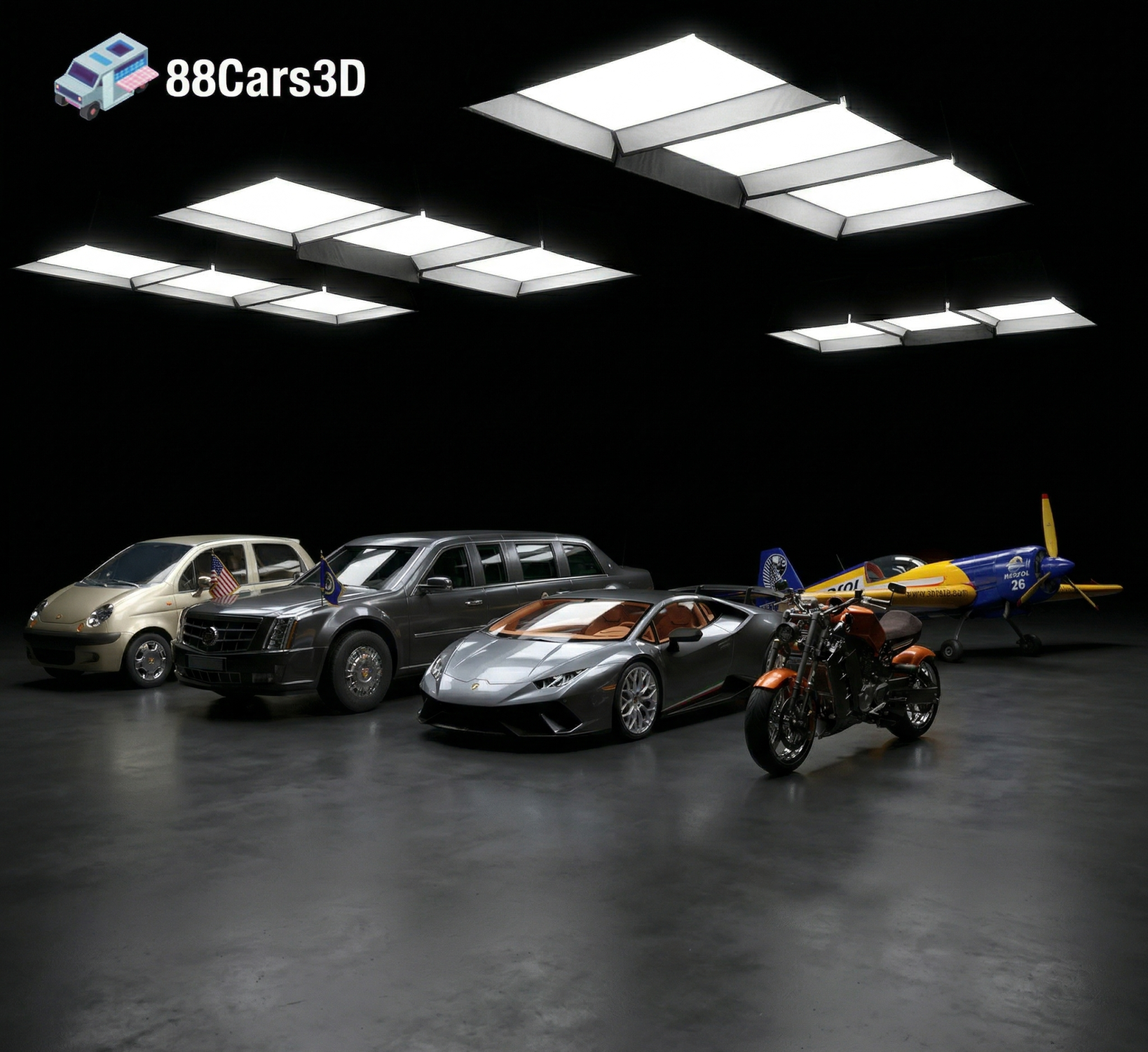
Texture: Yes | Material: Yes | 3D Printable: Yes. Download the Ultimate Creators’ Showcase featuring 5 premium 3D models: Lamborghini Huracan, ZAV Concept Motorcycle, Sukhoi SU-26, Presidential Limousine, and Daewoo Damas. Optimized for 4K CGI rendering and 3D printing. Save massive with this exclusive multi-category bundle!
Price: $99.99
View Product

Texture: Yes | Material: Yes | 3D Printable: Yes. Download the Italian Thoroughbreds Bundle featuring 5 iconic 3D models: Lamborghini Huracán Performante, Ferrari 458 Italia, Lamborghini Urus, Diablo SV, and Maserati GT. Optimized for 4K rendering and 3D printing (STL included). Save 50% with this ultimate Italian vehicle collection.
Price: $199.99
View Product

Download the Elite Future Mobility Bundle featuring 4 highly optimized 3D models: Tesla Model S, Avatr 11, Li L9, and Zoox Robotaxi. Perfect for ArchViz, Smart City renders, and game dev. Optimized for Unreal Engine and Blender. Includes .fbx, .obj, and .max formats.
Price: $99
View Product

🚗 5 Iconic German Cars (BMW M4 G82, M5 CS, X3, 1 Series & Mercedes E-Class). ✅ Optimized for ArchViz: Ready for Corona & V-Ray. 💰 Save €71 with this limited-time collection! 🚀 Instant Download after purchase.
Price: $119
View Product

Download the Extreme Off-Road & Survival 3D Models Bundle! Includes the Brabus 800 Adventure, Dodge Ram Bigfoot, Spec Truck, and a Caravan. Save over €210 on this premium 4-in-1 off-grid vehicle pack for ArchViz and game development.
Price: $149.99
View Product

Download the Heavy Duty & Commercial Logistics 3D Models Bundle! Includes the Ford Sterling, Caterpillar CT680, Mercedes Citaro Bus, and Vito Van. Save over €130 on this massive, game-ready 4-in-1 industrial vehicle pack.
Price: $109.99
View Product

Download the Ultimate Custom Motorcycles 3D Models Bundle. Includes a Custom Chopper, Ducati 916 Café Fighter, Harley XR1200X, and BMW K100. Perfect premium props for luxury ArchViz garages. Save over €250 today!
Price: $159.99
View Product

Download the ultimate JDM Street Racing 3D Models Bundle! Includes the Nissan GT-R, Toyota Supra, Mazda RX-7, Lancer Evo IX, and Honda NSX. Save big on this highly optimized, game-ready 5-in-1 Japanese legend car pack.
Price: $129.99
View Product

Download the ultimate American Muscle & Cinematic Classics 3D Models Bundle! Includes the Dodge Charger ’68, Mustang Eleanor GT500, Camaro Z28 ’79, and a custom ’69 Mustang. Save over €240 on this game-ready, premium 4-in-1 pack.
Price: $149.99
View Product

Download the Everyday City Traffic 3D Models Bundle. Includes the VW Golf, Kia Picanto, Hyundai Tucson, Toyota Yaris, and a DHL Ford Transit Van. Save big on this 5-in-1 pack, perfectly optimized for realistic ArchViz streets and game traffic.
Price: $99.99
View Product


