Get 50% OFF All Premium 3D & STL Models!

The allure of a perfectly sculpted automobile lies not just in its aesthetic appeal, but in the subtle yet profound science of its aerodynamics. For 3D artists, game developers, and automotive designers, replicating this intricate balance of form and function in a digital environment presents a unique challenge and a rewarding opportunity. A car model with flawless aerodynamic body panels doesn’t just look good; it communicates speed, efficiency, and engineering precision. This comprehensive guide will take you on a journey through the advanced techniques and meticulous workflows required to model, texture, render, and optimize aerodynamic car body panels, ensuring your digital creations stand up to the scrutiny of industry professionals. From the foundational principles of topology and UV mapping to the nuances of PBR materials, game engine optimization, and preparing models for AR/VR or 3D printing, we’ll equip you with the knowledge to craft automotive masterpieces that captivate and perform. Whether you’re aiming for photorealistic renders or highly optimized game assets, understanding these detailed processes is paramount to achieving professional-grade results.
Creating realistic aerodynamic car body panels begins with impeccable topology. Topology refers to the arrangement of faces, edges, and vertices that make up your 3D mesh. For automotive models, especially those with sleek, reflective surfaces, clean and efficient topology is not merely a preference; it’s a necessity. Poor topology leads to unsightly pinching, artifacts during subdivision, and difficulties in UV mapping and texturing. The goal is to create a mesh that faithfully represents the complex curves and subtle transitions of a car’s body, allowing light to fall across its surfaces smoothly, revealing its aerodynamic form. This involves a diligent approach to edge flow, polygon density, and the handling of intricate details. Professionals often spend a significant portion of their modeling time perfecting the underlying wireframe, knowing that it forms the backbone of a high-quality asset.
The concept of “edge flow” is critical for automotive modeling. Edge loops should follow the natural contours and design lines of the car, guiding the eye and allowing subdivision surfaces to generate smooth, continuous curves. This is particularly important for aerodynamic panels where every curve contributes to the vehicle’s airflow. A common best practice is to maintain an all-quadrilateral (quad) mesh, as quads subdivide predictably and produce cleaner results compared to triangles or N-gons. While triangles can be acceptable in flat, non-deforming areas or for game engine optimization at the lowest LODs, they generally lead to undesirable pinching and render artifacts on curved surfaces. Poles (vertices where more or less than four edges meet) should be strategically placed in areas of minimal deformation, such as flat surfaces or corners, and avoided on primary curvature lines. For instance, a 5-edge pole might be placed in an area where a design line ends or merges, allowing the flow to transition smoothly without disrupting major surfaces. The overall aim is to achieve “curvature continuity,” where reflections seamlessly glide across the surface without sudden breaks or distortions, mirroring the precision engineering of a real car body.
Balancing visual fidelity with performance is a constant challenge in 3D modeling. For high-end cinematic renders or detailed visualization projects, a higher polygon count is often desirable, allowing for incredibly smooth surfaces, especially when employing subdivision surface modifiers. A typical high-fidelity automotive render model might range from 500,000 to several million polygons after subdivision, ensuring every curve and detail is rendered with utmost precision. However, for real-time applications like game development or AR/VR experiences, these poly counts are prohibitive. Here, optimization becomes paramount. Strategies include starting with a lower base mesh resolution and only adding density where absolutely necessary to define crucial shapes. For game assets, multiple Levels of Detail (LODs) are essential, with the lowest LODs having significantly reduced polygon counts (e.g., a high LOD might be 150,000 polys, while a low LOD could be 10,000-20,000 polys). This allows the engine to dynamically switch between different mesh complexities based on the camera’s distance, maintaining performance without sacrificing visual quality up close. Careful planning during the initial modeling phase can streamline this optimization process, making it easier to generate LODs from a well-structured base mesh.
Car body panels are rarely monolithic; they feature intricate intersections, sharp edges, and precise panel gaps. Replicating these details without introducing mesh errors requires specific techniques. For sharp edges and panel gaps, careful use of supporting edge loops is crucial. These extra edge loops, placed close to the hard edge, prevent the edge from rounding out excessively when a subdivision surface modifier is applied. The spacing of these supporting loops directly influences the sharpness of the edge. Creating panel gaps involves duplicating edges or faces and extruding them inwards, then adjusting the spacing to match real-world tolerances (often fractions of a millimeter). Boolean operations can be tempting for cutting complex shapes, but they frequently lead to messy topology (N-gons, triangles, and unpredictable edge flow) that requires extensive cleanup. A more professional approach involves manual retopology around these areas, ensuring clean quad flow even after cutting into the mesh. This meticulous process ensures that reflections remain clean across these transitions, a critical factor for realism in automotive rendering.
Once the topology of your aerodynamic car body panels is perfected, the next crucial step is UV mapping. UV mapping is the process of flattening the 3D surface of your model into a 2D space, creating a map that tells your texturing software how to apply images or patterns. For car models, especially those intended for photorealistic renders or detailed game assets, precision UV mapping is non-negotiable. Imperfect UVs lead to texture stretching, seams, and ultimately, a loss of realism. Given the large, curved, and often intricate surfaces of a car, this process requires careful planning and execution to ensure even texel density and minimal distortion.
Unwrapping large, curved surfaces like a car’s hood, roof, or side panels requires a strategic approach to minimize distortion and provide a clean canvas for texturing. Common unwrapping techniques include planar mapping for relatively flat surfaces, cylindrical mapping for cylindrical parts (like wheel wells), and spherical mapping for curved, dome-like shapes. However, for the organic, flowing forms of car panels, often a combination of these, along with manual seam placement, yields the best results. The key is to strategically place “seams” – the cuts that define how your 3D mesh will unfold – in discreet areas where they will be less noticeable, such as along natural panel lines, under trim pieces, or in areas that will be occluded. The goal is to unfold the UV shells with as little stretching as possible, maintaining the relative proportions of the faces on the 2D map. Many 3D software packages offer tools for visualizing UV distortion (e.g., checker maps), which are invaluable for identifying and correcting problematic areas.
“Texel density” refers to the number of pixels per unit of 3D space. Maintaining consistent texel density across all panels of a car model is vital for a uniform look. If one panel has a significantly lower texel density than another, its textures will appear blurrier or less detailed when viewed up close, creating an inconsistent visual quality. To achieve consistency, the size of your UV shells in the 2D UV space should be proportional to the surface area of their corresponding 3D mesh parts. For example, a large car door should occupy a proportionally larger area on the UV map than a small wing mirror, assuming both require the same level of detail. Software tools often allow you to calculate and normalize texel density across different UV shells, providing a standardized approach. This consistency ensures that whether a camera is focused on the front fender or the rear bumper, the texture resolution and clarity remain uniform, contributing significantly to the overall realism of the 3D car model.
For game development and real-time applications, UV atlasing is a powerful optimization technique. Instead of having multiple small texture maps for individual car panels, UV atlasing involves consolidating the UVs of many different parts onto a single, larger UV map. This single map then corresponds to a single texture atlas (a large image file containing all the necessary textures). The primary benefit of UV atlasing is the reduction of “draw calls” in a game engine. Each time a game engine needs to render an object with a different material or texture, it incurs a draw call, which can be computationally expensive. By having a single material and texture atlas for many parts of the car, the engine can render them in fewer draw calls, significantly improving performance. This is particularly crucial for complex models like cars, which can have numerous distinct panels. While it requires careful organization of UV shells within the atlas to maximize space utilization, the performance gains make it an indispensable practice for creating optimized 3D car models for games and interactive experiences, similar to the assets found on platforms like 88cars3d.com.
The visual impact of an aerodynamic car model is largely defined by its materials, especially the automotive paint. Physically Based Rendering (PBR) has revolutionized the way we create realistic materials, simulating how light interacts with surfaces in a physically accurate manner. Crafting a convincing automotive paint shader involves understanding the complex layers of real-world car paint and translating them into a digital material network. This includes not only the base color but also the metallic flakes, clear coat reflections, and subtle imperfections that make a digital car indistinguishable from its real-world counterpart.
Real automotive paint is a marvel of engineering, typically consisting of several layers: a primer, a base coat (which provides the color, often with metallic or pearl flakes), and a protective clear coat. In a PBR workflow, we simulate these layers using various texture maps and shader parameters. The **base coat** is primarily controlled by the “Albedo” or “Base Color” map, which defines the diffuse color of the paint. For metallic paints, a “Metallic” map (or a metallic value) is used to tell the shader which parts behave like metal. The metallic flakes are often simulated using a combination of a fine-grained normal map or bump map, and sometimes an anisotropic shader component, to mimic the way flakes catch and reflect light at different angles. The **clear coat** is crucial for automotive paint. It’s a transparent, glossy layer that sits on top of the base coat, providing the characteristic high reflectivity and depth. This is typically achieved by layering a second specular/glossy shader on top of the base coat shader, often with a slightly different Index of Refraction (IOR) and a very low roughness value to simulate its mirror-like quality. The “Roughness” map is used to control how sharp or diffuse reflections appear – a perfectly smooth clear coat would have very low roughness, while a matte finish would have higher roughness. “Normal maps” are used to add fine surface details like tiny scratches or subtle undulations without adding actual geometry.
While a pristine paint job is visually stunning, real cars accumulate imperfections over time. Incorporating subtle wear, dust, dirt, and minor scratches can dramatically enhance realism, telling a story about the vehicle’s life. This is achieved through advanced shader networks that blend multiple materials or layers. For instance, a “dirt” layer might be created using ambient occlusion (AO) maps to accumulate grime in crevices and cavities. A “scratch” layer could be driven by a grunge texture or a custom mask, with the scratches appearing as areas of higher roughness or even exposing a primer layer underneath. These layers are typically blended using masks, which are grayscale images that define where each material or effect is visible. Sophisticated blending modes, driven by curvature maps, procedural noise, or hand-painted masks, allow for incredibly detailed and believable surface variations. For example, a procedural noise map might drive subtle variations in the clear coat roughness, breaking up perfectly uniform reflections and adding organic realism. This level of detail elevates a good model to an exceptional one, pushing the boundaries of photorealism.
While the principles of PBR are universal, their implementation can vary slightly between different render engines like Corona Renderer, V-Ray, Blender’s Cycles, and Arnold. Each engine has its own shader nodes and material parameters, requiring careful calibration to achieve consistent results. Generally, “Metallic/Roughness” workflows are becoming standard, where a metallic map defines what is metal and what is dielectric, and a roughness map defines surface smoothness. Some engines also support a “Specular/Glossiness” workflow. When transferring models and materials between software, it’s crucial to understand these differences. For example, a “Glossiness” value in one engine might be the inverse of a “Roughness” value in another. Testing materials under various lighting conditions and comparing them to reference images is essential. Many platforms, including 88cars3d.com, provide models with pre-configured materials for popular renderers, simplifying integration. Always refer to the specific documentation of your chosen render engine to fine-tune your PBR materials for optimal appearance and performance.
The culmination of detailed modeling and meticulous material creation is the rendering process. High-fidelity automotive rendering transforms your 3D car model into a photorealistic image or animation, showcasing its aerodynamic beauty and engineering details. This involves a strategic approach to lighting, environment setup, and fine-tuning render settings to achieve cinematic quality. Each render engine, whether it’s Corona, V-Ray, Cycles, or Arnold, offers powerful tools, but understanding the underlying principles is key to maximizing their potential.
Effective lighting is paramount for showcasing the aerodynamic contours and reflective surfaces of a car. Just like in real-world automotive photography, studio lighting techniques in 3D aim to highlight form, material, and reflection. High Dynamic Range Images (HDRIs) are an excellent starting point, providing realistic global illumination and reflections from real-world environments. However, for controlled studio shots, supplementing HDRIs with virtual physical lights is essential. A common setup involves a large, soft key light (e.g., a large area light or softbox) positioned to define the car’s primary forms and reflections. Fill lights, often softer and less intense, are used to open up shadows and reveal details in darker areas. Rim lights, placed behind and to the sides of the car, create a subtle highlight along its edges, separating it from the background and emphasizing its silhouette. Experimenting with different light temperatures and intensities can dramatically alter the mood and visual impact of your render. The goal is to sculpt the form with light, making the aerodynamic design truly shine.
While studio lighting is great for controlled shots, integrating a car model into a realistic environment elevates the render to another level. This can involve using detailed 3D environments, but often, the most convincing results come from blending the 3D car with photographic “backplates” – high-resolution background images. When using backplates, it’s crucial to match the perspective, focal length, and lighting conditions of the original photograph. HDRIs captured at the same location as the backplate are invaluable, providing accurate environmental lighting and reflections that seamlessly integrate the 3D model into the scene. For more dynamic scenes, setting up a 3D environment, even a simplified one, allows for greater control over camera angles and movement. Considerations include adding ground planes with appropriate materials to catch shadows and reflections, and scattering subtle environmental details like grass, pebbles, or distant buildings. The aim is to create a cohesive image where the 3D car feels like an authentic part of its surroundings, rather than simply placed on top.
Achieving a high-quality render involves navigating a myriad of render settings to balance visual fidelity with render time. Key parameters include sampling rates, global illumination settings, and denoisers. Higher sampling rates generally lead to cleaner images with less noise, but also increase render times. Modern render engines, including Blender’s Cycles, utilize intelligent sampling techniques and powerful denoisers (like NVIDIA OptiX or OpenImageDenoise) that can significantly reduce noise in post-production without excessively long render times. For **Blender 4.4**, the official documentation at https://docs.blender.org/manual/en/4.4/ offers extensive details on configuring Cycles and Eevee. For Cycles, optimizing settings like bounces for diffuse, glossy, and transmission, as well as light paths, can dramatically impact speed. Using progressive render modes and adjusting the noise threshold can help achieve a desired quality within a reasonable timeframe. Render passes, such as diffuse, glossy, reflection, and shadow passes, are crucial for post-processing and compositing, allowing artists to make fine-tuned adjustments to specific elements without re-rendering the entire scene. Understanding your render engine’s capabilities and systematically testing different settings is key to optimizing both quality and efficiency.
Bringing a meticulously crafted 3D car model into a game engine like Unity or Unreal Engine presents a new set of challenges focused on performance. Unlike offline rendering, game engines operate in real-time, demanding highly optimized assets that can be rendered at interactive frame rates. The aerodynamic body panels, with their complex curves and detailed materials, need careful attention to ensure they perform efficiently within the confines of a game environment, without sacrificing visual quality too dramatically.
One of the most critical optimization techniques for complex game assets like cars is Level of Detail (LOD). LODs are multiple versions of the same model, each with a progressively lower polygon count and often simpler materials. The game engine dynamically switches between these LODs based on the camera’s distance from the object. When the car is close to the camera, the highest detail LOD is rendered. As it moves further away, lower detail LODs are used, significantly reducing the computational load on the GPU. A typical automotive game asset might have 3-5 LODs. For example, LOD0 (high detail, 100,000-200,000 polygons for a hero car), LOD1 (medium detail, 30,000-50,000 polygons), LOD2 (low detail, 10,000-15,000 polygons), and LOD3 (very low detail, a few thousand polygons, often just a silhouette). Creating effective LODs requires careful decimation of the mesh while preserving the key silhouettes and features of the aerodynamic panels. Many 3D software packages offer automated decimation tools, but manual cleanup and optimization are often necessary to ensure clean transitions and avoid visual popping.
As mentioned earlier in the UV mapping section, texture atlasing is paramount for game engine efficiency. Consolidating multiple textures for different car panels into a single texture atlas significantly reduces the number of “draw calls.” Each draw call represents a command issued by the CPU to the GPU to render a batch of objects with the same material. The fewer draw calls, the better the performance. For a car, this means combining the UVs and textures for the body panels, interior, wheels, and other components into a minimal number of atlases. Ideally, a complex car model might aim for 1-3 texture atlases for all its primary components. Beyond atlasing, employing “material instancing” or “shader instancing” within game engines allows multiple objects to share the same base material, but with different parameters (like color or texture variations), further reducing draw calls and optimizing rendering. This is crucial for environments with many cars, such as racing games or open-world titles, where performance is directly tied to the efficiency of asset rendering.
Beyond visual rendering, game engines require simplified collision meshes for physics simulations and accurate interactions within the game world. The high-resolution visual mesh of a car is far too complex for real-time physics calculations. Instead, a separate, low-polygon “collision mesh” is created. This mesh is often a simplified convex hull or a series of primitive shapes (boxes, spheres, capsules) that approximate the car’s physical form. For intricate parts like aerodynamic spoilers or complex underbodies, more detailed convex decomposition might be used. These collision meshes are invisible to the player but dictate how the car interacts with the environment, other vehicles, and game logic. Additionally, “physics assets” are often set up, which are skeletal structures with rigid bodies and joints that define how different parts of the car (e.g., doors, hood, wheels) can move and interact under physics simulation, enabling realistic damage, suspension, and dynamic behaviors. This separation of visual and physical geometry is fundamental to maintaining optimal performance in interactive game environments.
With the advent of modern graphics cards and game engines, real-time ray tracing has become a reality, offering incredibly realistic reflections, shadows, and global illumination. For aerodynamic car body panels, real-time ray-traced reflections are a game-changer, accurately depicting the environment and other objects on the highly reflective surfaces. However, real-time ray tracing is still computationally intensive. Optimization strategies include limiting ray bounce counts, utilizing hybrid rendering approaches (combining ray tracing with rasterization), and carefully managing scene complexity. Understanding how your game engine (e.g., Unreal Engine’s Lumen or Unity’s High Definition Render Pipeline with ray tracing) implements these features is crucial. While ray tracing significantly enhances visual fidelity, especially for materials like automotive paint, it requires a careful balance with other optimization techniques to maintain smooth frame rates, ensuring that the visual spectacle doesn’t come at the cost of playability.
The utility of a high-quality 3D car model extends far beyond traditional rendering and game development. With the rise of Augmented Reality (AR), Virtual Reality (VR), and 3D printing, professional-grade automotive models are finding new and exciting applications. Preparing your aerodynamic car body panels for these diverse platforms requires specific considerations, from ultra-lightweight optimization to ensuring mesh integrity for physical fabrication.
AR/VR experiences demand an even more rigorous approach to optimization than traditional game development. Due to the stringent performance requirements for maintaining high frame rates (essential for preventing motion sickness) and the often-limited processing power of mobile AR devices, every polygon and texture byte counts. For AR/VR, typical polygon counts for a complete car model are significantly lower, often ranging from 30,000 to 80,000 polygons, with aggressive LODs extending down to just a few thousand for distant views. Textures should be optimized for mobile, often using smaller resolutions (e.g., 1K or 2K maps) and efficient compression formats.
Specific file formats are favored for AR/VR. **GLB (Binary GLTF)** is widely adopted for web-based AR/VR experiences due to its compact nature, embedding all model data, textures, and animations into a single file. For Apple’s ecosystem, **USDZ** is the standard for ARKit, offering similar benefits with robust support for PBR materials and animations. When targeting AR/VR, artists must focus on creating assets that load quickly and render smoothly, prioritizing key visual information and leveraging techniques like baking details from high-poly models onto low-poly meshes using normal maps to retain visual richness without excessive geometry. The goal is to provide an immersive, interactive experience where the aerodynamic forms of the car can be explored naturally.
3D printing a car model transforms the digital asset into a physical object, but this transition requires meticulous preparation to ensure the model is “print-ready.” Unlike rendering, where open edges and non-manifold geometry might be forgiving, 3D printers require a perfectly watertight, manifold mesh. This means:
* **Watertight Geometry:** There should be no holes or gaps in the mesh. Every edge must be shared by exactly two faces.
* **Manifold Mesh:** The mesh must represent a solid object, with no internal or intersecting faces that could confuse the printer.
* **Wall Thickness:** The model must have sufficient wall thickness (e.g., typically 1-2mm minimum for plastic, depending on scale and material) to be structurally sound when printed. Thin parts might break easily.
* **Scale:** The model needs to be scaled correctly in your 3D software to match the desired physical print size.
* **Mesh Repair:** Tools for mesh analysis and repair are crucial. Software features like Blender’s 3D Print Toolbox (accessible via the user preferences in Blender 4.4 and documented at https://docs.blender.org/manual/en/4.4/addons/mesh/3d_print_toolbox.html) can identify common issues like non-manifold edges, intersections, and thin walls, often providing one-click solutions for repair. For very complex models, dedicated mesh repair software might be necessary.
* **Detail Resolution:** Ensure that fine details, like emblems or small vents on aerodynamic panels, are large enough to be resolved by the printer. Too small and they may not print or become fragile.
Converting a visual model into a printable model often involves using solidify modifiers, remeshing tools, and extensive manual cleanup to ensure structural integrity and printability.
The world of 3D software and platforms utilizes a variety of file formats, each with its strengths and weaknesses. Understanding their compatibility and conversion processes is essential for a smooth workflow, especially when sharing models or deploying them across different applications.
* **FBX (Filmbox):** A widely used proprietary format by Autodesk, FBX is excellent for transferring entire scenes, including meshes, materials, textures, animations, and skeletal data, between different 3D applications (e.g., 3ds Max, Maya, Blender, Unity, Unreal Engine). It’s robust but can sometimes have compatibility quirks between different software versions.
* **OBJ (Wavefront Object):** A simpler, older, and universally supported format for mesh geometry and basic UVs. It’s highly compatible but does not support animations, advanced materials, or skeletal data directly, often requiring separate material files (MTL).
* **GLB (Binary GLTF):** As discussed for AR/VR, GLB is a compact, single-file format that embeds all necessary assets, making it ideal for web-based 3D, AR, and VR applications. It supports PBR materials, animations, and is gaining rapid traction.
* **USDZ (Universal Scene Description Zip):** Developed by Pixar and adopted by Apple, USDZ is an archive file format for USD, optimized for AR applications within the Apple ecosystem. It efficiently stores 3D models, textures, and animations.
When working with platforms like 88cars3d.com, you’ll often find models available in multiple formats, catering to different workflows. Knowing which format best suits your project’s needs will streamline your integration process, ensuring your aerodynamic car models are utilized effectively across all desired applications.
Crafting aerodynamic car body panels in 3D is a multifaceted discipline that marries artistic vision with technical precision. From the initial stages of defining flawless topology and mastering edge flow to the intricate details of UV mapping and the realism of PBR materials, every step contributes to a professional-grade automotive asset. We’ve explored the nuances of high-fidelity rendering for stunning visuals and delved into the critical optimizations required for seamless integration into demanding game engines and interactive AR/VR experiences. Furthermore, the specialized preparation for 3D printing opens up exciting avenues for physical manifestation of your digital designs.
The journey through advanced 3D modeling for automotive design is continuous, requiring dedication to learning and adapting to new technologies. By meticulously applying the techniques discussed – ensuring clean quad topology, strategically unwrapping complex surfaces, building sophisticated PBR shader networks, optimizing for performance with LODs and atlasing, and preparing models for diverse outputs – you will elevate your 3D car models to an exceptional standard. Remember, the quality of your foundational model directly impacts the final output, whether it’s a breathtaking render, a high-performance game asset, or a tangible 3D print. Platforms like 88cars3d.com offer a wealth of high-quality, pre-made assets that exemplify these principles, providing excellent starting points or reference for your own projects. Embrace these advanced workflows, continue to hone your skills, and unlock the full potential of your 3D automotive creations, driving them towards unparalleled realism and performance.
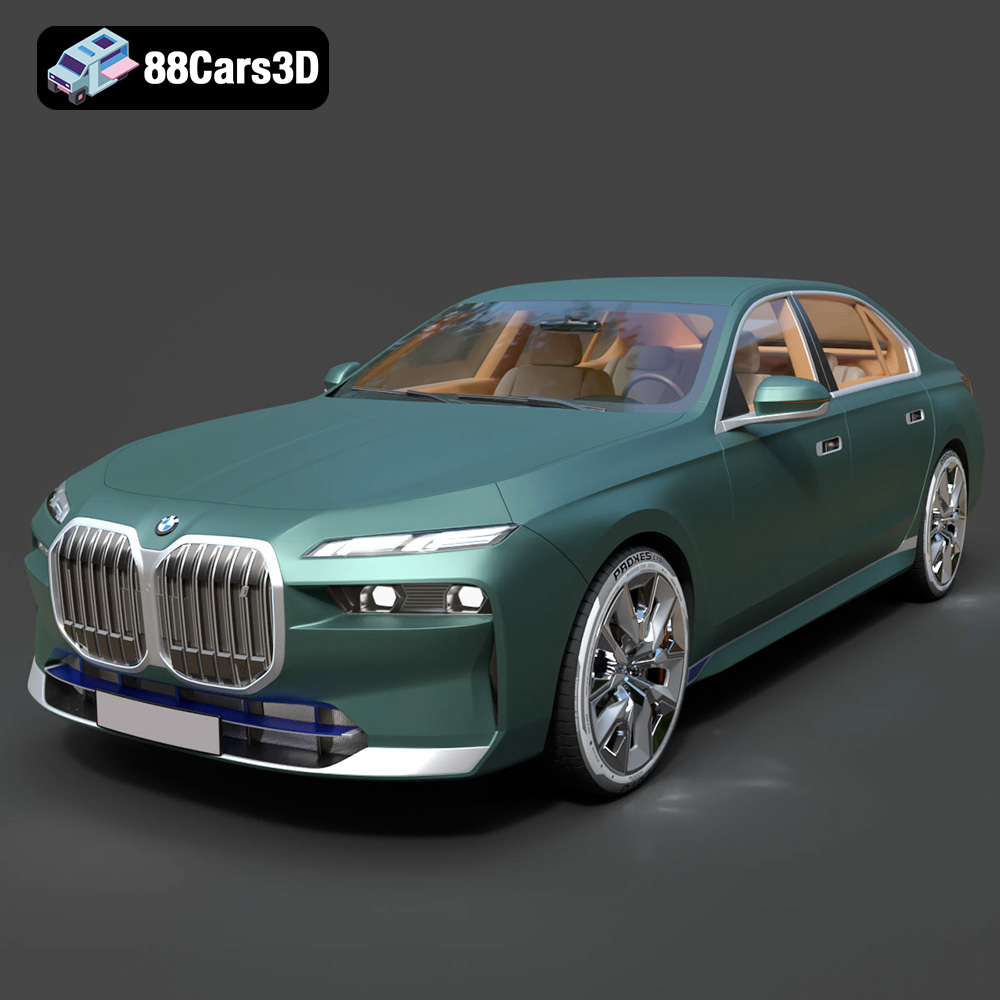
Texture: Yes | Material: Yes Download the ultra-high-detail BMW i7 (2023) 3D Model (4.14M Triangles). Features the illuminated kidney grille, split crystal headlights, fully modeled Theatre Screen interior, and monolithic luxury styling. Perfect for ArchViz, VFX, and cinematic rendering. Includes .blend, .fbx, .obj, .glb, .stl, and .max formats.
Price: $19.99
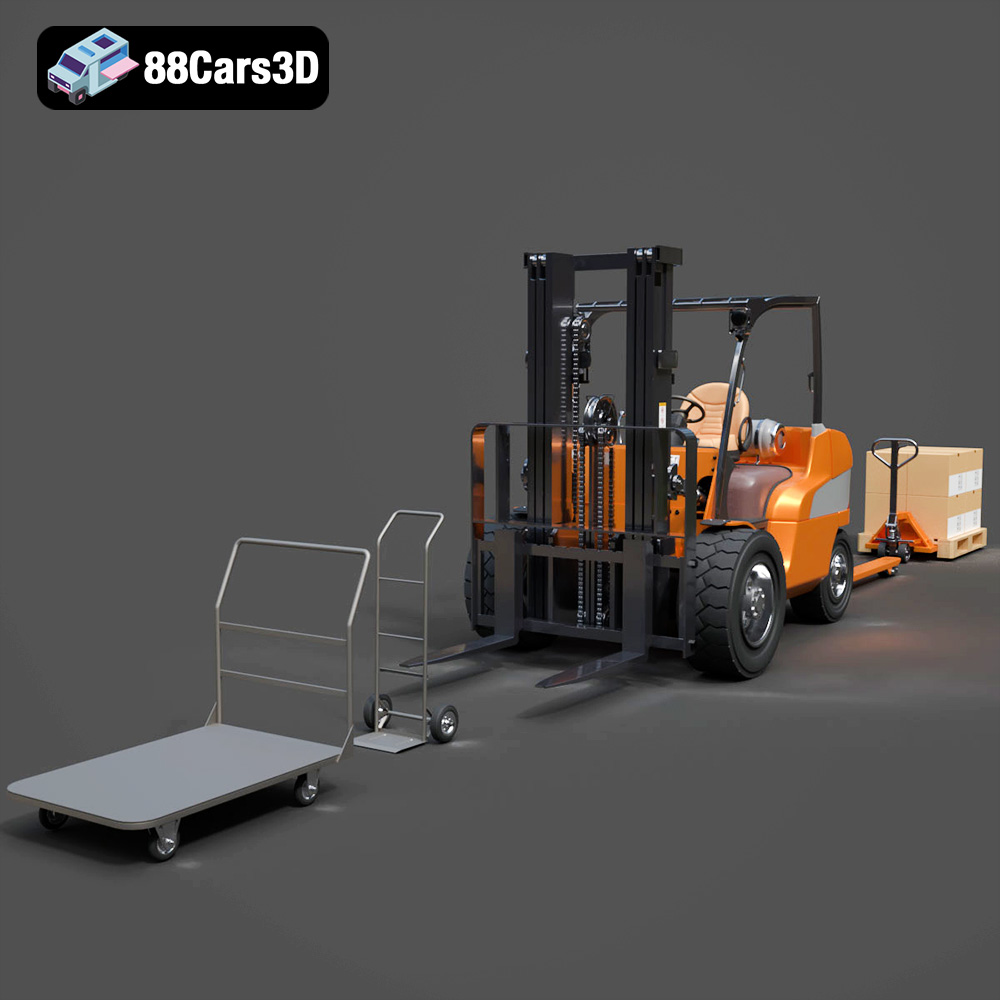
Texture: Yes | Material: Yes Download the highly detailed CAT Manual Loader & Warehouse Carts Kit 3D Model (2.4M Triangles). Features a macro-detailed hydraulic pallet jack, heavy-duty forks, and transport carts. Perfect for industrial ArchViz, factory rendering, and logistics simulations. Includes .blend, .fbx, .obj, .glb, .stl, and .max formats.
Price: $19.99
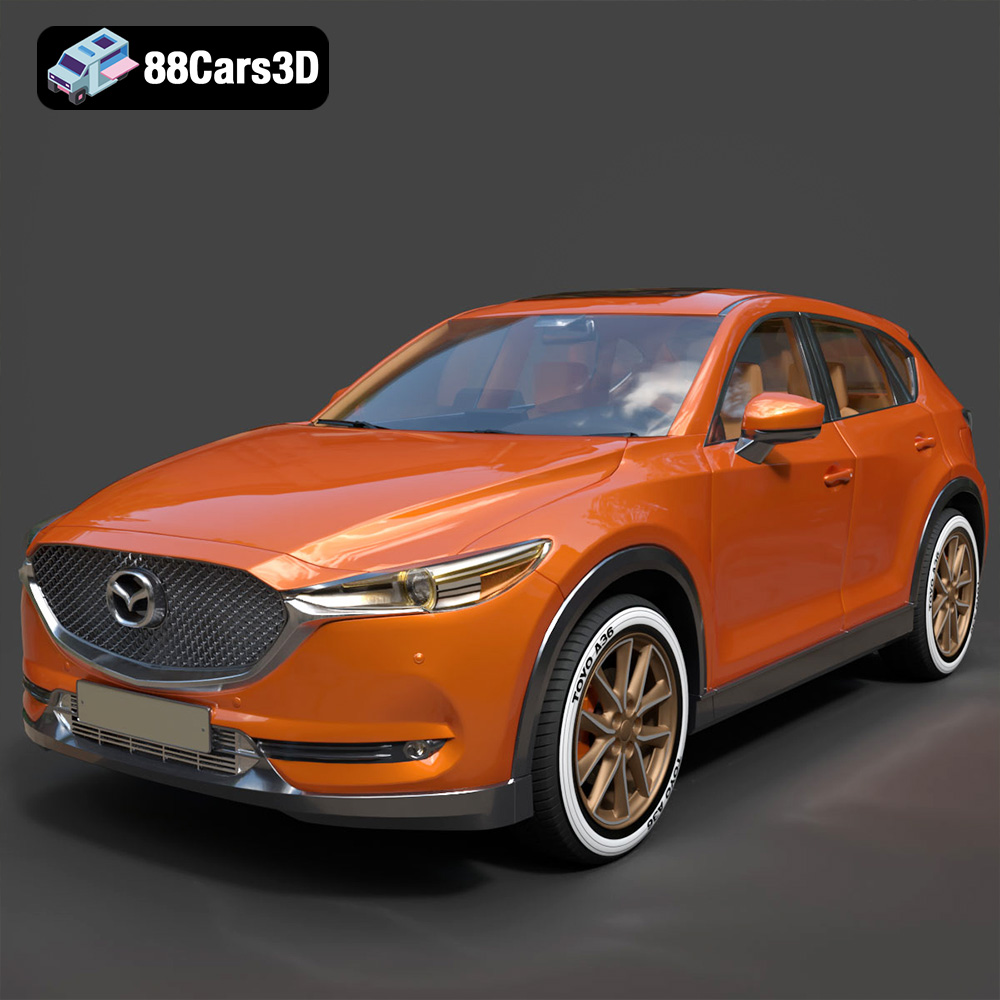
Texture: Yes | Material: Yes
Download the highly optimized Mazda CX-5 2014 3D Model (294k Triangles). Features the dynamic Kodo design language, signature grille, and a clean interior. Perfectly balanced for ArchViz, background traffic, and game development. Includes .blend, .fbx, .obj, .glb, .stl, and .max formats.
Price: $19.99
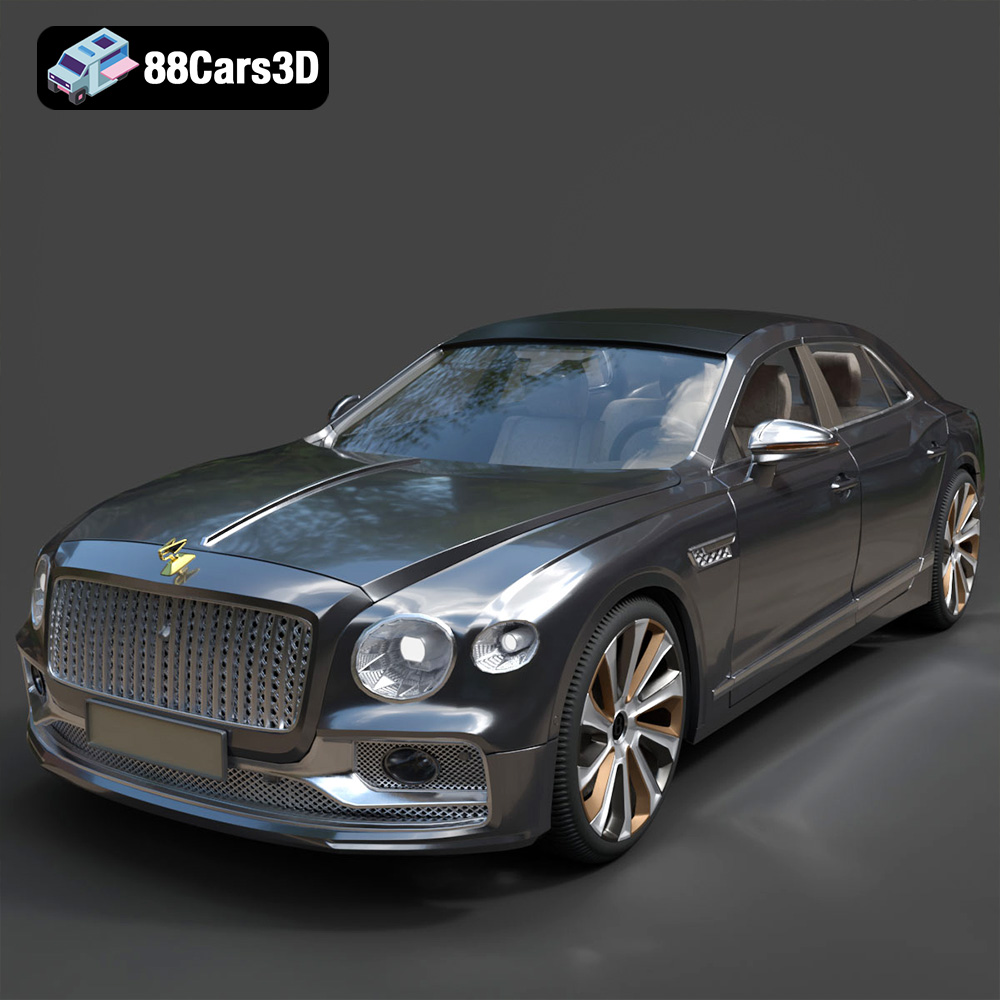
Texture: Yes | Material: Yes Download the ultra-high-detail Bentley Flying Spur Mulliner 2022 3D Model (2.94M Triangles). Features the bespoke Double Diamond grille, a fully modeled diamond-quilted interior, and exquisite luxury styling. Perfect for high-end ArchViz, VFX, and cinematic rendering. Includes .blend, .fbx, .obj, .glb, .stl, and .max formats.
Price: $19.90
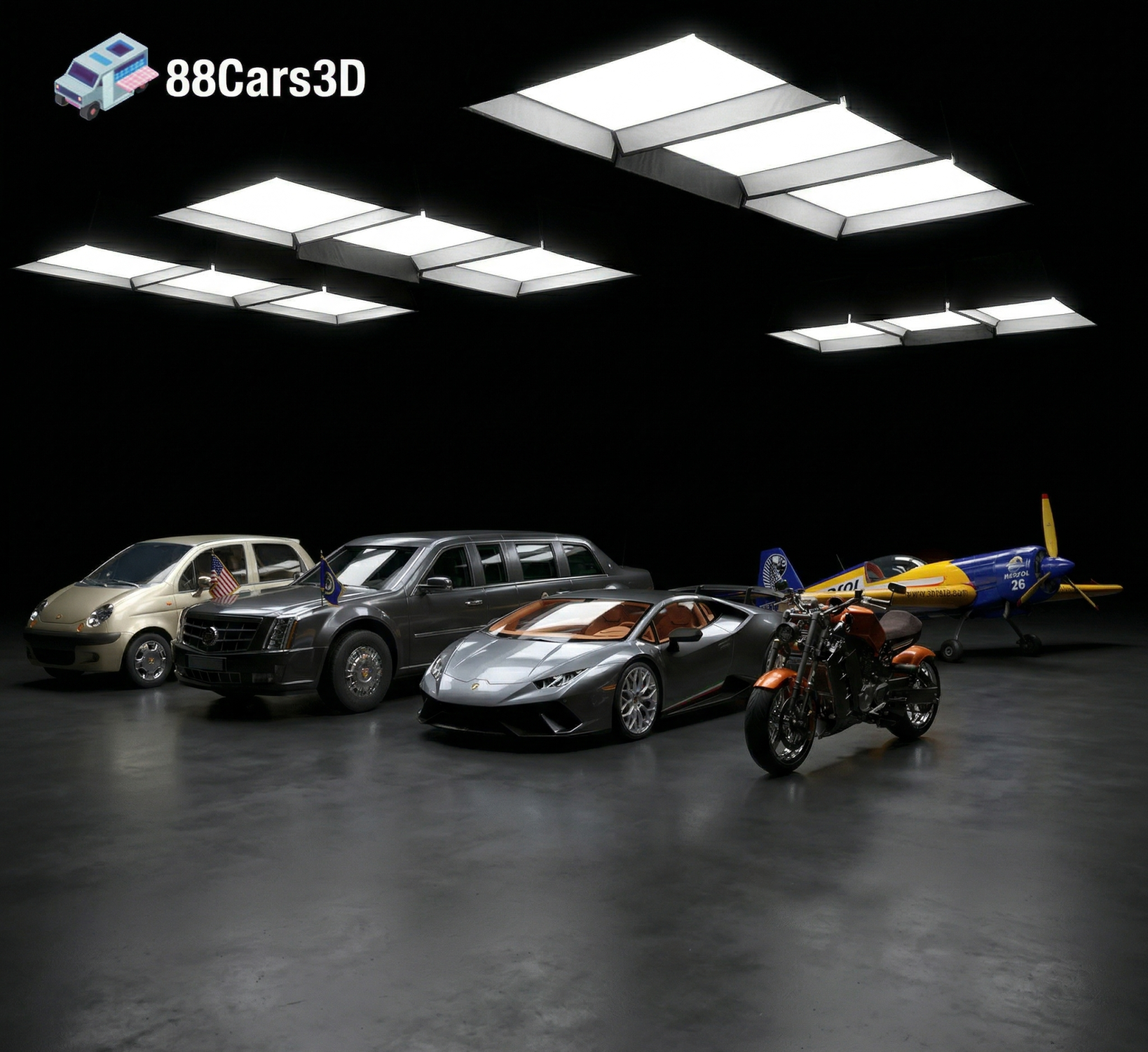
Texture: Yes | Material: Yes | 3D Printable: Yes. Download the Ultimate Creators’ Showcase featuring 5 premium 3D models: Lamborghini Huracan, ZAV Concept Motorcycle, Sukhoi SU-26, Presidential Limousine, and Daewoo Damas. Optimized for 4K CGI rendering and 3D printing. Save massive with this exclusive multi-category bundle!
Price: $99.99

Texture: Yes | Material: Yes | 3D Printable: Yes. Download the Italian Thoroughbreds Bundle featuring 5 iconic 3D models: Lamborghini Huracán Performante, Ferrari 458 Italia, Lamborghini Urus, Diablo SV, and Maserati GT. Optimized for 4K rendering and 3D printing (STL included). Save 50% with this ultimate Italian vehicle collection.
Price: $199.99

Download the Elite Future Mobility Bundle featuring 4 highly optimized 3D models: Tesla Model S, Avatr 11, Li L9, and Zoox Robotaxi. Perfect for ArchViz, Smart City renders, and game dev. Optimized for Unreal Engine and Blender. Includes .fbx, .obj, and .max formats.
Price: $99

🚗 5 Iconic German Cars (BMW M4 G82, M5 CS, X3, 1 Series & Mercedes E-Class). ✅ Optimized for ArchViz: Ready for Corona & V-Ray. 💰 Save €71 with this limited-time collection! 🚀 Instant Download after purchase.
Price: $119

Download the Extreme Off-Road & Survival 3D Models Bundle! Includes the Brabus 800 Adventure, Dodge Ram Bigfoot, Spec Truck, and a Caravan. Save over €210 on this premium 4-in-1 off-grid vehicle pack for ArchViz and game development.
Price: $149.99

Download the Heavy Duty & Commercial Logistics 3D Models Bundle! Includes the Ford Sterling, Caterpillar CT680, Mercedes Citaro Bus, and Vito Van. Save over €130 on this massive, game-ready 4-in-1 industrial vehicle pack.
Price: $109.99

